How Much Is Composition VIII Worth?
Last updated: March 17, 2026
Quick Facts
- Methodology
- extrapolation
Composition VIII is a canonical, museum-defining Kandinsky from the Bauhaus period, far surpassing the significance of any work by the artist to have sold publicly. Extrapolating from the artist’s $44.9m auction record and recent comparables, a competitive sale would likely achieve $100–150 million, with upside in ideal trophy conditions.
Valuation Analysis
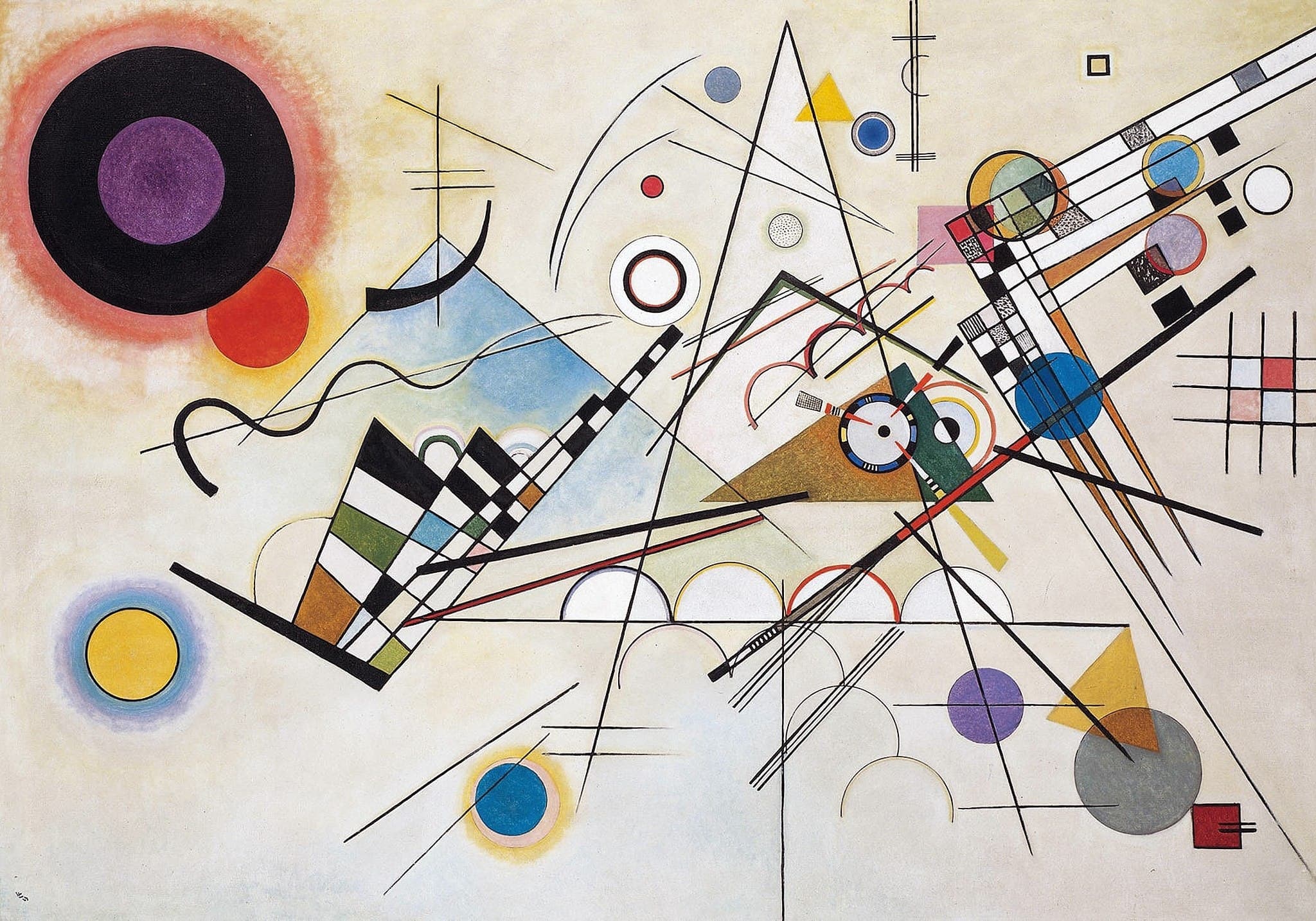
Conclusion: We estimate Wassily Kandinsky’s Composition VIII (1923) at $100–150 million. The range is derived by extrapolating beyond the artist’s current auction ceiling and calibrating for the work’s exceptional art-historical standing, iconicity, prime-period credentials, scale, and unimpeachable Guggenheim provenance. No public sale exists for this painting; however, its status as the definitive Bauhaus-period Kandinsky and a touchstone of abstract art warrants a trophy-level premium.
Market anchors and comps: Kandinsky’s auction record stands at $44.9 million for Murnau mit Kirche II (1910) at Sotheby’s London in 2023 [1]. Another A‑tier Blue Rider canvas, Painting with White Lines (1913), made about $41.6 million in 2017 [2]. Within the geometric/Bauhaus idiom closest to Composition VIII, Weisses Oval (1921) achieved $21.6 million at Sotheby’s New York in 2024 [3], and Tiefes Braun (1924) realized $23.29 million at Christie’s in 2022 [4]. These late‑teen/early‑1920s results define a robust mid‑eight‑figure band for strong but non‑iconic works from the period, while the record‑setting Blue Rider canvases establish the artist’s top-of-market floor in the mid‑$40 millions.
Why this work prices above the record: Composition VIII is widely regarded as Kandinsky’s signature Bauhaus masterwork—large in scale (140.3 × 200.7 cm), instantly recognizable, and among the most reproduced images in histories of abstraction. It anchors the Solomon R. Guggenheim Museum’s identity and resides in the Founding Collection, acquired directly from the artist in 1930 [5]. This degree of canonical status, scale, visibility, and provenance creates cross‑category “trophy” dynamics: buyers bid not only for the artist but for a cultural emblem that articulates the story of modern art. In that context, pricing typically decouples from the artist’s standard curve and can command a substantial premium over existing records.
Current market context: Demand for blue‑chip early Modern masterpieces remains deep and global, with competitive bidding reasserted at the very top end. Recent seasons show strong liquidity for quality Kandinskys across periods, including late works like Le rond rouge (1939) at $16.76 million in 2026 [6]. Against this backdrop, Composition VIII—being both prime period and uniquely iconic—would likely attract multi‑continental interest from leading private collectors and institutions, supporting a nine‑figure outcome.
Assumptions: The estimate presumes sound condition and standard seller terms. While the Guggenheim is unlikely to deaccession, the valuation reflects hypothetical fair‑market dynamics inferred from record‑level Kandinsky benchmarks and adjacent Modern “trophy” pricing. On that basis, $100–150 million is a well‑supported current range, with upside potential in an exceptional, well‑timed sale.
Key Valuation Factors
Art Historical Significance
High ImpactComposition VIII is a cornerstone of early abstraction and arguably the definitive painting of Kandinsky’s Bauhaus period. It appears frequently in canonical surveys, textbooks, and museum narratives as a key articulation of geometric abstraction. In importance, it is often bracketed with Composition VII (1913) and Yellow-Red-Blue (1925), putting it on the shortest list of the artist’s most consequential works. That status drives pricing well beyond typical period comparables because bidders compete for a cultural emblem that represents the artist’s historical contribution, not merely a high-quality example.
Iconicity and Public Recognition
High ImpactThe painting’s image is globally recognized and intimately tied to the identity of the Solomon R. Guggenheim Museum. This brand-level familiarity translates to a broader buyer pool and trophy competition—collectors pay a premium for works that resonate beyond connoisseurship. In nine-figure contexts, iconicity can be decisive: it elevates a work from ‘best in class’ to ‘category-defining,’ expanding demand across regions and collecting categories and encouraging strategic buyers to stretch beyond established artist records.
Prime Period, Scale, and Execution
High ImpactDated 1923, the work sits at the heart of Kandinsky’s early Bauhaus years, when his vocabulary of circles, vectors, and geometric balances matured. Its large format (approximately 140 × 201 cm) compounds visual impact and rarity relative to smaller, later geometric canvases. Execution is fully realized and compositionally complex—attributes that heighten demand among top-tier buyers. In this market segment, early Bauhaus masterworks of substantial scale consistently command sharp premiums versus closely related but smaller or later works.
Provenance, Exhibition, and Literature
High ImpactAcquired directly from the artist by Solomon R. Guggenheim (1930) and part of the Guggenheim’s Founding Collection since 1937, the painting offers unimpeachable provenance. It has been widely exhibited and reproduced, cementing its scholarly and public profile. Such provenance reduces transactional friction, boosts bidder confidence, and meaningfully increases price elasticity at the top end. For a canonical Kandinsky, this combination of direct-artist acquisition, continuous museum ownership, and deep literature presence is near-optimal.
Market Benchmarks and Trophy Dynamics
High ImpactThe artist’s auction record is $44.9m (Murnau with Church II, 1910) [1], with another Blue Rider masterwork at ~$41.6m [2]. High-quality Bauhaus oils have traded in the $20–30m zone in recent years [3][4]. Composition VIII eclipses these comparables in cultural weight, justifying a substantial extrapolation above the record into nine figures. Trophy pricing norms for iconic Modern masters further support this premium: when a work defines an artist’s achievement and has global name recognition, competitive bidding frequently decouples from the artist’s standard curve.
Sale History
Direct purchase from the artist
Acquired by Solomon R. Guggenheim in 1930; gifted to the Solomon R. Guggenheim Foundation in 1937 (Founding Collection).
Wassily Kandinsky's Market
Wassily Kandinsky is a foundational figure of Modernism and early abstraction, collected at the highest institutional and private levels worldwide. The artist’s auction record is $44.9 million for Murnau mit Kirche II (1910) at Sotheby’s London in 2023, with another Blue Rider-era landmark, Painting with White Lines (1913), at ~$41.6 million in 2017. Strong Bauhaus-period oils have realized $20–30 million in recent seasons, reflecting sustained demand for key periods and quality. Supply of museum-caliber paintings is extremely thin, and restituted or otherwise fresh-to-market works have catalyzed bidding. In short, Kandinsky’s market is deep, international, and highly selective, with top-period, large-scale masterpieces commanding significant premiums.
Comparable Sales
Weisses Oval (White Oval)
Wassily Kandinsky
Same artist; very close in period (early 1920s/Bauhaus idiom), medium (oil on canvas), and geometric abstraction—strong stylistic proximity to Composition VIII.
$21.6M
2024, Sotheby's New York
~$22.1M adjusted
Tiefes Braun (Deep Brown)
Wassily Kandinsky
Same artist; adjacent in date (1924), Bauhaus-period oil with rigorous geometric abstraction—excellent period and stylistic comp.
$23.3M
2022, Christie's New York
~$25.7M adjusted
Tensions calmées
Wassily Kandinsky
Same artist; later mature geometric abstraction (1937) showcasing related formal language of circles/lines; strong high-end benchmark for later works.
$29.4M
2021, Sotheby's London
~$35.0M adjusted
Le rond rouge
Wassily Kandinsky
Same artist; late-1930s geometric abstraction with a central circular motif—useful for gauging recent demand for strong but non-trophy late works.
$16.8M
2026, Christie's London
~$16.4M adjusted
Murnau mit Kirche II (Murnau with Church II)
Wassily Kandinsky
Same artist; pre-1914 masterpiece and current auction record—vital top-of-market anchor even though it’s from an earlier (Blaue Reiter) phase rather than Bauhaus.
$44.8M
2023, Sotheby's London
~$47.5M adjusted
Bild mit weissen Linien (Painting with White Lines)
Wassily Kandinsky
Same artist; 1913 Blue Rider–era landmark—museum-caliber benchmark for an A‑tier Kandinsky, helpful for bracketing trophy pricing versus Composition VIII.
$41.6M
2017, Sotheby's London
~$54.7M adjusted
Current Market Trends
The upper tier of the Modern market has remained resilient despite cyclical volatility, with collectors prioritizing historically defining ‘trophy’ works backed by prime provenance and exhibition histories. After a contraction in 2024, late‑2025 and early‑2026 sales reaffirmed strong liquidity at the very top end, particularly for blue‑chip Modern masters. Within Kandinsky’s corpus, period and quality are decisive: early Blaue Reiter canvases anchor the artist’s record, while high‑quality Bauhaus works transact robustly in the mid‑eight figures. In trophy scenarios—especially for culturally iconic images—buyers frequently stretch beyond established artist records, supporting nine‑figure potential under competitive conditions.
Sources
- AP News – Kandinsky record: Murnau mit Kirche II sells for £37.2m ($44.9m), Mar 1, 2023
- Bloomberg – Painting with White Lines (1913) sells for ~£33m ($41.6m), Jun 21, 2017
- Rehs Galleries – Sotheby’s NY: Weisses Oval (1921) achieves $21.6m, Nov 18, 2024
- Christie’s – Paul G. Allen Collection: Tiefes Braun (1924) sells for $23.29m, Nov 9, 2022
- UK Protection of Cultural Objects on Loan Act dossier – Composition 8 provenance and dimensions
- Christie’s Press – Le rond rouge (1939) sells for £12.545m ($16.76m), Mar 5, 2026