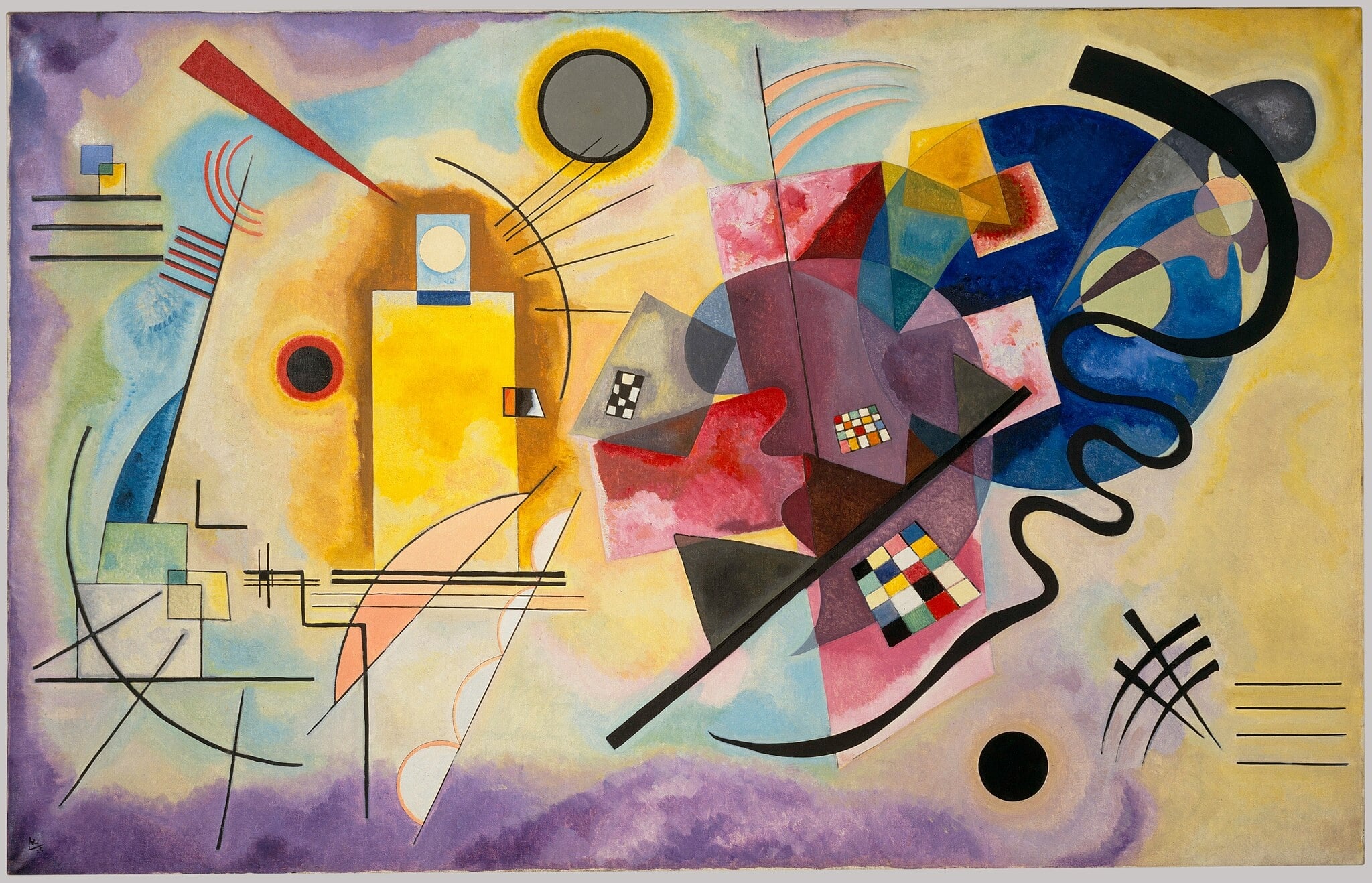
Read as a composition, the painting assigns each form a role in a dynamic ensemble. The large black circle in the upper left acts as a
gravitational bass note—its darkness embodies silence and cessation in Kandinsky’s color theory—against which smaller, chromatic circles vibrate like brighter instruments (yellow radiates, blue retreats)
5. Their dispersal across the field turns the surface into a
cosmos of tensions that Kandinsky associated with the circle’s capacity to synthesize opposites and hint at
higher dimensions 6. From this still center, razor-thin
diagonals accelerate toward the right, intersecting arcs and semicircles that register as pulses and echoes rather than objects. The result is rhythm without motif: a choreography of approach, collision, and release, in which line operates as pure vector, the very force Kandinsky theorized in Point and Line to Plane
1.
Equally decisive is the painting’s architecture of measurement. A wedge of
checkerboard squares climbs from the lower left toward a blue triangular plane, as if a scale or keyboard were being struck; at mid-right, a
compass-dial cluster ticks like a metronome, surrounded by gearlike rings and ruled bands. Along the extreme right margin, a
gridded scaffold and stacked stripes impose a
drafting-room clarity, emblematic of the Bauhaus’s
machine-age ethos 13. Yet these tools of calculation do not suppress lyricism; they frame it. Arcs hover like legato phrases above a staff of horizontal lines near the bottom edge, while acute triangles—especially the translucent one spanning center-right—cut crisp staccato accents through the haze of pastel washes. This is the engineered musicality scholars identify as the hallmark of Kandinsky’s Bauhaus period: a
shift from prewar tumult to lucid, conducted form 234.
Color seals the argument by granting each geometry an affective charge. The
yellow triangle near the upper right and the sun-like yellow disks at lower left and bottom center thrust outward with bright insistence, while the
blue circles (one pressed to the right edge, another hovering near the bottom) recede into felt depth; the violet disk at lower right cools the tempo, and the hovering
red note anchoring the gray circle’s edge introduces heat and dissonance
5. These chromatic oppositions—yellow/blue, red/green, white/black—operate as counterpoint rather than illustration, confirming Kandinsky’s premise that non-objective art can transmit spiritual states through calibrated relationships alone
5. In Composition VIII, that premise is realized with Bauhaus discipline: lines are honed to vectors, planes are parsed into triangles and circles, and the picture’s “melody” moves from left to right, from the black circle’s silence to the right-edge grid’s articulated speech. The painting therefore reads as a
map of invisible harmonies—a cosmos orchestrated by geometry—while serving as a manifesto for
universal, non-representational communication. This synthesis explains why museums cast Composition VIII as a summit of his postwar work and a beacon for later geometric abstraction, including his subsequent, circle-dominated explorations
124.