Painting Meanings Essay
The Pink Portrait the Revolution Seized
Start in 1877. Renoir is broke, ambitious, and tired of being called a lightweight.
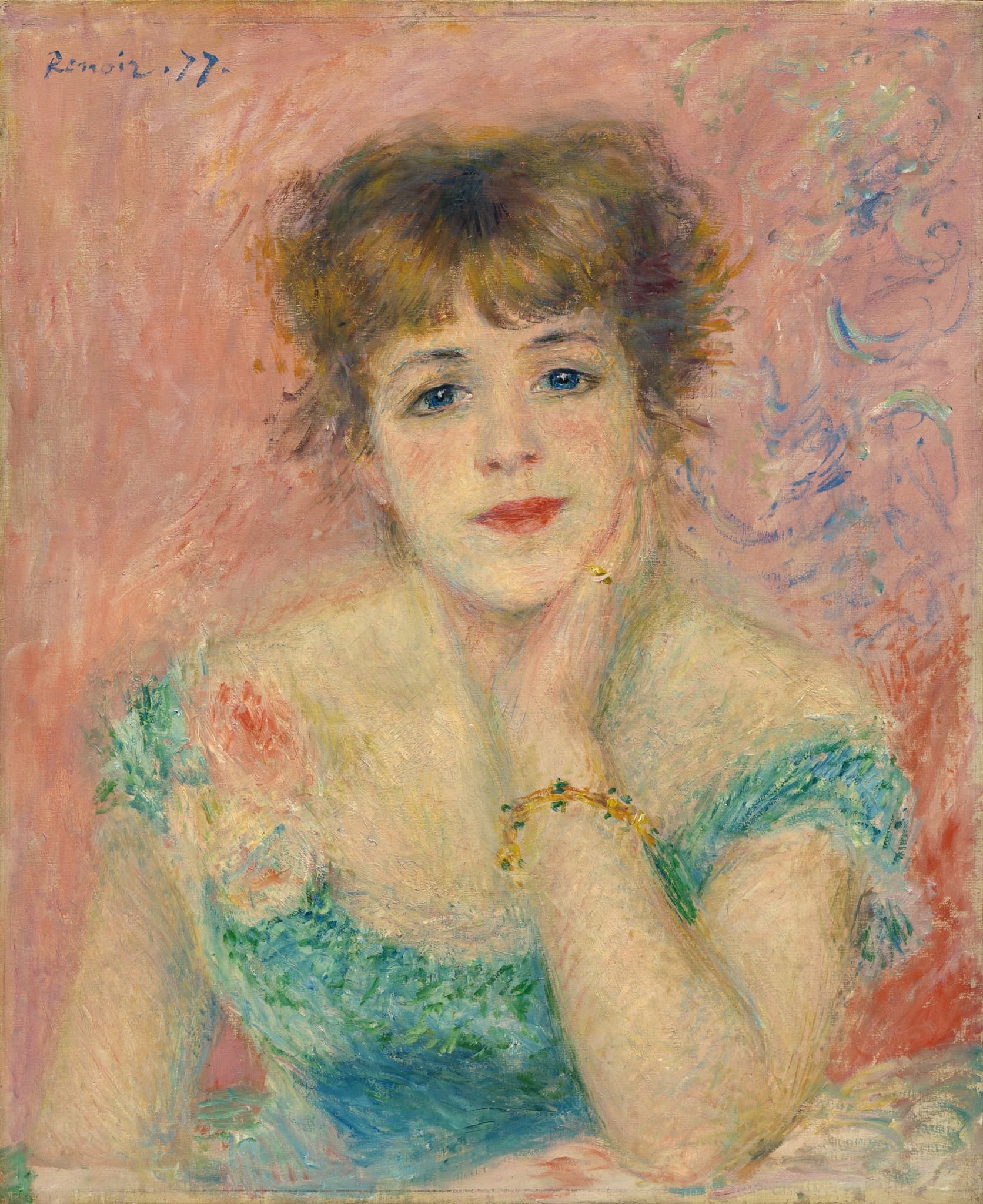
Start in 1877. Renoir is broke, ambitious, and tired of being called a lightweight. He paints a young actress from the Comédie‑Française—Jeanne Samary—with a coral-pink atmosphere and a sea‑green dress, a portrait designed to charm the Salon and the paying classes. The picture glows like a debutante’s rumor. It still does. See it up close on our artwork page: /artworks/pierre-auguste-renoir/portrait-of-jeanne-samary.
But the stakes weren’t pastel. Renoir needed the establishment to like him, not just the Impressionist crowd. Samary, meanwhile, was staking her image on modern visibility—fame is a second currency for actors, and portraits were the billboards of the day. Her résumé glimmered; the Comédie‑Française records chart her rise through the late 1870s, a house star in training [3].
Renoir’s bet: beauty sells. He even said the quiet part out loud.
“For me a picture must be a pleasant thing, joyful and pretty—yes, pretty! There are too many unpleasant things in life as it is.” [6]
Then comes the wobble. Renoir keeps after Samary in 1878, polishing a second, more formal likeness for the official Salon. It lands with a thud. The Hermitage, which now owns that 1878 version, notes its cool reception at the 1879 Salon—a reminder that fashion can be fickle, and the Salon could turn a shrug into a verdict [4]. Renoir would win big the same year with Madame Charpentier, but the Samary gambit didn’t cash out immediately [6].
Meanwhile, the 1877 picture—the one suffused with pink air and the quick, shimmering strokes—circulates as a symbol of modern glamour. A rose pinned to her bodice, an ivy‑green bracelet: in 19th‑century floriography, roses read as love and ivy as fidelity, the era’s polite code for intimacy [11] [12]. That intimacy was the value proposition. Collectors bought access to a mood they could never quite live—radiance in oil.
Enter Ivan Morozov, the Moscow textile magnate with an eye for French moderns. He acquires the portrait in the early 20th century, joining his wall of Cézannes, Matisses, and Bonnards. It’s not just taste; it’s a wager that yesterday’s scandal becomes tomorrow’s canon. The Pushkin Museum’s record confirms the canvas and its present home, while Russian sources trace its path through Morozov’s collection 1 [8]. Money and prestige secure the glow.
And then—flip. In 1918, after the October Revolution, the new government nationalizes the Morozov and Shchukin collections. The paintings, including Renoir’s smiling actress, stop being private assets and become state property, routed into the State Museum of New Western Art, and later divided between the Pushkin and the Hermitage. The 1877 Samary ends up in Moscow at the Pushkin [8] 1. A boudoir‑pink portrait becomes an instrument of ideology. Value, reset by decree.
Here’s the twist: the market didn’t decide. Taste didn’t decide. Power did. Renoir’s pink cloud was suddenly priceless because the state said so—a trophy of modernity appropriated for a new order. That’s not how we tell art-market stories, which usually climb a staircase of sales. This one drops through a trapdoor.
Decades later, curators would reframe the painting not as bourgeois frippery but as a keystone of 19th‑century portraiture—its fused figure and air, its quicksilver color, its flirt with celebrity. Colin B. Bailey has written about how Renoir’s portraits distilled the glamour of their moment, a lens collectors coveted even when critics didn’t [2]. The painting’s price was once fashion; after 1918, its price was history.
“Why shouldn’t art be pretty?” Renoir asked elsewhere. “There are enough unpleasant things in the world.” [6]
He painted that plea into Jeanne’s face. The market tried to answer with money. The revolution answered with force. And the portrait kept smiling.
Notes
1 Pushkin State Museum of Fine Arts collection record, Portrait of Jeanne Samary (1877): https://collection.pushkinmuseum.art/entity/OBJECT/78254
[2] Colin B. Bailey (via Christie’s), Renoir’s Portraits: Impressions of an Age: https://www.christies.com/en/lot/lot-5433450
[3] Comédie‑Française, Jeanne Samary biography: https://www.comedie-francaise.fr/en/artist/jeanne-samary
[4] State Hermitage Museum, Portrait of the Actress Jeanne Samary (1878) — Salon context: https://www.hermitagemuseum.org/digital-collection/28704?lng=en%28
[6] Britannica, Pierre‑Auguste Renoir — biography and quotations: https://www.britannica.com/biography/Pierre-Auguste-Renoir
[8] Provenance summary (Morozov → State Museum of New Western Art → Pushkin): https://www.newestmuseum.ru/data/authors/r/renoir_pierre_auguste/portrait_of_jeanne_samary.php
Sources & Further Reading
Portrait of Jeanne Samary — Pierre-Auguste Renoir
Continue Exploring
Want the close‑ups and color notes? Explore the painting here: /artworks/pierre-auguste-renoir/portrait-of-jeanne-samary