Portrait of Jeanne Samary

by Pierre-Auguste Renoir

Renoir’s Portrait of Jeanne Samary (1877) turns a modern actress into a study of radiance and immediacy, fusing figure and air with shimmering strokes. Cool blue‑green dress notes spark against a warm coral-pink atmosphere, while the cheek‑in‑hand pose crystallizes a moment of intimate poise [1][4].

Fast Facts

Year
1877
Medium
Oil on canvas
Dimensions
56 × 47 cm
Location
Pushkin State Museum of Fine Arts, Moscow
Portrait of Jeanne Samary by Pierre-Auguste Renoir (1877) featuring Rose corsage

Click on any numbered symbol to learn more about its meaning

Meaning & Symbolism

Renoir builds the sitter’s nearness out of color harmonies that feel as tactile as skin. A field of coral‑pink envelops the head and shoulders, its feathered strokes curling into arabesques that echo stage décor without naming a place; within this haze, the cool turquoise and teal of the dress flicker like cool light on water. The complementary pairing intensifies her presence—the blue‑greens press forward against the warm ground—while the softly rubbed transitions make edges breathe, so that body and background trade energy rather than boundaries 12. The cheek propped on the right hand locks the figure into a gentle triangle, a structural armature that stabilizes an otherwise vaporous surface. Renoir places crucial accents with economy: the red of the lips, the lucid blue of the eyes, a rose tint blooming at the bodice, and tiny yellow pricks along a leaf‑link bracelet. These notes punctuate the pastel haze like stage footlights, animating the face with a pulse of attention. The effect is not literary “daydreaming” but a visual thesis: identity can be apprehended as a vibration of color—a radiant state—rather than a contour enclosed in line 12. The picture also theorizes modern fame. Jeanne Samary was a rising Comédie‑Française actress, part of the cultural circuitry that fascinated Renoir in the late 1870s 3. Here, glamour is not an accumulation of attributes but a quality of light: the backdrop’s decorative sweeps read as public spectacle distilled to atmosphere, while the sitter’s half‑smile stages intimacy as performance. Renoir had just exhibited with the Impressionists in 1877, where critics often demanded clearer modeling and official finish; instead of capitulating, he doubles down on painterly facture, letting short, iridescent touches articulate cheeks, neck, and shoulder with a warmth that feels breathed rather than built 24. The rose corsage functions as a flash of charm and flirtation—period viewers would have recognized the rose’s conventional associations with love—while the ivy‑like bracelet hints at fidelity or constancy, a witty counterbalance to the sitter’s public, changeable stage roles 89. These readings are not programmatic symbols, but they deepen the portrait’s play between theater and sincerity: adornment becomes a language of sentiment embedded in fashion. As a node in Renoir’s series of Samary images, the painting asserts the supremacy of the intimate bust‑length Impressionist portrait over the forthcoming “official” full‑length submitted to the Salon in 1879 4. Where the Salon model organizes authority through stature and finish, the 1877 canvas finds modern authority in fresh contact—the viewer seems to share the sitter’s space, bathed in the same pink light. Colin Bailey rightly calls this audacious and ravishing, its “parrot‑colored” palette pitching Impressionism as a vehicle for contemporary celebrity rather than a retreat into landscape plein air 2. The push‑and‑pull between atmospheric dissolution and armature gives the work its afterimage: the memory of a face that lingers not as a fixed profile, but as a shimmer. In this sense, the meaning of Portrait of Jeanne Samary is to redefine portrait truth as a fleeting, sensuous encounter, and why Portrait of Jeanne Samary is important is that it models a path by which Impressionism could speak persuasively about people—about public figures and private warmth—without abandoning its devotion to light.

Explore Deeper with AI

Ask questions about Portrait of Jeanne Samary

Popular questions:

Powered by AI • Get instant insights about this artwork

💬 Ask questions about this artwork!

Interpretations

Cultural History of Celebrity

Renoir translates modern stardom into a visual economy of light. Rather than enumerating social emblems, he casts Samary’s allure as a field of optical charge, the “parrot‑colored” palette Colin B. Bailey praises for its audacity in projecting stage glamour through chromatic vibration. In doing so, the portrait aligns with Paris’s late‑1870s celebrity culture: the Comédie‑Française actress is rendered not via attributes but via a radiant surround that implies publicity, spectatorship, and circulation. The sitter’s half‑smile and cheek‑in‑hand pose play to the viewer like a close‑up, a theatrical intimacy engineered for mass attention. Renoir thereby proposes celebrity as ambient charisma—an atmospheric condition viewers inhabit—anticipating later image economies where persona is inseparable from lighting, color, and facture 23.

Source: Colin B. Bailey, Renoir’s Portraits: Impressions of an Age; Comédie‑Française

Institutional Politics: Salon vs. Impressionists

The 1877 bust‑length debuted at the Third Impressionist Exhibition, then Renoir pursued an “official” full‑length for the 1879 Salon. This pivot illuminates how display regimes shape portrait authority. The Moscow canvas asserts immediacy—close range, dissolving contours, and a vaporous ground—defying Salon demands for strong modeling and finish. The Hermitage’s 1878 full‑length retains Impressionist color yet adopts vertical grandeur to court institutional legitimacy. Read together, they map a double strategy: Renoir tests whether intimate facture can carry public prestige, and when critics resist, he scales the format without abandoning chromatic modernity. The result is a case study in how Impressionist portraiture negotiated status within and against the Salon’s protocols of decorum and visibility 24.

Source: State Hermitage Museum; Colin B. Bailey

Formal-Technical Analysis: Color, Edge, and Armature

The portrait orchestrates complementary cools (turquoise/teal dress) against a coral‑pink field, making the figure advance via simultaneous contrast. Edges “breathe,” achieved by softly rubbed transitions and feathery strokes that trade energy between body and ground. A triangular schema—cheek, hand, shoulder—anchors this atmospheric dissolution, preventing drift and focusing attention at the face and accented areas: lips, eyes, corsage, and the glinting bracelet. Such controlled dispersion exemplifies Impressionist facture as a register of perception rather than a denial of structure. The Pushkin object record grounds date/medium/format; Bailey’s commentary helps situate the palette’s audacity within Renoir’s 1870s portrait manner 12.

Source: Pushkin State Museum of Fine Arts; Colin B. Bailey

Semiotics of Adornment

The rose at the bodice and the leaf‑link bracelet open a 19th‑century codebook. In floriography, roses commonly signal love or charm; ivy—evoked by the bracelet’s leaf‑like links—signifies fidelity and constancy. Renoir doesn’t announce fixed symbols, but he embeds a fashionable lexicon that period viewers would parse intuitively, enriching the sitter’s public persona with intimations of attachment and sincerity. This coded sentiment offsets the theater aura: a coquettish rose meets steadfast ivy, staging a witty play between flirtation and constancy. The jewelry’s tiny yellow pricks act as optical motes while also cueing a cultural reading that tethers modern glamour to moralized feeling, a typical Victorian strategy for reconciling display with virtue 16.

Source: Pushkin State Museum of Fine Arts; Gemological Institute of America (floriography overview)

Provenance and the Politics of Taste

The work’s passage from Ivan Morozov’s collection into the nationalized State Museum of New Western Art, and finally to the Pushkin in 1948, tracks a seismic recontextualization: private bourgeois taste transformed into state patrimony. This trajectory reframes an intimate Parisian portrait as a public cultural asset within Soviet museology, where Impressionism’s once‑controversial modernity becomes heritage. The shift illustrates how political regimes reassign value and meaning, moving a portrait of a French actress from salon culture to didactic collection narratives. The institutional afterlife—labels, cataloging, and display—thus becomes part of the work’s interpretive field, shaping how audiences encounter Renoir’s color‑driven modernity across ideological borders 15.

Source: Pushkin State Museum of Fine Arts; Newest Museum (GMNZI/transfer history)

Gendered Theatricality and the Gaze

Samary’s profession inflects the portrait’s psychology: as a Comédie‑Française actress, she navigated roles that commodified intimacy. Renoir amplifies this through the cheek‑in‑hand pose and half‑smile, which stage a controlled accessibility—the sitter seems available yet authored by performance. The viewer becomes an imagined spectator, and the painting calibrates desire through managed proximity: bust‑length format, luminous skin tones, and selective accents that guide looking without surrendering autonomy. Bailey’s emphasis on theatrical glamour and the Comédie‑Française record of Samary’s rising status anchor this reading, situating the image at the intersection of gender, labor, and spectatorship in 1870s Paris 23.

Source: Colin B. Bailey; Comédie‑Française

Related Themes

About Pierre-Auguste Renoir

Pierre-Auguste Renoir (1841–1919) emerged from craft training into the avant-garde circle around Monet, Sisley, and Bazille, helping to found Impressionism. In the mid‑1870s he focused on outdoor scenes of modern leisure in and around Montmartre, using dappled light and high-chroma color to capture transient sensations [1][2][5].
View all works by Pierre-Auguste Renoir

More by Pierre-Auguste Renoir
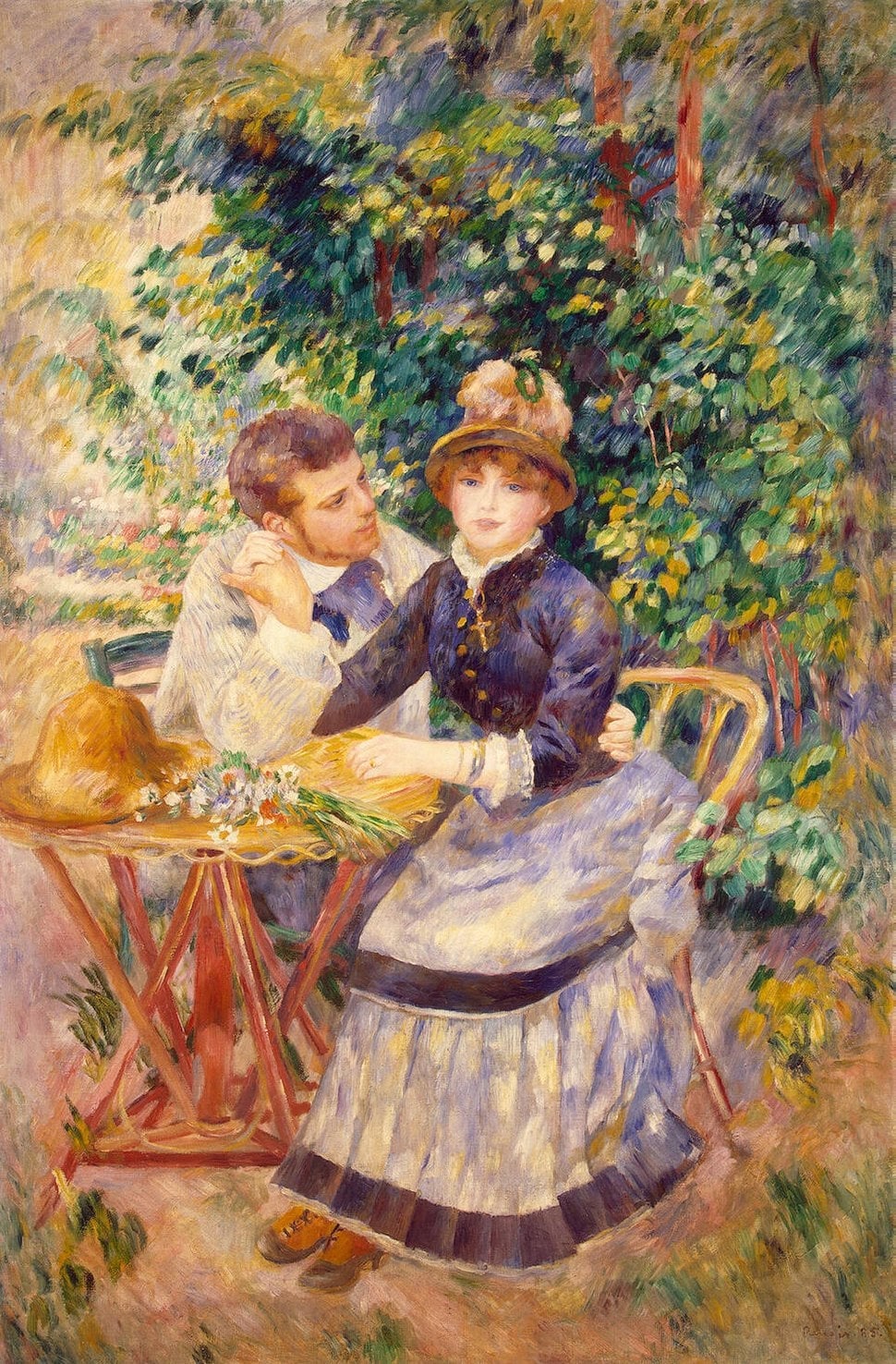
In the Garden by Pierre-Auguste Renoir

In the Garden

Pierre-Auguste Renoir (1885)

In the Garden presents a charged pause in modern leisure: a young couple at a café table under a living arbor of leaves. Their lightly clasped hands and the bouquet on the tabletop signal courtship, while her calm, front-facing gaze checks his lean. Renoir’s flickering brushwork fuses figures and foliage, rendering love as a <strong>transitory, luminous sensation</strong> <sup>[1]</sup><sup>[3]</sup>.
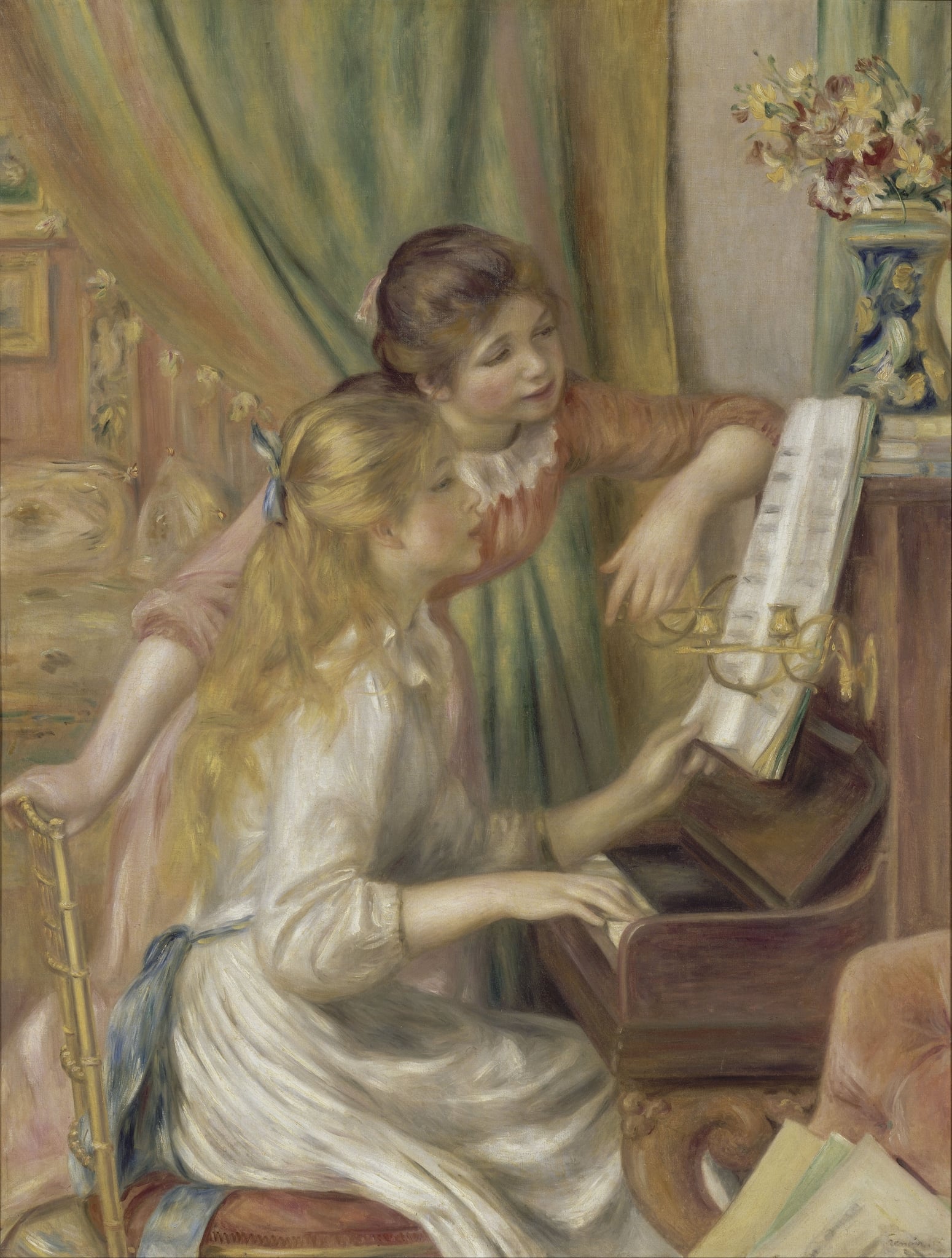
Young Girls at the Piano by Pierre-Auguste Renoir

Young Girls at the Piano

Pierre-Auguste Renoir (1892)

Renoir’s Young Girls at the Piano turns a quiet lesson into a scene of <strong>attunement</strong> and <strong>bourgeois grace</strong>. Two adolescents—one seated at the keys, the other leaning to guide the score—embody harmony between discipline and delight, rendered in Renoir’s late, <strong>luminous</strong> touch <sup>[1]</sup><sup>[2]</sup>.

Pont Neuf Paris by Pierre-Auguste Renoir

Pont Neuf Paris

Pierre-Auguste Renoir (1872)

In Pont Neuf Paris, Pierre-Auguste Renoir turns the oldest bridge in Paris into a stage where <strong>light</strong> and <strong>movement</strong> bind a city back together. From a high perch, he orchestrates crowds, carriages, gas lamps, the rippling Seine, and a fluttering <strong>tricolor</strong> so that everyday bustle reads as civic grace <sup>[1]</sup>.
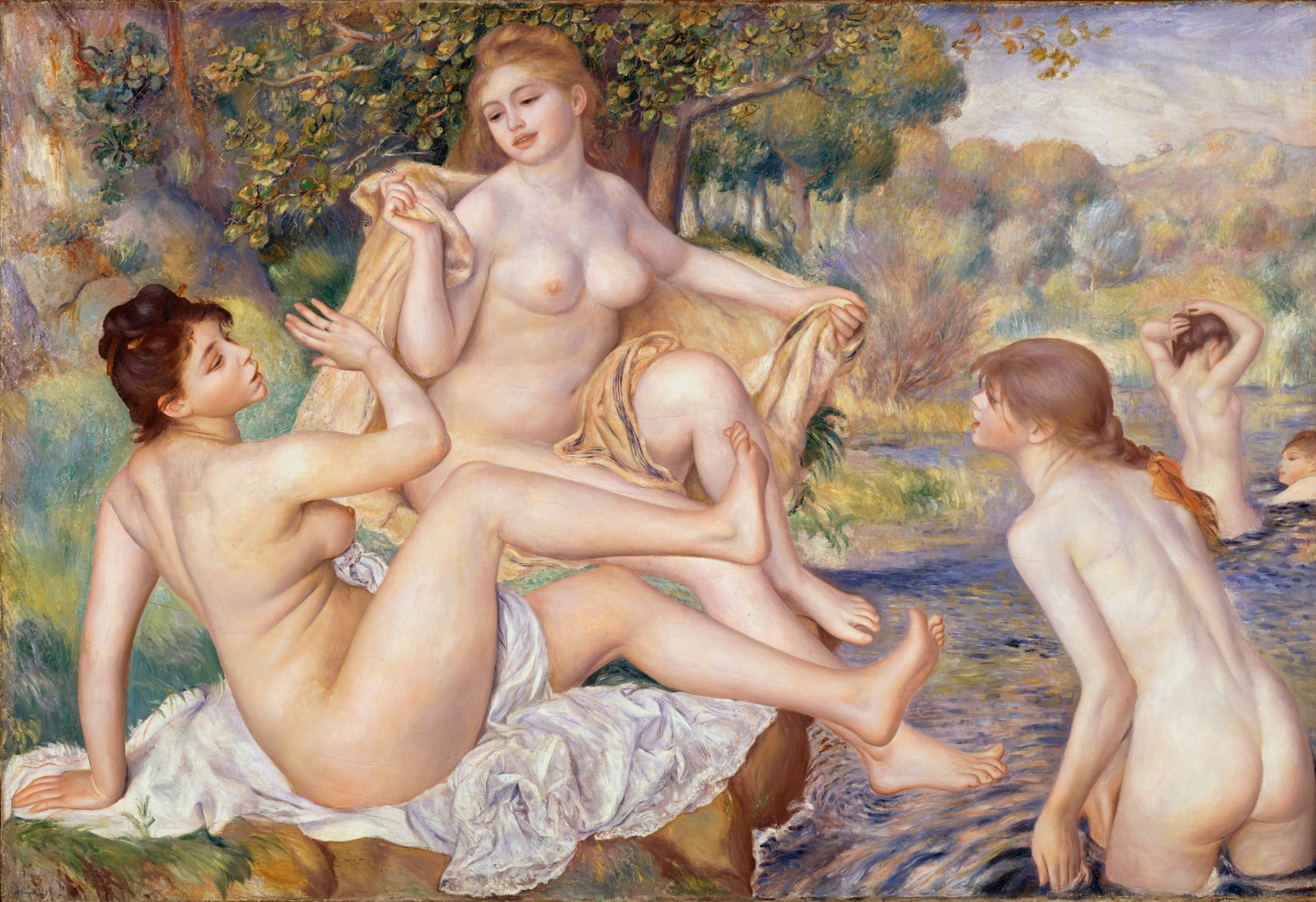
The Large Bathers by Pierre-Auguste Renoir

The Large Bathers

Pierre-Auguste Renoir (1884–1887)

Pierre-Auguste Renoir’s The Large Bathers unites modern bodies with a pastoral grove to stage an <strong>Arcadian ideal</strong>. Three monumental nudes form interlocking curves and triangles while two background figures splash and groom, fusing <strong>sensual warmth</strong> with <strong>classical order</strong> <sup>[1]</sup><sup>[2]</sup>.

The Loge by Pierre-Auguste Renoir

The Loge

Pierre-Auguste Renoir (1874)

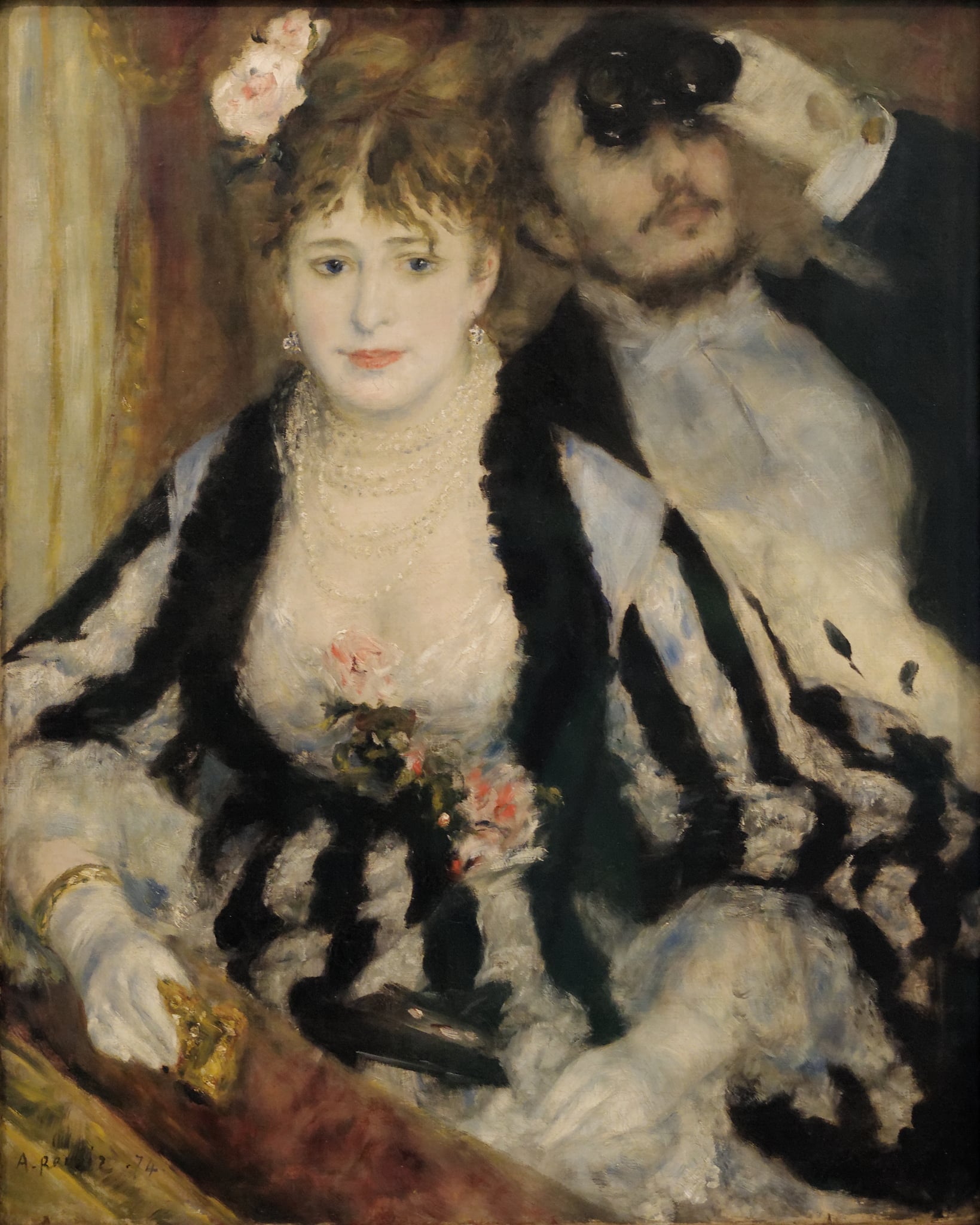
Renoir’s The Loge (1874) turns an opera box into a <strong>stage of looking</strong>, where a woman meets our gaze while her companion scans the crowd through binoculars. The painting’s <strong>frame-within-a-frame</strong> and glittering fashion make modern Parisian leisure both alluring and self-conscious, turning spectators into spectacles <sup>[1]</sup><sup>[2]</sup>.

The Swing by Pierre-Auguste Renoir

The Swing

Pierre-Auguste Renoir (1876)

Renoir’s The Swing fixes a fleeting, sun-dappled exchange in a Montmartre garden, where a woman in a white dress with blue bows steadies herself on a swing while a man in a blue jacket addresses her. The scene crystallizes <strong>modern leisure</strong>, <strong>flirtation</strong>, and <strong>optical shimmer</strong>, as broken strokes scatter light over faces, fabric, and ground <sup>[1]</sup><sup>[4]</sup>.