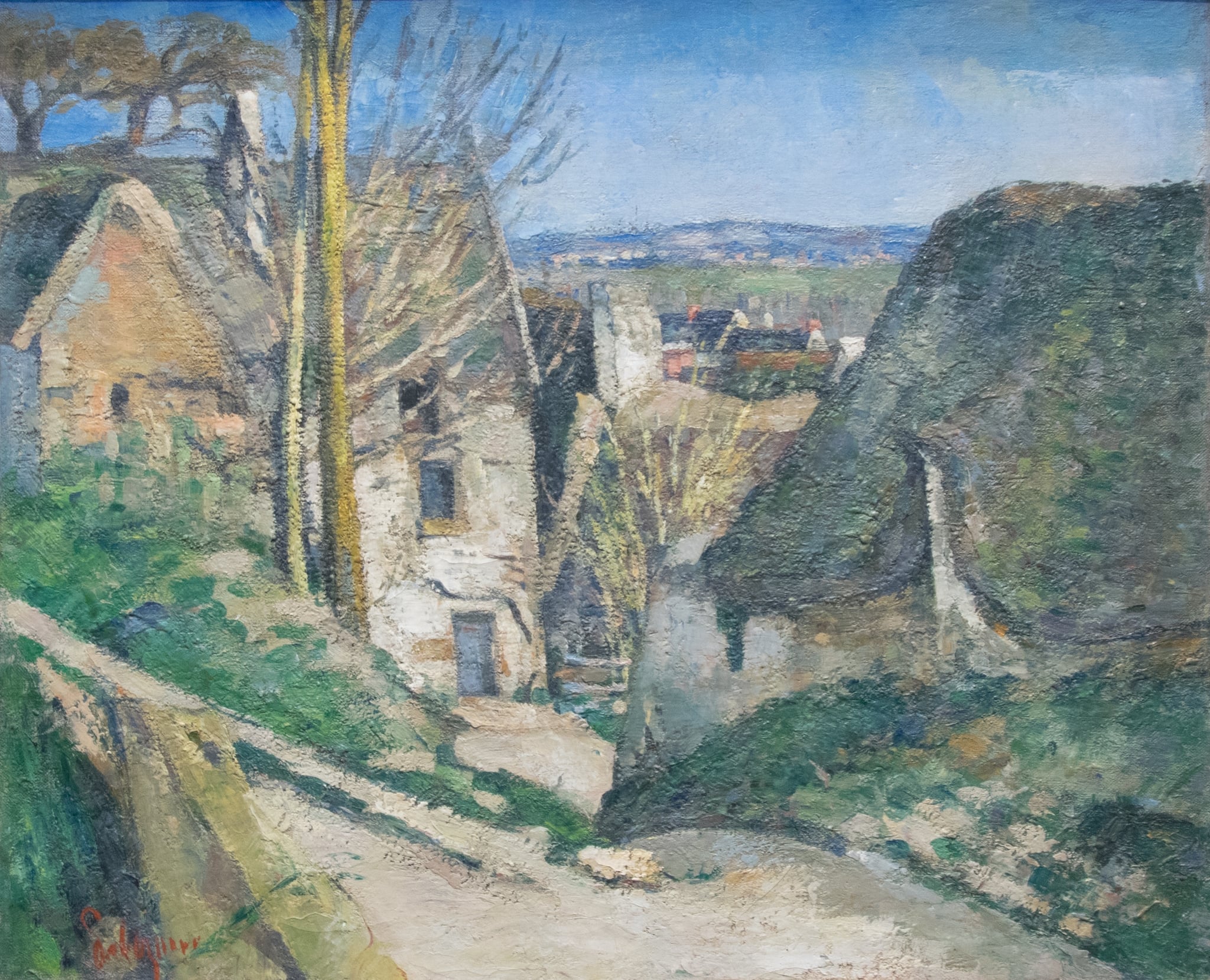
Central V-shaped void Symbolism
A central V-shaped void is a gap or dark wedge formed by converging diagonals that opens near the center of an image. Across art history, such negative space halts the gaze and heightens suspense, turning absence into an active compositional element. By bracketing the void with solid forms, artists direct attention to what is withheld as much as to what is depicted.
Central V-shaped void in The House of the Hanged Man
In Paul Cézanne’s The House of the Hanged Man (1873), jagged roofs, laddered trees, and a steep path funnel the viewer into a narrow, shadowed V that withholds the scene’s center. This withheld middle becomes the painting’s gravitational point: the flanking architecture and vegetation act like retaining walls, guiding and then stopping vision at the notch. Cool greens and slate blues, laid in blocky, masonry-like strokes, reinforce the solidity of the edges so the middle reads as a deliberate absence rather than a passage. The result is engineered unease and structural reflection, with the V-shaped void suspending resolution and defining the work’s tense equilibrium.