Landscape & place
Featured Artworks
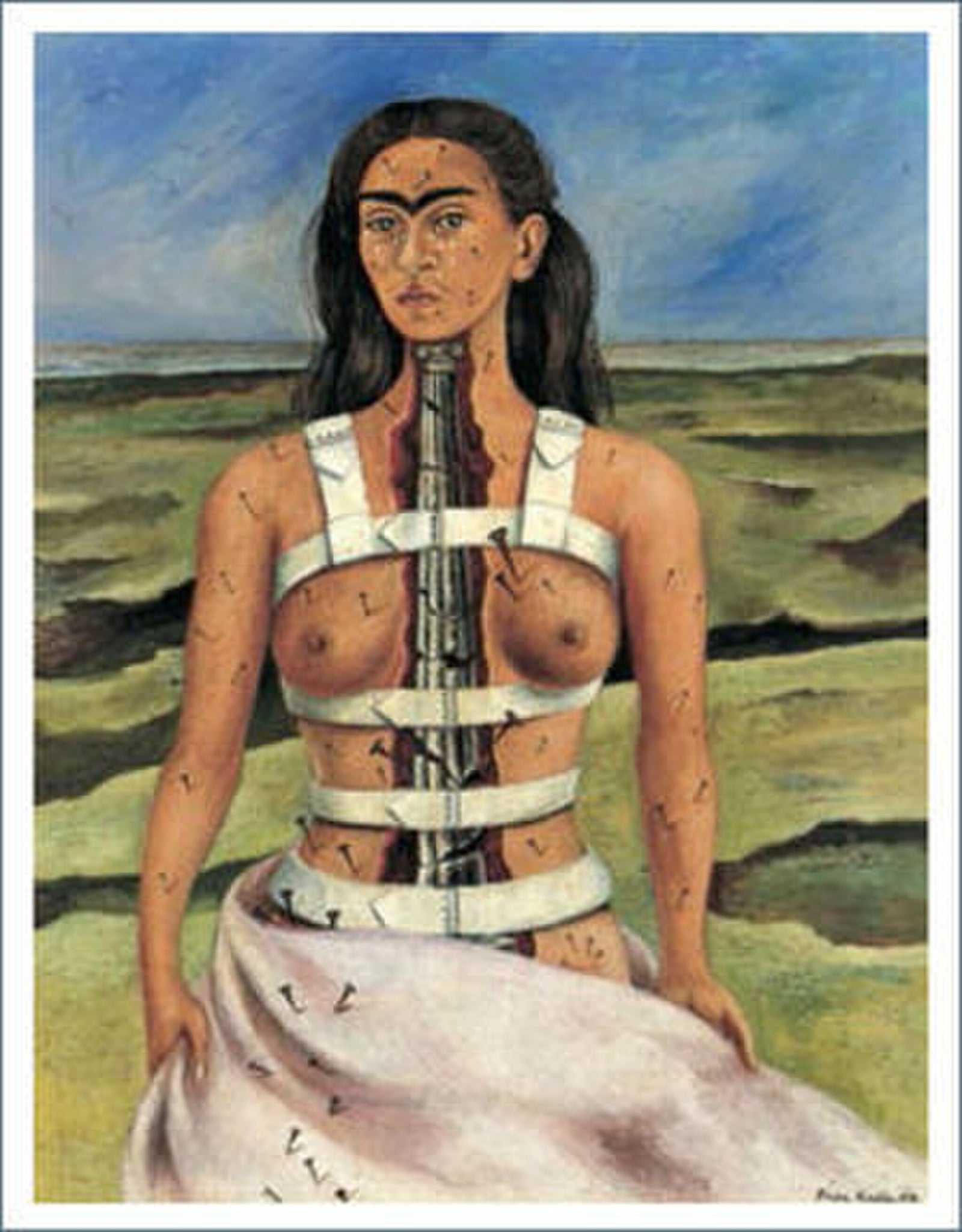
The Broken Column
Frida Kahlo (1944)
The Broken Column presents a frontal self-image split open to expose a shattered classical spine, mapping <strong>chronic pain</strong> across the body with nails while a white <strong>medical corset</strong> both supports and imprisons. Against a cracked, barren landscape, Kahlo’s steady gaze transforms injury into <strong>endurance</strong> and self-possession <sup>[1]</sup><sup>[2]</sup>.
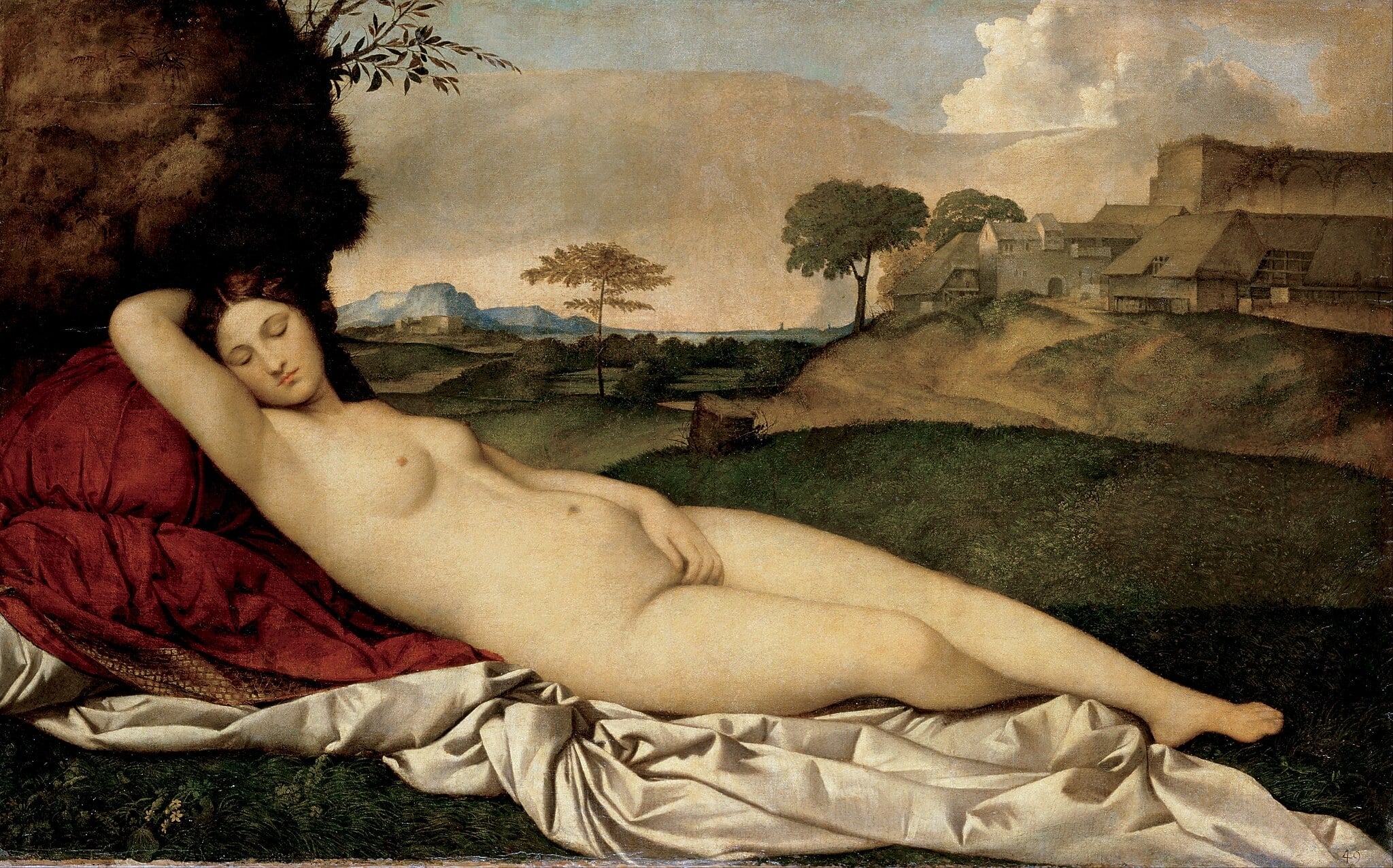
The Sleeping Venus
Giorgione (c. 1508–1510)
In The Sleeping Venus, the goddess reclines across a rolling landscape, her body a serene diagonal that fuses human beauty with nature’s forms. Cool, <strong>silvery drapery</strong> and <strong>deep red cushions</strong> intensify her luminous flesh, while the right-hand <strong>Venus pudica</strong> gesture suspends desire between revelation and restraint. The painting crystallizes the Venetian ideal of poetic harmony (<strong>poesia</strong>) and inaugurates the fully realized reclining nude in Western art <sup>[2]</sup><sup>[4]</sup><sup>[6]</sup>.
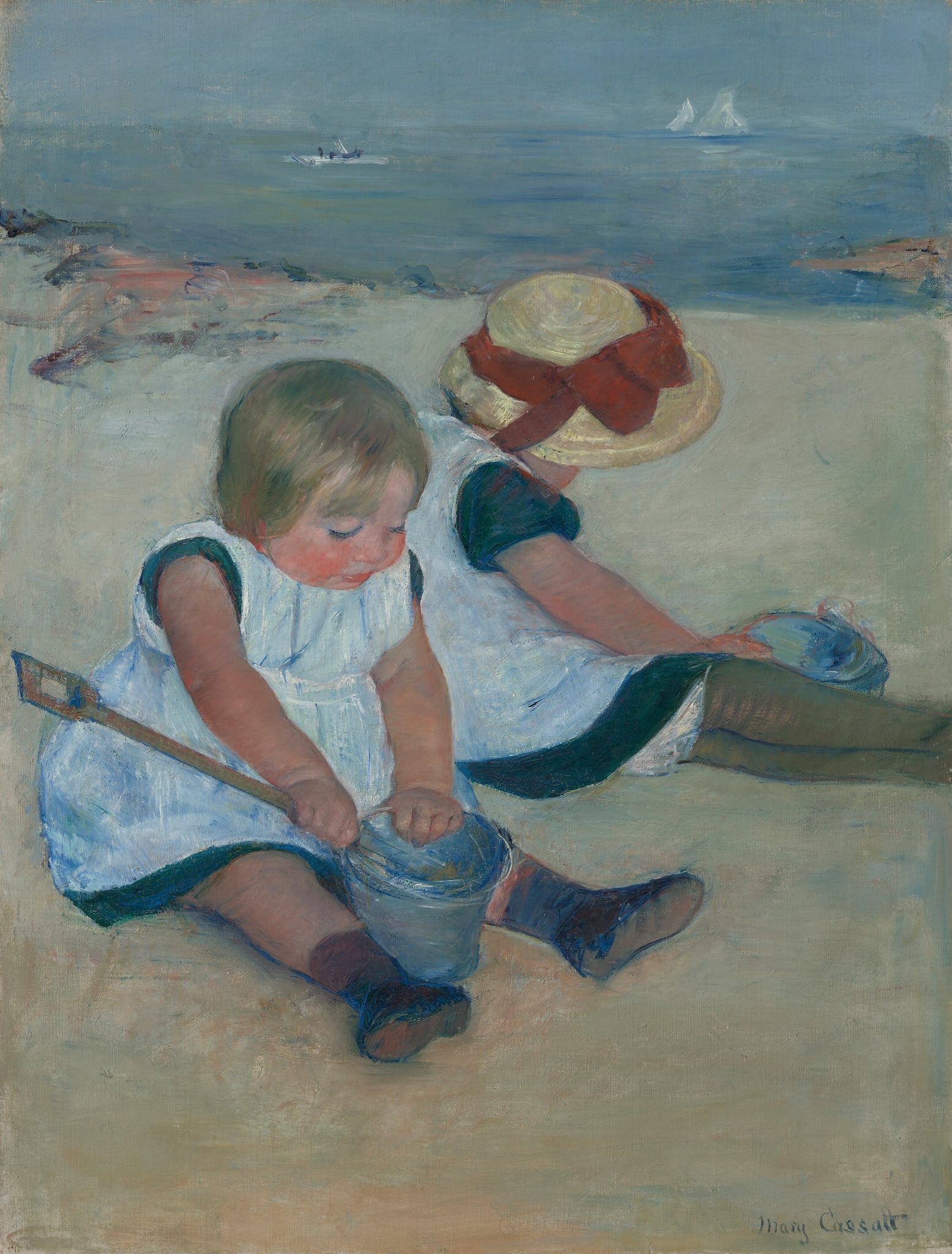
Children Playing on the Beach
Mary Cassatt (1884)
In Children Playing on the Beach, Mary Cassatt brings the viewer down to a child’s eye level, granting everyday play the weight of <strong>serious, self-contained work</strong>. The cool horizon and tiny boats open onto <strong>modern space and possibility</strong>, while the cropped, tilted foreground seals us inside the children’s focused world <sup>[1]</sup>.
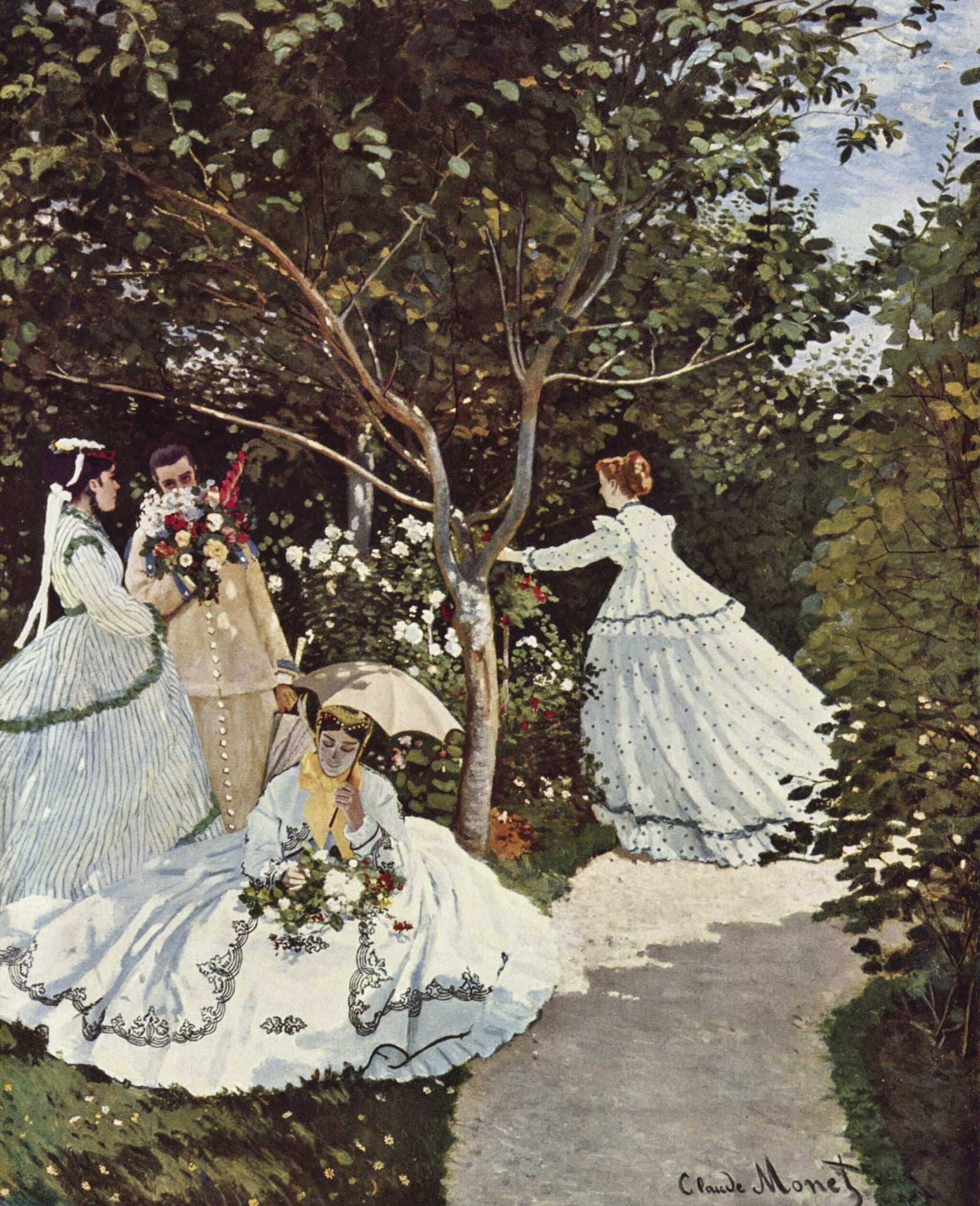
Women in the Garden
Claude Monet (1866–1867)
Claude Monet’s Women in the Garden choreographs four figures in a sunlit bower to test how <strong>white dresses</strong> register <strong>dappled light</strong> and shadow. The path, parasol, and clipped flowers frame a modern ritual of leisure while turning fashion into an instrument of <strong>perception</strong>. The scene reads less as portraiture than as a manifesto for painting the <strong>momentary</strong> outdoors <sup>[1]</sup><sup>[3]</sup>.
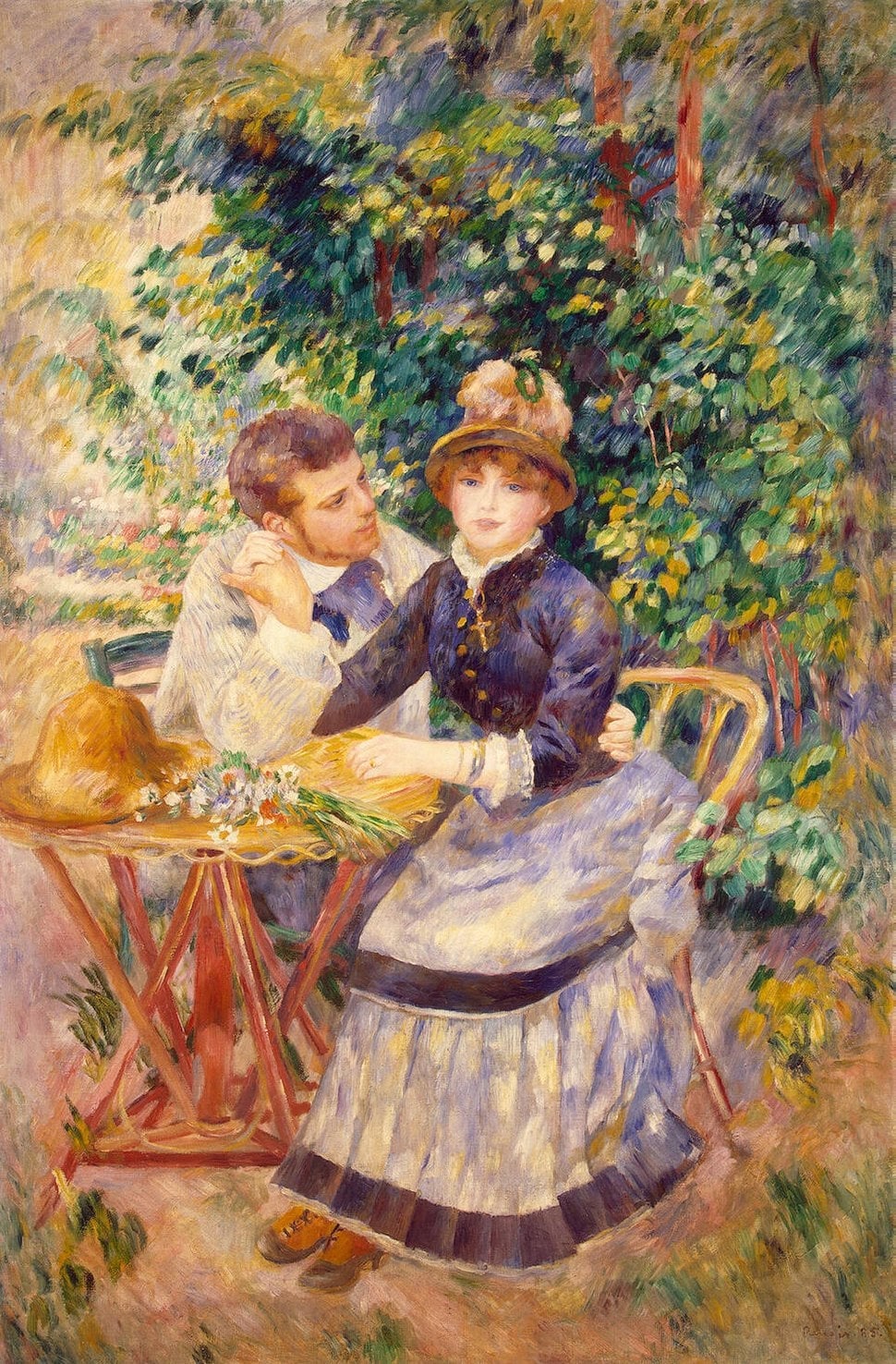
In the Garden
Pierre-Auguste Renoir (1885)
In the Garden presents a charged pause in modern leisure: a young couple at a café table under a living arbor of leaves. Their lightly clasped hands and the bouquet on the tabletop signal courtship, while her calm, front-facing gaze checks his lean. Renoir’s flickering brushwork fuses figures and foliage, rendering love as a <strong>transitory, luminous sensation</strong> <sup>[1]</sup><sup>[3]</sup>.
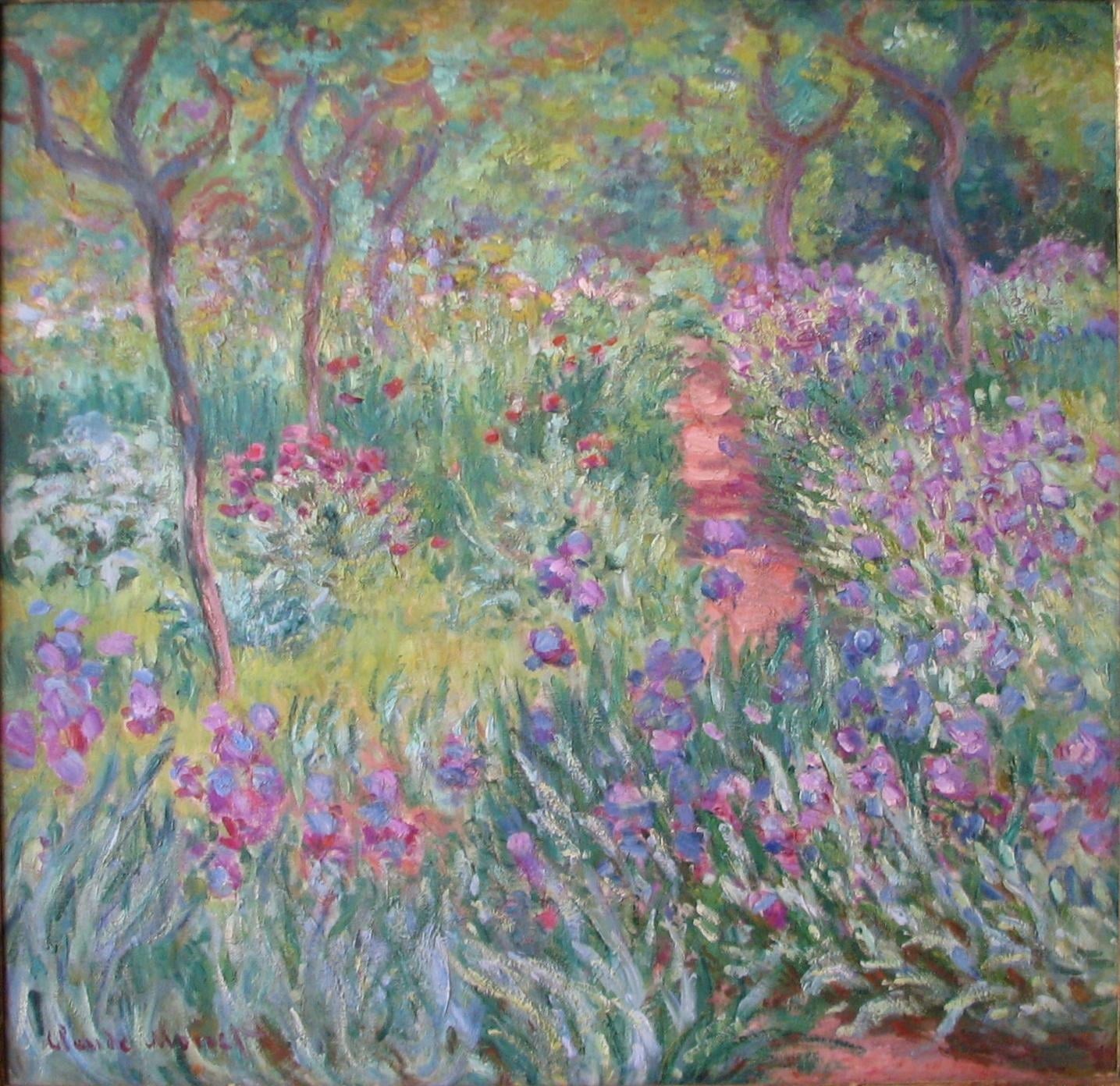
The Artist's Garden at Giverny
Claude Monet (1900)
In The Artist's Garden at Giverny, Claude Monet turns his cultivated Clos Normand into a field of living color, where bands of violet <strong>irises</strong> surge toward a narrow, rose‑colored path. Broken, flickering strokes let greens, purples, and pinks mix optically so that light seems to tremble across the scene, while lilac‑toned tree trunks rhythmically guide the gaze inward <sup>[1]</sup><sup>[3]</sup>.
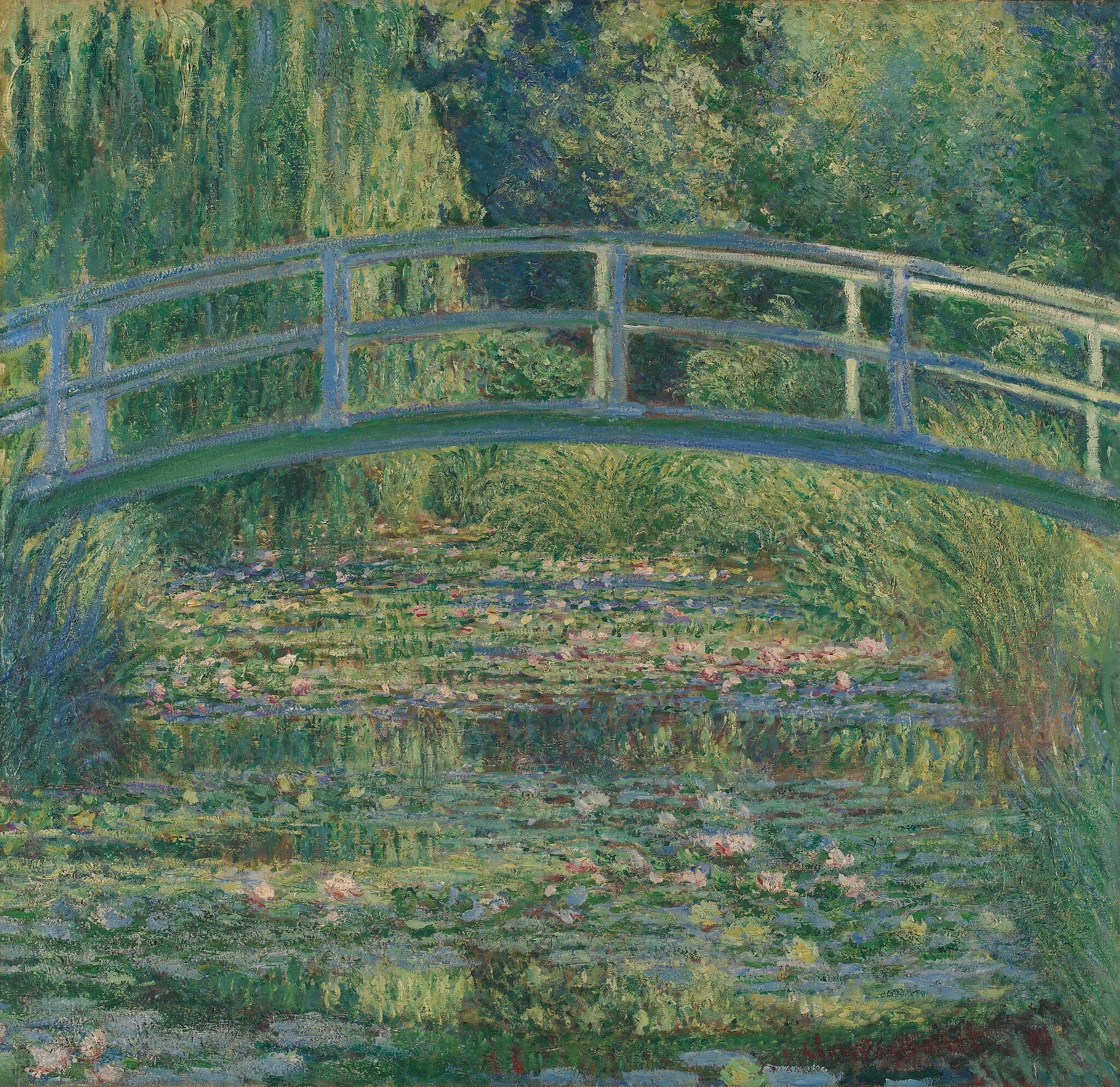
Water Lilies
Claude Monet (1899)
<strong>Water Lilies</strong> centers on an arched <strong>Japanese bridge</strong> suspended over a pond where lilies and rippling reflections fuse into a single, vibrating surface. Monet turns the scene into a study of <strong>perception-in-flux</strong>, letting water, foliage, and light dissolve hard edges into atmospheric continuity <sup>[1]</sup><sup>[3]</sup>.
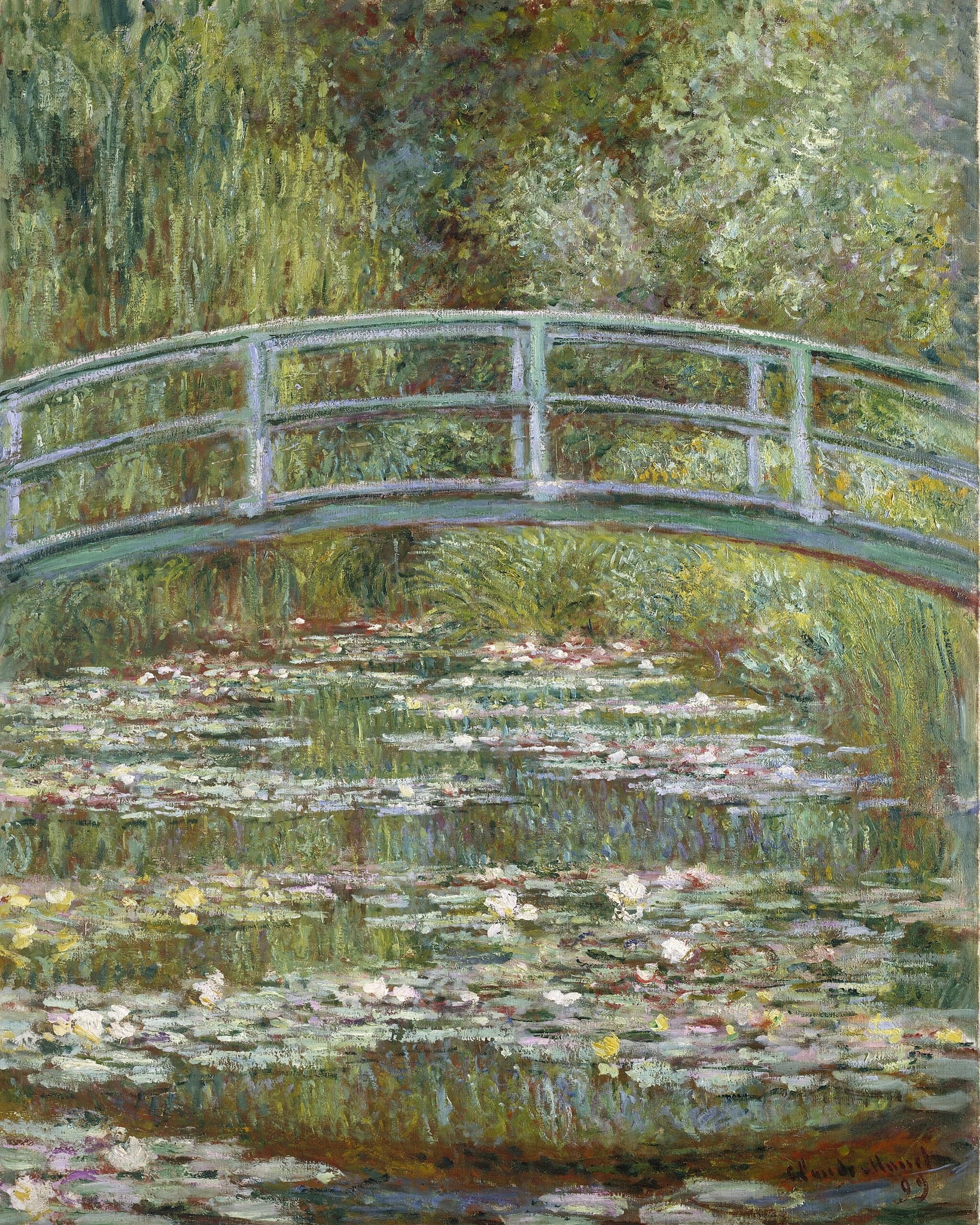
Bridge over a Pond of Water Lilies
Claude Monet (1899)
Claude Monet’s Bridge over a Pond of Water Lilies stages a <strong>threshold</strong> where garden and reflection merge. The cool arc of the <strong>Japanese-style bridge</strong> steadies a field of trembling light, while lilies hover between surface and depth, turning perception itself into the subject <sup>[1]</sup><sup>[2]</sup>.
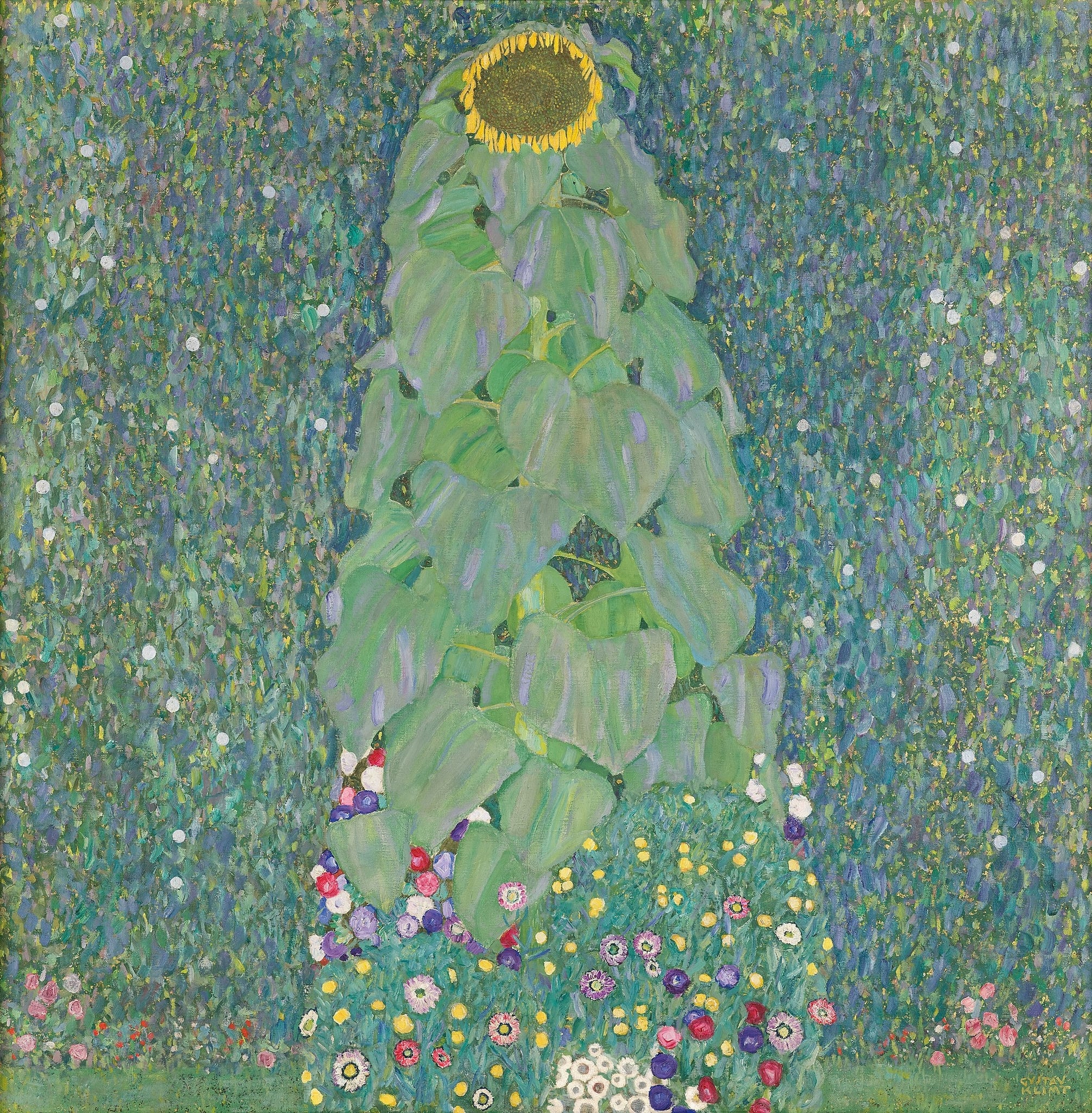
Sunflower
Gustav Klimt (1907/1908)
Gustav Klimt’s Sunflower turns a single bloom into a <strong>monumental, figure-like presence</strong>. A tapering stack of broad, drooping leaves rises from a <strong>mosaic-like carpet of round blossoms</strong>, crowned by a gold-flecked disc that glows against a cool, stippled field. The work fuses <strong>portrait, icon, and landscape</strong> into one emblem of vitality and quiet sanctity <sup>[1]</sup><sup>[2]</sup>.

Pont Neuf Paris
Pierre-Auguste Renoir (1872)
In Pont Neuf Paris, Pierre-Auguste Renoir turns the oldest bridge in Paris into a stage where <strong>light</strong> and <strong>movement</strong> bind a city back together. From a high perch, he orchestrates crowds, carriages, gas lamps, the rippling Seine, and a fluttering <strong>tricolor</strong> so that everyday bustle reads as civic grace <sup>[1]</sup>.
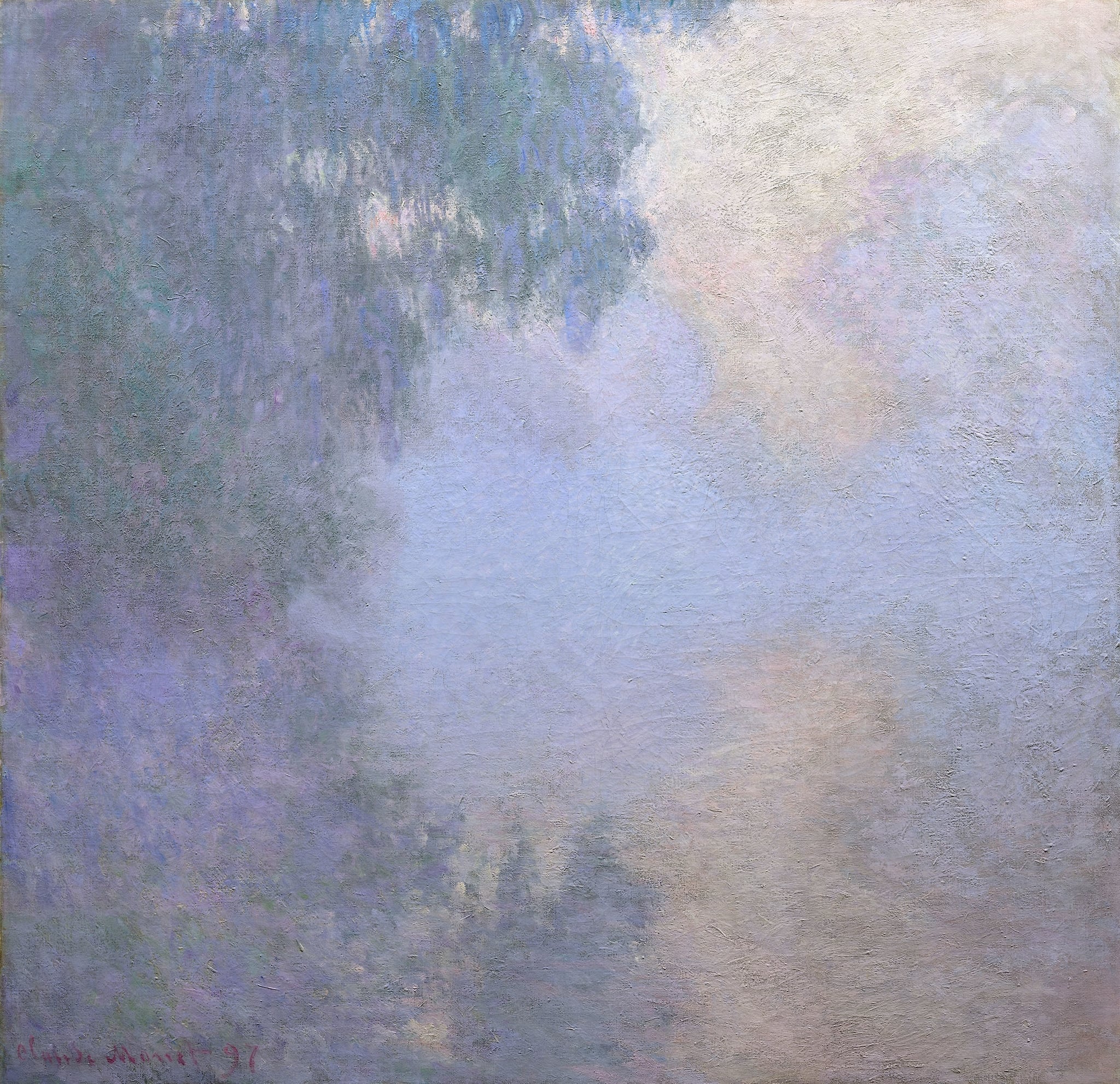
Morning on the Seine (series)
Claude Monet (1897)
Claude Monet’s Morning on the Seine (series) turns dawn into an inquiry about <strong>perception</strong> and <strong>time</strong>. In this canvas, the left bank’s shadowed foliage dissolves into lavender mist while a pale radiance opens at right, fusing sky and water into a single, reflective field <sup>[1]</sup><sup>[2]</sup>.

The Grand Canal
Claude Monet (1908)
Claude Monet’s The Grand Canal turns Venice into <strong>pure atmosphere</strong>: the domes of Santa Maria della Salute waver at right while a regiment of <strong>pali</strong> stands at left, their verticals reverberating in the water. The scene asserts <strong>light over architecture</strong>, transforming stone into memory and time into color <sup>[2]</sup><sup>[3]</sup>.
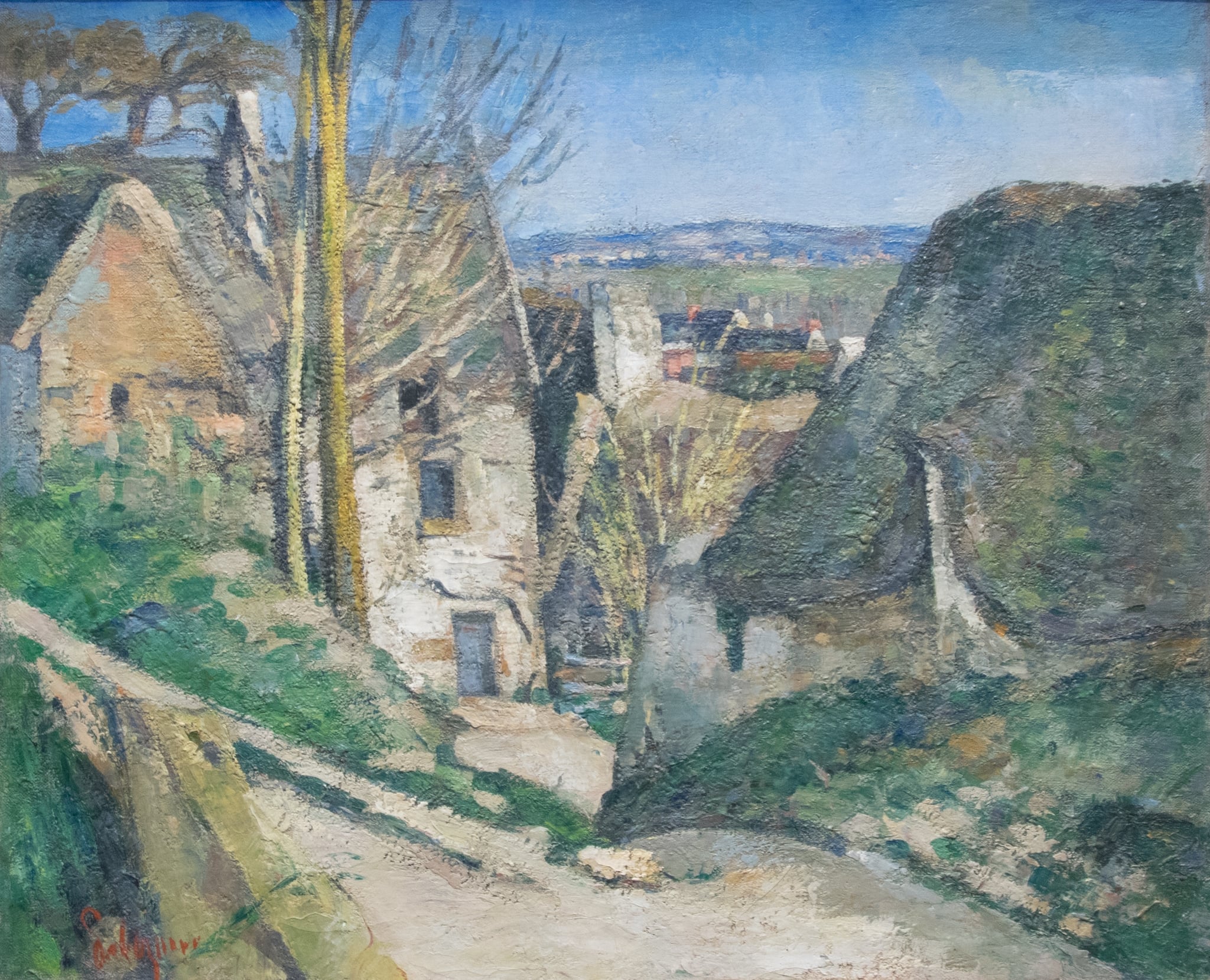
The House of the Hanged Man
Paul Cézanne (1873)
Paul Cézanne’s The House of the Hanged Man turns a modest Auvers-sur-Oise lane into a scene of <strong>engineered unease</strong> and <strong>structural reflection</strong>. Jagged roofs, laddered trees, and a steep path funnel into a narrow, shadowed V that withholds a center, making absence the work’s gravitational force. Cool greens and slate blues, set in blocky, masoned strokes, build a world that feels both solid and precarious.
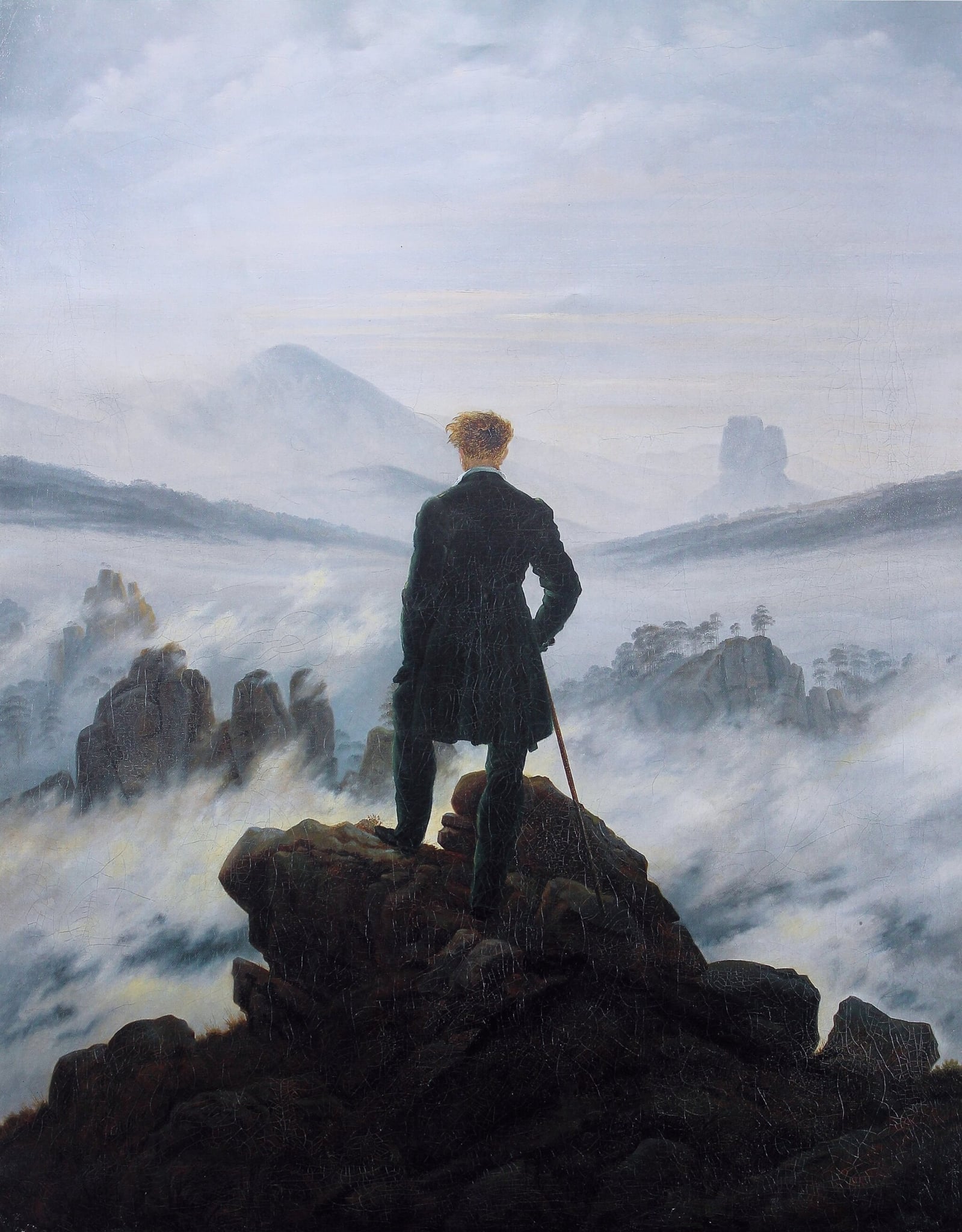
Wanderer above the Sea of Fog
Caspar David Friedrich (ca. 1817)
A solitary figure stands on a jagged crag above a churning <strong>sea of fog</strong>, his back turned in the classic <strong>Rückenfigur</strong> pose. Caspar David Friedrich transforms the landscape into an inner stage where <strong>awe, uncertainty, and resolve</strong> meet at the edge of perception <sup>[3]</sup><sup>[5]</sup>.
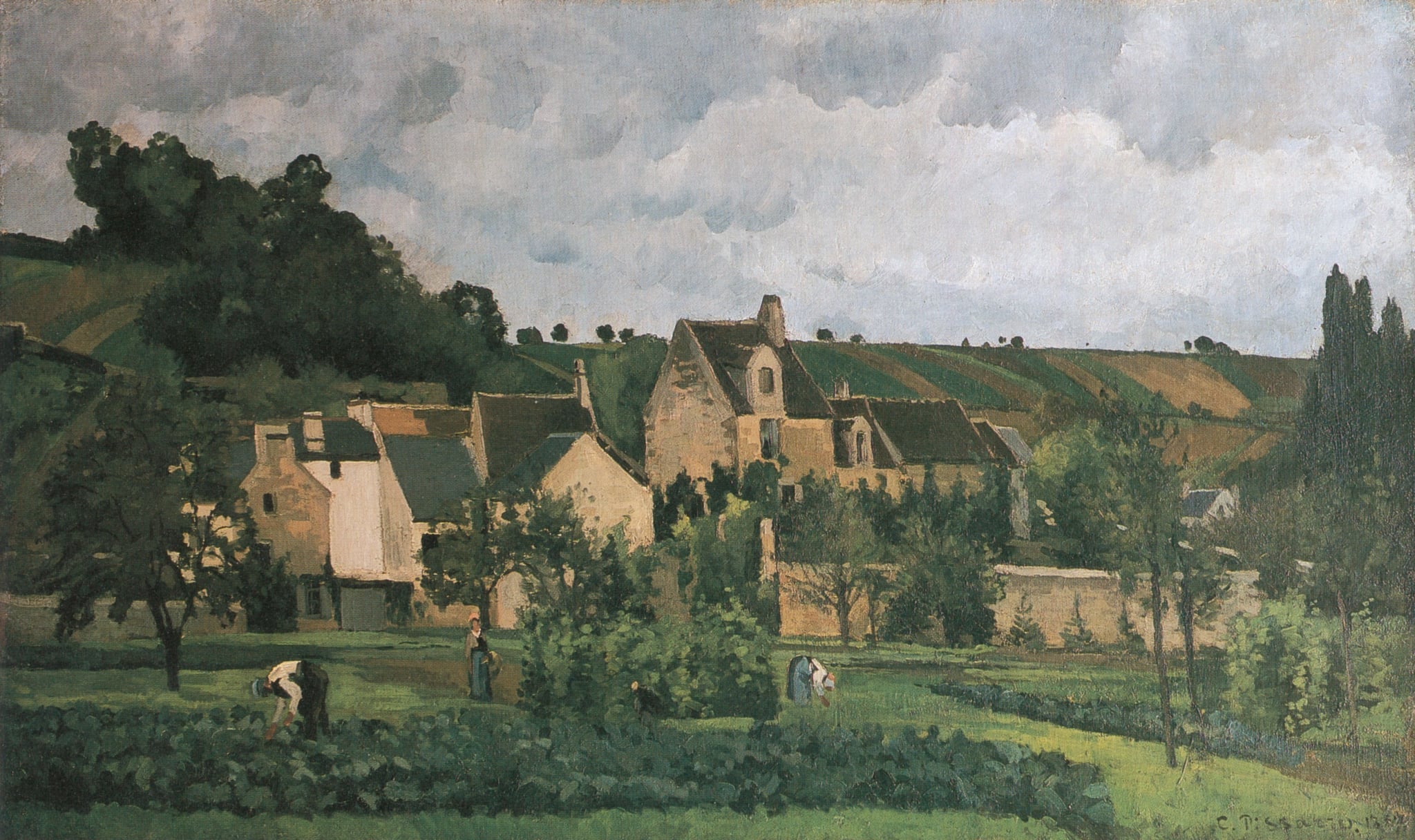
The Hermitage at Pontoise
Camille Pissarro (ca. 1867)
Camille Pissarro’s The Hermitage at Pontoise shows a hillside village interlaced with <strong>kitchen gardens</strong>, stone houses, and workers bent to their tasks under a <strong>low, cloud-laden sky</strong>. The painting binds human labor to place, staging a quiet counterpoint between <strong>architectural permanence</strong> and the <strong>seasonal flux</strong> of fields and weather <sup>[1]</sup><sup>[3]</sup>.

The Valley of the Nervia
Claude Monet (1884)
Claude Monet’s The Valley of the Nervia is a high‑key meditation on <strong>atmosphere as structure</strong>: snow‑lit Maritime Alps rise above a pale, stony riverbed, their mass defined by air and light rather than contour. Through quick, broken strokes of <strong>violet, blue, and lemon</strong>, Monet fuses fleeting afternoon shimmer with the valley’s geologic permanence <sup>[1]</sup><sup>[2]</sup>.
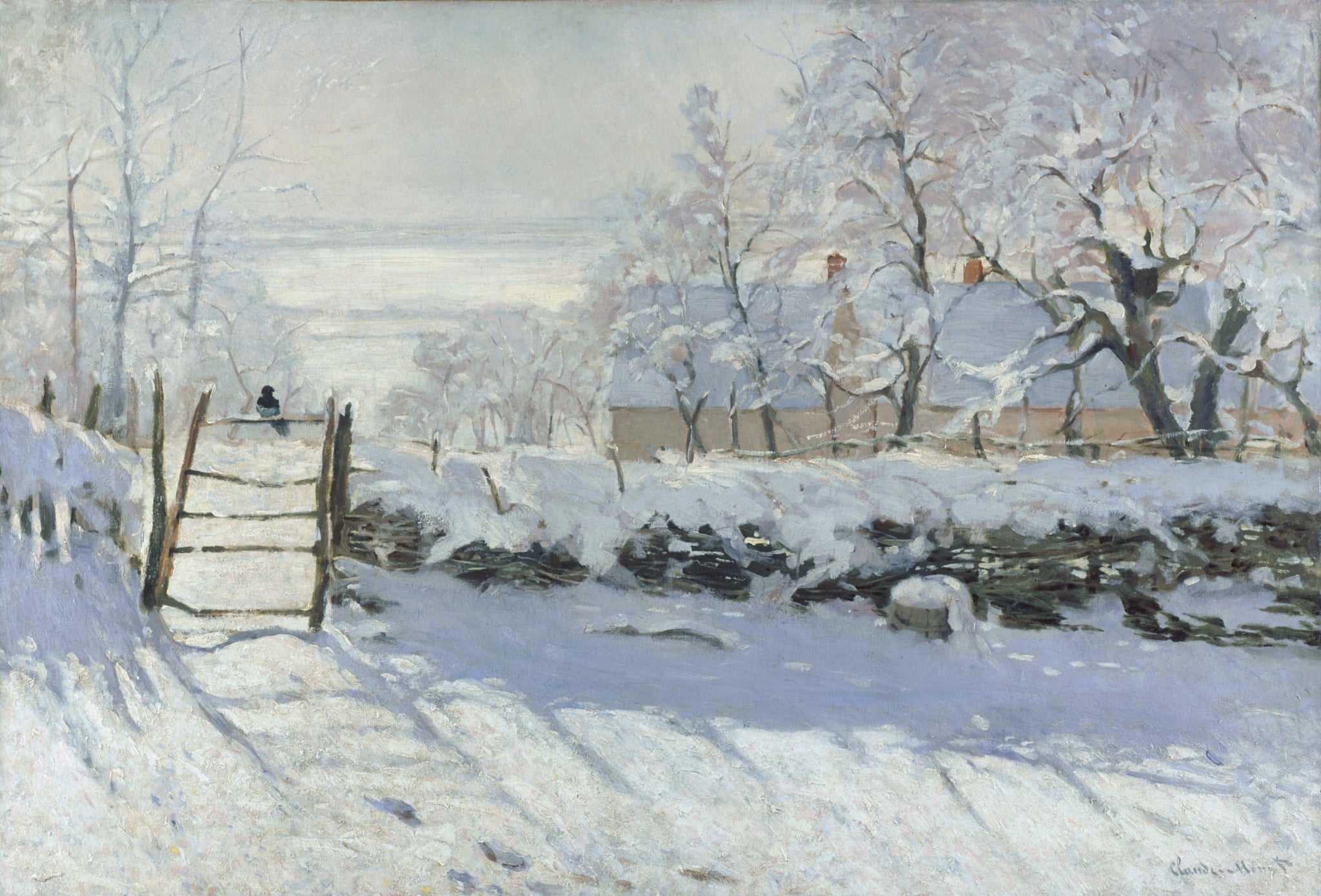
The Magpie
Claude Monet (1868–1869)
Claude Monet’s The Magpie turns a winter field into a study of <strong>luminous perception</strong>, where blue-violet shadows articulate snow’s light. A lone <strong>magpie</strong> perched on a wooden gate punctuates the silence, anchoring a scene that balances homestead and open countryside <sup>[1]</sup>.
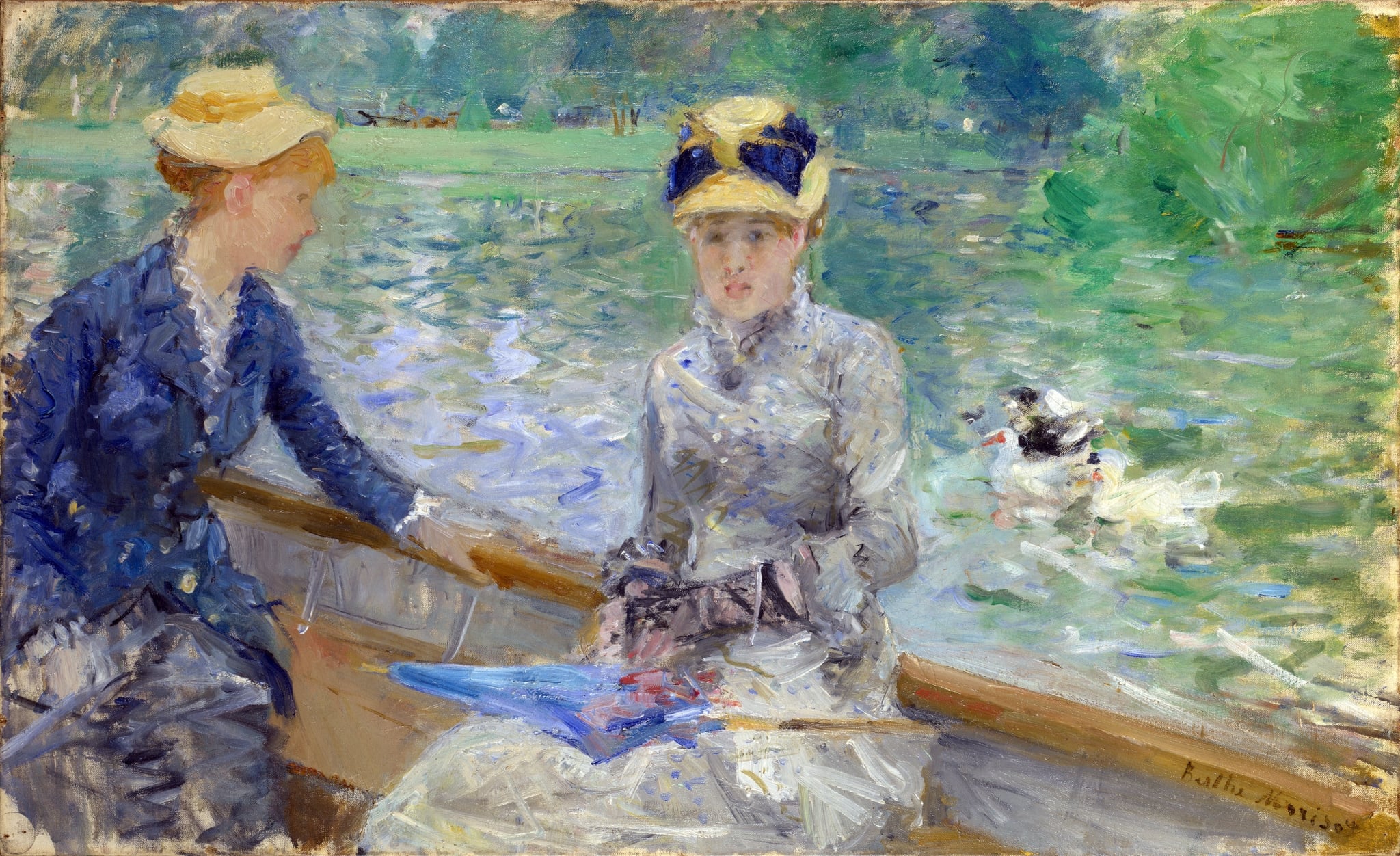
Summer's Day
Berthe Morisot (about 1879)
Two women drift on a boat in the Bois de Boulogne, their dresses, hats, and a bright blue parasol fused with the lake’s flicker by Morisot’s swift, <strong>zig‑zag brushwork</strong>. The scene turns a brief outing into a poised study of <strong>modern leisure</strong> and <strong>female companionship</strong> in public space <sup>[1]</sup>.
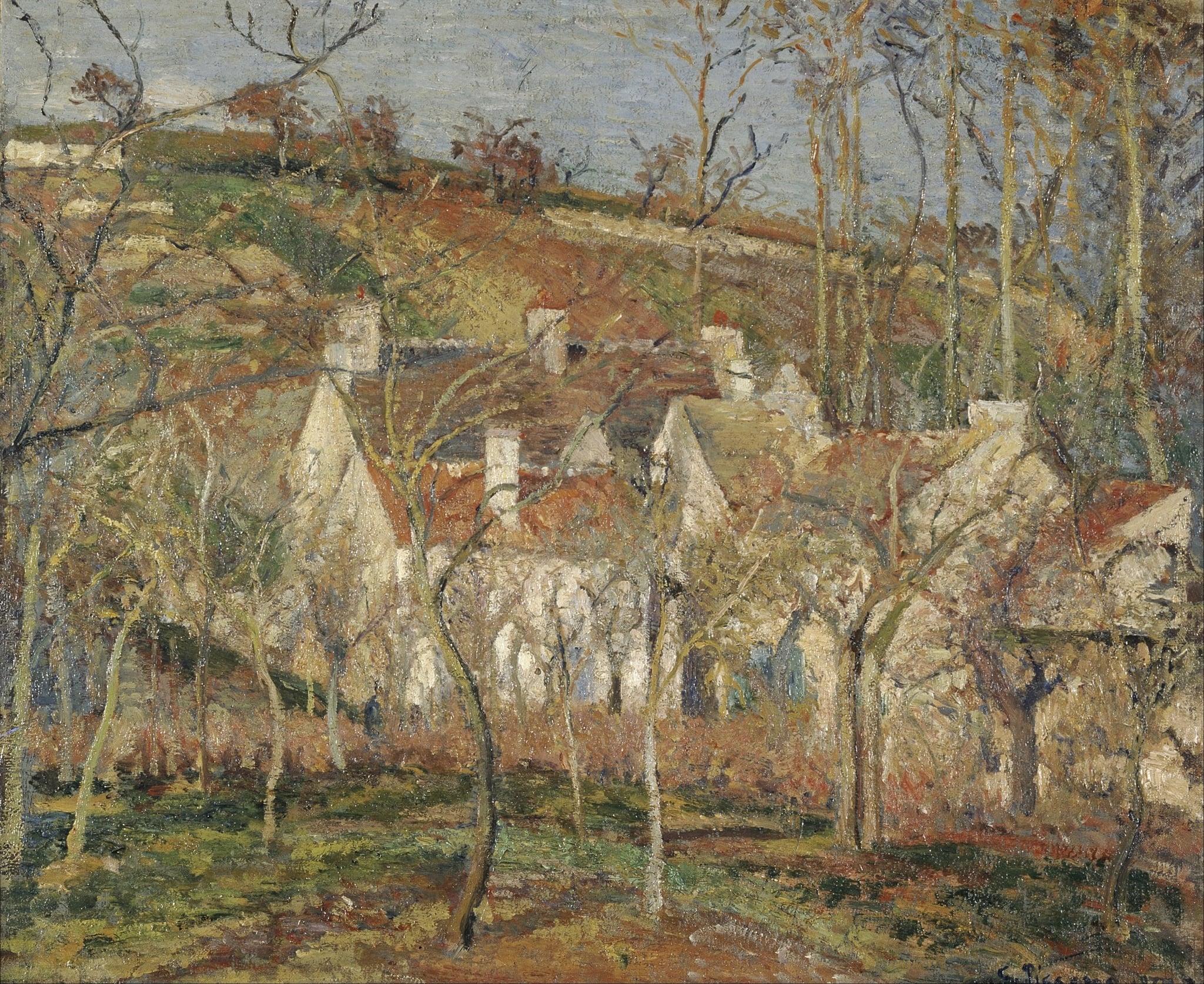
Red Roofs
Camille Pissarro (1877)
In Red Roofs, Camille Pissarro knits village and hillside into a single living fabric through a <strong>screen of winter trees</strong> and vibrating, tactile brushwork. The warm <strong>red-tiled roofs</strong> act as chromatic anchors within a cool, silvery atmosphere, asserting human shelter as part of nature’s rhythm rather than its negation <sup>[1]</sup><sup>[3]</sup>. The composition’s <strong>parallel planes</strong> and color echoes reveal a deliberate structural order that anticipates Post‑Impressionist concerns <sup>[1]</sup><sup>[2]</sup>.
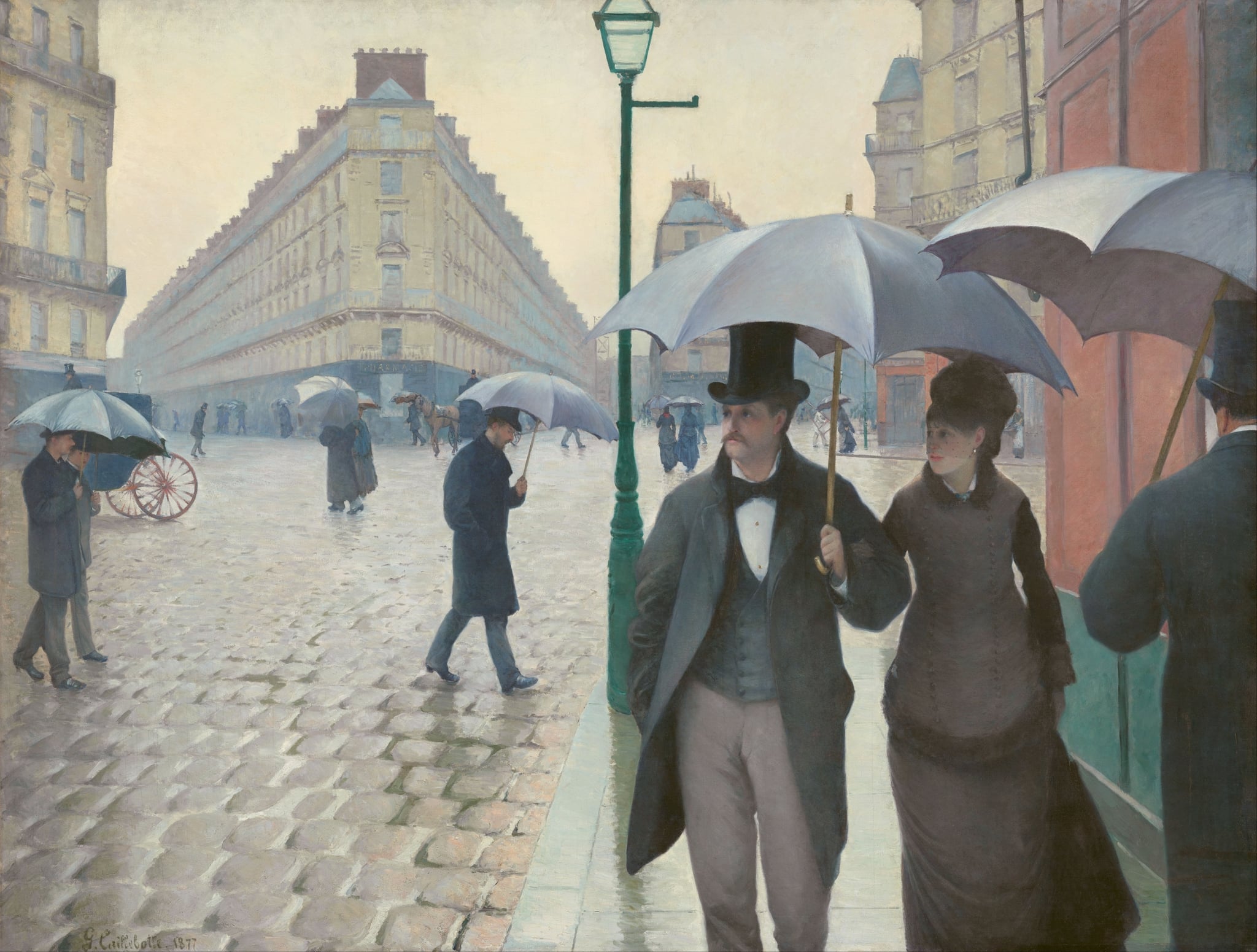
Paris Street; Rainy Day
Gustave Caillebotte (1877)
Gustave Caillebotte’s Paris Street; Rainy Day renders a newly modern Paris where <strong>Haussmann’s geometry</strong> meets the <strong>anonymity of urban life</strong>. Umbrellas punctuate a silvery atmosphere as a <strong>central gas lamp</strong> and knife-sharp façades organize the space into measured planes <sup>[1]</sup><sup>[2]</sup>.
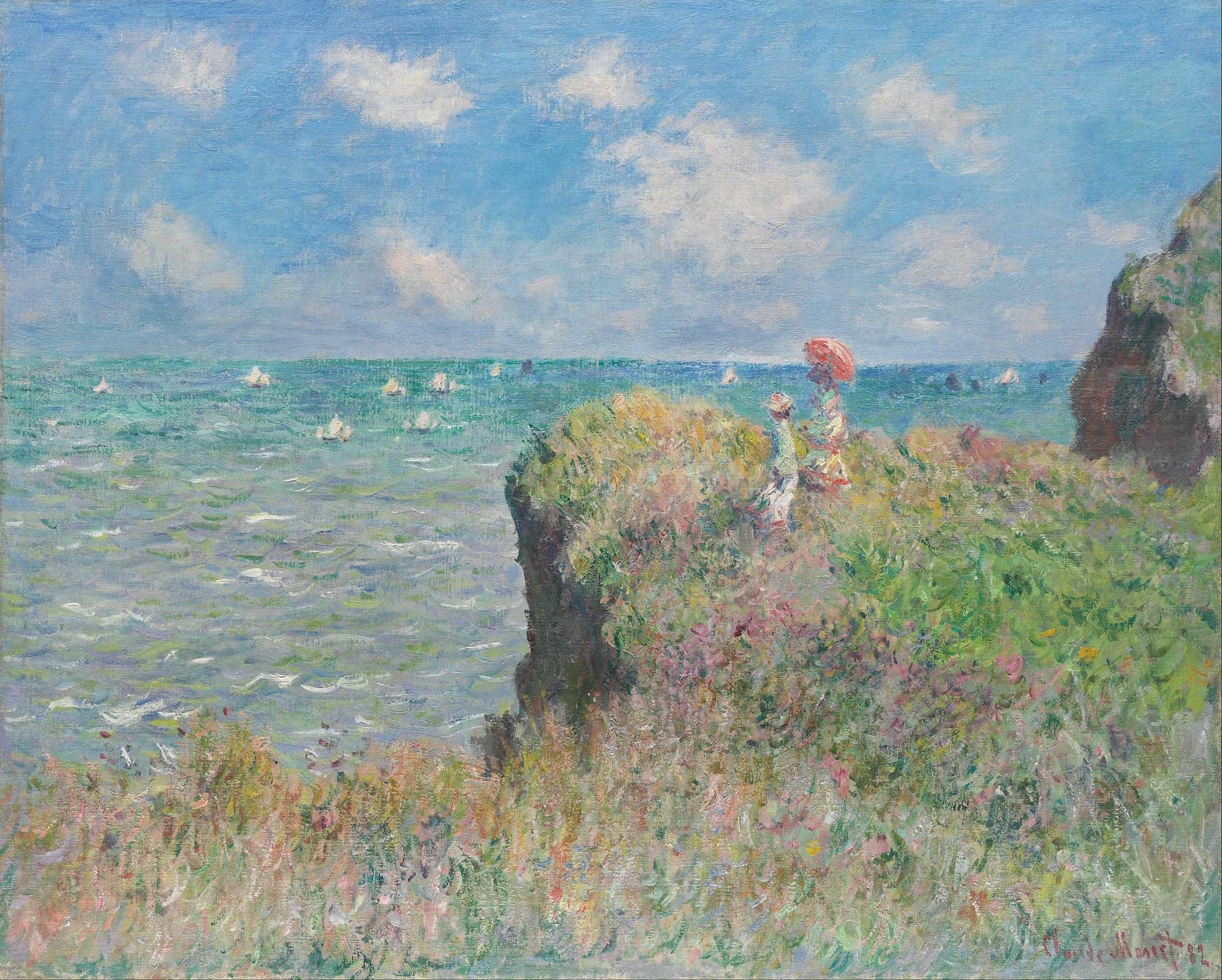
The Cliff Walk at Pourville
Claude Monet (1882)
Claude Monet’s The Cliff Walk at Pourville renders wind, light, and sea as interlocking forces through <strong>shimmering, broken brushwork</strong>. Two small walkers—one beneath a pink parasol—stand near the <strong>precipitous cliff edge</strong>, their presence measuring the vastness of turquoise water and bright sky dotted with white sails. The scene fuses leisure and the <strong>modern sublime</strong>, making perception itself the subject <sup>[1]</sup><sup>[2]</sup>.
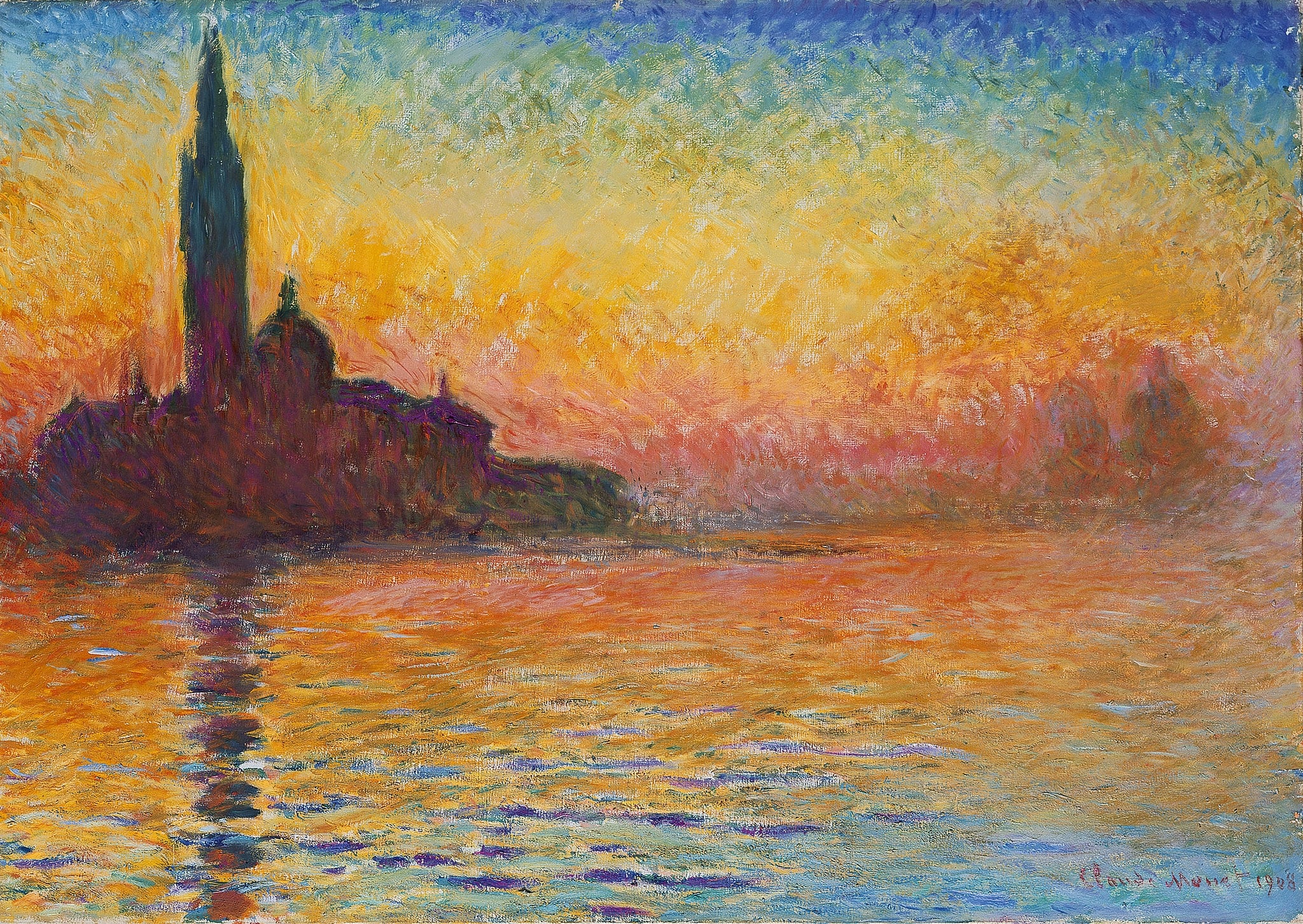
San Giorgio Maggiore at Dusk
Claude Monet (1908–1912)
Claude Monet’s San Giorgio Maggiore at Dusk fuses the Benedictine church’s dark silhouette with a sky flaming from apricot to cobalt, turning architecture into atmosphere. The campanile’s vertical and its wavering reflection anchor a sea of trembling color, staging a meditation on <strong>permanence</strong> and <strong>flux</strong>.
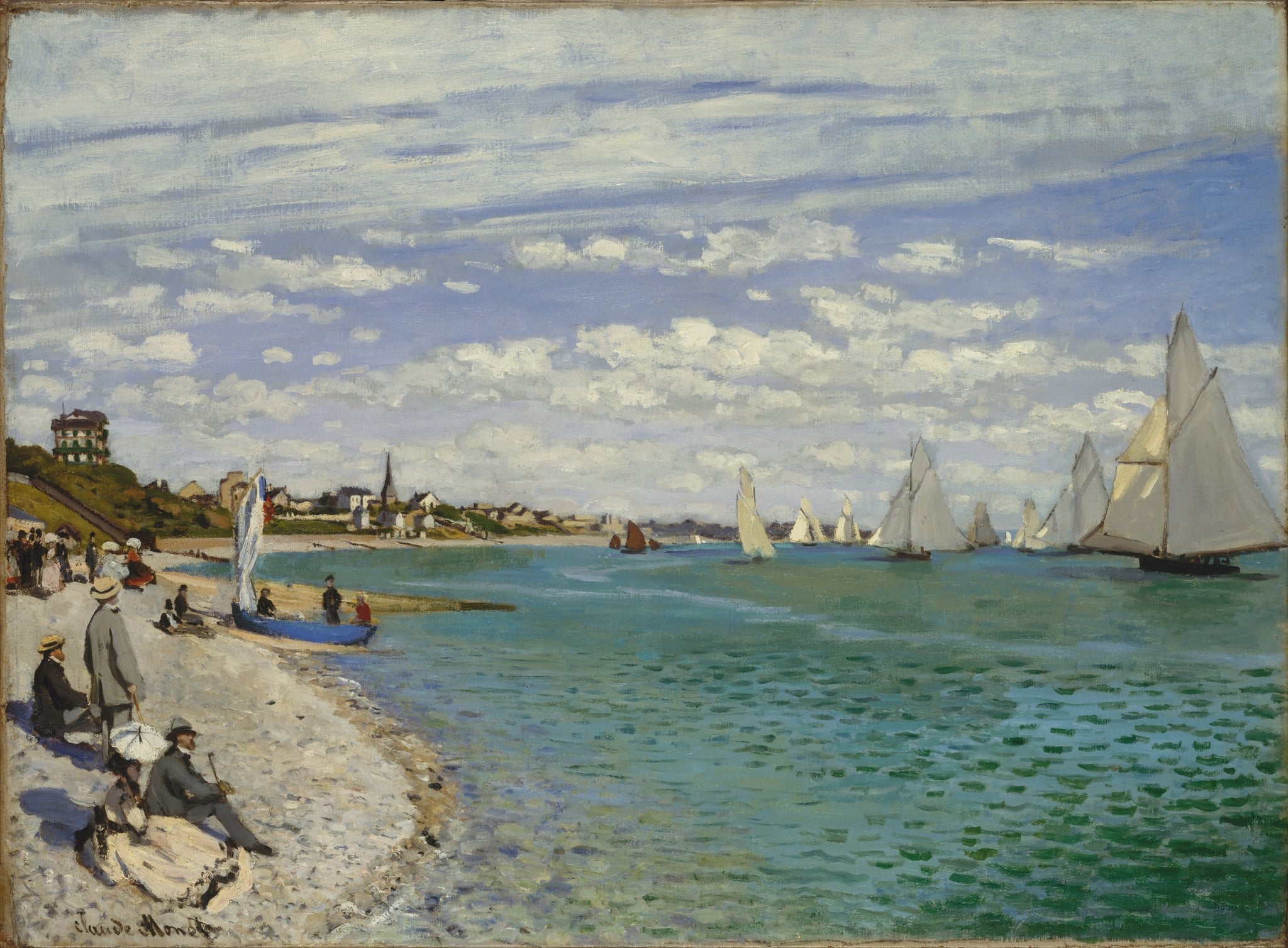
Regatta at Sainte-Adresse
Claude Monet (1867)
On a brilliant afternoon at the Normandy coast, a diagonal <strong>pebble beach</strong> funnels spectators with parasols toward a bay scattered with <strong>white-sailed yachts</strong>. Monet’s quick, broken strokes set <strong>wind, water, and light</strong> in synchrony, turning a local regatta into a modern scene of leisure held against the vastness of sea and sky <sup>[1]</sup><sup>[2]</sup>.
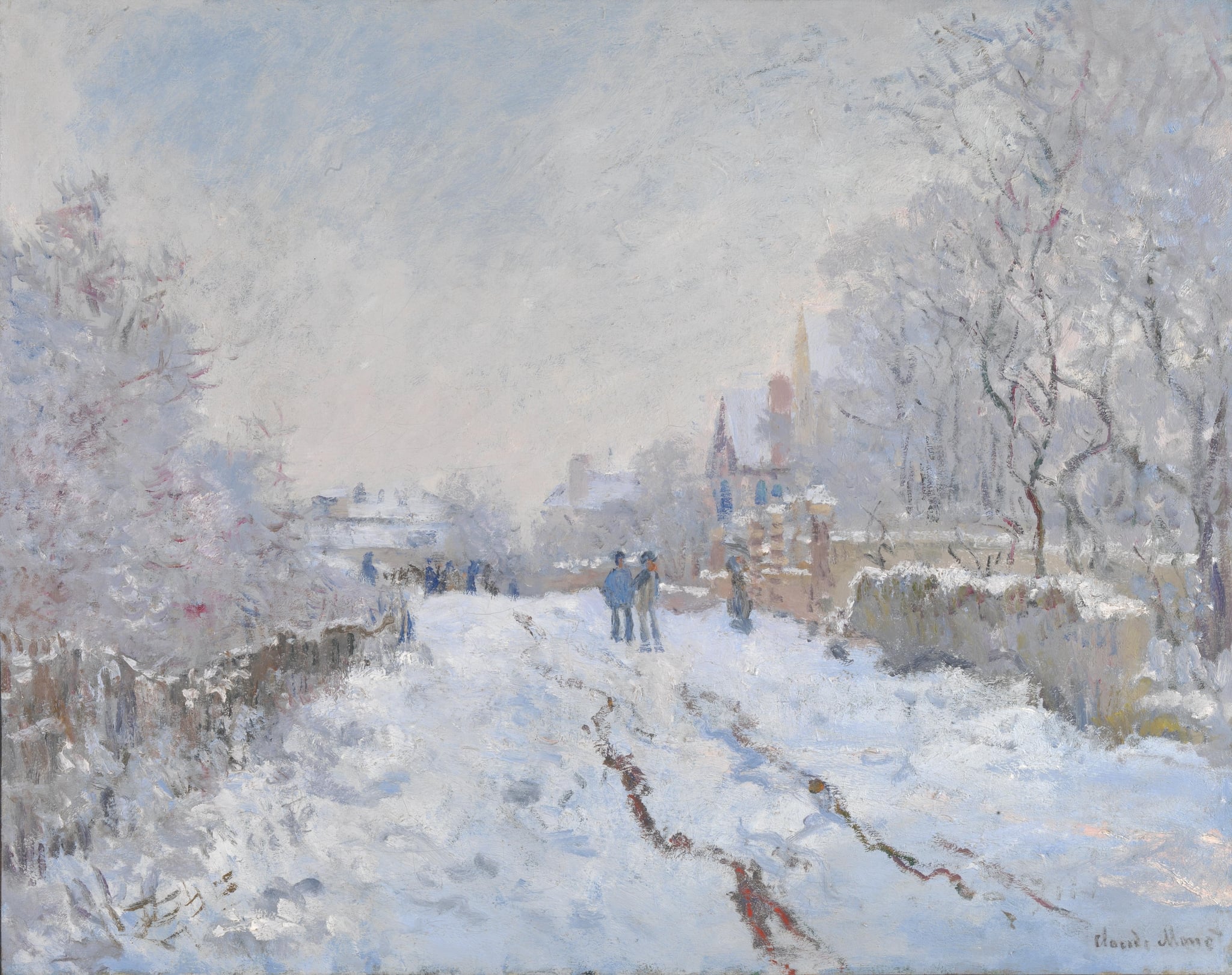
Snow at Argenteuil
Claude Monet (1875)
<strong>Snow at Argenteuil</strong> renders a winter boulevard where light overtakes solid form, turning snow into a luminous field of blues, violets, and pearly pinks. Reddish cart ruts pull the eye toward a faint church spire as small, blue-gray figures persist through the hush. Monet elevates atmosphere to the scene’s <strong>protagonist</strong>, making everyday passage a meditation on time and change <sup>[1]</sup><sup>[2]</sup>.

Dance in the City
Pierre-Auguste Renoir (1883)
Pierre-Auguste Renoir’s Dance in the City stages an urban waltz where decorum and desire briefly coincide. A couple’s close embrace—his black tailcoat enclosing her luminous white satin gown—creates a <strong>cool, elegant</strong> harmony against potted palms and marble. Renoir’s refined, post‑Impressionist touch turns social ritual into <strong>sensual modernity</strong> <sup>[1]</sup><sup>[2]</sup>.
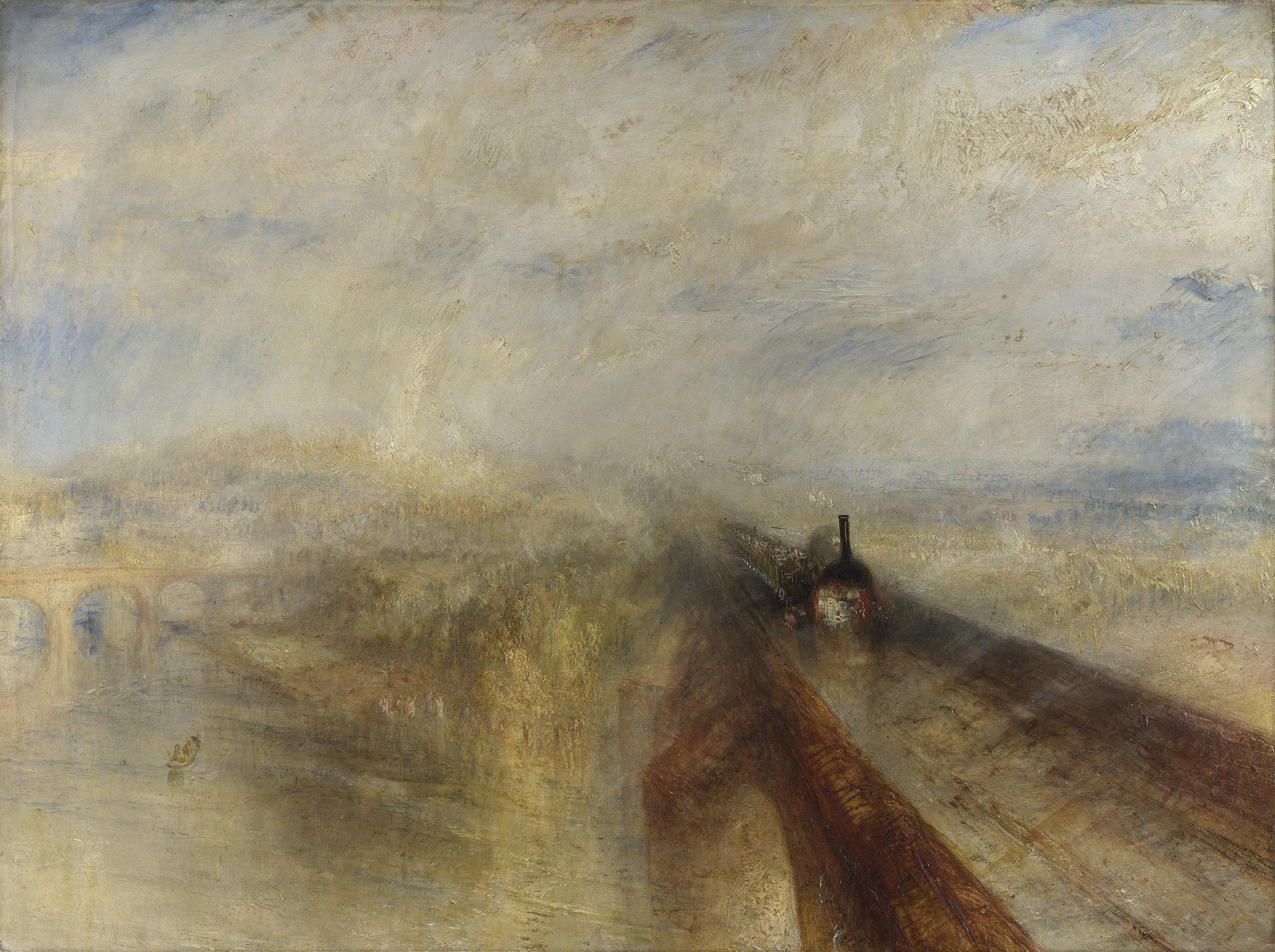
Rain, Steam and Speed
J. M. W. Turner (1844)
In Rain, Steam and Speed, J. M. W. Turner fuses weather and industry into a single onrushing vision, as a dark locomotive thrusts along the diagonal of Brunel’s Maidenhead Railway Bridge through veils of rain and light. The blurred fields, river, and town dissolve into a charged atmosphere where <strong>rain</strong>, <strong>steam</strong>, and <strong>speed</strong> become the true subjects. Counter-motifs—a small boat beneath pale arches and a near-invisible hare ahead of the train—stage a drama between pre‑industrial life and modern velocity <sup>[1]</sup><sup>[2]</sup>.
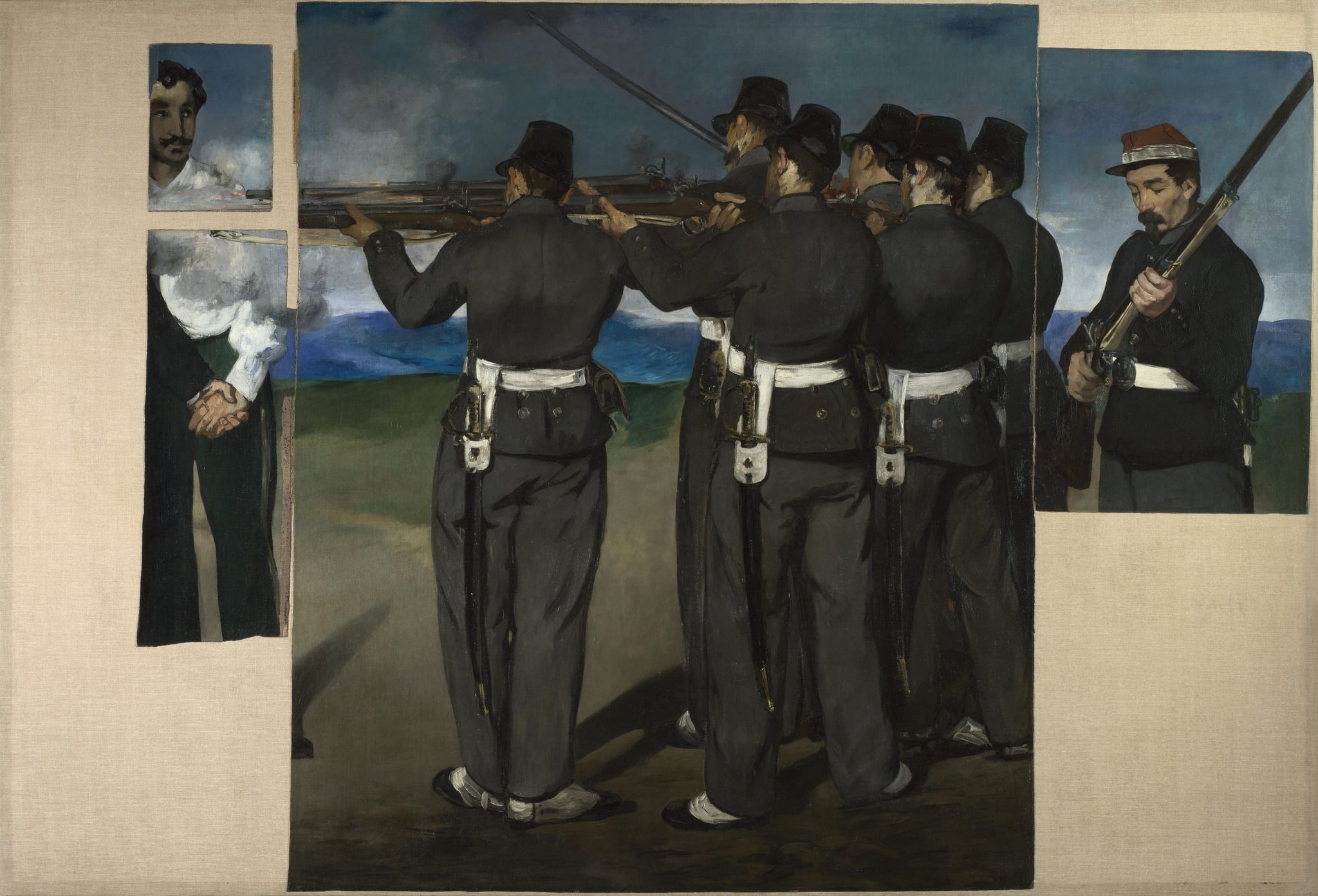
The Execution of Emperor Maximilian
Édouard Manet (1867–1868)
Manet’s The Execution of Emperor Maximilian confronts state violence with a <strong>cool, reportorial</strong> style. The wall of gray-uniformed riflemen, the <strong>fragmented canvas</strong>, and the dispassionate loader at right turn the killing into <strong>impersonal machinery</strong> that implicates the viewer <sup>[1]</sup><sup>[2]</sup>.
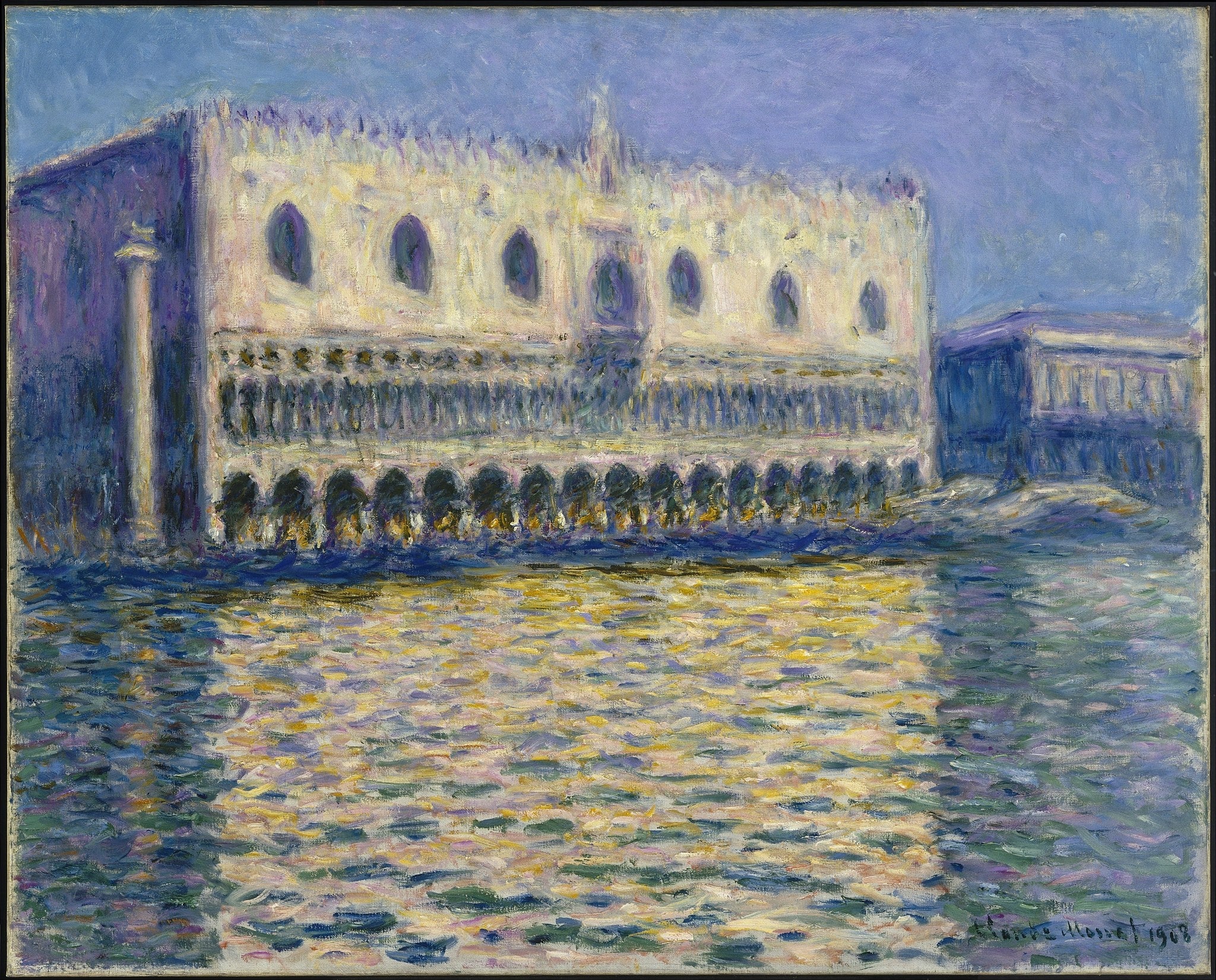
The Doge's Palace
Claude Monet (1908)
Monet’s The Doge’s Palace translates Venice’s emblem of authority into an <strong>atmospheric drama</strong> of lilac, cream, and ultramarine. Architecture becomes a <strong>screen for light</strong>, as the ogival windows and double arcades blur into vibrating strokes mirrored by the lagoon’s <strong>second architecture</strong>—its reflection <sup>[1]</sup><sup>[4]</sup>.
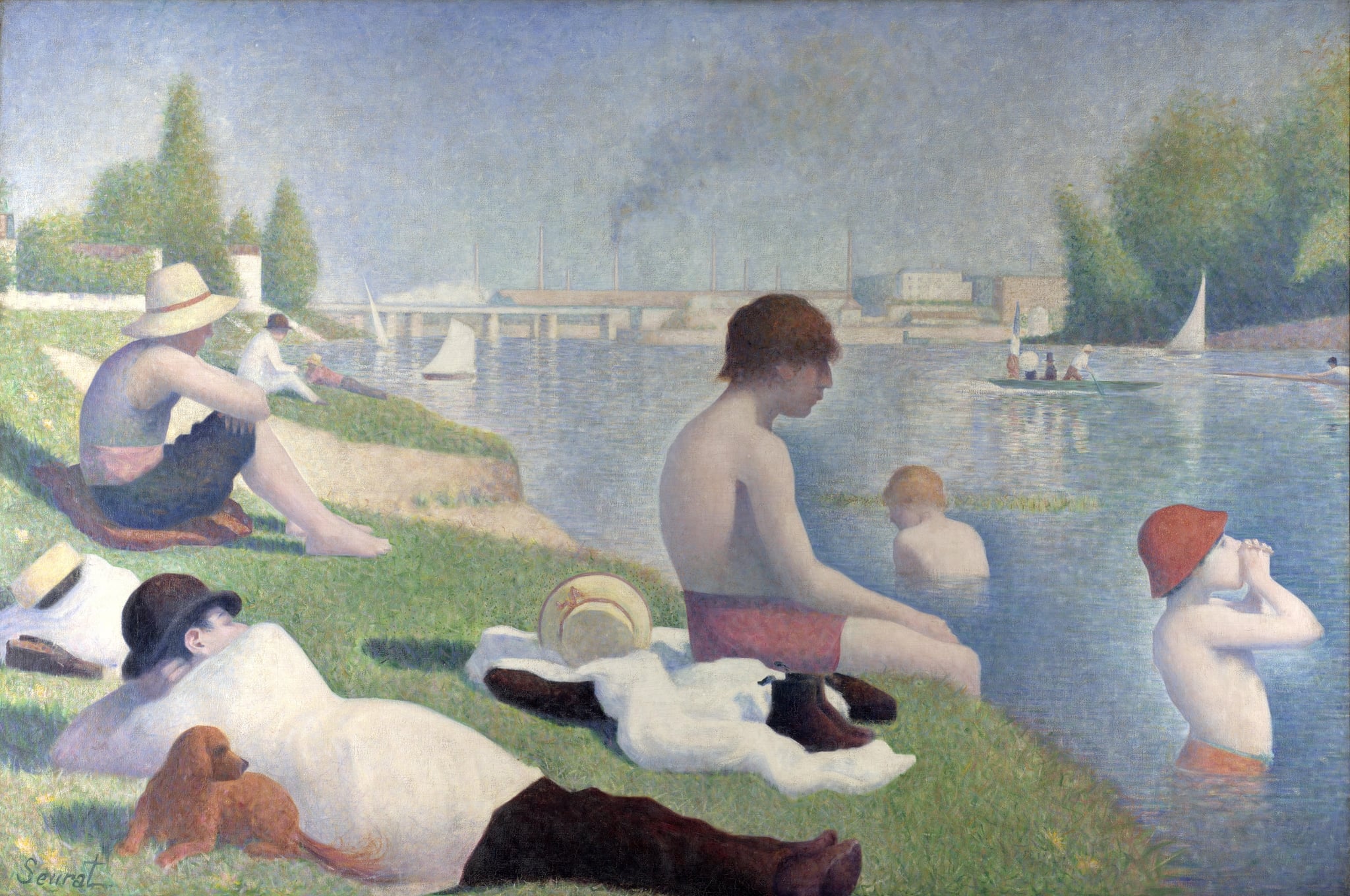
Bathers at Asnières
Georges Seurat (1884)
Bathers at Asnières stages a scene of <strong>modern leisure</strong> on the Seine, where workers recline and wade beneath a hazy, unified light. Seurat fuses <strong>classicizing stillness</strong> with an <strong>industrial backdrop</strong> of chimneys, bridges, and boats, turning ordinary rest into a monumental, ordered image of urban life <sup>[1]</sup><sup>[3]</sup>. The canvas balances soft greens and blues with geometric structures, producing a calm yet charged harmony.

The Garden of Pontoise
Camille Pissarro (1874)
In The Garden of Pontoise, Camille Pissarro turns a modest suburban plot into a stage for <strong>modern leisure</strong> and <strong>fugitive light</strong>. A woman shaded by a parasol and a child in a bright red skirt punctuate the deep greens, while a curving sand path and beds of red–pink blossoms draw the eye toward a pale house and cloud‑flecked sky. The painting asserts that everyday, cultivated nature can be a <strong>modern Eden</strong> where time, season, and social ritual quietly unfold <sup>[1]</sup><sup>[3]</sup>.
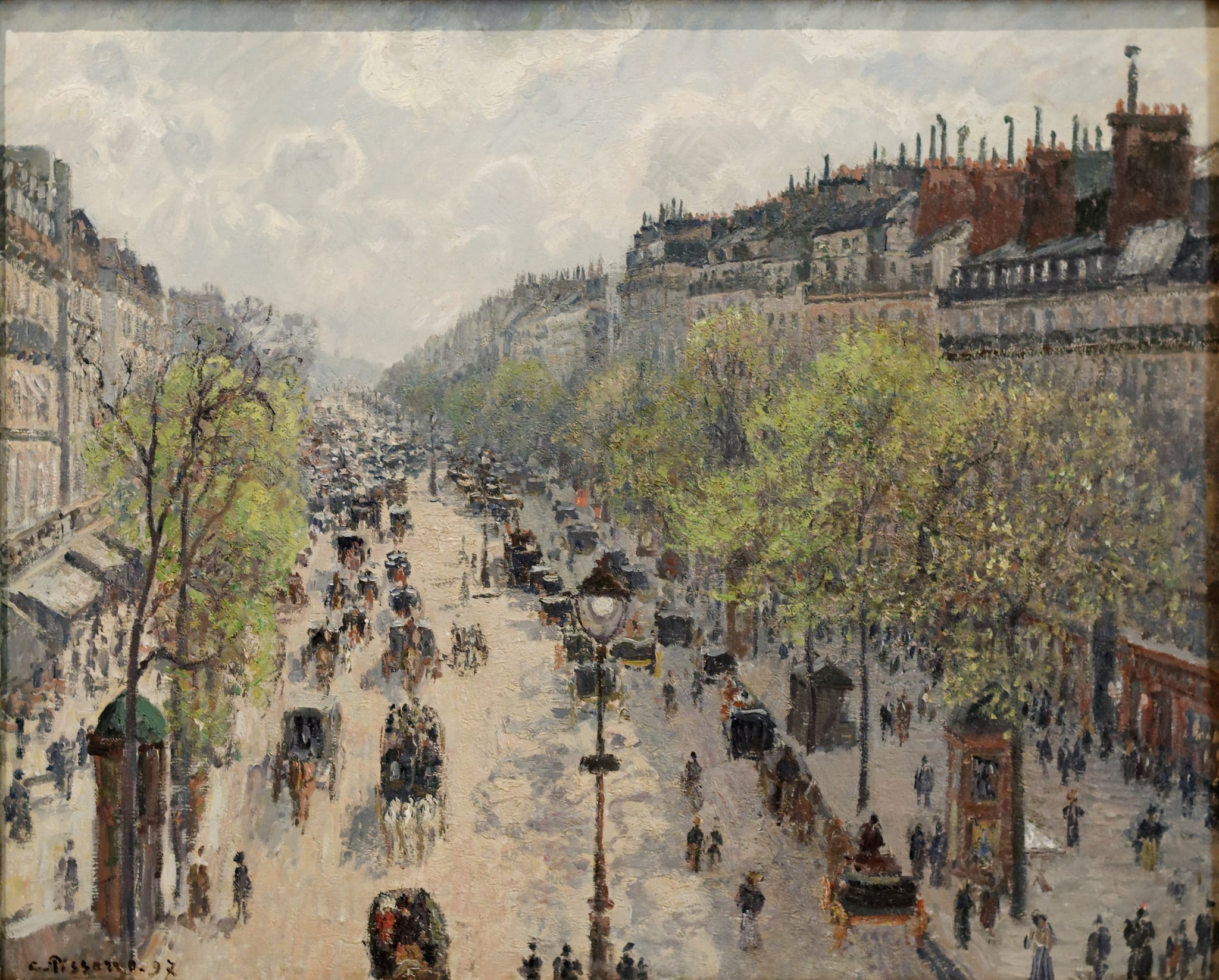
The Boulevard Montmartre on a Spring Morning
Camille Pissarro (1897)
From a high hotel window, Camille Pissarro turns Paris’s grands boulevards into a river of light and motion. In The Boulevard Montmartre on a Spring Morning, pale roadway, <strong>tender greens</strong>, and <strong>flickering brushwork</strong> fuse crowds, carriages, and iron streetlamps into a single urban current <sup>[1]</sup><sup>[2]</sup>. The scene demonstrates Impressionism’s commitment to time, weather, and modern life, distilled through a fixed vantage across a serial project <sup>[1]</sup><sup>[3]</sup>.

The Bridge at Villeneuve-la-Garenne
Alfred Sisley (1872)
Alfred Sisley's The Bridge at Villeneuve-la-Garenne crystallizes the encounter between <strong>modern engineering</strong> and <strong>riverside leisure</strong> under <strong>Impressionist light</strong>. The diagonal suspension bridge, dark pylons, and filigreed truss command the left foreground while small boats skim the Seine, their wakes breaking into shimmering strokes that echo the sky.

The Church at Moret
Alfred Sisley (1894)
Alfred Sisley’s The Church at Moret turns a Flamboyant Gothic façade into a living barometer of light, weather, and time. With <strong>cool blues, lilacs, and warm ochres</strong> laid in broken strokes, the stone seems to breathe as tiny townspeople drift along the street. The work asserts <strong>permanence meeting transience</strong>: a communal monument held steady while the day’s atmosphere endlessly remakes it <sup>[1]</sup><sup>[2]</sup><sup>[3]</sup>.
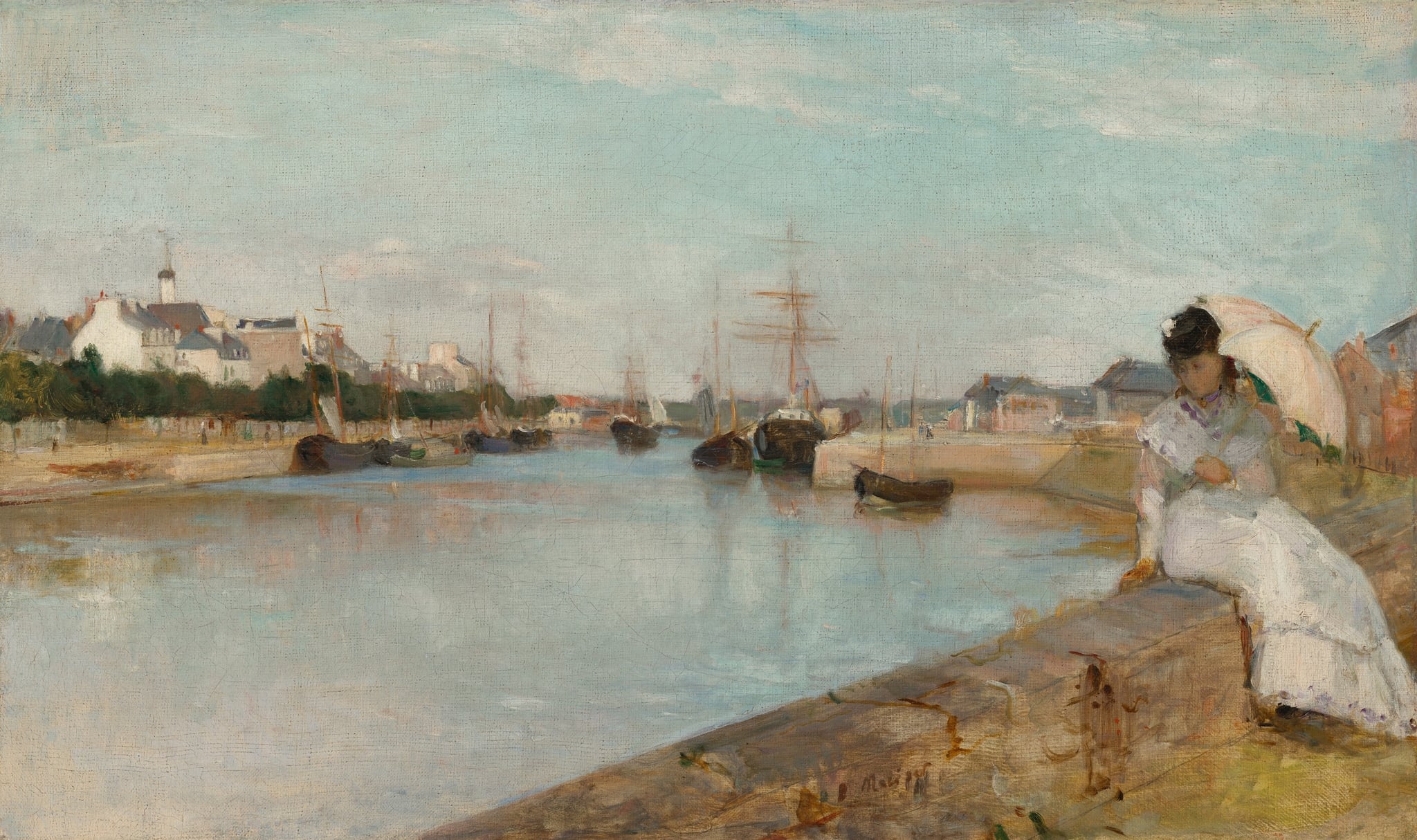
The Harbour at Lorient
Berthe Morisot (1869)
Berthe Morisot’s The Harbour at Lorient stages a quiet tension between <strong>private reverie</strong> and <strong>public movement</strong>. A woman under a pale parasol sits on the quay’s stone lip while a flotilla of masted boats idles across a silvery basin, their reflections dissolving into light. Morisot’s <strong>pearly palette</strong> and brisk brushwork make the water read as time itself, holding stillness and departure in the same breath <sup>[1]</sup>.
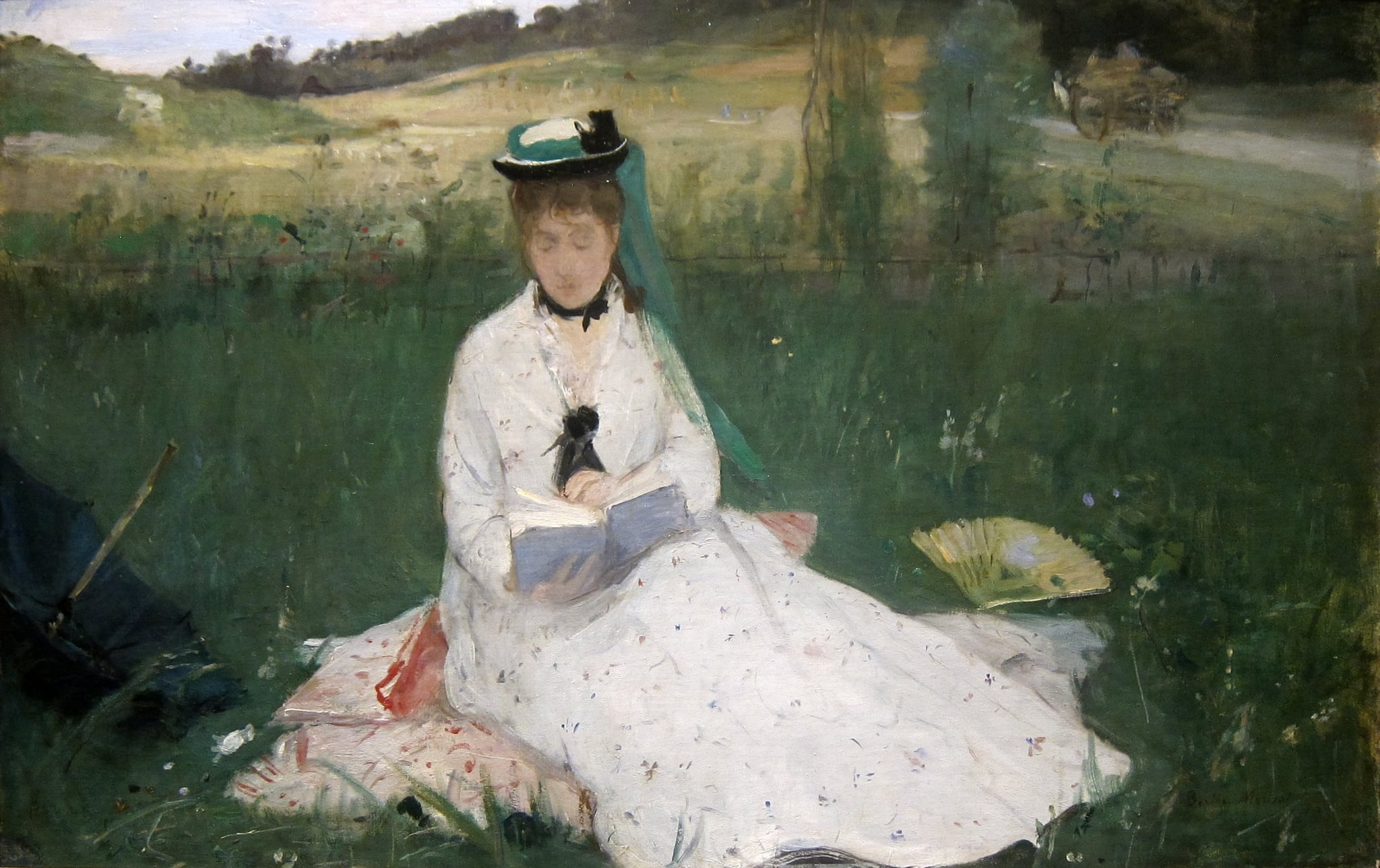
Reading
Berthe Morisot (1873)
In Berthe Morisot’s <strong>Reading</strong> (1873), a woman in a pale, patterned dress sits on the grass, absorbed in a book while a <strong>green parasol</strong> and <strong>folded fan</strong> lie nearby. Morisot’s quick, luminous brushwork dissolves the landscape into <strong>atmospheric greens</strong> as a distant carriage passes, turning an outdoor scene into a study of interior life. The work makes <strong>female intellectual absorption</strong> its true subject, aligning modern leisure with private thought.
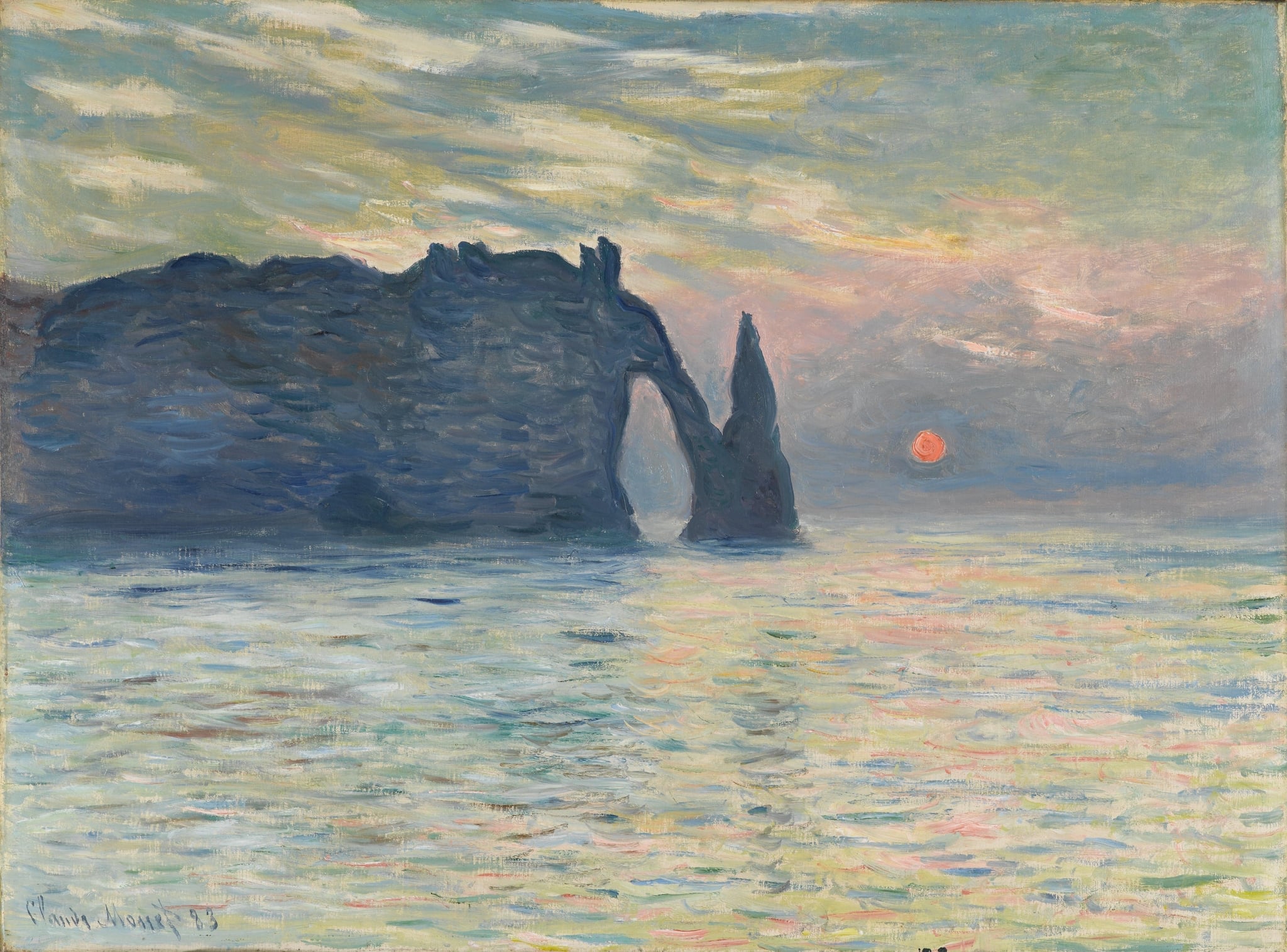
The Cliff, Etretat
Claude Monet (1882–1883)
<strong>The Cliff, Etretat</strong> stages a confrontation between <strong>permanence and flux</strong>: the dark mass of the arch and needle holds like a monument while ripples of coral, green, and blue light skate across the water. The low <strong>solar disk</strong> fixes the instant, and Monet’s fractured strokes make the sea and sky feel like time itself turning toward dusk. The arch reads as a <strong>threshold</strong>—an opening to the unknown that organizes vision and meaning <sup>[1]</sup><sup>[2]</sup>.

The Red Boats, Argenteuil
Claude Monet (1875)
Claude Monet’s The Red Boats, Argenteuil crystallizes a luminous afternoon on the Seine, where two <strong>vermilion hulls</strong> anchor a scene of leisure and light. The tremoring <strong>reflections</strong> and vertical <strong>masts/poplars</strong> weave nature and modern recreation into a single atmospheric field <sup>[1]</sup>.
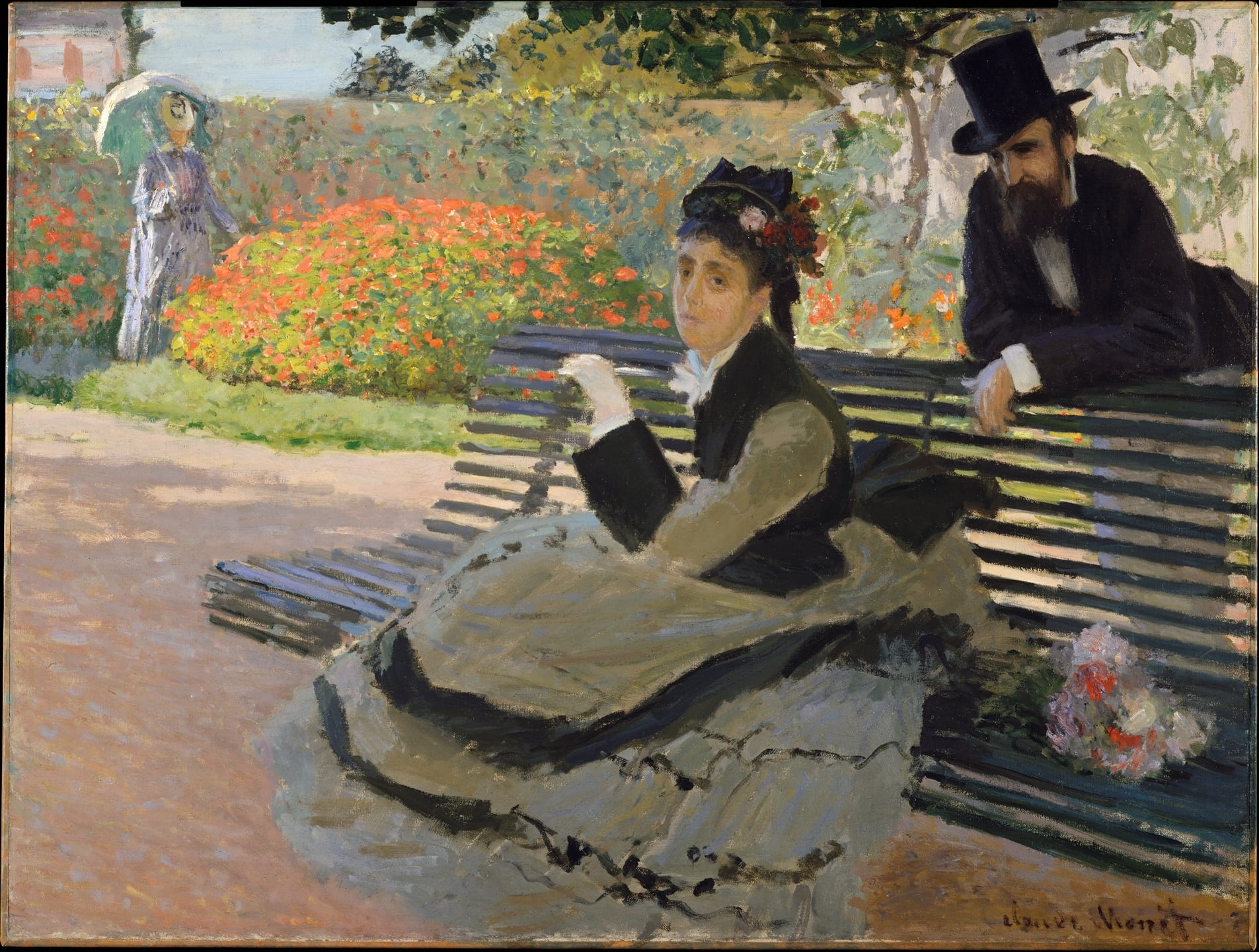
Camille Monet on a Garden Bench
Claude Monet (1873)
Claude Monet’s Camille Monet on a Garden Bench (1873) stages an intimate pause where <strong>light, grief, and modern leisure</strong> intersect. Camille, shaded and withdrawn, holds a letter while a <strong>top‑hatted neighbor</strong> hovers; a bright bank of <strong>red geraniums</strong> and a strolling woman with a parasol ignite the distance <sup>[1]</sup>. Monet converts a domestic garden into a scene about <strong>psychological distance</strong> amid fleeting sunlight.
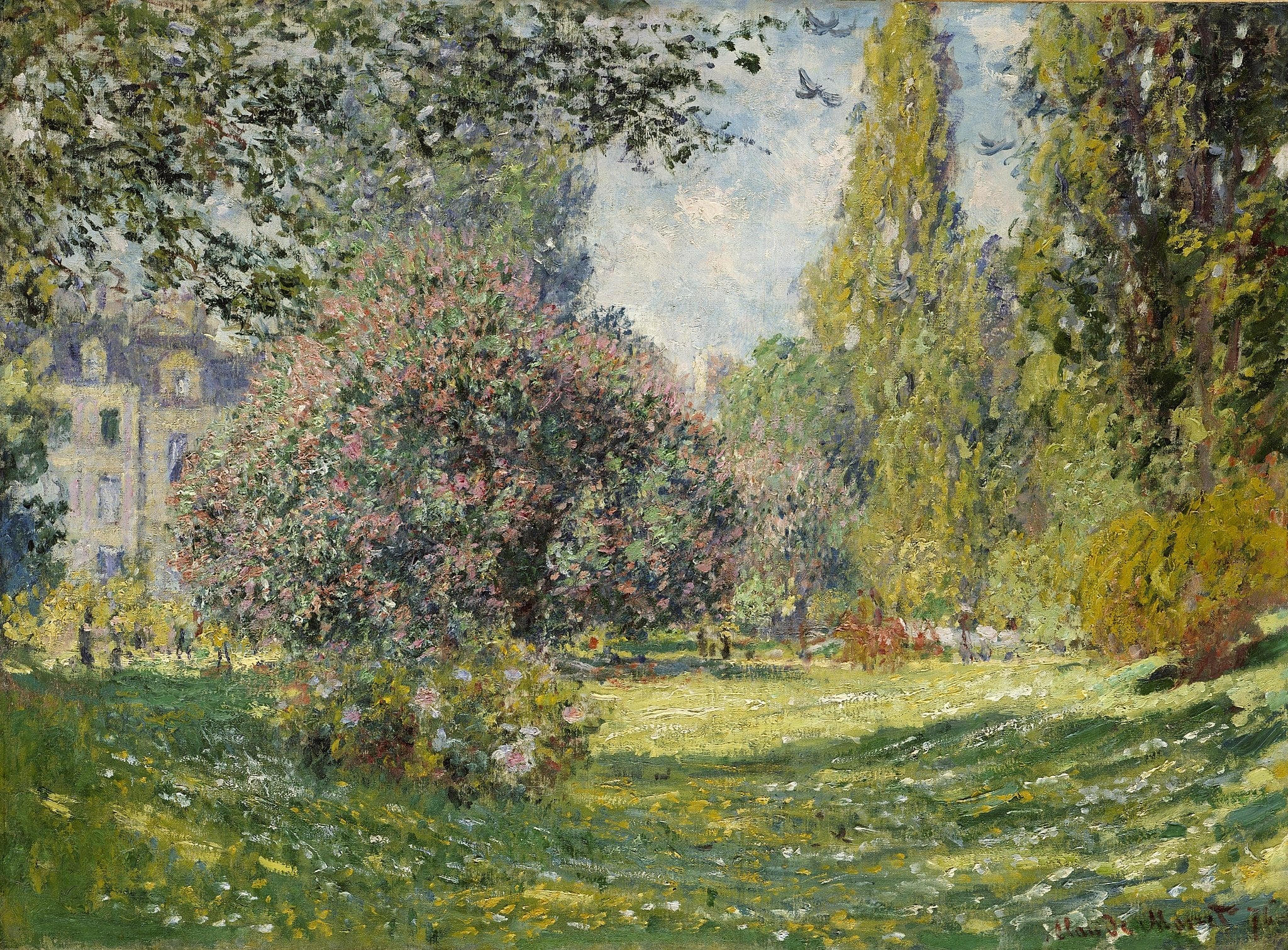
Landscape: The Parc Monceau
Claude Monet (1876)
Claude Monet’s Landscape: The Parc Monceau distills a spring afternoon into a choreography of <strong>flickering light</strong> and <strong>urban leisure</strong>. A diagonal of brightness pulls the eye from the shaded foreground toward a radiant lawn, where a voluminous, flowering shrub anchors the scene and a softened townhouse tethers nature to the city <sup>[1]</sup>. Monet turns perception itself into subject, making <strong>time and weather</strong> the picture’s active protagonists <sup>[5]</sup>.
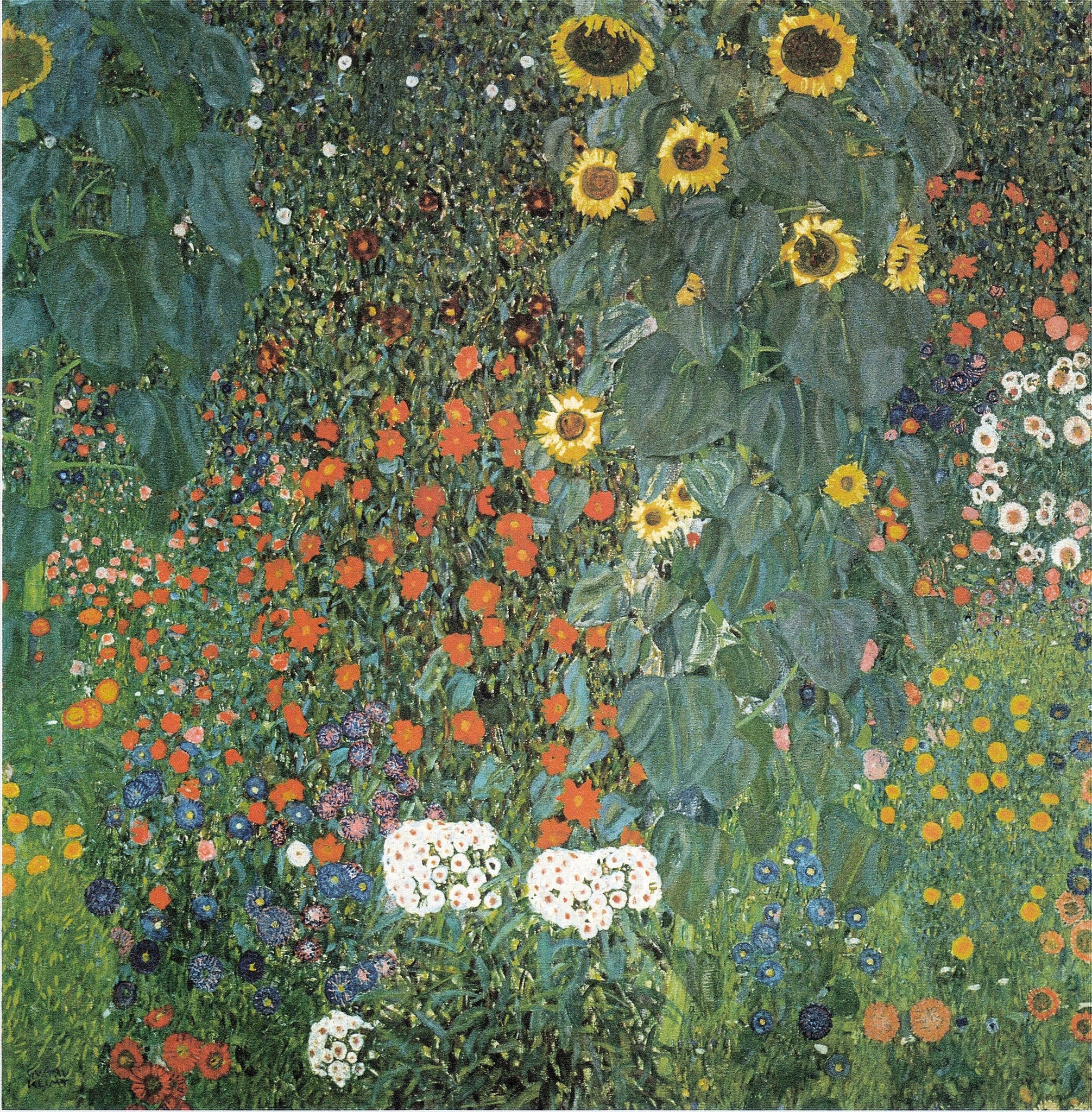
Cottage Garden with Sunflowers
Gustav Klimt (1906–1907 (signed 1907))
Cottage Garden with Sunflowers is a square, horizonless field of blooms where a vertical column of <strong>sunflowers</strong> anchors an all-over weave of color and pattern. Klimt fuses <strong>ornament and nature</strong>, turning a humble Litzlberg cottage plot into a radiant matrix of cyclical life and renewal <sup>[1]</sup><sup>[4]</sup><sup>[5]</sup>.
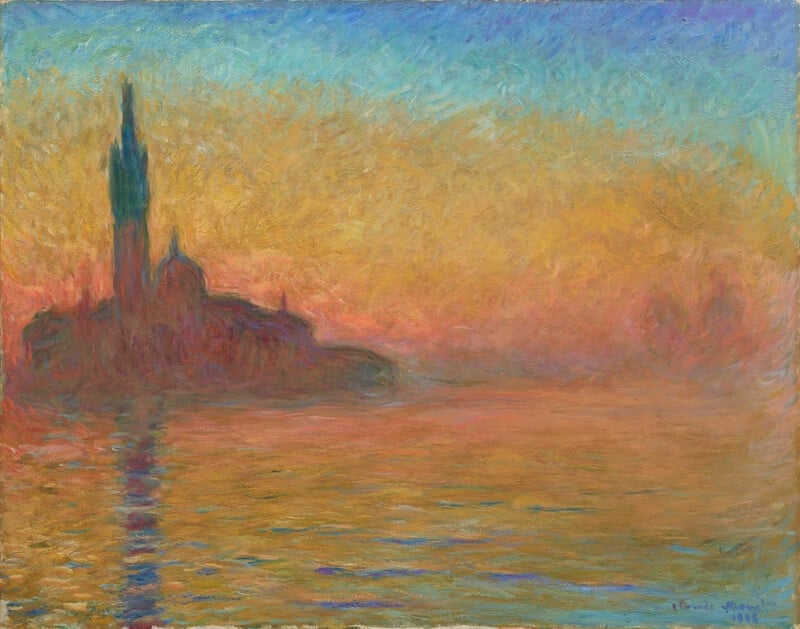
San Giorgio Maggiore by Twilight
Claude Monet (1908)
Claude Monet’s San Giorgio Maggiore by Twilight turns Venice into a <strong>luminous threshold</strong> where stone, air, and water merge. The dark, melting silhouette of the church and its vertical reflection anchor a field of <strong>apricot–rose–violet</strong> light that drifts into cool turquoise, making permanence feel provisional <sup>[1]</sup>. Monet’s subject is not the monument, but the <strong>enveloppe</strong> of atmosphere that momentarily creates it <sup>[4]</sup>.

The Piazza San Marco, Venice
Pierre-Auguste Renoir (1881)
Renoir’s The Piazza San Marco, Venice redefines St. Mark’s Basilica as <strong>atmosphere</strong> rather than architecture, fusing domes, mosaics, and crowd into vibrating color. Blue‑violet shadows sweep the square while pigeons and passersby resolve into <strong>daubs of light</strong>, declaring modern vision as the true subject <sup>[1]</sup><sup>[3]</sup>.
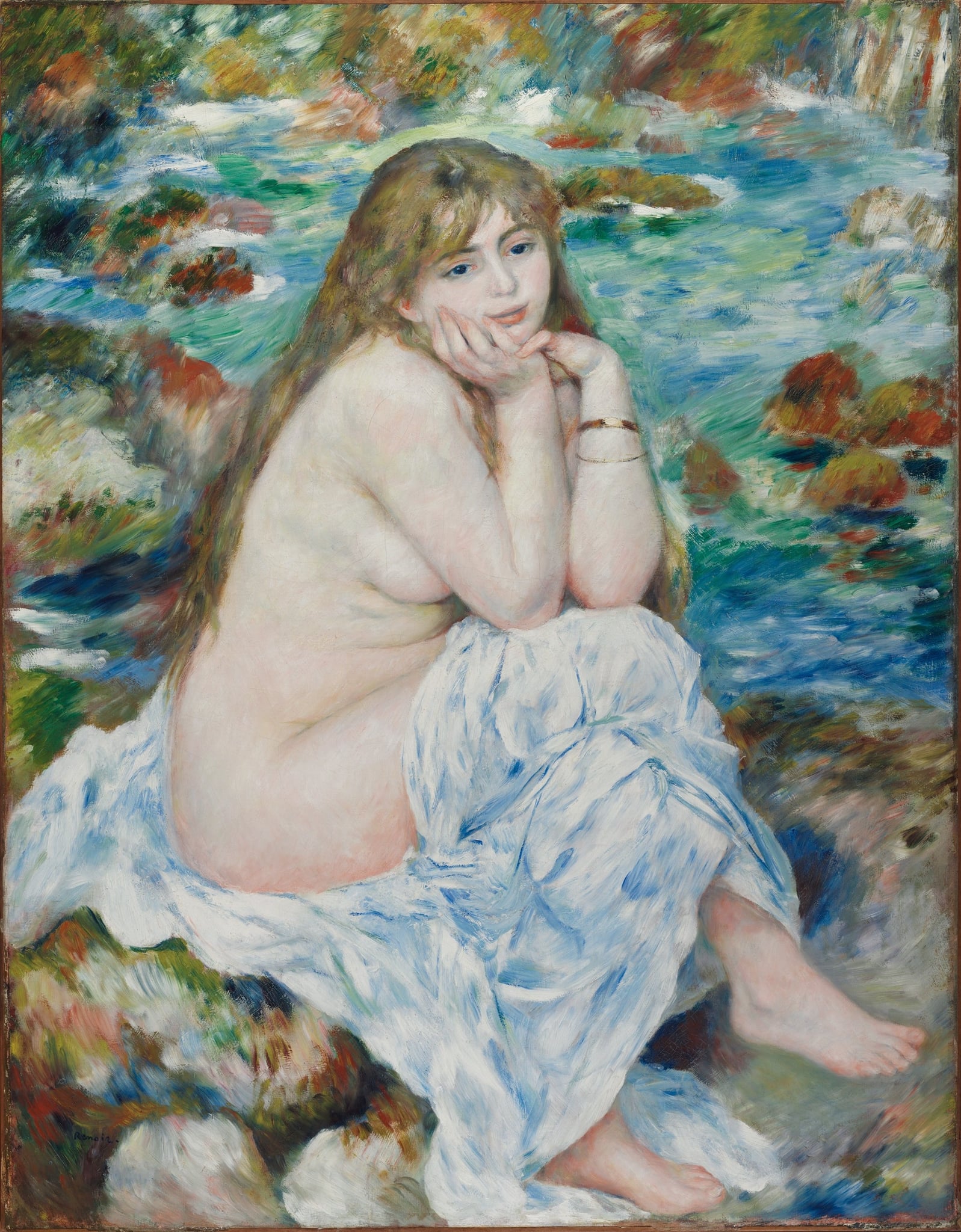
Seated Bather
Pierre-Auguste Renoir
Renoir’s Seated Bather stages a quiet pause between bathing and reverie, fusing the model’s pearly flesh with the flicker of stream and stone. The white drapery pooled around her hips and the soft, frontal gaze convert a simple toilette into a <strong>modern Arcadia</strong> where body and landscape dissolve into light. In this late-Impressionist idiom, Renoir refines the nude as a <strong>timeless ideal</strong> felt through color and touch <sup>[1]</sup><sup>[2]</sup>.
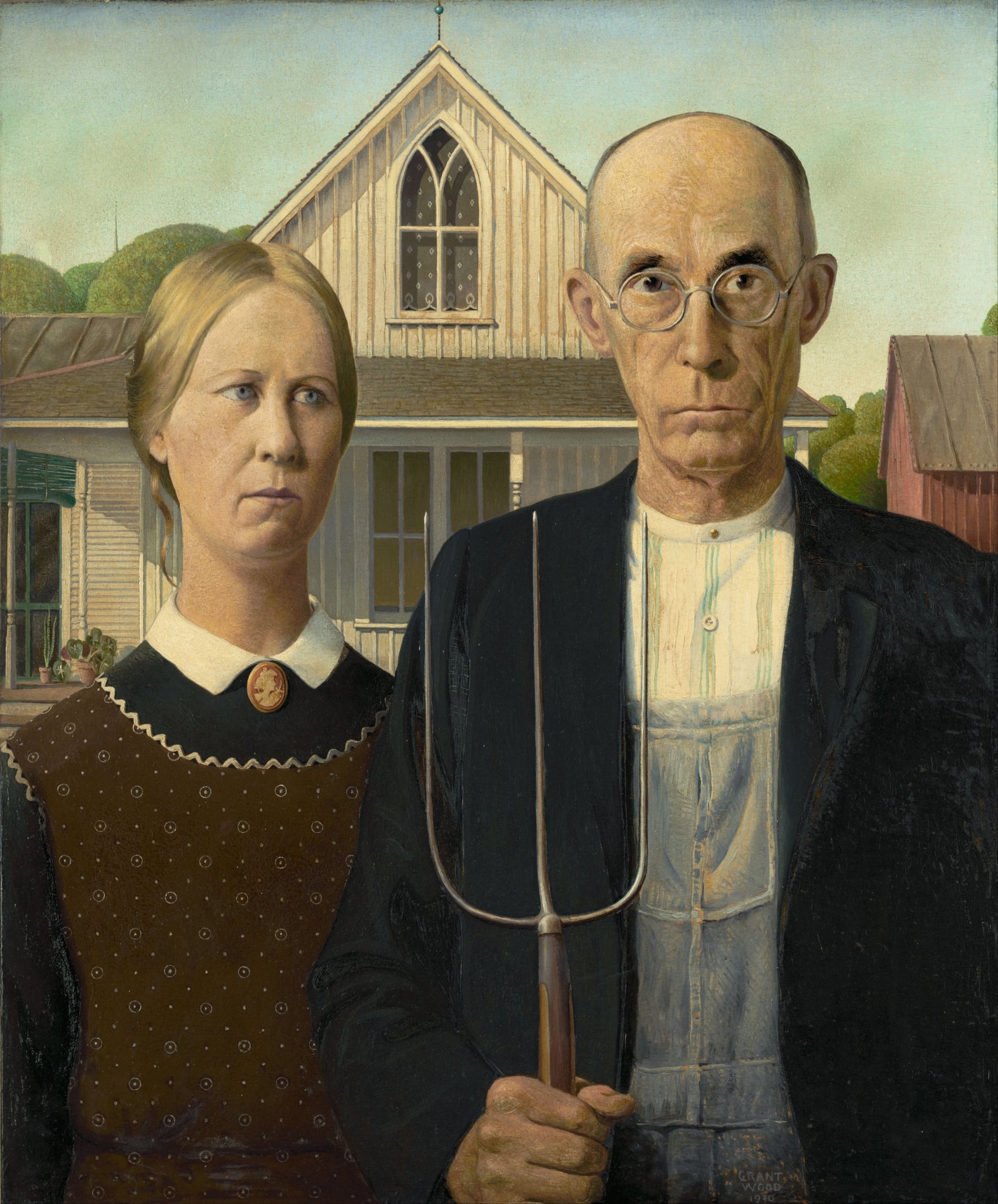
American Gothic
Grant Wood (1930)
Grant Wood’s American Gothic (1930) turns a plain Midwestern homestead into a <strong>moral emblem</strong> by binding two flinty figures to the strict geometry of a Carpenter Gothic gable and a three‑tined pitchfork. The painting’s cool precision and echoing verticals create a <strong>compressed ethic of work, order, and restraint</strong> that can read as both tribute and critique <sup>[1]</sup><sup>[2]</sup><sup>[3]</sup>.
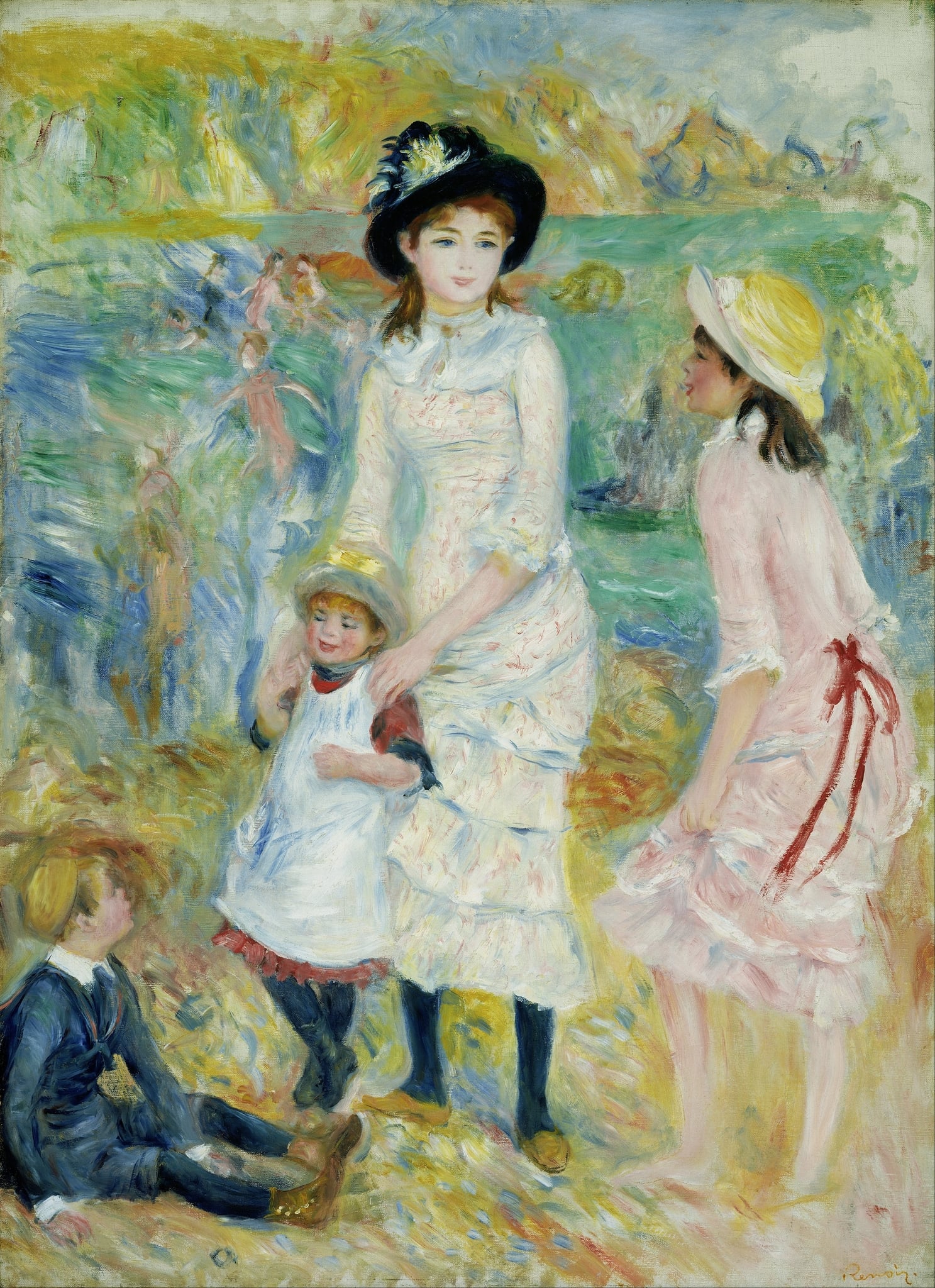
Children on the Seashore, Guernsey
Pierre-Auguste Renoir (about 1883)
Renoir’s Children on the Seashore, Guernsey crystallizes a wind‑bright moment of modern leisure with <strong>flickering brushwork</strong> and a gently choreographed group of children. The central girl in a white dress and black feathered hat steadies a toddler while a pink‑clad companion leans in and a sailor‑suited boy rests on the pebbles—an intimate triangle set against a <strong>shimmering, populated sea</strong>. The canvas makes light and movement the protagonists, dissolving edges into <strong>pearly surf and sun‑washed cliffs</strong>.
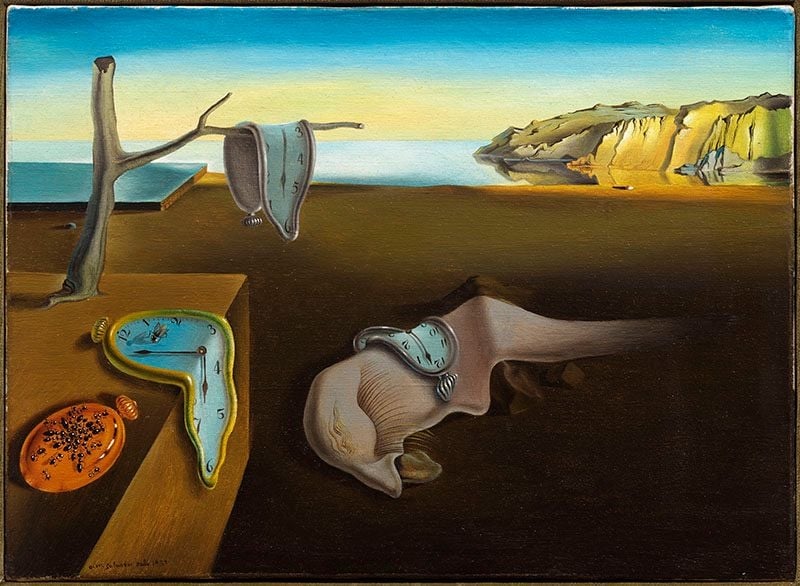
The Persistence of Memory
Salvador Dali (1931)
Salvador Dali’s The Persistence of Memory turns clock time into <strong>soft, malleable matter</strong>, staging a dream in which chronology buckles and the self dissolves. Four pocket watches droop across a barren platform, a dead branch, and a lash‑eyed biomorph, while ants overrun a hard, closed watch—a sign of <strong>decay</strong> and the futility of mechanical order <sup>[1]</sup><sup>[2]</sup>.
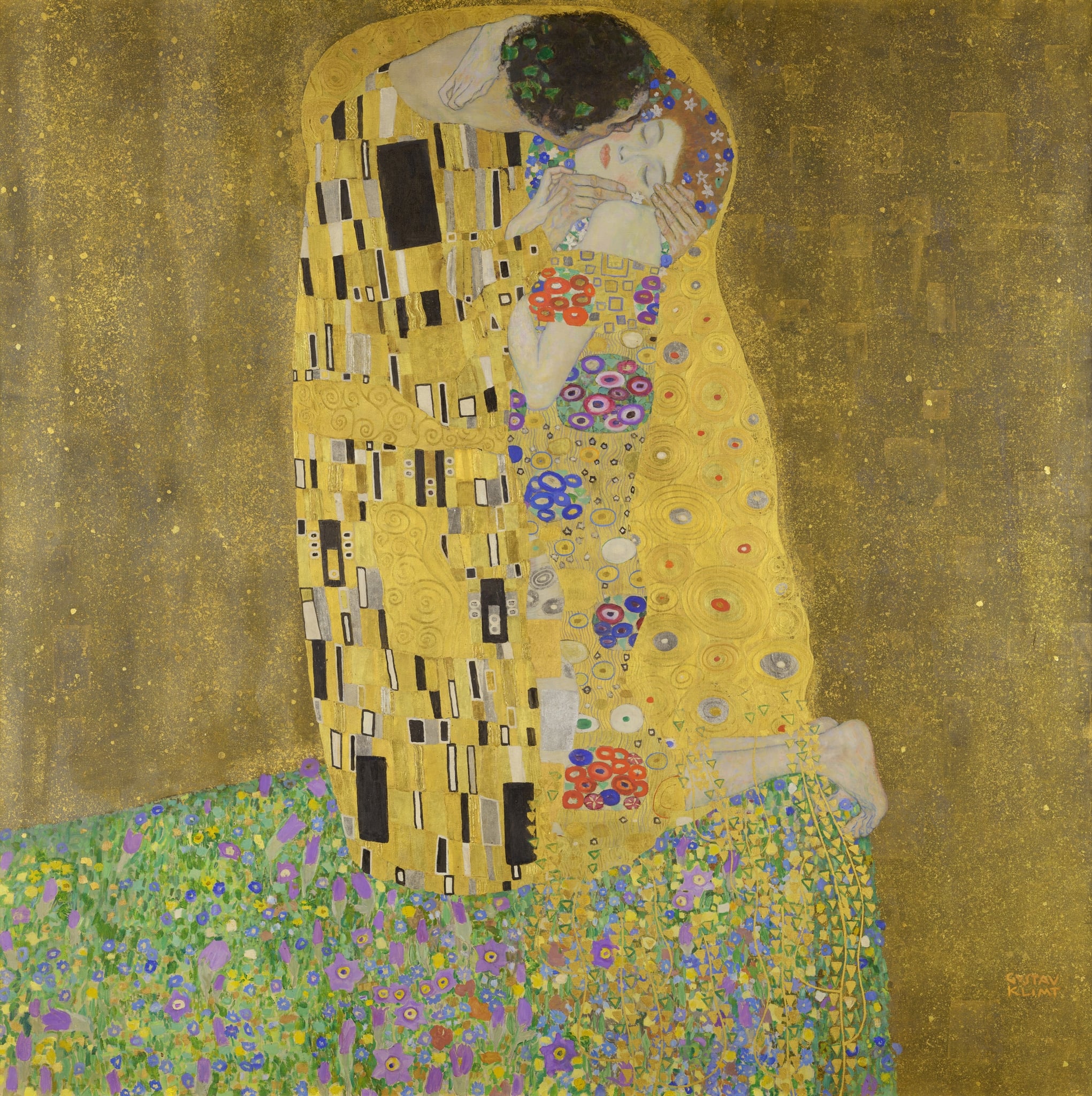
The Kiss
Gustav Klimt (1908 (completed 1909))
The Kiss stages human love as a <strong>sacred union</strong>, fusing two figures into a single, gold-clad form against a timeless field. Klimt opposes <strong>masculine geometry</strong> (black-and-white rectangles) to <strong>feminine organic rhythm</strong> (spirals, circles, flowers), then resolves them in radiant harmony <sup>[1]</sup><sup>[2]</sup>.
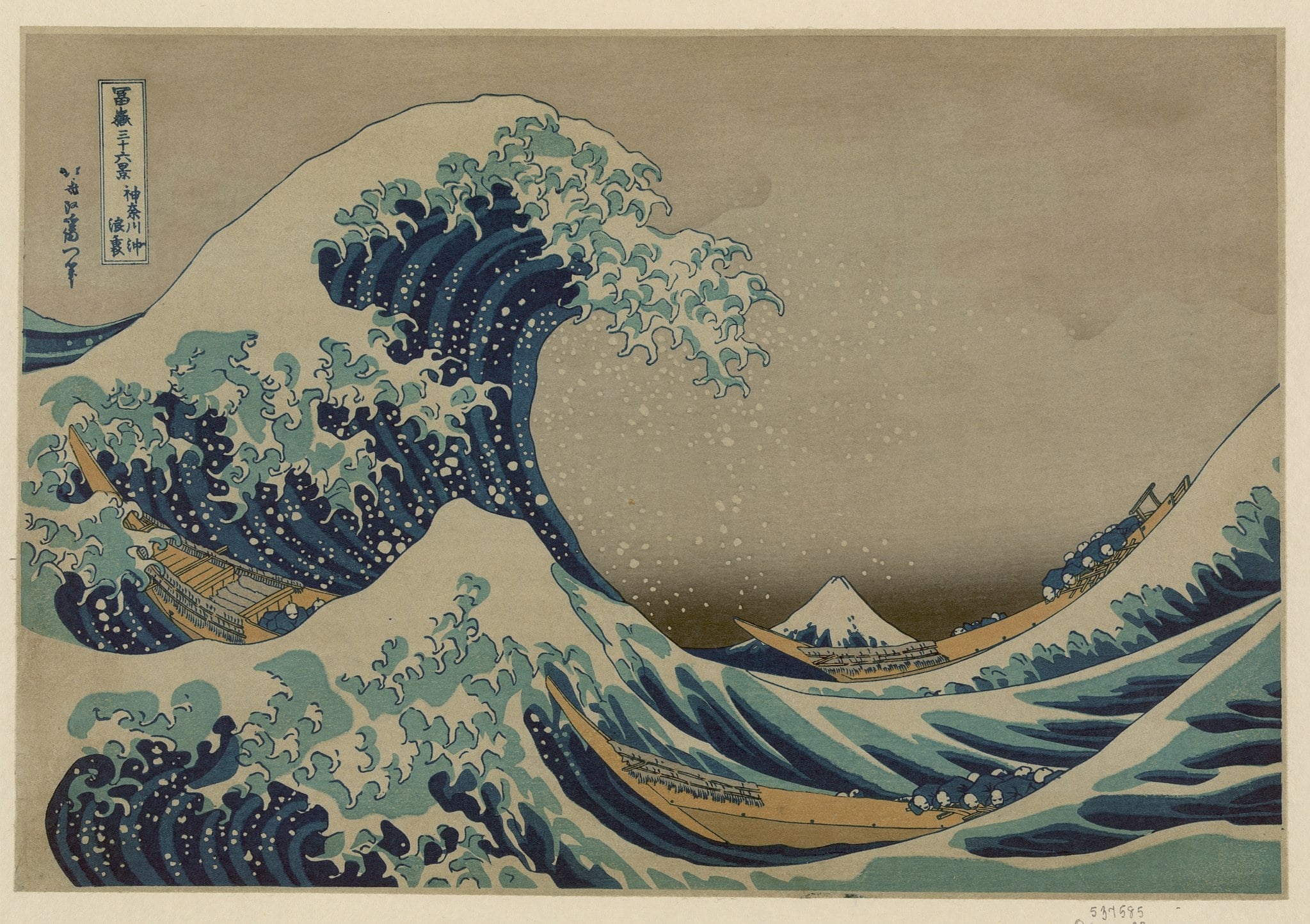
The Great Wave off Kanagawa
Hokusai (ca. 1830–32)
The Great Wave off Kanagawa distills a universal drama: fragile laboring boats face a <strong>towering breaker</strong> while <strong>Mount Fuji</strong> sits small yet immovable. Hokusai wields <strong>Prussian blue</strong> to sculpt depth and cold inevitability, fusing ukiyo‑e elegance with Western perspective to stage nature’s power against human resolve <sup>[1]</sup><sup>[3]</sup>.

The Son of Man
Rene Magritte (1964)
Rene Magritte’s The Son of Man stages a crisp <strong>everyman</strong> in bowler hat and overcoat before a sea horizon while a <strong>green apple</strong> hovers to block his face. The tiny glimpse of one eye above the fruit turns a straightforward portrait into a <strong>riddle about seeing and knowing</strong> <sup>[1]</sup><sup>[2]</sup>.
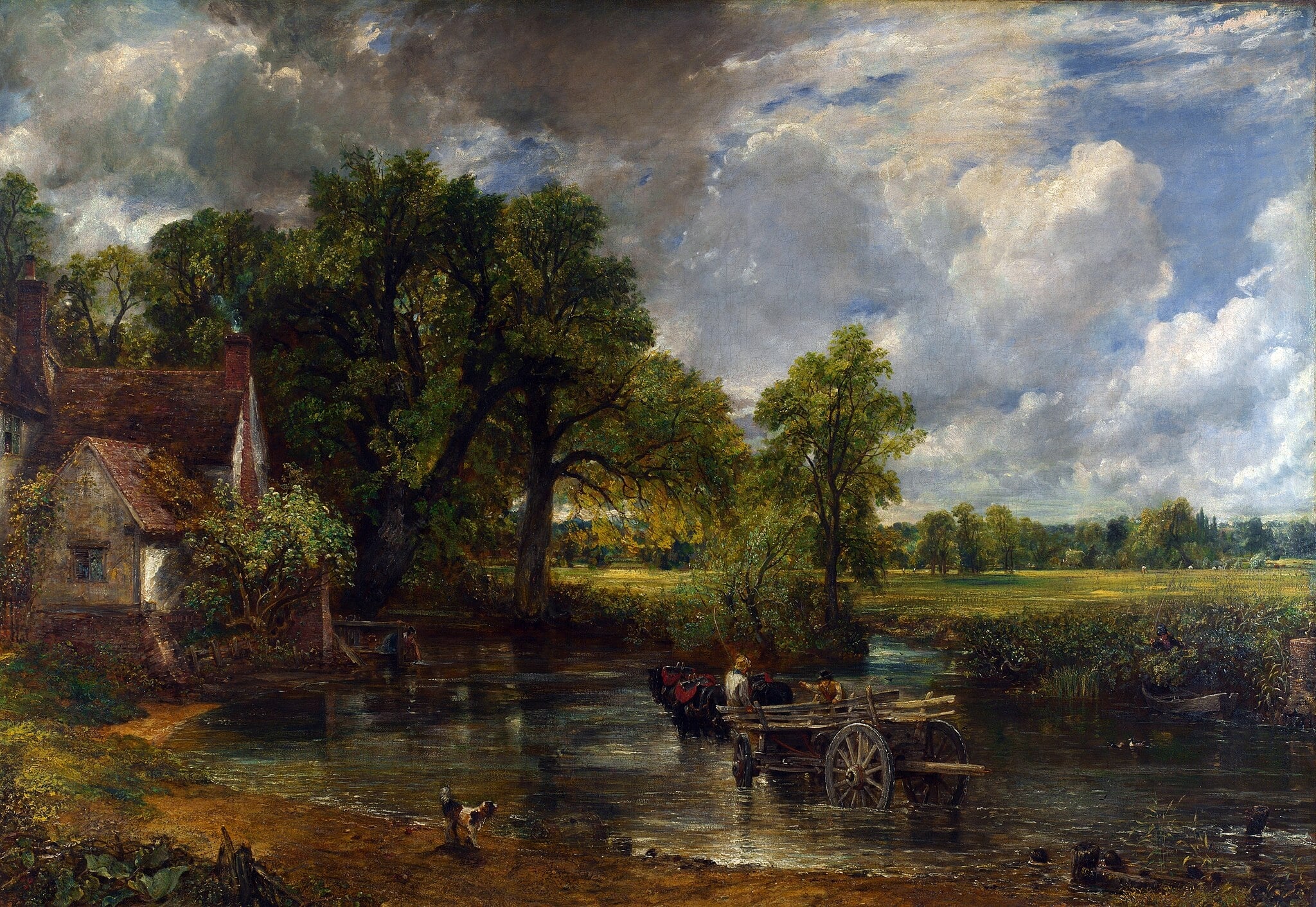
The Hay Wain
John Constable (1821)
Set beside Willy Lott’s cottage on the River Stour, The Hay Wain stages a moment of <strong>unhurried rural labor</strong>: an empty timber cart, drawn by three horses with red-collared tack, pauses mid‑ford as weather shifts above. Constable fuses <strong>empirical observation</strong>—rippling reflections, chimney smoke, flickers of white on leaves—with a composed vista of fields opening to sun. The result is a serene yet alert meditation on <strong>work, weather, and continuity</strong> in the English countryside <sup>[1]</sup><sup>[3]</sup>.
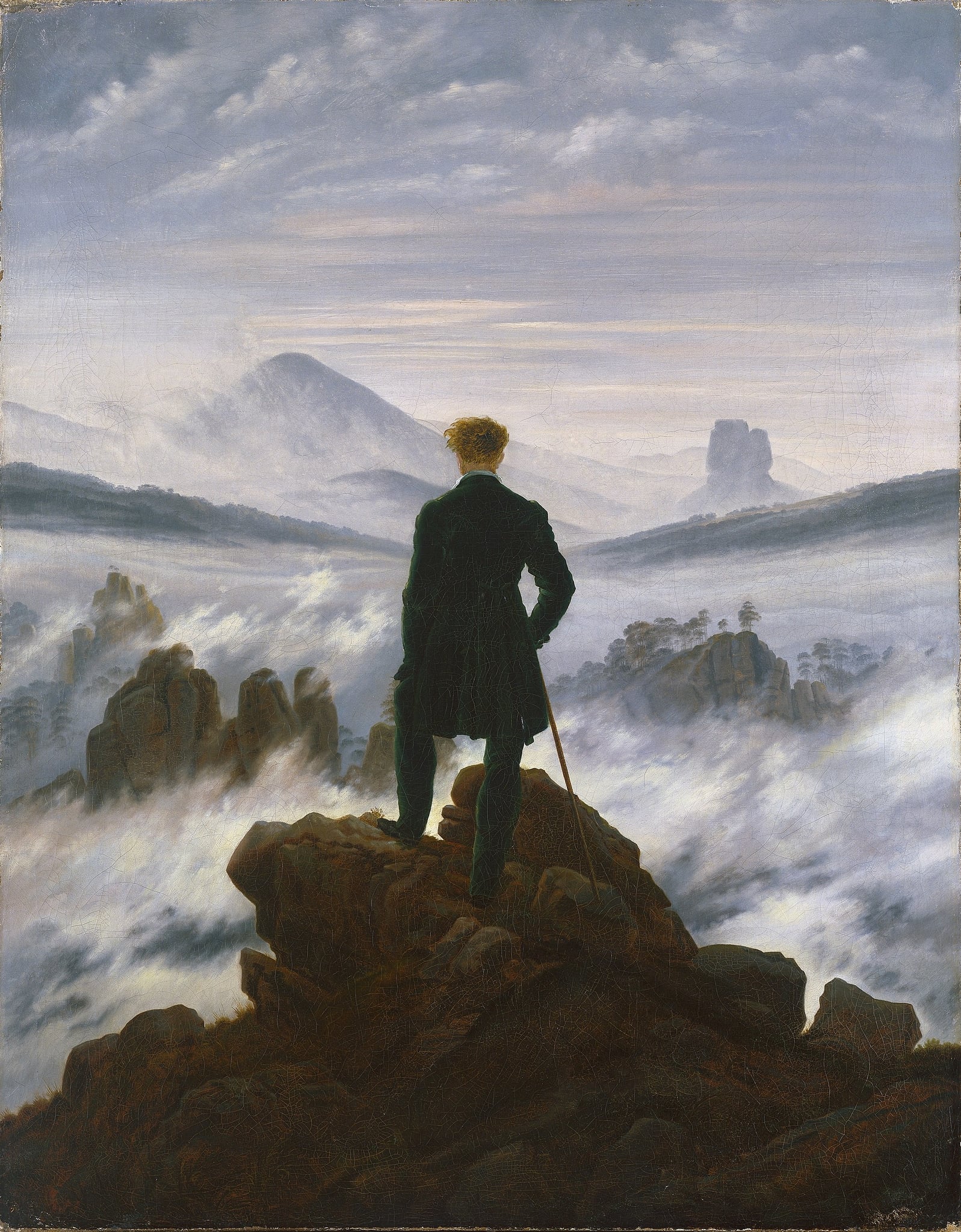
The Wanderer above the Sea of Fog
Caspar David Friedrich (ca. 1817)
Caspar David Friedrich’s The Wanderer above the Sea of Fog distills the Romantic encounter with nature into a single <strong>Rückenfigur</strong> poised on jagged rock above a rolling <strong>sea of mist</strong>. The cool, receding vista and the figure’s still stance convert landscape into an <strong>inner drama of contemplation</strong> and the <strong>sublime</strong> <sup>[1]</sup><sup>[3]</sup>.
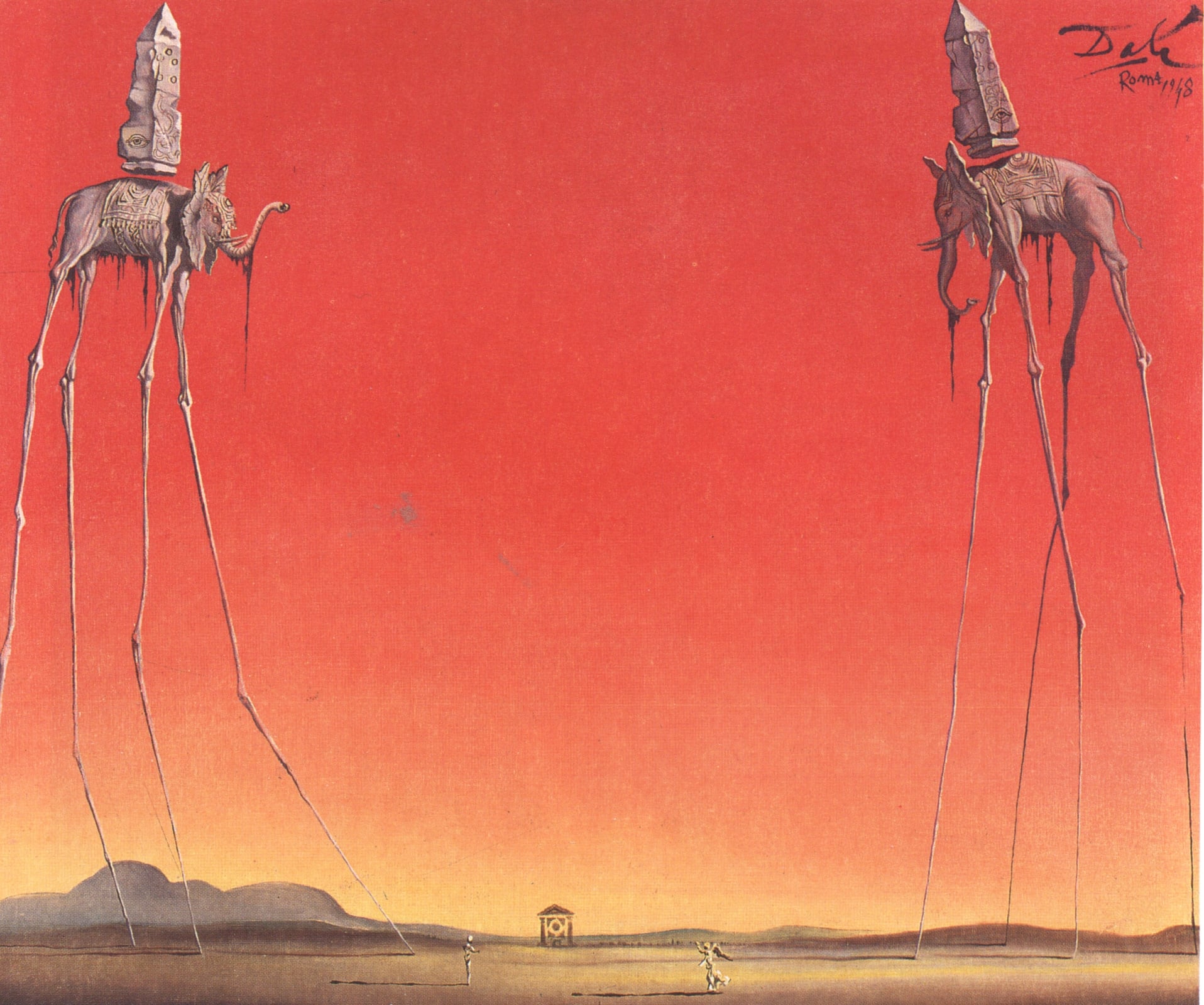
The Elephants
Salvador Dali (1948)
In The Elephants, Salvador Dali distills a stark paradox of <strong>weight and weightlessness</strong>: gaunt elephants tiptoe on <strong>stilt-thin legs</strong> while bearing stone <strong>obelisks</strong>. The blazing red-orange sky and tiny human figures compress ambition into a vision of <strong>precarious power</strong> and time stretched thin <sup>[1]</sup><sup>[2]</sup>.
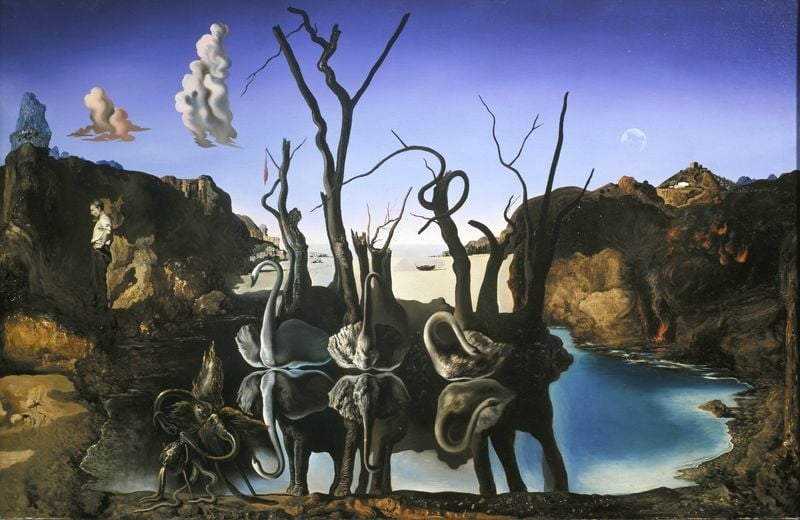
Swans Reflecting Elephants
Salvador Dali (1937)
Swans Reflecting Elephants stages a calm Catalan lagoon where three swans and a thicket of bare trees flip into monumental <strong>elephants</strong> in the mirror of water. Salvador Dali crystallizes his <strong>paranoiac-critical</strong> method: a meticulously painted illusion that makes perception generate its own doubles <sup>[1]</sup><sup>[2]</sup>. The work locks grace to gravity, surface to depth, turning the lake into a theater of <strong>metamorphosis</strong>.
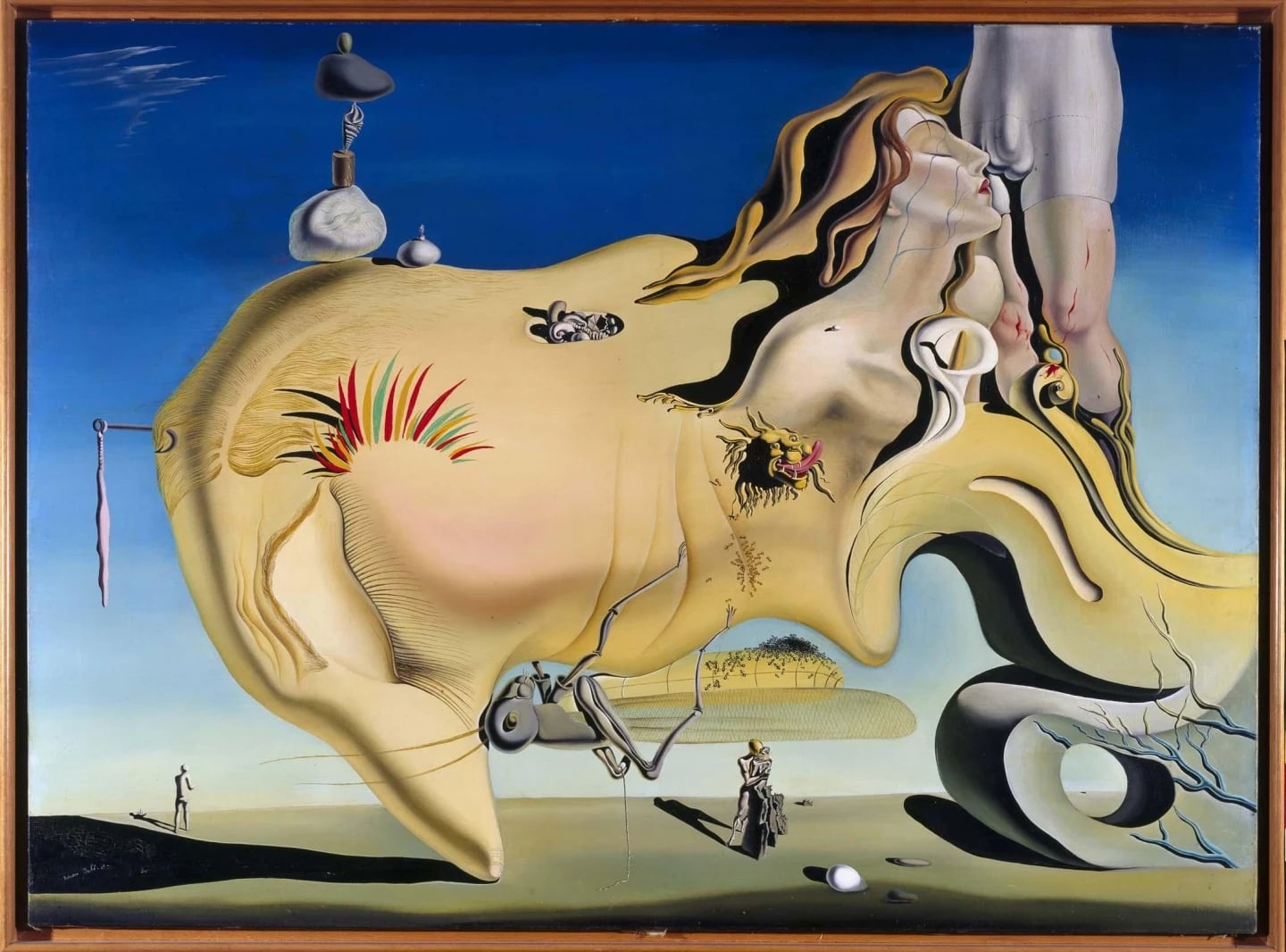
The Great Masturbator
Salvador Dali (1929)
The Great Masturbator condenses Dalí’s newly ignited desire and crippling dread into a single, biomorphic head set against a crystalline Catalan sky. Ants, a gaping grasshopper, a lion’s tongue, a bleeding knee, crutches, stones, and an egg collide to script a confession where <strong>eros</strong> and <strong>decay</strong> are inseparable <sup>[1]</sup><sup>[3]</sup><sup>[4]</sup>. Its precision staging turns autobiography into a <strong>surreal map of compulsion</strong> at the moment Gala enters his life <sup>[1]</sup>.

Water Lilies (triptych)
Claude Monet (1914–1926)
Water Lilies (triptych) dissolves banks and horizon into an <strong>immersive field</strong> of reflected sky and water. Across three mural‑scale panels, <strong>layered blues and greens</strong> are punctuated by floating pads while <strong>peach‑lavender light</strong> gathers at the right, turning the pond into a living mirror <sup>[1]</sup><sup>[3]</sup>.
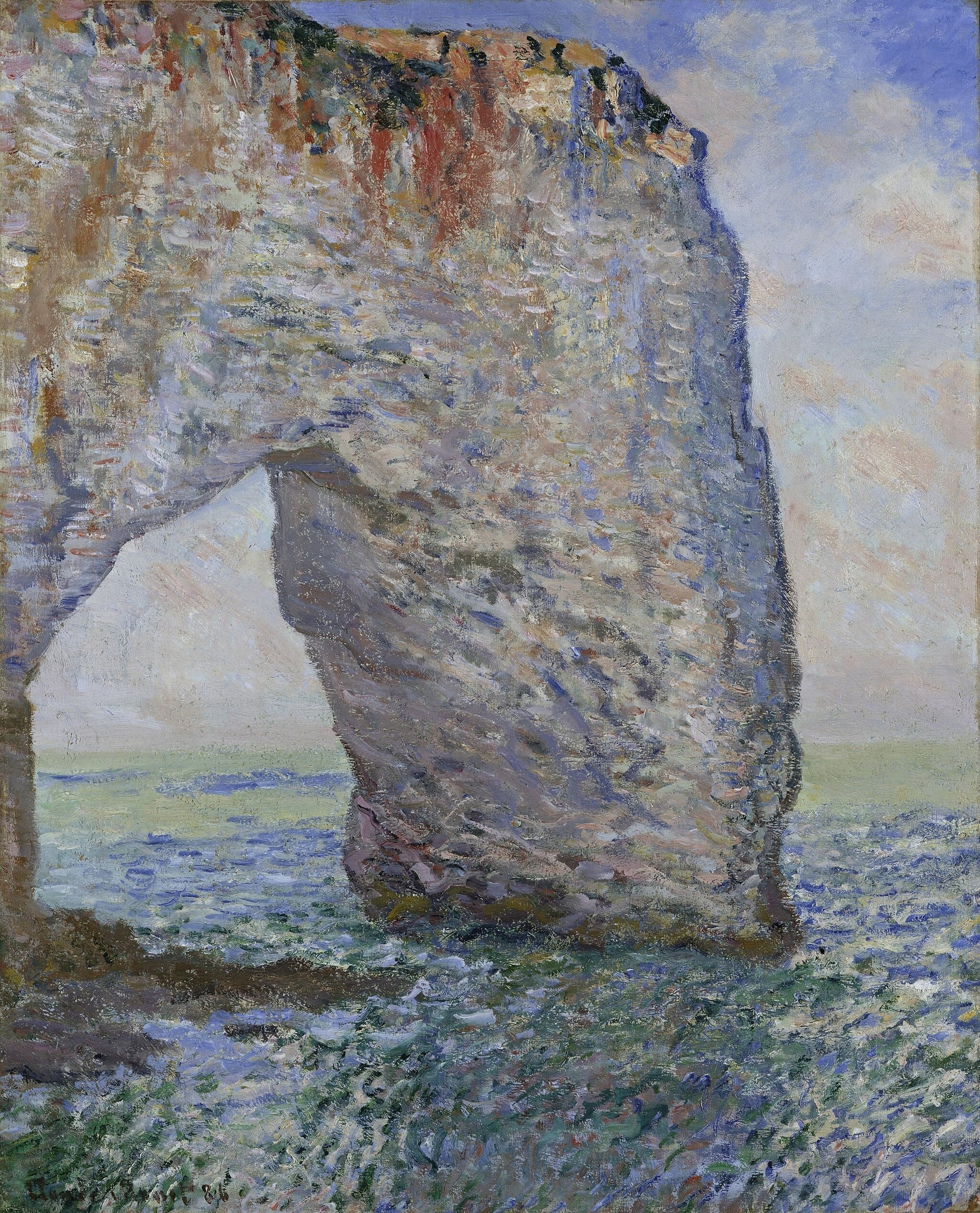
The Manneporte near Étretat
Claude Monet (1886)
Monet’s The Manneporte near Étretat turns the colossal sea arch into a <strong>threshold of light</strong>: rock, sea, and air interlock as shifting color rather than fixed form. Dense lilac–ochre strokes make the cliff feel massive yet <strong>dematerialized</strong> by illumination, while the arch’s opening stages a quiet, glimmering horizon <sup>[1]</sup><sup>[2]</sup>.
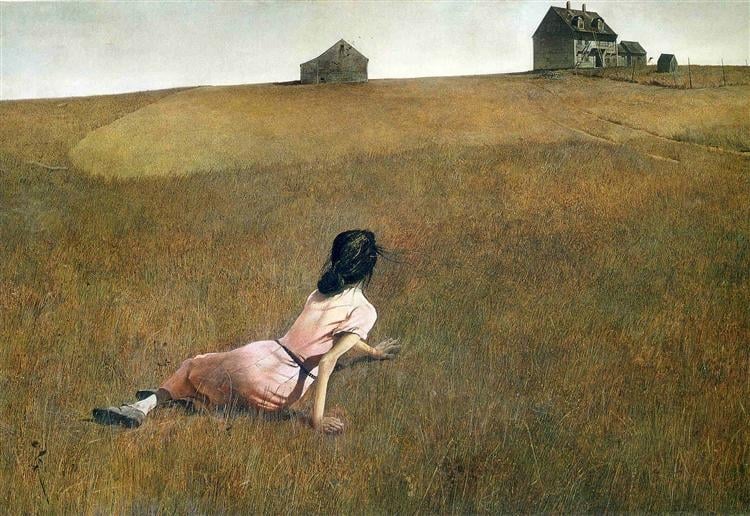
Christina's World
Andrew Wyeth (1948)
Andrew Wyeth’s Christina’s World distills vast rural space and human resolve into a single, charged image: a woman in a <strong>faded pink dress</strong> braces on the <strong>up-slope</strong> toward a weathered farmhouse. The diagonal pull between her body and the <strong>Olson House</strong> turns distance itself into <strong>yearning and endurance</strong> <sup>[1]</sup><sup>[4]</sup>. Wyeth’s spare, <strong>egg tempera</strong> surface makes every brittle grass blade feel like an act of will <sup>[1]</sup><sup>[3]</sup>.
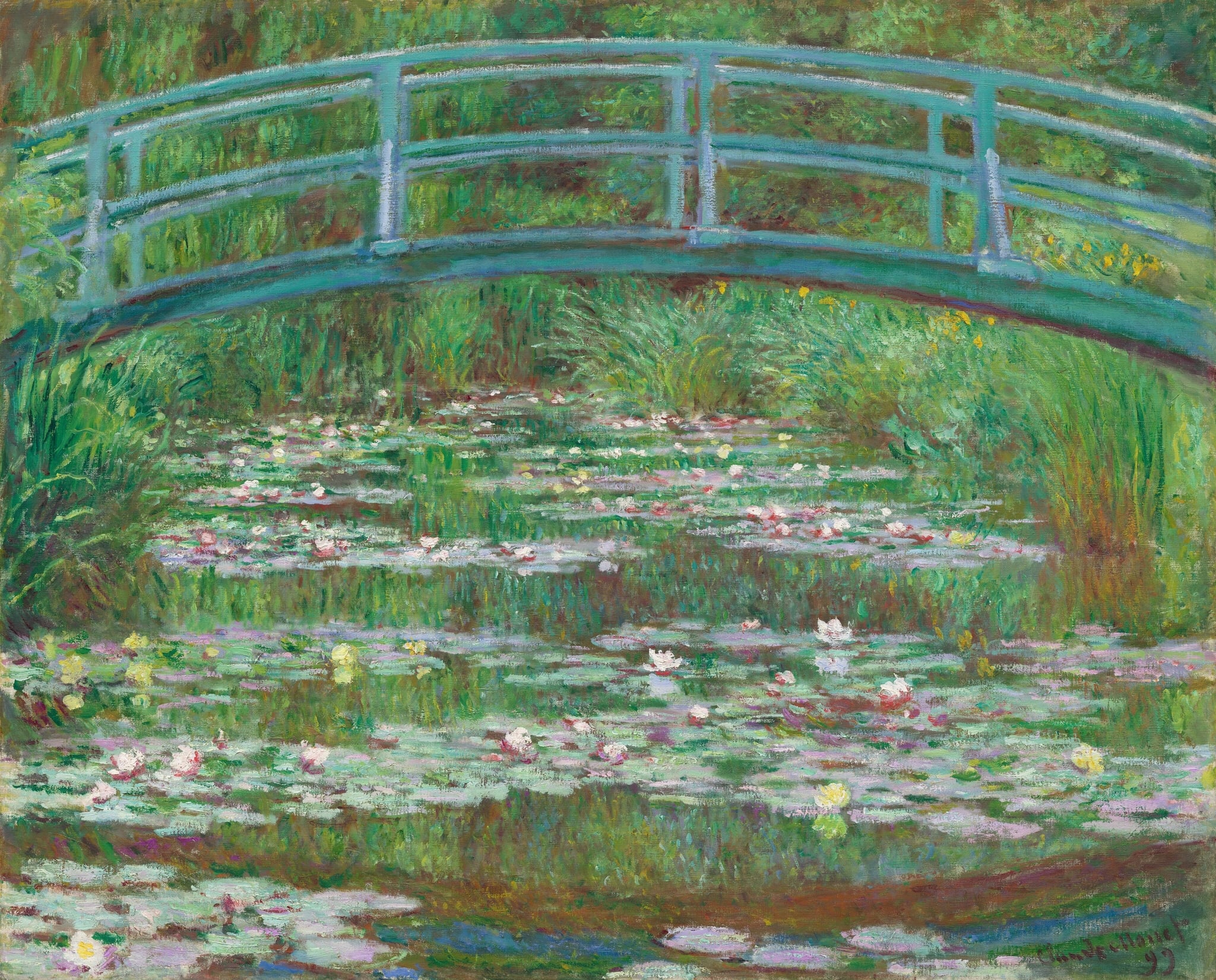
The Japanese Bridge
Claude Monet (1899)
Claude Monet’s The Japanese Bridge centers a pale <strong>blue‑green arch</strong> above a horizonless pond, where water‑lily pads and blossoms punctuate a field of shifting reflections. The bridge reads as both structure and <strong>contemplative threshold</strong>, suspending the eye between surface shimmer and mirrored depths <sup>[1]</sup><sup>[2]</sup>.
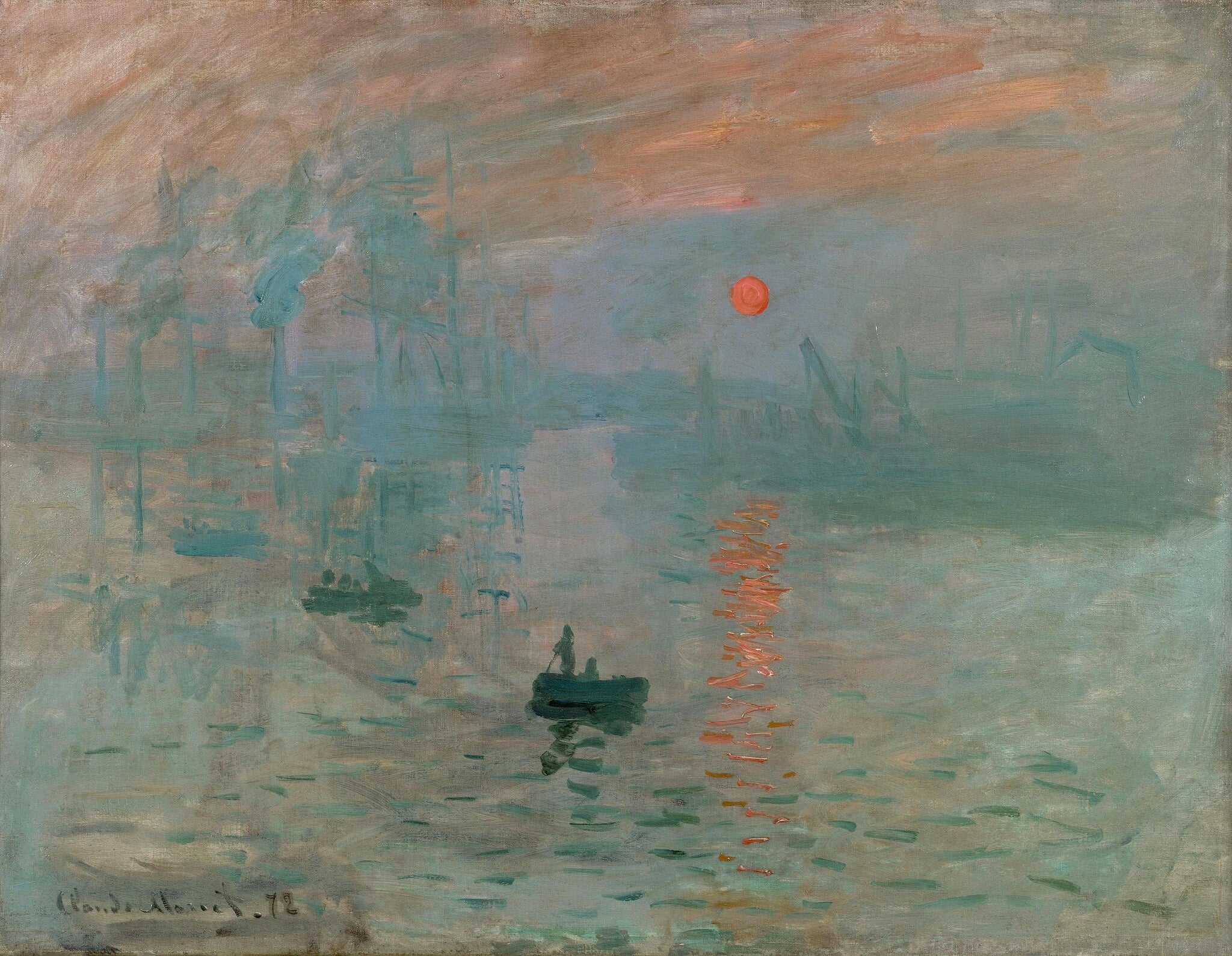
Impression, Sunrise
Claude Monet (1872)
In Impression, Sunrise, Claude Monet turns Le Havre’s fog-bound harbor into an experiment in <strong>immediacy</strong> and <strong>modernity</strong>. Cool blue-greens dissolve cranes, masts, and smoke, while a small skiff cuts the water beneath a blazing, <strong>equiluminant</strong> orange sun whose vertical reflection stitches the scene together <sup>[1]</sup><sup>[3]</sup>. The effect is a poised dawn where industry meets nature, a quiet <strong>awakening</strong> rendered through light rather than line.
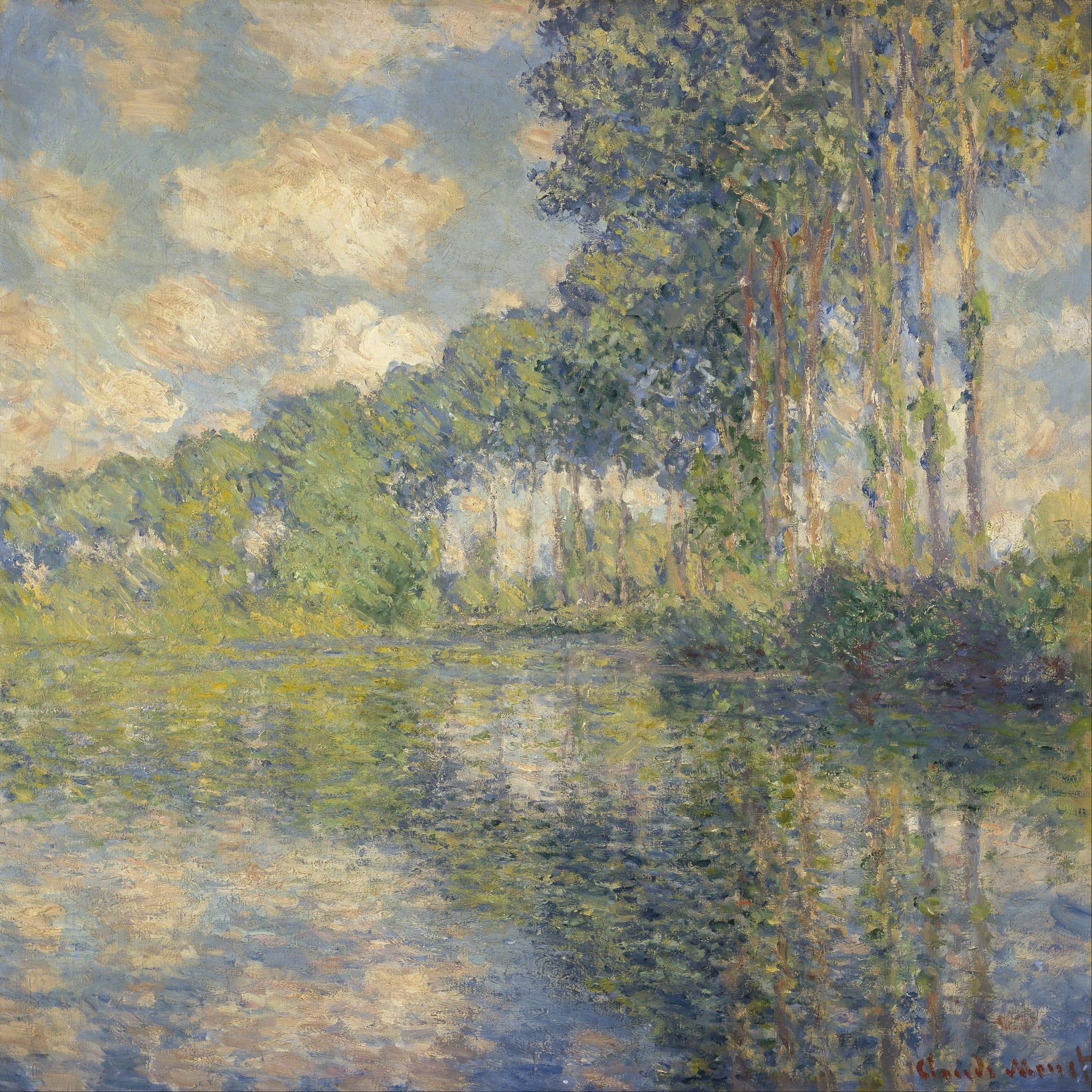
Poplars on the Epte
Claude Monet (1891)
Claude Monet’s Poplars on the Epte turns a modest river bend into a meditation on <strong>time, light, and perception</strong>. Upright trunks register as steady <strong>vertical chords</strong>, while their broken, shimmering reflections loosen form into <strong>pure sensation</strong>. The image stages a tension between <strong>order and flux</strong> that anchors the series within Impressionism’s core aims <sup>[1]</sup><sup>[2]</sup>.
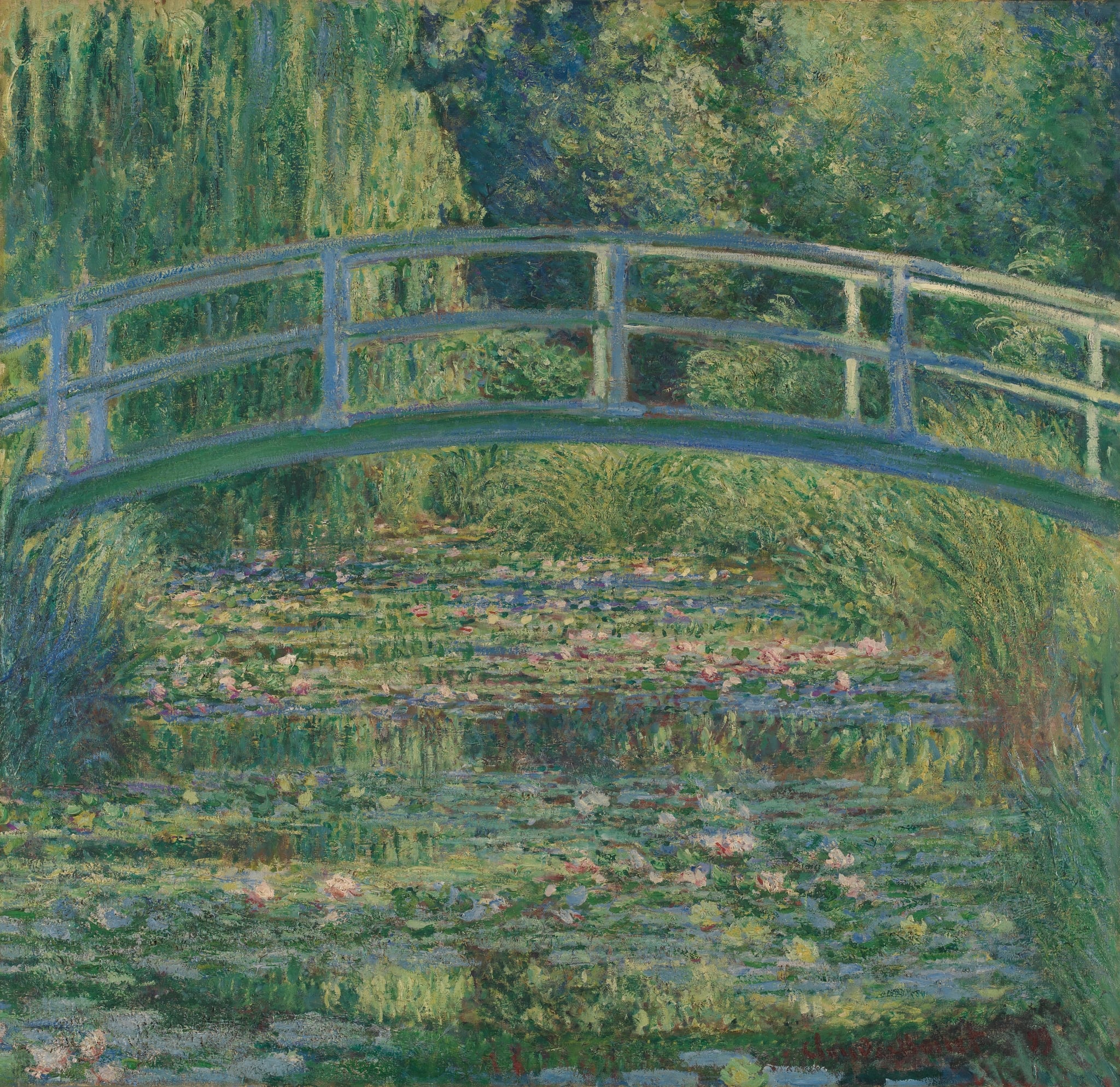
The Water Lily Pond
Claude Monet (1899)
Claude Monet’s The Water Lily Pond transforms a designed garden into a theater of <strong>perception and reflection</strong>. The pale, arched <strong>Japanese bridge</strong> hovers over a surface where lilies, reeds, and mirrored willow fronds dissolve boundaries between water and sky, proposing <strong>seeing itself</strong> as the subject <sup>[1]</sup><sup>[3]</sup>.
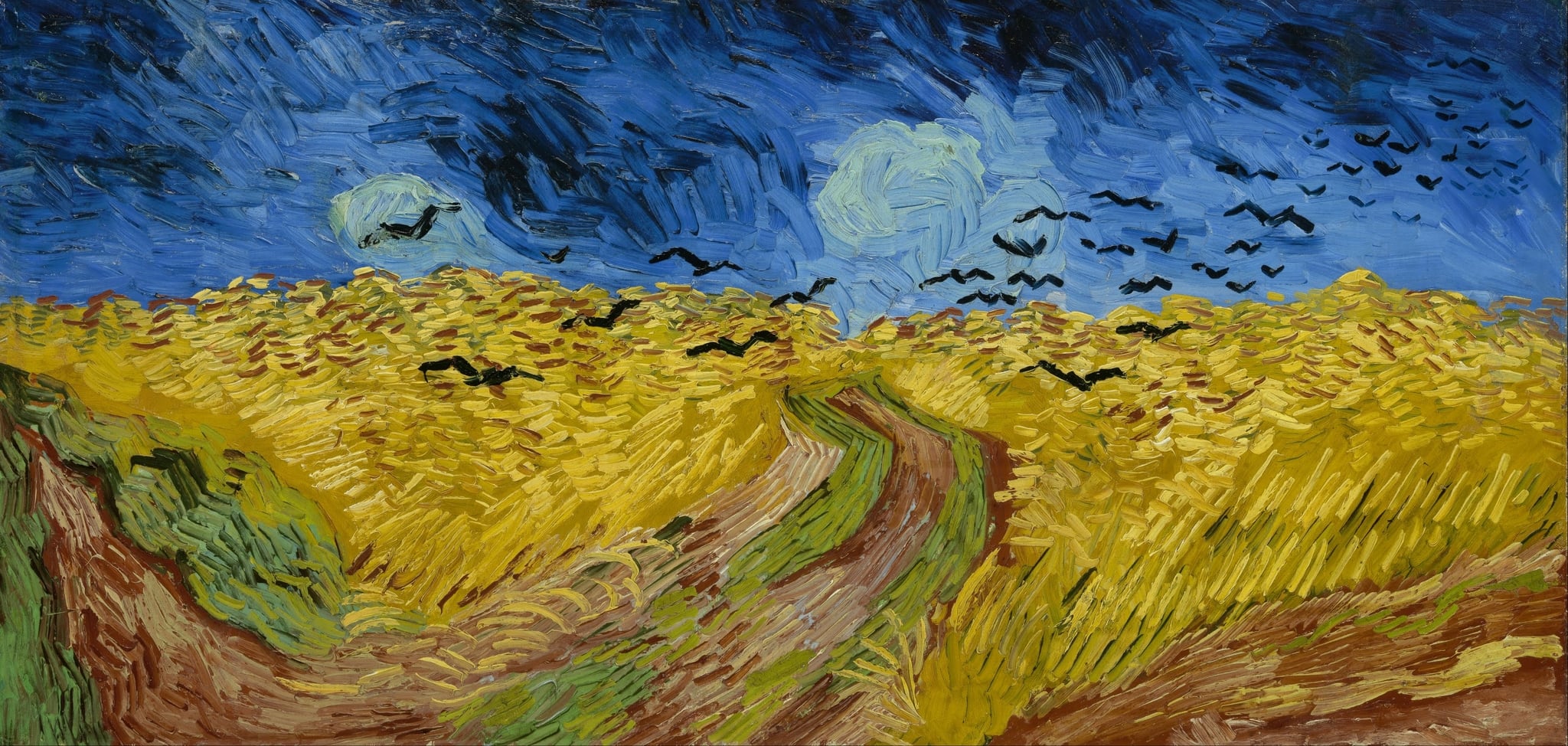
Wheatfield with Crows
Vincent van Gogh (1890)
A panoramic wheatfield splits around a rutted track under a storm-charged sky while black crows rush toward us. Van Gogh drives complementary blues and yellows into collision, fusing <strong>nature’s vitality</strong> with <strong>inner turbulence</strong>.

Towing a Boat, Honfleur
Claude Monet (1864)
Claude Monet’s Towing a Boat, Honfleur frames coastal labor against a dusk of <strong>fugitive light</strong> and <strong>reflective sands</strong>, where three figures strain on taut ropes as a lighthouse holds steady on the horizon. The canvas turns a routine task into a meditation on <strong>endurance, guidance, and time’s passage</strong>.

Garden at Sainte-Adresse
Claude Monet (1867)
<strong>Garden at Sainte-Adresse</strong> distills a breezy seaside terrace into a lucid design of color bands and flagpoles, where private leisure meets a busy, modern harbor. Claude Monet binds <strong>bourgeois ease</strong> (wicker chairs, parasol, promenade) to <strong>national and nautical identity</strong> (the French tricolor and a regatta/signal pennant) while sail and steam share the channel. Light and wind animate every element, turning a family terrace into a statement about modern life and its swift transitions <sup>[1]</sup><sup>[3]</sup><sup>[5]</sup>.

Chrysanthemums
Claude Monet (1878)
Claude Monet’s Chrysanthemums fixes a burst of late‑season bloom in a <strong>scarlet, plush‑textured vase</strong> against a cool <strong>blue‑gray wall</strong> where faint floral <strong>sprigs</strong> echo the bouquet. The painting privileges <strong>vibration of color</strong> over contour, turning still life into a decorative field. It condenses autumnal abundance and the fleetingness of light into a single, shimmering sensation <sup>[1]</sup><sup>[2]</sup>.
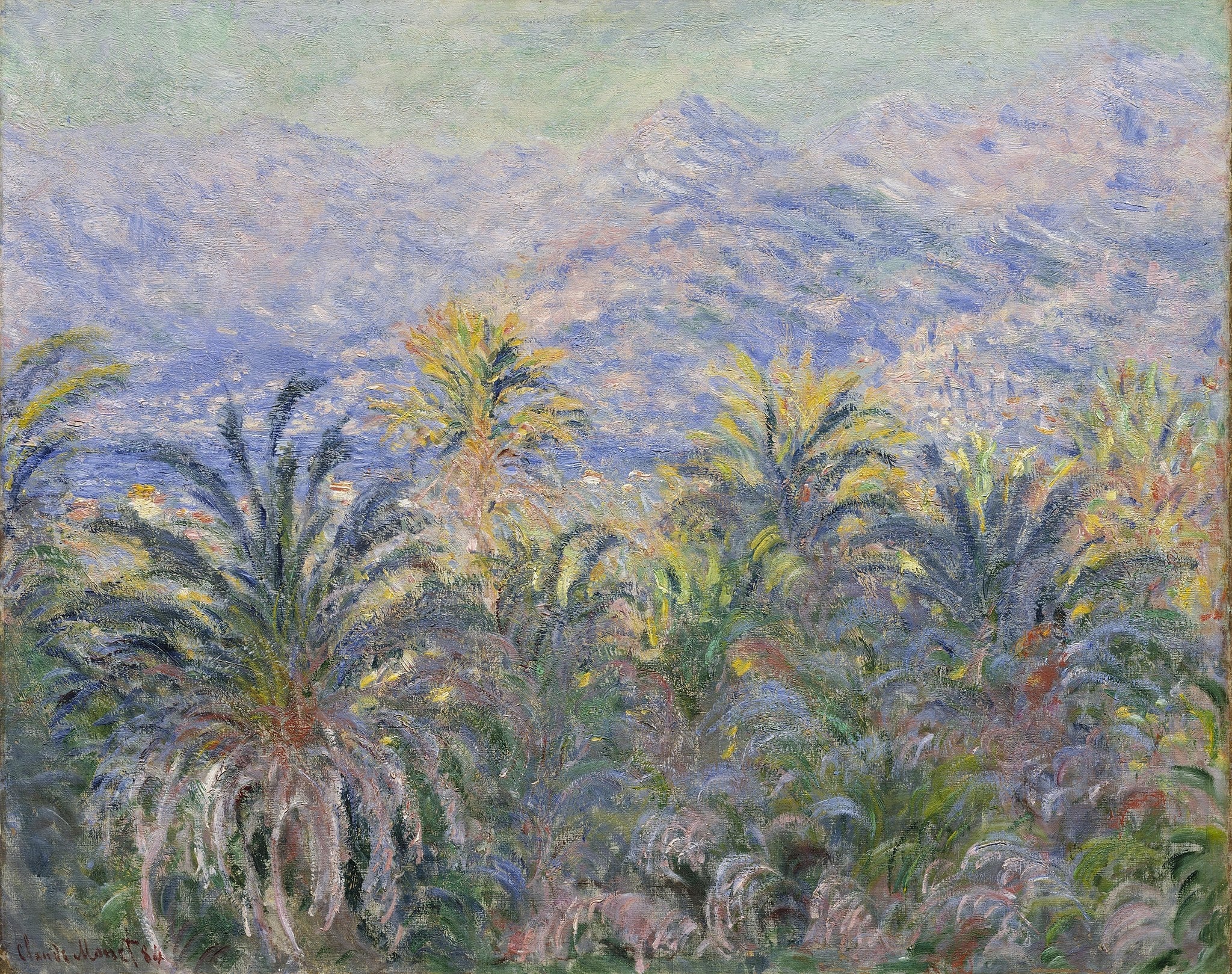
Palm Trees at Bordighera
Claude Monet (1884)
Claude Monet’s Palm Trees at Bordighera (1884) turns a Riviera grove into <strong>vibrating atmosphere</strong>: palm fronds surge across the foreground while a <strong>cobalt sea</strong> and <strong>violet-blue Alps</strong> dissolve into a misted sky. Monet pushes cool mauves, blues, and lemon tints into broken strokes so the scene reads as <strong>light-in-motion</strong> rather than botany <sup>[1]</sup><sup>[2]</sup>.
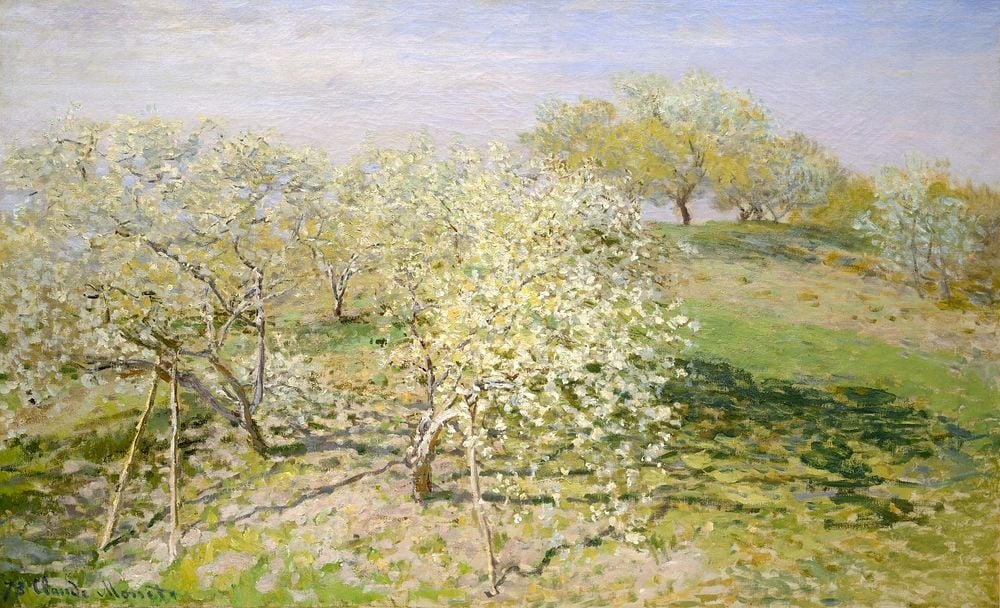
Spring (Fruit Trees in Bloom)
Claude Monet (1873)
Claude Monet’s Spring (Fruit Trees in Bloom) captures a hillside orchard at Argenteuil where pale blossoms flicker across a diagonal slope under a <strong>pearly, breathable sky</strong>. The canvas privileges <strong>light over contour</strong>, letting trunks, stakes, and petal-clusters resolve through vibrating touches of color that register passing air and sun <sup>[1]</sup><sup>[2]</sup>. The scene fixes a <strong>radiant instant</strong> while acknowledging its fragility.
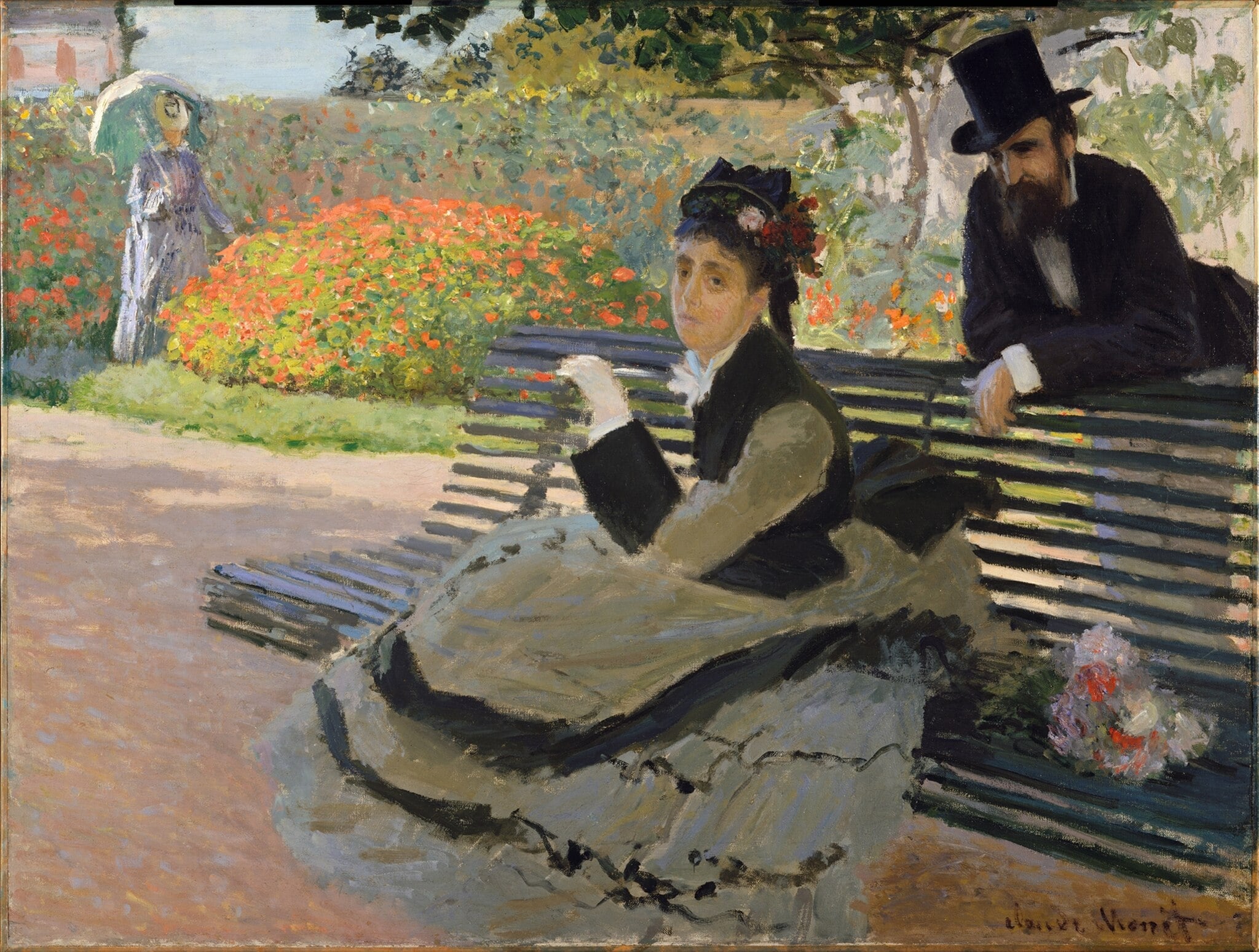
Camille Monet (1847–1879) on a Garden Bench
Claude Monet (1873)
Monet stages a modern garden drama along the <strong>diagonal bench</strong> that slices the foreground, setting Camille’s poised figure against a blaze of <strong>geraniums</strong> and dappled light. A <strong>top‑hatted neighbor</strong> leans over the slats as a second woman with a <strong>parasol</strong> wanders among blooms, while a <strong>note</strong> and a slightly tumbled <strong>bouquet</strong> cue a moment interrupted. Light, not contour, builds the scene, suspending private feeling within public leisure <sup>[1]</sup><sup>[2]</sup>.
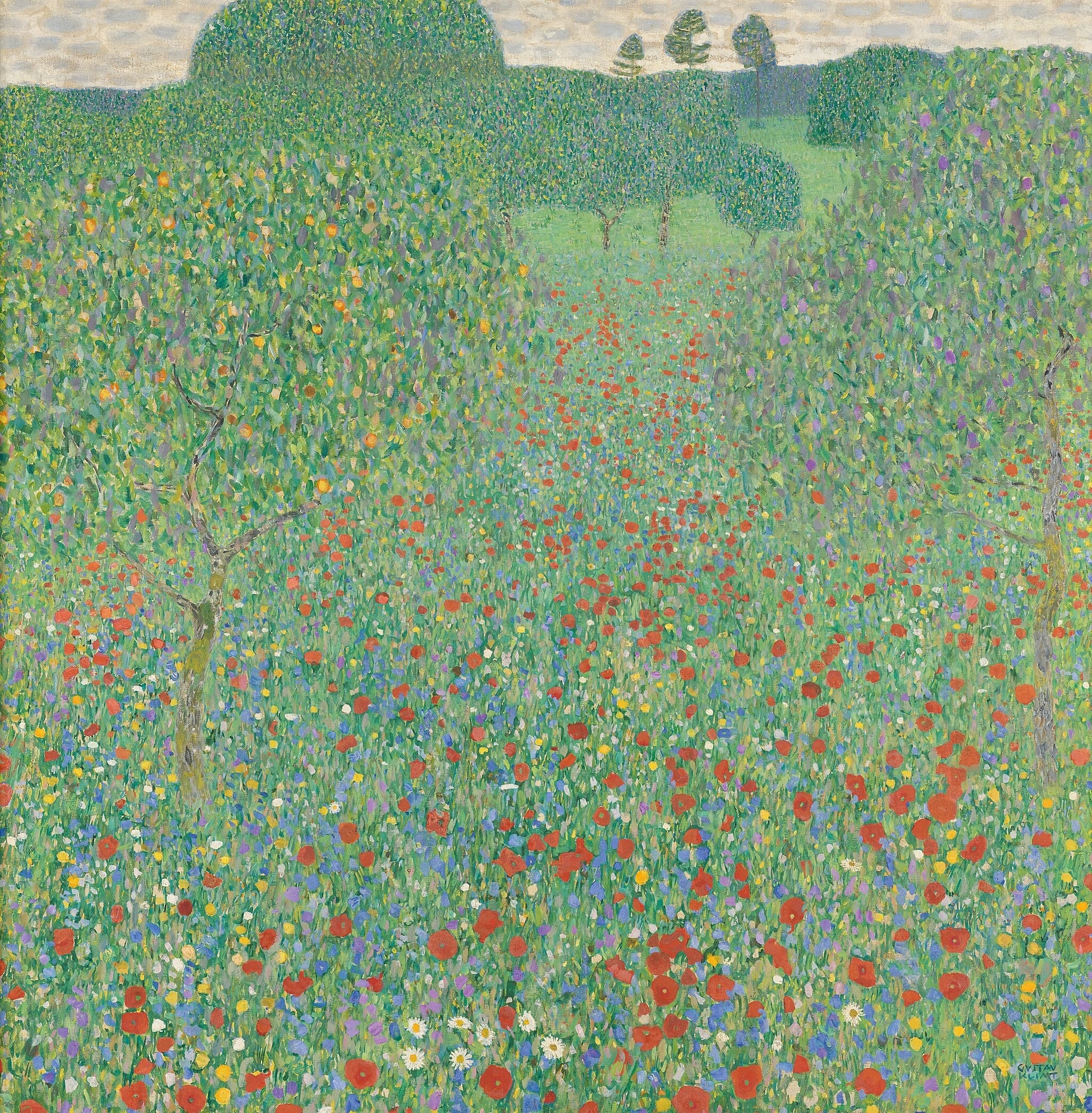
Flowering Poppies
Gustav Klimt (1907)
Gustav Klimt’s <strong>Flowering Poppies</strong> (1907) turns a meadow into a shimmering, all-over field where botany becomes <strong>ornament</strong>. A square canvas packed with red poppies, daisies, and fruiting trees compresses depth and invites a drifting gaze rather than linear recession <sup>[1]</sup><sup>[2]</sup>. The result is a sensuous, immersive vision that fuses observed nature with <strong>decorative abstraction</strong> <sup>[2]</sup>.
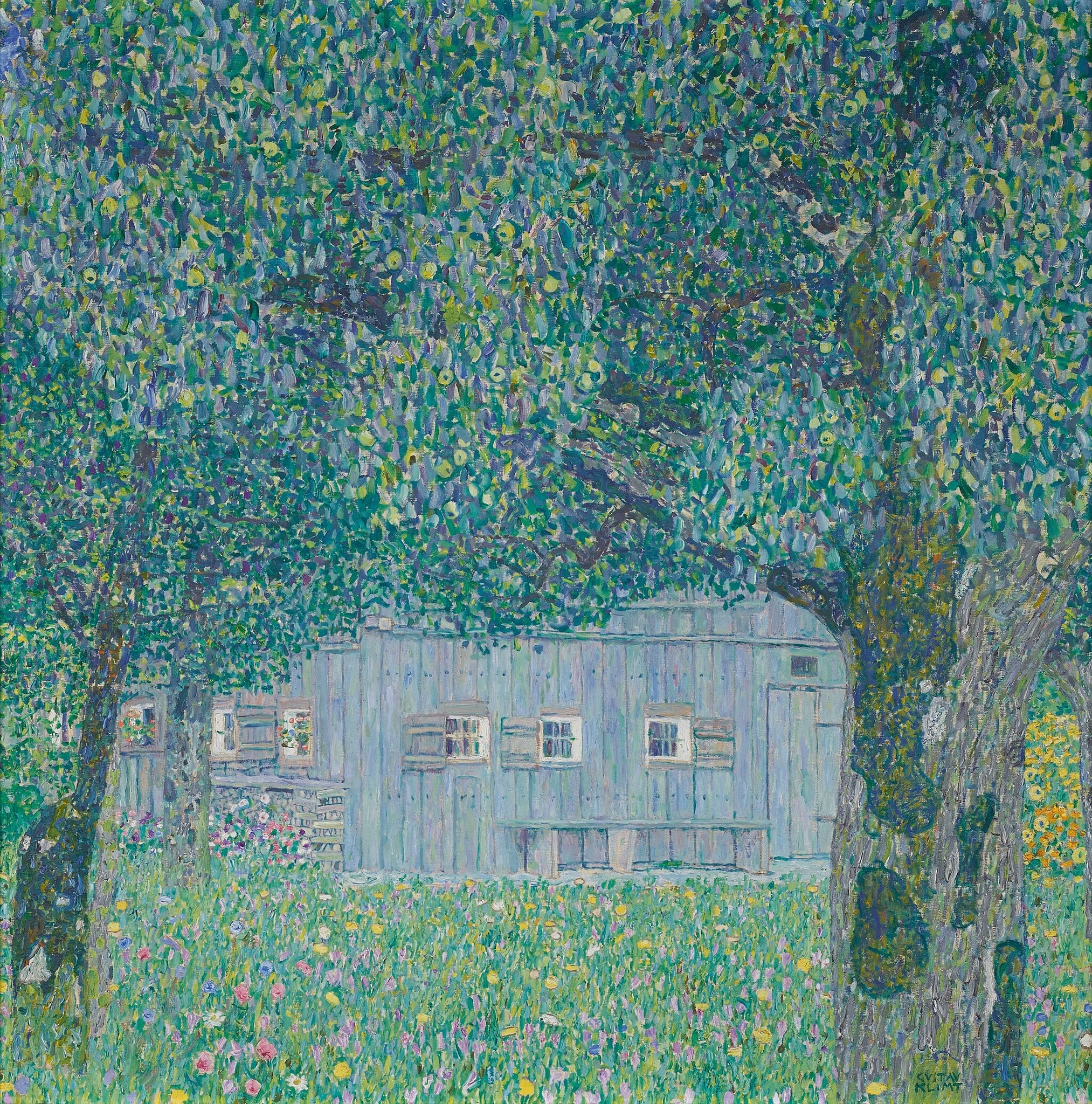
Farmhouse in Buchberg (Upper Austrian Farmhouse)
Gustav Klimt (1911)
Gustav Klimt’s Farmhouse in Buchberg (Upper Austrian Farmhouse) renders a rural dwelling almost absorbed by an orchard, its cool façade held in balance against a vibrating canopy of leaves and a jewel-like meadow. Through a square format and <strong>selective pointillism</strong>, Klimt fuses house, trees, and flowers into a contemplative, patterned field that privileges <strong>stillness</strong> over incident <sup>[1]</sup><sup>[6]</sup>. The work turns everyday architecture into an emblem of <strong>refuge within fecund nature</strong>.
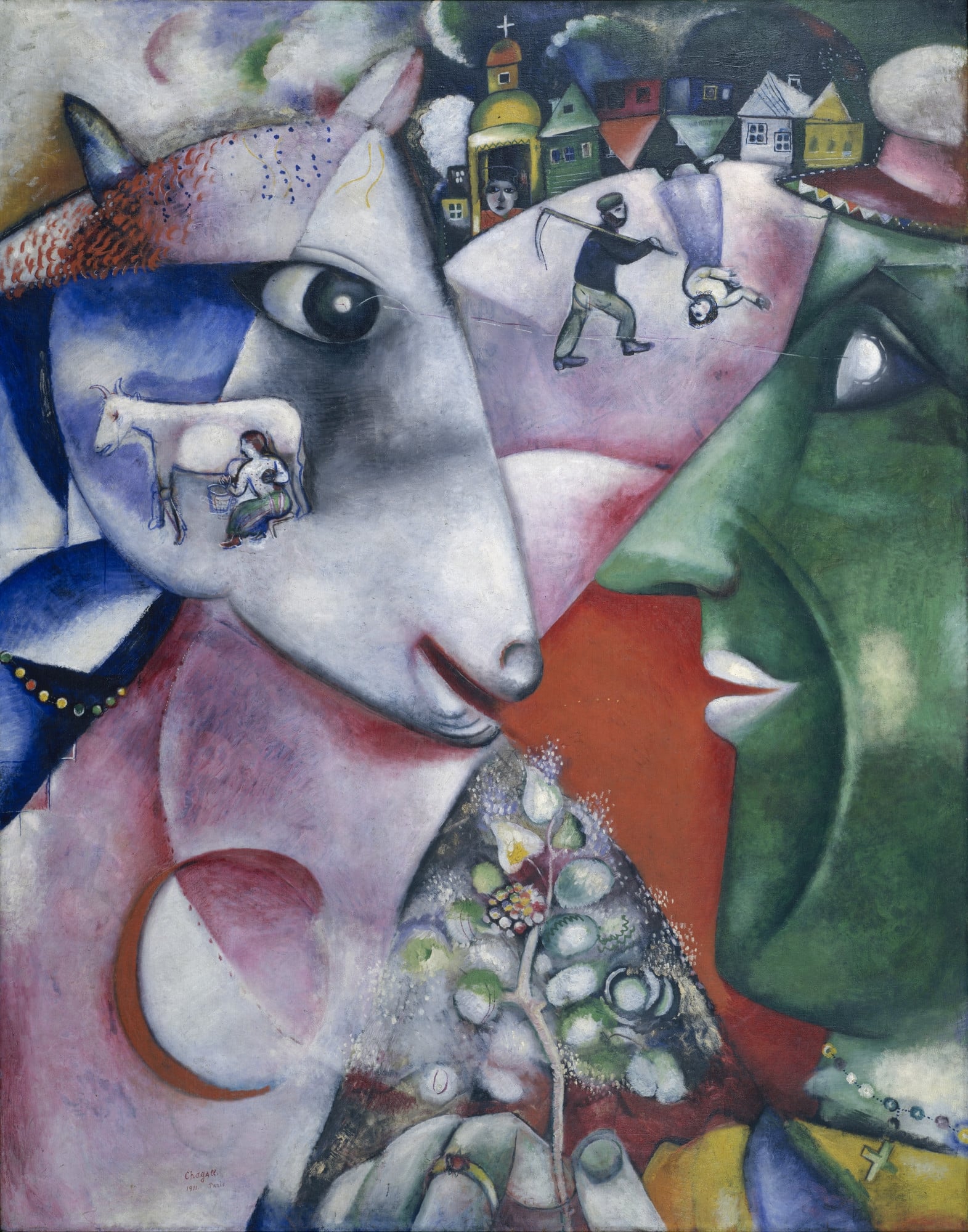
I and the Village
Marc Chagall (1911)
In I and the Village, Marc Chagall fuses <strong>memory, myth, and rural ritual</strong> into a dream‑logic tableau where a green‑faced villager and a pale bovine meet <strong>eye‑to‑eye</strong>. Concentric forms, prismatic color, and floating figures turn Vitebsk’s everyday life into a <strong>cosmic community</strong> where work, faith, and imagination coexist <sup>[1]</sup><sup>[3]</sup>.
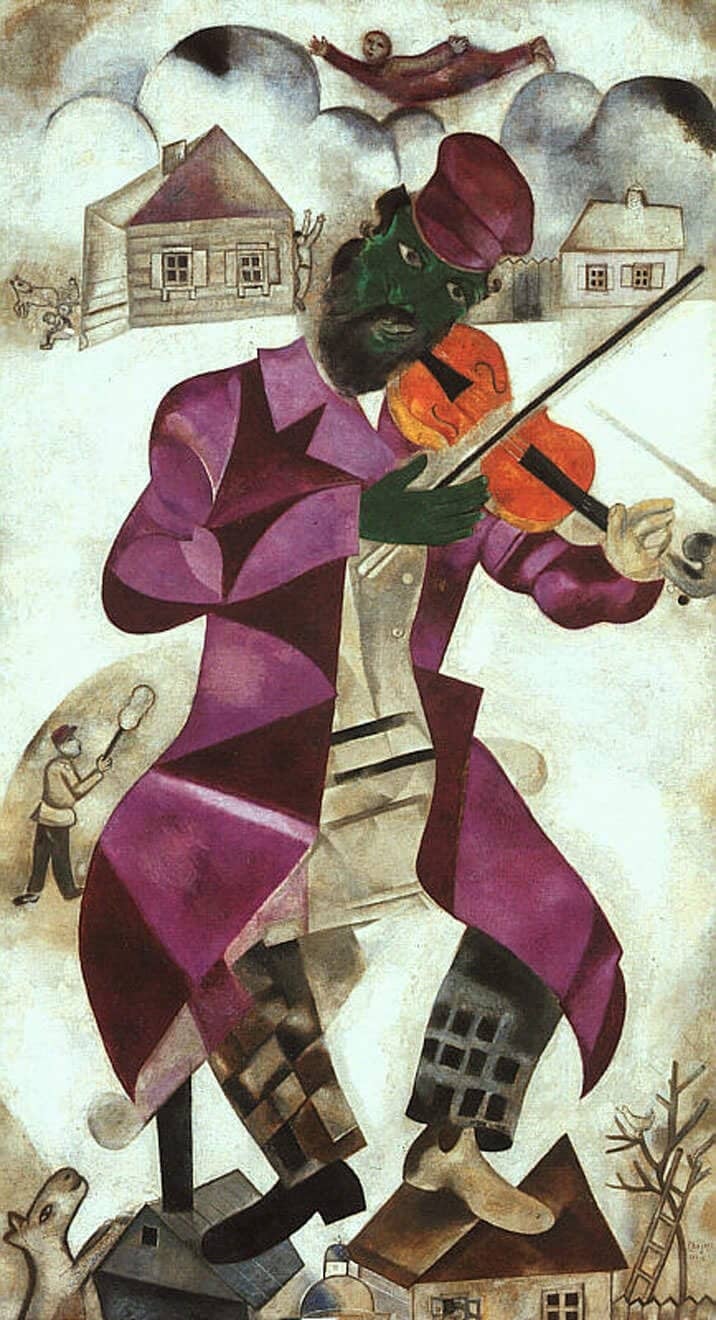
The Green Violinist
Marc Chagall (1923–1924)
The Green Violinist magnifies a village fiddler into a sky‑bridging guardian, his <strong>green face</strong> and <strong>purple coat</strong> turning him into a spiritual emissary rather than a mere entertainer. Striding across crooked <strong>rooftops</strong> without crushing them, he binds the shtetl’s houses, tree, clouds, and wandering figures into one continuous chord. Chagall fuses folkloric memory with modernist facets to assert music as the community’s sustaining force.
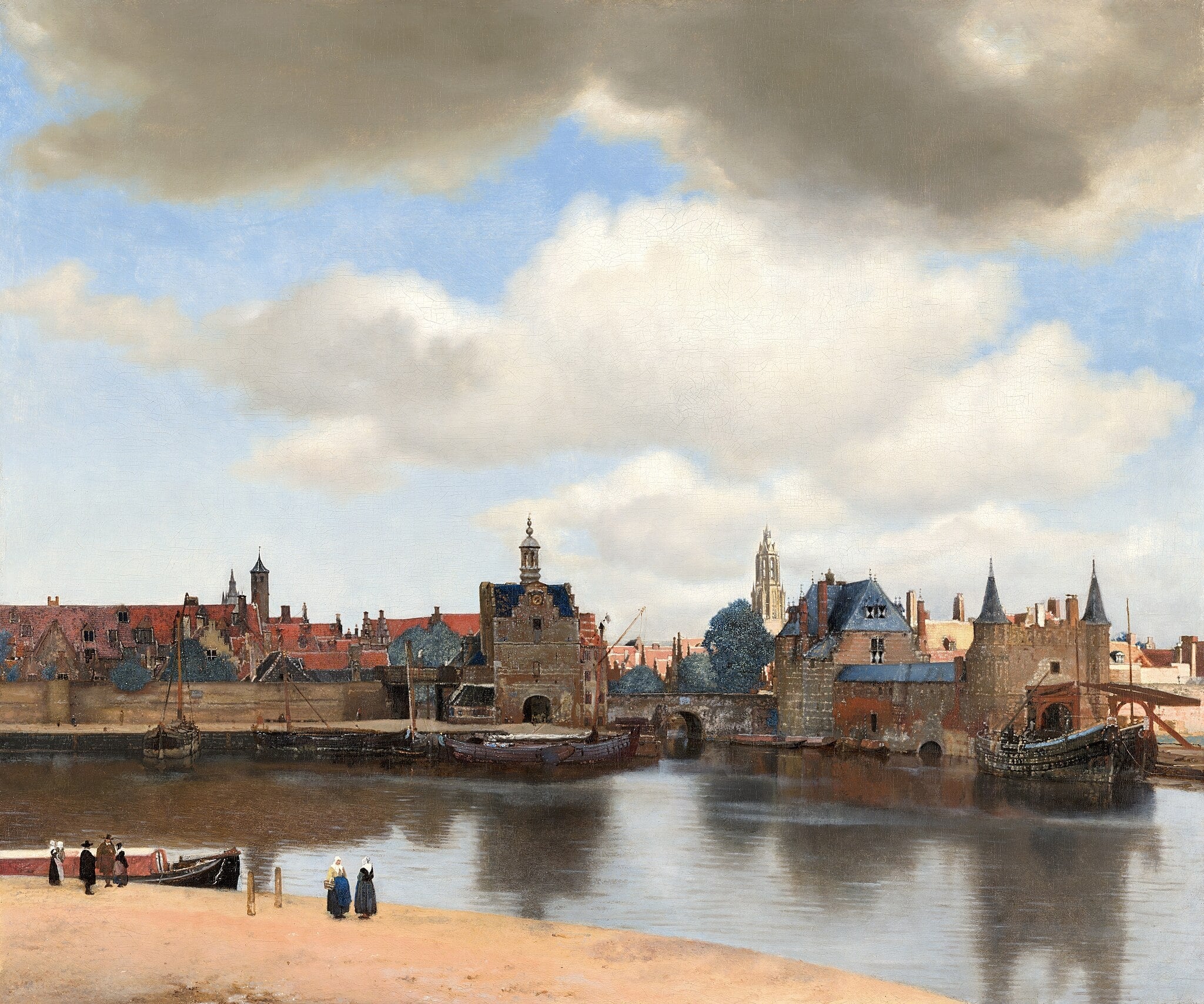
View of Delft
Johannes Vermeer (c. 1660–1661)
View of Delft turns a faithful city prospect into a meditation on <strong>civic order, resilience, and time</strong>. Beneath a low horizon, drifting clouds cast mobile shadows while shafts of sun ignite blue roofs and the bright spire of the <strong>Nieuwe Kerk</strong>, holding the scene’s moral center <sup>[1]</sup>. Small figures and moored boats ground prosperity in <strong>everyday community</strong> without breaking the hush.

Agapanthus
Claude Monet (c. 1915–1926)
In Agapanthus, Claude Monet turns a close-cropped bed of lilies into a field of <strong>pure movement and light</strong>. Lilac blooms flicker against layered greens, their long, arcing stems written in <strong>calligraphic strokes</strong> that dissolve the line between plant and air.

The Palazzo Ducale, Seen from San Giorgio Maggiore
Claude Monet (1908)
In The Palazzo Ducale, Seen from San Giorgio Maggiore, Claude Monet turns Venice into a theater of <strong>light and time</strong>. The Doge’s Palace glows as a pale, honeyed rectangle while the <strong>lagoon’s rippling violets and blues</strong> swallow stone into shimmer. A <strong>dark triangular quay</strong> in the foreground steadies the eye, making the city seem to hover above water.

The Palazzo Ducale (The Doge’s Palace)
Claude Monet (1908)
Claude Monet’s The Palazzo Ducale (The Doge’s Palace) converts Venice’s seat of power into an apparition of <strong>light and atmosphere</strong>. The lilac-and-rose façade dissolves into rhythmic brushwork while its <strong>broken reflection</strong> braids golds and violets across the canal. Monument becomes <strong>sensation</strong>, authority becomes shimmer.
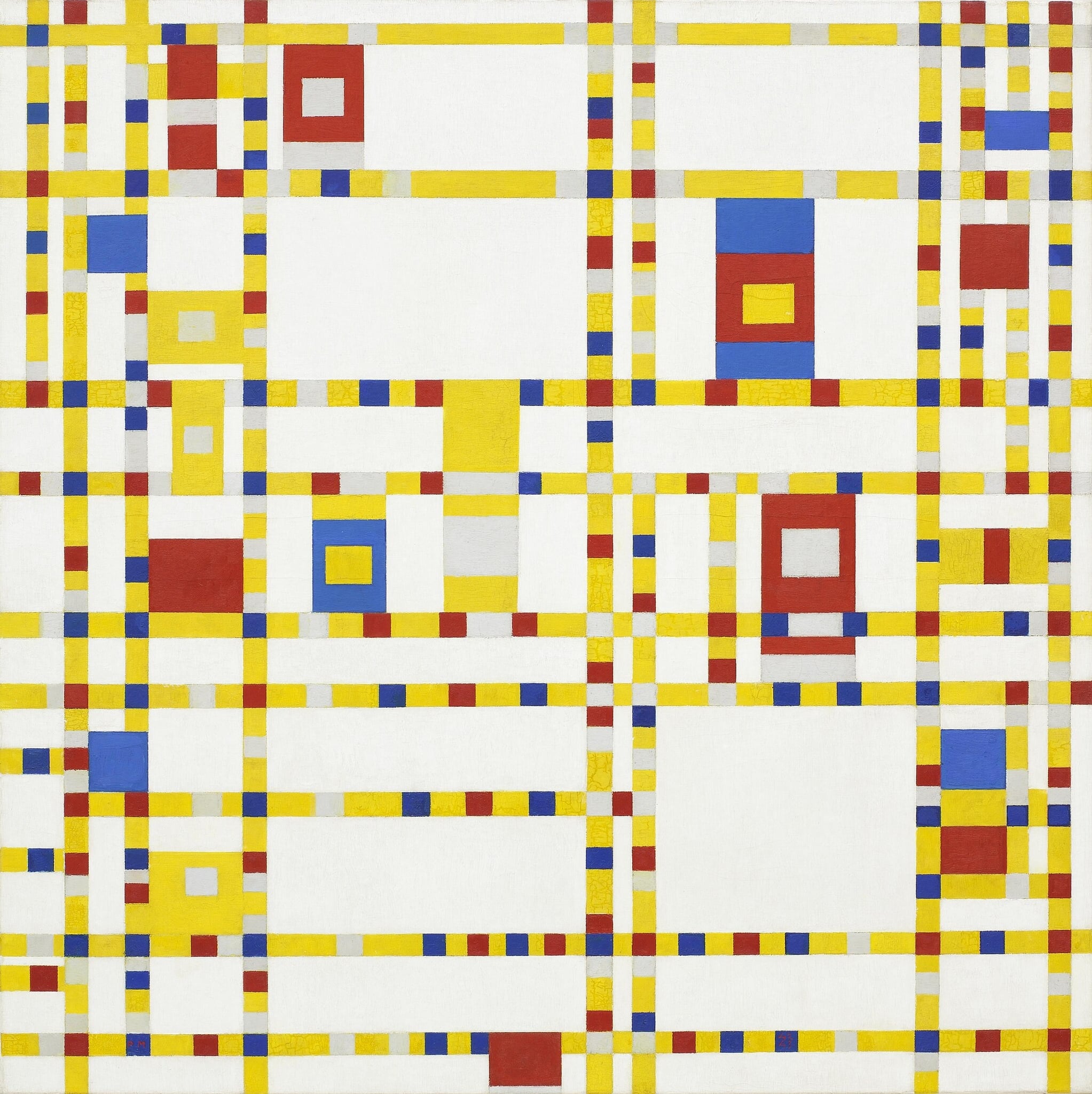
Broadway Boogie Woogie
Piet Mondrian (1942–1943)
Mondrian converts New York’s pulse into a <strong>vibrating grid</strong> of color. In place of black bars, intersecting <strong>yellow bands</strong> studded with red, blue, white, and light gray units generate a <strong>syncopated rhythm</strong> across wide white blocks that read as pauses and city blocks <sup>[1]</sup><sup>[2]</sup>.
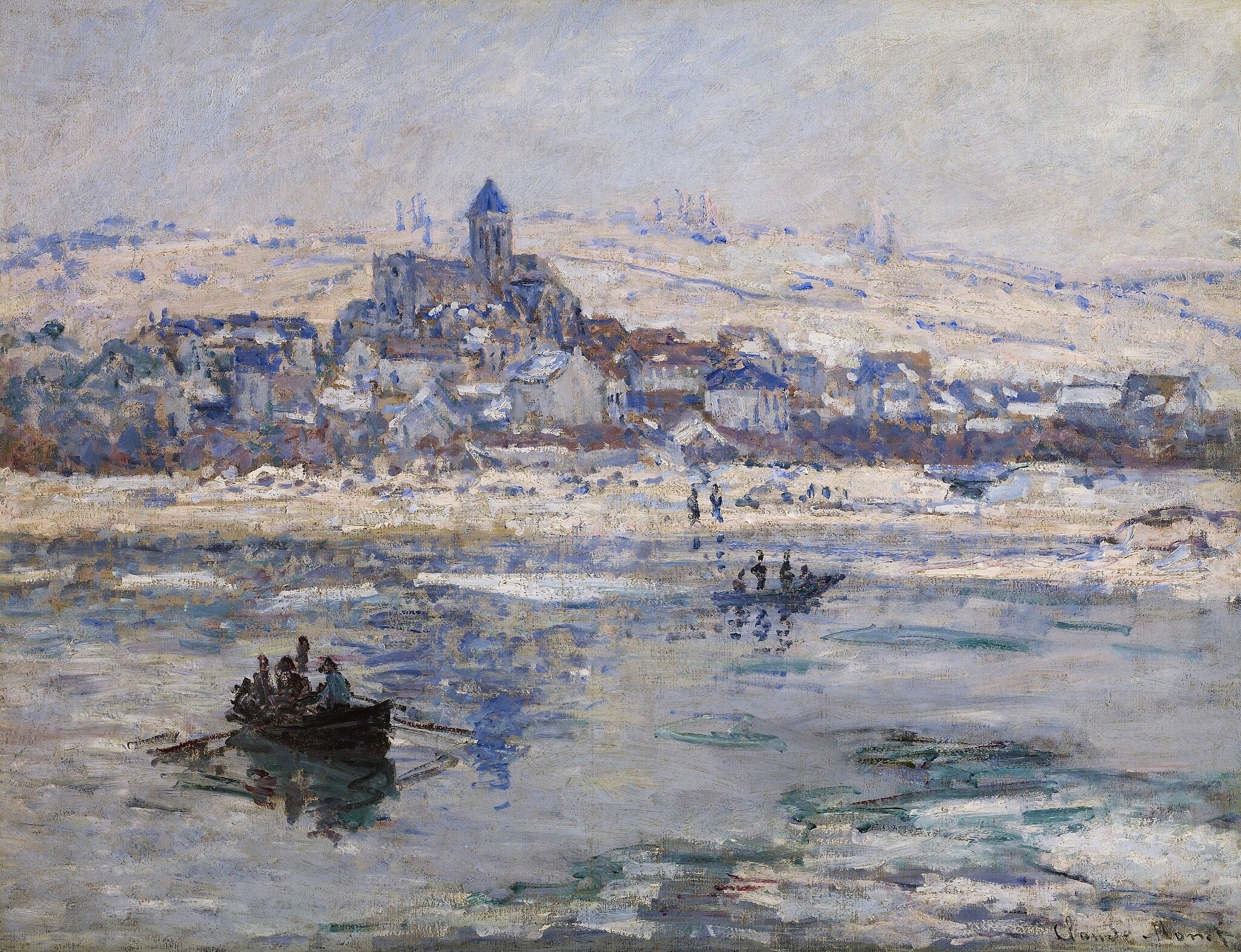
Vétheuil in Winter
Claude Monet (1878–79)
Claude Monet’s Vétheuil in Winter renders a riverside village in a <strong>silvery, frost-laden light</strong>, where the Seine carries <strong>broken ice</strong> past clustered houses and the tall church tower. The scene’s <strong>granular blue-green palette</strong> and softened edges make the town appear to crystallize out of air and water, while small boats and figures signal quiet persistence.
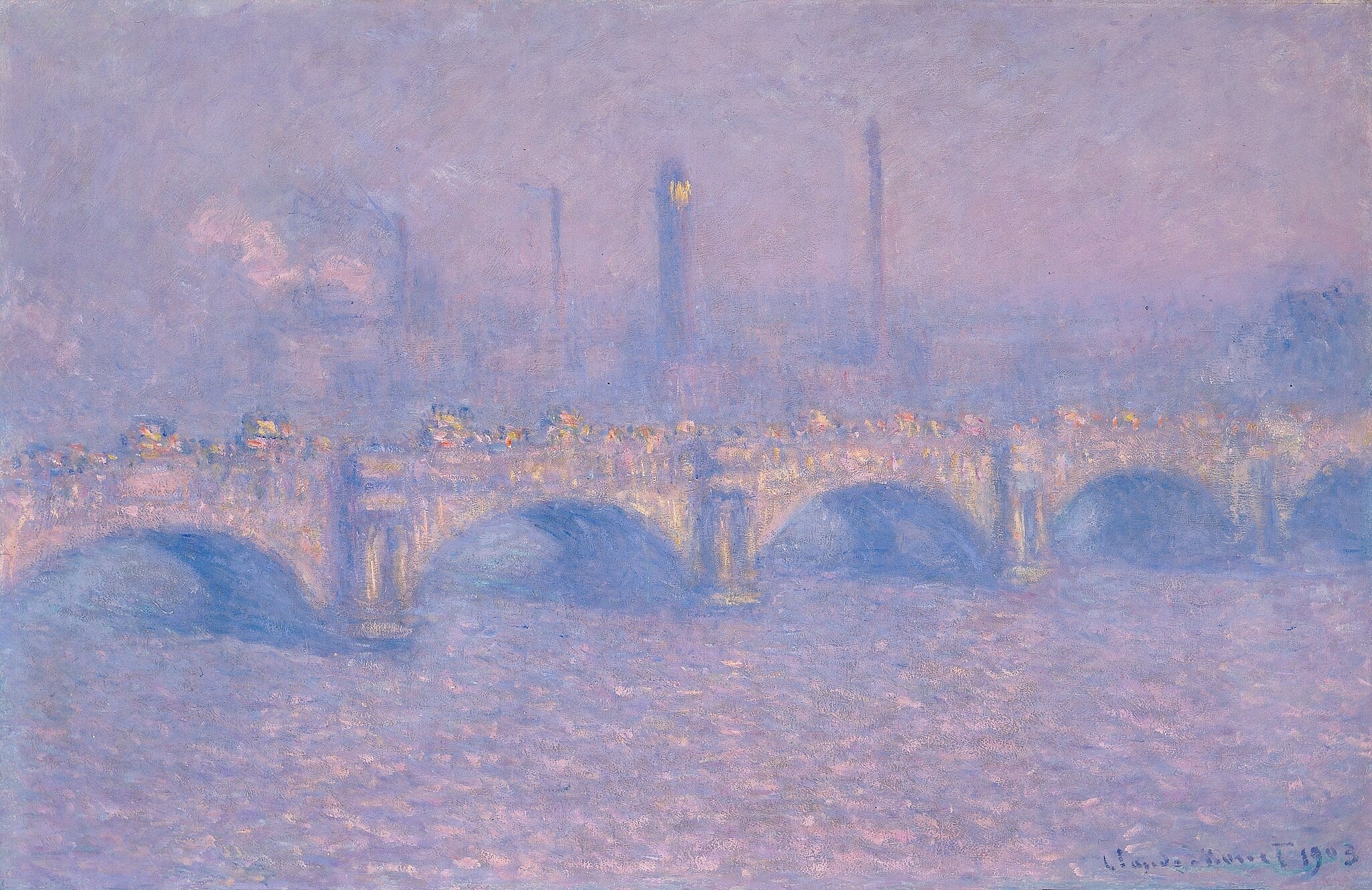
Waterloo Bridge, Veiled Sun
Claude Monet (1903)
Claude Monet’s Waterloo Bridge, Veiled Sun renders London as a field of vibrating color where <strong>atmosphere</strong> overtakes architecture. The bridge’s cool violet arches and the tiny <strong>veiled sun</strong>—a gold pin of light above the parapet—stage a dialogue between urban <strong>modernity</strong> and shifting light.
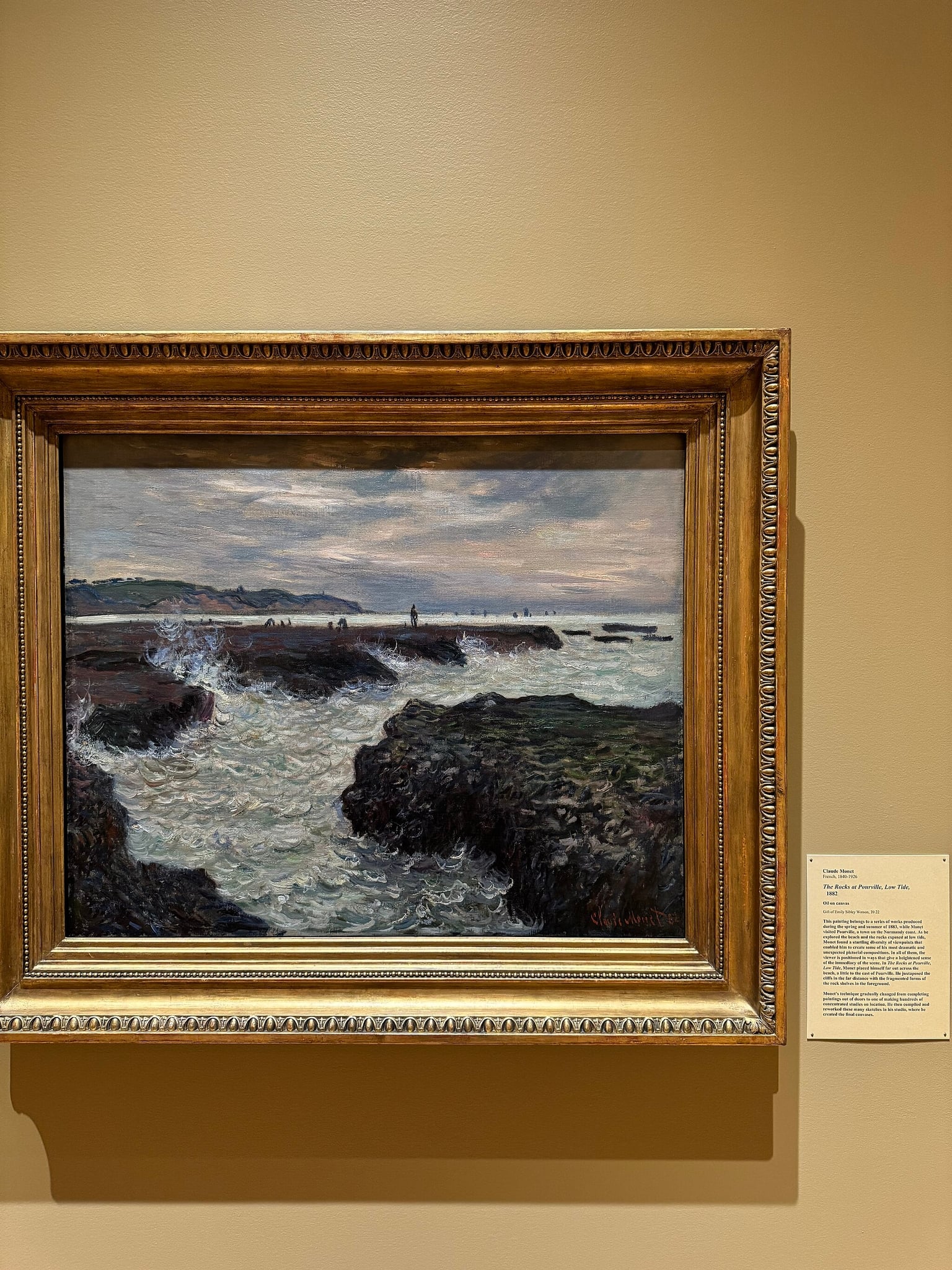
The Rocks at Pourville, Low Tide
Claude Monet (1882)
Claude Monet’s The Rocks at Pourville, Low Tide renders the Normandy foreshore as a meeting of <strong>endurance and flux</strong>—dark, seaweed-laden rocks cleave through <strong>foaming, mobile surf</strong> beneath a cool, <strong>pewter sky</strong>. Tiny silhouettes along the horizon reduce human presence to scale and rhythm, centering nature’s <strong>temporal pulse</strong>.

Mont Sainte-Victoire
Paul Cézanne (1902–1906)
Cézanne’s Mont Sainte-Victoire renders the Provençal massif as a constructed order of <strong>planes and color</strong>, not a fleeting impression. Cool blues and violets articulate the mountain’s facets, while <strong>ochres and greens</strong> laminate the fields and blocky houses, binding atmosphere and form into a single structure <sup>[2]</sup><sup>[4]</sup>.
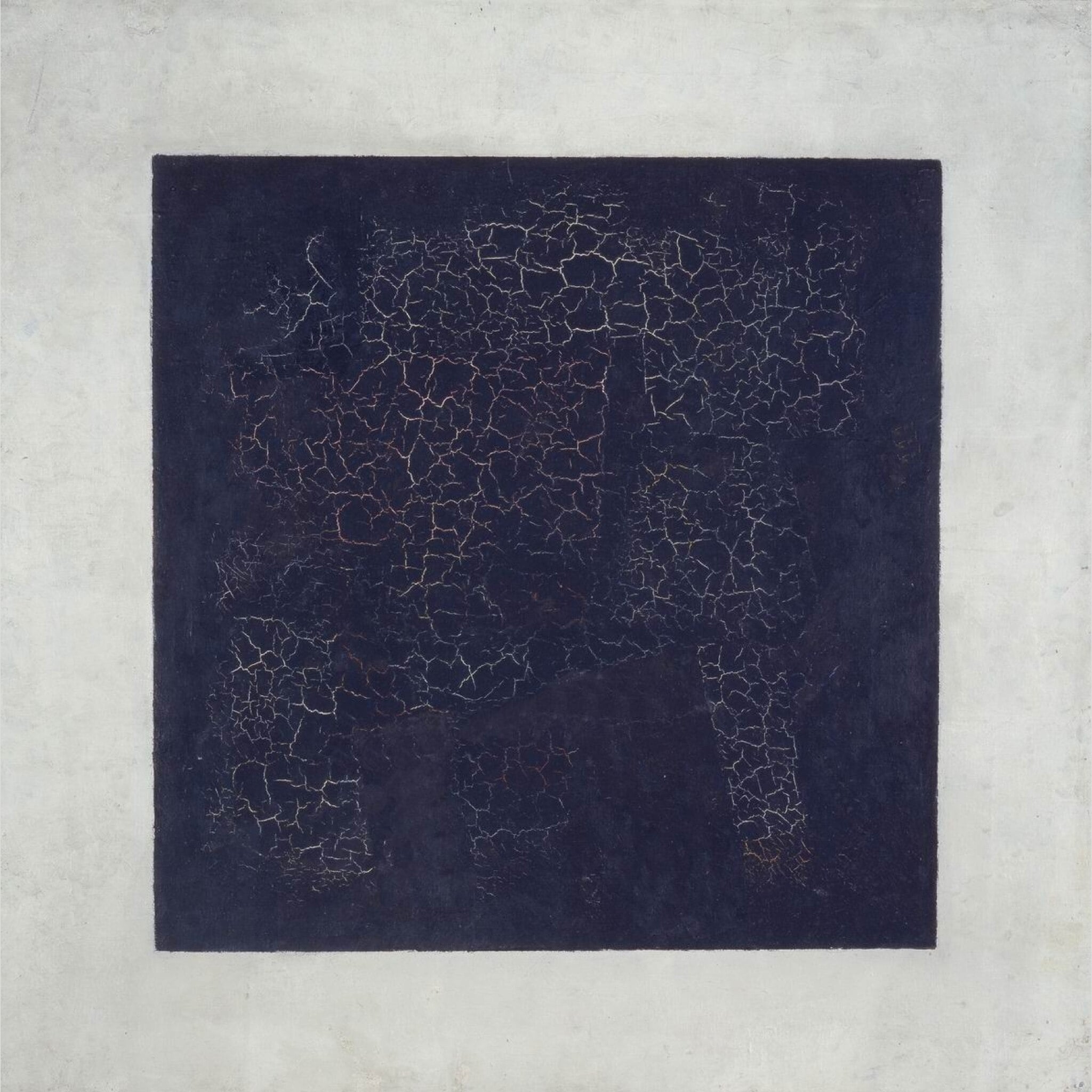
Black Square
Kazimir Malevich (1915)
Kazimir Malevich’s Black Square declares a radical reset: a hand-painted, slightly irregular black form set on a chalky white field, presented as an artistic <strong>zero</strong> and a new spiritual-conceptual space. The hairline craquelure that webs across the dark surface counters any idea of a perfect void, binding utopian claim to material time.
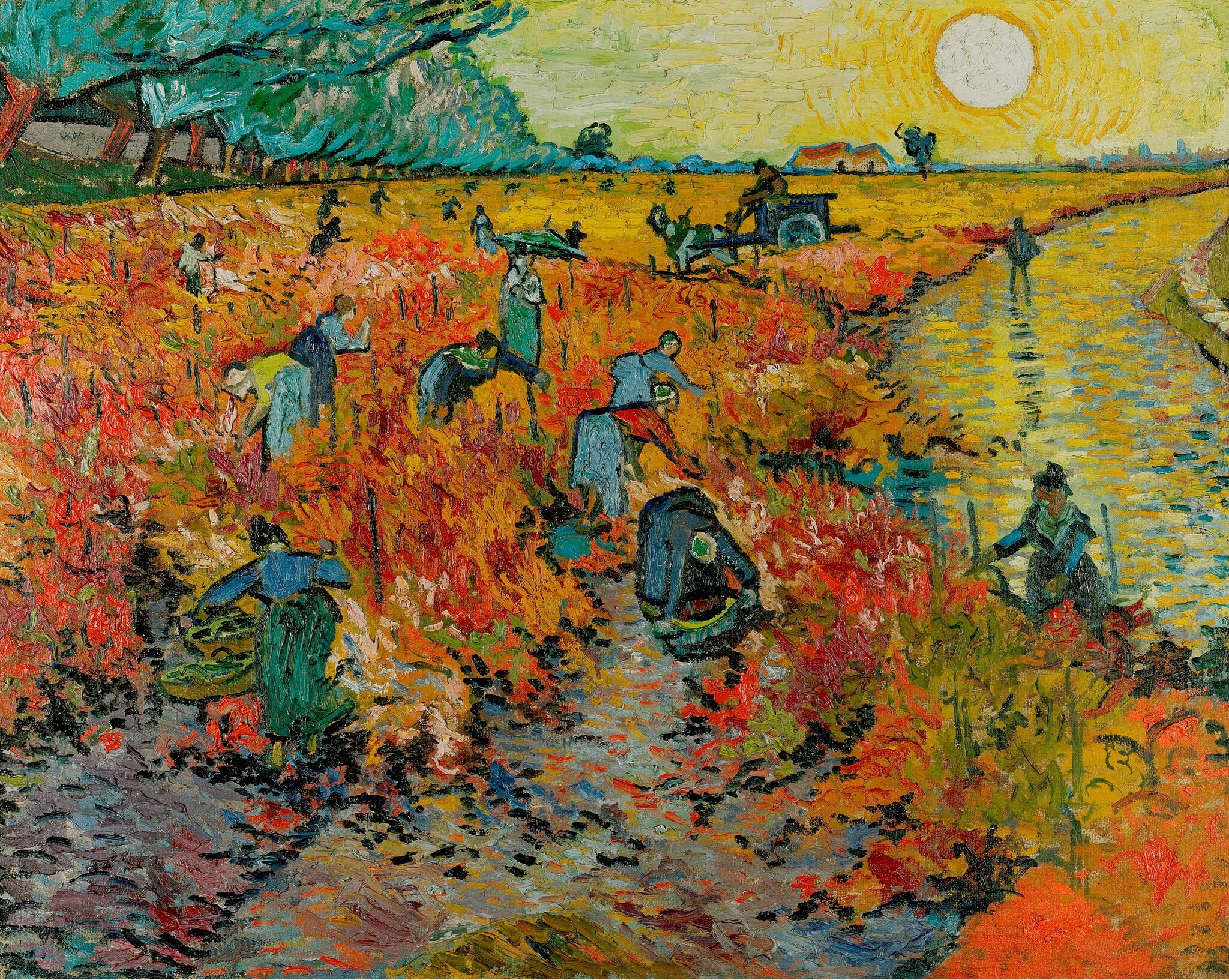
The Red Vineyard
Vincent van Gogh (1888)
In The Red Vineyard, Vincent van Gogh forges a vision of <strong>autumn labor under a blazing sun</strong>, where harvesters flow diagonally through scarlet vines while a band of <strong>yellow light</strong> flares along a reflective roadway. The scene fuses <strong>exhaustion and ripeness</strong>, turning work into a rhythmic, almost liturgical procession <sup>[1]</sup><sup>[3]</sup>.
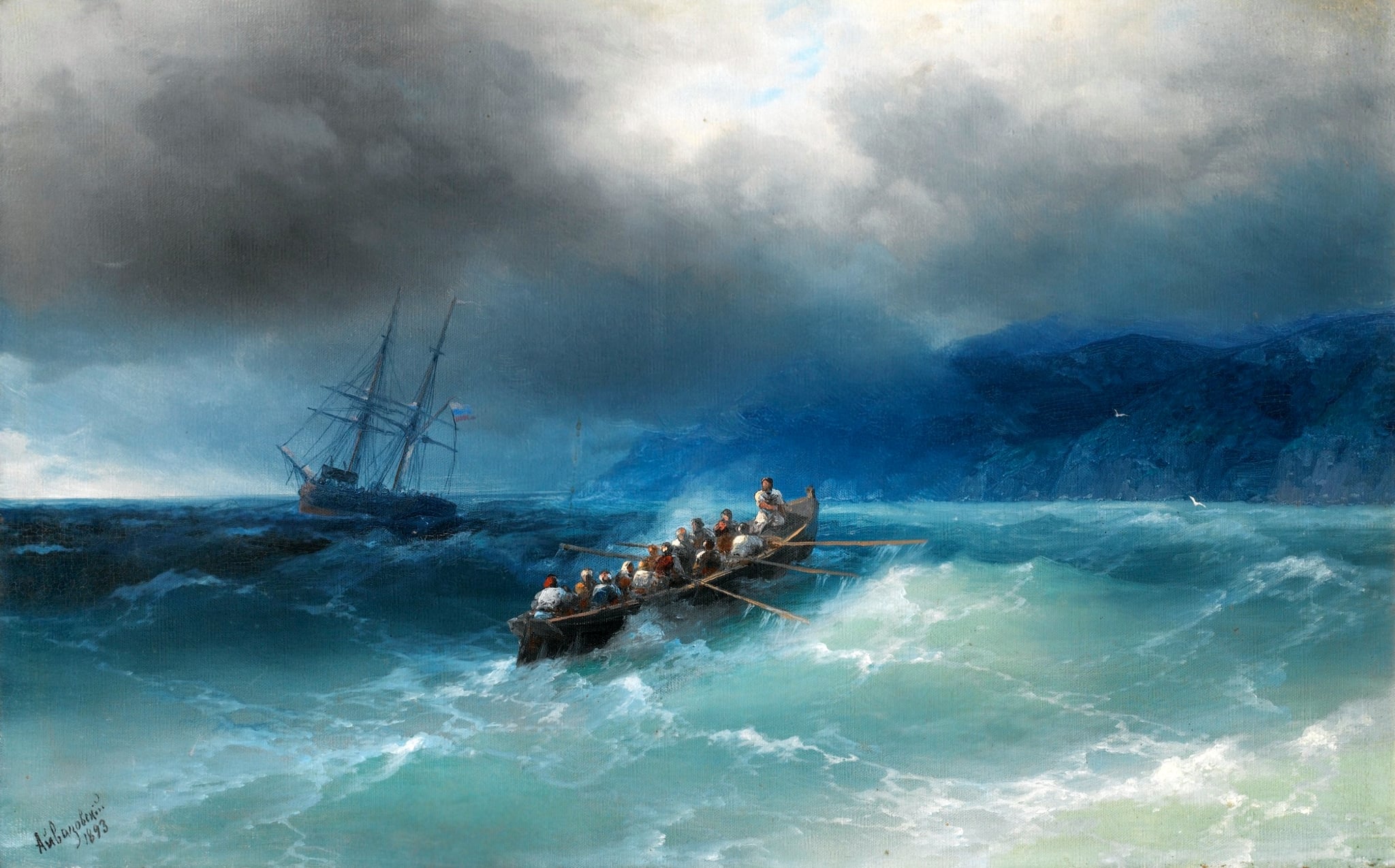
The Storm (Seascape)
Ivan Aivazovsky (1850)
In The Storm (Seascape), Ivan Aivazovsky forges a drama of <strong>human resolve</strong> against the <strong>Sublime sea</strong>. A crowded lifeboat claws up a green-blue swell toward a <strong>break of light</strong>, while a tall-masted ship lists behind and a <strong>rocky coast</strong> looms to the right. The painting crystallizes peril and hope in a single, surging moment.
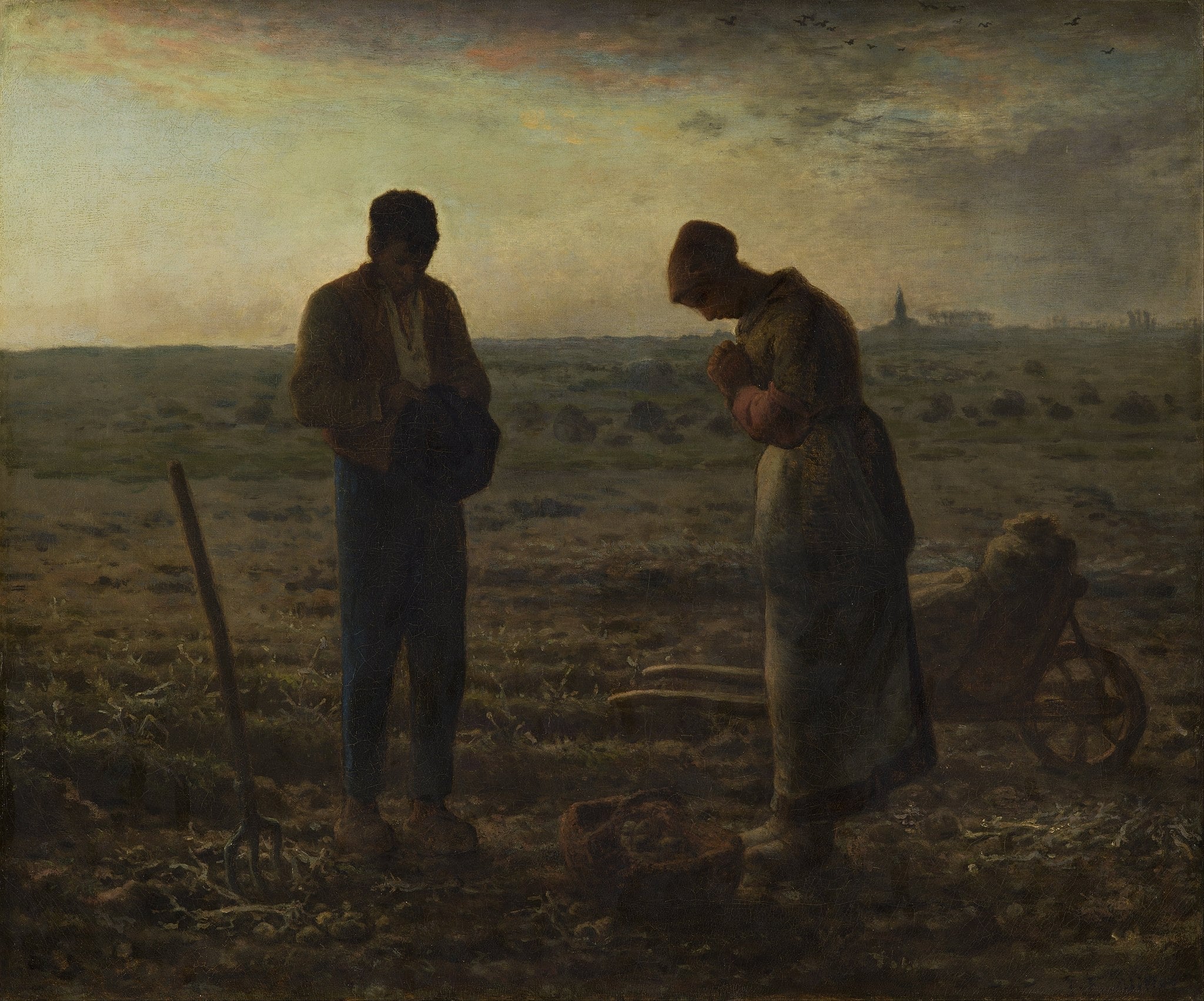
The Angelus
Jean-Francois Millet (1857–1859)
Jean-Francois Millet’s The Angelus (1857–1859) fuses <strong>devotion</strong> and <strong>labor</strong>: two peasants pause at dusk, heads bowed, as the Angelus bell sounds from a distant steeple. With a <strong>low horizon</strong>, earthen palette, and monumental silhouettes, the painting makes a brief pause in fieldwork feel timeless and sacred <sup>[1]</sup><sup>[2]</sup>.
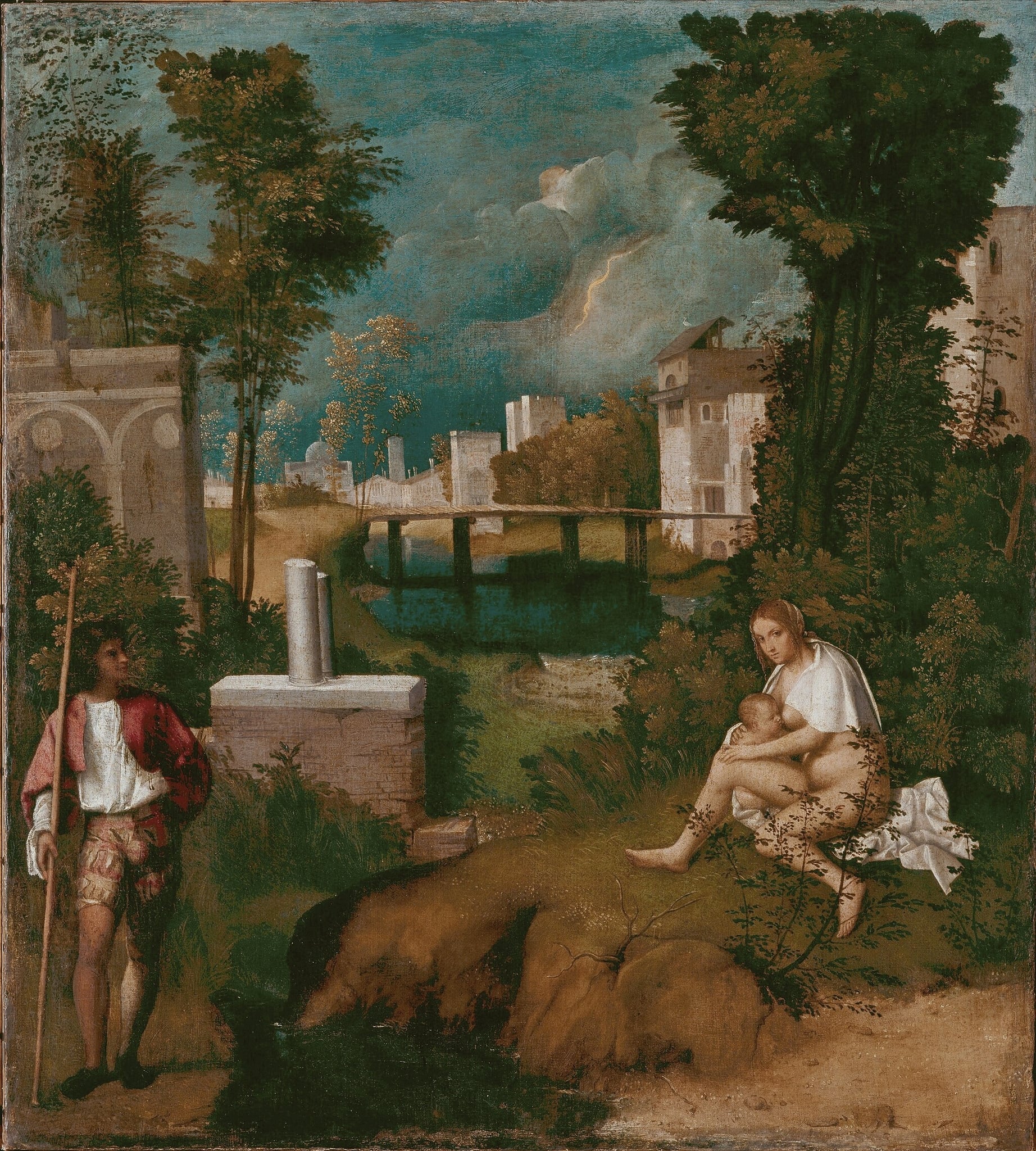
The Storm
Giorgione (c. 1505–1508)
Giorgione’s The Storm stages human life on the brink of change, fusing <strong>pastoral calm</strong> with <strong>sudden rupture</strong>. A watchful youth and a nursing mother face each other across a stream as lightning splits the blue‑green sky, while ruins and a narrow bridge signal fragile passage. The landscape itself becomes the protagonist, turning everyday figures into a <strong>poetic allegory</strong> of vulnerability and fate <sup>[1]</sup><sup>[2]</sup>.
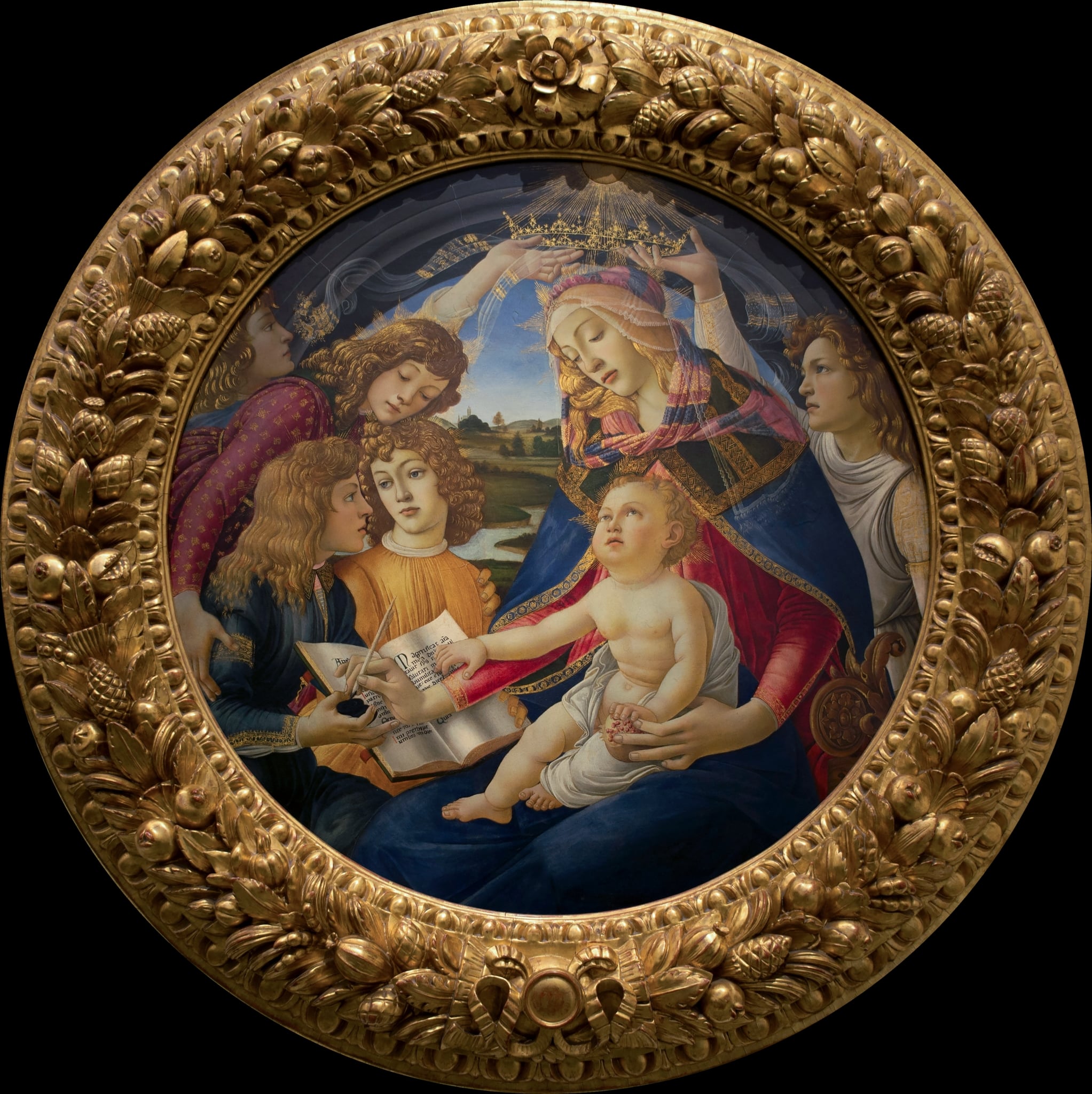
Madonna of the Magnificat
Sandro Botticelli (c. 1483)
Botticelli’s Madonna of the Magnificat is a circular panel where the Virgin, <strong>crowned by angels</strong>, writes the <strong>Magnificat</strong> as the Christ Child guides her hand. A split <strong>pomegranate</strong> in the Child’s grasp prefigures the Passion while the wingless, courtly angels and a Tuscan view bind sacred mystery to Florentine life <sup>[1]</sup><sup>[2]</sup>. The tondo’s swirl of fabrics and gold makes theology visible as a choreography of <strong>praise, prophecy, and sacrifice</strong>.
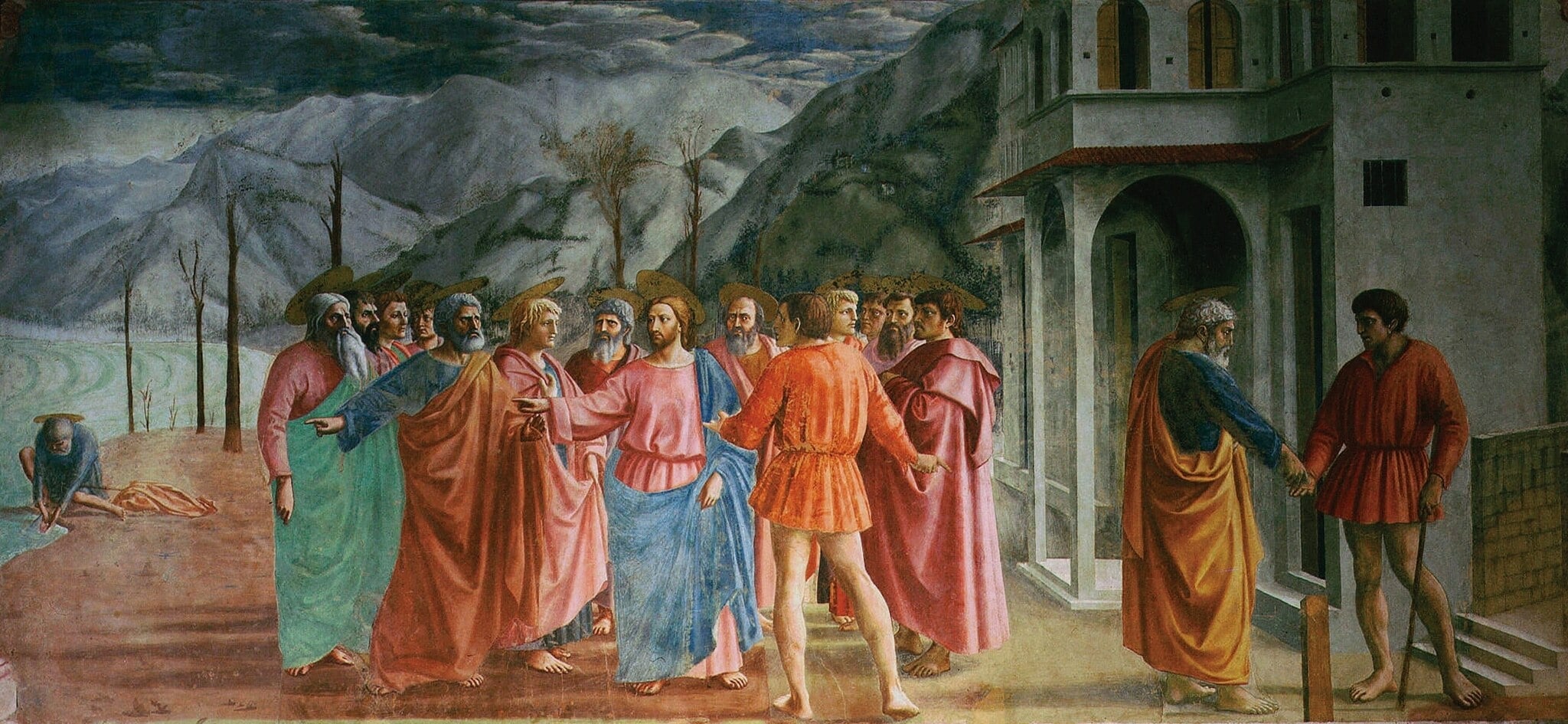
The Tribute Money
Masaccio (c. 1425–1427)
Masaccio’s The Tribute Money unifies three Gospel moments into one rational space, using <strong>continuous narrative</strong>, coherent <strong>light from the right</strong>, and strict <strong>linear perspective</strong> to dramatize Christ’s directive to Peter about the temple tax. The red-clad tax collector confronts the group at center, Peter retrieves the coin at the lake on the left, and he pays the dues at the portico on the right, all bound by emphatic pointing hands and a shared illumination <sup>[2]</sup><sup>[3]</sup>.
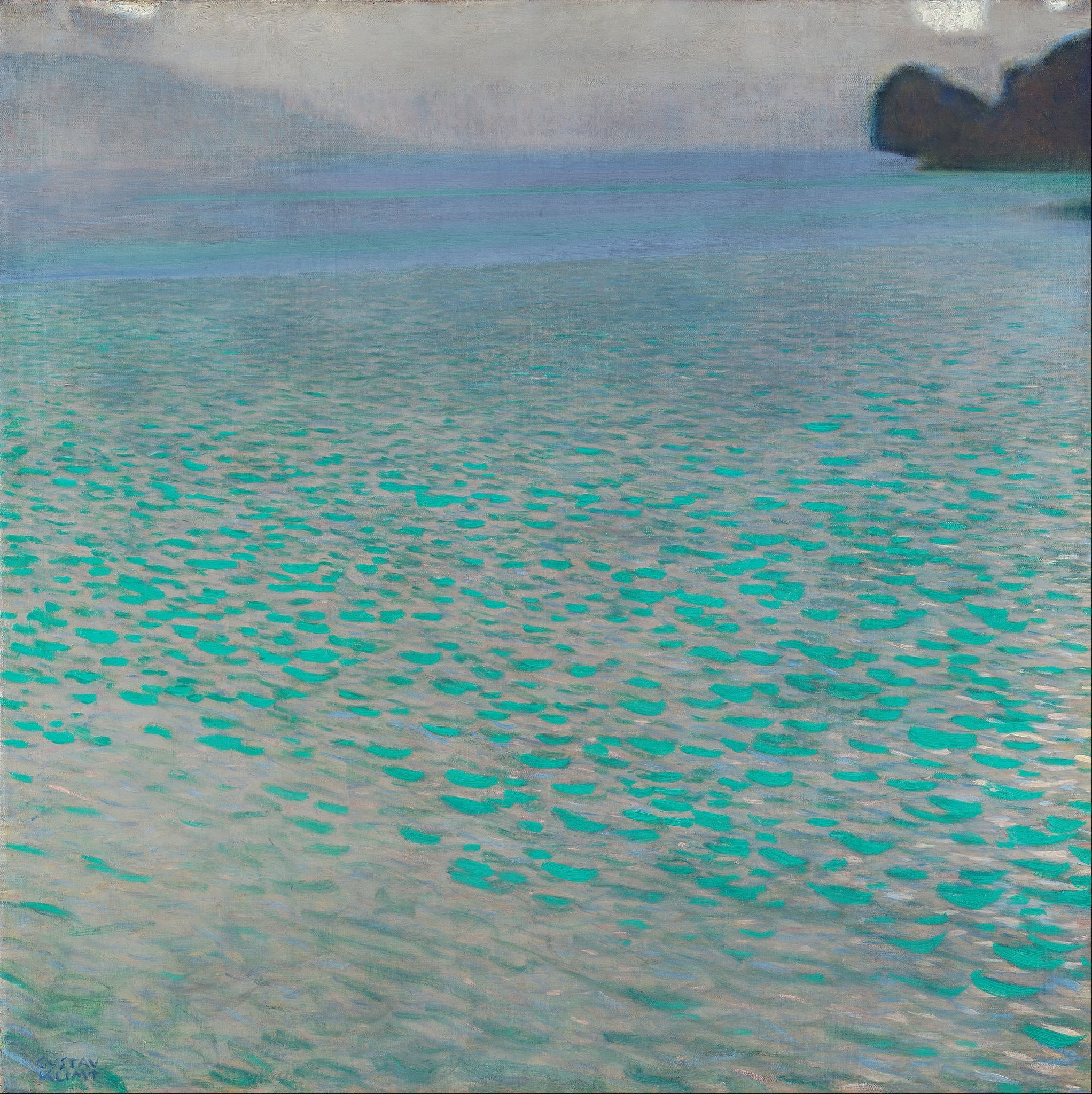
On Lake Attersee
Gustav Klimt (1900)
Gustav Klimt’s On Lake Attersee (1900) turns a summer lake into a <strong>woven field of light</strong>. A square canvas nearly filled with water, it stages a quiet duel between <strong>surface pattern</strong> and <strong>atmospheric depth</strong>, letting a tiny dark headland at the upper right anchor an otherwise hypnotic expanse <sup>[1]</sup><sup>[2]</sup>.
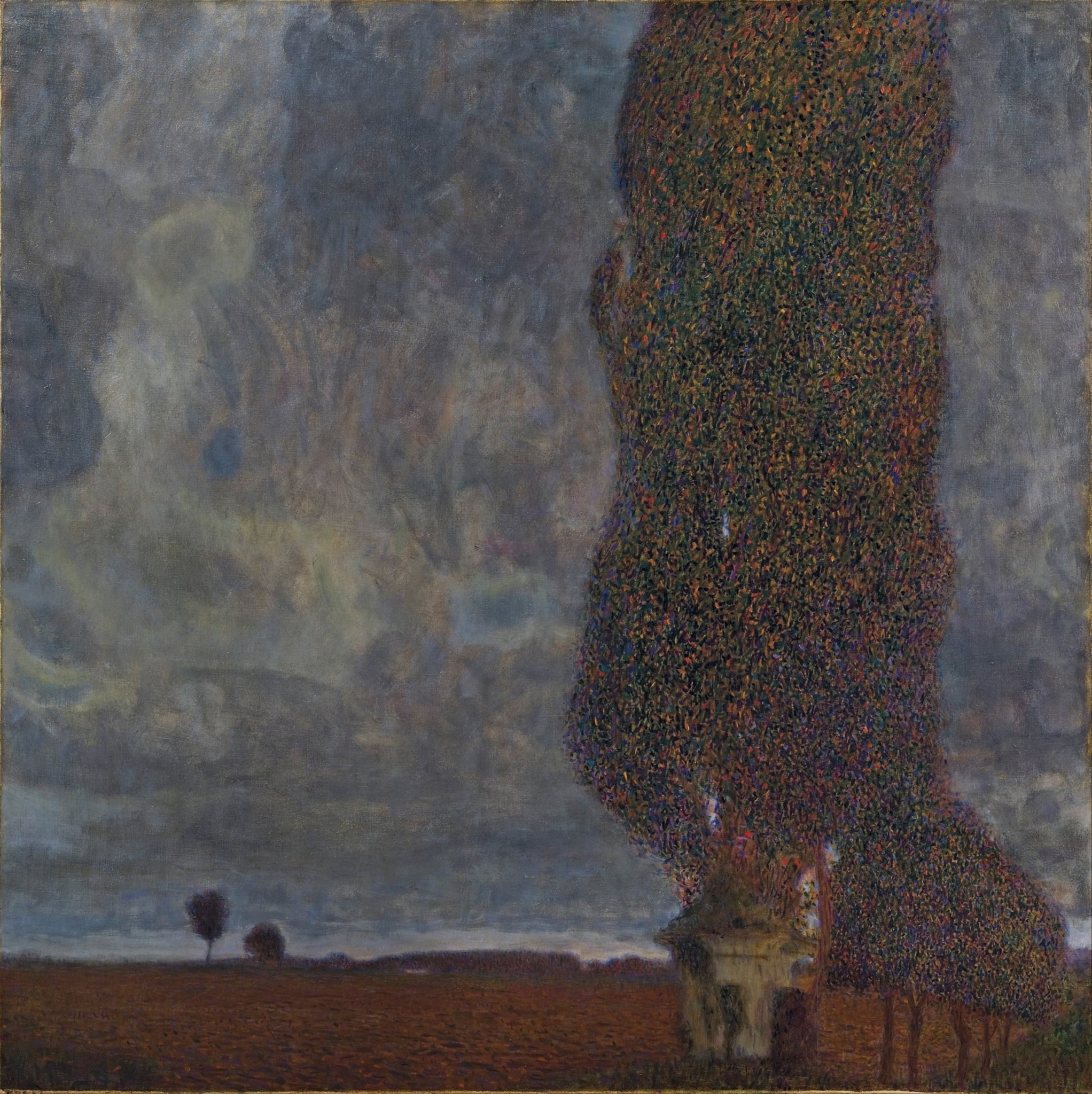
The Large Poplar II (Gathering Storm)
Gustav Klimt (1902/03)
In The Large Poplar II (Gathering Storm), a monumental poplar rises like a <strong>sentinel</strong> at the right edge while a low, rust-toned plain and tiny chapel anchor the horizon. Klimt devotes most of the square canvas to a <strong>charged, near-monochrome sky</strong>, making weather the protagonist and turning the tree’s flecked canopy into a shimmering, ominous <strong>mosaic</strong> <sup>[1]</sup><sup>[2]</sup>.
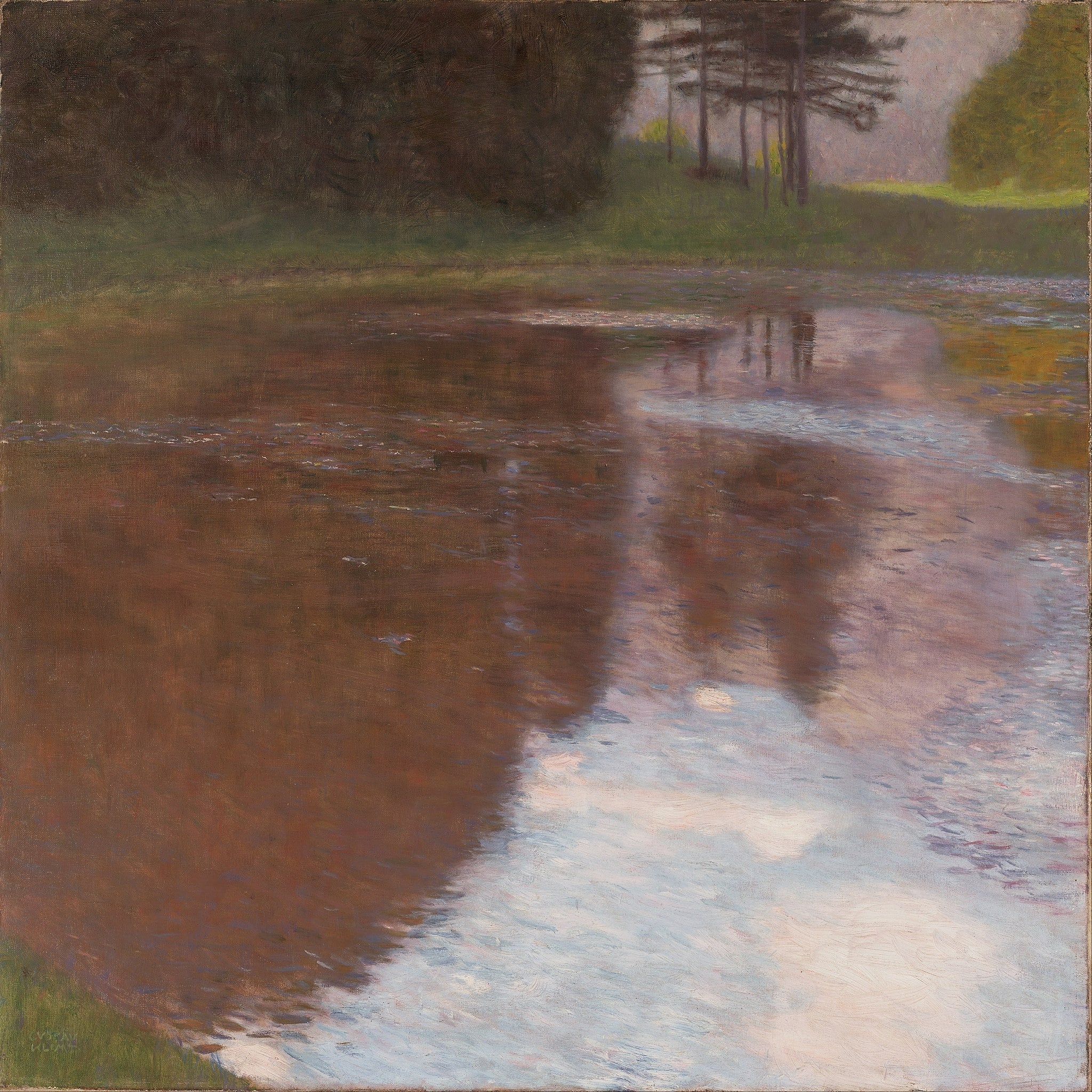
A Morning by the Pond
Gustav Klimt (1899)
A Morning by the Pond turns a quiet Egelsee shoreline into a field of <strong>reflection</strong> where trees, bank, and sky dissolve into one surface. Klimt’s first <strong>square format</strong> landscape compresses depth and makes water the true subject, staging a luminous <strong>threshold</strong> between night and day. The work establishes perception itself—what we see and how—as Klimt’s modern theme.
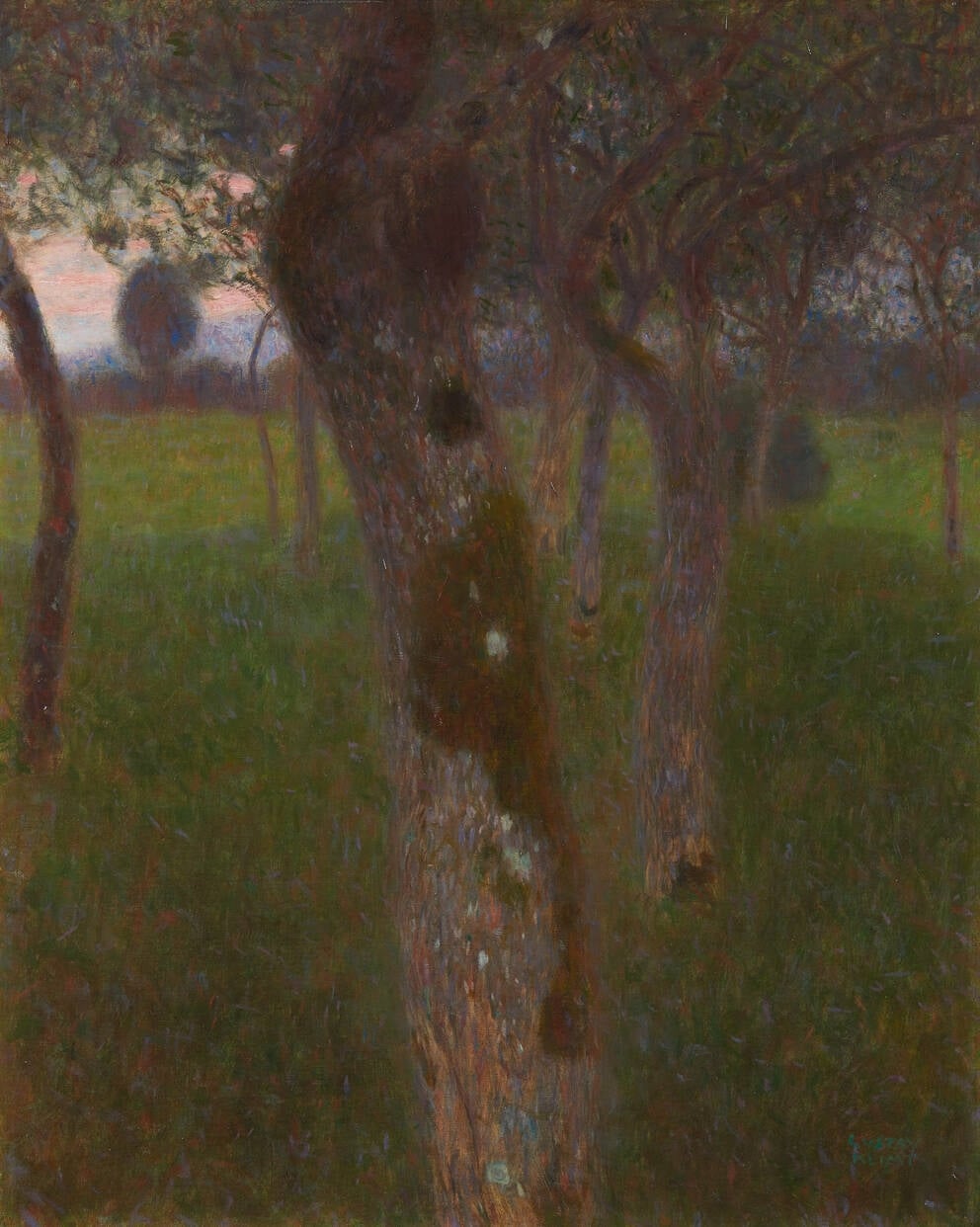
Orchard in the Evening
Gustav Klimt (1898)
Gustav Klimt’s Orchard in the Evening compresses a grove of fruit trees into a shallow, <strong>planar</strong> field where trunks press forward and dusk thins the color. A pale <strong>twilight</strong> band at the high horizon seals the space, turning observed nature into a contemplative, <strong>ornamental</strong> enclosure <sup>[1]</sup><sup>[2]</sup>.
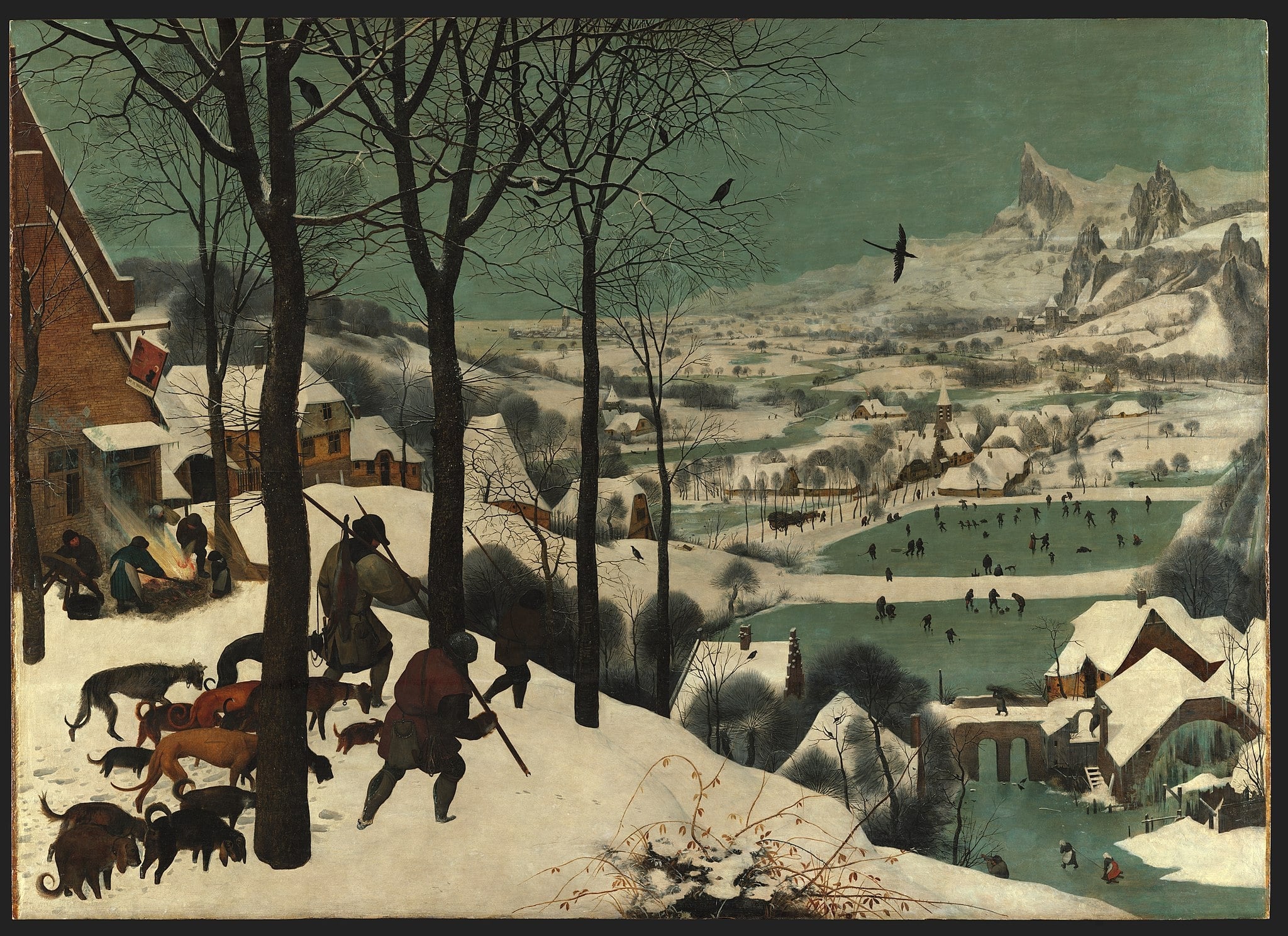
The Return of the Hunters
Pieter Bruegel the Elder (1565)
In The Return of the Hunters, Pieter Bruegel the Elder stages a wintry descent where three exhausted hunters and their dogs enter a valley alive with skaters and village chores. The painting forges a panoramic drama of <strong>hardship and resilience</strong>, contrasting scant game with communal play beneath a cold, teal sky <sup>[1]</sup><sup>[2]</sup>.
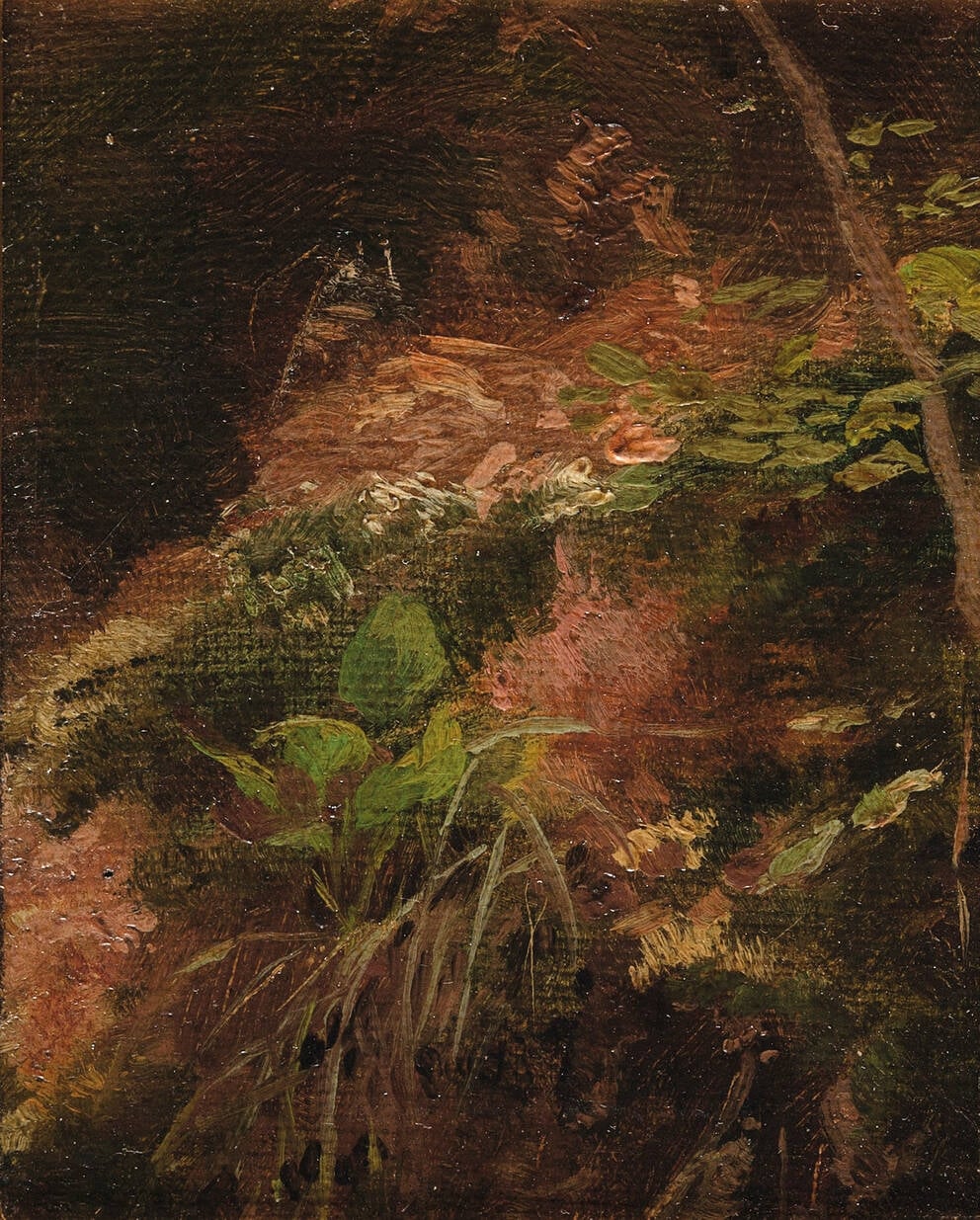
Forest Floor
Gustav Klimt (c. 1881/1882)
Forest Floor concentrates the eye on a miniature world of soil, moss, and leaf-litter rendered in tactile strokes and dark-to-amber light. Klimt frames a diagonal bank with a small sapling and sprouting leaves, turning the ground into a <strong>living tapestry</strong> of decay and renewal <sup>[1]</sup>. As an early oil sketch, it fuses <strong>academic chiaroscuro</strong> with a proto-decorative rhythm that hints at later developments <sup>[1]</sup>.
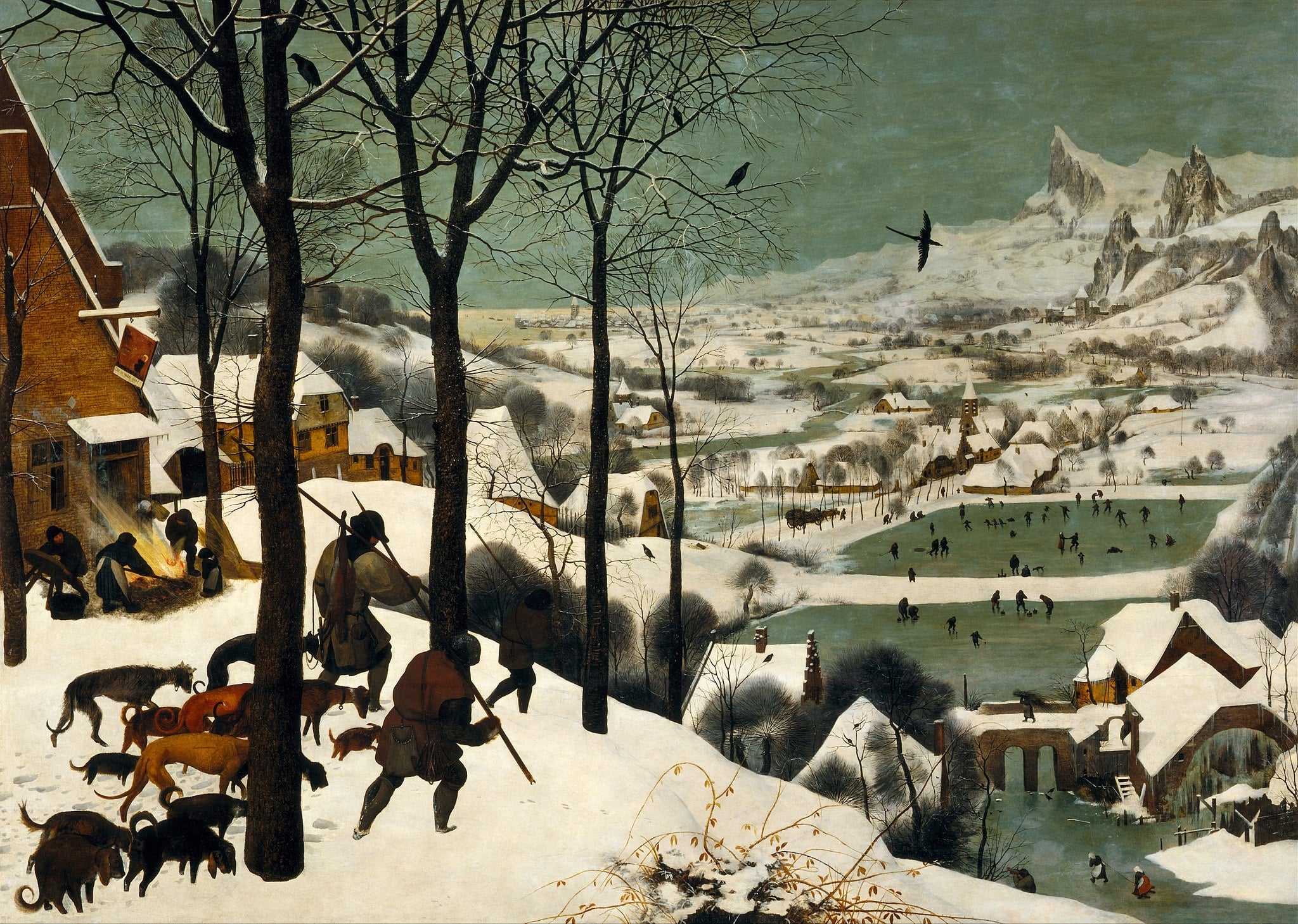
Hunters in the Snow
Pieter Bruegel the Elder (1565)
In Pieter Bruegel the Elder’s <strong>Hunters in the Snow</strong> (1565), a trio of tired hunters and <strong>gaunt dogs</strong> descend past an inn toward a vast frozen valley where villagers <strong>work, play, and endure</strong>. Bruegel fuses <strong>winter scarcity</strong> (a single fox, bare trees, crows) with <strong>communal resilience</strong> (pig-singeing fire, skaters, mill smoke) to stage a world ordered by the season’s cycle.
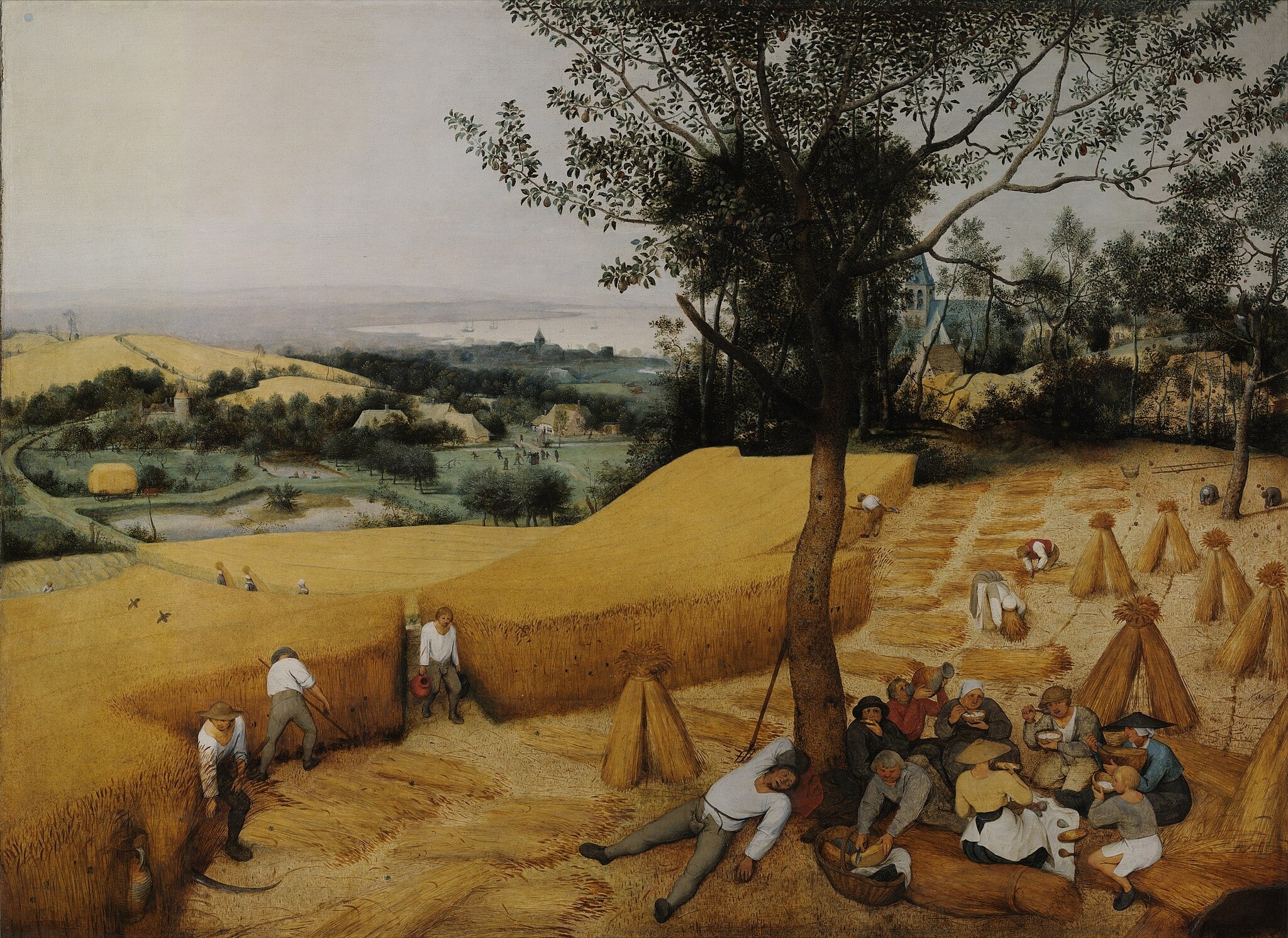
The Harvesters
Pieter Bruegel the Elder (1565)
The Harvesters distills late summer into a seamless weave of <strong>labor and reward</strong>: reapers bend to wheat while others eat and doze beneath a tree, and the world opens to roads, a village, and ships. Bruegel dignifies every action with <strong>even light</strong> and a democratic gaze, turning a specific day’s work into an image of <strong>cyclical time</strong> and shared sustenance <sup>[1]</sup><sup>[4]</sup>.
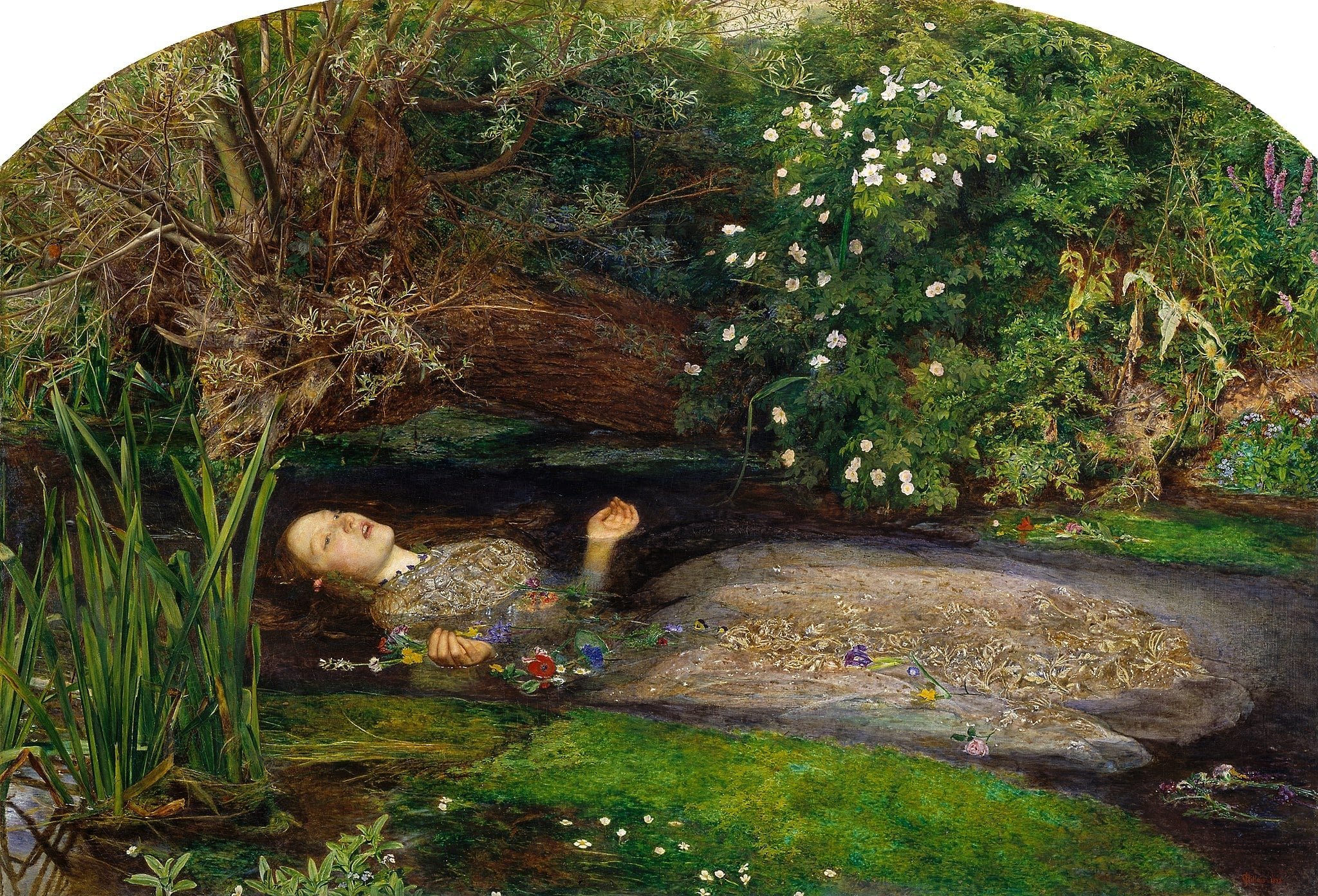
Ophelia
John Everett Millais (1851–1852)
John Everett Millais’s Ophelia shows Shakespeare’s heroine floating in a narrow stream, her jeweled dress both buoying and engulfing her. Millais renders the riverbank with <strong>forensic botanical precision</strong>, so that reeds, willow, briars, nettles, and a scatter of emblematic flowers surround a face slack in mid‑song and hands raised in <strong>open‑palmed surrender</strong> <sup>[1]</sup><sup>[3]</sup>.