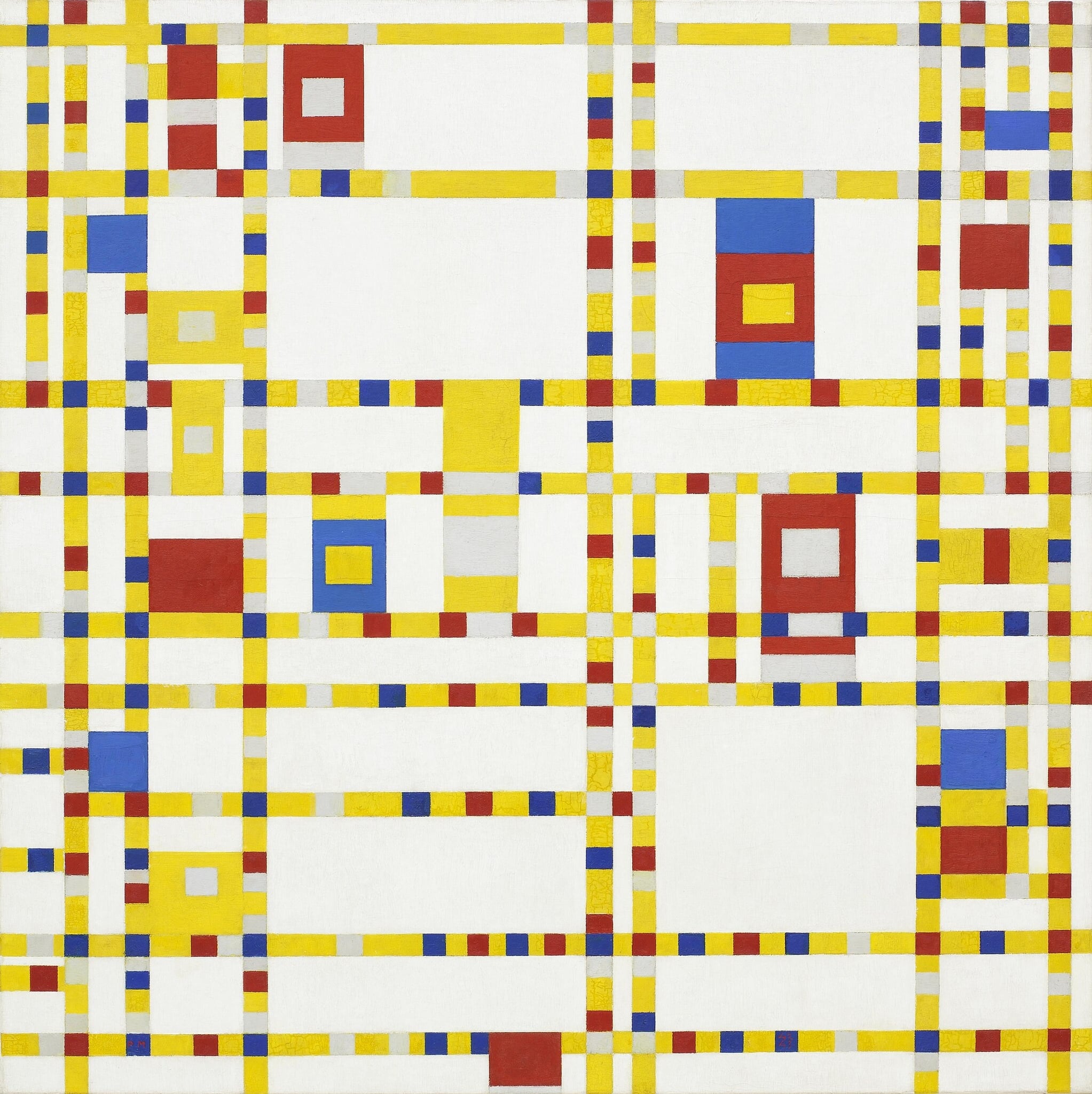
Orthogonal grid Symbolism
An orthogonal grid is a right-angled lattice artists use to impose order and measure space. In modern geometric abstraction it functions as a sign of rational structure while evoking mapping, architecture, and modular rhythm. Its even intervals can also suggest musical regularity, turning visual composition into a kind of score.
Orthogonal grid in Broadway Boogie Woogie
In Broadway Boogie Woogie (1942–1943), Piet Mondrian turns the grid into a dynamic emblem of urban and musical order. Intersecting yellow bands, punctuated by red, blue, white, and light gray units, create a syncopated beat across broad white blocks that read as pauses and city blocks; the orthogonal framework organizes the canvas like a street plan while also measuring time like bars in music. By replacing black bars with vibrating color, Mondrian makes the grid an active symbol of New York’s pulse, aligning urban mapping and rational structure with boogie-woogie’s regularity and variation.