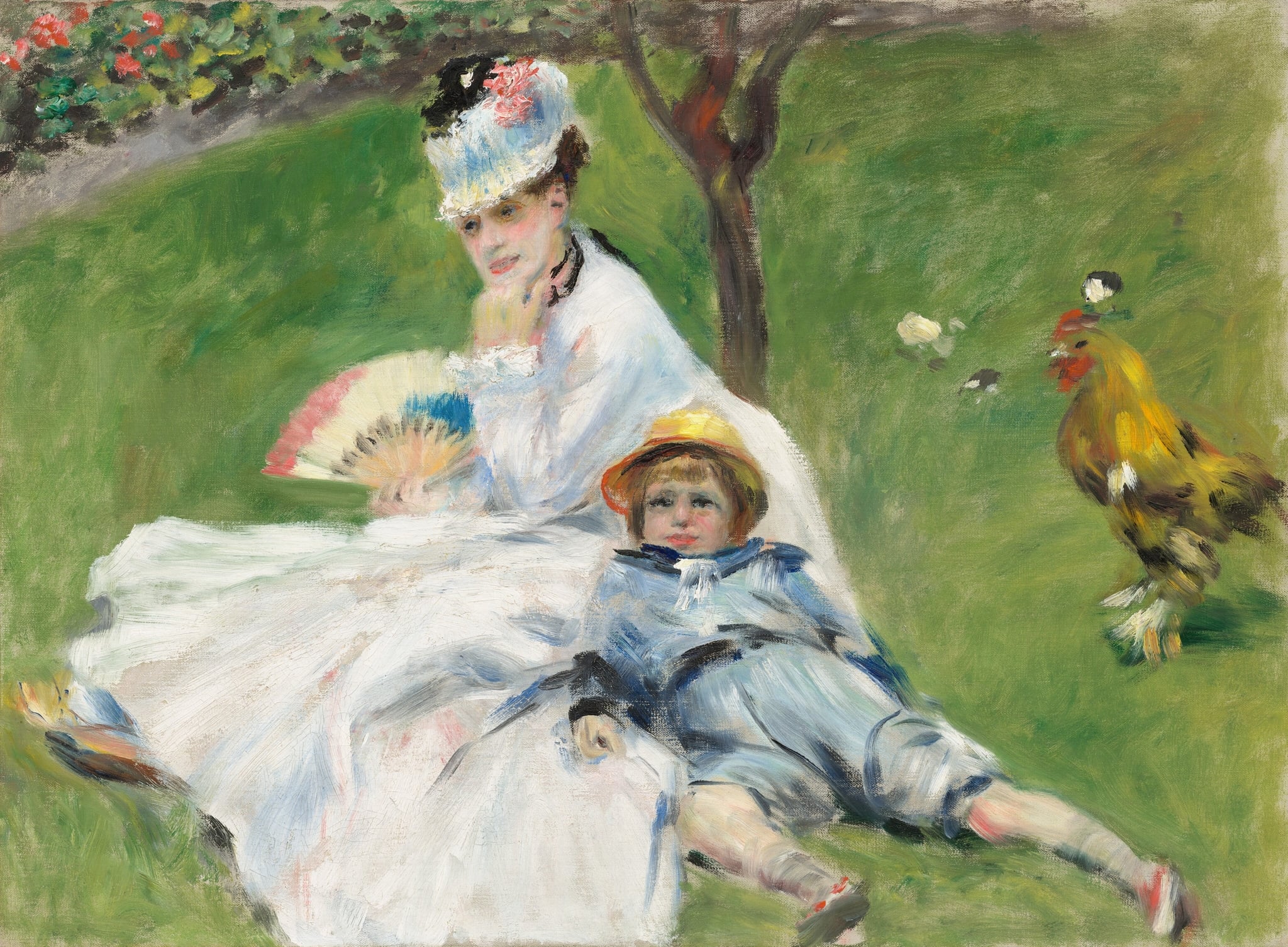
White dress Symbolism
A white dress often operates as a luminous surface that catches and reflects daylight, making light itself a visible subject. In Impressionist practice—as exemplified by Renoir’s 1874 canvas—it also signals modern outdoor leisure and a sense of cleanliness and clarity.
White dress in Madame Monet and Her Son
In Pierre-Auguste Renoir’s Madame Monet and Her Son (1874), the white dress spreads into sunshine and becomes a light-gathering plane, helping the plein-air moment read as lived rather than staged. Its radiance anchors the garden setting, plays against the child’s pale-blue sailor suit, and heightens the warm accent of the strutting rooster. Renoir’s fused brushwork allows fabric and foliage to intermingle, turning the dress into a register of changing outdoor light and an emblem of modern domestic leisure in Argenteuil.