Fashion & adornment
Featured Artworks
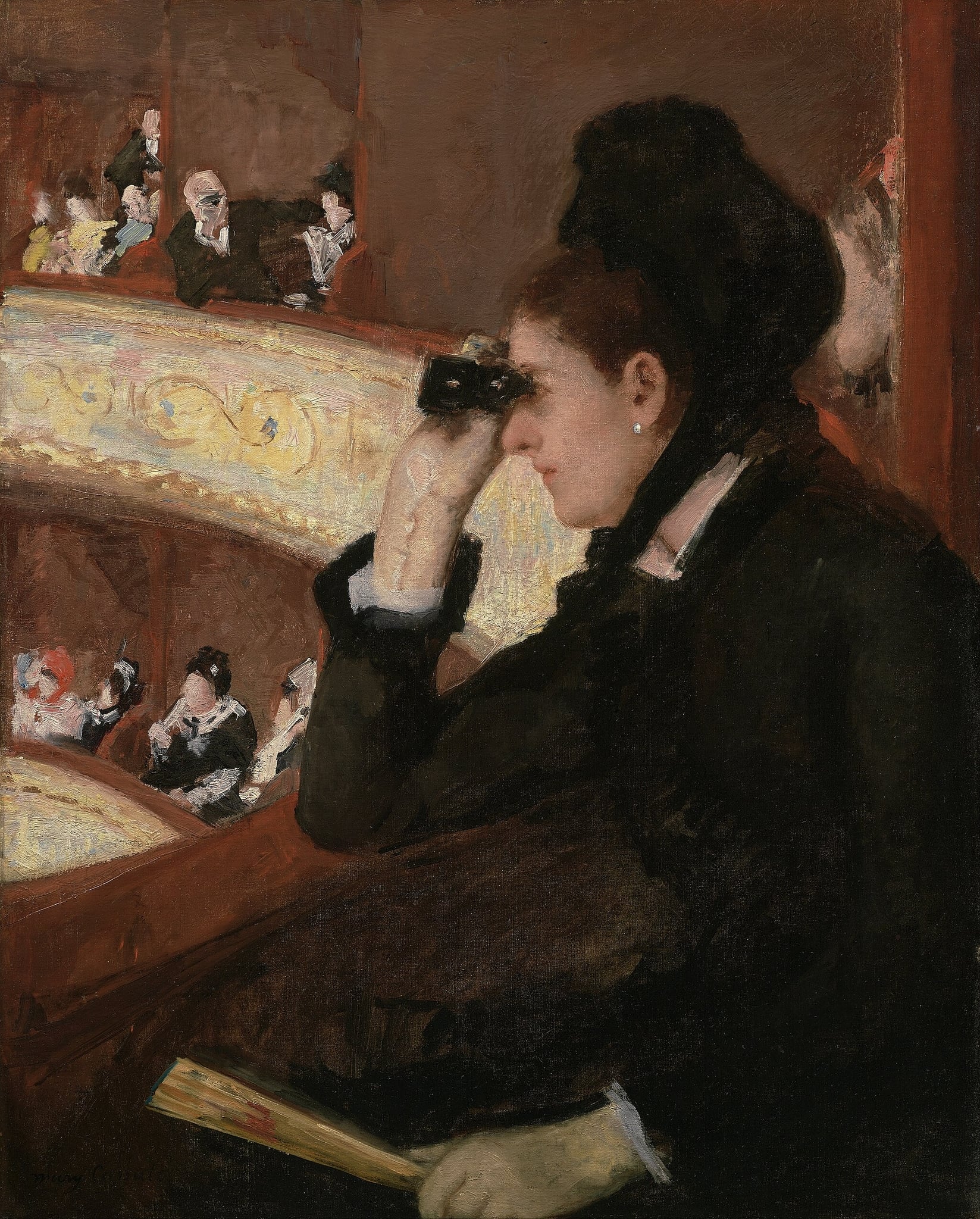
Woman in Black at the Opera
Mary Cassatt (1878)
Mary Cassatt’s Woman in Black at the Opera stages a taut drama of vision and visibility. A woman in <strong>black attire</strong> raises <strong>opera glasses</strong> while a distant man aims his own at her, setting off a chain of looks that makes public leisure a site of <strong>power, agency, and surveillance</strong> <sup>[1]</sup><sup>[2]</sup>.
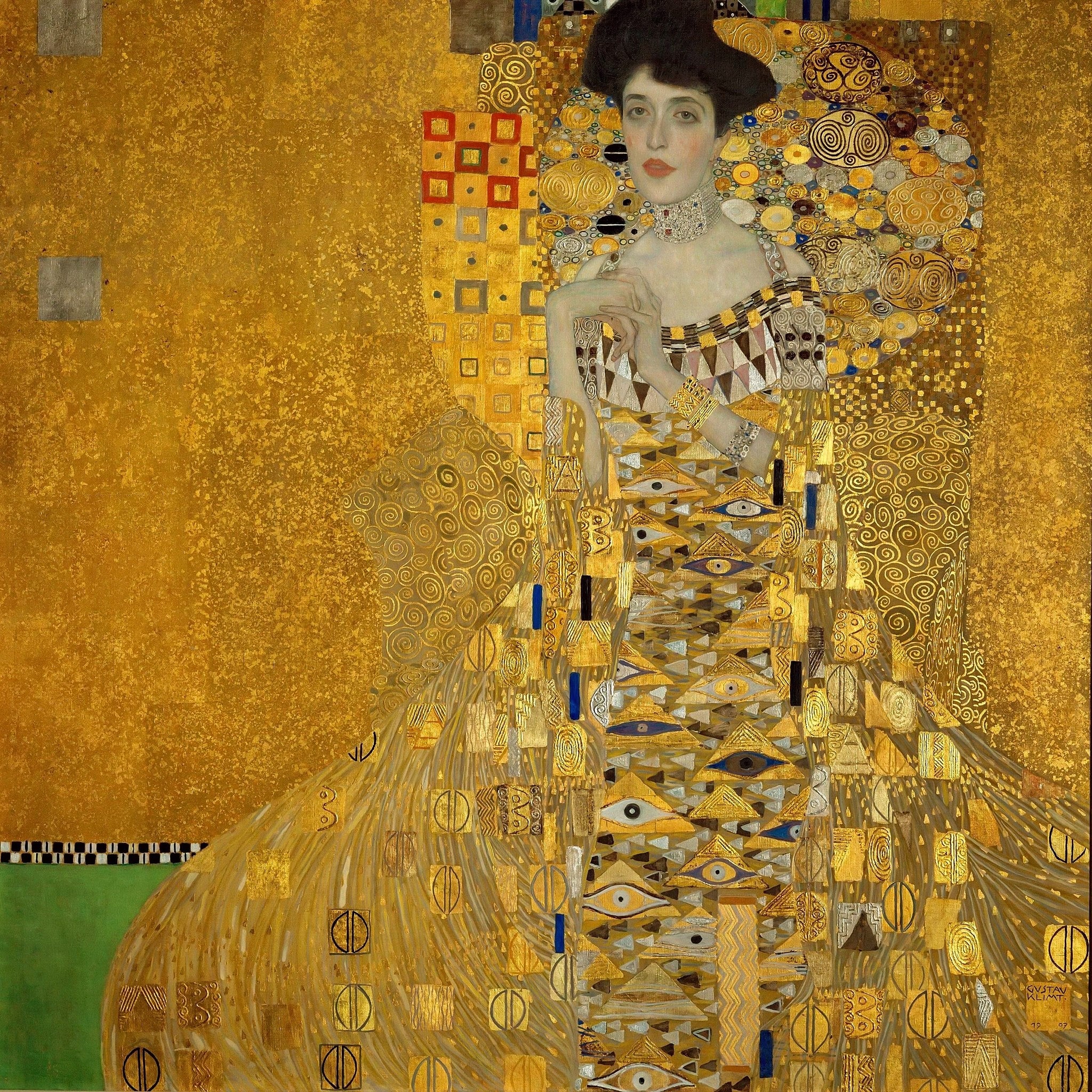
Portrait of Adele Bloch-Bauer I
Gustav Klimt (1907)
Gustav Klimt’s Portrait of Adele Bloch-Bauer I stages its sitter as a <strong>secular icon</strong>—a living presence suspended in a field of gold that converts space into <strong>pattern and power</strong>. The naturalistic face and hands emerge from a reliquary-like cascade of eyes, triangles, and tesserae, turning light, ornament, and status into the painting’s true subjects <sup>[1]</sup><sup>[2]</sup>.
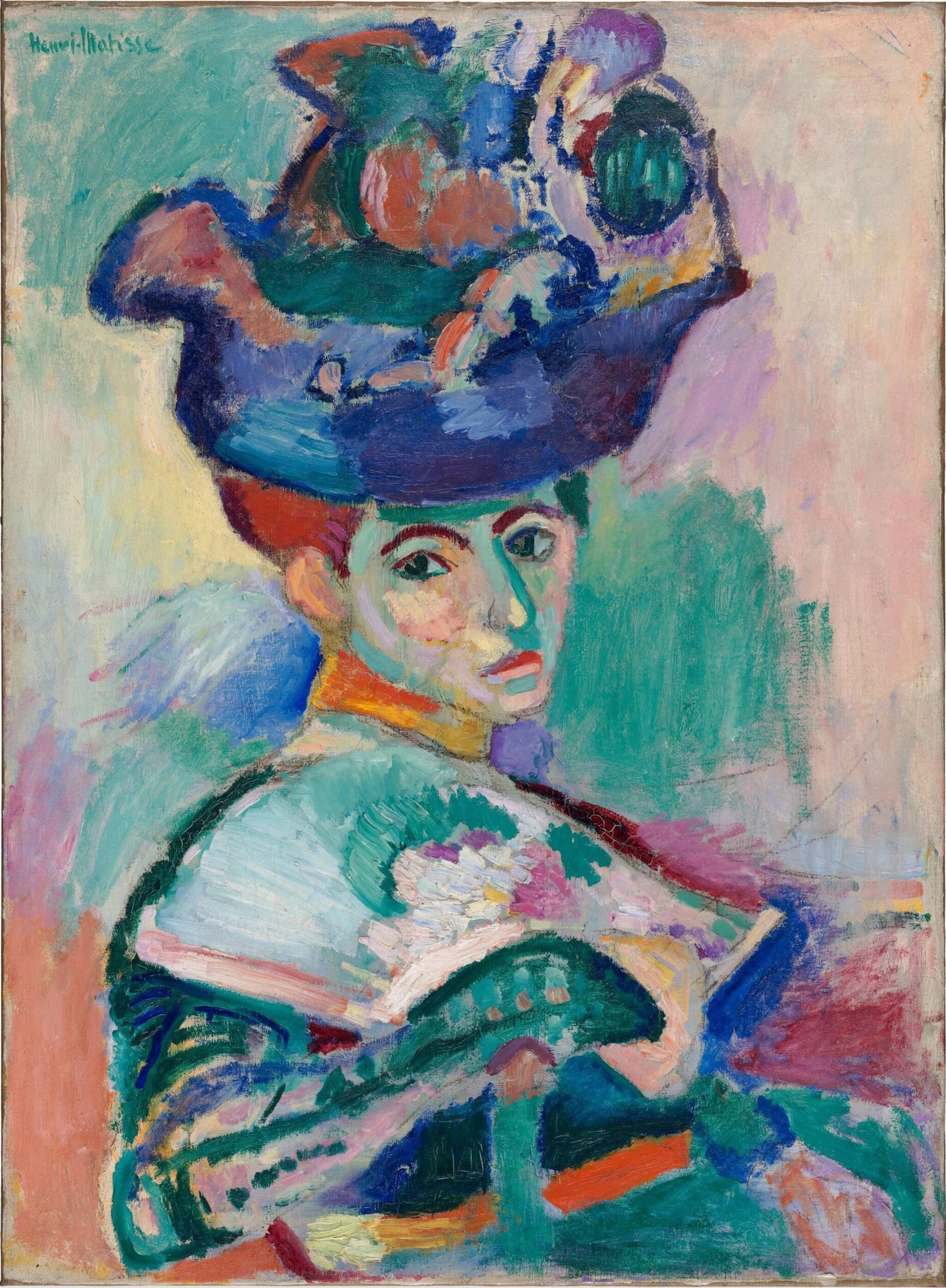
Woman with a Hat
Henri Matisse (1905)
In Woman with a Hat, Henri Matisse turns portraiture into a laboratory for <strong>pure color</strong> and <strong>modern identity</strong>. Jagged greens and violets carve the face; the hat detonates into a crown of brushstrokes; a fan slices the torso into bright planes. The result declares Fauvism’s credo: <strong>feeling over description</strong> <sup>[1]</sup><sup>[2]</sup>.

The Tea
Mary Cassatt (about 1880)
Mary Cassatt’s The Tea stages a poised, interior <strong>drama of manners</strong>: two women sit close yet feel apart, one thoughtful, the other raising a cup that <strong>veils her face</strong>. A gleaming, oversized <strong>silver tea service</strong> commands the foreground, its reflections turning ritual objects into actors in the scene <sup>[1]</sup>. The shallow, cropped room—striped wall, gilt mirror, marble mantel—compresses the atmosphere into <strong>intimacy edged by restraint</strong>.
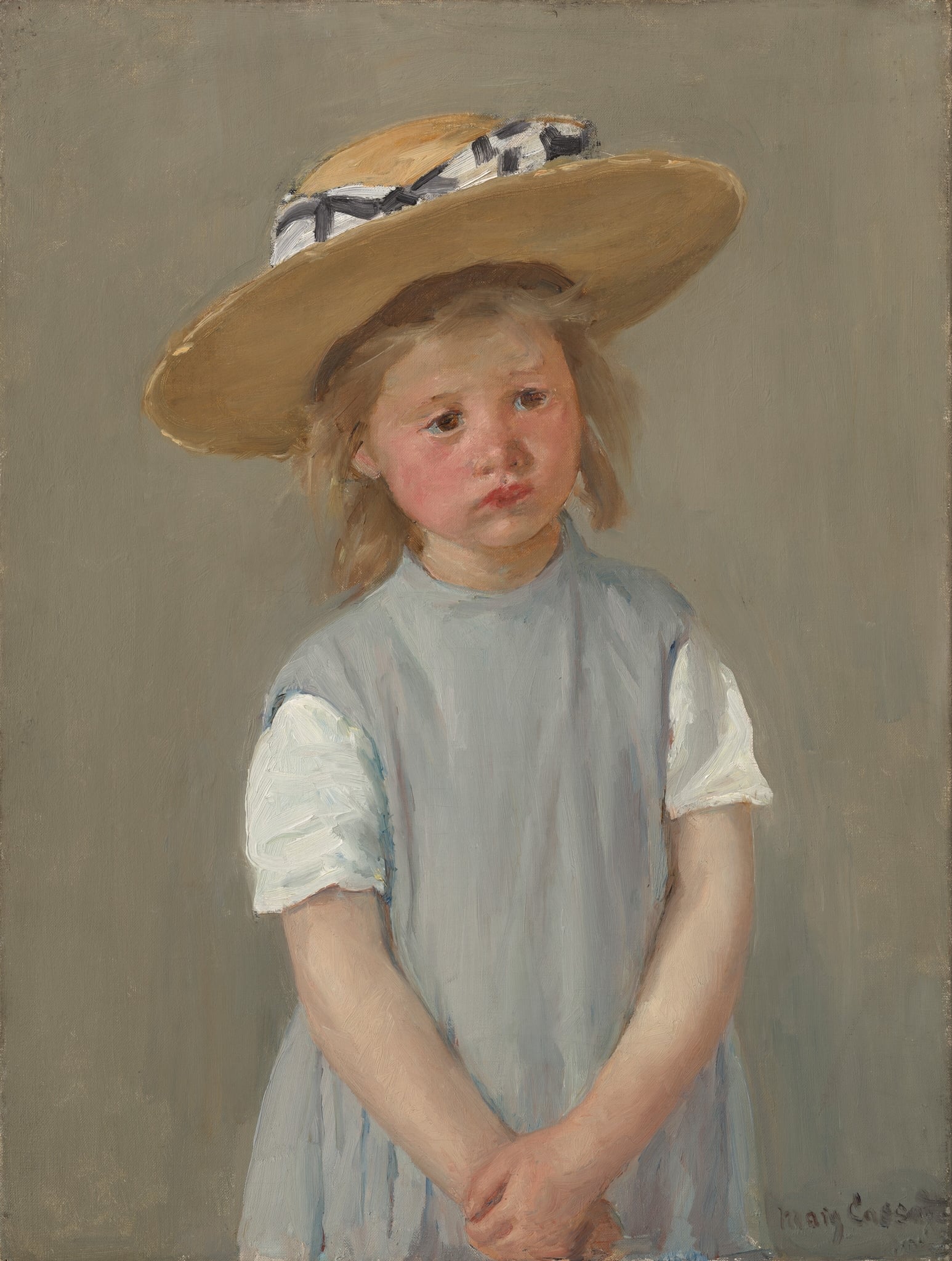
Little Girl in a Big Straw Hat and a Pinafore
Mary Cassatt (c. 1886)
Mary Cassatt’s Little Girl in a Big Straw Hat and a Pinafore distills childhood into a quiet drama of <strong>interiority</strong> and <strong>constraint</strong>. The oversized straw hat and plain pinafore bracket a flushed face, downcast eyes, and <strong>clasped hands</strong>, turning a simple pose into a study of modern self‑consciousness <sup>[1]</sup>. Cassatt’s cool grays and swift, luminous strokes make mood—not costume—the subject.
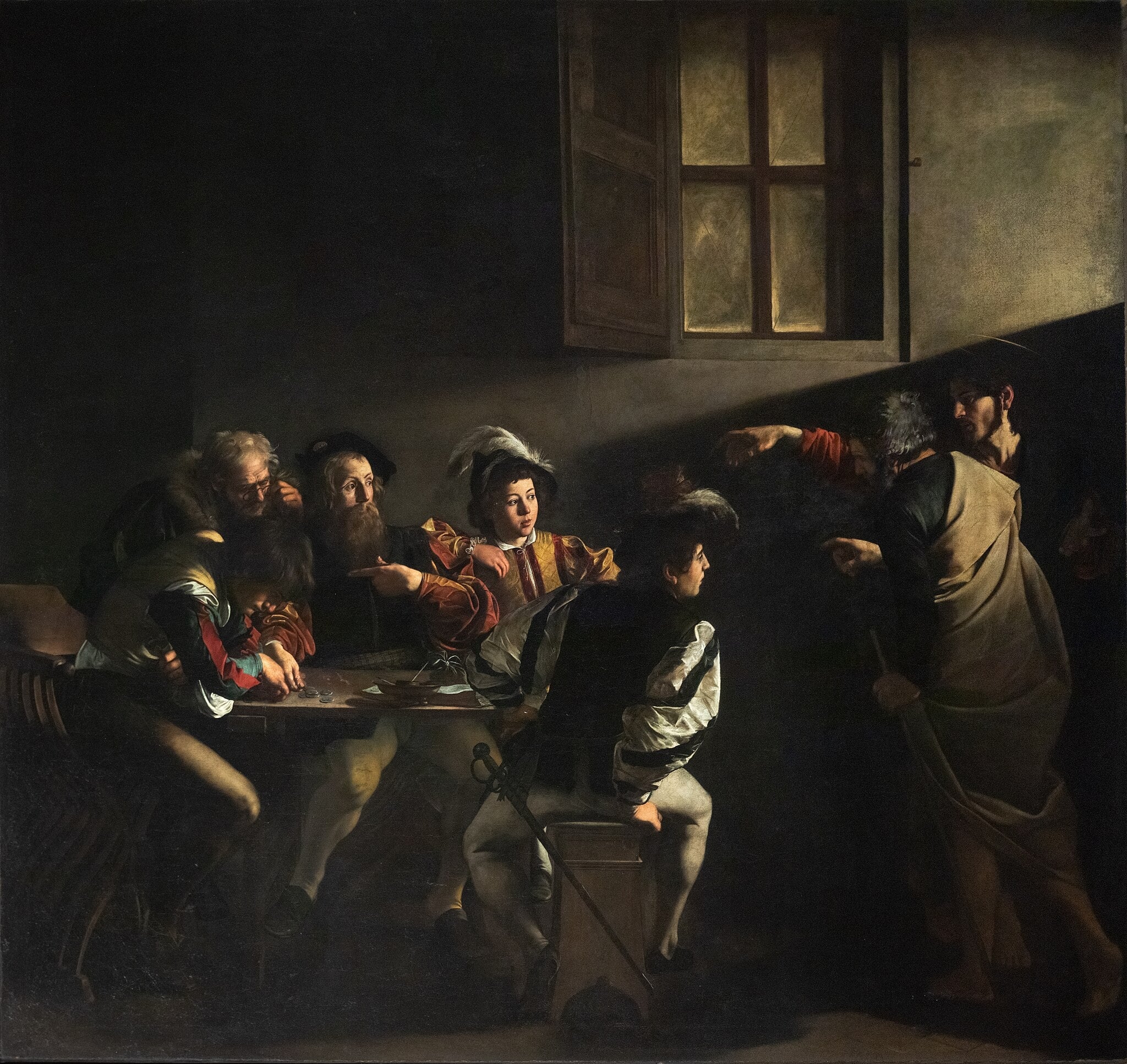
The Calling of Saint Matthew
Caravaggio (1599–1600)
Caravaggio’s The Calling of Saint Matthew stages the instant when <strong>divine grace</strong> pierces ordinary life. A diagonal <strong>beam of light</strong> and Christ’s <strong>Sistine‑echoing hand</strong> single out Matthew at a money table, suspending time between hesitation and assent <sup>[2]</sup><sup>[3]</sup>. The painting fuses Baroque <strong>tenebrism</strong> with contemporary dress to dramatize conversion as a public, present-tense event <sup>[1]</sup><sup>[2]</sup>.
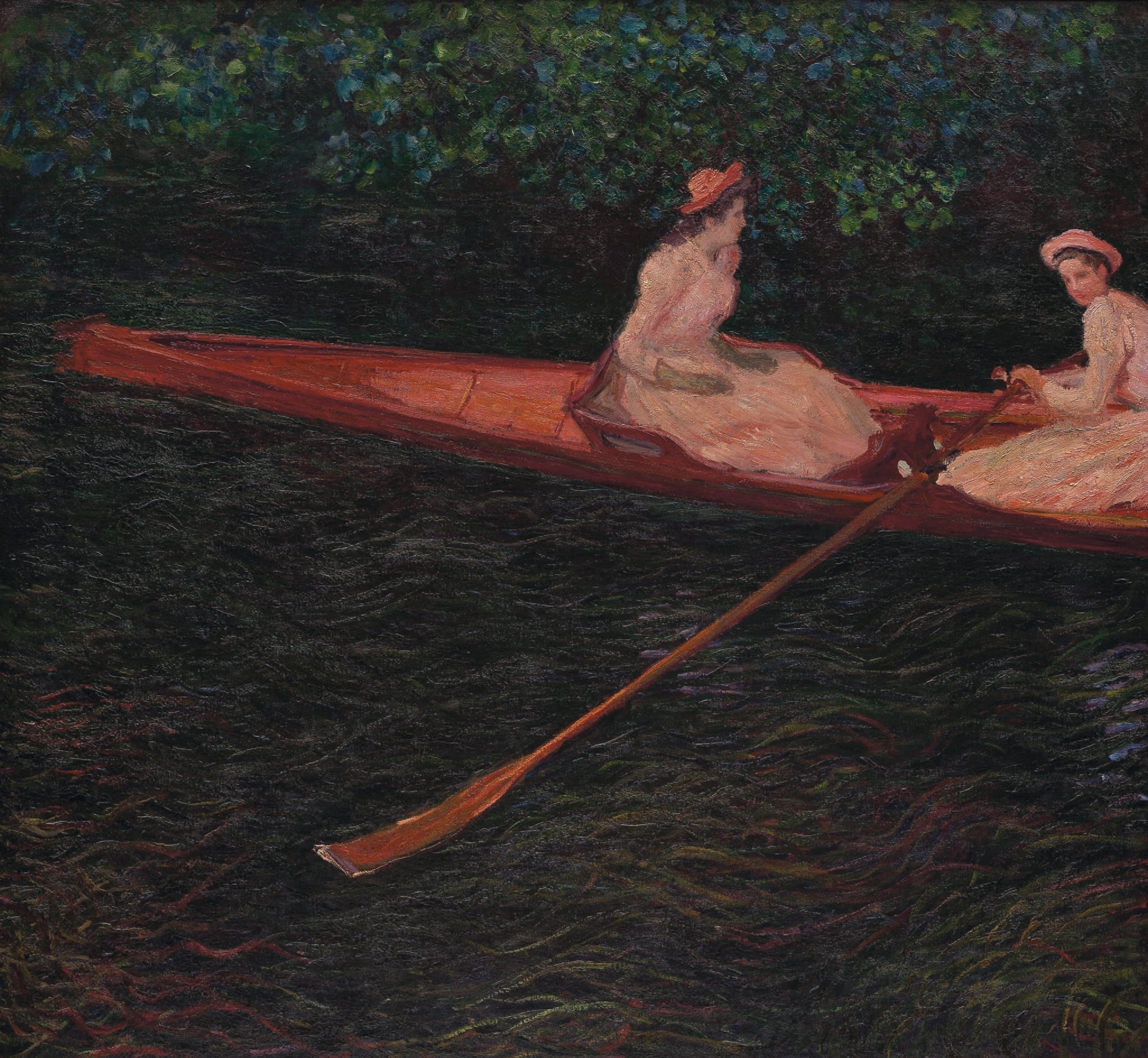
Boating
Claude Monet (1887)
Monet’s Boating crystallizes modern leisure as a drama of perception, setting a slim skiff and two pale dresses against a field of dark, mobile water. Bold cropping, a thrusting oar, and the complementary flash of hull and foliage convert a quiet outing into an experiment in <strong>modern vision</strong> and the <strong>materiality of water</strong> <sup>[1]</sup><sup>[2]</sup>.
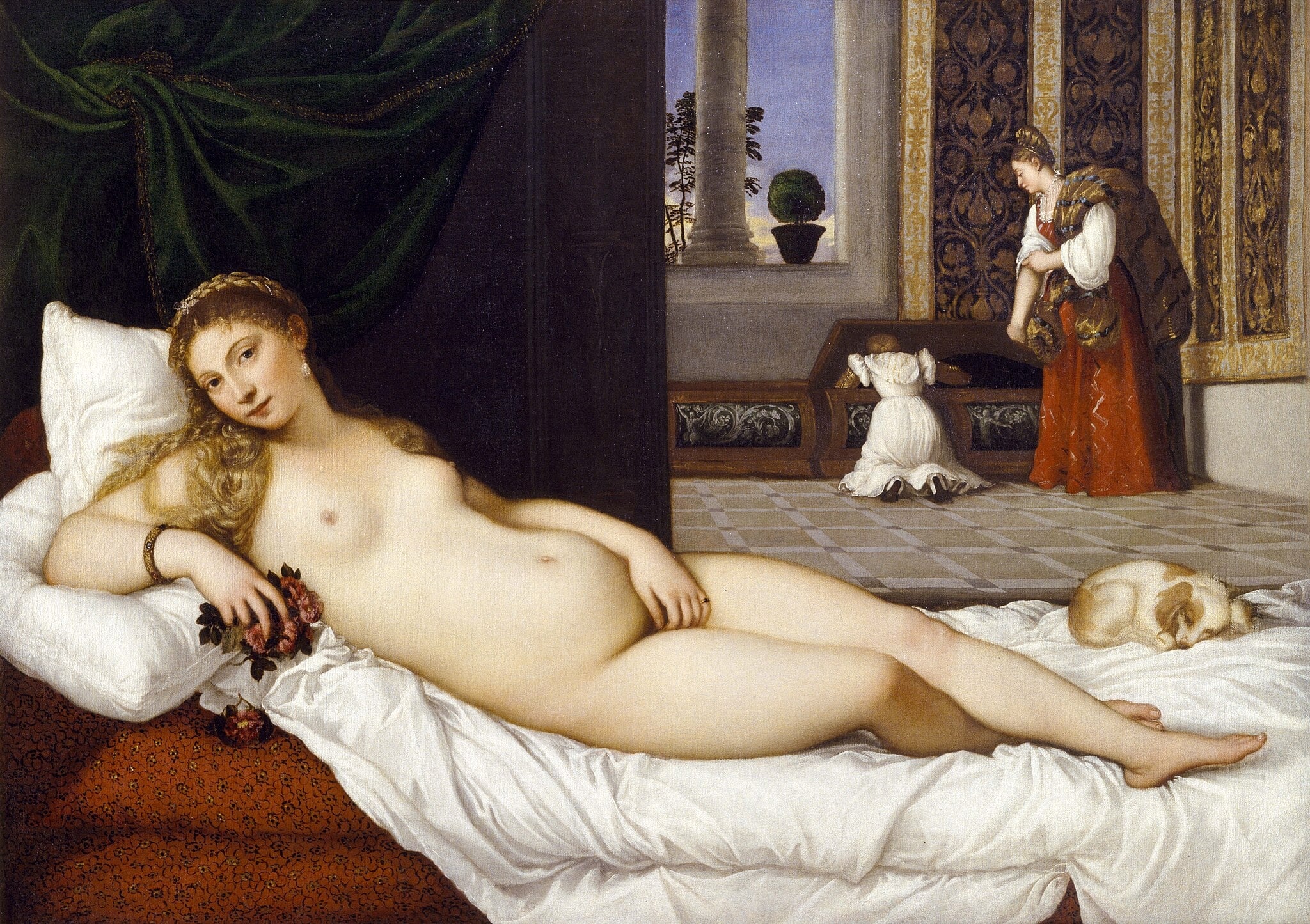
Venus of Urbino
Titian (1538)
Titian’s Venus of Urbino turns the mythic goddess into an ideal bride, merging frank <strong>eroticism</strong> with the codes of <strong>marital fidelity</strong>. In a Venetian bedroom, the nude’s direct gaze, roses, sleeping lapdog, and attendants at a cassone bind desire to domestic virtue and fertility <sup>[1]</sup><sup>[2]</sup>.
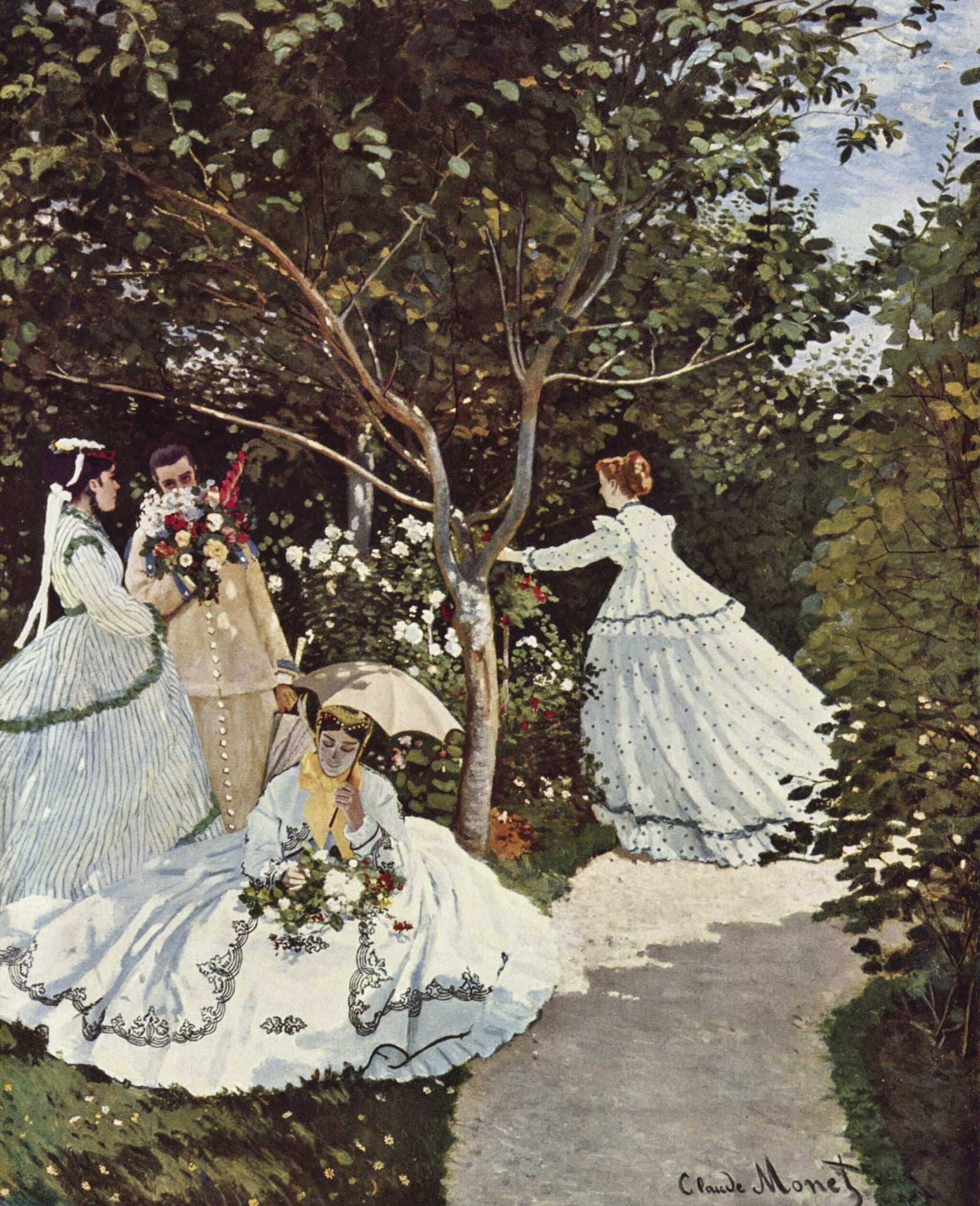
Women in the Garden
Claude Monet (1866–1867)
Claude Monet’s Women in the Garden choreographs four figures in a sunlit bower to test how <strong>white dresses</strong> register <strong>dappled light</strong> and shadow. The path, parasol, and clipped flowers frame a modern ritual of leisure while turning fashion into an instrument of <strong>perception</strong>. The scene reads less as portraiture than as a manifesto for painting the <strong>momentary</strong> outdoors <sup>[1]</sup><sup>[3]</sup>.
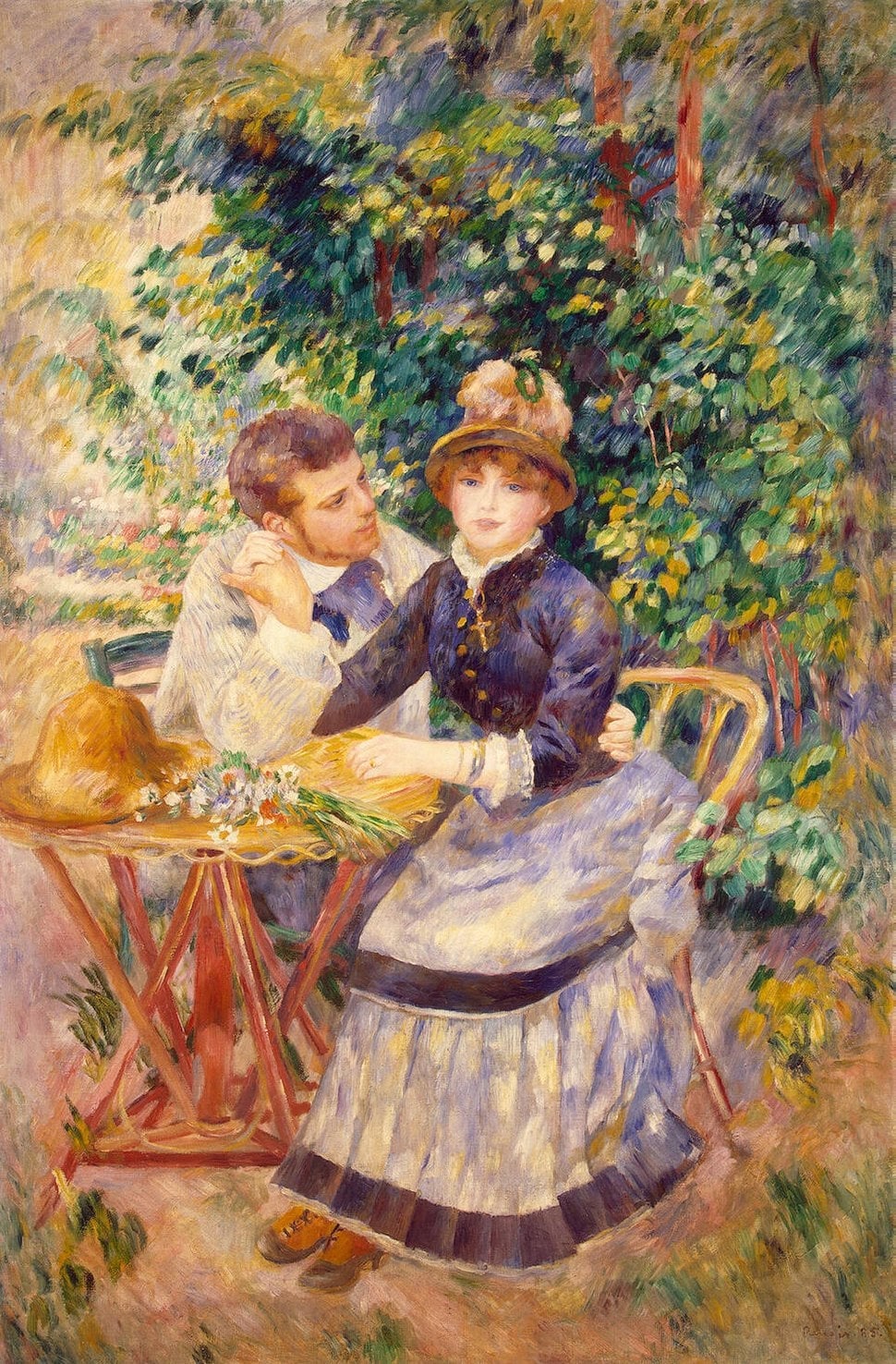
In the Garden
Pierre-Auguste Renoir (1885)
In the Garden presents a charged pause in modern leisure: a young couple at a café table under a living arbor of leaves. Their lightly clasped hands and the bouquet on the tabletop signal courtship, while her calm, front-facing gaze checks his lean. Renoir’s flickering brushwork fuses figures and foliage, rendering love as a <strong>transitory, luminous sensation</strong> <sup>[1]</sup><sup>[3]</sup>.
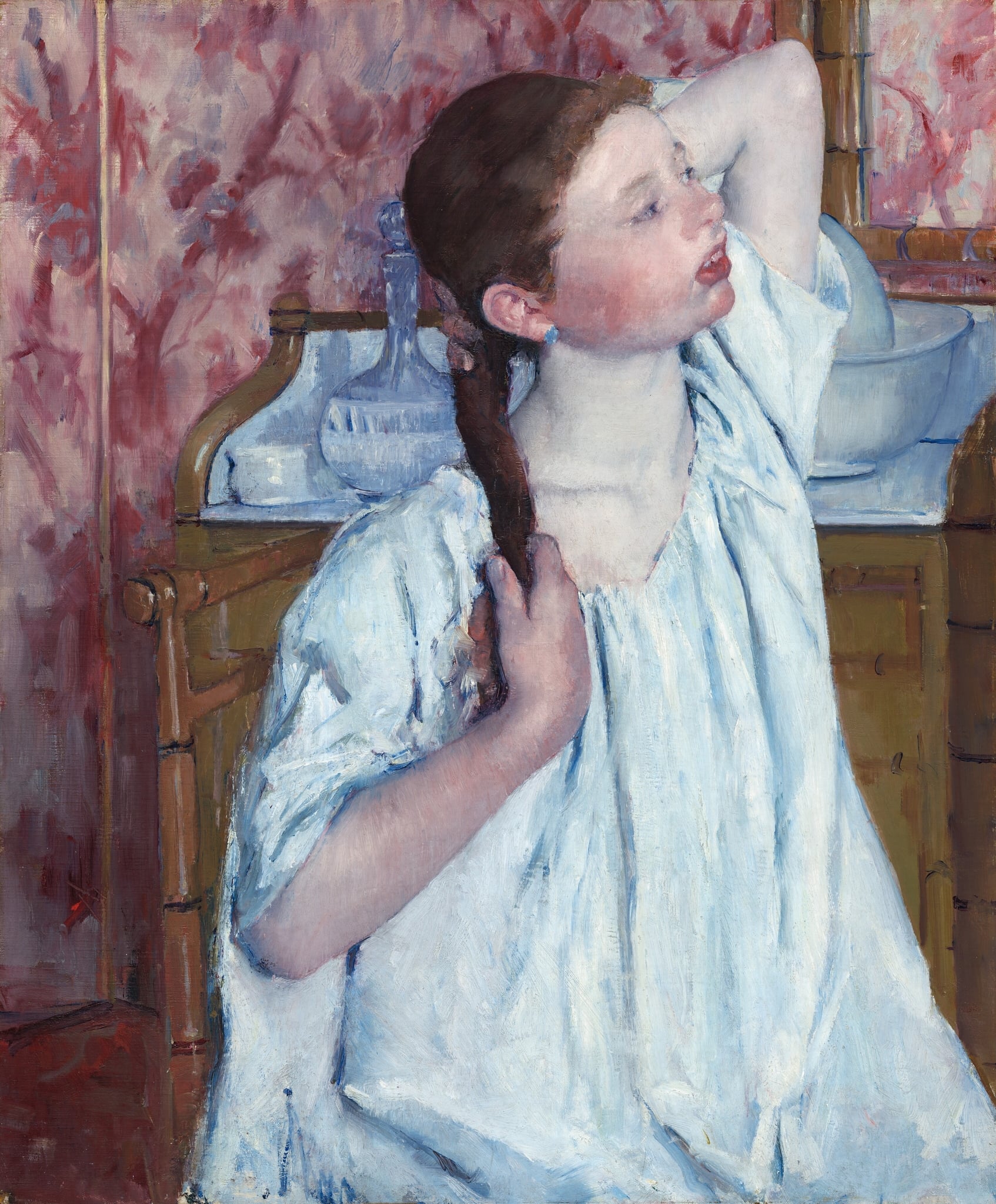
Girl Arranging Her Hair
Mary Cassatt (1886)
Mary Cassatt’s Girl Arranging Her Hair crystallizes a private rite of <strong>self‑regard</strong> into modern painting. Cool, broken strokes of the pale chemise meet the warm, patterned wall and bamboo furniture, staging a quiet drama of <strong>autonomy</strong> rather than display <sup>[1]</sup>. Exhibited in 1886, the work reframes the toilette as lived experience within Impressionism’s language of immediacy <sup>[2]</sup>.

After the Luncheon
Pierre-Auguste Renoir (1879)
After the Luncheon crystallizes a <strong>suspended instant</strong> of Parisian leisure: coffee finished, glasses dappled with light, and a cigarette just being lit. Renoir’s <strong>shimmering brushwork</strong> and the trellised spring foliage turn the scene into a tapestry of conviviality where time briefly pauses.
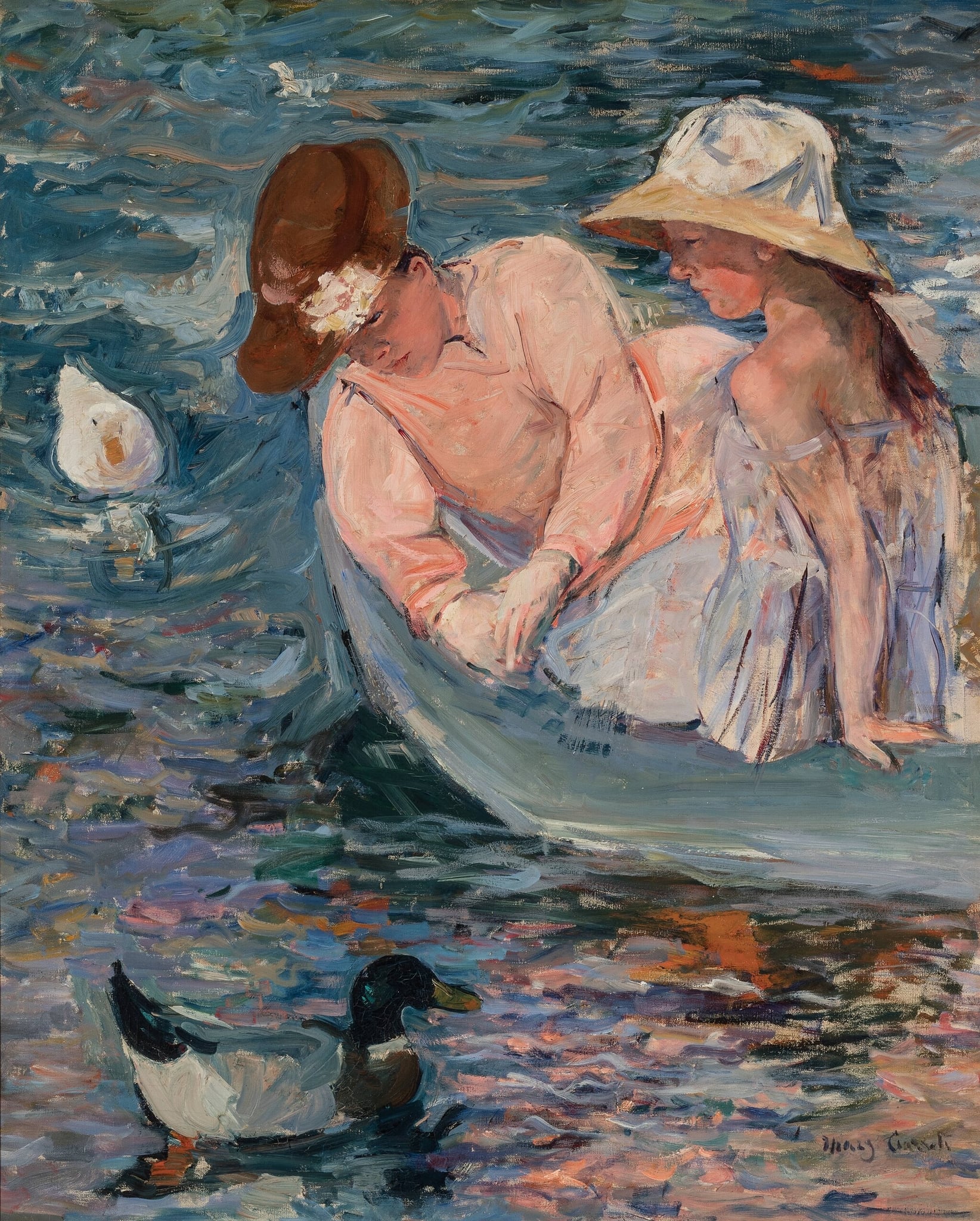
Summertime
Mary Cassatt (1894)
Mary Cassatt’s Summertime (1894) stages a quiet drama of <strong>attentive looking</strong>: a woman and a girl lean from a cropped boat toward two ducks as the lake flickers with broken color. Cassatt fuses <strong>Impressionism</strong> and <strong>Japonisme</strong>—no horizon, tipped perspective, and abrupt cropping—to press our gaze downward into light-spattered water. The result is an image of <strong>modern leisure</strong> that is also a study of perception itself <sup>[1]</sup>.
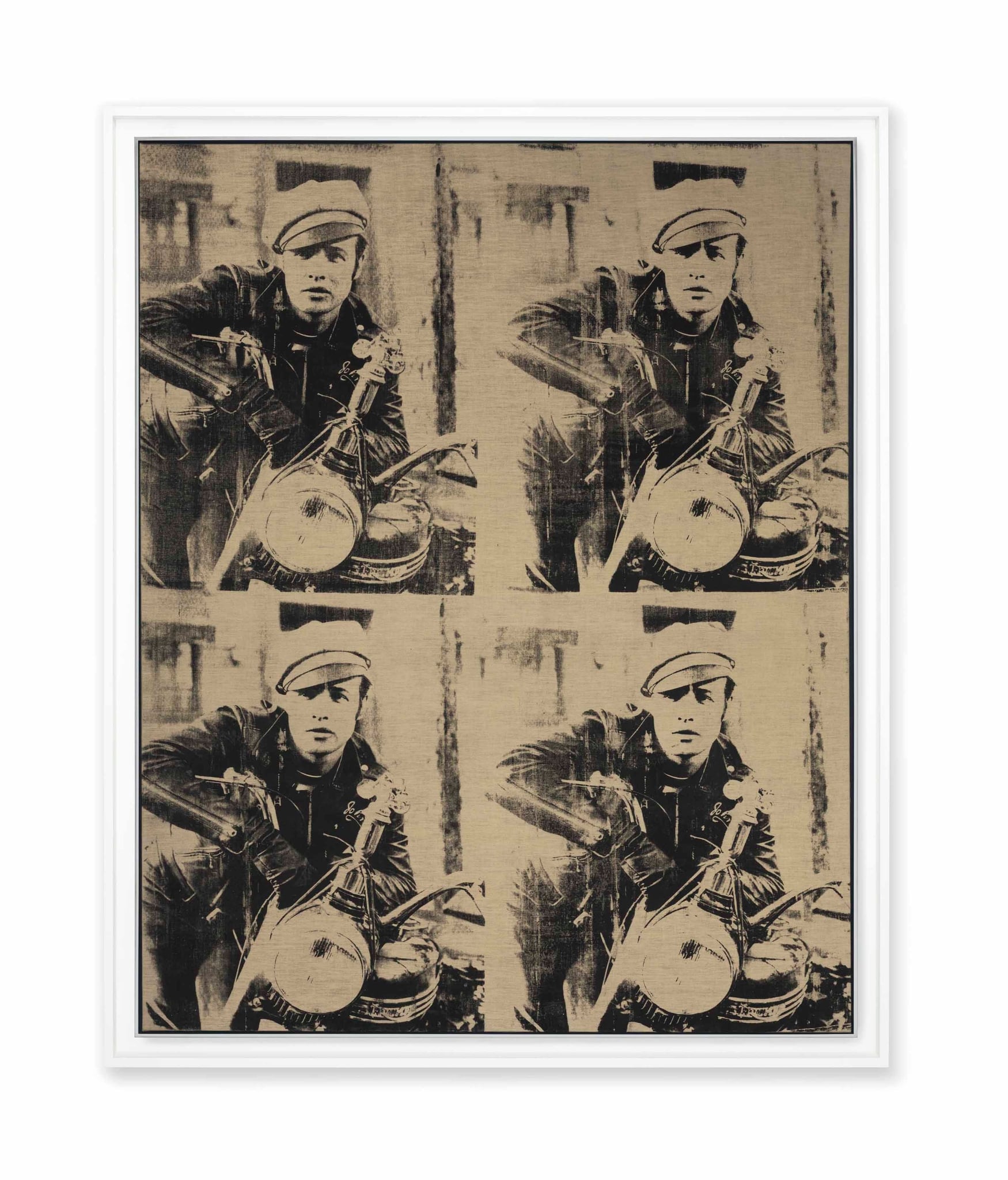
Four Marlons
Andy Warhol (1966)
Four Marlons is a 1966 silkscreen by Andy Warhol that multiplies a single biker film-still into a tight 2×2 grid on raw linen. Its inky blacks against a tan, unprimed ground turn the glare of the headlamp, the angled handlebars, and the figure’s guarded pose into a <strong>repeatable icon</strong> of outlaw cool. Warhol’s seriality both <strong>amplifies and drains</strong> the image’s aura, exposing fame as a commodity pattern <sup>[1]</sup><sup>[3]</sup>.
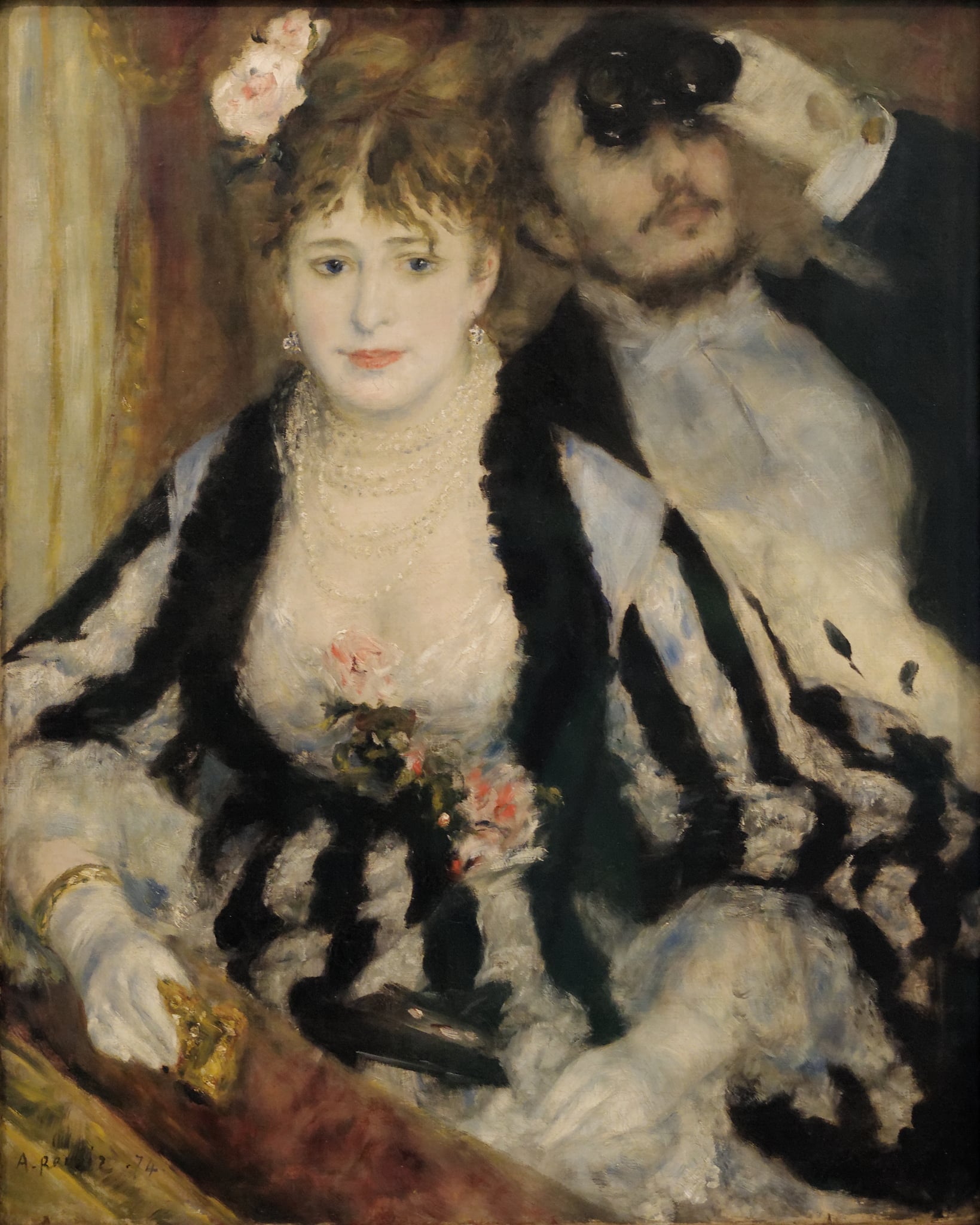
The Loge
Pierre-Auguste Renoir (1874)
Renoir’s The Loge (1874) turns an opera box into a <strong>stage of looking</strong>, where a woman meets our gaze while her companion scans the crowd through binoculars. The painting’s <strong>frame-within-a-frame</strong> and glittering fashion make modern Parisian leisure both alluring and self-conscious, turning spectators into spectacles <sup>[1]</sup><sup>[2]</sup>.
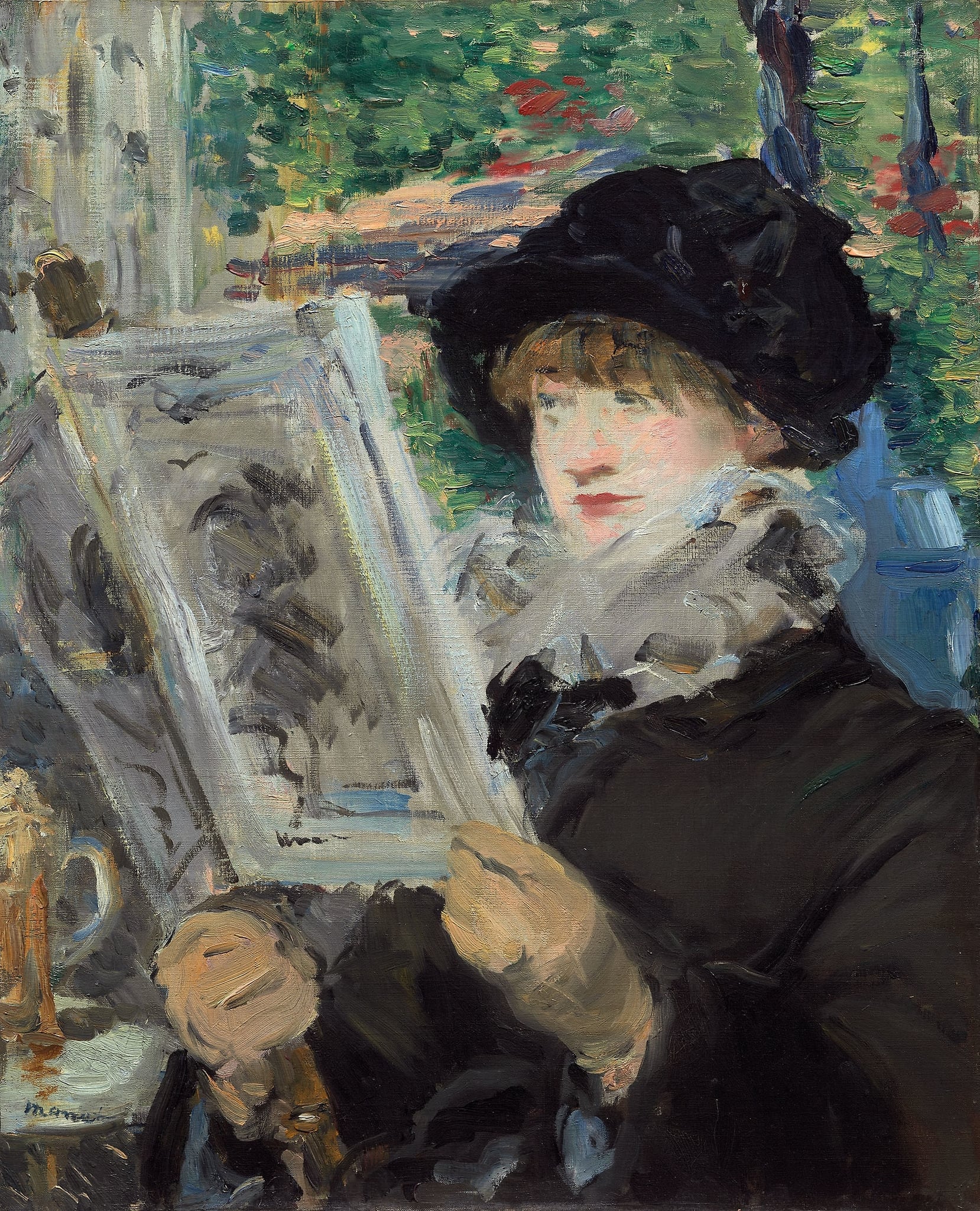
Woman Reading
Édouard Manet (1880–82)
Manet’s Woman Reading distills a fleeting act into an emblem of <strong>modern self-possession</strong>: a bundled figure raises a journal-on-a-stick, her luminous profile set against a brisk mosaic of greens and reds. With quick, loaded strokes and a deliberately cropped <strong>beer glass</strong> and paper, Manet turns perception itself into subject—asserting the drama of a private mind within a public café world <sup>[1]</sup><sup>[2]</sup>.
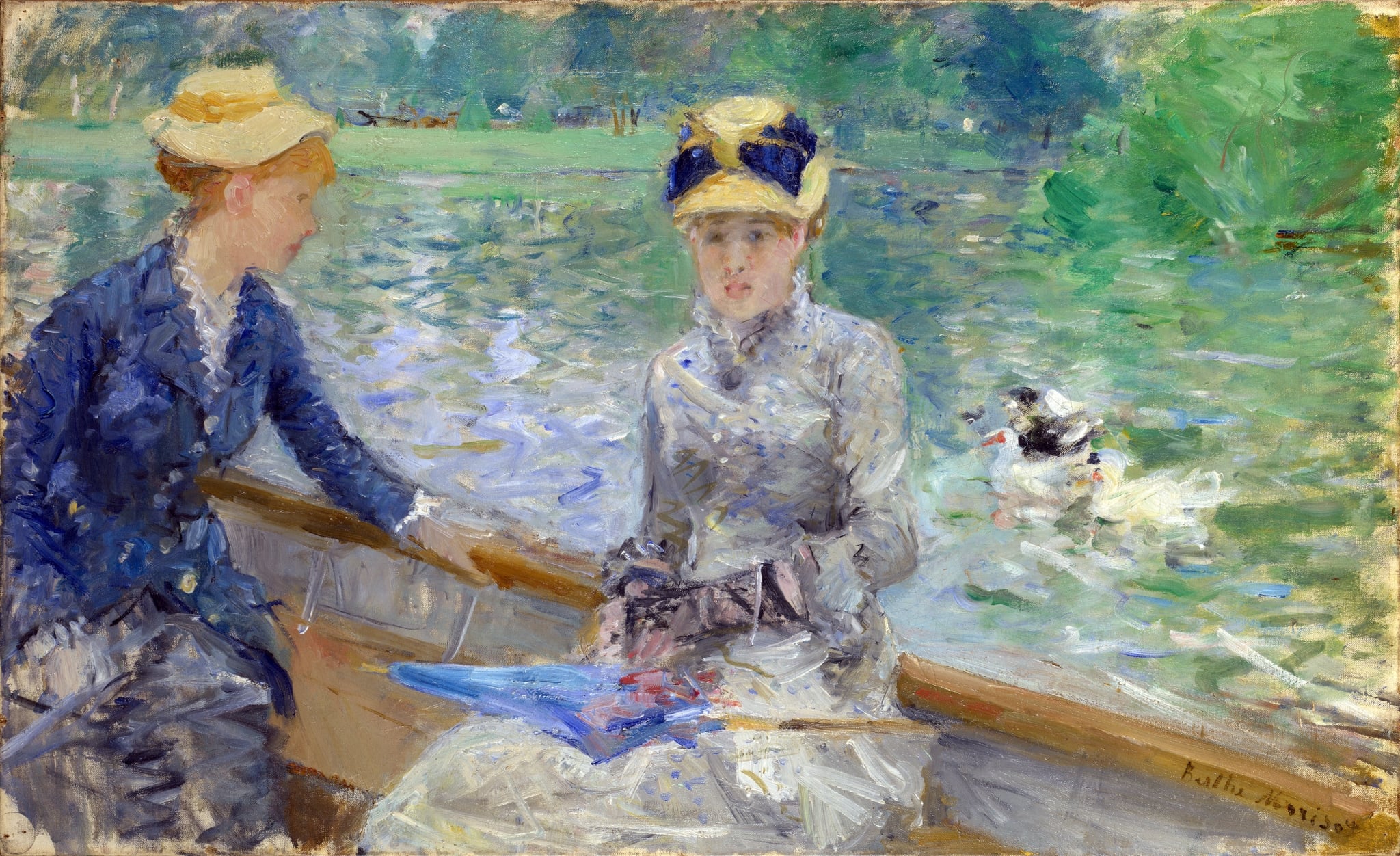
Summer's Day
Berthe Morisot (about 1879)
Two women drift on a boat in the Bois de Boulogne, their dresses, hats, and a bright blue parasol fused with the lake’s flicker by Morisot’s swift, <strong>zig‑zag brushwork</strong>. The scene turns a brief outing into a poised study of <strong>modern leisure</strong> and <strong>female companionship</strong> in public space <sup>[1]</sup>.

Jeanne (Spring)
Édouard Manet (1881)
Édouard Manet’s Jeanne (Spring) fuses a time-honored allegory with <strong>modern Parisian fashion</strong>: a crisp profile beneath a cream parasol, set against <strong>luminous, leafy greens</strong>. Manet turns couture—hat, glove, parasol—into the language of <strong>renewal and youth</strong>, making spring feel both perennial and up-to-the-minute <sup>[1]</sup><sup>[2]</sup>.
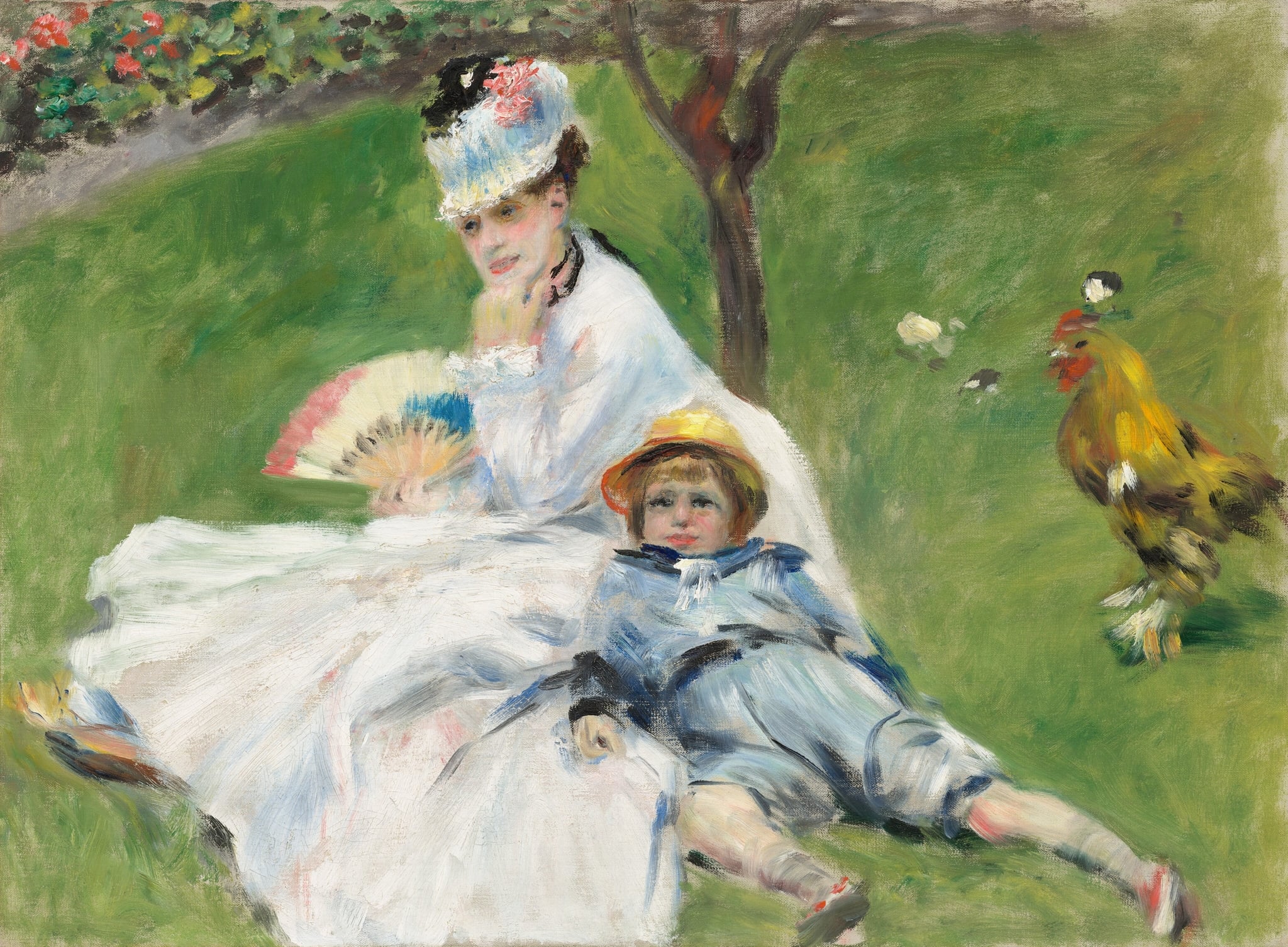
Madame Monet and Her Son
Pierre-Auguste Renoir (1874)
Renoir’s 1874 canvas Madame Monet and Her Son crystallizes <strong>modern domestic leisure</strong> and <strong>plein‑air immediacy</strong> in Argenteuil. A luminous white dress pools into light while a child in a pale‑blue sailor suit reclines diagonally; a strutting rooster punctuates the greens with warm color. The brushwork fuses figure and garden so the moment reads as <strong>lived, not staged</strong> <sup>[1]</sup><sup>[2]</sup><sup>[5]</sup>.
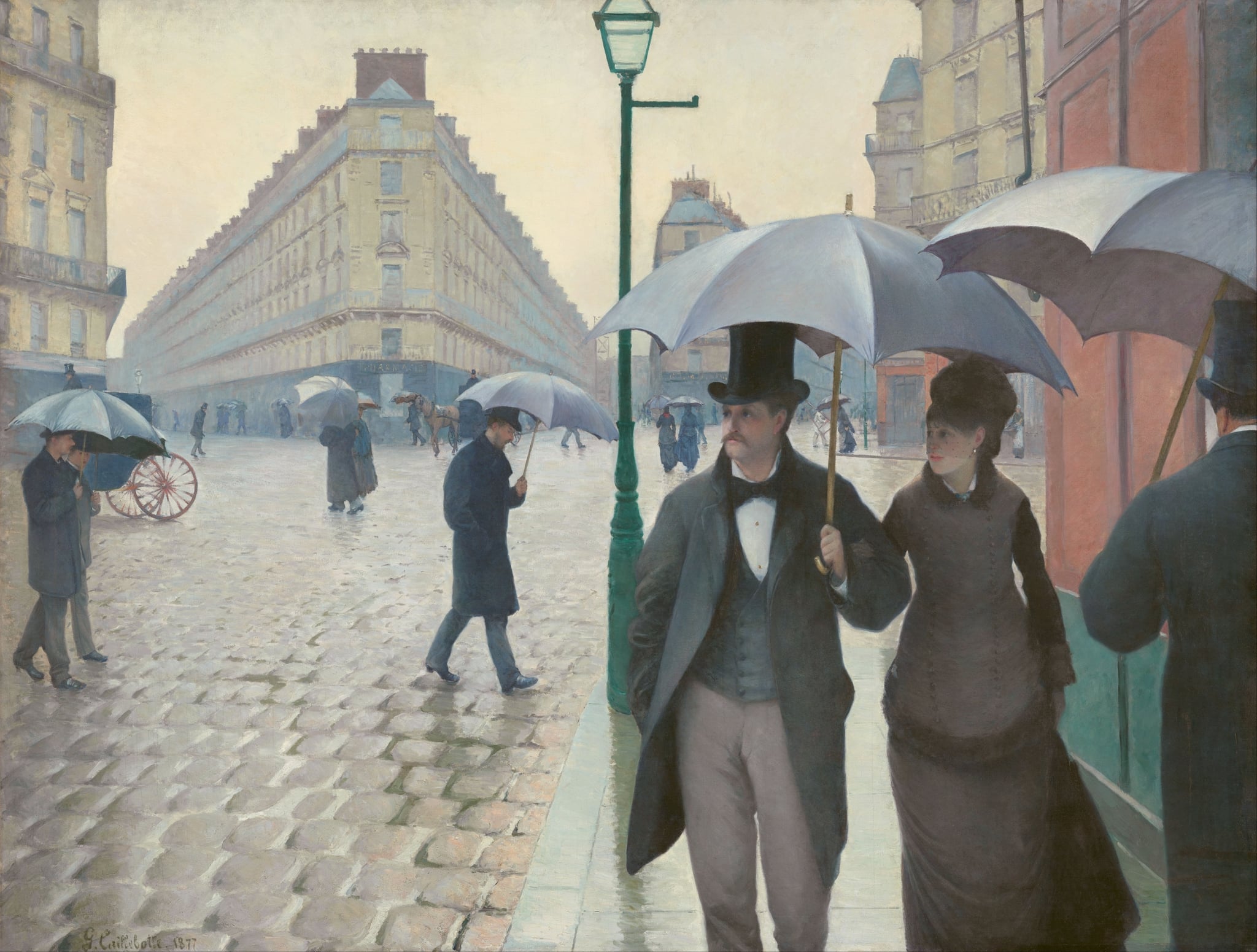
Paris Street; Rainy Day
Gustave Caillebotte (1877)
Gustave Caillebotte’s Paris Street; Rainy Day renders a newly modern Paris where <strong>Haussmann’s geometry</strong> meets the <strong>anonymity of urban life</strong>. Umbrellas punctuate a silvery atmosphere as a <strong>central gas lamp</strong> and knife-sharp façades organize the space into measured planes <sup>[1]</sup><sup>[2]</sup>.
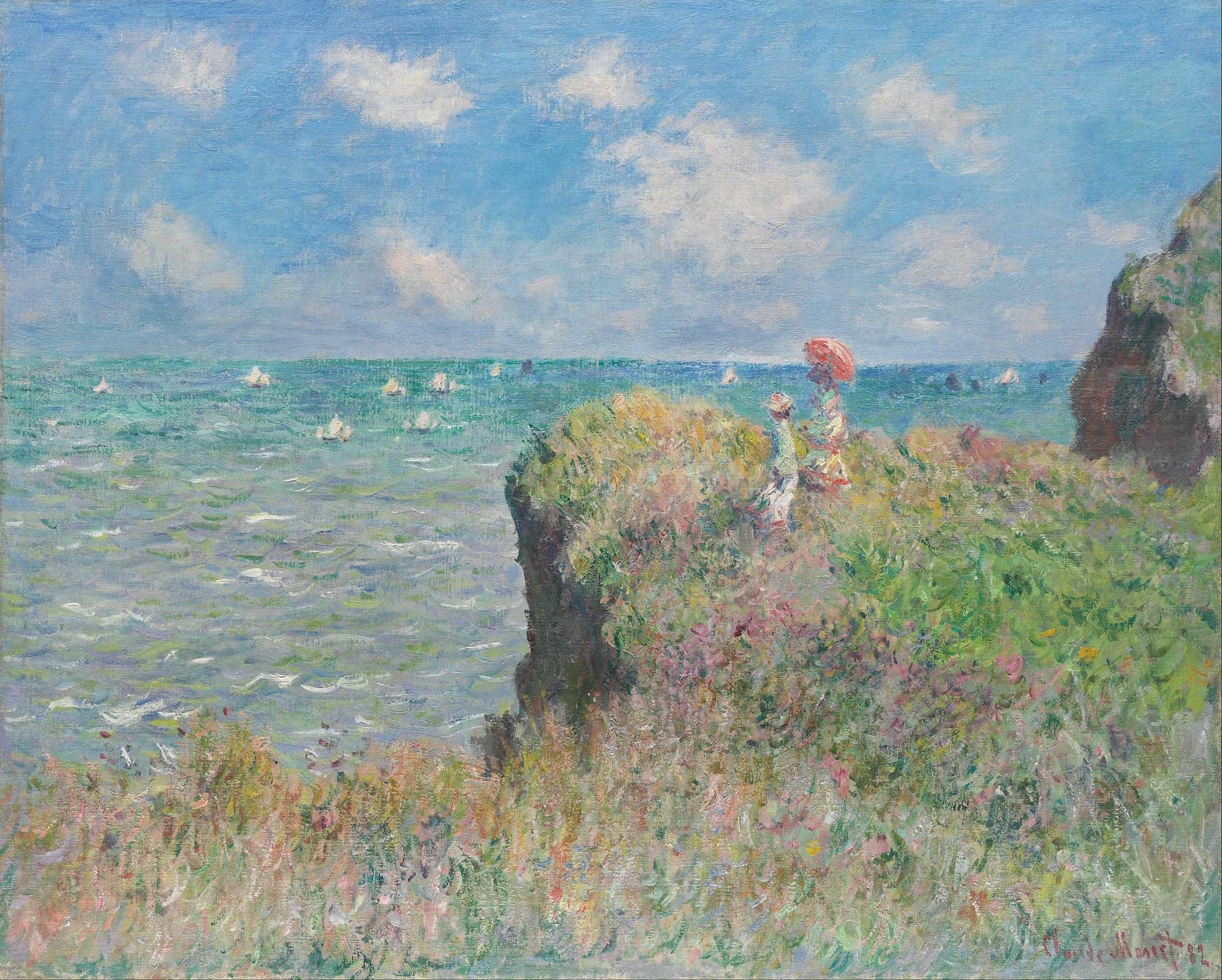
The Cliff Walk at Pourville
Claude Monet (1882)
Claude Monet’s The Cliff Walk at Pourville renders wind, light, and sea as interlocking forces through <strong>shimmering, broken brushwork</strong>. Two small walkers—one beneath a pink parasol—stand near the <strong>precipitous cliff edge</strong>, their presence measuring the vastness of turquoise water and bright sky dotted with white sails. The scene fuses leisure and the <strong>modern sublime</strong>, making perception itself the subject <sup>[1]</sup><sup>[2]</sup>.
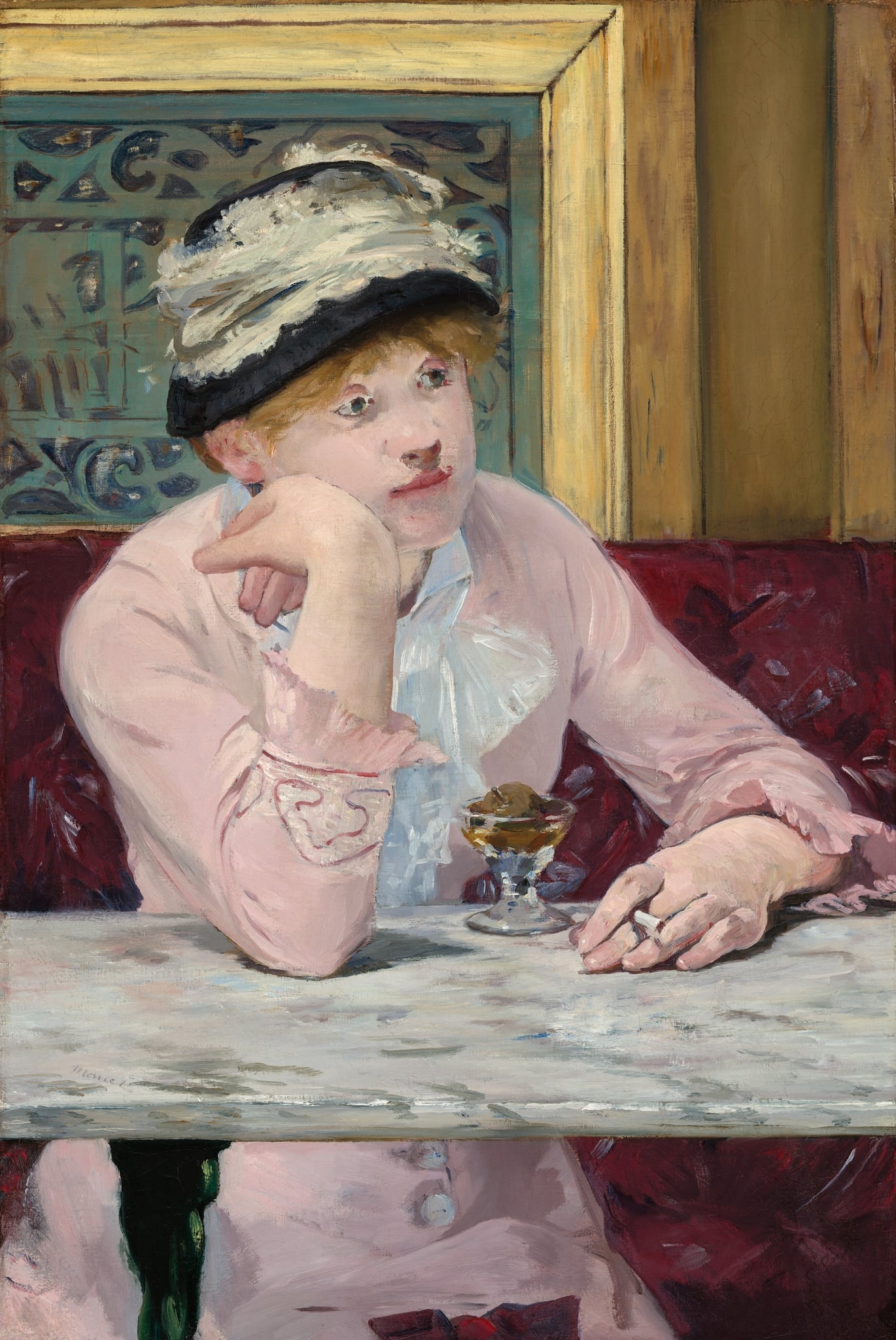
Plum Brandy
Édouard Manet (ca. 1877)
Manet’s Plum Brandy crystallizes a modern pause—an urban <strong>interval of suspended action</strong>—through the idle tilt of a woman’s head, an <strong>unlit cigarette</strong>, and a glass cradling a <strong>plum in amber liquor</strong>. The boxed-in space—marble table, red banquette, and decorative grille—turns a café moment into a stage for <strong>solitude within public life</strong> <sup>[1]</sup><sup>[2]</sup>.

Woman at Her Toilette
Berthe Morisot (1875–1880)
Woman at Her Toilette stages a private ritual of self-fashioning, not a spectacle of vanity. A woman, seen from behind, lifts her arm to adjust her hair as a <strong>black velvet choker</strong> punctuates Morisot’s silvery-violet haze; the <strong>mirror’s blurred reflection</strong> with powders, jars, and a white flower refuses a clear face. Morisot’s <strong>feathery facture</strong> turns a fleeting toilette into modern subjectivity made visible <sup>[1]</sup>.
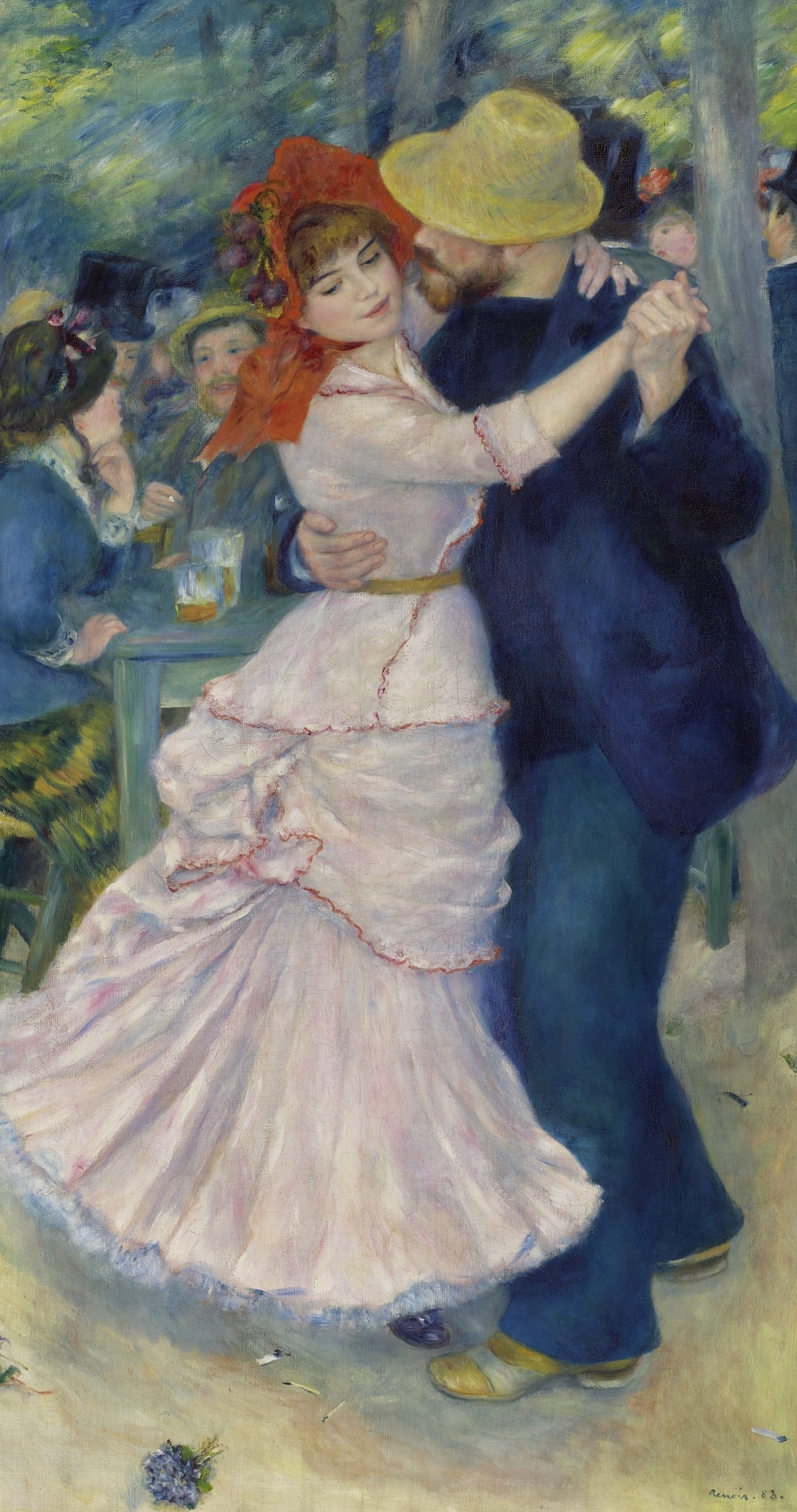
Dance at Bougival
Pierre-Auguste Renoir (1883)
In Dance at Bougival, Pierre-Auguste Renoir turns a crowded suburban dance into a <strong>private vortex of intimacy</strong>. Rose against ultramarine, skin against shade, and a flare of the woman’s <strong>scarlet bonnet</strong> concentrate the scene’s energy into a single turning moment—modern leisure made palpable as <strong>touch, motion, and light</strong> <sup>[1]</sup><sup>[2]</sup>.
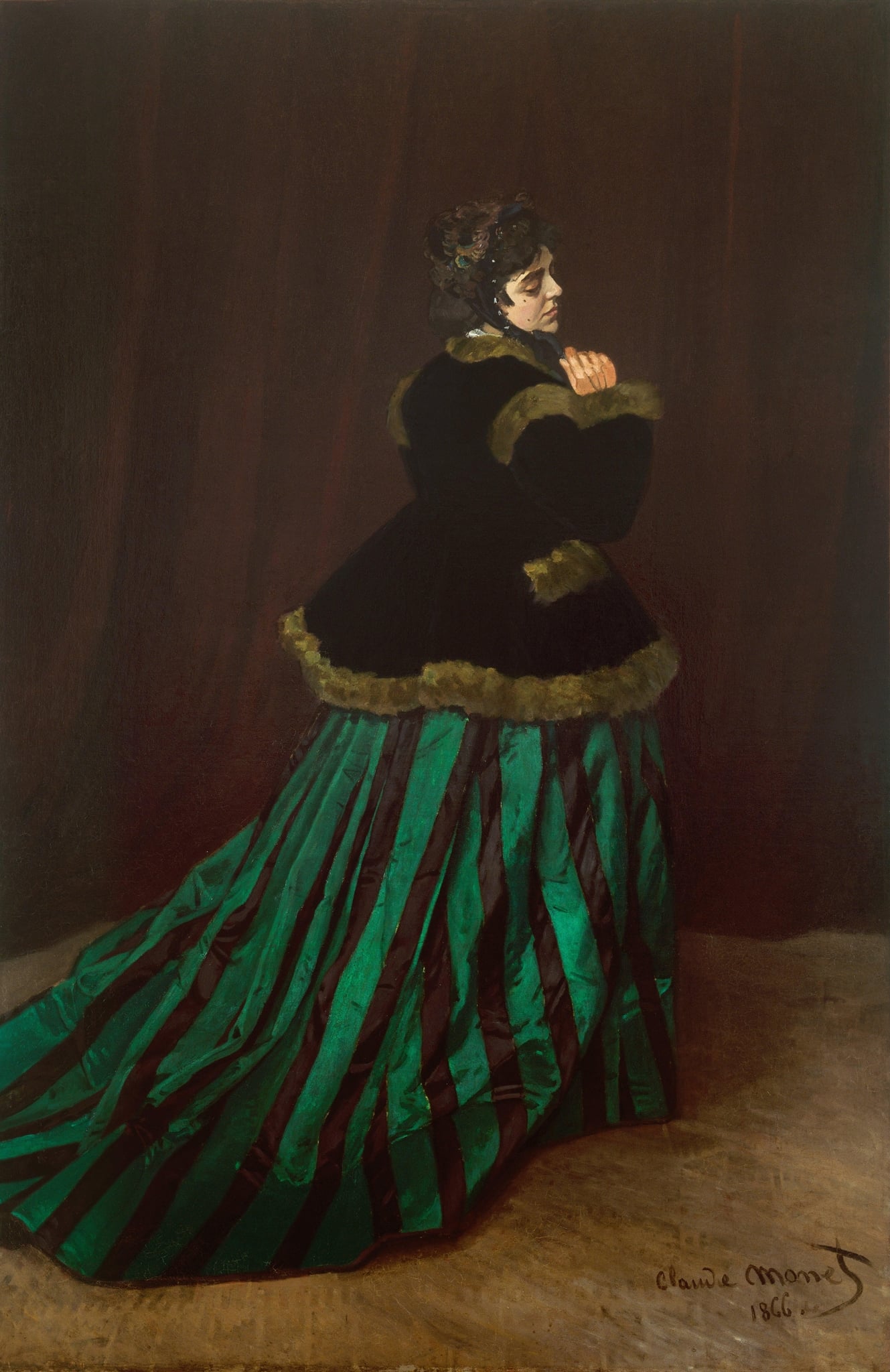
Camille (The Woman in the Green Dress)
Claude Monet (1866)
Monet’s Camille (The Woman in the Green Dress) turns a full-length portrait into a study of <strong>modern spectacle</strong>. The spotlit emerald-and-black skirt, set against a near-black curtain, makes <strong>fashion</strong> the engine of meaning and the vehicle of status.
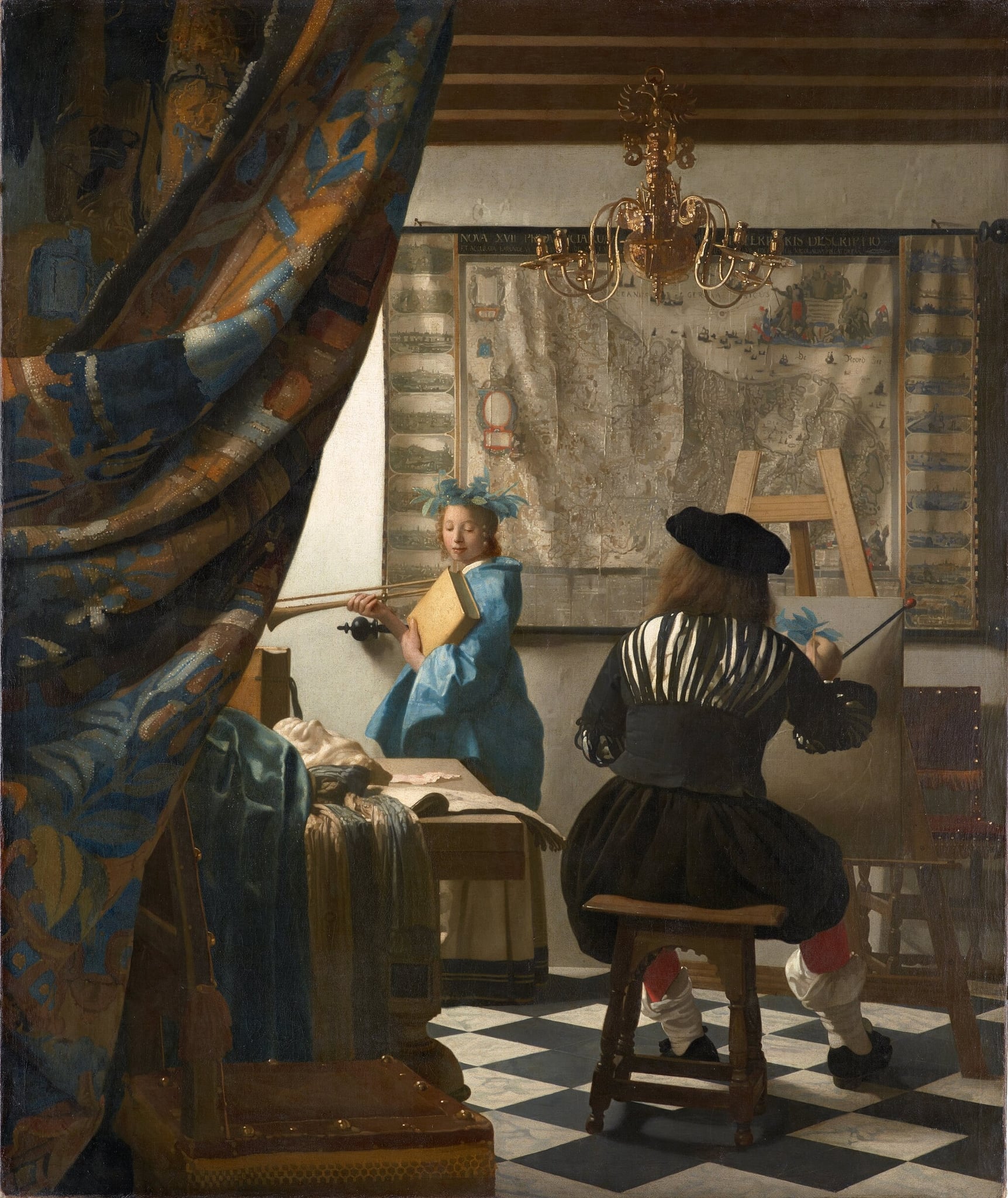
The Art of Painting
Johannes Vermeer (c. 1666–1668)
Johannes Vermeer’s The Art of Painting is a self-aware allegory that equates <strong>painting with history and fame</strong>. Framed by a parted <strong>tapestry</strong> like a stage curtain, an artist in historical dress paints the muse <strong>Clio</strong>, while a vast <strong>map of the Seventeen Provinces</strong> and a <strong>double‑headed eagle</strong> chandelier fold national memory into the studio scene <sup>[1]</sup><sup>[3]</sup>.

Dance in the City
Pierre-Auguste Renoir (1883)
Pierre-Auguste Renoir’s Dance in the City stages an urban waltz where decorum and desire briefly coincide. A couple’s close embrace—his black tailcoat enclosing her luminous white satin gown—creates a <strong>cool, elegant</strong> harmony against potted palms and marble. Renoir’s refined, post‑Impressionist touch turns social ritual into <strong>sensual modernity</strong> <sup>[1]</sup><sup>[2]</sup>.
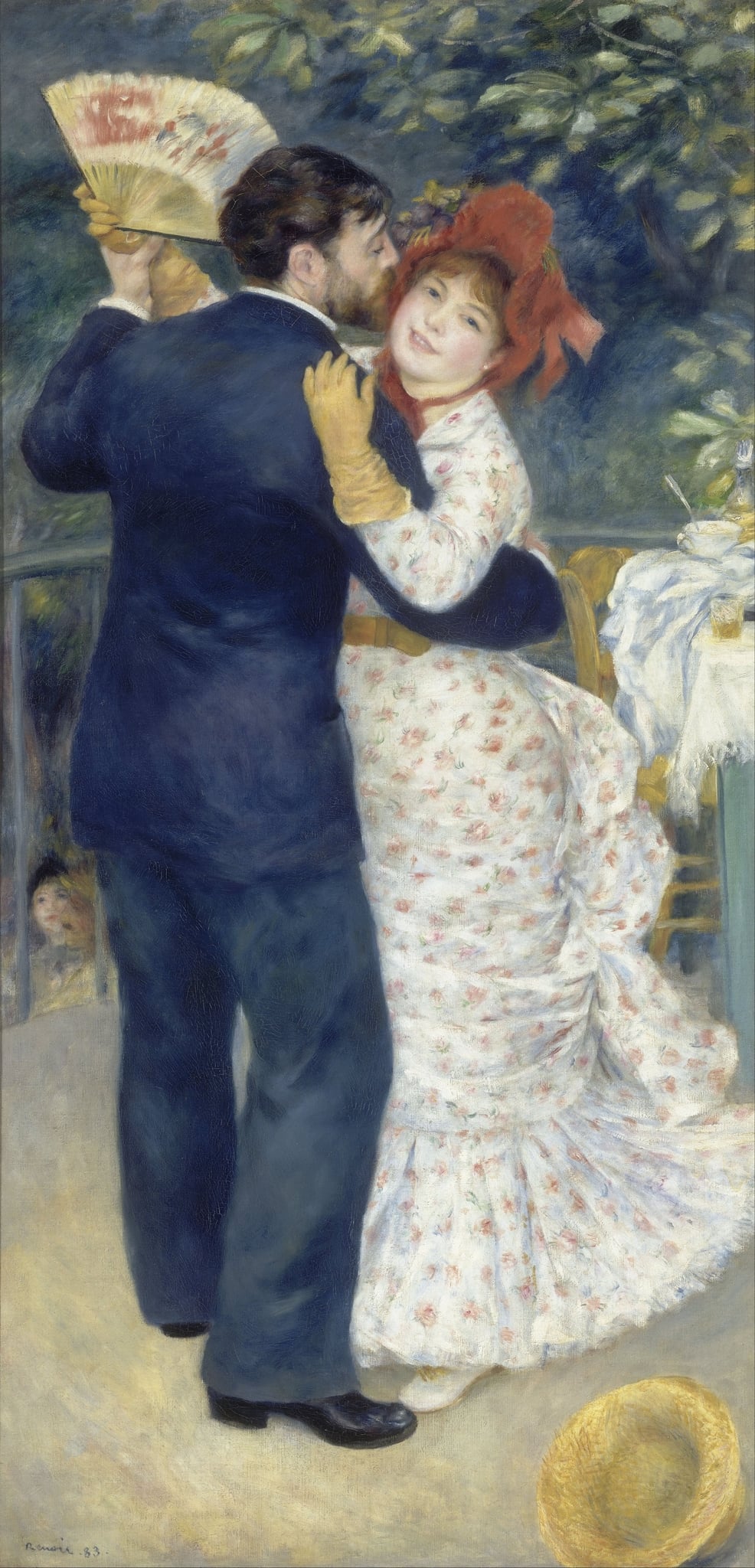
Dance in the Country
Pierre-Auguste Renoir (1883)
Dance in the Country shows a couple swept into a close embrace on a café terrace, their bodies turning in a soft spiral as foliage and sunlight dissolve into <strong>dappled color</strong>. Renoir orchestrates <strong>bourgeois leisure</strong>—the tossed straw boater, a small table with glass and napkin, the woman’s floral dress and red bonnet—to stage a moment where decorum and desire meet. The result is a modern emblem of shared pleasure, poised between Impressionist shimmer and a newly <strong>firm, linear touch</strong>.
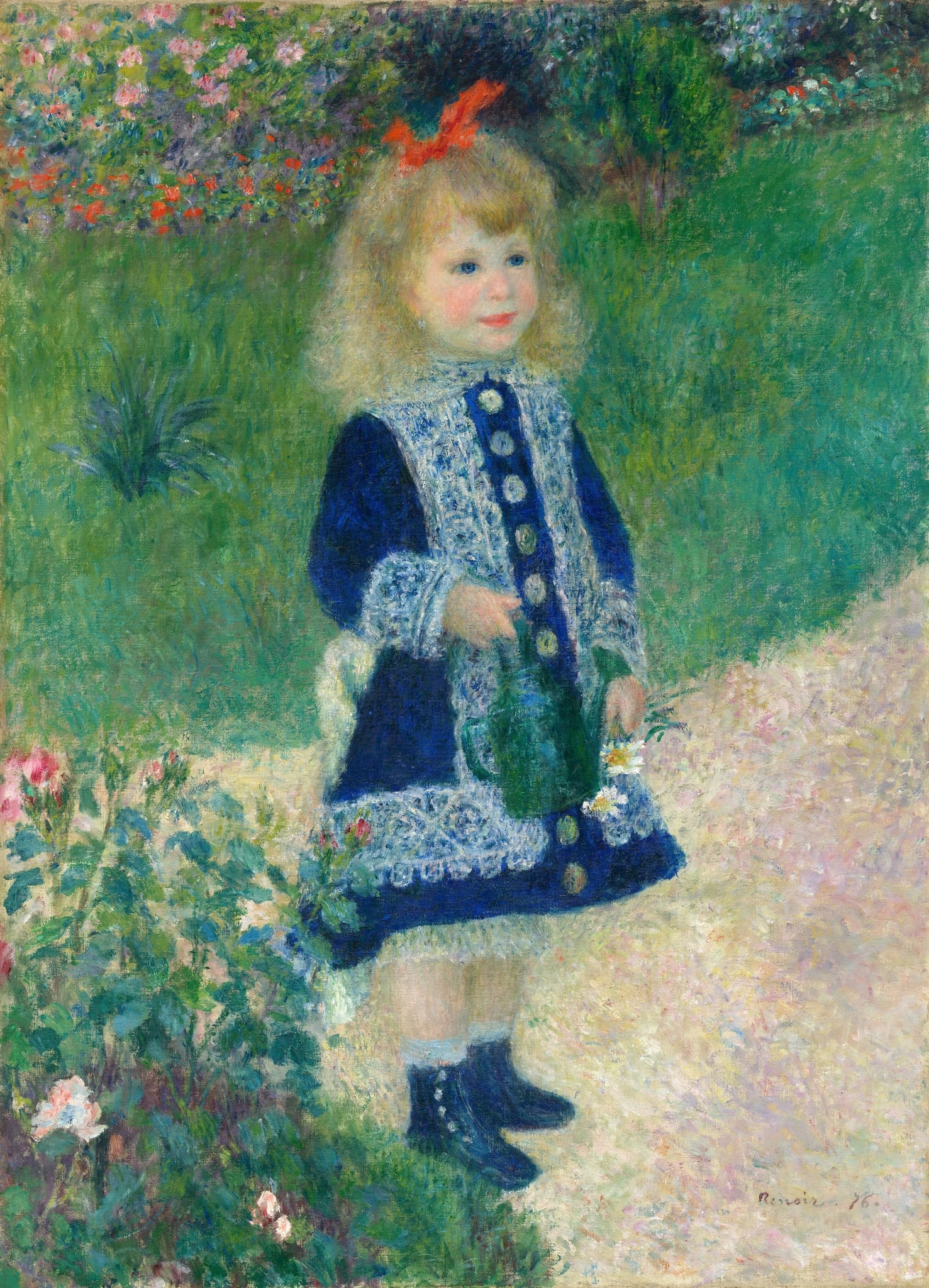
Girl with a Watering Can
Pierre-Auguste Renoir (1876)
Renoir’s 1876 Girl with a Watering Can fuses a crisply perceived child with a dissolving garden atmosphere, using <strong>prismatic color</strong> and <strong>controlled facial modeling</strong> to stage innocence within modern leisure <sup>[1]</sup>. The cobalt dress, red bow, and green can punctuate a haze of pinks and greens, making nurture and growth the scene’s quiet thesis.
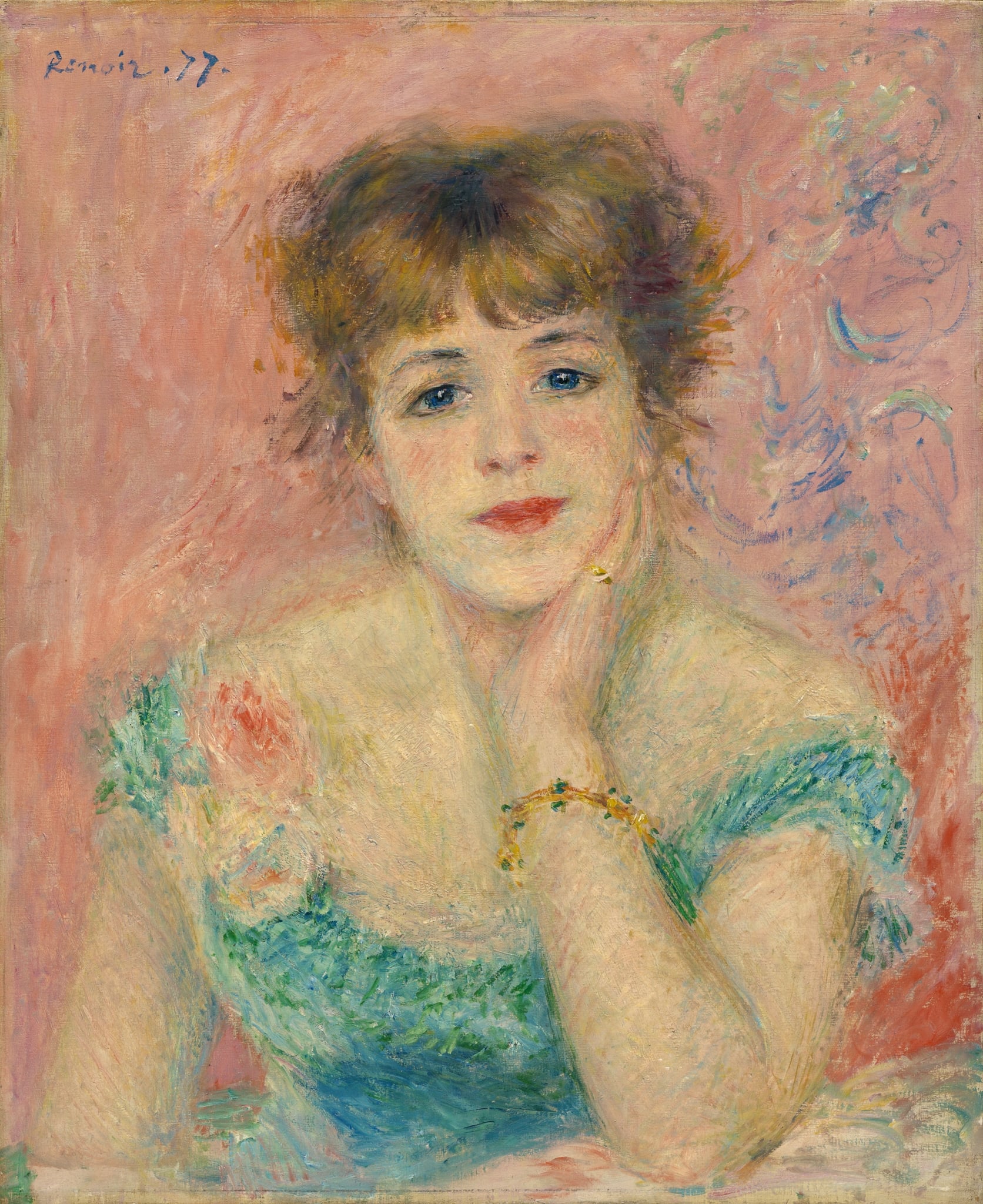
Portrait of Jeanne Samary
Pierre-Auguste Renoir (1877)
Renoir’s Portrait of Jeanne Samary (1877) turns a modern actress into a study of <strong>radiance and immediacy</strong>, fusing figure and air with shimmering strokes. Cool blue‑green dress notes spark against a warm <strong>coral-pink atmosphere</strong>, while the cheek‑in‑hand pose crystallizes a moment of intimate poise <sup>[1]</sup><sup>[4]</sup>.
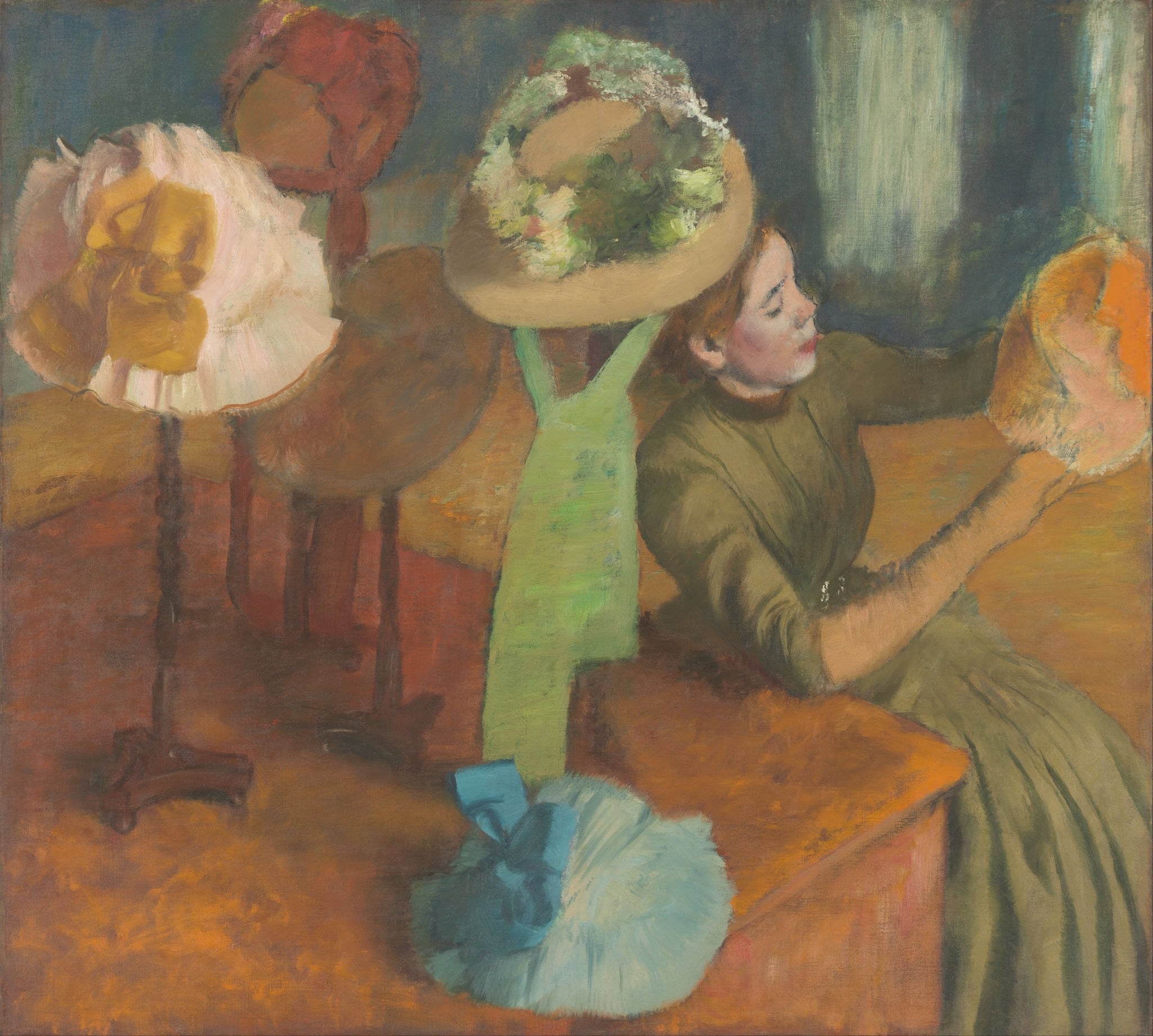
The Millinery Shop
Edgar Degas (1879–1886)
Edgar Degas’s The Millinery Shop stages modern Paris through a quiet act of <strong>work</strong> rather than display. A young woman, cropped in profile, studies a glowing <strong>orange hat</strong> while faceless stands crowned with ribbons and plumes press toward the picture plane. Degas turns a boutique into a meditation on <strong>labor, commodities, and identity</strong> <sup>[1]</sup><sup>[2]</sup>.
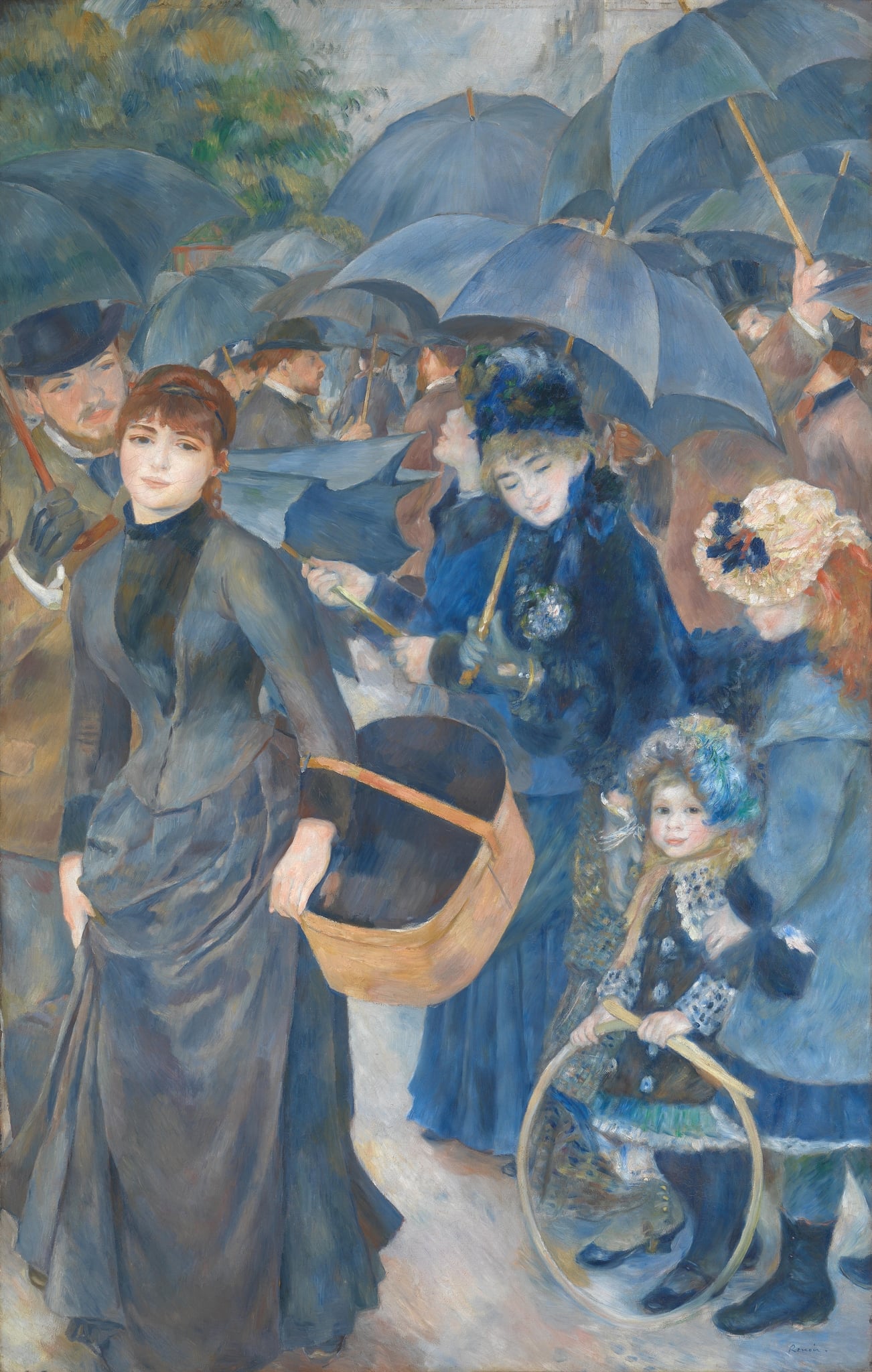
The Umbrellas
Pierre-Auguste Renoir (about 1881–86)
A sudden shower turns a Paris street into a lattice of <strong>slate‑blue umbrellas</strong>, knitting strangers into a single moving frieze. A bareheaded young woman with a <strong>bandbox</strong> strides forward while a bourgeois mother and children cluster at right, their <strong>hoop</strong> echoing the umbrellas’ arcs <sup>[1]</sup><sup>[5]</sup>.
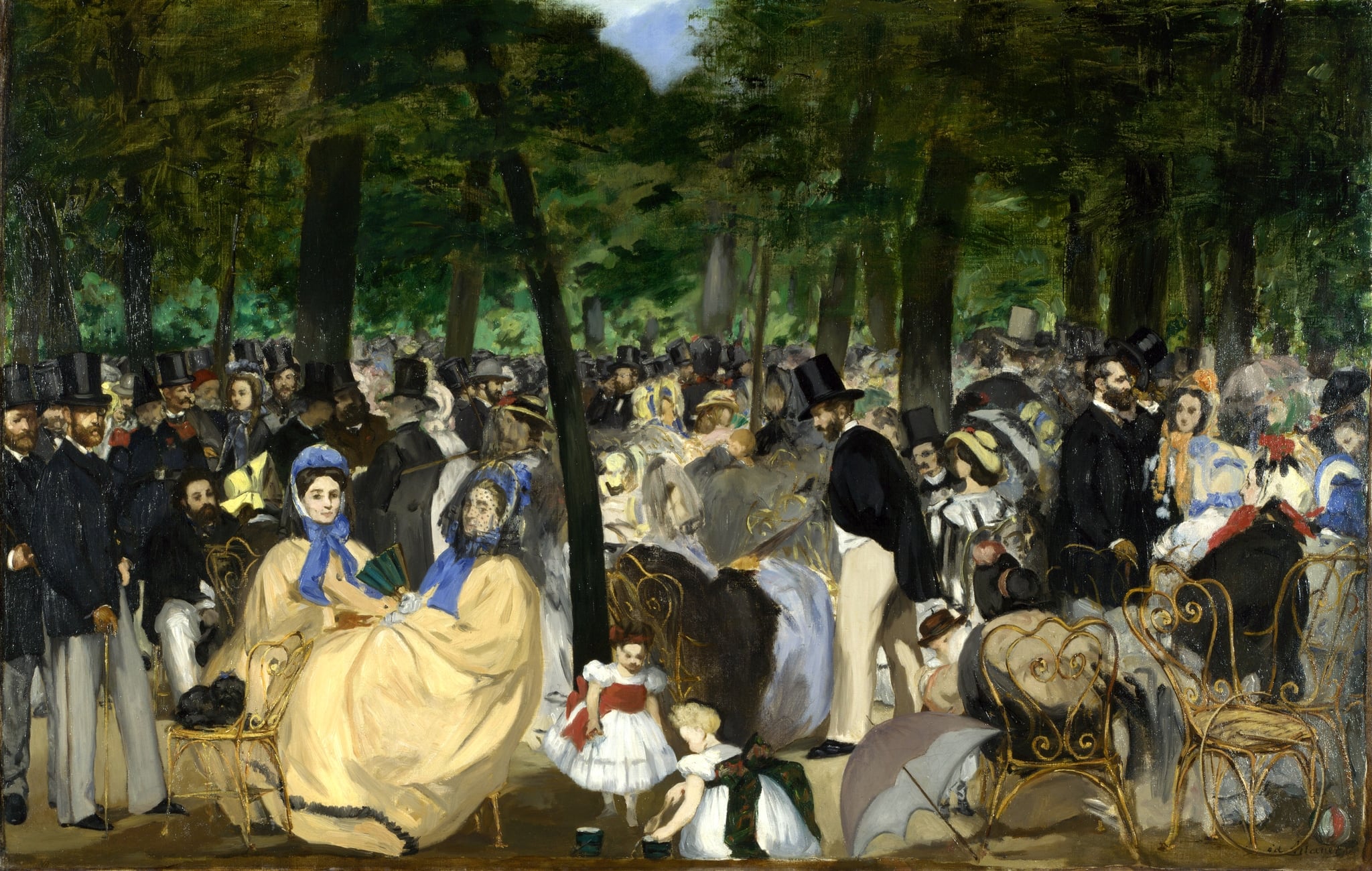
Music in the Tuileries
Édouard Manet (1862)
Édouard Manet’s Music in the Tuileries turns a Sunday concert into a manifesto of <strong>modern life</strong>: a frieze of top hats, crinolines, and iron chairs flickering beneath <strong>toxic green</strong> foliage. Instead of a hero or center, the painting disperses attention across a restless crowd, making <strong>looking itself</strong> the drama of the scene <sup>[1]</sup><sup>[2]</sup>.
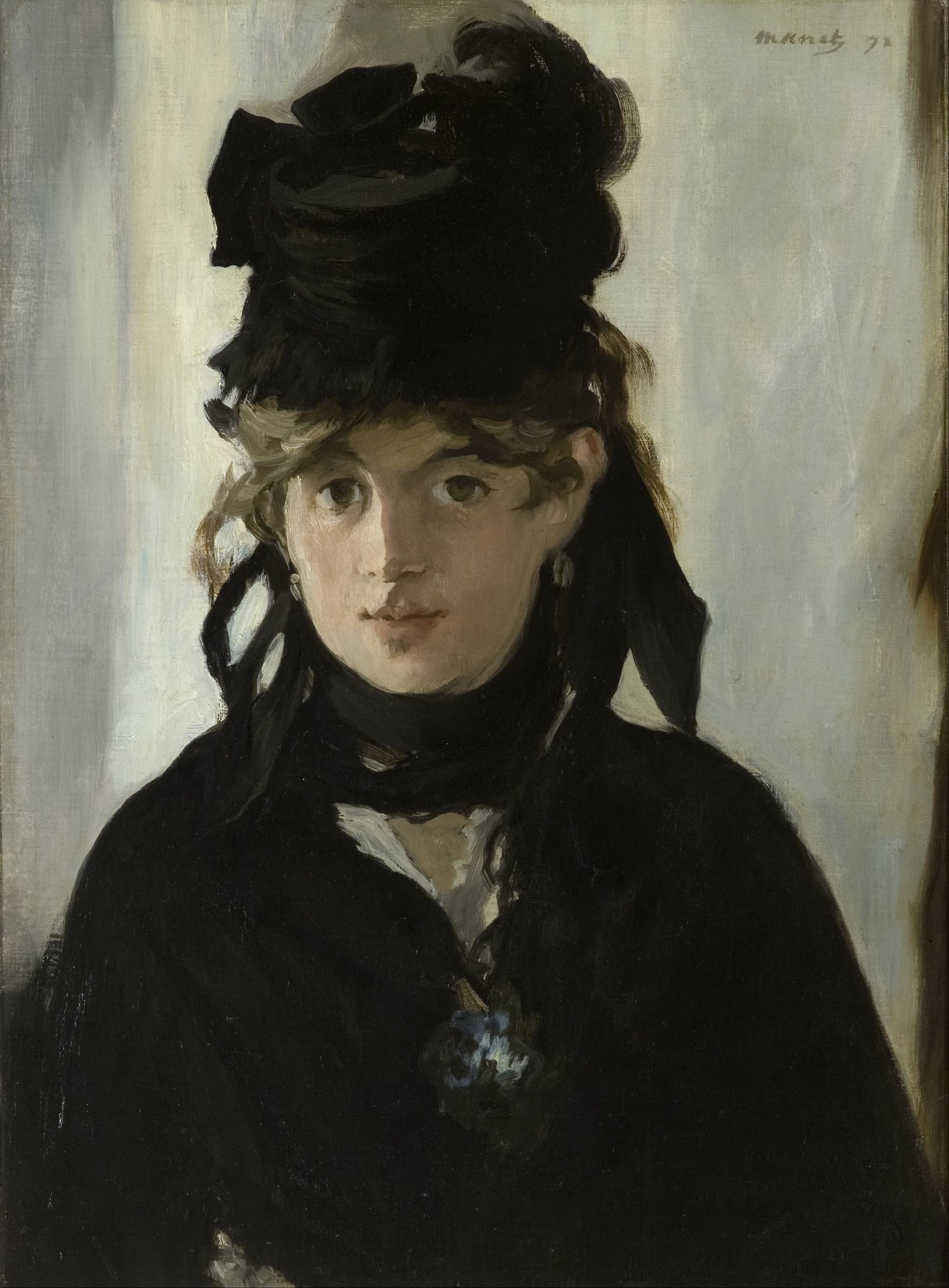
Berthe Morisot with a Bouquet of Violets
Édouard Manet (1872)
Édouard Manet’s Berthe Morisot with a Bouquet of Violets is a close, modern portrait built as a <strong>symphony in black</strong> punctuated by a tiny violet knot. Side‑light chisels the face from a cool, silvery ground while hat, scarf, and coat merge into one dark silhouette, and the eyes are painted strikingly <strong>black</strong> for effect <sup>[1]</sup>. The single touch of violets introduces a discreet, coded <strong>tenderness</strong> within the portrait’s refined restraint <sup>[1]</sup><sup>[3]</sup><sup>[4]</sup>.
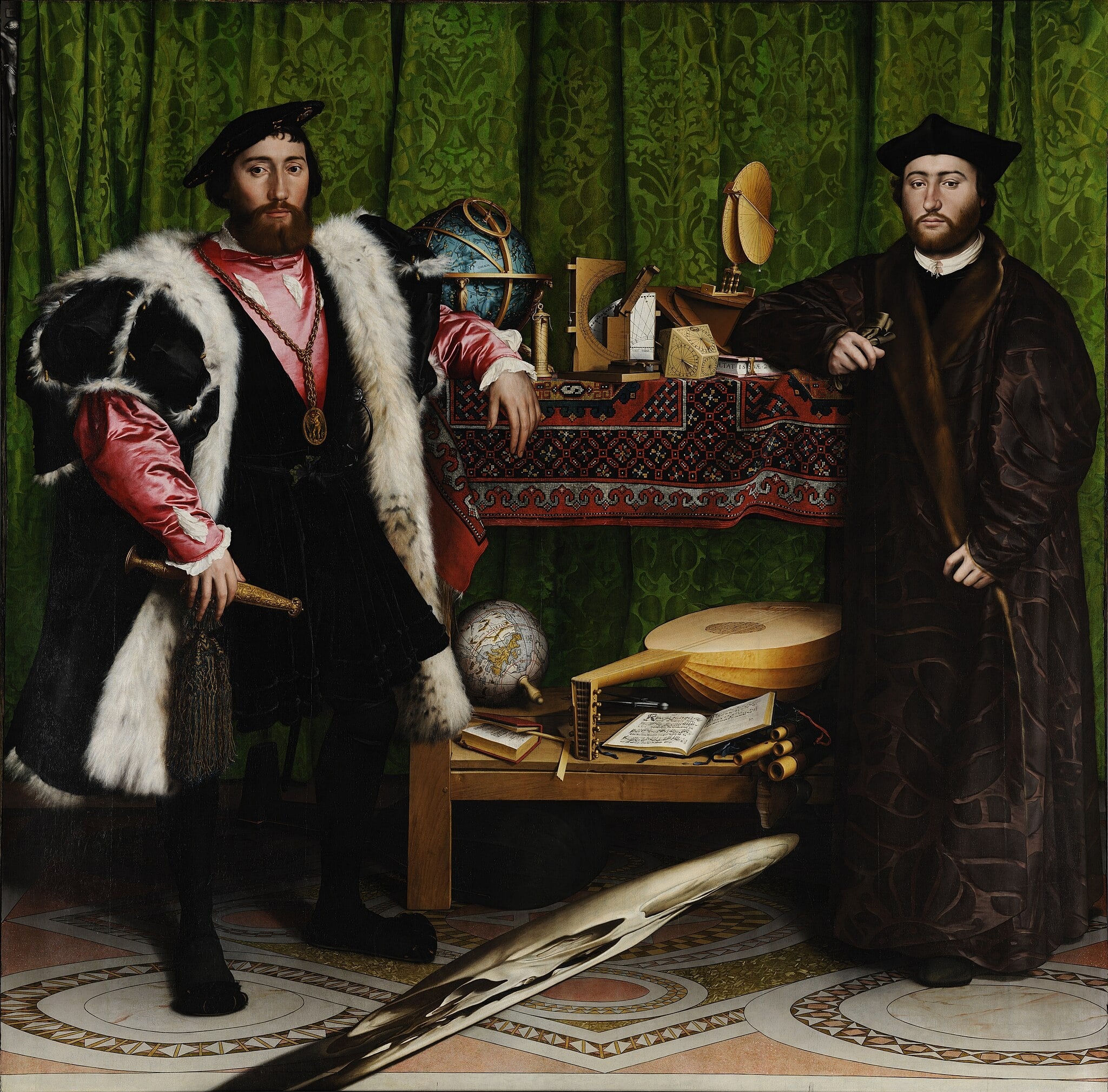
The Ambassadors
Hans Holbein the Younger (1533)
Holbein’s The Ambassadors is a double-portrait staged before a green curtain, where shelves of scientific instruments, books, and musical devices enact <strong>Renaissance learning</strong> while an anamorphic <strong>skull</strong> and a veiled <strong>crucifix</strong> counter it with mortality and salvation <sup>[1]</sup><sup>[2]</sup>. The work balances worldly status—fur, velvet, Oriental carpet—with a sober theology of limits amid the <strong>Reformation’s discord</strong> <sup>[1]</sup><sup>[2]</sup>.
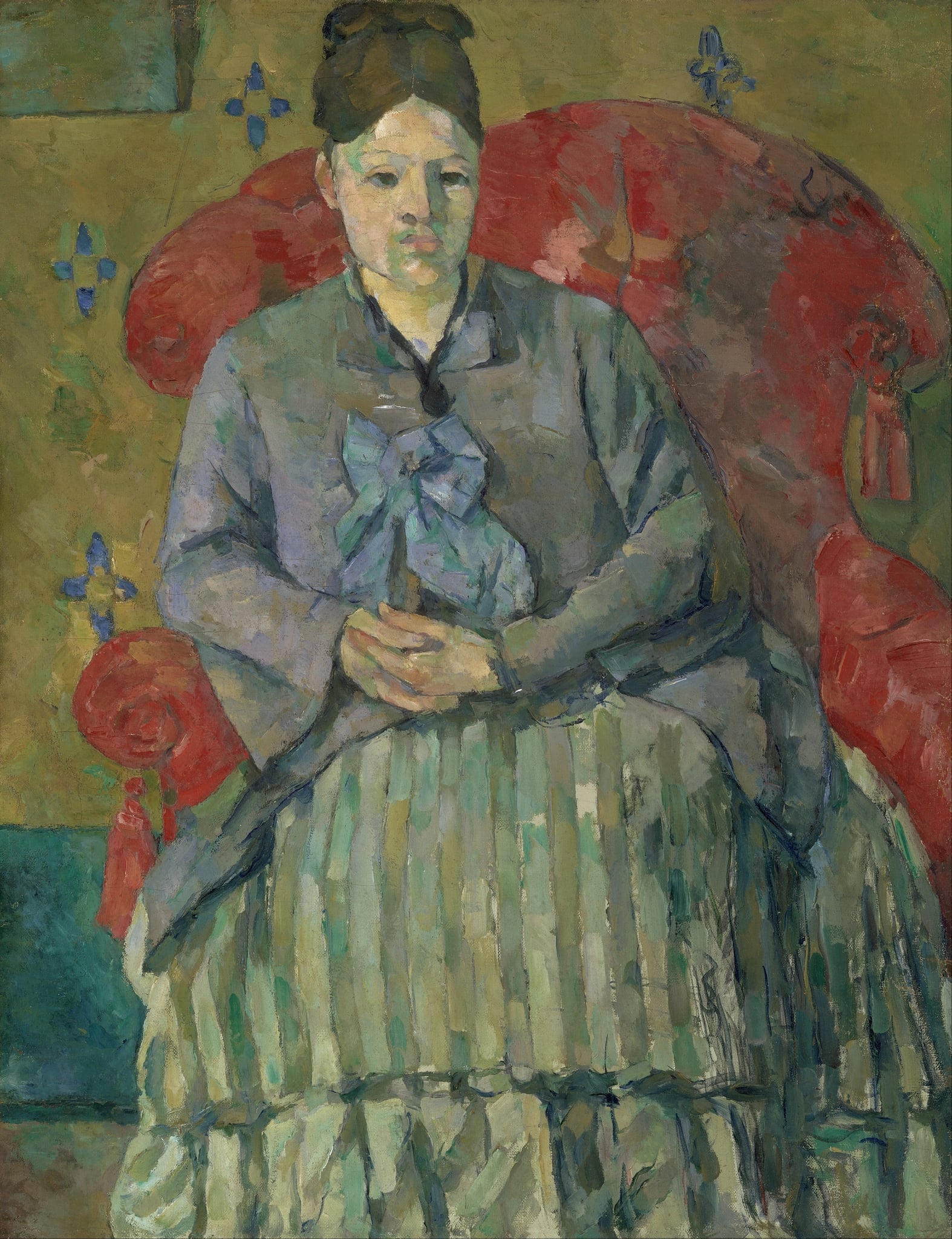
Madame Cézanne in a Red Armchair
Paul Cézanne (about 1877)
Paul Cézanne’s Madame Cézanne in a Red Armchair (about 1877) turns a domestic sit into a study of <strong>color-built structure</strong> and <strong>compressed space</strong>. Cool blue-greens of dress and skin lock against the saturated <strong>crimson armchair</strong>, converting likeness into an inquiry about how painting makes stability visible <sup>[1]</sup><sup>[3]</sup>.
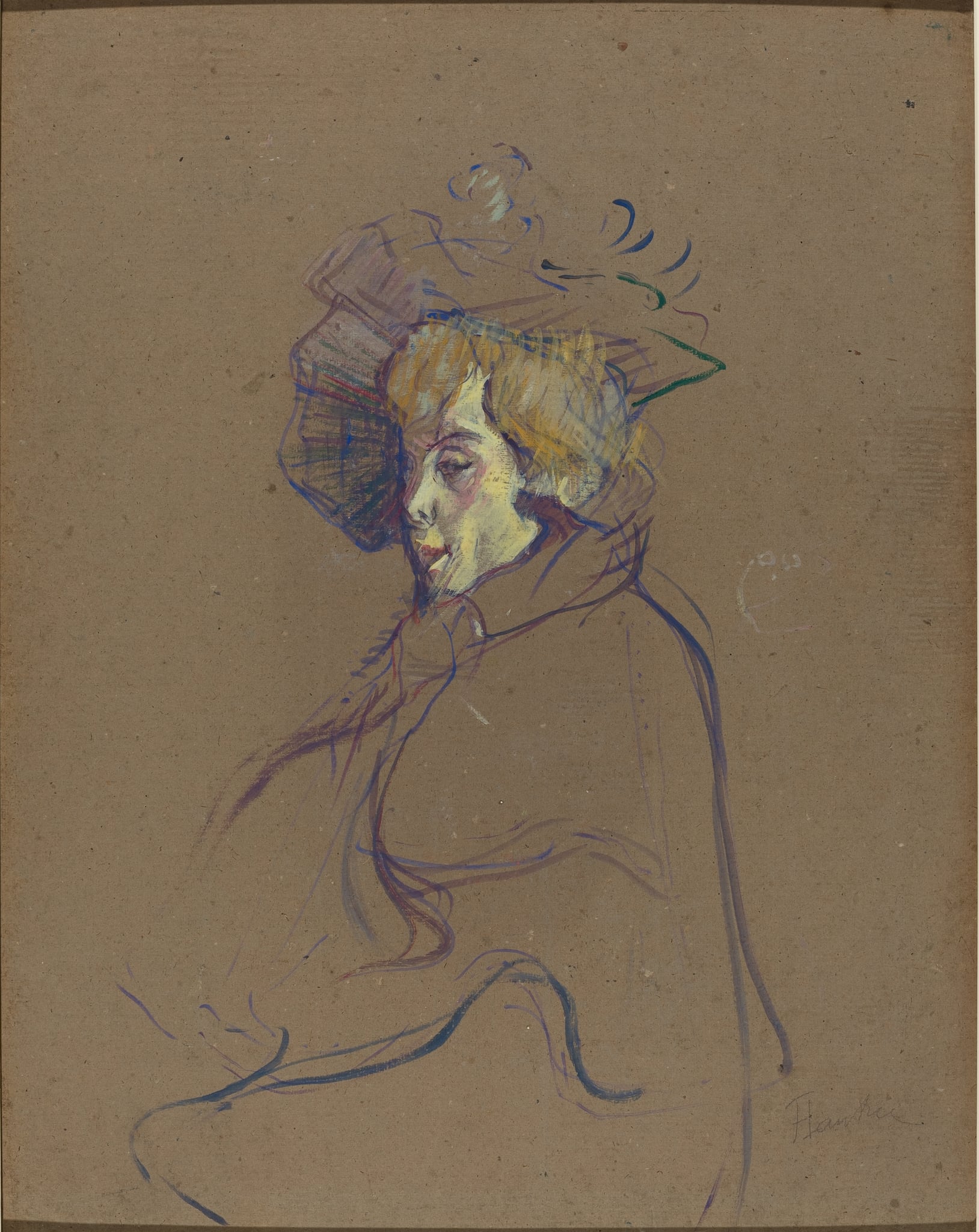
Jane Avril
Henri de Toulouse-Lautrec (c. 1891–1892)
In Jane Avril, Henri de Toulouse-Lautrec crystallizes a public persona from a few <strong>urgent, chromatic strokes</strong>: violet and blue lines whirl into a cloak, while green and indigo dashes crown a buoyant hat. Her face—sharply keyed in <strong>lemon yellow, lilac, and carmine</strong>—hovers between mask and likeness, projecting poise edged with fatigue. The raw brown ground lets her <strong>whiplash silhouette</strong> materialize like smoke from Montmartre’s nightlife.
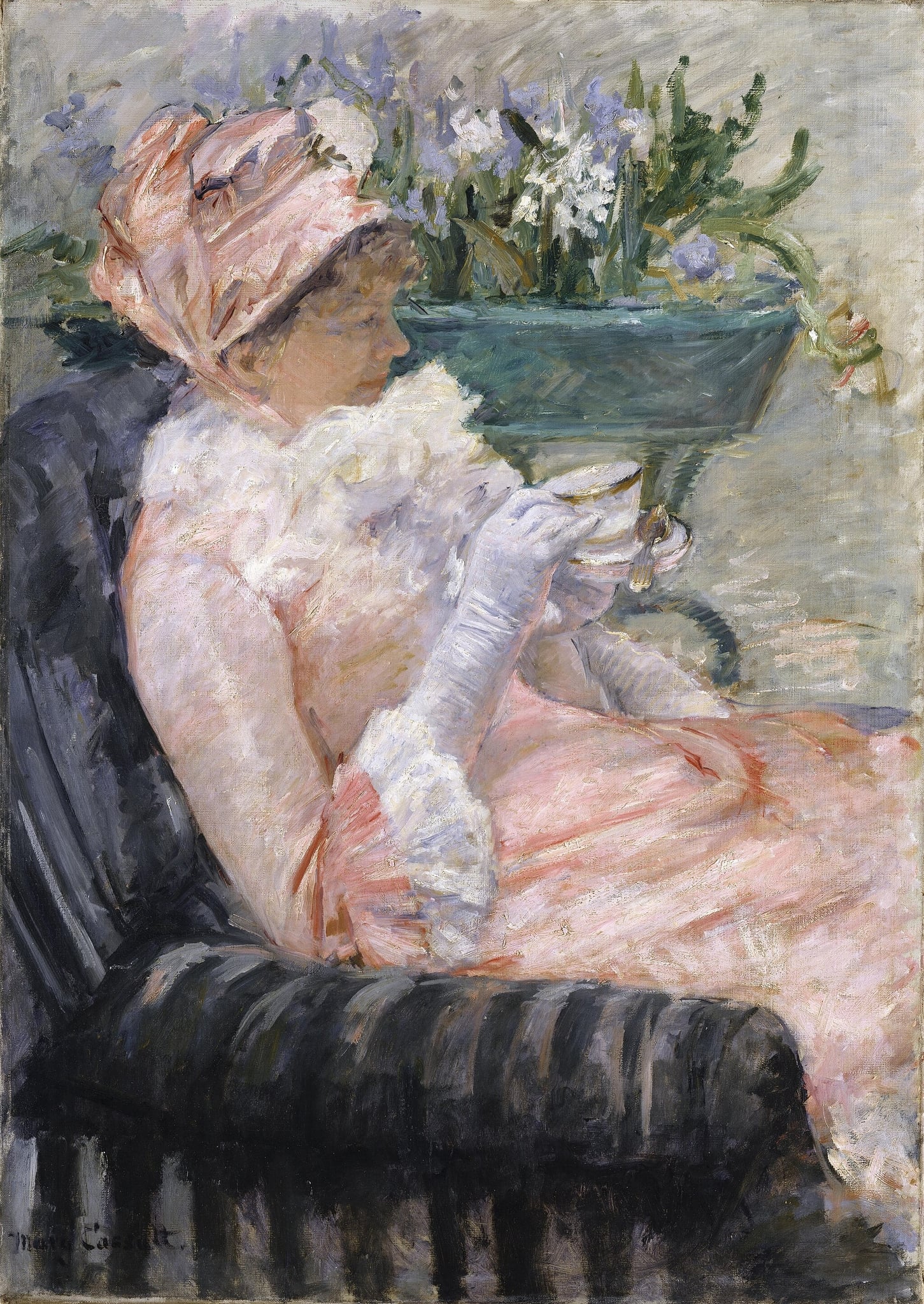
The Cup of Tea
Mary Cassatt (ca. 1880–81)
Mary Cassatt’s The Cup of Tea distills a moment of bourgeois leisure into a study of <strong>poise</strong>, <strong>etiquette</strong>, and <strong>private reflection</strong>. A woman in a rose‑pink dress and bonnet, white‑gloved, balances a gold‑rimmed cup against the shimmer of <strong>Impressionist</strong> brushwork, while a green planter of pale blossoms echoes her pastel palette <sup>[1]</sup>. The work turns an ordinary ritual into a modern emblem of women’s experience.
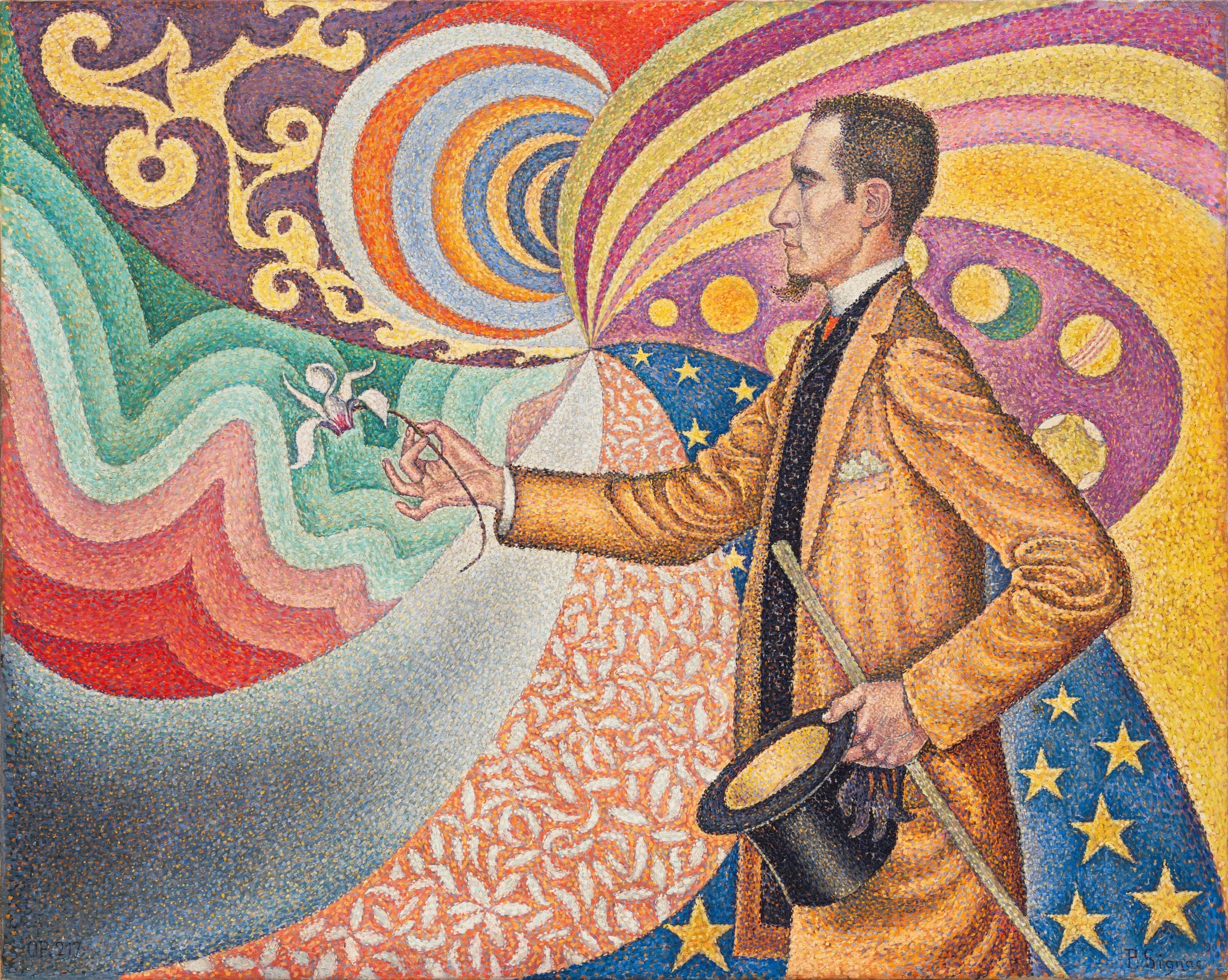
Portrait of Félix Fénéon
Paul Signac (1890)
Portrait of Félix Fénéon turns a critic into a <strong>conductor of color</strong>: a dandy in a yellow coat proffers a delicate cyclamen as concentric disks, whiplash arabesques, stars, and palette-like circles whirl around him. Rendered in precise <strong>Pointillist</strong> dots, the scene stages the fusion of <strong>art, science, and modern style</strong>.<sup>[1]</sup><sup>[2]</sup>
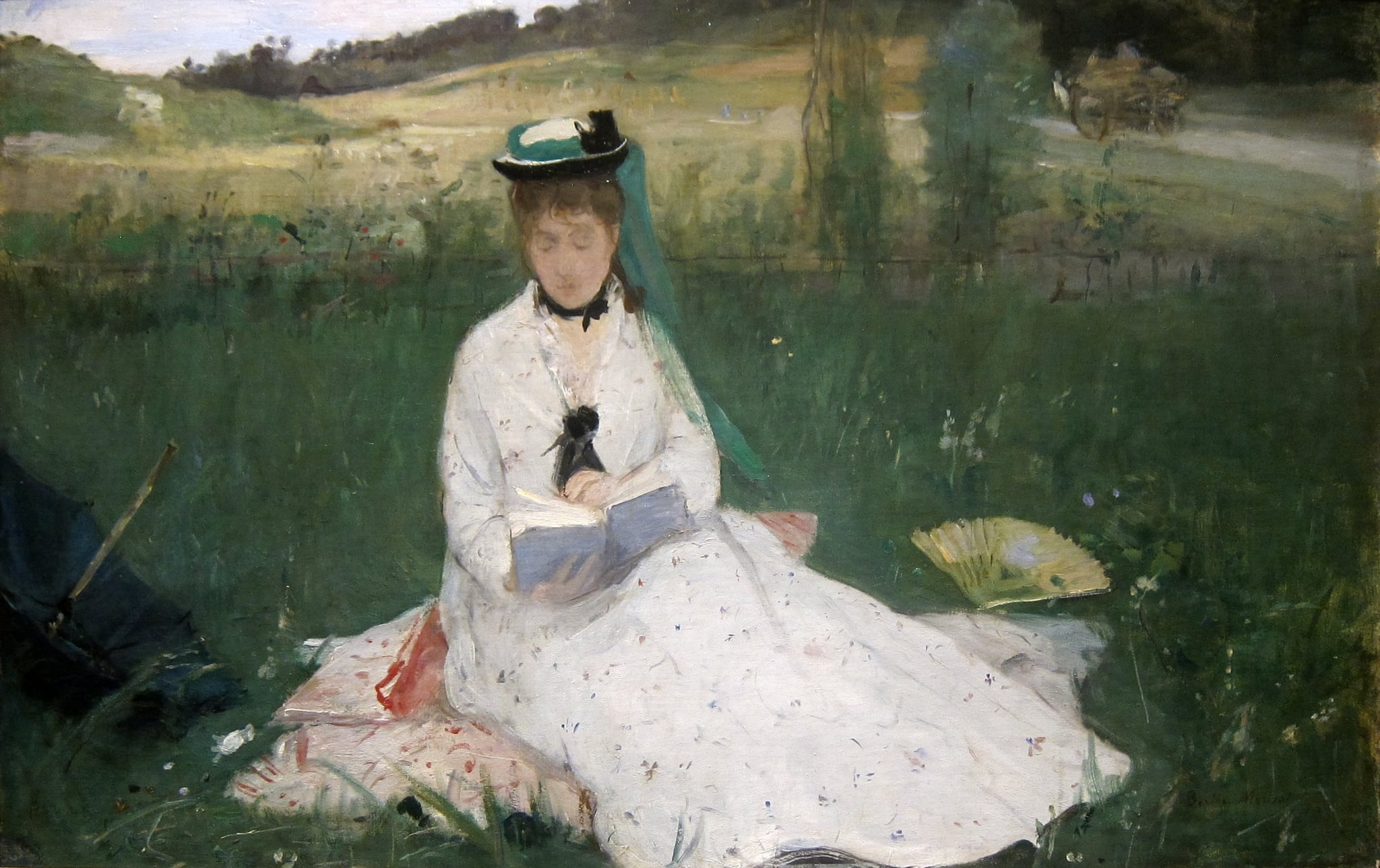
Reading
Berthe Morisot (1873)
In Berthe Morisot’s <strong>Reading</strong> (1873), a woman in a pale, patterned dress sits on the grass, absorbed in a book while a <strong>green parasol</strong> and <strong>folded fan</strong> lie nearby. Morisot’s quick, luminous brushwork dissolves the landscape into <strong>atmospheric greens</strong> as a distant carriage passes, turning an outdoor scene into a study of interior life. The work makes <strong>female intellectual absorption</strong> its true subject, aligning modern leisure with private thought.
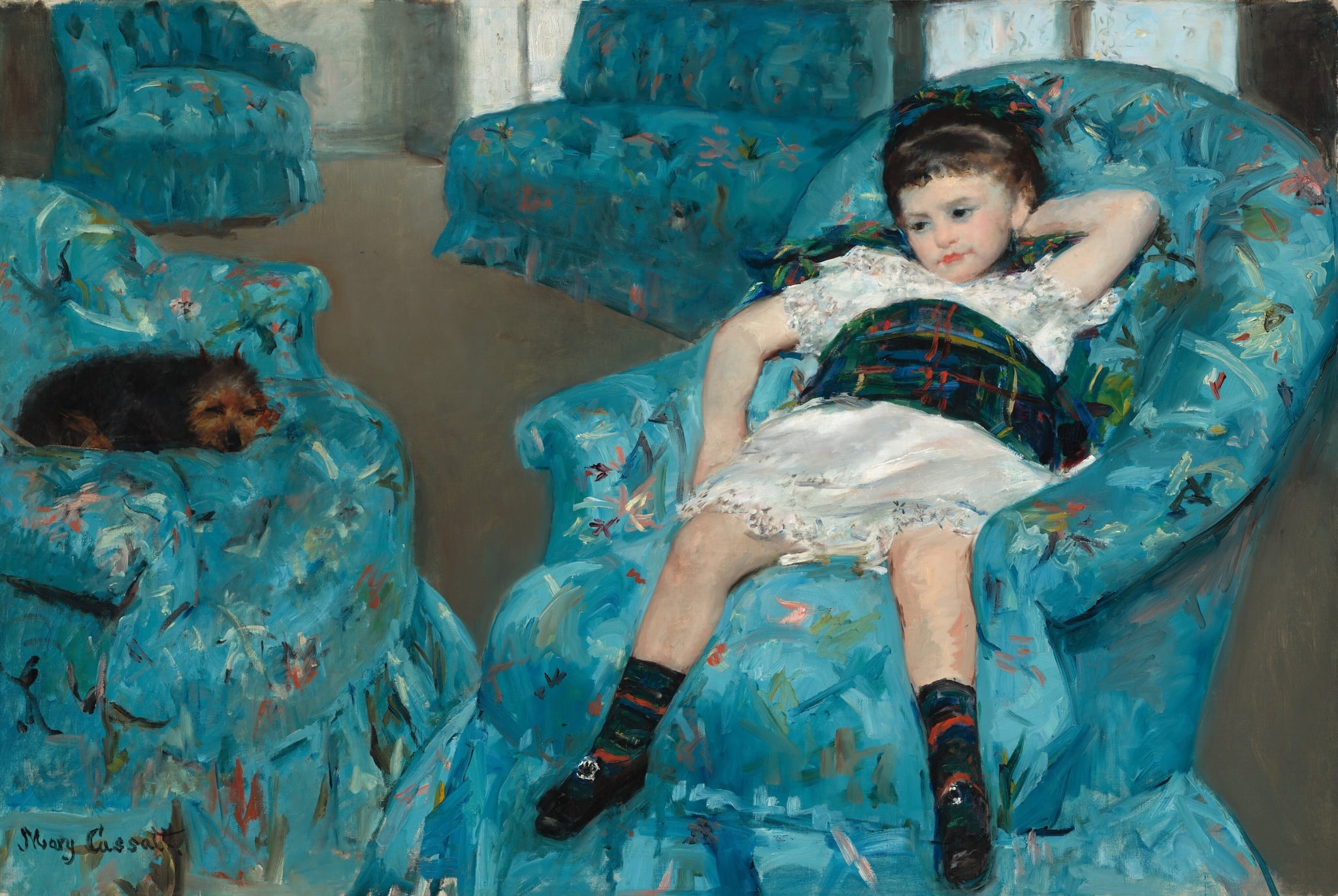
Little Girl in a Blue Armchair
Mary Cassatt (1878)
Mary Cassatt’s Little Girl in a Blue Armchair renders a child slumped diagonally across an oversized seat, surrounded by a flotilla of blue chairs and cool window light. With brisk, broken strokes and a skewed recession, Cassatt asserts a modern, unsentimental view of childhood—bored, autonomous, and <strong>out of step with adult decorum</strong> <sup>[1]</sup><sup>[4]</sup>. Subtle collaboration with <strong>Degas</strong> in the background design sharpens the picture’s daring spatial thrust <sup>[2]</sup>.
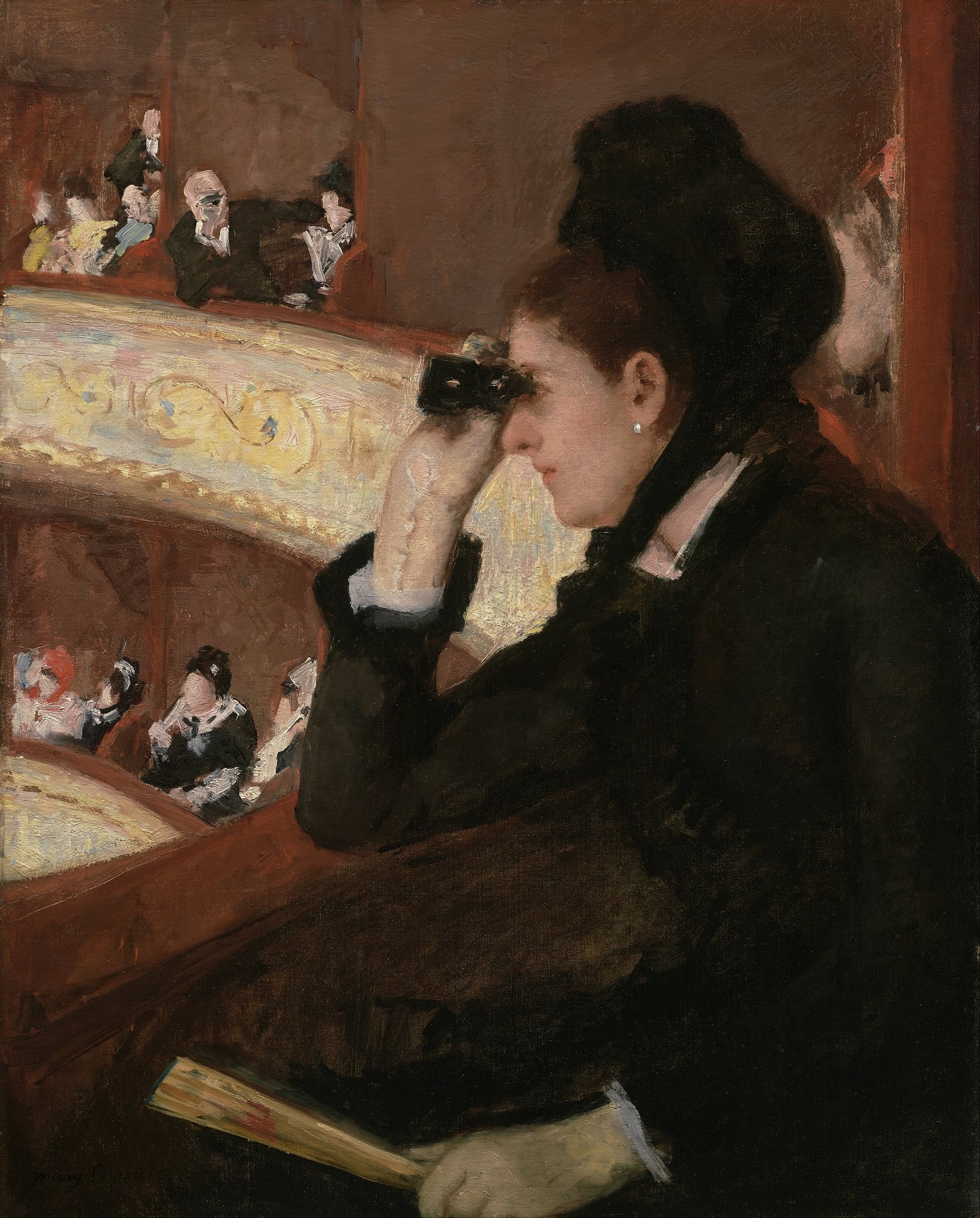
In the Loge
Mary Cassatt (1878)
Mary Cassatt’s In the Loge (1878) stages modern spectatorship as a drama of <strong>mutual looking</strong>. A woman in dark dress leans forward with <strong>opera glasses</strong>, her <strong>fan closed</strong> on her lap, as a man in the distance raises his own glasses toward her—turning the theater into a circuit of gazes <sup>[1]</sup><sup>[2]</sup>.
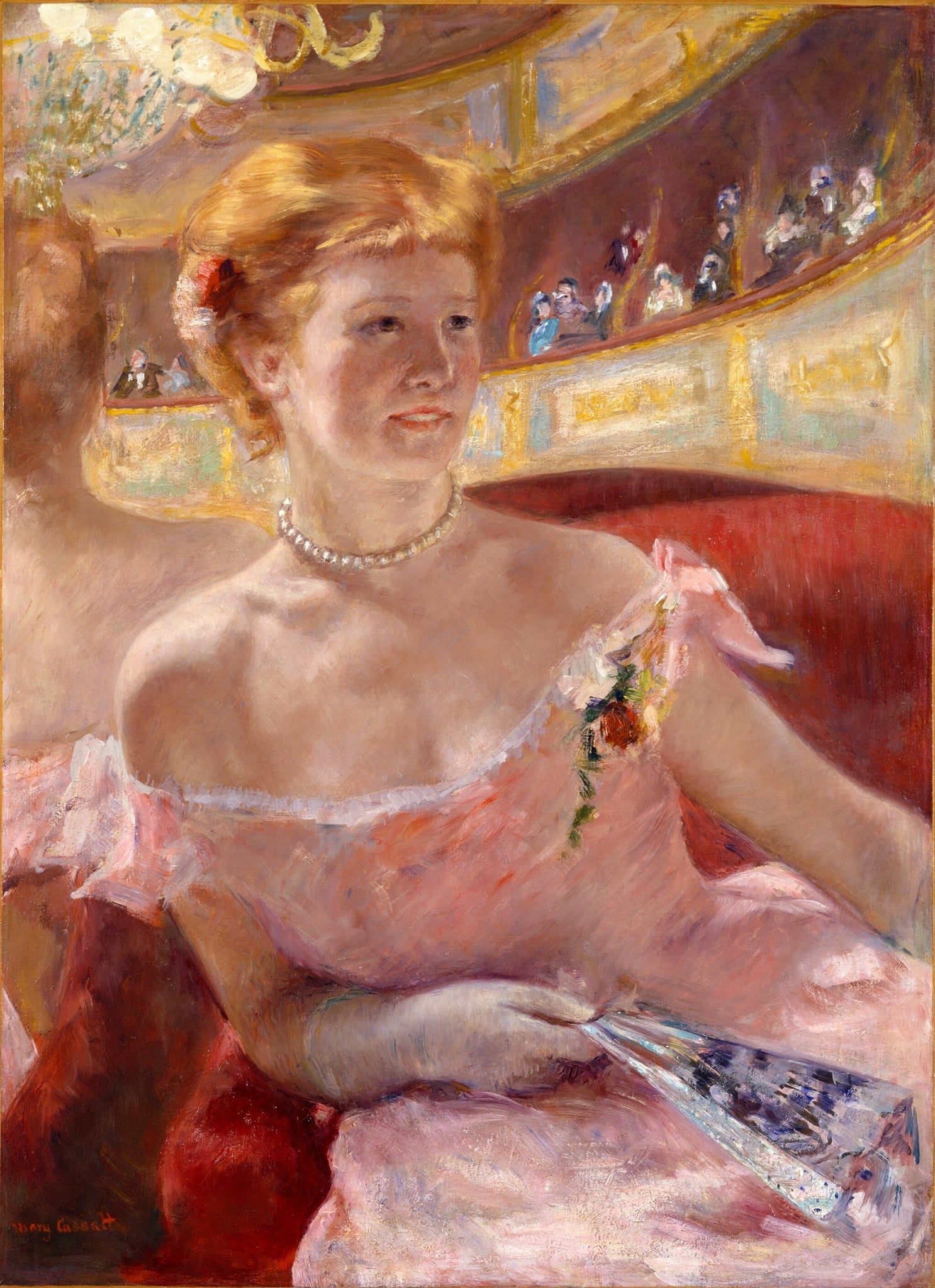
Woman with a Pearl Necklace in a Loge
Mary Cassatt (1879)
Mary Cassatt’s Woman with a Pearl Necklace in a Loge (1879) stages modern <strong>spectatorship</strong> inside a plush opera box, where a young woman in pink satin, pearls, and gloves occupies the red velvet seat while a mirror multiplies the chandeliers and balconies. Cassatt fuses <strong>intimacy</strong> and <strong>public display</strong>, using luminous brushwork to place her sitter within the social theater of Parisian leisure <sup>[1]</sup><sup>[2]</sup>.
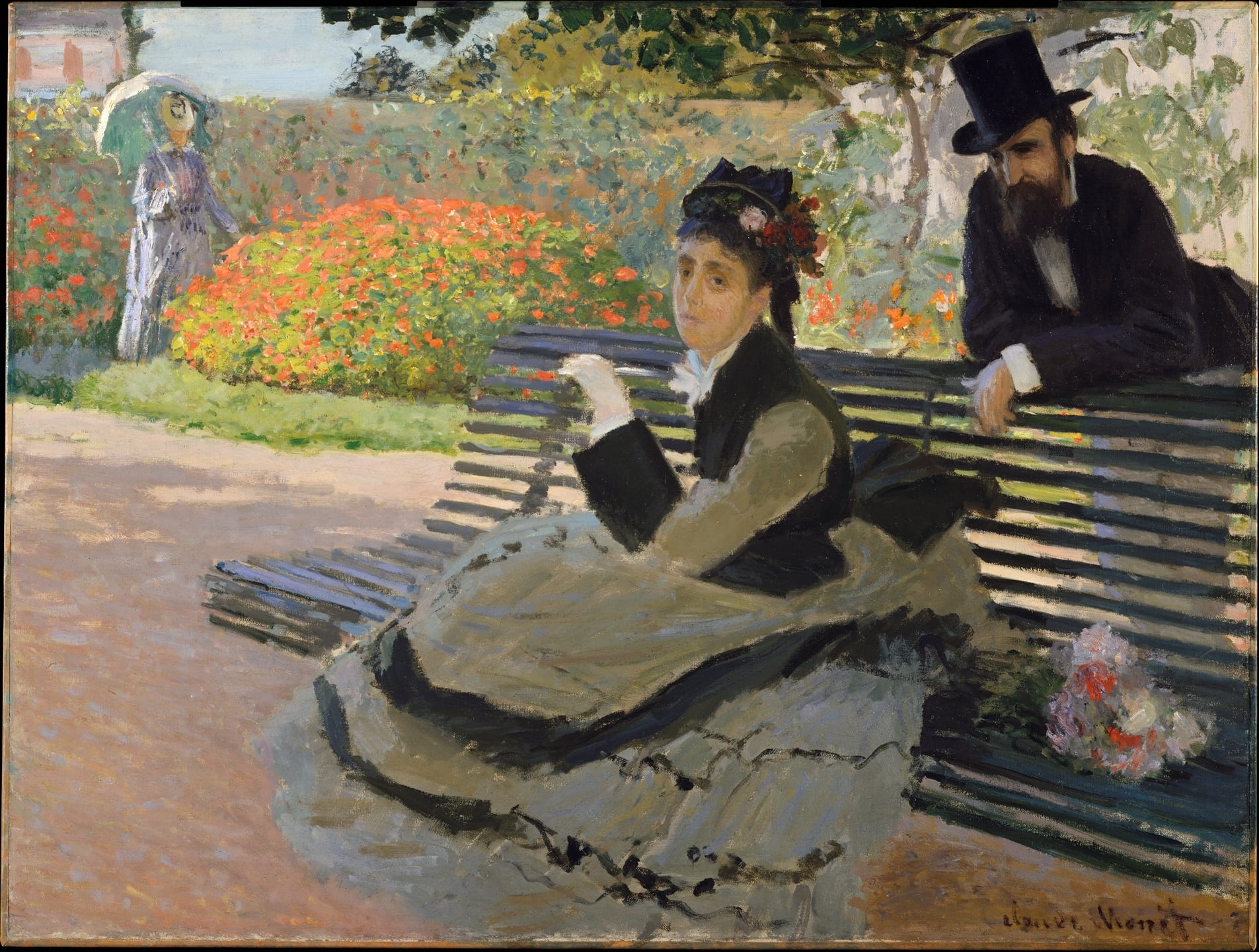
Camille Monet on a Garden Bench
Claude Monet (1873)
Claude Monet’s Camille Monet on a Garden Bench (1873) stages an intimate pause where <strong>light, grief, and modern leisure</strong> intersect. Camille, shaded and withdrawn, holds a letter while a <strong>top‑hatted neighbor</strong> hovers; a bright bank of <strong>red geraniums</strong> and a strolling woman with a parasol ignite the distance <sup>[1]</sup>. Monet converts a domestic garden into a scene about <strong>psychological distance</strong> amid fleeting sunlight.
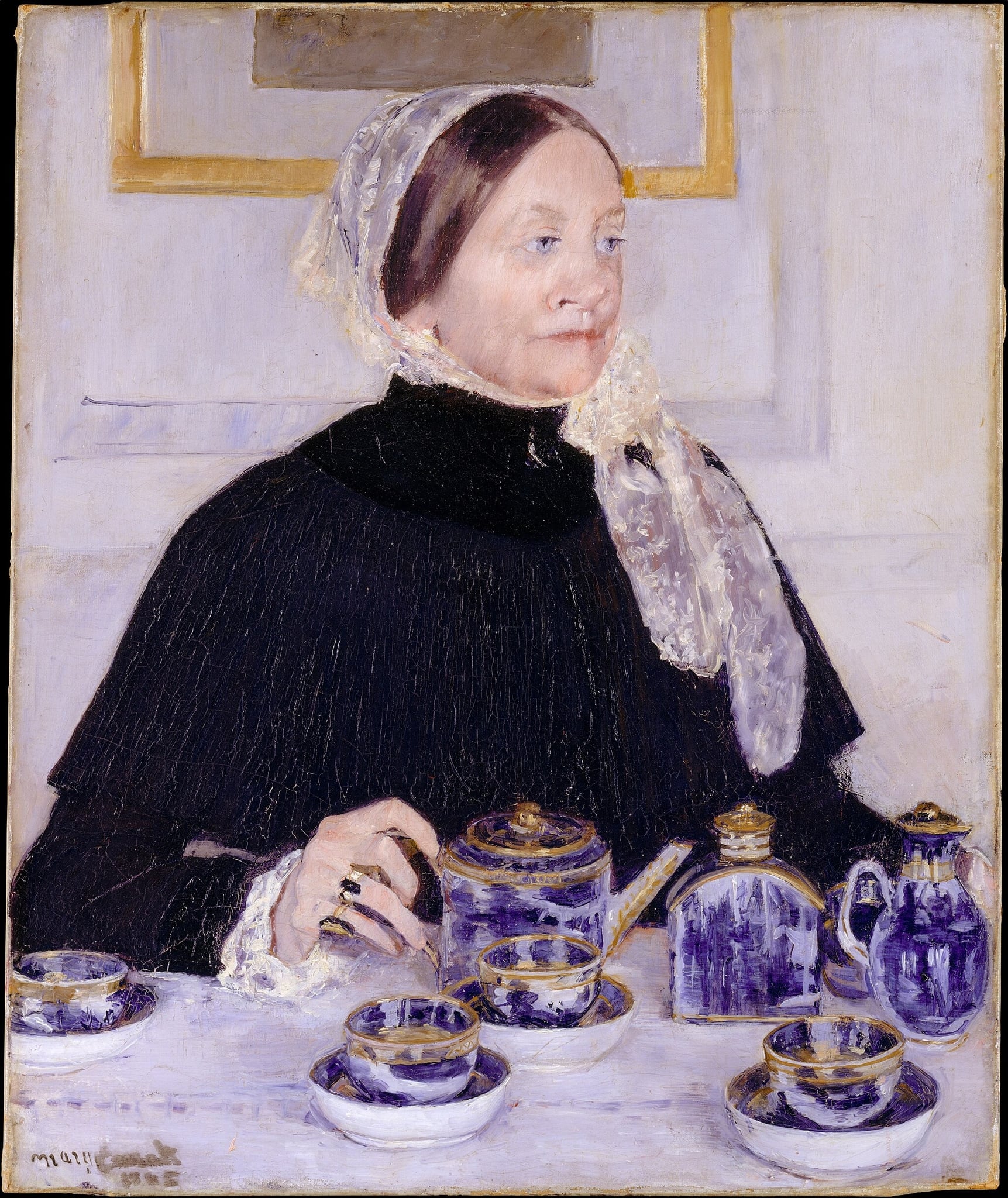
Lady at the Tea Table
Mary Cassatt (1883–85 (signed 1885))
Mary Cassatt’s Lady at the Tea Table distills a domestic rite into a scene of <strong>quiet authority</strong>. The sitter’s black silhouette, lace cap, and poised hand marshal a regiment of <strong>cobalt‑and‑gold Canton porcelain</strong>, while tight cropping and planar light convert hospitality into <strong>modern self‑possession</strong> <sup>[1]</sup><sup>[5]</sup>.
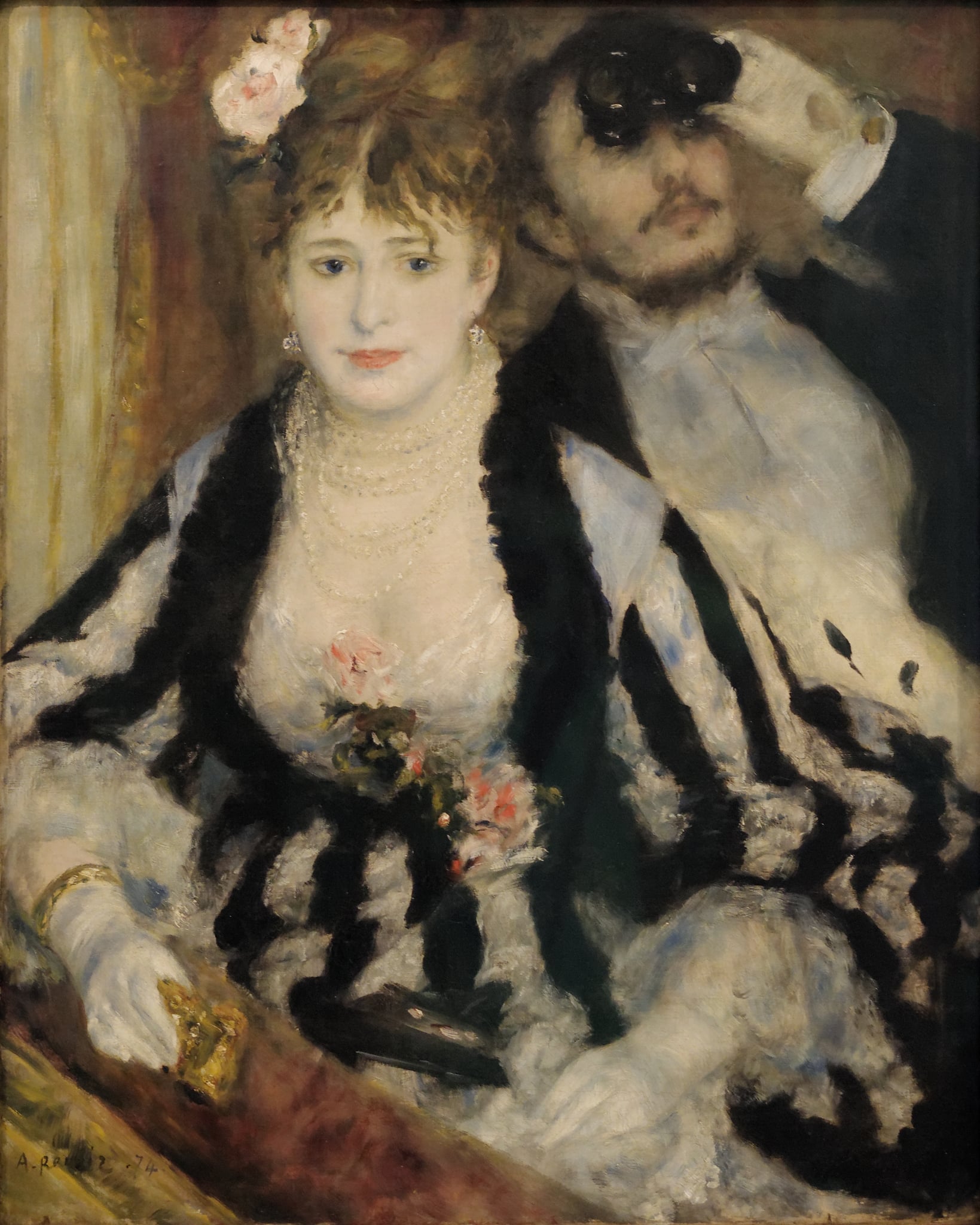
The Theater Box
Pierre-Auguste Renoir (1874)
Renoir’s The Theater Box turns a plush loge into a stage where seeing becomes the performance. A luminous woman—pearls, pale gloves, black‑and‑white stripes—faces us, while her companion scans the auditorium through opera glasses. The painting crystallizes Parisian <strong>modernity</strong> and the choreography of the <strong>gaze</strong> <sup>[1]</sup><sup>[5]</sup>.
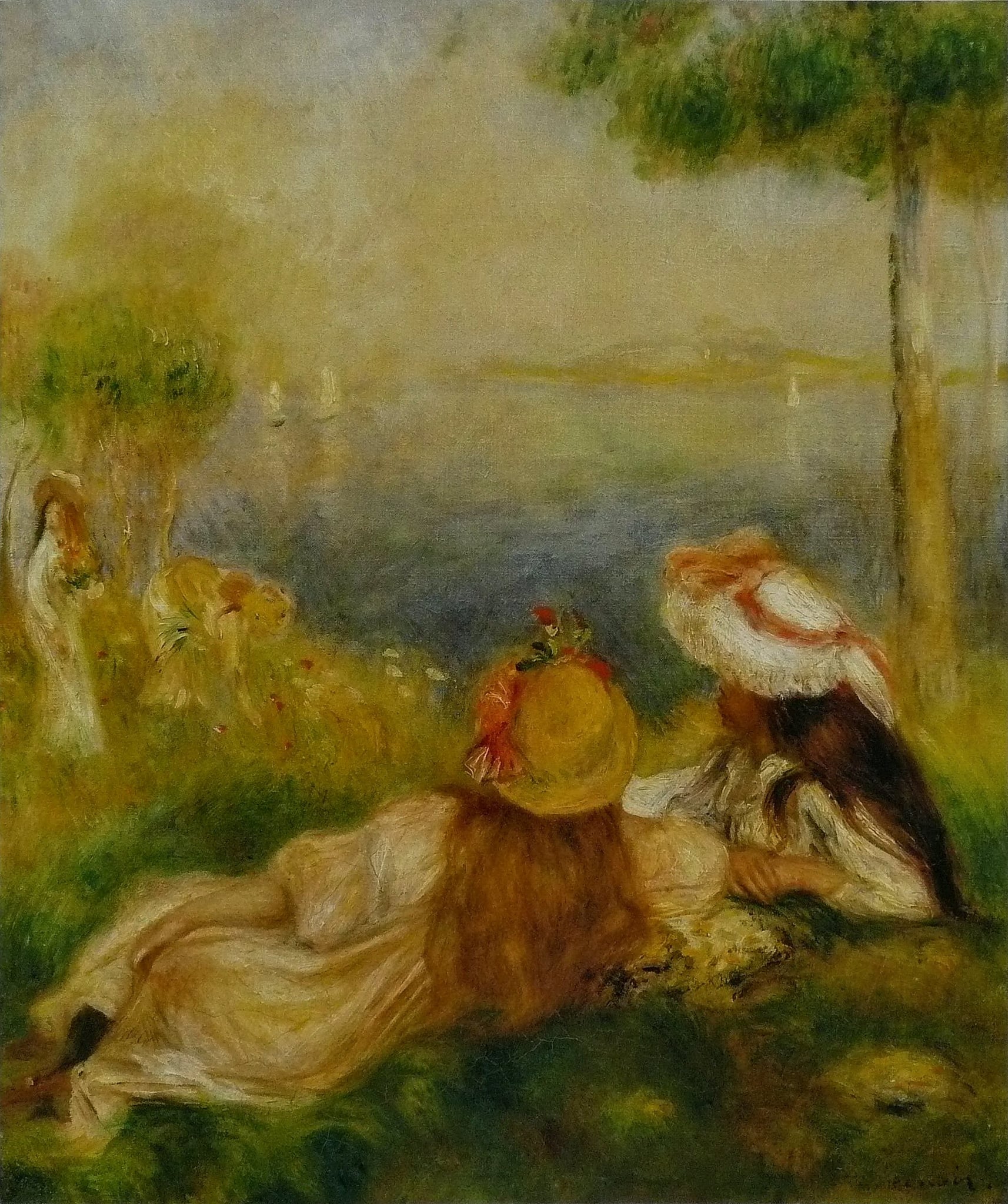
Girls at the Seashore
Pierre-Auguste Renoir (c.1890–1894)
Girls at the Seashore presents two young figures reclining on a grassy bank, their straw hats trimmed with flowers as they look toward a hazy waterway flecked with small sails. Renoir fuses figure and setting through soft, vaporous brushwork so that skin, fabric, foliage, and sea share the same light. The image is an ode to <strong>reverie</strong>, <strong>companionship</strong>, and the <strong>fleeting</strong> warmth of summer.
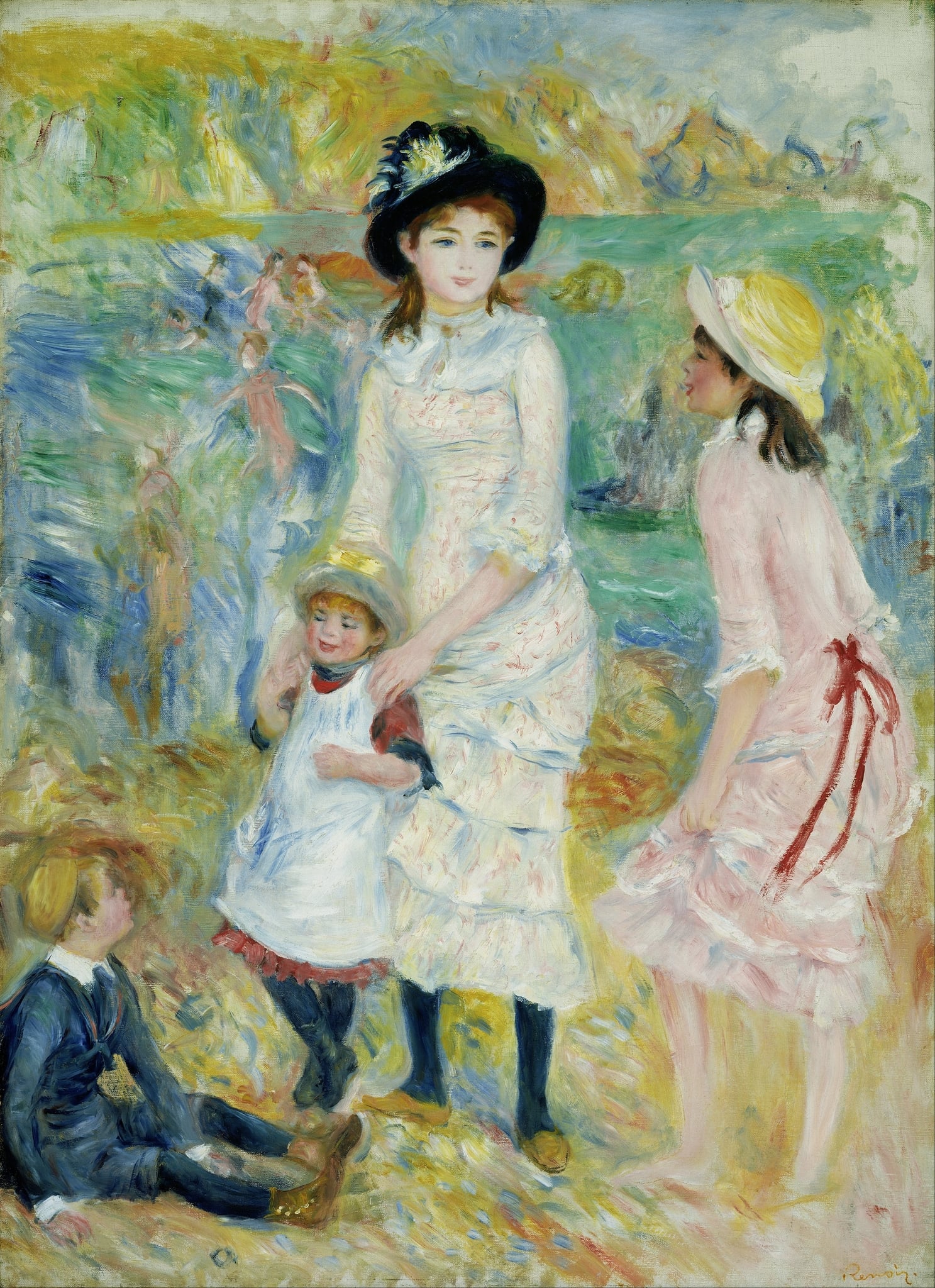
Children on the Seashore, Guernsey
Pierre-Auguste Renoir (about 1883)
Renoir’s Children on the Seashore, Guernsey crystallizes a wind‑bright moment of modern leisure with <strong>flickering brushwork</strong> and a gently choreographed group of children. The central girl in a white dress and black feathered hat steadies a toddler while a pink‑clad companion leans in and a sailor‑suited boy rests on the pebbles—an intimate triangle set against a <strong>shimmering, populated sea</strong>. The canvas makes light and movement the protagonists, dissolving edges into <strong>pearly surf and sun‑washed cliffs</strong>.
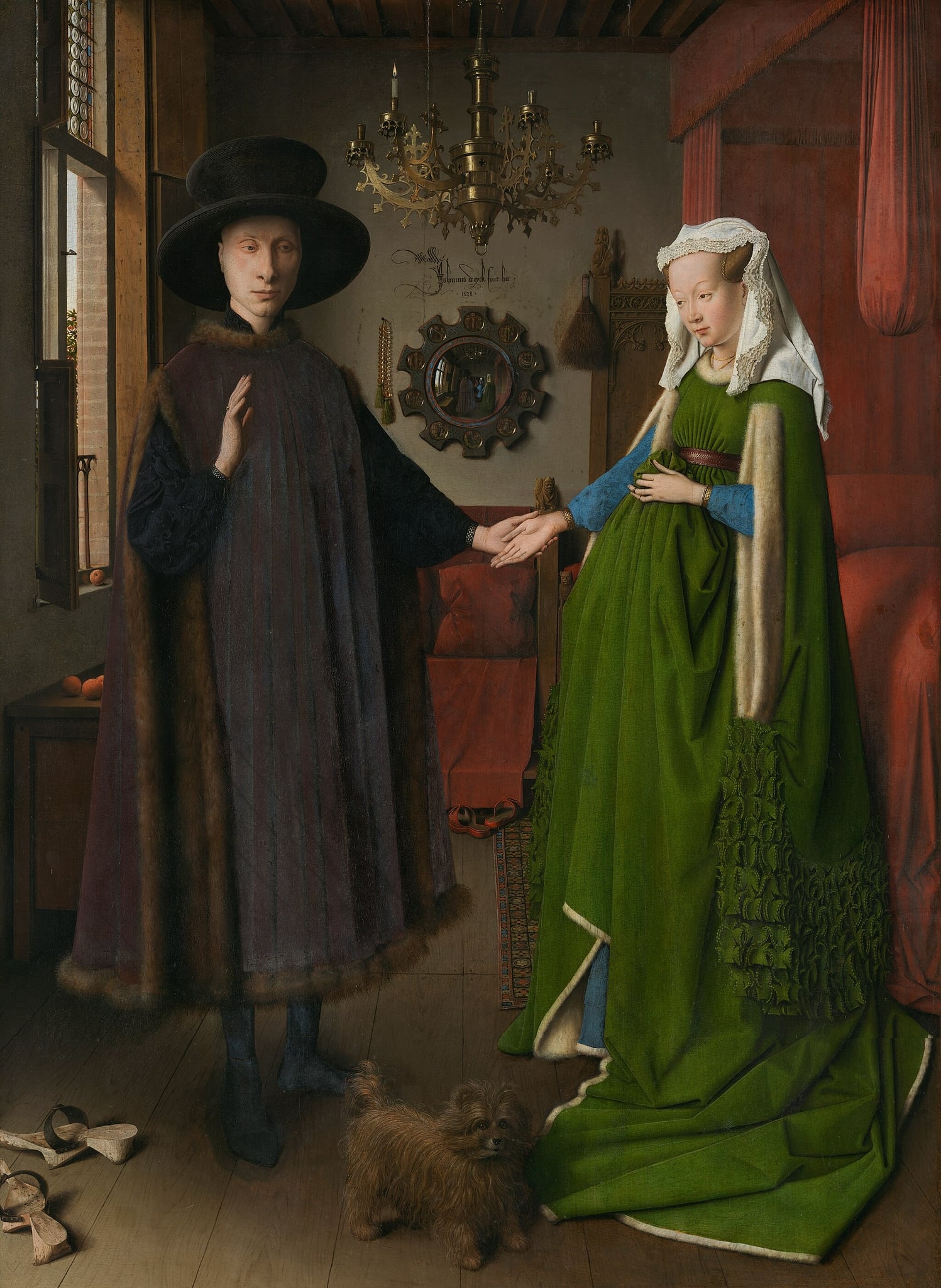
The Arnolfini Portrait
Jan van Eyck (1434)
In The Arnolfini Portrait, Jan van Eyck stages a poised encounter between a richly dressed couple whose joined hands, a single burning candle, and a convex mirror transform a domestic interior into a scene of <strong>status and sanctity</strong>. The painting asserts the artist’s own <strong>presence</strong>—"Johannes de eyck fuit hic 1434"—as if to validate the moment while showcasing oil painting’s power to make belief tangible through light, texture, and reflection <sup>[1]</sup><sup>[2]</sup>.
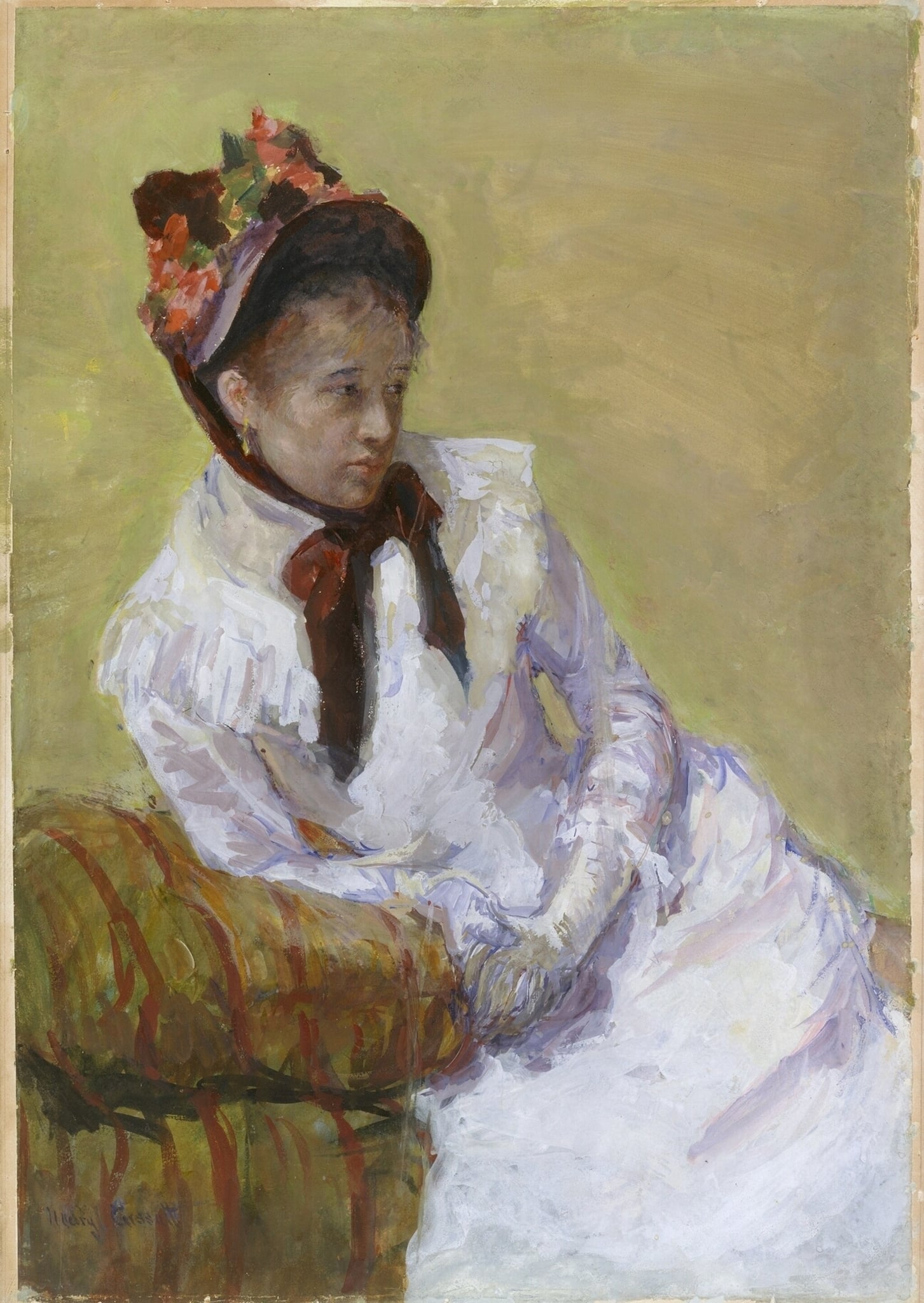
Self-Portrait
Mary Cassatt (1878)
In Self-Portrait, Mary Cassatt presents a poised, <strong>modern woman</strong> angled diagonally across a striped chair, her gaze turned away in <strong>thoughtful reserve</strong>. A <strong>sage-olive ground</strong> and tight crop strip away setting, while the <strong>white dress</strong> flickers with lilacs and blues against a <strong>decisive red ribbon</strong> and floral bonnet. The image asserts <strong>professional selfhood</strong> through restraint, asymmetry, and broken color.<sup>[1]</sup>
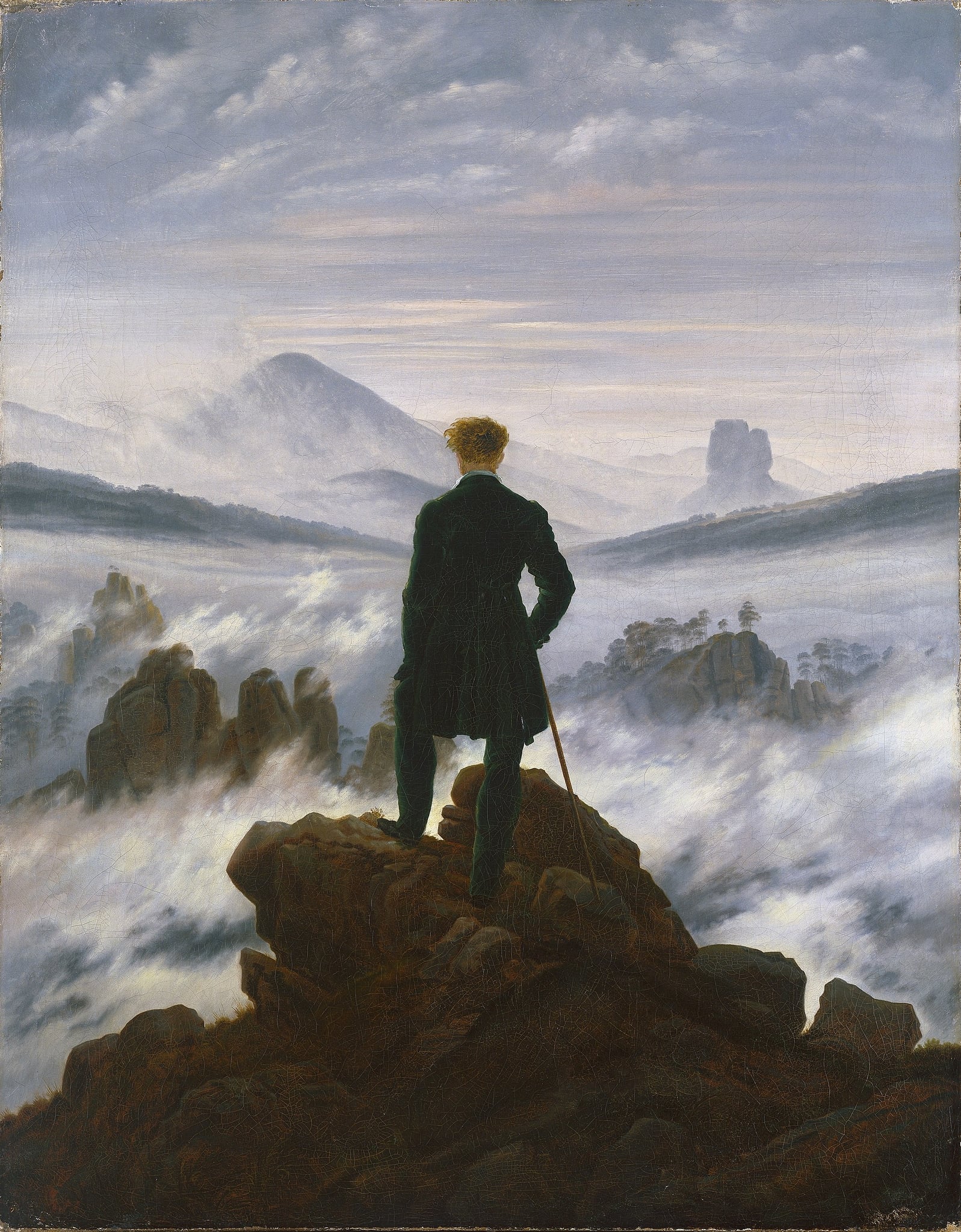
The Wanderer above the Sea of Fog
Caspar David Friedrich (ca. 1817)
Caspar David Friedrich’s The Wanderer above the Sea of Fog distills the Romantic encounter with nature into a single <strong>Rückenfigur</strong> poised on jagged rock above a rolling <strong>sea of mist</strong>. The cool, receding vista and the figure’s still stance convert landscape into an <strong>inner drama of contemplation</strong> and the <strong>sublime</strong> <sup>[1]</sup><sup>[3]</sup>.
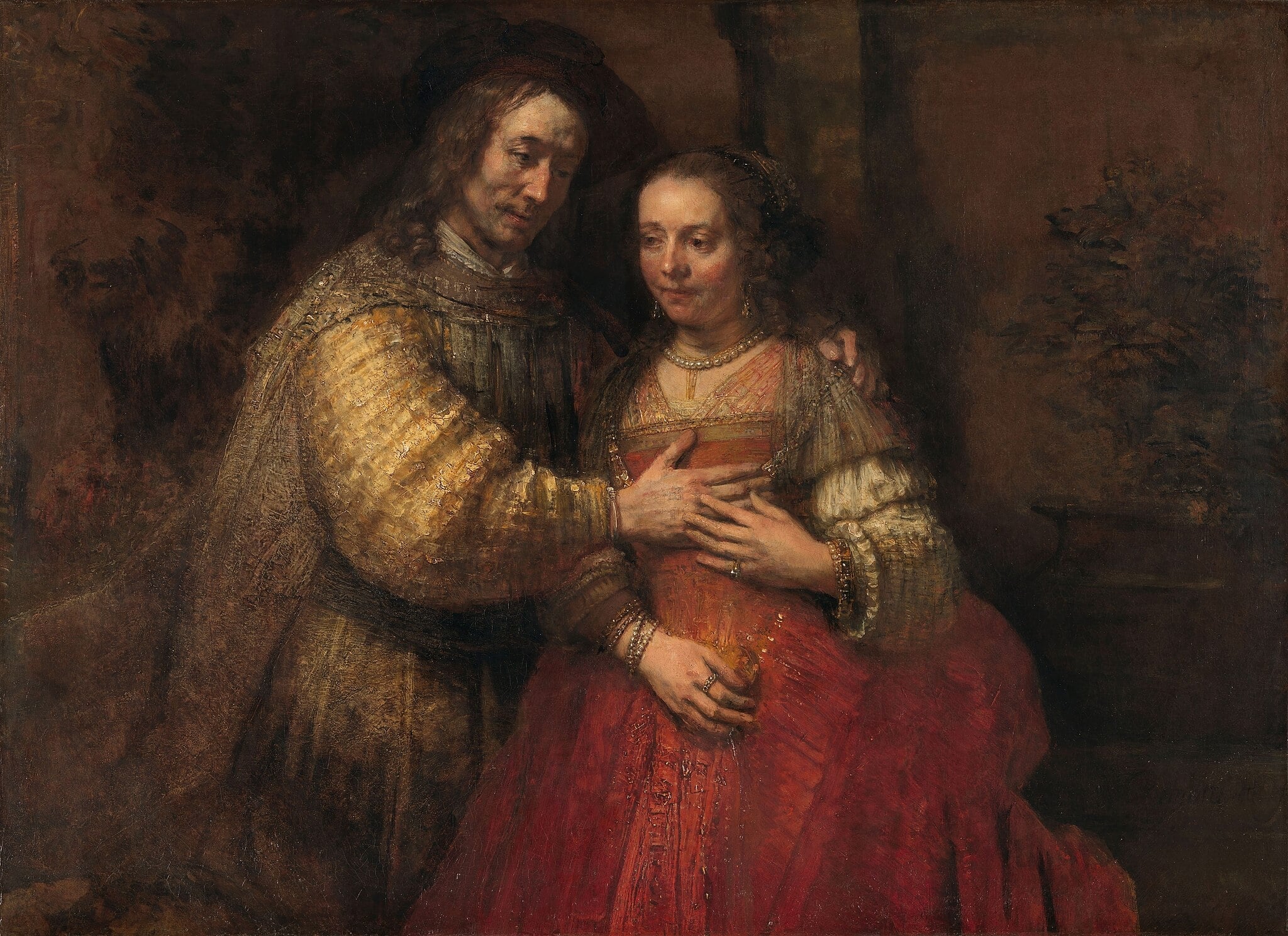
The Jewish Bride
Rembrandt van Rijn (c. 1665–1669)
The Jewish Bride by Rembrandt van Rijn stages an intimate covenant: two figures, read today as <strong>Isaac and Rebecca</strong>, seal their union through touch rather than spectacle. Light concentrates on faces and hands, while the man’s glittering <strong>gold sleeve</strong> and the woman’s <strong>coral-red gown</strong> turn paint itself into a metaphor for fidelity and tenderness <sup>[1]</sup><sup>[3]</sup>. This late masterpiece embodies Rembrandt’s <strong>material eloquence</strong>—impasto as feeling—within a hushed, dark setting <sup>[1]</sup><sup>[2]</sup>.
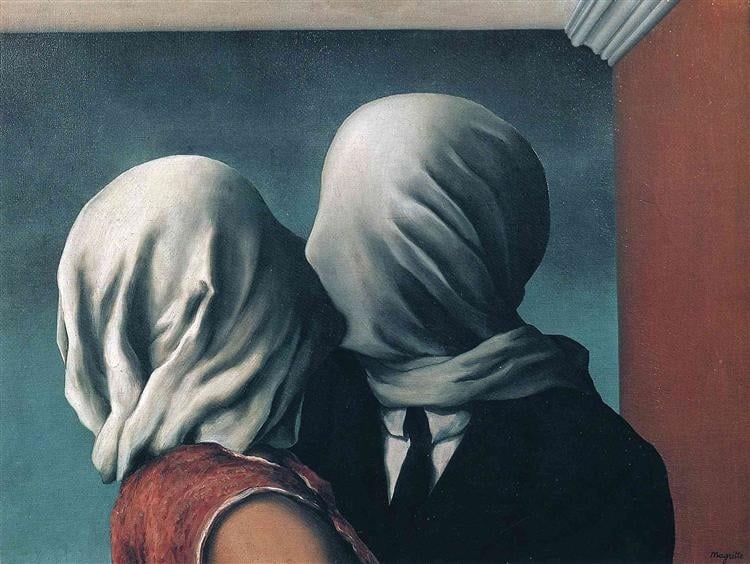
The Lovers
Rene Magritte (1928)
René Magritte’s The Lovers turns a kiss into an emblem of <strong>desire obstructed</strong>: two figures—she in red, he in a dark suit—press together while their heads are swathed in <strong>white cloth</strong>. Within a cool blue‑grey interior bounded by crown molding and a rust-red wall, intimacy becomes an image of <strong>opacity</strong> rather than revelation <sup>[1]</sup>.

The Two Fridas
Frida Kahlo (1939)
The Two Fridas presents a doubled self seated under a storm-charged sky, their opened chests revealing two hearts joined by a single artery. One Frida in a European dress clamps the vessel with a surgical <strong>hemostat</strong> as blood stains her skirt, while the other in a <strong>Tehuana</strong> dress steadies a locket and the shared pulse. The canvas turns private injury into a public image of <strong>dual identity</strong> and endurance <sup>[1]</sup><sup>[2]</sup>.
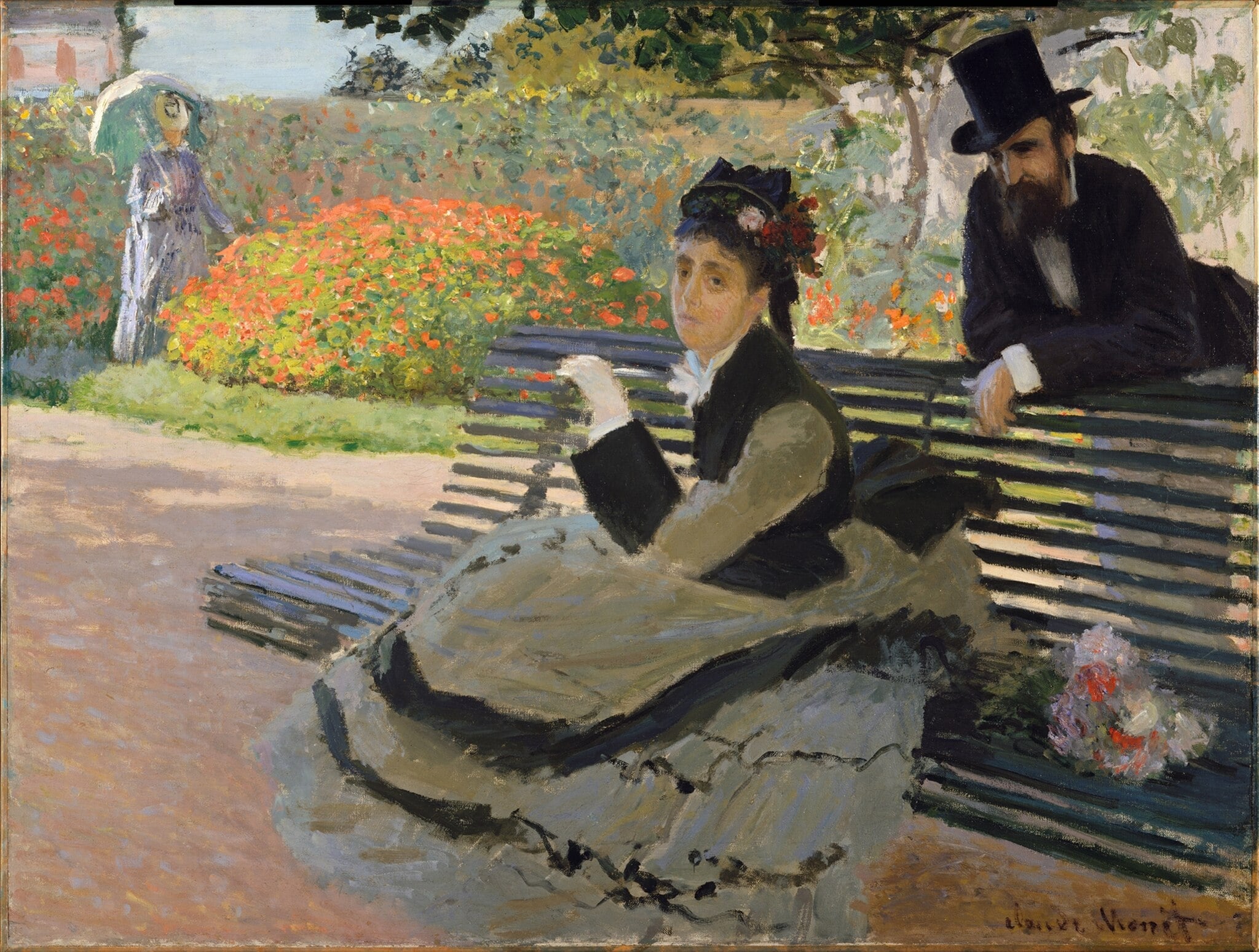
Camille Monet (1847–1879) on a Garden Bench
Claude Monet (1873)
Monet stages a modern garden drama along the <strong>diagonal bench</strong> that slices the foreground, setting Camille’s poised figure against a blaze of <strong>geraniums</strong> and dappled light. A <strong>top‑hatted neighbor</strong> leans over the slats as a second woman with a <strong>parasol</strong> wanders among blooms, while a <strong>note</strong> and a slightly tumbled <strong>bouquet</strong> cue a moment interrupted. Light, not contour, builds the scene, suspending private feeling within public leisure <sup>[1]</sup><sup>[2]</sup>.
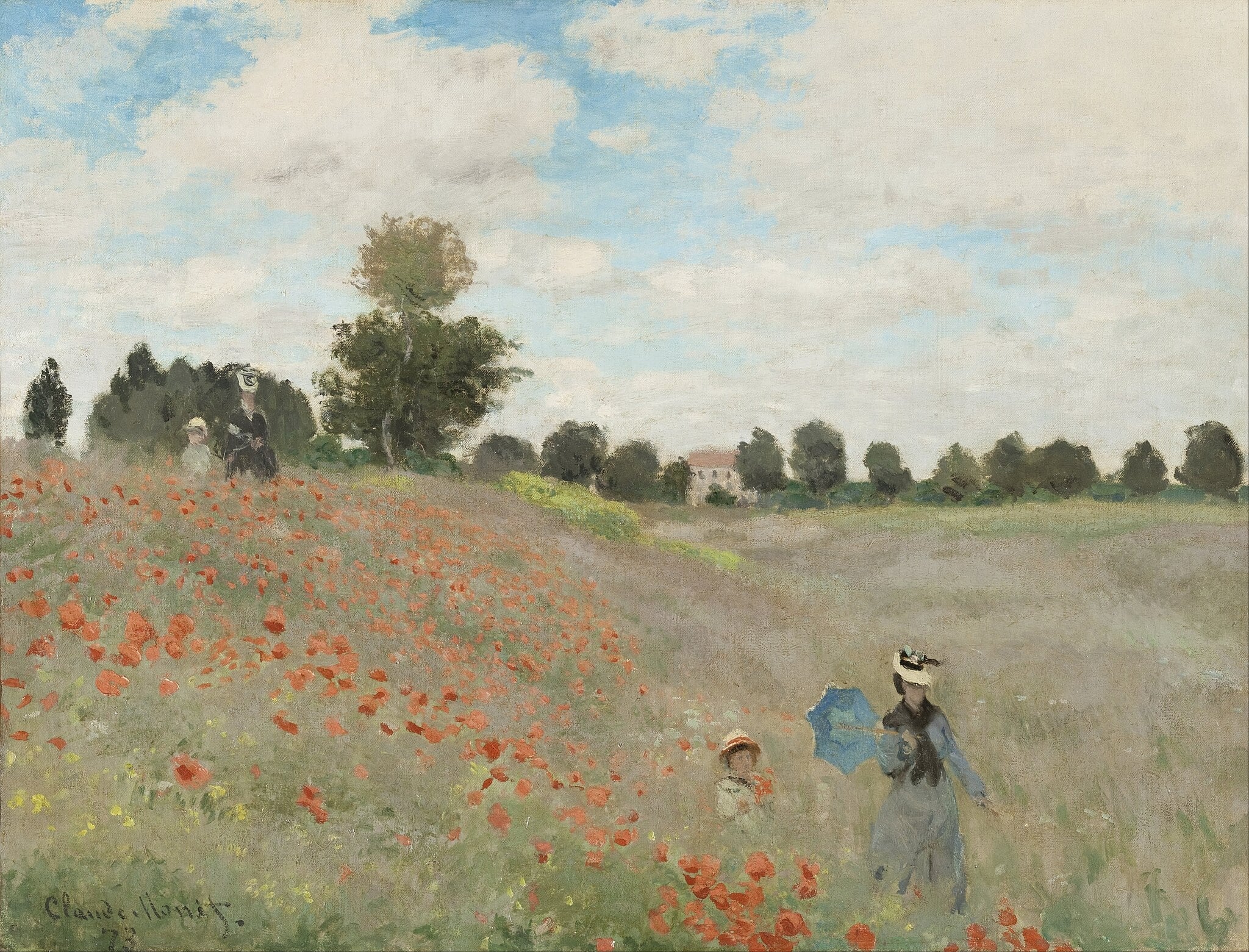
Poppy Fields near Argenteuil
Claude Monet (1873)
A modern pastoral where <strong>color and weather become the subject</strong>: in Poppy Fields near Argenteuil (1873), Monet arrays red poppies along a diagonal slope beneath an immense, changeable sky. Two promenading figures recur across the hill, turning a stroll into a <strong>rhythm of time and movement</strong> <sup>[1]</sup><sup>[2]</sup>.
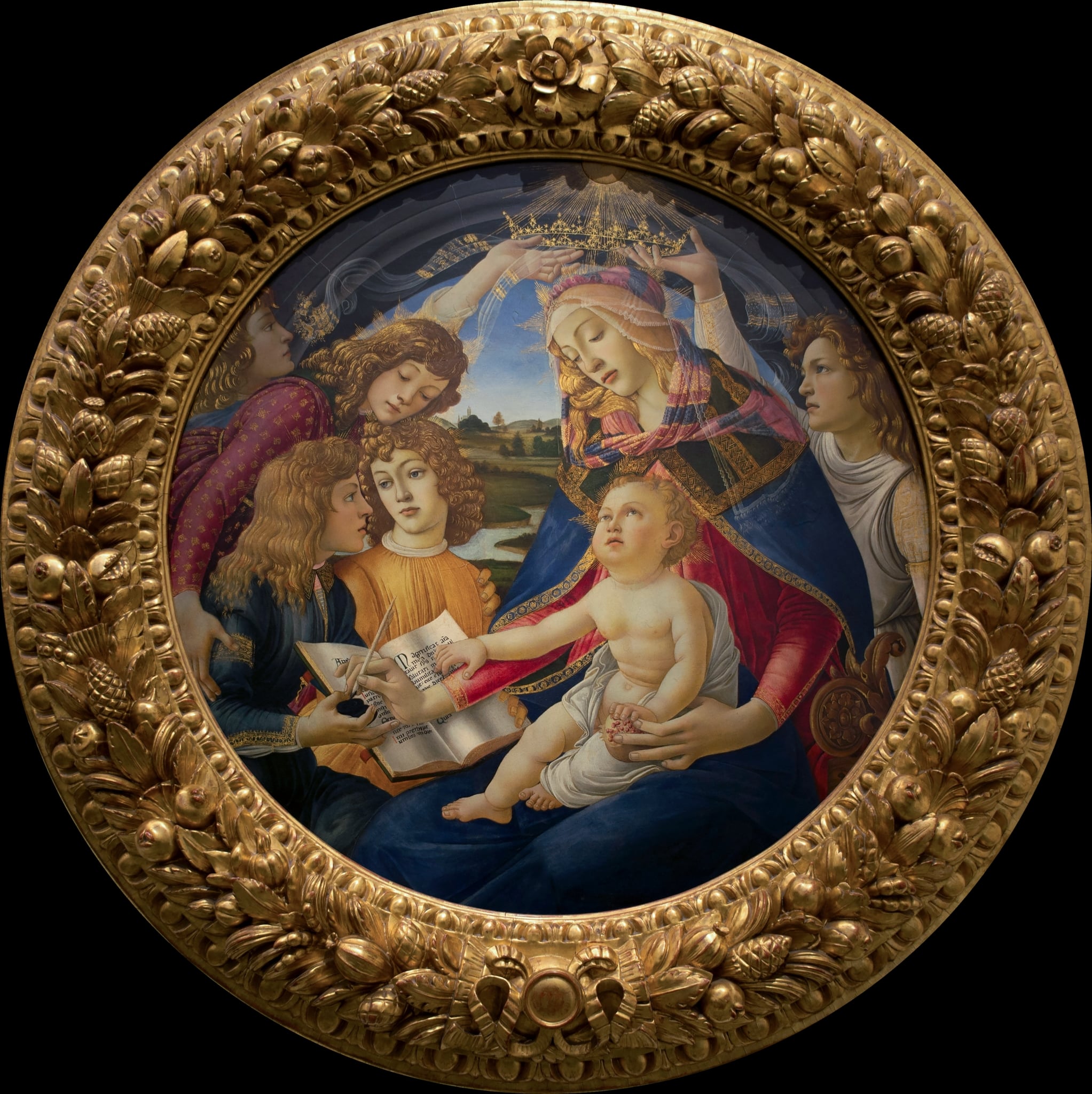
Madonna of the Magnificat
Sandro Botticelli (c. 1483)
Botticelli’s Madonna of the Magnificat is a circular panel where the Virgin, <strong>crowned by angels</strong>, writes the <strong>Magnificat</strong> as the Christ Child guides her hand. A split <strong>pomegranate</strong> in the Child’s grasp prefigures the Passion while the wingless, courtly angels and a Tuscan view bind sacred mystery to Florentine life <sup>[1]</sup><sup>[2]</sup>. The tondo’s swirl of fabrics and gold makes theology visible as a choreography of <strong>praise, prophecy, and sacrifice</strong>.
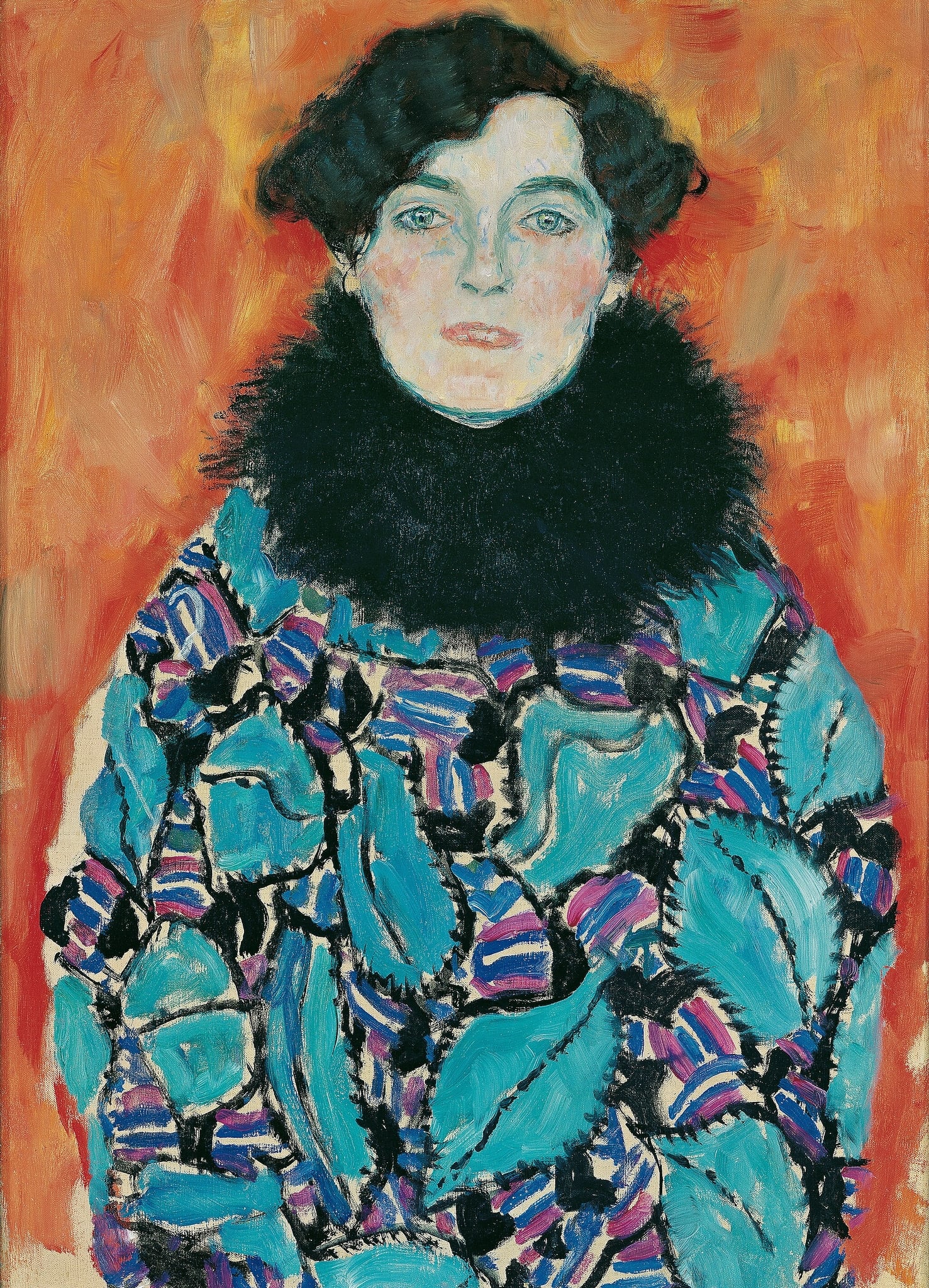
Johanna Staude
Gustav Klimt (1917/1918)
<strong>Johanna Staude</strong> distills Klimt’s late style into a charged encounter between a cool, impassive face and a blazing orange field. The sitter’s head is isolated by a <strong>black feather collar</strong>, while a <strong>Wiener Werkstätte</strong> blouse in turquoise leaves and violet stripes surges forward as a near-abstract surface <sup>[1]</sup><sup>[2]</sup>. Painted in 1917/1918 and left <strong>unfinished</strong> at the mouth, it becomes a poised emblem of modern identity in Vienna on the eve of Klimt’s death <sup>[1]</sup><sup>[2]</sup><sup>[5]</sup>.
Sonja Knips
Gustav Klimt (1897/1898)
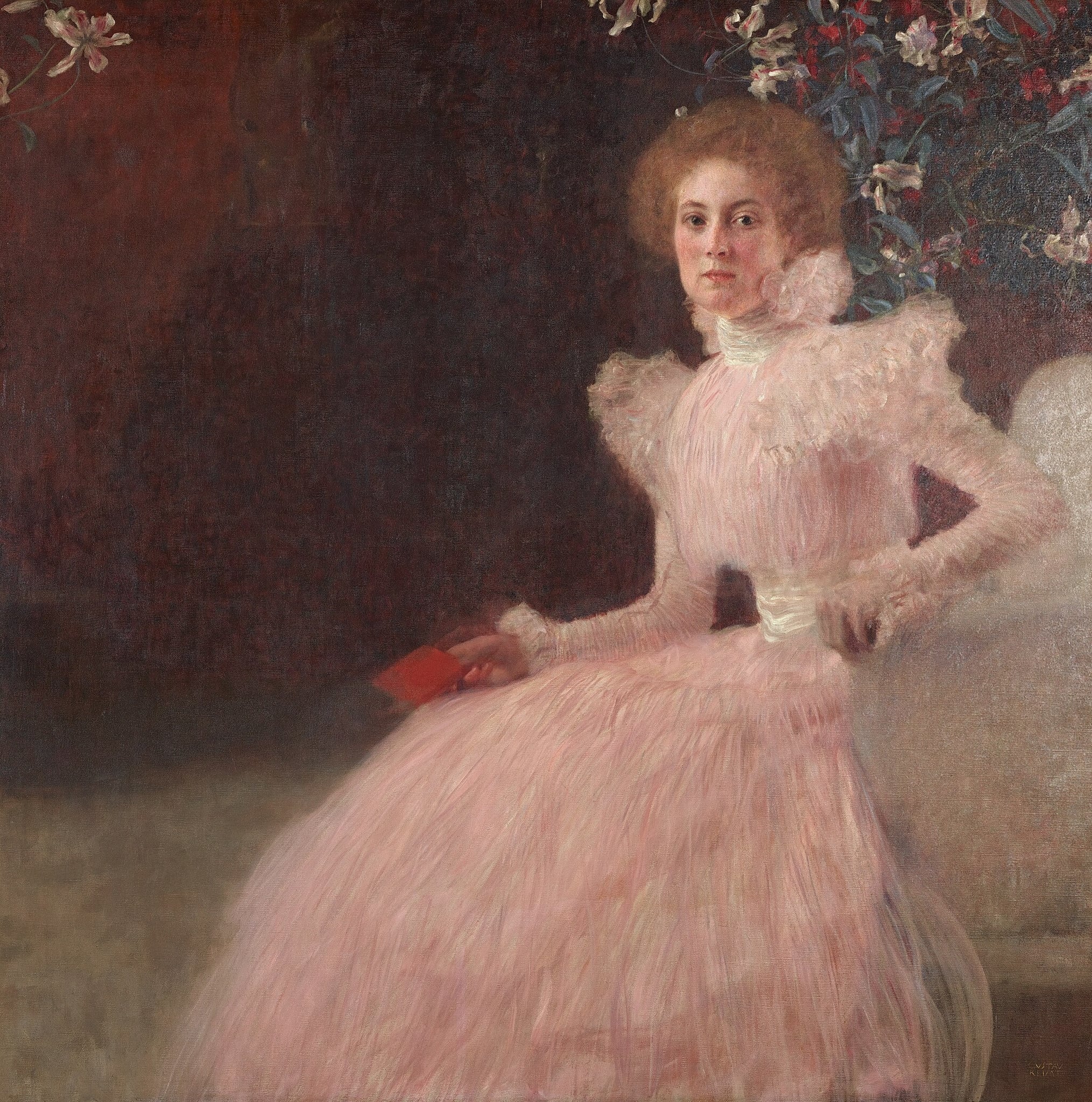
In Sonja Knips, Gustav Klimt stages a poised young woman as a modern self—held taut between <strong>lucid presence</strong> and <strong>ornamental dissolution</strong>. The square canvas, the feathery pink dress, the climbing white lilies, and the single <strong>red sketchbook</strong> in her hand crystallize an identity that is reflective, intelligent, and self‑aware within a decorous world <sup>[1]</sup><sup>[2]</sup><sup>[4]</sup>.
Amalie Zuckerkandl
Gustav Klimt (1917–1918)
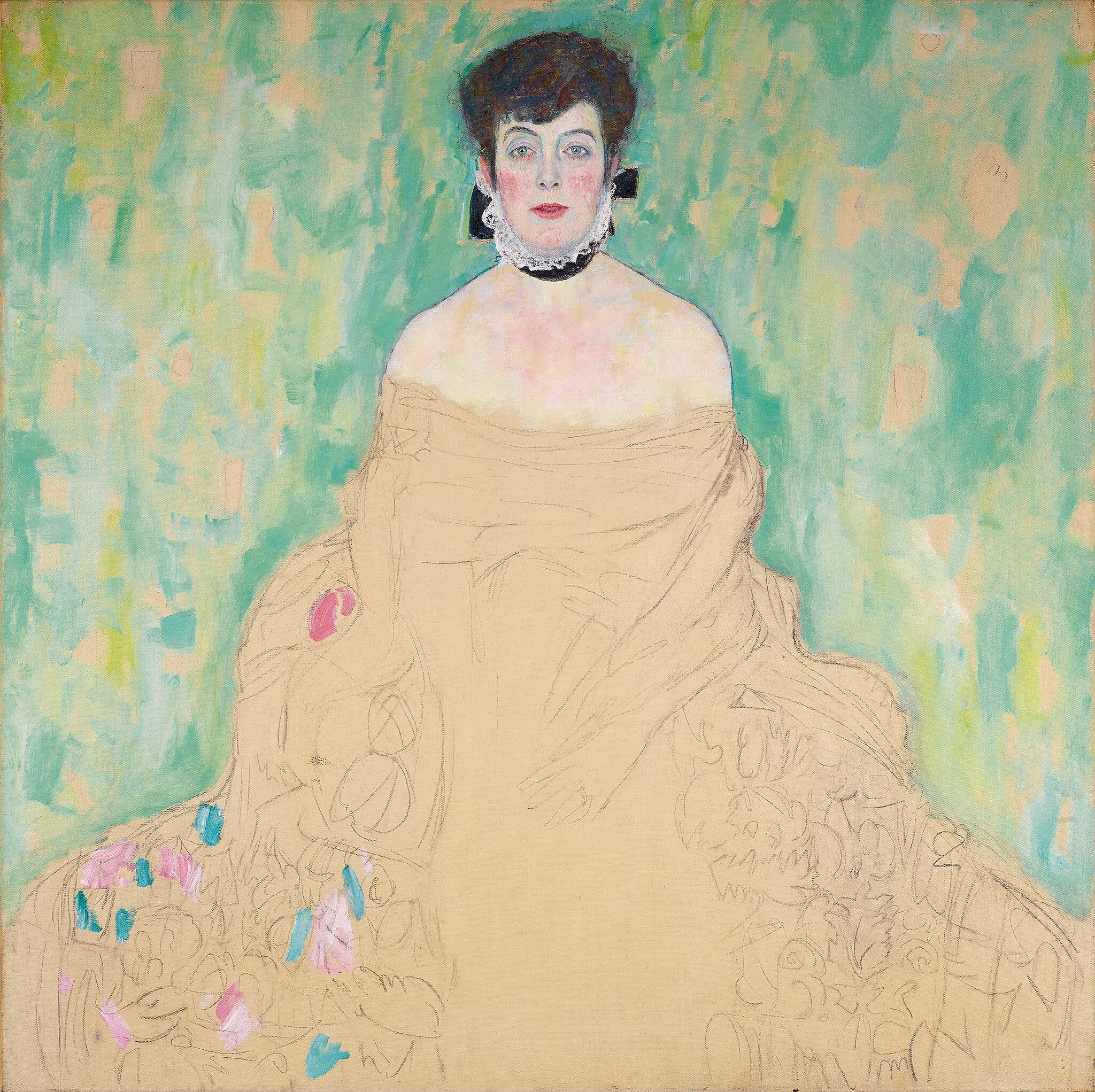
Gustav Klimt’s Amalie Zuckerkandl is an <strong>unfinished</strong> late portrait in which a fully realized head and shoulders float above a gown left as <strong>skeletal graphite and washes</strong>. Set against a mottled, cool <strong>green ground</strong>, her flushed face, direct gaze, black <strong>choker</strong> and crisp lace collar stage a drama of poise, sensuality, and restraint <sup>[1]</sup><sup>[6]</sup>. The painting’s incompletion becomes the work’s meaning: a vivid selfhood <strong>emerging</strong> while ornament remains <strong>in potential</strong>.
Lady in White
Gustav Klimt (1917–1918)
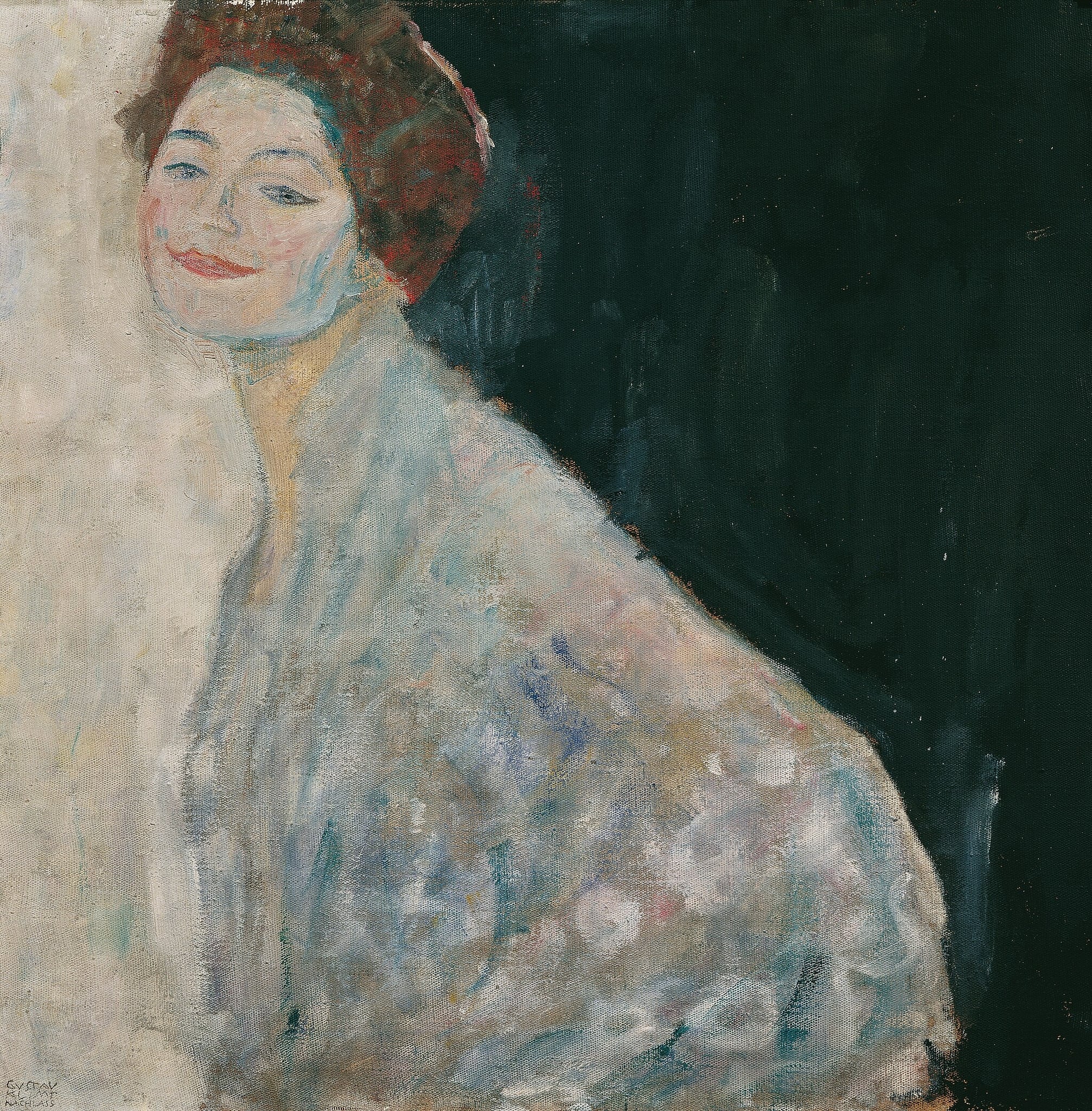
Lady in White crystallizes Klimt’s late style as a <strong>liminal apparition</strong>: a woman who seems to form out of paint where a pale field meets a dark one. Her kimono‑like robe dissolves into <strong>iridescent whites</strong> touched by blues and violets, while a tilted, <strong>mask‑like smile</strong> hovers between intimacy and anonymity <sup>[1]</sup><sup>[2]</sup><sup>[3]</sup>. The result is less a likeness than a <strong>luminous state of being</strong> suspended on a threshold.
The Kiss (Hayez)
Francesco Hayez (1859)
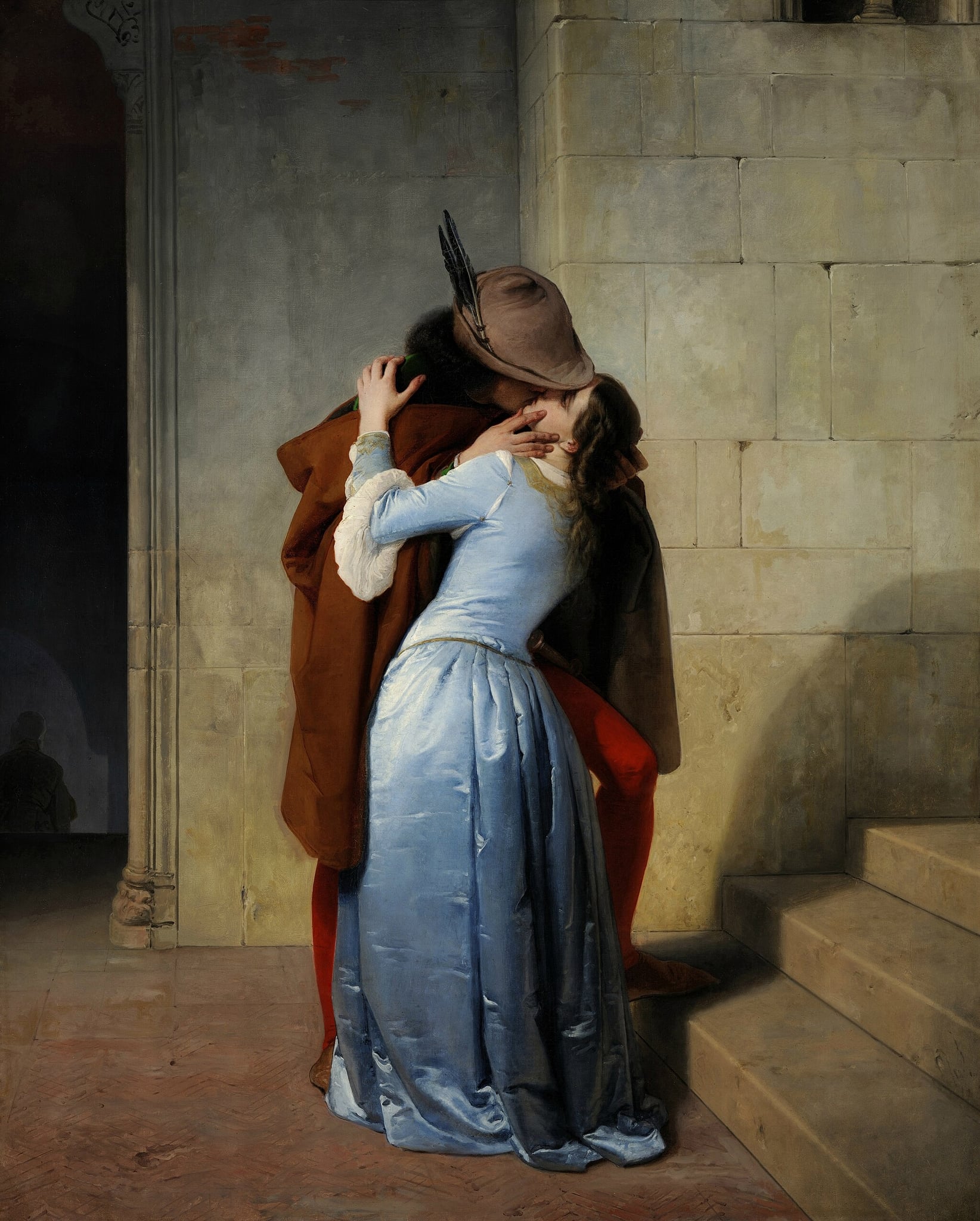
Francesco Hayez’s The Kiss (Hayez) fuses intimate passion with <strong>political resolve</strong>: a clandestine embrace staged on a cold stone threshold as departure looms. The man’s <strong>outward-angled foot</strong> on the stair and the flash of a <strong>dagger</strong> compress time to a final instant before flight, while tricolour cues fold love into the Risorgimento alliance of 1859 <sup>[1]</sup>. The painting’s cool masonry and <strong>theatrical light</strong> make private tenderness read as public courage.