Paul Cézanne Paintings in Paris — Where to See Them
Paris is essential for seeing Paul Cézanne up close: about eight of his paintings are on permanent display across three museums in the city, with six at the Musée de l'Orangerie, one at the Petit Palais (Musée des Beaux-Arts de la Ville de Paris), and one at the Musée national Picasso-Paris. That concentration—especially the six works at the Orangerie—lets you compare his modulation of color, structural brushwork and compositional experiments in person, in the same city where his work shaped the shift to modern art.
At a Glance
- Museums
- Musée de l'Orangerie, Petit Palais (Musée des Beaux-Arts de la Ville de Paris), Musée national Picasso-Paris
- Highlight
- See Cézanne's still lifes and landscapes at Musée de l'Orangerie
- Best For
- Fans of Impressionism and post-Impressionist masters
Musée de l'Orangerie
Although the Orangerie is best known for Monet’s Water Lilies, its intimate galleries also present key works by Cézanne that show how his structural approach to form and color fed into the transition from Impressionism to modernism. Seeing Cézanne’s paintings here — grouped close to other late-19th/early-20th-century masters — makes it easier to read his formal experiments (planes of color, geometric simplification) alongside the artists who responded directly to him.
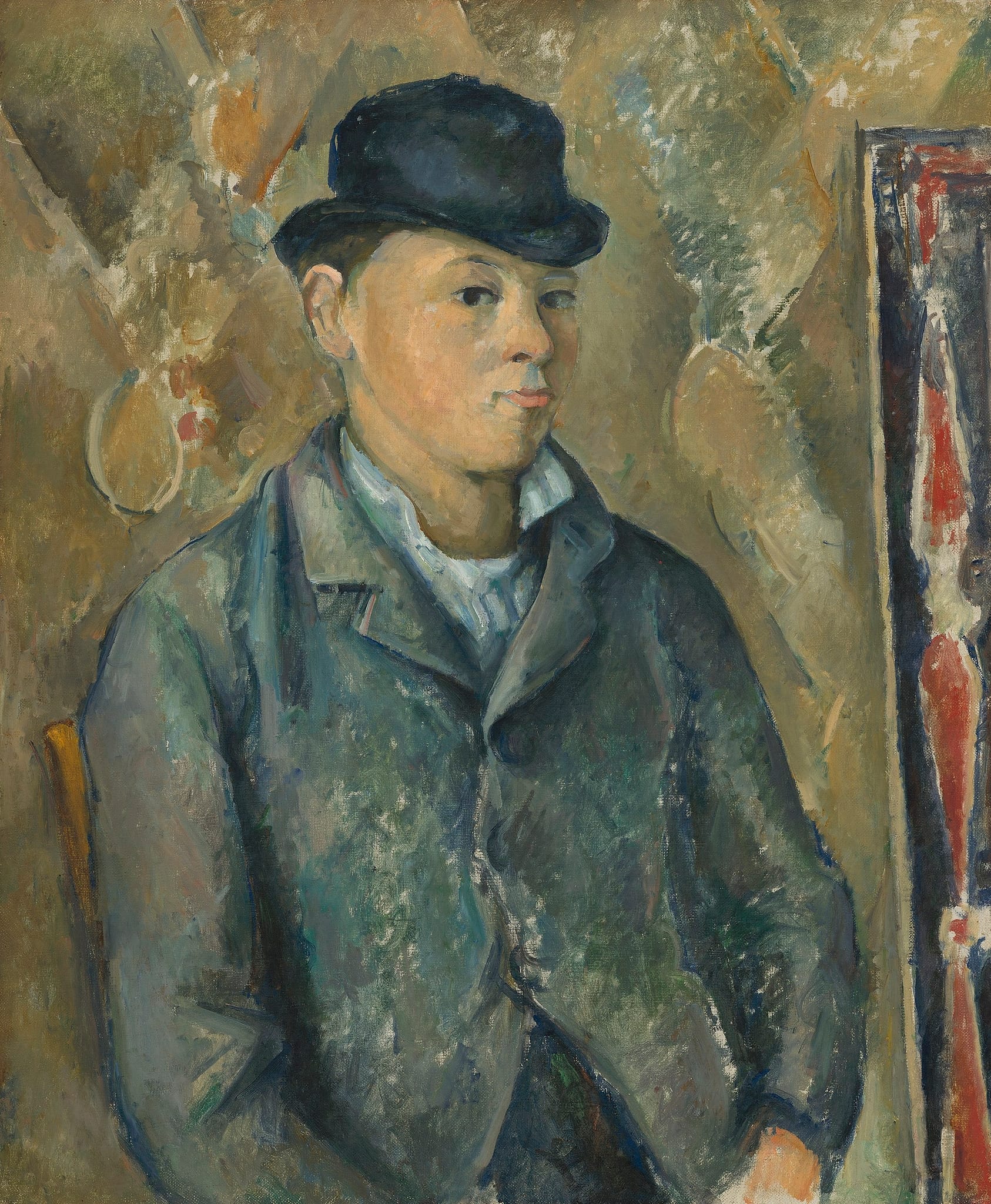
Portrait du fils de l'artiste
circa 1880
A sensitive portrait of Cézanne’s son showing a quiet, introspective child seated against a simplified background; the pose and restraint reflect the artist’s interest in psychological presence rather than flattery. Significant as an example of Cézanne’s move away from academic portraiture toward structural simplification, it reveals his method of building form through planes of color; look for the subtle modulation of tone in the face and the way brushstrokes organize volume rather than describe detail.
Must-see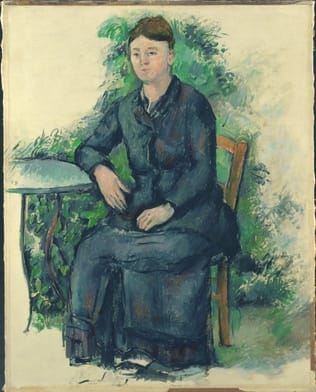
Portrait de Madame Cézanne (Madame Cézanne au jardin)
between 1885 and 1895
Madame Cézanne is portrayed in the garden with a composed, slightly remote expression, set amid dappled foliage and carefully arranged spatial planes. This work is important for how Cézanne treats a recurring personal subject with a rigorous, constructive approach—notice the flattened perspective, the measured color harmonies, and the interplay of verticals and foliage that both contain and isolate the sitter.
Must-see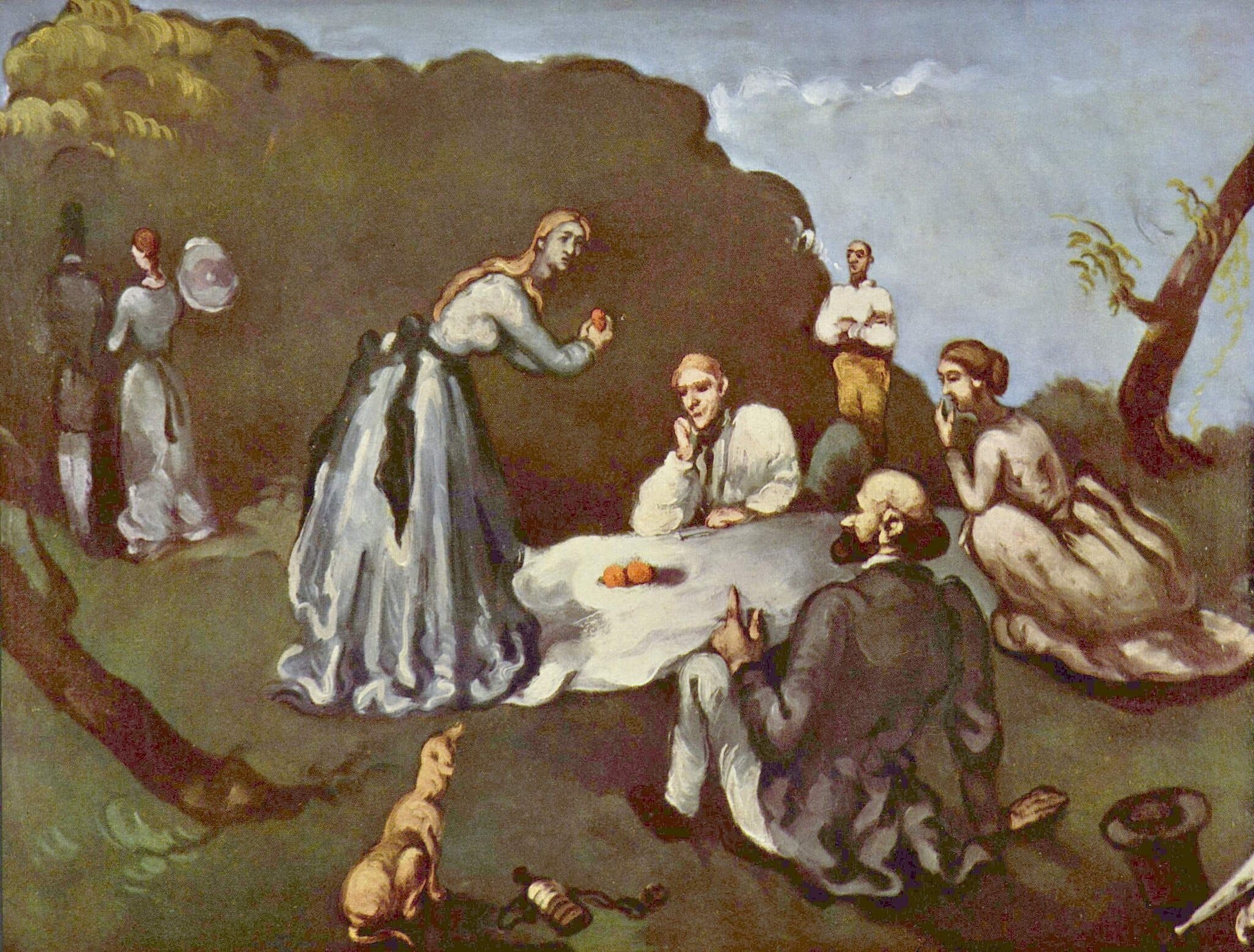
Le Déjeuner sur l'herbe
between 1876 and 1877
Cézanne’s reworking of the déjeuner motif shows figures in a park-like setting, balancing naturalism with compositional experimentation rather than copying the earlier Manet subject. Its significance lies in Cézanne’s exploration of spatial ambiguity and the relationship between figures and landscape; observe the fractured planes, the geometric simplification of bodies, and the way foreground and background interlock through color.
Must-see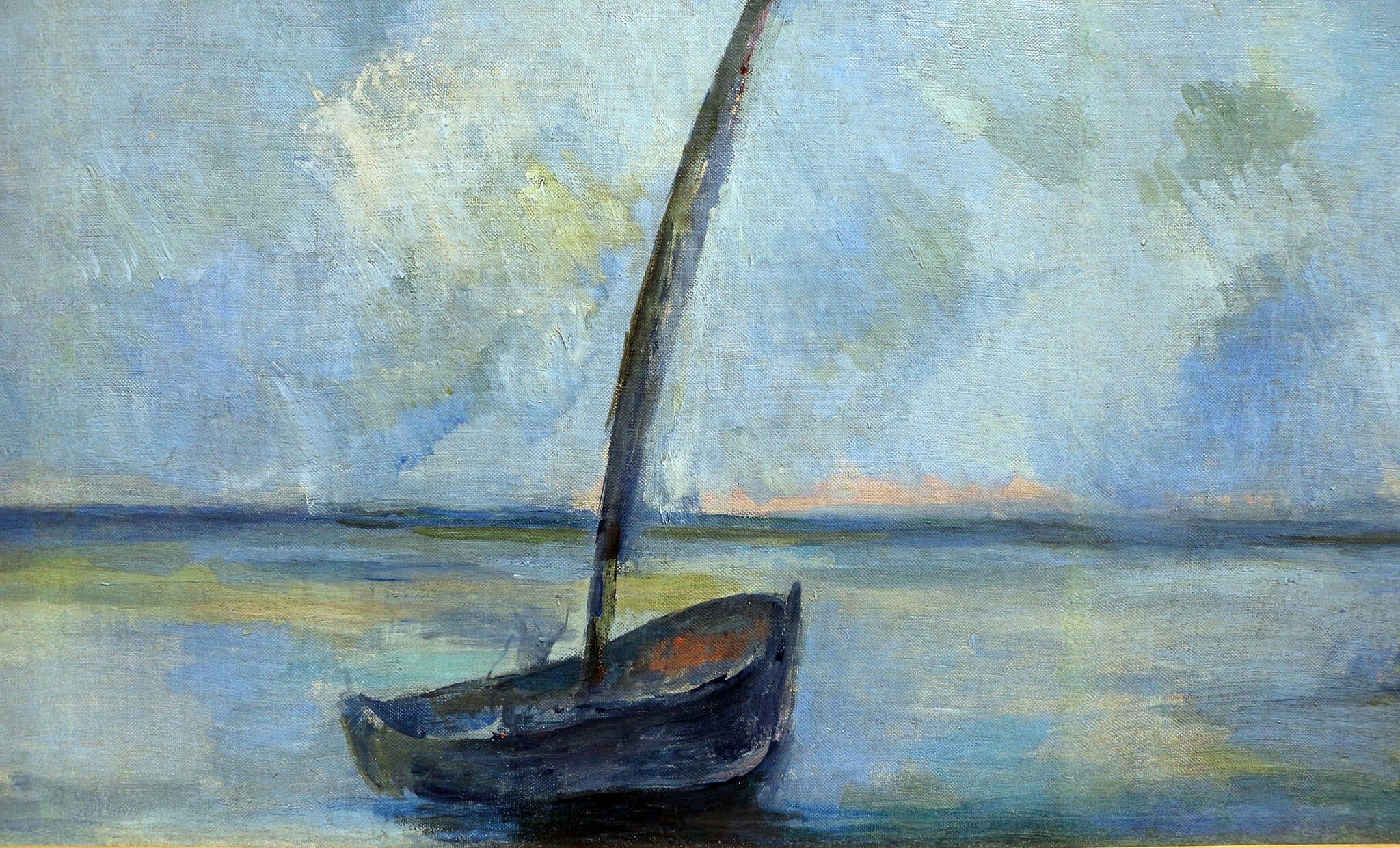
La Barque et les baigneurs
circa 1890
This scene of bathers and a small boat on a river captures both leisurely activity and Cézanne’s study of form within landscape, merging figure and environment into a unified plane. Important as an instance of his late-19th-century explorations into structure and rhythm, the painting rewards attention to the broad, sculptural brushstrokes, the careful placement of masses, and the way color builds depth without relying on traditional perspective.
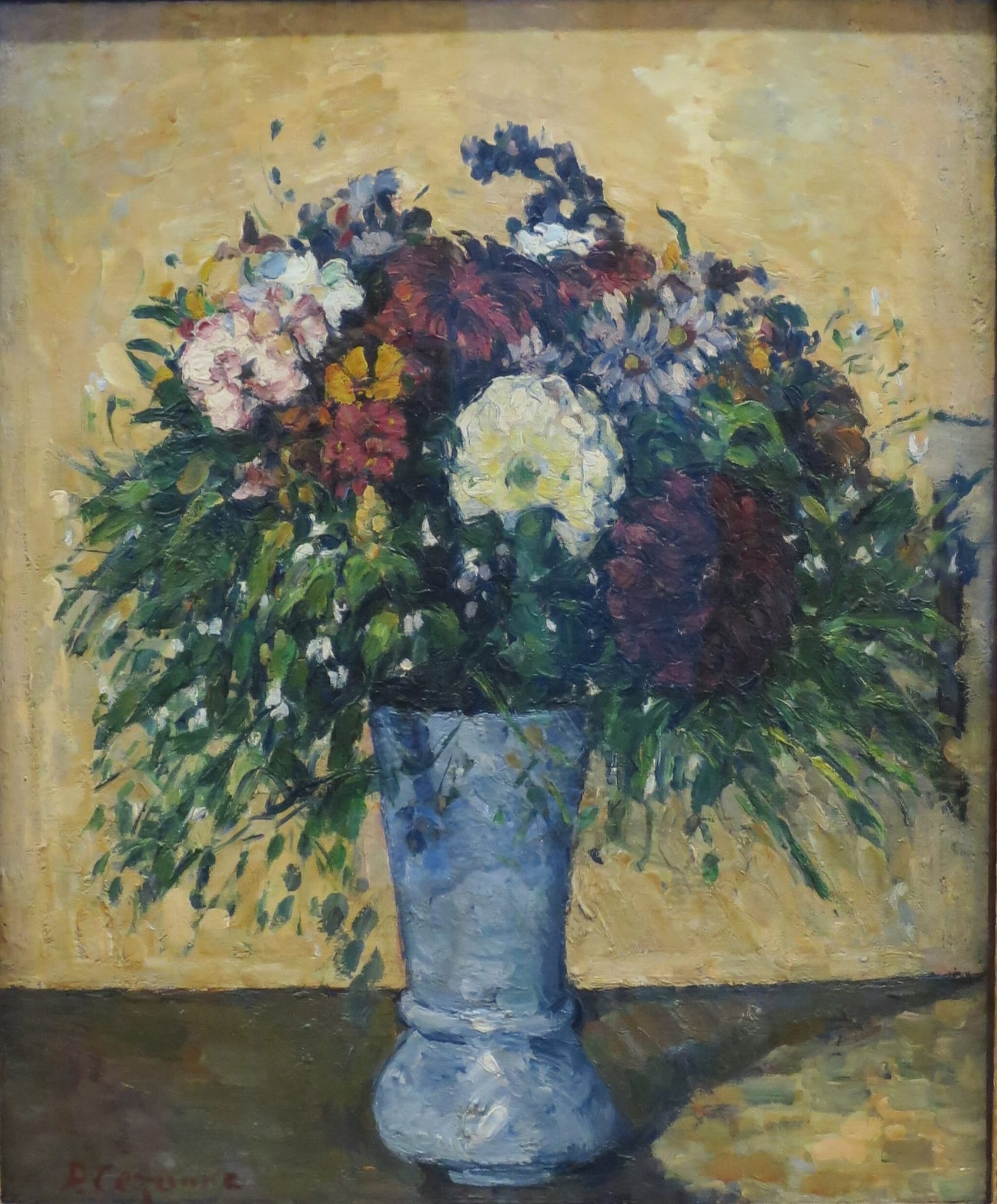
Fleurs dans un vase bleu
circa 1880
A still life of flowers arranged in a blue vase, rendered with economical strokes that emphasize color relationships and surface presence rather than botanical detail. It demonstrates Cézanne’s pivotal role in transforming still life into a study of pictorial construction; look for the tension between spontaneous brushwork and deliberate composition, and how the vase anchors a network of color harmonies across the canvas.
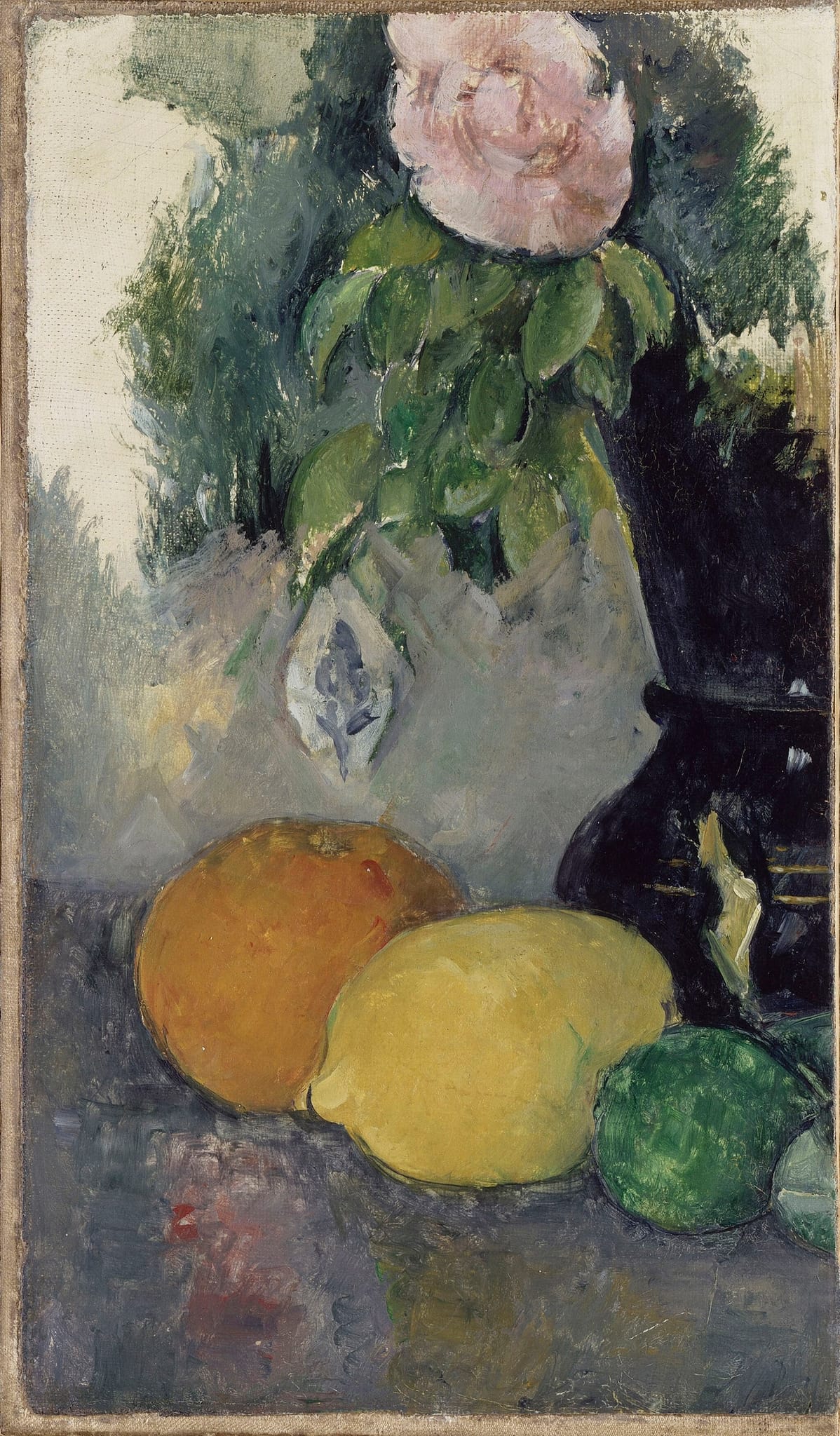
Fleurs et fruits
circa 1890s
This still life pairs floral blooms with arranged fruit, presenting everyday objects as motifs for exploring volume, light, and color. Representative of Cézanne’s mature approach to composition, it is significant for the way objects are reduced to geometric masses that interact spatially; focus on the weight and solidity he gives each element, the subtle shifts in hue that define form, and the overall balance between surface pattern and structural depth.
Petit Palais (Musée des Beaux-Arts de la Ville de Paris)
The Petit Palais’s municipal collection includes a singular Cézanne that’s useful for understanding how the artist was canonized in French civic collections: the painting is displayed among 19th-century and early modern works that trace the evolution of academic practice into Post-Impressionism. In that setting the Cézanne stands out as a pivotal link between traditional subjects (still life, landscape) and the modernist rethinking of composition and pictorial space.
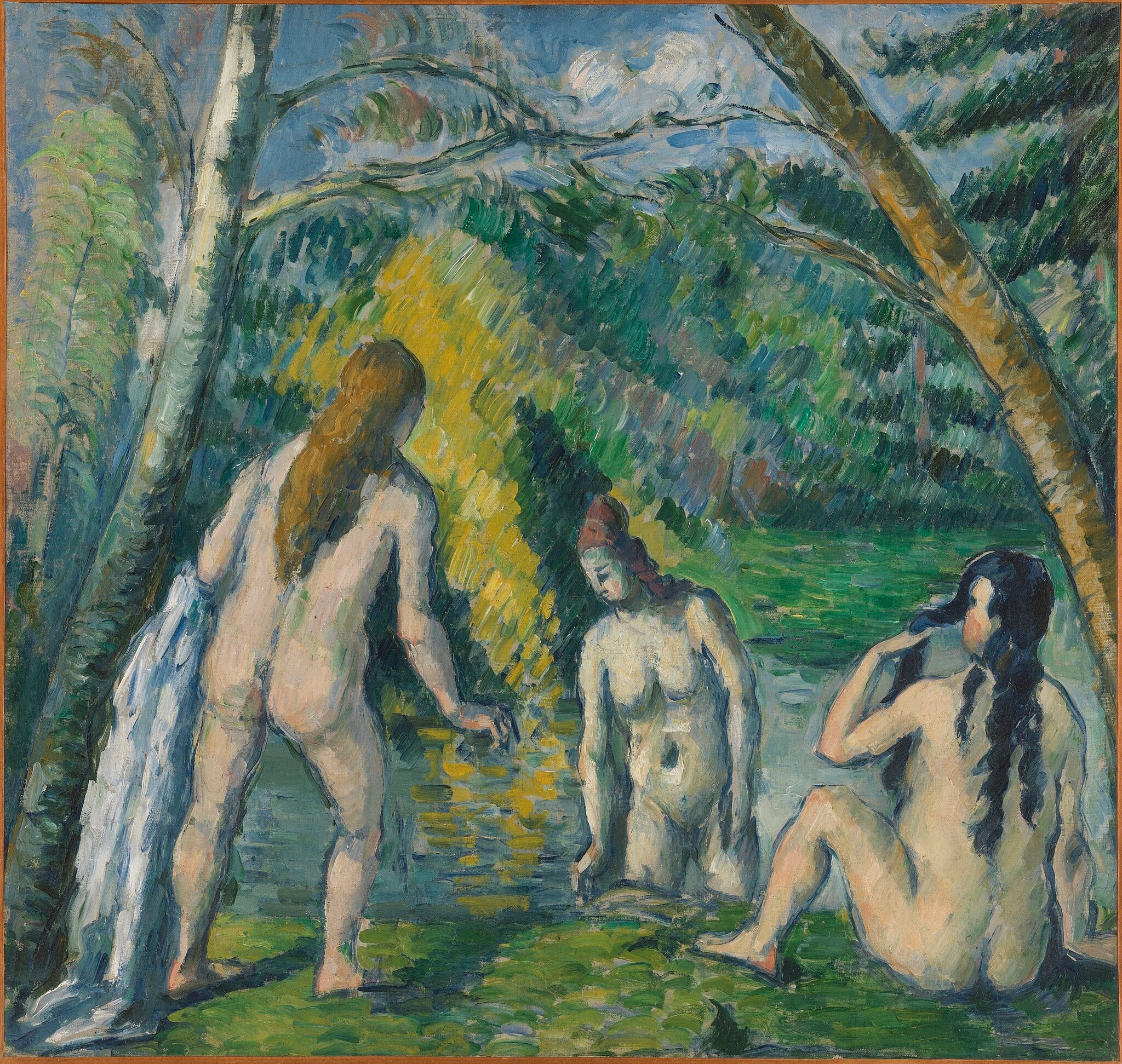
Three Bathers
One of Cézanne’s important bathers compositions donated by Matisse, notable for its dense, pyramidal arrangement and luminous handling.
Must-seeMusée national Picasso-Paris
Picasso kept Cézanne as a touchstone throughout his career, calling him a foundational influence, and the Picasso Museum’s Cézanne piece is shown within displays that explore Picasso’s sources and dialogues with earlier masters. Seeing Cézanne in the Picasso museum allows you to view the older artist not in isolation but as a formative presence that Picasso collected, studied, and reworked mentally — making the relationship between the two artists directly legible on the walls.
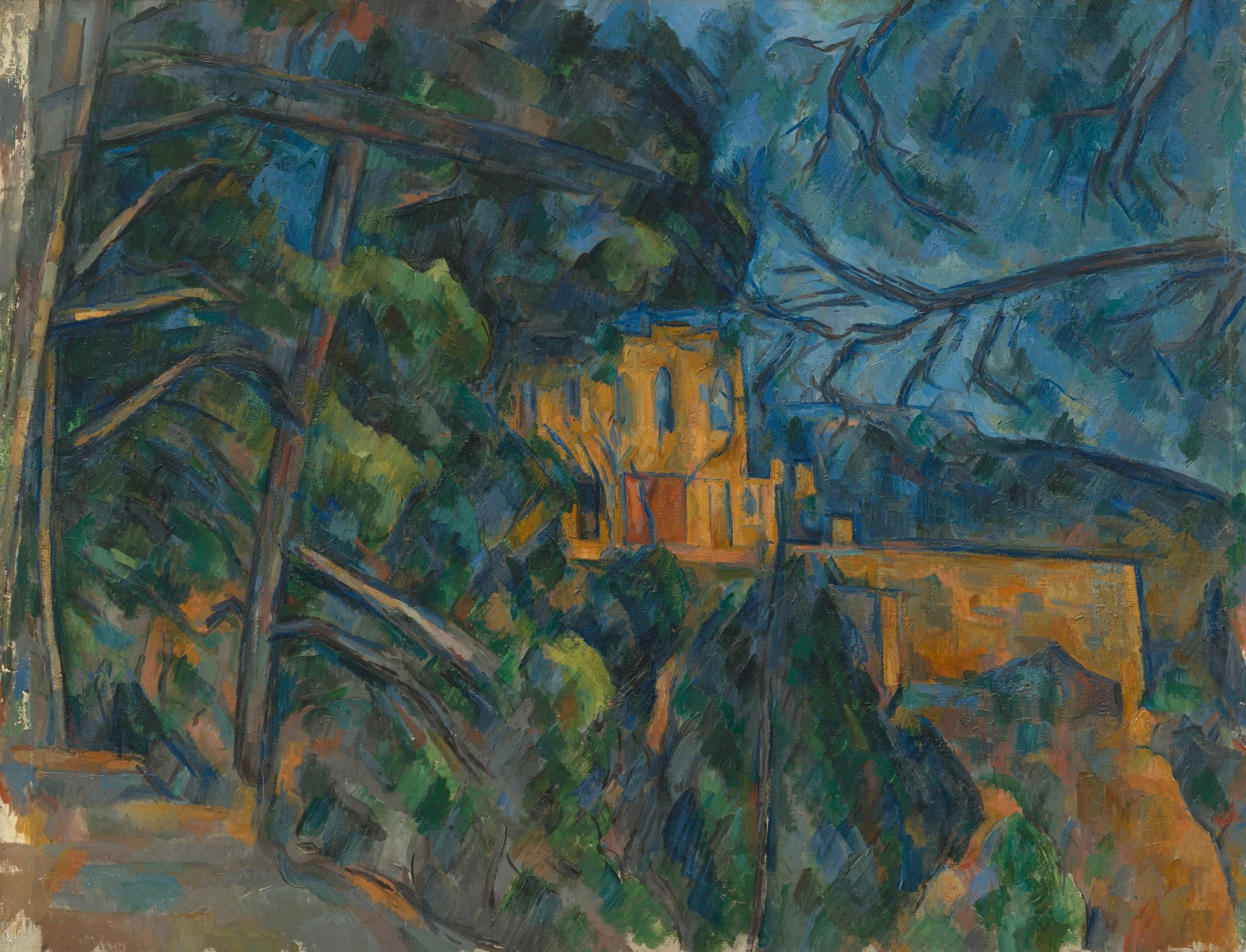
Château Noir
1905
A late landscape showing the small, dark Gothic‑style estate known as the Château Noir set among pines and rocky ground near Aix‑en‑Provence; Cézanne reduces the scene to interlocking planes of color rather than fine detail. The work is significant as one of Cézanne’s mature treatments of familiar Provençal motifs that directly influenced Picasso and the development of Cubism, and it entered the Musée national Picasso‑Paris from Picasso’s collection. Look for Cézanne’s faceted brushstrokes and the way he builds form through color patches—notice the tense geometry of the house against the organic trees and the subtle modulation of light across the surfaces. ([cep.museepicassoparis.fr](https://cep.museepicassoparis.fr/en/node/117294?utm_source=openai))
Must-see