Place de la Concorde

by Edgar Degas

Degas’s Place de la Concorde turns a famous Paris square into a study of modern isolation and instantaneous vision. Figures stride past one another without contact, their bodies abruptly cropped and adrift in a wide, airless plaza—an urban stage where elegance masks estrangement [1][2].

Fast Facts

Year
1875
Medium
Oil on canvas
Dimensions
78.4 × 117.5 cm
Location
The State Hermitage Museum, St. Petersburg (General Staff Building, Room 404)
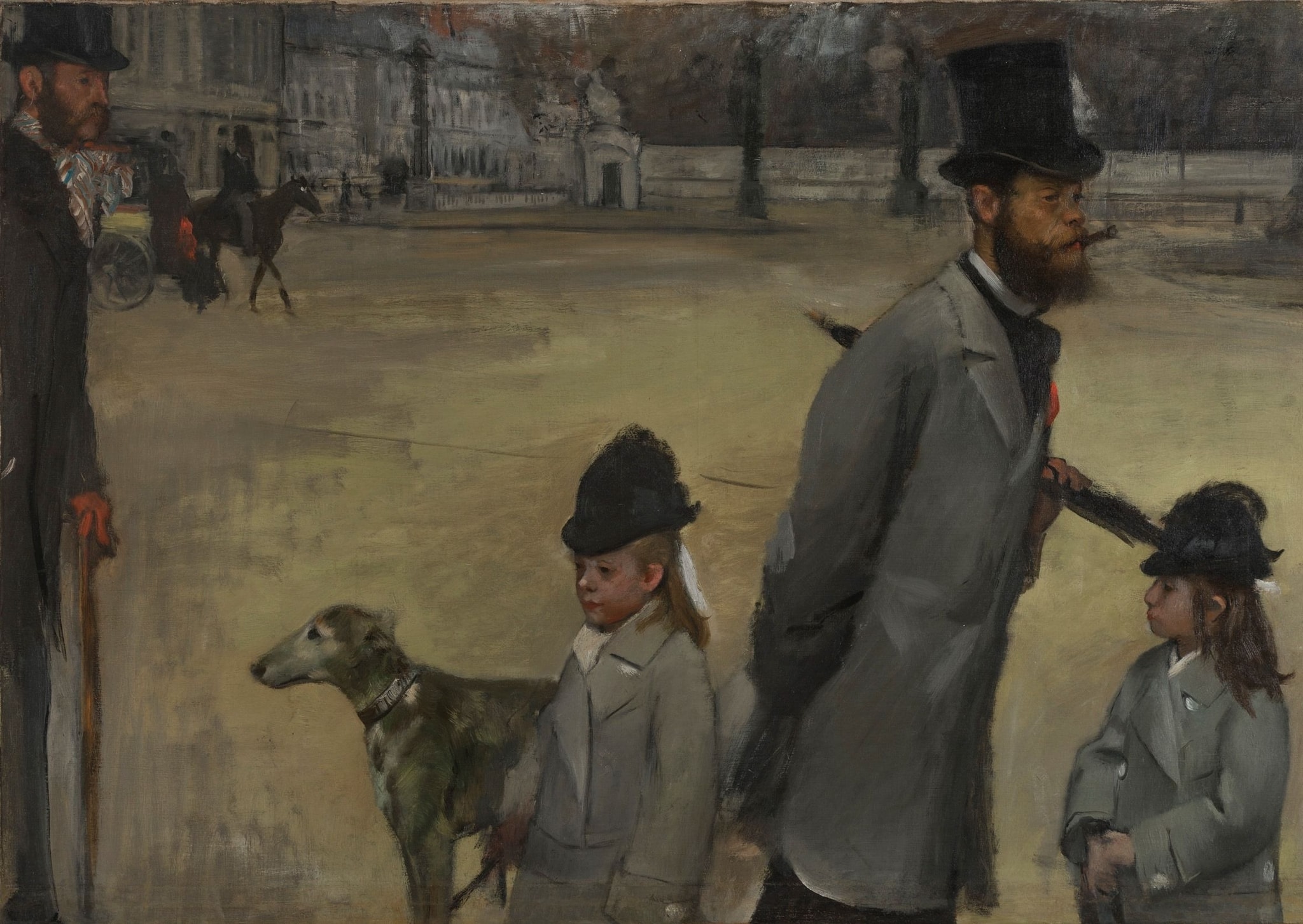
Place de la Concorde by Edgar Degas (1875) featuring Negative space of the plaza, Cropping of figures, Angled umbrella, Red lapel rosette (Legion of Honour ribbon)

Click on any numbered symbol to learn more about its meaning

Meaning & Symbolism

Degas structures the square as a field of separations. The central gentleman—identified as Viscount Lepic—moves rightward, cigar angled and umbrella thrust like a lance; his two daughters and greyhound drift beside him, each absorbed and self‑contained. At the far left, another man is sheared by the frame so that only part of his head and cane remain; he is often identified as Ludovic Halévy, though this is not museum‑certified 16. No gaze meets another. The plaza’s pale, scumbled surface stretches between the figures and the distant Tuileries wall, creating a buffer of negative space that cools the scene and suspends contact. Degas’s asymmetry—heads clipped by the top edge, bodies cropped at the margins—produces the shock of instantaneity while refusing narrative closure 2. The eye ricochets along diagonals set by the umbrella, the dog’s back, and the girls’ profiles, only to be absorbed by the dry, ochre‑gray ground. This is modern life as a choreography of non‑encounter, a city that gathers people without making them a public. Form doubles as social argument. Degas’s “snapshot” feel is not a simple borrowing from the camera; it arises from his studio‑honed drawing, his appetite for unusual vantage points, and his engagement with Japanese print cropping—all marshaled to register fractured urban perception 456. The work’s cool tonality and ample unoccupied ground produce an air of detachment that critics read as the look of Haussmannized Paris: broad, ordered surfaces that nonetheless estrange its inhabitants 5. André Dombrowski deepens this by tying the picture’s emptiness and missed gazes to the city’s post‑1870 memory politics; in this reading, the square—site of monuments and mourning—becomes an arena where a fragmented body politic takes visual form 2. Small, pointed notations behave like social signals: the lapel dot on Lepic, which appears to be a Legion of Honour ribbon, folds official decorum into a world of private preoccupation; the smart top hats and the sleek greyhound sketch the flâneur’s elegance while underscoring distance rather than conviviality 26. Even the horizon, where architecture is painted thinly and evasively, reads as memory in recession. The painting’s notorious “cut‑off” look is not a mere effect but part of its meaning. Hermitage research found a band of original paint folded under the stretcher; debate continues whether the trimming was Degas’s late intervention or an early owner’s alteration 3. Either way, the canvas performs cropping as a modern condition: a world seen on the fly, in fragments, under pressures of speed and distraction. That pressure also clarifies Degas’s self‑positioning within Impressionism: he portrays the instant without surrendering structure, substituting analytic drawing for atmospheric shimmer 14. Thus the square ceases to be a postcard view and becomes an abstract machine for thinking about city life—how bodies share space without forming society, how memory lingers in surfaces, how style can carry history. Place de la Concorde stages all of that with ruthless economy, showing how pictorial decisions—space withheld, edges that cut, tones that cool—make modernity visible 25.

Explore Deeper with AI

Ask questions about Place de la Concorde

Popular questions:

Powered by AI • Get instant insights about this artwork

💬 Ask questions about this artwork!

Interpretations

Medium Reflexivity: Cropping as Meaning

Hermitage research uncovered a strip of original paint folded beneath the stretcher, triggering debate over whether the canvas was cropped by Degas or altered later. Natalia Demina argues for Degas’s own intervention, which makes framing itself an authored act—an image that performs its own truncation. Rather than imitating photography, the picture turns format into content: edges cut heads, space withholds contact, and the canvas declares modernity as edited experience. Authorship resides not only in depiction but in the violent decisions of inclusion/exclusion, aligning Degas with a reflexive modernism that treats the picture plane as a site of procedural risk and meaning-making 13.

Source: State Hermitage Museum; Natalia B. Demina

Historical-Political Context

Read through the early Third Republic, the square becomes a pressure chamber of history and mourning. André Dombrowski argues that Degas’s vast negative ground and misaligned gazes visualize a fractured body politic after the Franco‑Prussian War and the Commune: collective memory persists, yet public feeling disperses into private orbits. In this view, the Concorde—dense with monuments and civic ritual—no longer organizes consensus; it dissolves it. Even small cues (the lapel red, the elegant yet withdrawn flâneur) operate as social signs that register decorum in the key of loss. The painting’s cool tonality is thus not neutrality but a mode of commemorative distance, where modern optics and political history meet on a pale, scumbled stage 2.

Source: André Dombrowski (The Art Bulletin, 2011)

Social Typologies: Flâneur, Fashion, and Class

Viscount Lepic’s ensemble—top hat, cigar, umbrella—and the sleek greyhound construct the flâneur as a mobile emblem of classed vision. Yet Degas detaches elegance from sociability: sartorial display and canine grace index status while reinforcing the picture’s etiquette of non‑address. This recoding aligns with Degas’s realist discipline (drawing, studio construction) that anatomizes how bodies signal rank in Haussmann’s new spaces. The apparent Legion of Honour ribbon adds official decorum to private absorption, making fashion an index of state and class rather than conviviality. It’s a portrait of urban distinction turned centrifugal, consistent with broader accounts of modern life’s stylish yet solitary stage 245.

Source: National Gallery of Art; André Dombrowski; T. J. Clark

Psychological Reading: Childhood in the City

Lepic’s daughters drift as self-contained units, their profiles aligned yet unengaged—figures of childhood moving through a plaza that offers no sheltering narrative. Degas refuses anecdote, isolating gesture and bearing: averted faces, small steps, the dog’s parallel back. This restraint psychologizes the street as a pedagogy of attentional self-sufficiency, consonant with accounts of modern Paris where children, like adults, learn to manage proximity without contact. The neutral ochres and thinly painted horizon suppress sentiment, letting behavior carry meaning. Childhood here is neither idyll nor melodrama; it is an education in urban poise under the rule of space and speed 45.

Source: National Gallery of Art; T. J. Clark

Perceptual Modernity: Photography, Japonisme, and Control

The painting’s ‘snapshot’ look invites a photographic analogy, but Degas modulates that effect through drawing, constructed vantage points, and debts to ukiyo‑e cropping. Rather than passively adopting the camera, he orchestrates a hierarchy of diagonals and voids that structure chance. This balances the Impressionist pursuit of the instant with an almost classical insistence on design, producing a hybrid perceptual regime: speed without blur, immediacy without surrender. The result exemplifies a modern lens that is made, not found—an authored choreography of sight where technological and cross-cultural stimuli become tools for analytic seeing 45.

Source: National Gallery of Art; T. J. Clark

Object Biography: War, Loss, and Afterlives

The canvas’s own history echoes its themes of rupture. After entering Otto Gerstenberg’s collection, it vanished into WWII’s fog—long presumed destroyed—only to re-emerge when the Hermitage disclosed seized works in the 1990s. Exhibited in “Hidden Treasures Revealed,” the painting’s afterlife bears the mark of war and displacement, reframing its image of urban detachment as an object lesson in cultural fragmentation. That a scene about modern estrangement endured literal dislocation tightens the knot between form (cropping, gaps) and fate (confiscation, concealment, redescription). The Concorde’s cold distances now read through the museum’s contested geographies and the politics of restitution 16.

Source: The New York Times; State Hermitage Museum

Related Themes

About Edgar Degas

Edgar Degas (1834–1917) trained in rigorous drawing, revered the Old Masters, and pursued modern urban subjects—from races to café-concerts and ballet. Though he exhibited with the Impressionists, he insisted on a controlled, realist construction of scenes, often synthesizing observations into complex studio compositions [5][6].
View all works by Edgar Degas

More by Edgar Degas

The Opera Orchestra by Edgar Degas | Analysis by Edgar Degas

The Opera Orchestra by Edgar Degas | Analysis

Edgar Degas

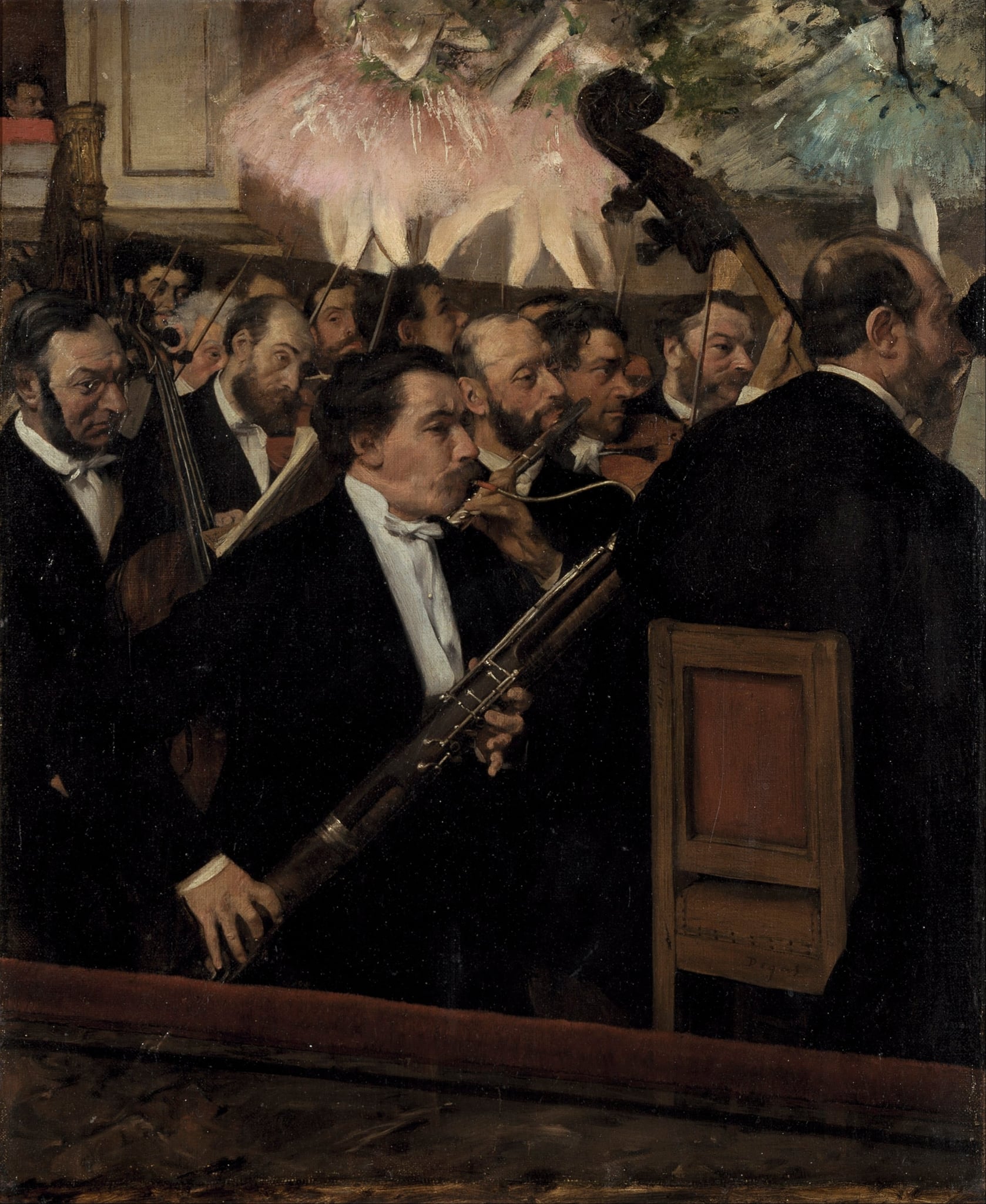
In The Opera Orchestra, Degas flips the theater’s hierarchy: the black-clad pit fills the frame while the ballerinas appear only as cropped tutus and legs, glittering above. The diagonal <strong>bassoon</strong> and looming <strong>double bass</strong> marshal a dense field of faces lit by footlights, turning backstage labor into the subject and spectacle into a fragment <sup>[1]</sup><sup>[2]</sup>.
The Tub by Edgar Degas

The Tub

Edgar Degas (1886)

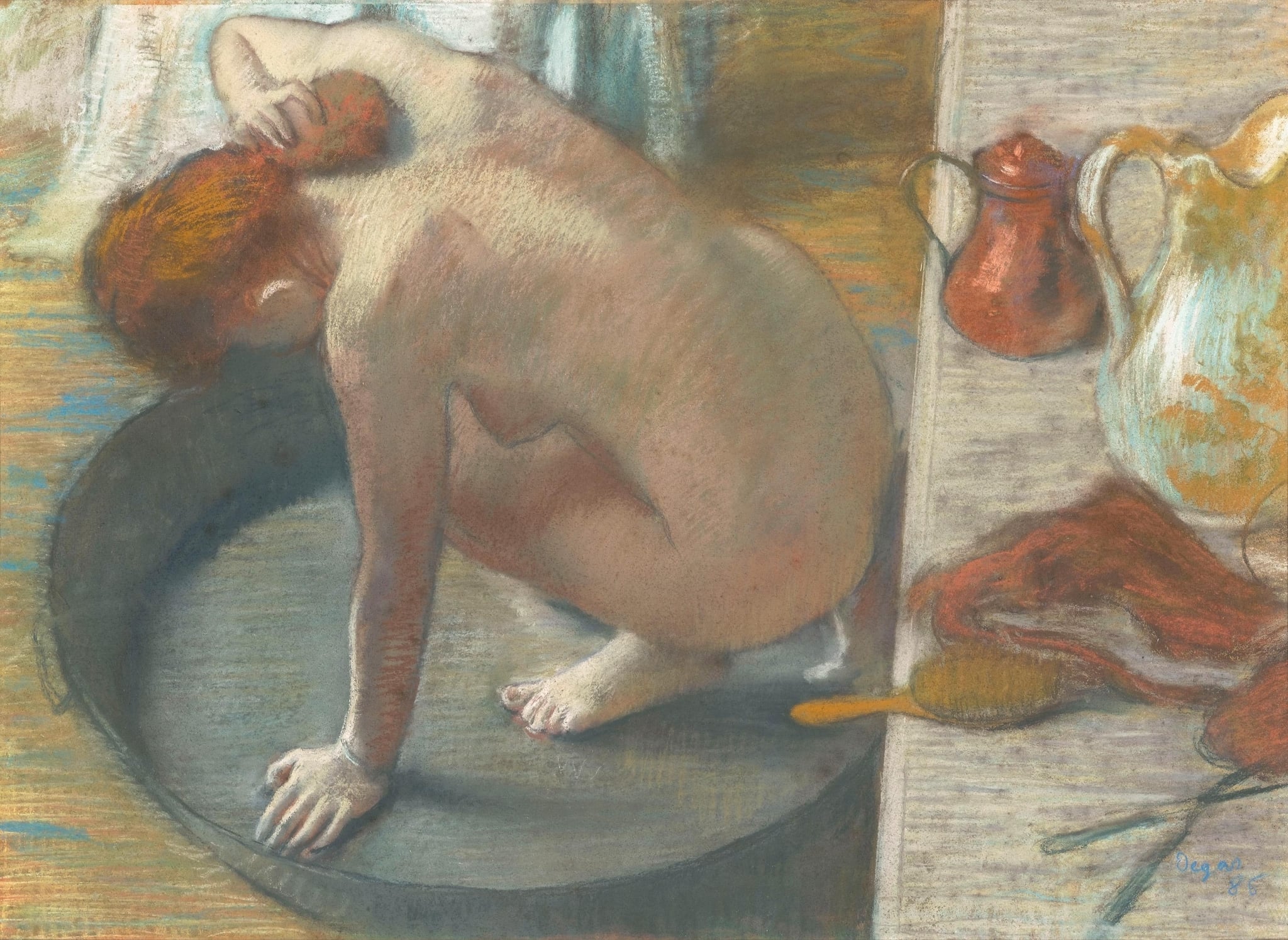
In The Tub (1886), Edgar Degas turns a routine bath into a study of <strong>modern solitude</strong> and <strong>embodied labor</strong>. From a steep, overhead angle, a woman kneels within a circular basin, one hand braced on the rim while the other gathers her hair; to the right, a tabletop packs a ewer, copper pot, comb/brush, and cloth. Degas’s layered pastel binds skin, water, and objects into a single, breathing field of <strong>warm flesh tones</strong> and blue‑greys, collapsing distance between body and still life <sup>[1]</sup>.
The Ballet Class by Edgar Degas

The Ballet Class

Edgar Degas (1873–1876)

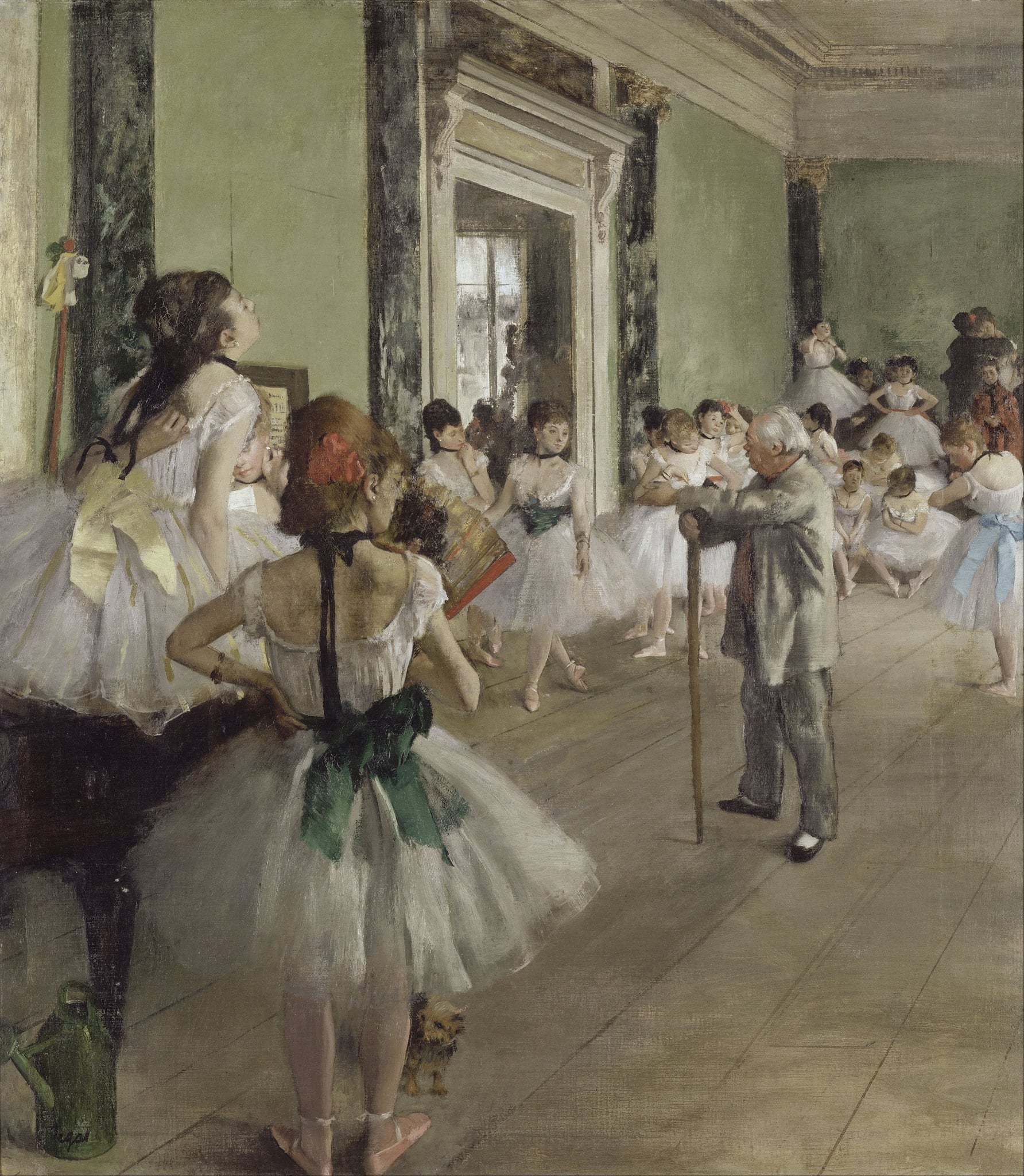
<strong>The Ballet Class</strong> shows the work behind grace: a green-walled studio where young dancers in white tutus rest, fidget, and stretch while the gray-suited master stands with his cane. Degas’s diagonal floorboards, cropped viewpoints, and scattered props—a watering can, a music stand, even a tiny dog—stage a candid vision of routine rather than spectacle. The result is a modern image of discipline, hierarchy, and fleeting poise.
Woman Ironing by Edgar Degas

Woman Ironing

Edgar Degas (c. 1876–1887)

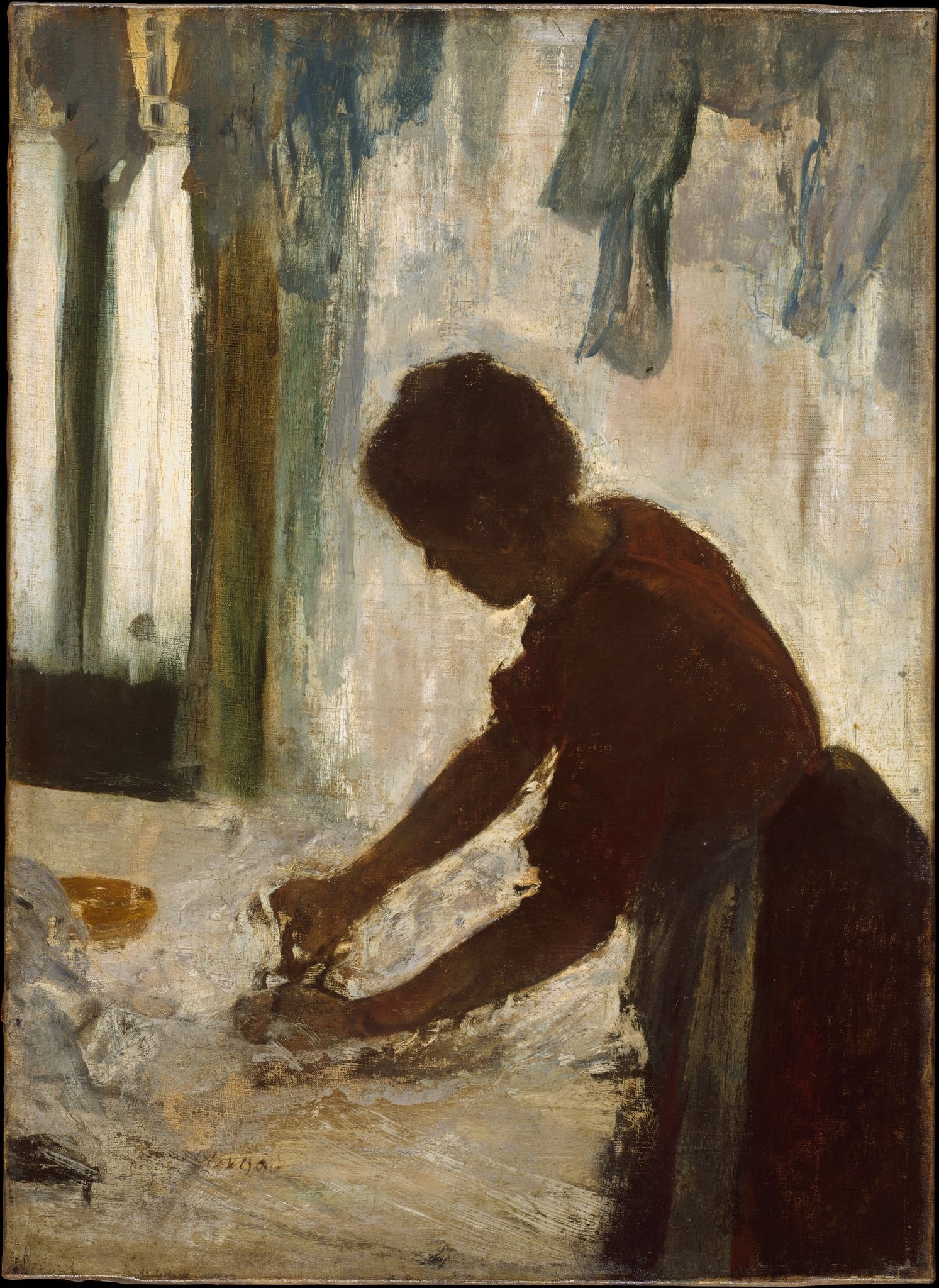
In Woman Ironing, Degas builds a modern icon of labor through <strong>contre‑jour</strong> light and a forceful diagonal from shoulder to iron. The worker’s silhouette, red-brown dress, and the cool, steamy whites around her turn repetition into <strong>ritualized transformation</strong>—wrinkled cloth to crisp order <sup>[1]</sup><sup>[2]</sup>.
The Rehearsal of the Ballet Onstage by Edgar Degas

The Rehearsal of the Ballet Onstage

Edgar Degas (ca. 1874)

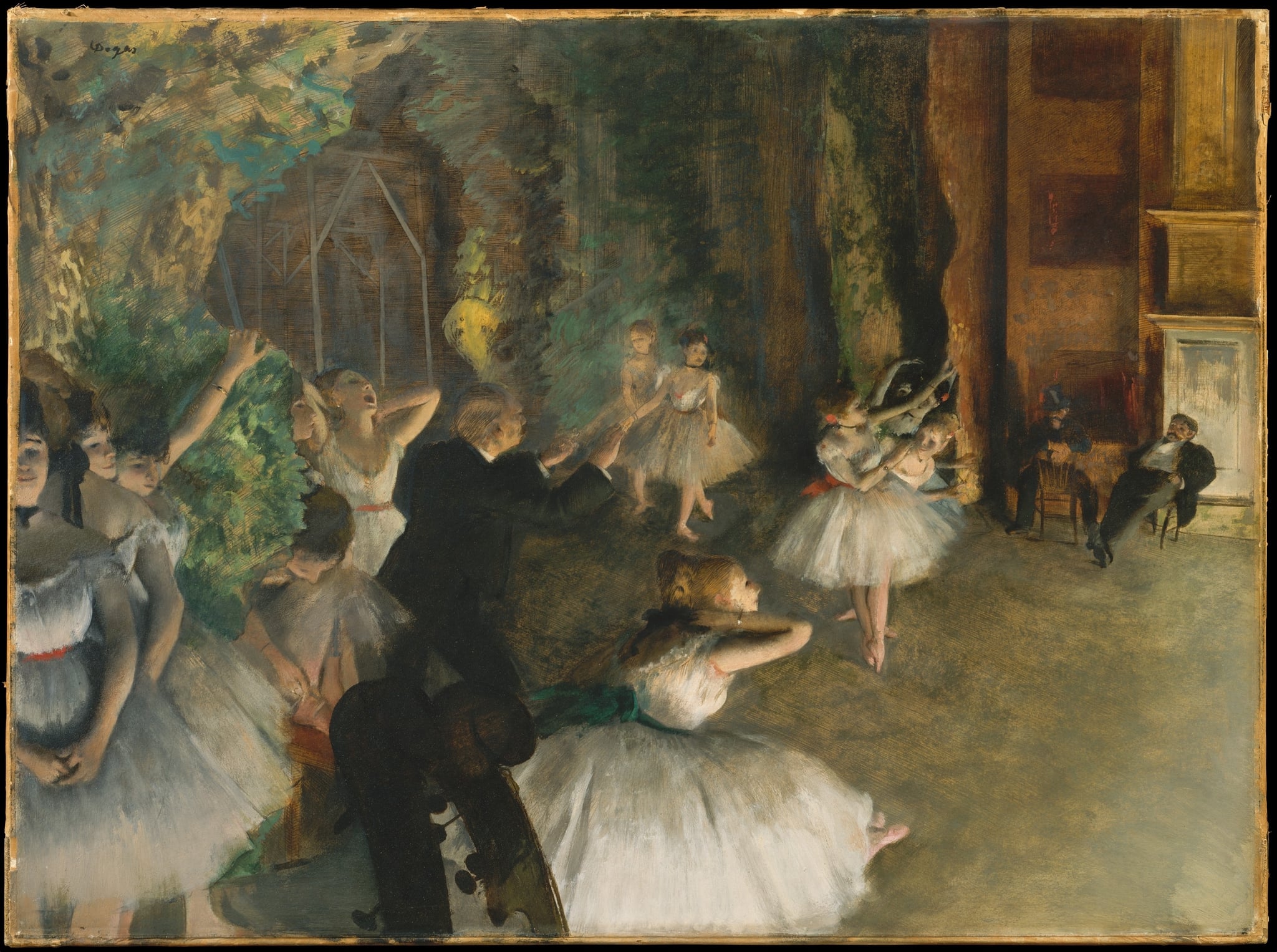
Degas’s The Rehearsal of the Ballet Onstage turns a moment of practice into a modern drama of work and power. Under <strong>harsh footlights</strong>, clustered ballerinas stretch, yawn, and repeat steps as a <strong>ballet master/conductor</strong> drives the tempo, while <strong>abonnés</strong> lounge in the wings and a looming <strong>double bass</strong> anchors the labor of music <sup>[1]</sup><sup>[3]</sup><sup>[4]</sup>.
The Millinery Shop by Edgar Degas

The Millinery Shop

Edgar Degas (1879–1886)

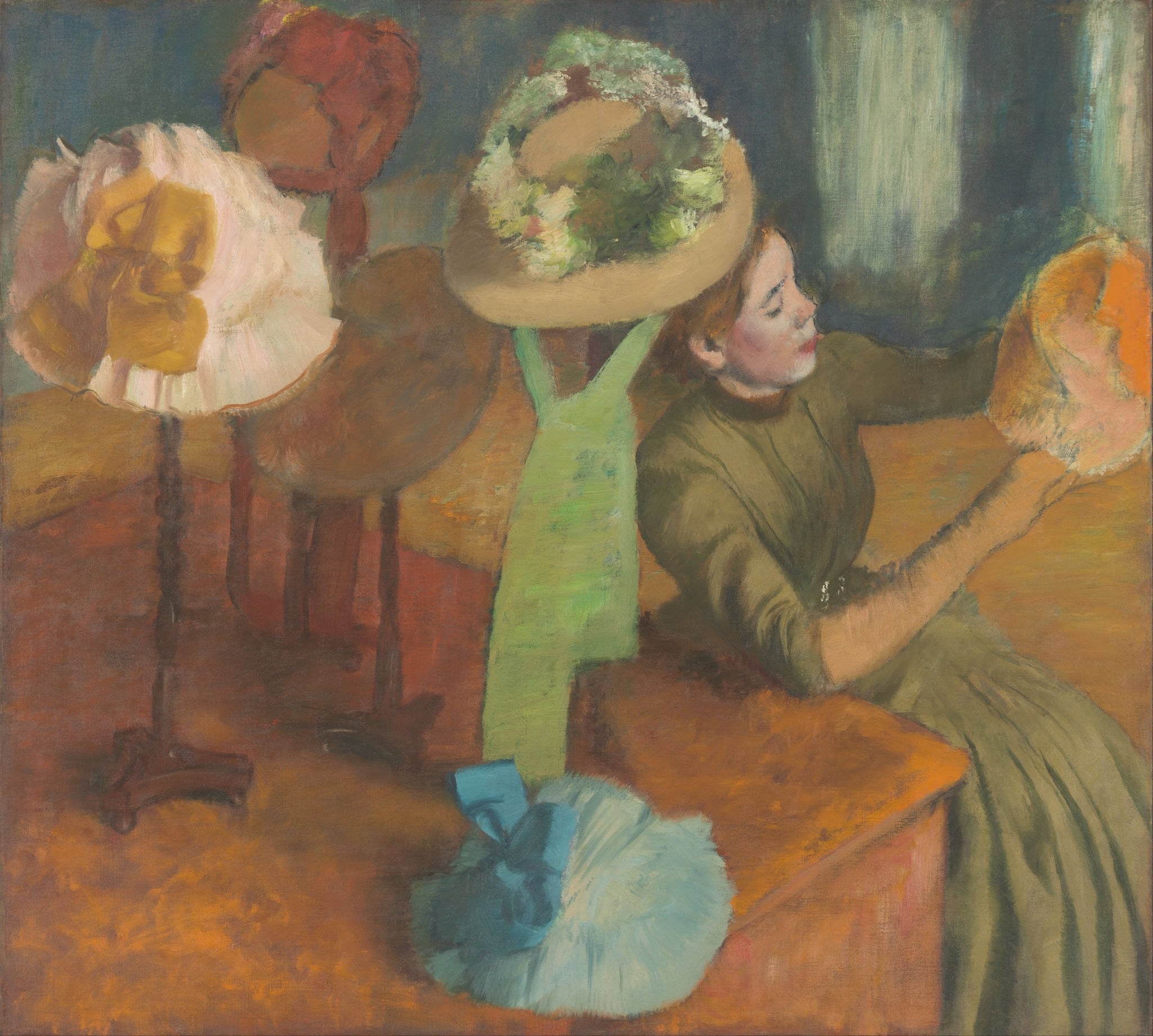
Edgar Degas’s The Millinery Shop stages modern Paris through a quiet act of <strong>work</strong> rather than display. A young woman, cropped in profile, studies a glowing <strong>orange hat</strong> while faceless stands crowned with ribbons and plumes press toward the picture plane. Degas turns a boutique into a meditation on <strong>labor, commodities, and identity</strong> <sup>[1]</sup><sup>[2]</sup>.