The Millinery Shop

by Edgar Degas

Edgar Degas’s The Millinery Shop stages modern Paris through a quiet act of work rather than display. A young woman, cropped in profile, studies a glowing orange hat while faceless stands crowned with ribbons and plumes press toward the picture plane. Degas turns a boutique into a meditation on labor, commodities, and identity [1][2].

Fast Facts

Year
1879–1886
Medium
Oil on canvas
Dimensions
100 × 110.7 cm
Location
The Art Institute of Chicago, Chicago
The Millinery Shop by Edgar Degas (1879–1886)

Click on any numbered symbol to learn more about its meaning

Meaning & Symbolism

Degas builds an ethics of looking out of commodities. The largest assertive presence is not the woman but the orange‑ochre field of goods, punctuated by cool blues and greens. At lower left a pale hat with a large yellow bow faces us; at bottom center a powder‑blue puff capped with a blue ribbon flattens against the surface; at center a straw bonnet encircled with artificial blossoms perches on a bright green stand. These faceless supports read as placeholders for absent wearers, “heads” awaiting the social performance that hats enable. By staging these totemlike forms front and center and pushing the woman to the right margin as she inspects a vivid orange hat at arm’s length, Degas asserts that objects of fashion dominate modern vision while the maker disappears. The Art Institute’s technical study notes that Degas revised the figure from a likely client toward a working milliner—gloves that safeguard fabrics and lips pursed as if to hold a pin—yet he leaves her status strategically uncertain 1. The device keeps viewers toggling between shopper and worker, exposing how easily labor is misread as leisure in the theater of consumption. Form enacts this argument. Degas’s tilted viewpoint and abrupt cropping—procedures indebted to photography and Japonisme—convert the shop into a shallow stage where ovoid crowns and looping ribbons rhythmically lock the surface, making the scene feel like a passing glance snared mid‑task 4. Warm ochers and oranges saturate counters and hats, while cool notes—the sea‑green stand, the blue bow, the teal background—puncture the heat, a chromatic economy that both seduces and warns. The result is a deliberately modern image whose beauty is uneasy: the SLAM catalogue identifies trims such as artificial flowers and red ostrich plumes, details that embed the painting in a global trade of feathers and florals that had contested environmental costs in the 1880s–90s 23. Degas thus treats adornment as both material poetry and moral complication, a doubleness amplified by his visible reworking and “unfinished” passages, especially around the stands and the floor. The Art Institute reads these painterly seams as an analogy between the modiste’s assembling and the painter’s composing: both select, pin, and adjust until form persuades 1. Why The Millinery Shop is important follows from this synthesis. It is the most ambitious of Degas’s many millinery images and a touchstone for Impressionism’s engagement with urban modernity beyond the boulevard or café 1. Instead of a spectacle of display, Degas gives us concentration: the worker’s profile locked on the orange hat, arms triangulated, body anchored on the counter’s edge. The picture claims attention for feminized, undervalued creative labor while acknowledging the lure of commodities that threaten to eclipse it. In doing so, Degas models a way of seeing in which composition, color, and subject become inseparable from social meaning. The shop is both boutique and studio, the hats both goods and ideas. That friction—between allure and critique, surface and making—is the enduring meaning of The Millinery Shop and the reason it remains central to narratives of modern art and the fashioning of identity 124.

Explore Deeper with AI

Ask questions about The Millinery Shop

Popular questions:

Powered by AI • Get instant insights about this artwork

💬 Ask questions about this artwork!

Interpretations

Historical Context: Paris’s Hat Economy

Rather than a mere boutique vignette, the canvas condenses Paris’s late‑19th‑century millinery boom: modistes, suppliers, and bourgeois clients in a tightly networked luxury market. The subject recurs across Degas’s oeuvre, but here scale and density let the shop stand for the broader urban commodity system. The woman’s ambiguous role indexes the shop as a social hinge where labor, aspiration, and money meet; hats operate as portable status engines. Exhibition research on the Paris millinery trade situates such interiors within a city of department stores, seasonal styles, and global sourcing, aligning Degas’s scene with the rhythms of modernization. The Art Institute’s dating (1879–86) and evidence of prolonged revision echo the era’s churn: fashion cycles accelerate while both modiste and painter continually recompose their wares for a volatile market 12.

Source: Art Institute of Chicago; Saint Louis Art Museum

Symbolic Reading: Surrogate Heads and Commodity Fetish

The headless stands crowned with plumes and blossoms behave like surrogate heads, waiting for bodies—and social scripts—to animate them. By pushing the figure to the margin while amplifying these totemic forms, Degas stages a quiet drama of commodity fetishism: the hat’s aura eclipses the maker. The blue ribbon, orange hat, and green stand puncture the field like signals in a display window, converting the shop into a stage of desire. This is not simply genre; it’s an ethics of looking built from commodities. Fashion catalogues of the period and recent scholarship emphasize how display constructs identity; Degas literalizes that insight by letting supports read as absent wearers, collapsing consumption, self-fashioning, and spectatorship into one charged tableau 16.

Source: Art Institute of Chicago; Impressionism, Fashion, and Modernity (ed. Gloria Groom)

Formal Analysis: Cropping, Color, and the Modern Glance

Degas’s tilted viewpoint and abrupt cropping—procedures linked to photography and Japonisme—flatten depth into a shallow stage where ovoid crowns and looping ribbons rhythmically lock the surface. Warm ochres and oranges saturate counters and hats, punctured by cool sea‑greens and blues that aerate the field yet also read as chromatic warning signs within a seductive display. The composition’s asymmetry and the figure’s off‑center placement create the sensation of a glance intercepted mid‑task, consistent with Degas’s broader modernity: an urban optics attuned to speed, distraction, and partial views. The result is a picture that reads as both instantaneous and composed, reconciling Impressionist sensation with calculated structure—an ambiguity that intensifies its social critique of the spectacle before us 14.

Source: Art Institute of Chicago; National Gallery of Art

Eco‑critical Lens: Birds, Blooms, and Extraction

Feathered trims and artificial florals are not innocent embellishments; they index a global trade that, by the 1880s–90s, drew criticism for devastating bird populations. Curators of the millinery‑trade exhibition identify ostrich plumes and specific blossoms in Degas’s hats, tying these luxuries to colonial supply chains and environmental harm. The painting’s material poetry—silk, straw, plume—thus carries a moral counterpoint: beauty underwritten by extraction. CAA’s review of the catalogue underscores how fashion’s appetite for plumage catalyzed early conservationist responses. By bathing the shop in warm ochres yet puncturing it with cool, almost corrective notes, Degas embeds ambivalence in the palette itself, letting color register both allure and the costs that adornment conceals 23.

Source: Saint Louis Art Museum; CAA Reviews

Feminist/Labor Lens: Ambiguity as Social Critique

Gloves that protect fabrics and lips pursed as if holding a pin signal work, yet the figure’s fashionable profile keeps her legible as a client. The Art Institute stresses that Degas leaves her status ambiguous, toggling viewers between leisure and labor. That instability exposes how easily women’s shop work is misread, a slippage built into the choreographies of Paris retail. The millinery theme across Degas’s practice often privileges the concentrated gestures of makers, aligning the modiste’s expertise with artistry. Here, concentration replaces display: arms triangulated, gaze locked on the orange hat. The scene reframes feminized, undervalued creative labor as the engine of beauty, not its backdrop—while acknowledging that the commodity tableau can still eclipse the worker who assembles it 15.

Source: Art Institute of Chicago; The Metropolitan Museum of Art (comparanda)

Process/Medium Reflexivity: Boutique as Studio

Degas turns the shop into a studio analogue. Visible reworkings and “unfinished” passages, especially near stands and floor, mirror the modiste’s iterative practice: select, pin, adjust, reassess. AIC notes that the figure likely began as a client and was revised toward a working milliner, evidence of Degas composing meaning through alteration. Fashion scholarship from Impressionism, Fashion, and Modernity frames such interiors as laboratories of modern image‑making; Degas intensifies this by binding millinery montage to pictorial construction. The boutique becomes a site where materials are edited into form, and the painting thematizes its own making. In this reciprocity, authorship is shared across trades: the hat is a picture; the picture, a hat—each persuading through crafted surface 16.

Source: Art Institute of Chicago; Impressionism, Fashion, and Modernity (ed. Gloria Groom)

Related Themes

About Edgar Degas

Edgar Degas (1834–1917) trained in rigorous drawing, revered the Old Masters, and pursued modern urban subjects—from races to café-concerts and ballet. Though he exhibited with the Impressionists, he insisted on a controlled, realist construction of scenes, often synthesizing observations into complex studio compositions [5][6].
View all works by Edgar Degas

More by Edgar Degas

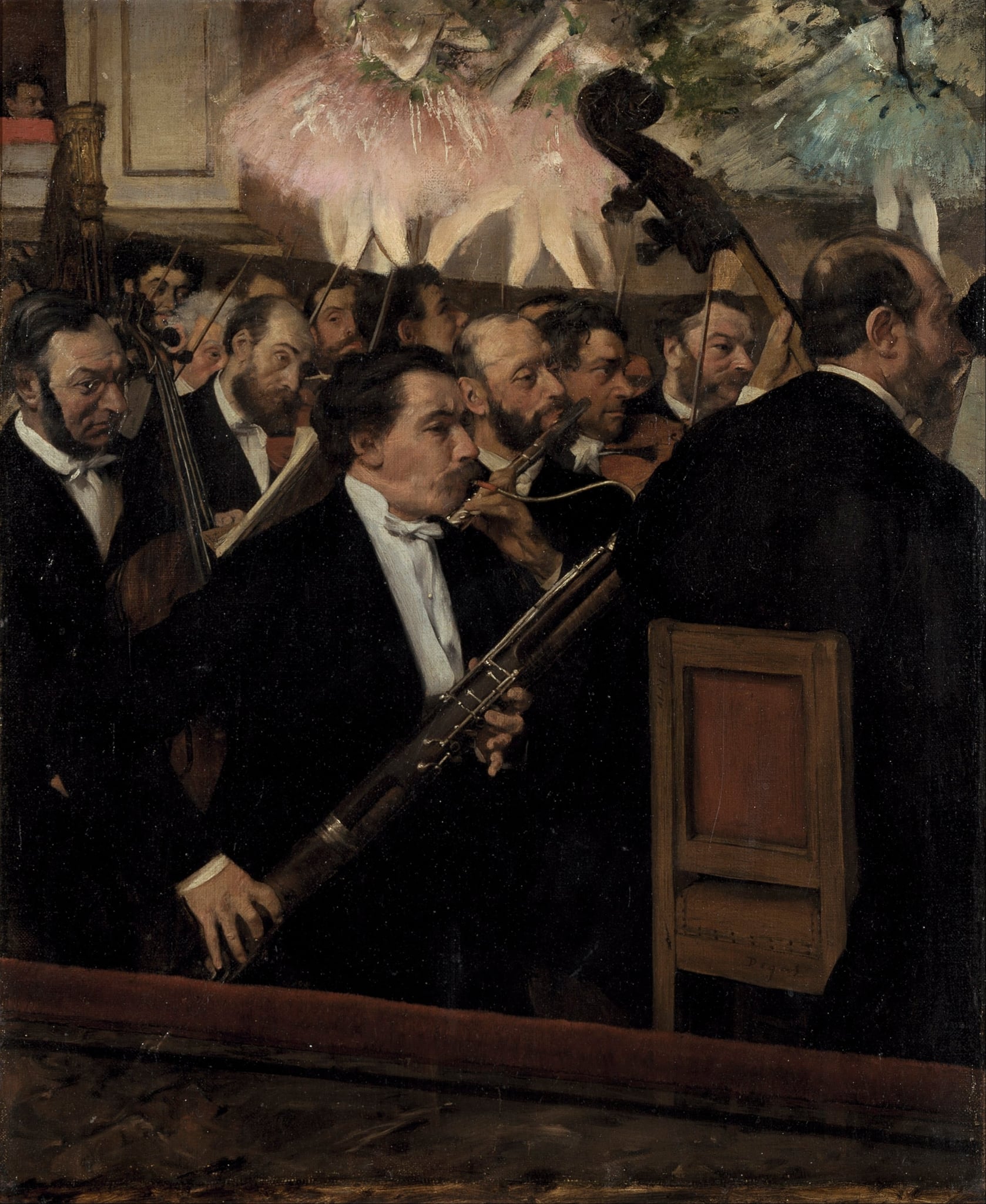
The Opera Orchestra by Edgar Degas | Analysis by Edgar Degas

The Opera Orchestra by Edgar Degas | Analysis

Edgar Degas

In The Opera Orchestra, Degas flips the theater’s hierarchy: the black-clad pit fills the frame while the ballerinas appear only as cropped tutus and legs, glittering above. The diagonal <strong>bassoon</strong> and looming <strong>double bass</strong> marshal a dense field of faces lit by footlights, turning backstage labor into the subject and spectacle into a fragment <sup>[1]</sup><sup>[2]</sup>.
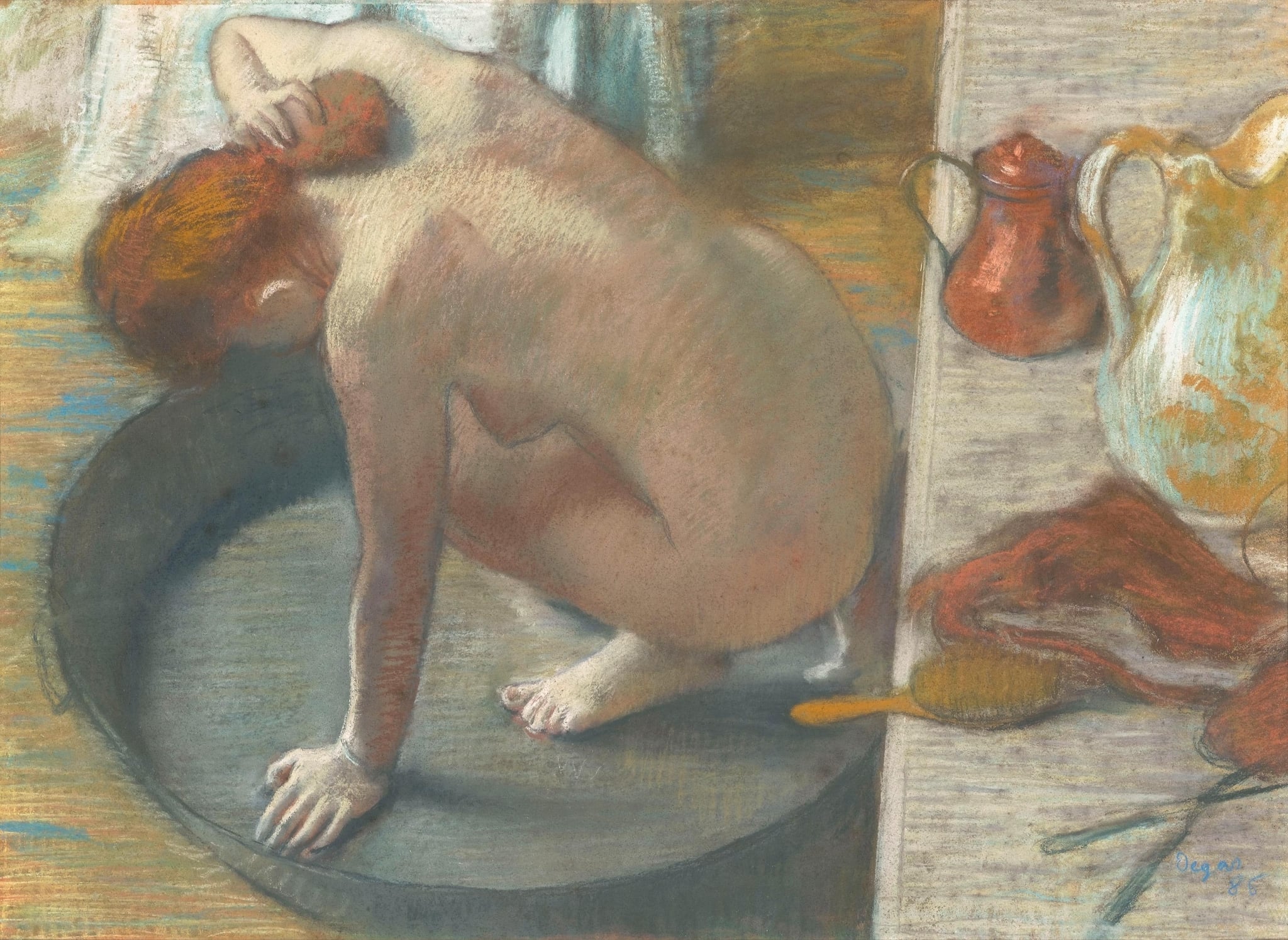
The Tub by Edgar Degas

The Tub

Edgar Degas (1886)

In The Tub (1886), Edgar Degas turns a routine bath into a study of <strong>modern solitude</strong> and <strong>embodied labor</strong>. From a steep, overhead angle, a woman kneels within a circular basin, one hand braced on the rim while the other gathers her hair; to the right, a tabletop packs a ewer, copper pot, comb/brush, and cloth. Degas’s layered pastel binds skin, water, and objects into a single, breathing field of <strong>warm flesh tones</strong> and blue‑greys, collapsing distance between body and still life <sup>[1]</sup>.
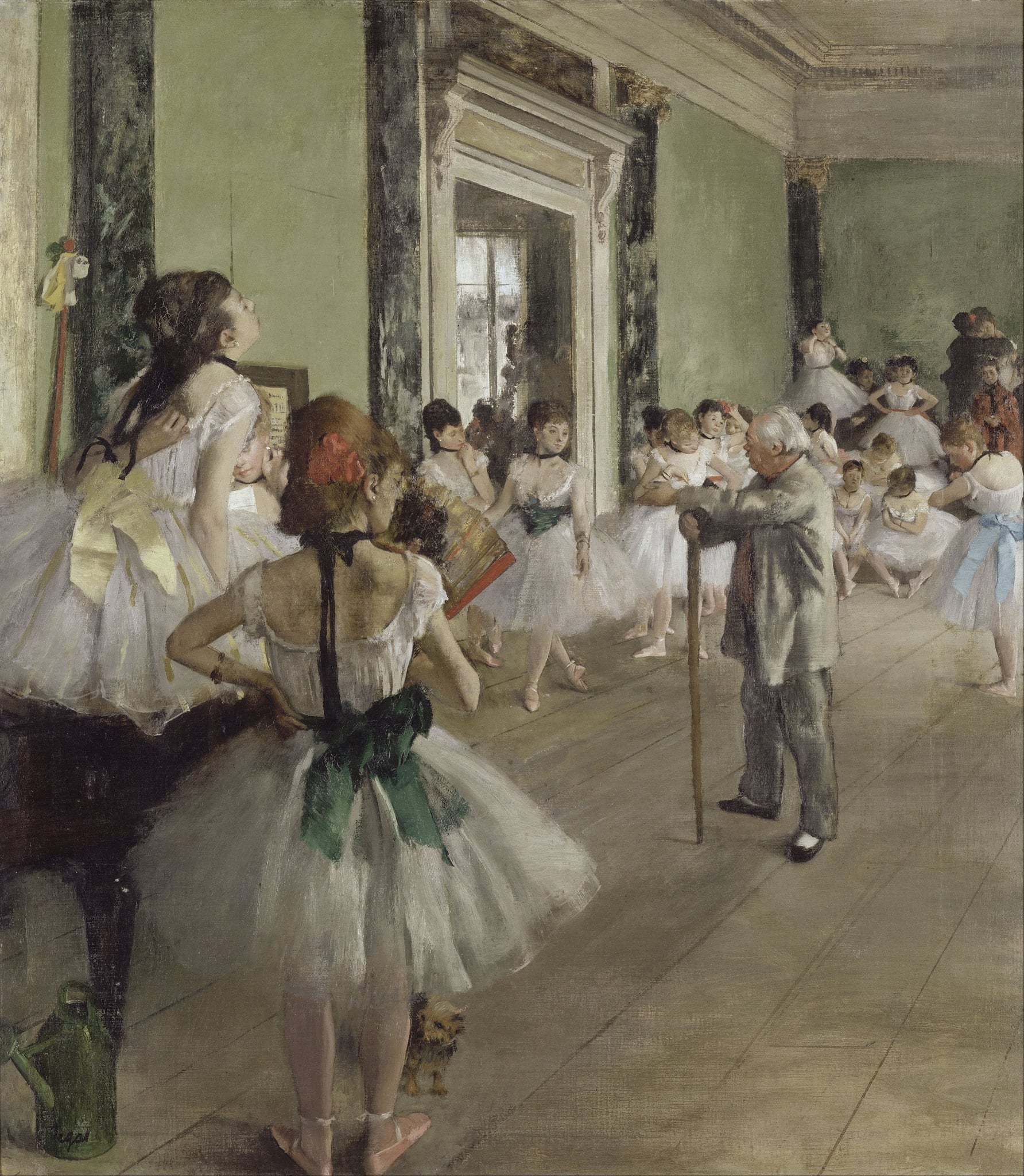
The Ballet Class by Edgar Degas

The Ballet Class

Edgar Degas (1873–1876)

<strong>The Ballet Class</strong> shows the work behind grace: a green-walled studio where young dancers in white tutus rest, fidget, and stretch while the gray-suited master stands with his cane. Degas’s diagonal floorboards, cropped viewpoints, and scattered props—a watering can, a music stand, even a tiny dog—stage a candid vision of routine rather than spectacle. The result is a modern image of discipline, hierarchy, and fleeting poise.
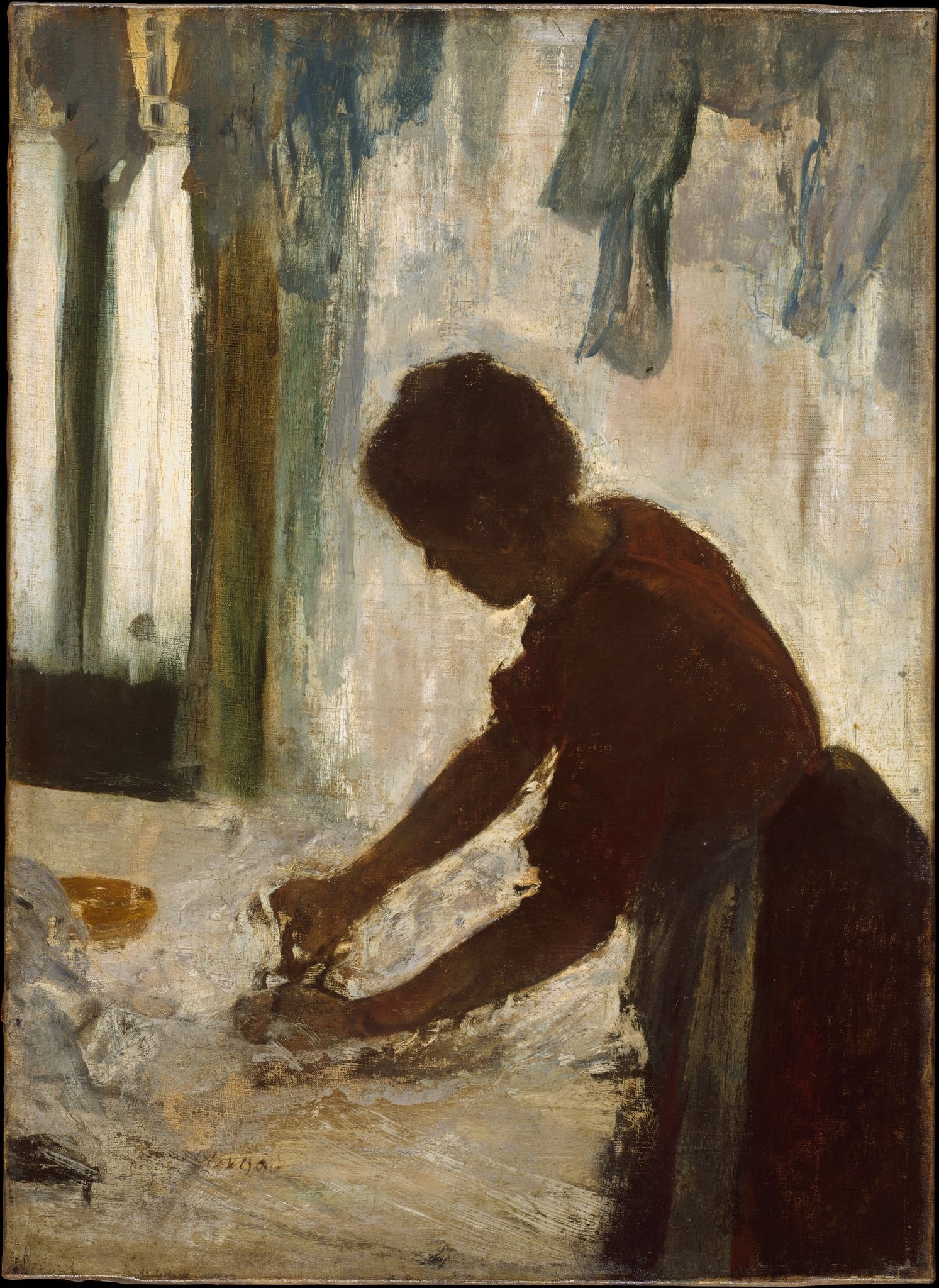
Woman Ironing by Edgar Degas

Woman Ironing

Edgar Degas (c. 1876–1887)

In Woman Ironing, Degas builds a modern icon of labor through <strong>contre‑jour</strong> light and a forceful diagonal from shoulder to iron. The worker’s silhouette, red-brown dress, and the cool, steamy whites around her turn repetition into <strong>ritualized transformation</strong>—wrinkled cloth to crisp order <sup>[1]</sup><sup>[2]</sup>.
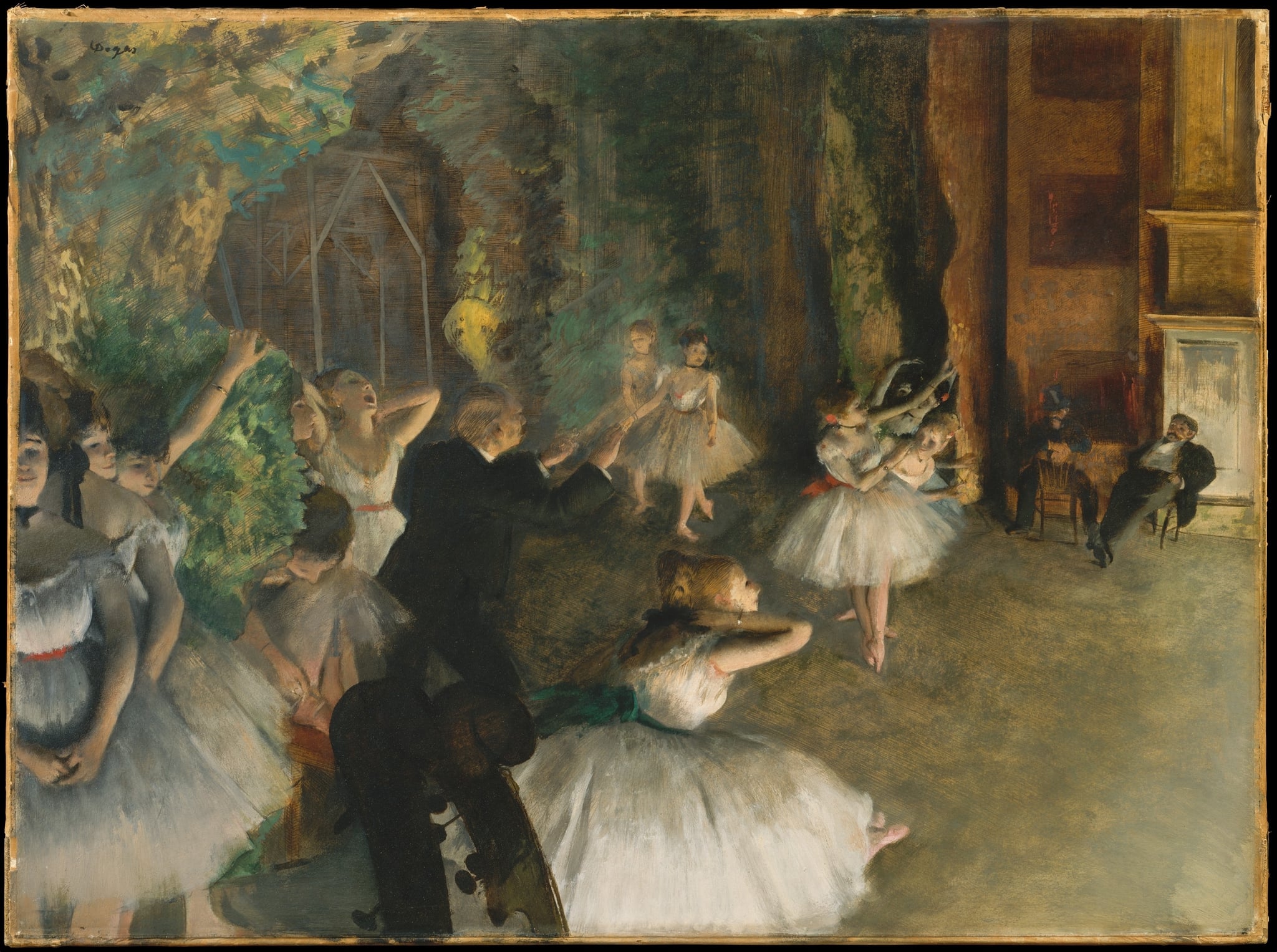
The Rehearsal of the Ballet Onstage by Edgar Degas

The Rehearsal of the Ballet Onstage

Edgar Degas (ca. 1874)

Degas’s The Rehearsal of the Ballet Onstage turns a moment of practice into a modern drama of work and power. Under <strong>harsh footlights</strong>, clustered ballerinas stretch, yawn, and repeat steps as a <strong>ballet master/conductor</strong> drives the tempo, while <strong>abonnés</strong> lounge in the wings and a looming <strong>double bass</strong> anchors the labor of music <sup>[1]</sup><sup>[3]</sup><sup>[4]</sup>.
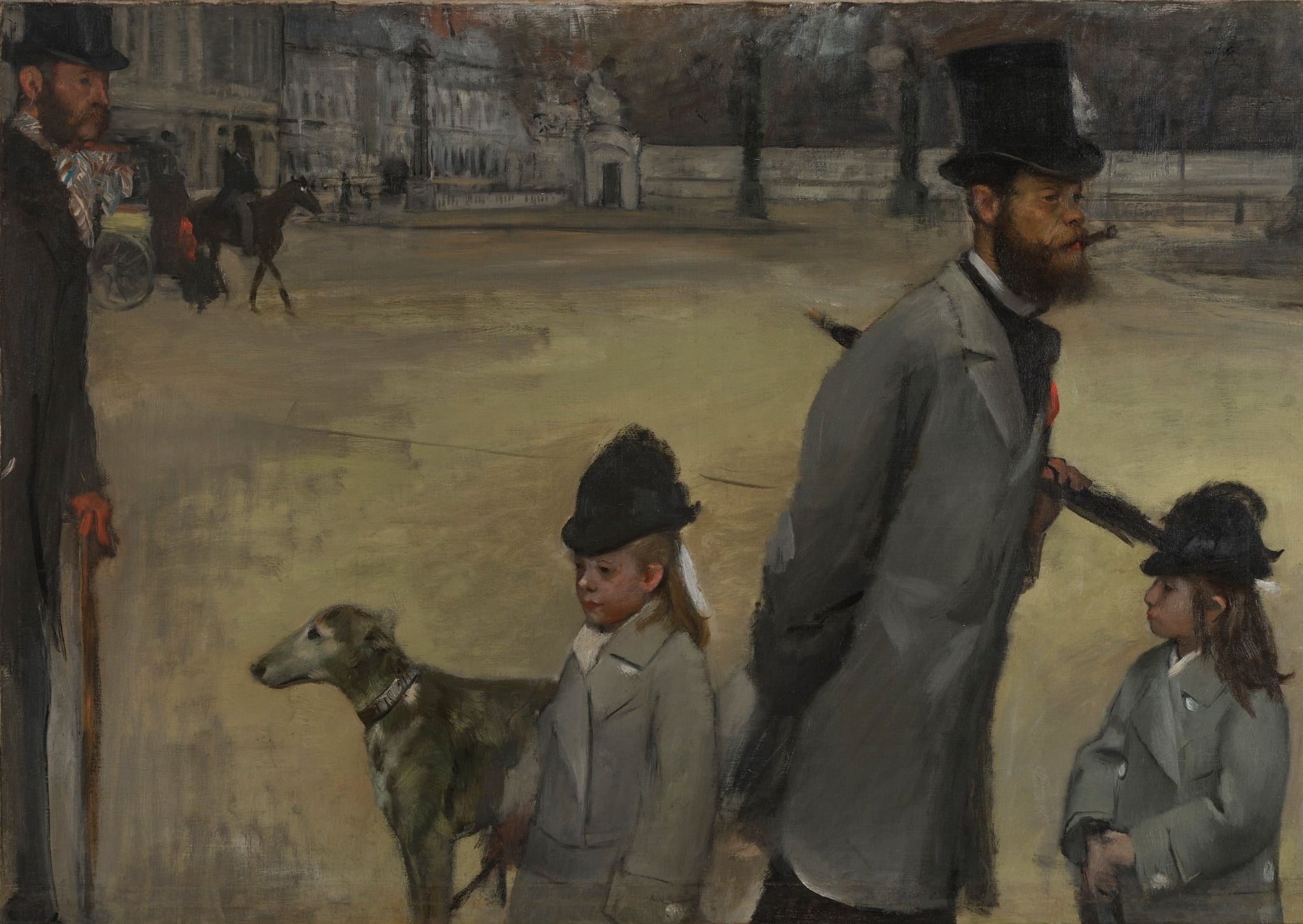
Place de la Concorde by Edgar Degas

Place de la Concorde

Edgar Degas (1875)

Degas’s Place de la Concorde turns a famous Paris square into a study of <strong>modern isolation</strong> and <strong>instantaneous vision</strong>. Figures stride past one another without contact, their bodies abruptly <strong>cropped</strong> and adrift in a wide, airless plaza—an urban stage where elegance masks estrangement <sup>[1]</sup><sup>[2]</sup>.