Originality, authorship, and appropriation
Featured Artworks
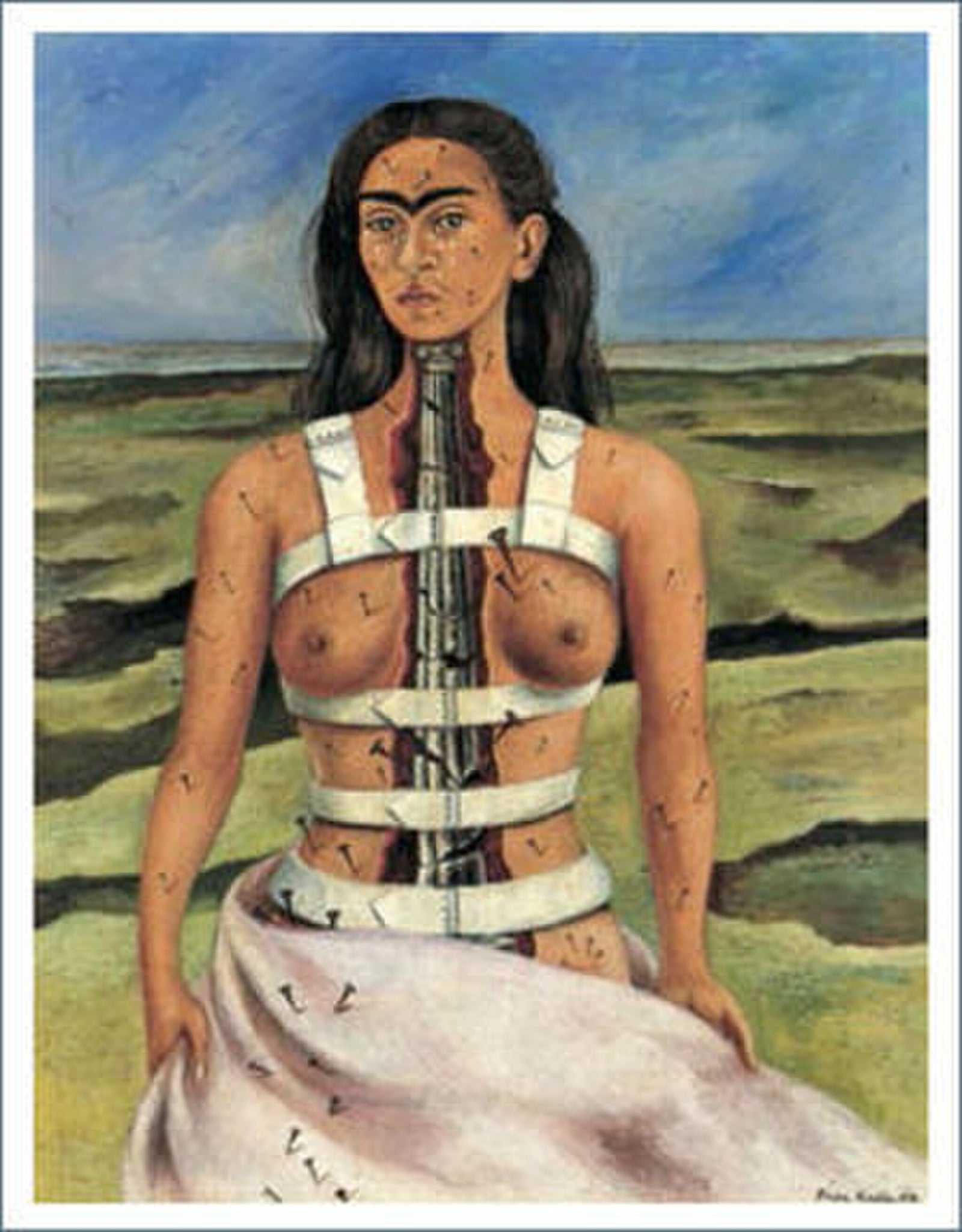
The Broken Column
Frida Kahlo (1944)
The Broken Column presents a frontal self-image split open to expose a shattered classical spine, mapping <strong>chronic pain</strong> across the body with nails while a white <strong>medical corset</strong> both supports and imprisons. Against a cracked, barren landscape, Kahlo’s steady gaze transforms injury into <strong>endurance</strong> and self-possession <sup>[1]</sup><sup>[2]</sup>.
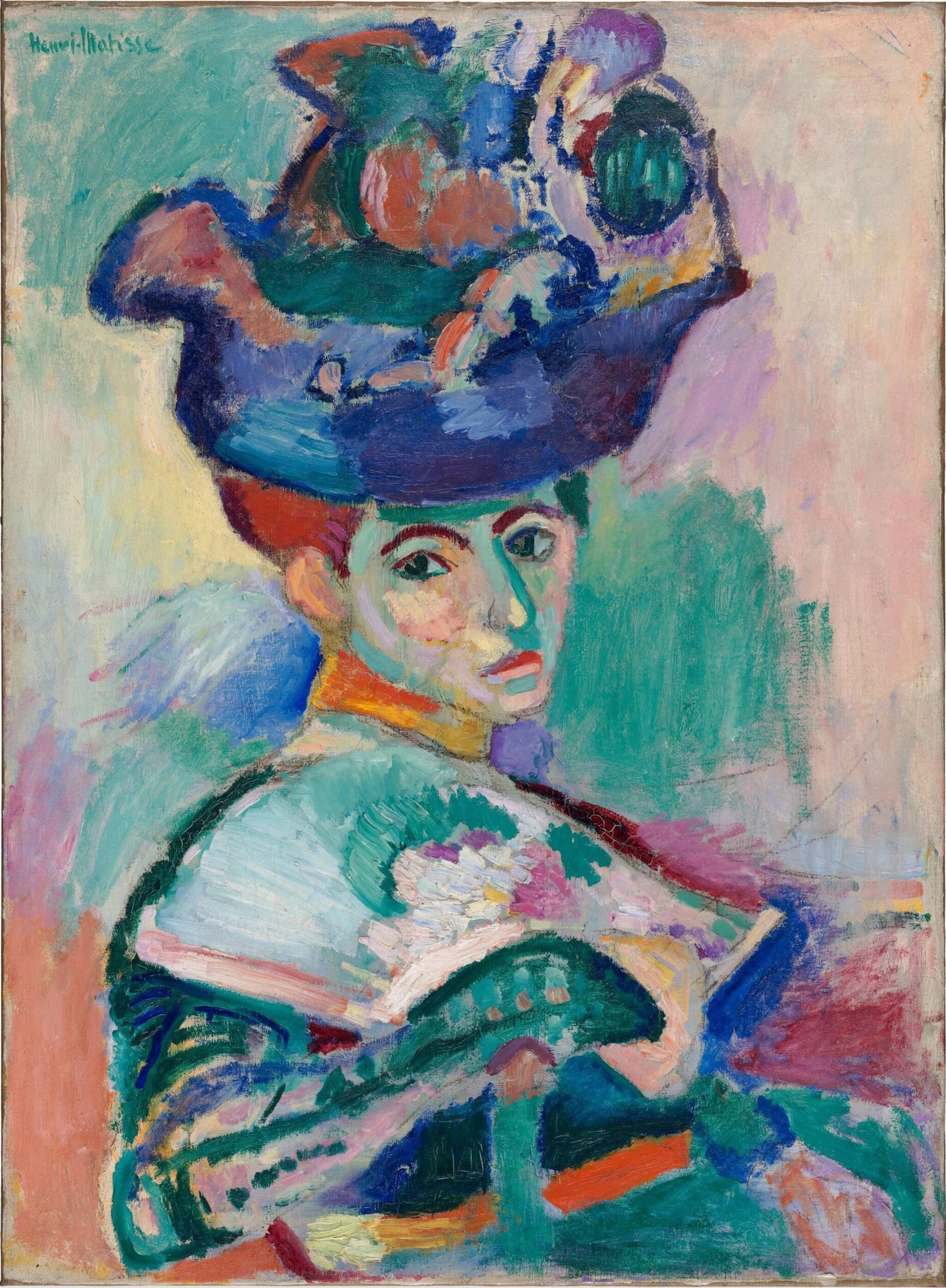
Woman with a Hat
Henri Matisse (1905)
In Woman with a Hat, Henri Matisse turns portraiture into a laboratory for <strong>pure color</strong> and <strong>modern identity</strong>. Jagged greens and violets carve the face; the hat detonates into a crown of brushstrokes; a fan slices the torso into bright planes. The result declares Fauvism’s credo: <strong>feeling over description</strong> <sup>[1]</sup><sup>[2]</sup>.
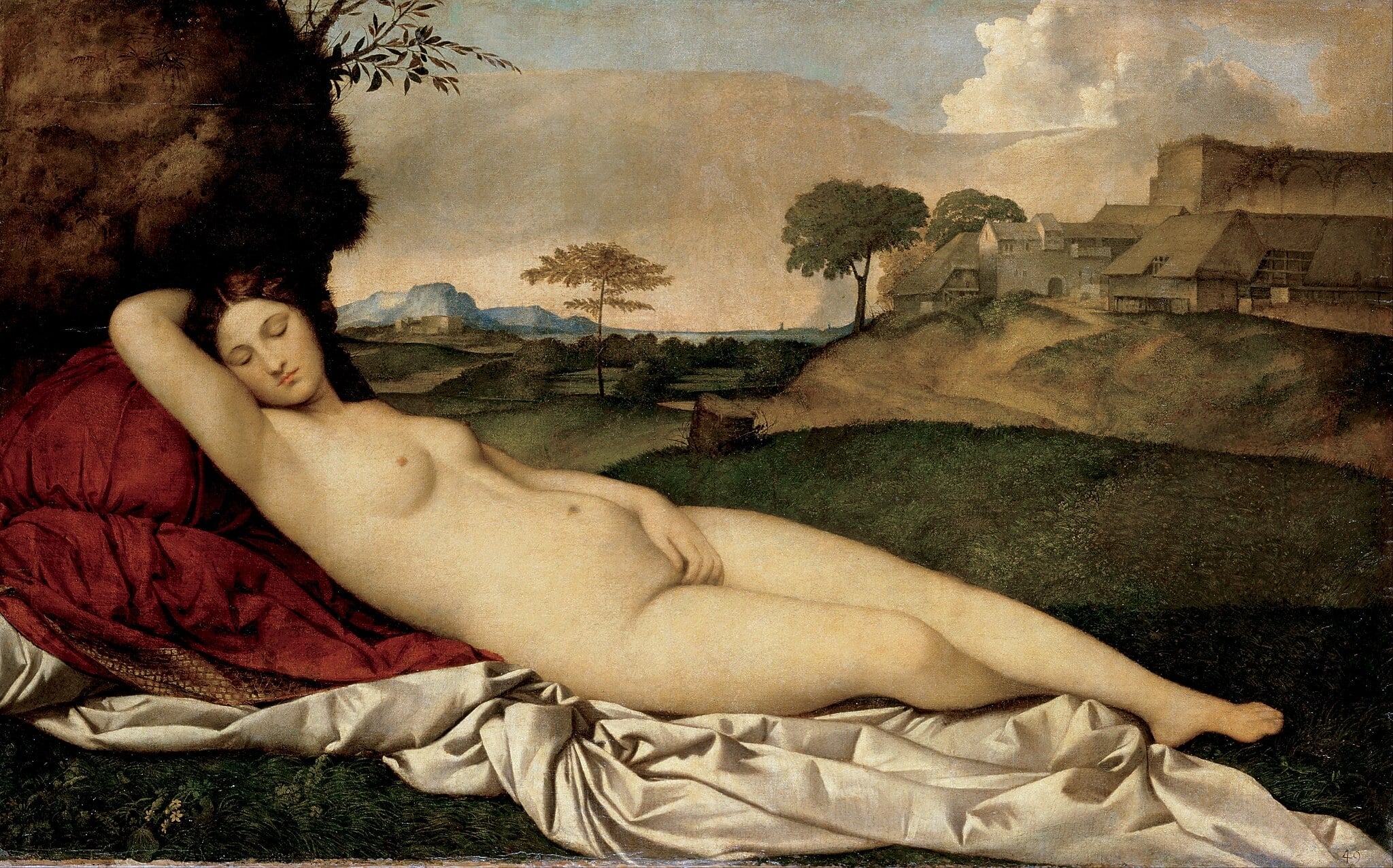
The Sleeping Venus
Giorgione (c. 1508–1510)
In The Sleeping Venus, the goddess reclines across a rolling landscape, her body a serene diagonal that fuses human beauty with nature’s forms. Cool, <strong>silvery drapery</strong> and <strong>deep red cushions</strong> intensify her luminous flesh, while the right-hand <strong>Venus pudica</strong> gesture suspends desire between revelation and restraint. The painting crystallizes the Venetian ideal of poetic harmony (<strong>poesia</strong>) and inaugurates the fully realized reclining nude in Western art <sup>[2]</sup><sup>[4]</sup><sup>[6]</sup>.
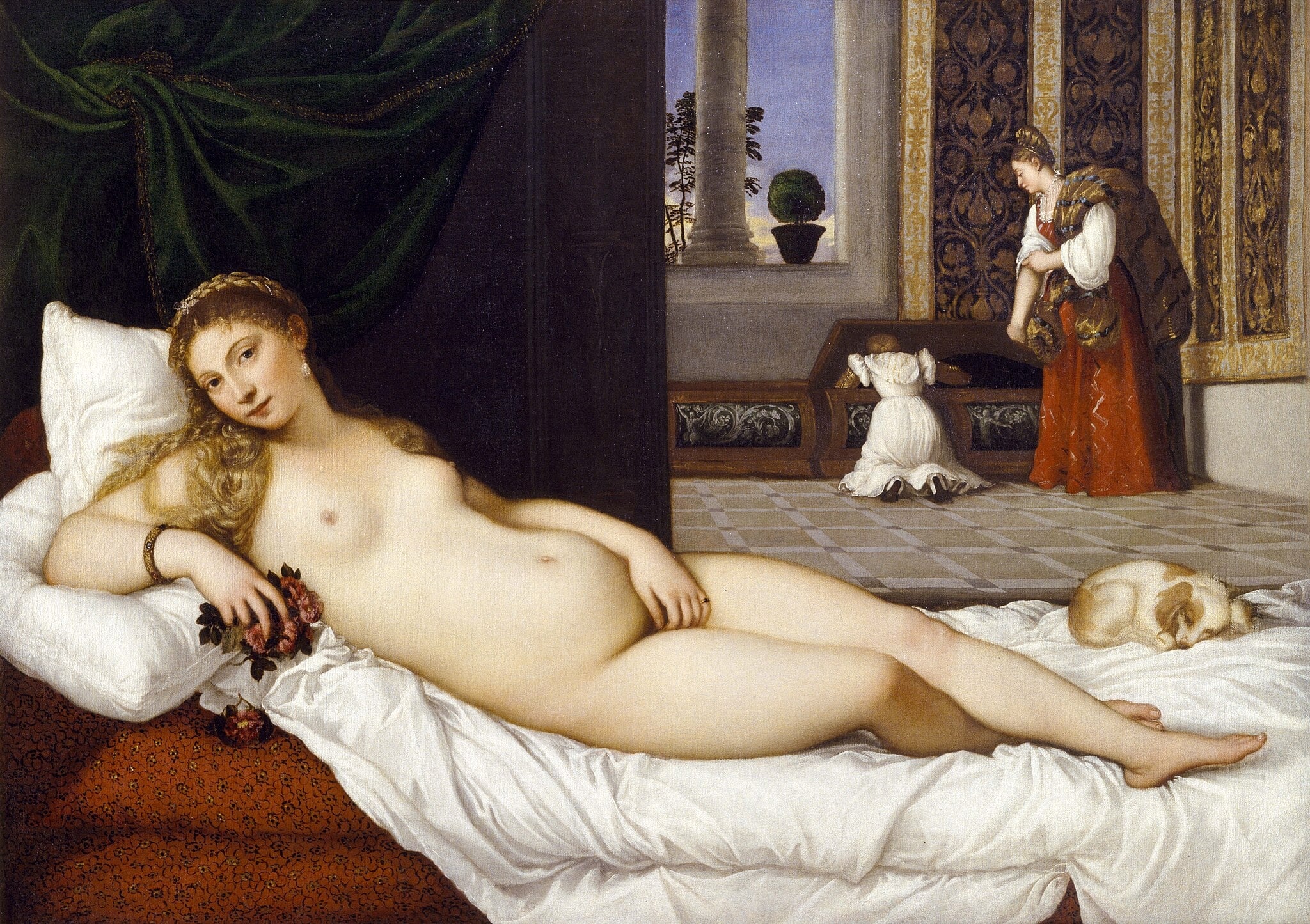
Venus of Urbino
Titian (1538)
Titian’s Venus of Urbino turns the mythic goddess into an ideal bride, merging frank <strong>eroticism</strong> with the codes of <strong>marital fidelity</strong>. In a Venetian bedroom, the nude’s direct gaze, roses, sleeping lapdog, and attendants at a cassone bind desire to domestic virtue and fertility <sup>[1]</sup><sup>[2]</sup>.

The Assumption of the Virgin
Titian (1516–1518)
Titian’s The Assumption of the Virgin stages a three-tier ascent—apostles below, Mary rising on clouds, and God the Father above—fused by radiant light and Venetian <strong>colorito</strong>. Mary’s red and blue drapery, open <strong>orant</strong> hands, and the vortex of putti visualize grace lifting humanity toward the divine. The painting’s scale and kinetic design turned a doctrinal mystery into a public, liturgical drama for Venice. <sup>[1]</sup><sup>[2]</sup>
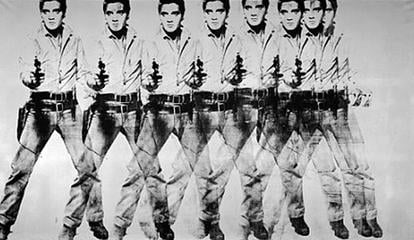
Eight Elvises
Andy Warhol (1963)
A sweeping frieze of eight overlapping, gun‑drawn cowboys marches across a silver field, their forms slipping and ghosting as if frames of a film. Warhol converts a singular star into a <strong>serial commodity</strong>, where <strong>mechanical misregistration</strong> and life‑size scale turn bravado into spectacle <sup>[1]</sup><sup>[2]</sup>.
![Triple Elvis [Ferus Type] by Andy Warhol](/_next/image?url=https%3A%2F%2Fstorage.googleapis.com%2Fsite-images-programmatic%2Fpaintings%2F1771915343451-6gzg8m.jpg&w=3840&q=85&dpl=dpl_DuquBXTjD9SpHPWkwvoCYAx3ZDiZ)
Triple Elvis [Ferus Type]
Andy Warhol (1963)
In Triple Elvis [Ferus Type] (1963), Andy Warhol multiplies a gunslinging movie idol across a cool, metallic field, turning a singular persona into a <strong>serial commodity</strong>. The sharply printed figure at center flanked by fading, <strong>ghosted</strong> doubles collapses still image, filmic motion, and mass reproduction into one charged surface <sup>[1]</sup><sup>[2]</sup>.

The Death of Marat
Jacques-Louis David (1793)
<strong>The Death of Marat</strong> turns a private murder into a <strong>secular martyrdom</strong>: Marat’s idealized body slumps in a bath, a pleading letter in his hand, a quill slipping from the other beside a bloodied knife and inkwell. Against a vast dark void, David’s calm light and austere geometry elevate humble objects—the green baize plank and the crate inscribed “À MARAT, DAVID, L’AN DEUX”—into civic emblems <sup>[1]</sup><sup>[2]</sup><sup>[3]</sup>.
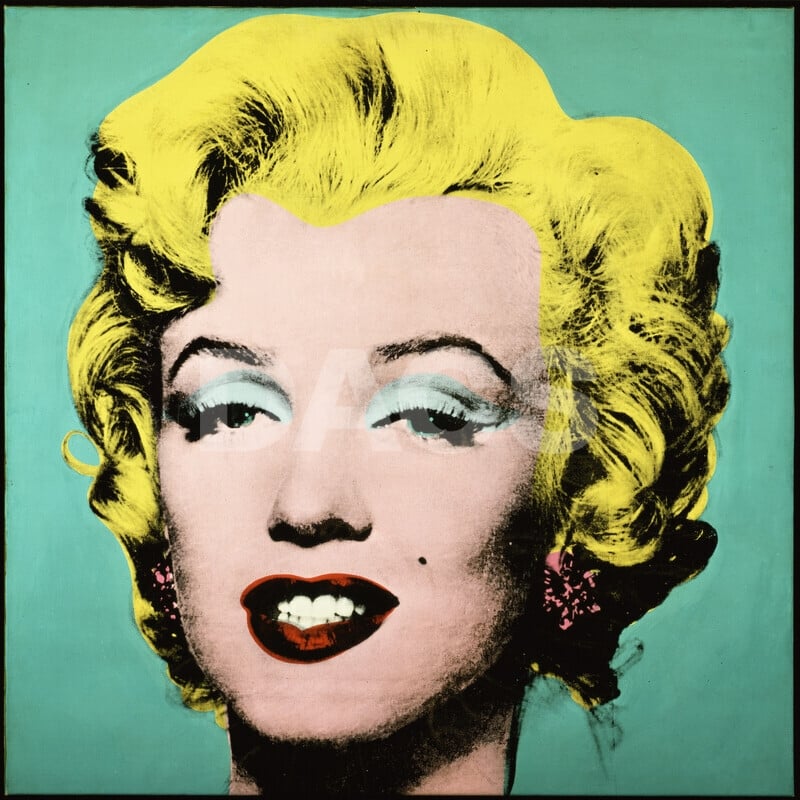
Turquoise Marilyn
Andy Warhol (1964)
In Turquoise Marilyn, Andy Warhol converts a movie star’s face into a <strong>modern icon</strong>: a tightly cropped head floating in a flat <strong>turquoise</strong> field, its <strong>acidic yellow hair</strong>, turquoise eye shadow, and <strong>lipstick-red</strong> mouth stamped by silkscreen’s mechanical bite. The slight <strong>misregistration</strong> around eyes and hair produces a halo-like tremor, fusing <strong>glamour and ghostliness</strong> to expose celebrity as a manufactured surface <sup>[1]</sup><sup>[2]</sup>.
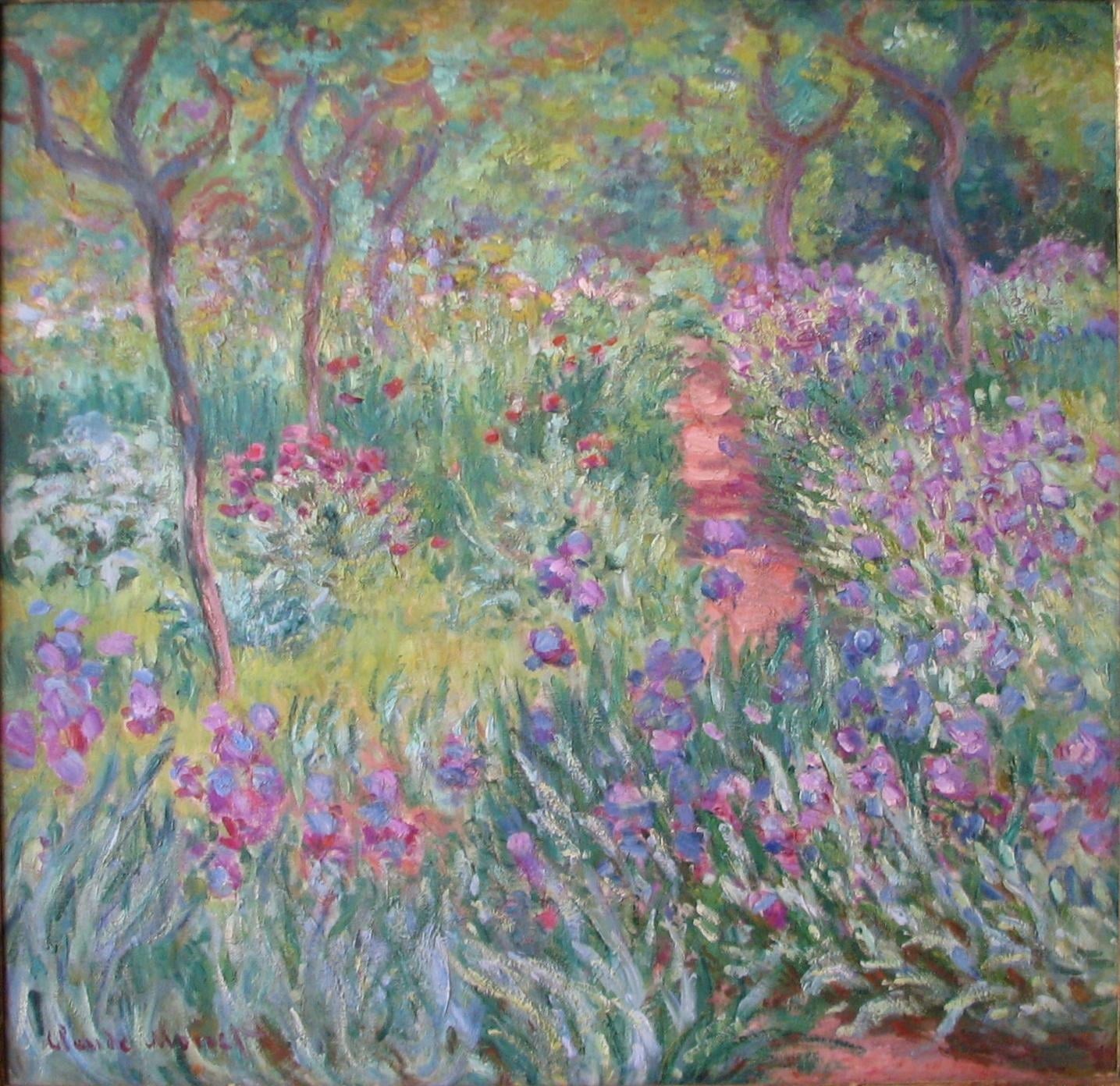
The Artist's Garden at Giverny
Claude Monet (1900)
In The Artist's Garden at Giverny, Claude Monet turns his cultivated Clos Normand into a field of living color, where bands of violet <strong>irises</strong> surge toward a narrow, rose‑colored path. Broken, flickering strokes let greens, purples, and pinks mix optically so that light seems to tremble across the scene, while lilac‑toned tree trunks rhythmically guide the gaze inward <sup>[1]</sup><sup>[3]</sup>.
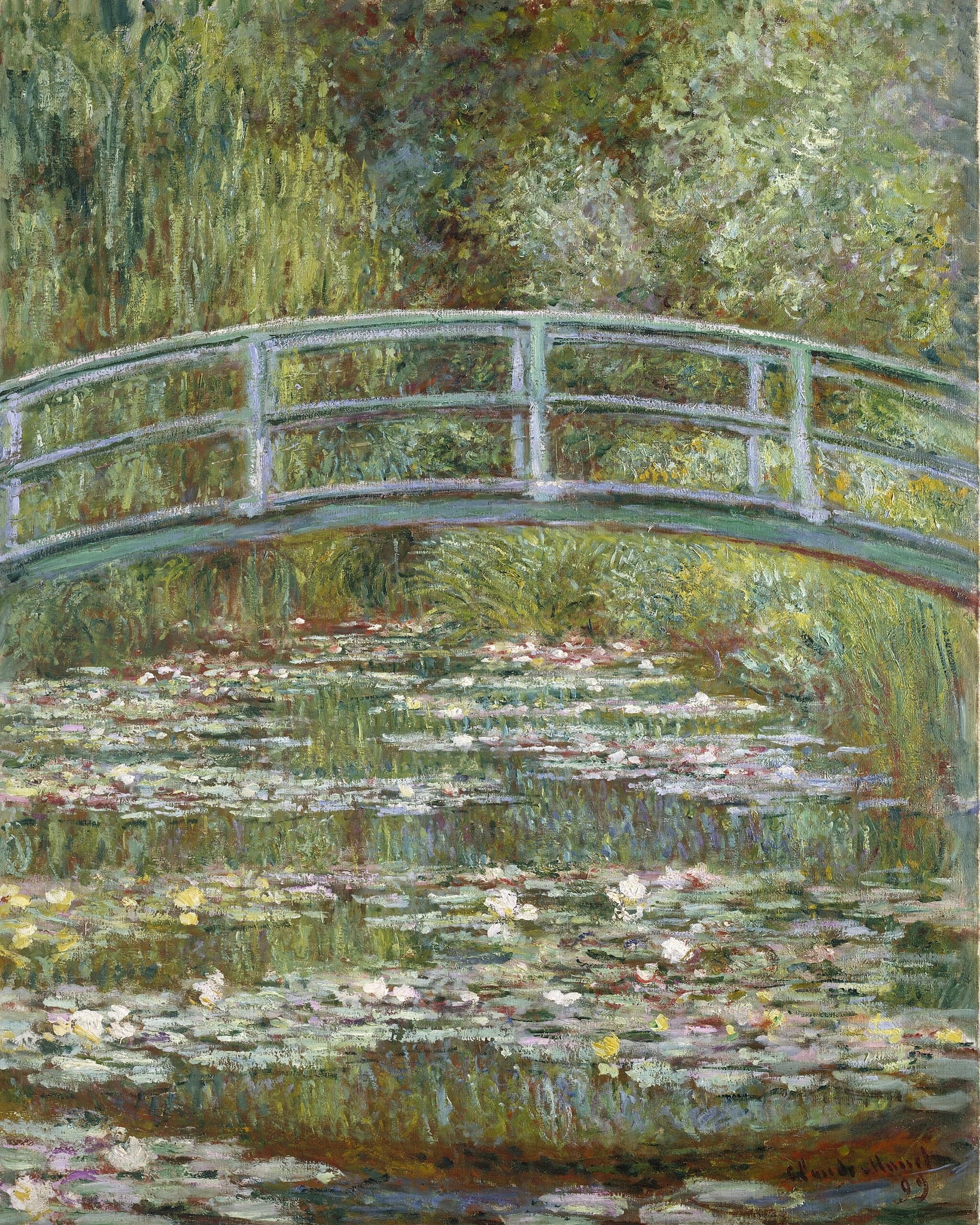
Bridge over a Pond of Water Lilies
Claude Monet (1899)
Claude Monet’s Bridge over a Pond of Water Lilies stages a <strong>threshold</strong> where garden and reflection merge. The cool arc of the <strong>Japanese-style bridge</strong> steadies a field of trembling light, while lilies hover between surface and depth, turning perception itself into the subject <sup>[1]</sup><sup>[2]</sup>.
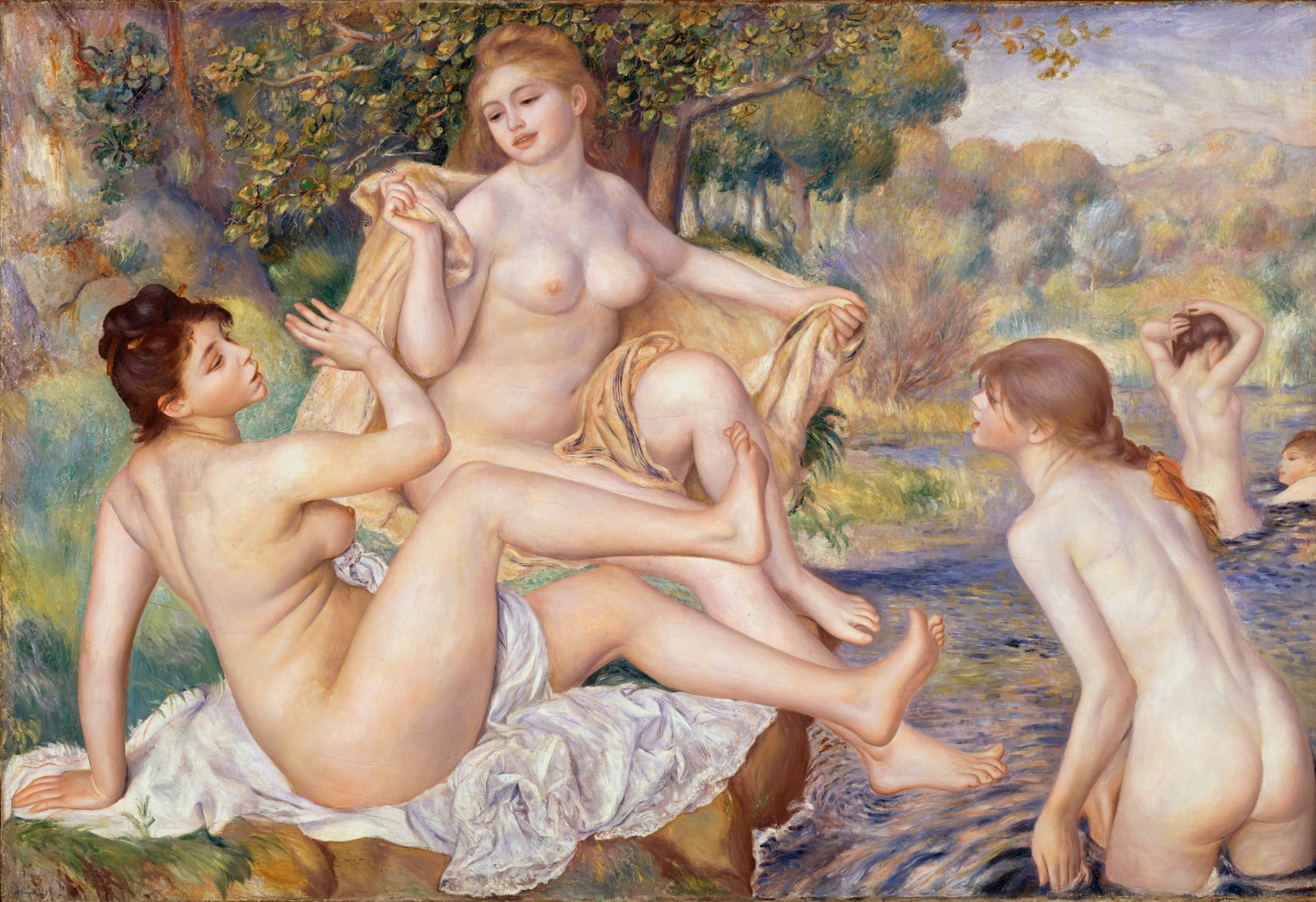
The Large Bathers
Pierre-Auguste Renoir (1884–1887)
Pierre-Auguste Renoir’s The Large Bathers unites modern bodies with a pastoral grove to stage an <strong>Arcadian ideal</strong>. Three monumental nudes form interlocking curves and triangles while two background figures splash and groom, fusing <strong>sensual warmth</strong> with <strong>classical order</strong> <sup>[1]</sup><sup>[2]</sup>.
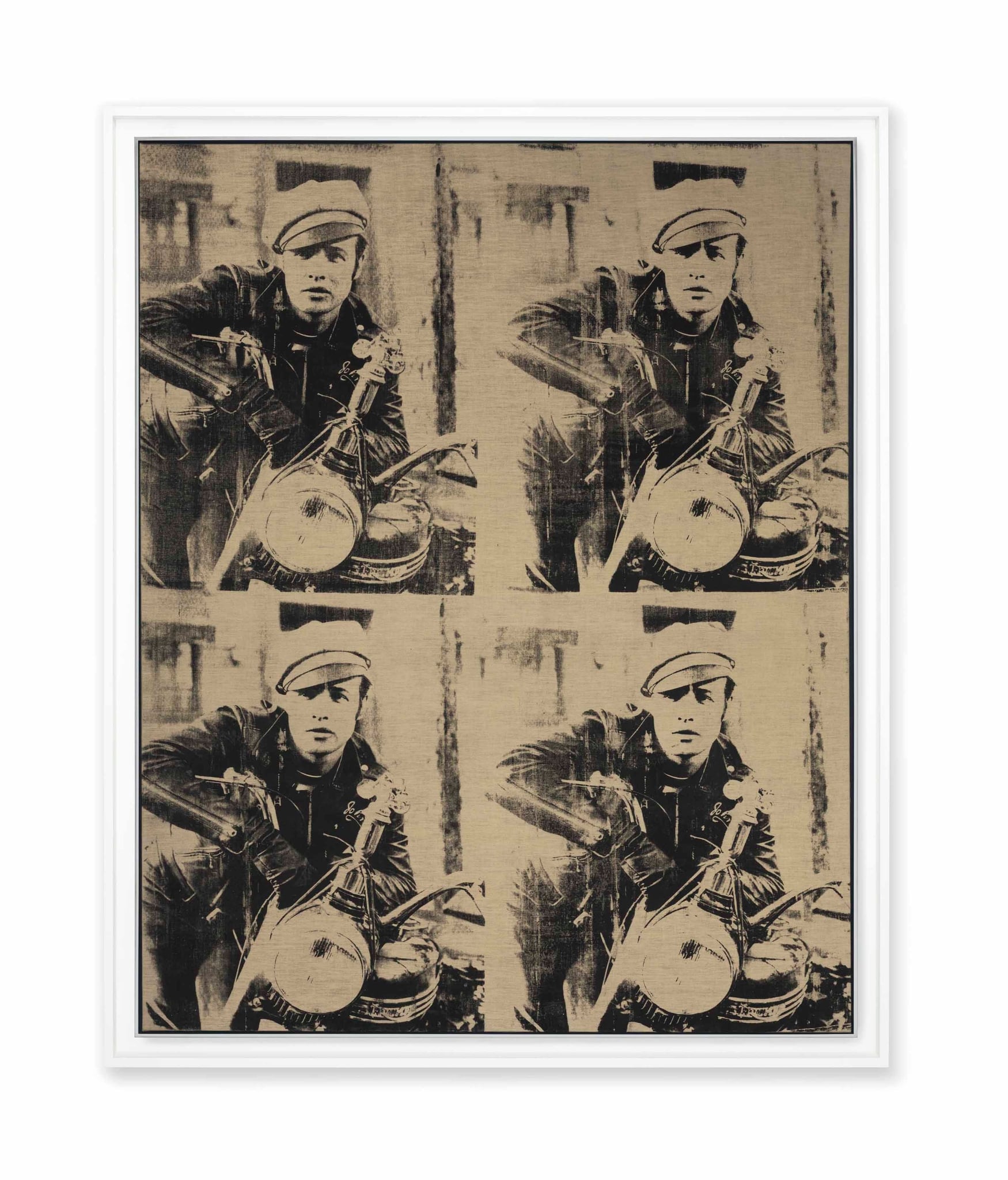
Four Marlons
Andy Warhol (1966)
Four Marlons is a 1966 silkscreen by Andy Warhol that multiplies a single biker film-still into a tight 2×2 grid on raw linen. Its inky blacks against a tan, unprimed ground turn the glare of the headlamp, the angled handlebars, and the figure’s guarded pose into a <strong>repeatable icon</strong> of outlaw cool. Warhol’s seriality both <strong>amplifies and drains</strong> the image’s aura, exposing fame as a commodity pattern <sup>[1]</sup><sup>[3]</sup>.
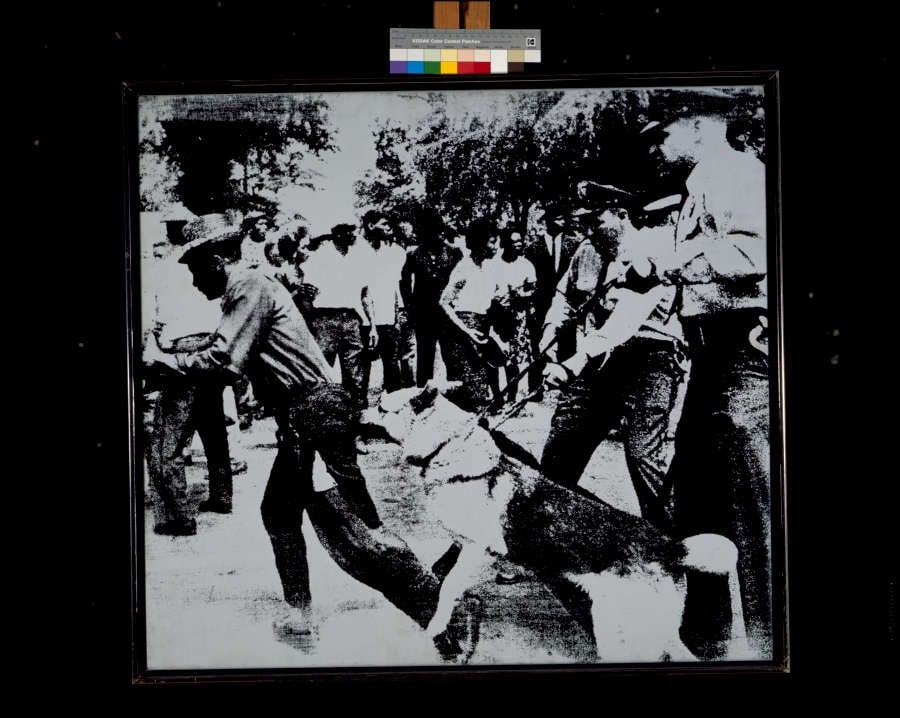
Race Riot
Andy Warhol (1964)
Race Riot crystallizes a split-second of state force: a police dog lunges while officers with batons surge and a ring of onlookers compresses the scene into a <strong>claustrophobic frieze</strong>. Warhol’s stark, high-contrast silkscreen translates a LIFE wire-photo into a <strong>mechanized emblem</strong> of American racial violence and its mass-media circulation <sup>[1]</sup><sup>[2]</sup>.
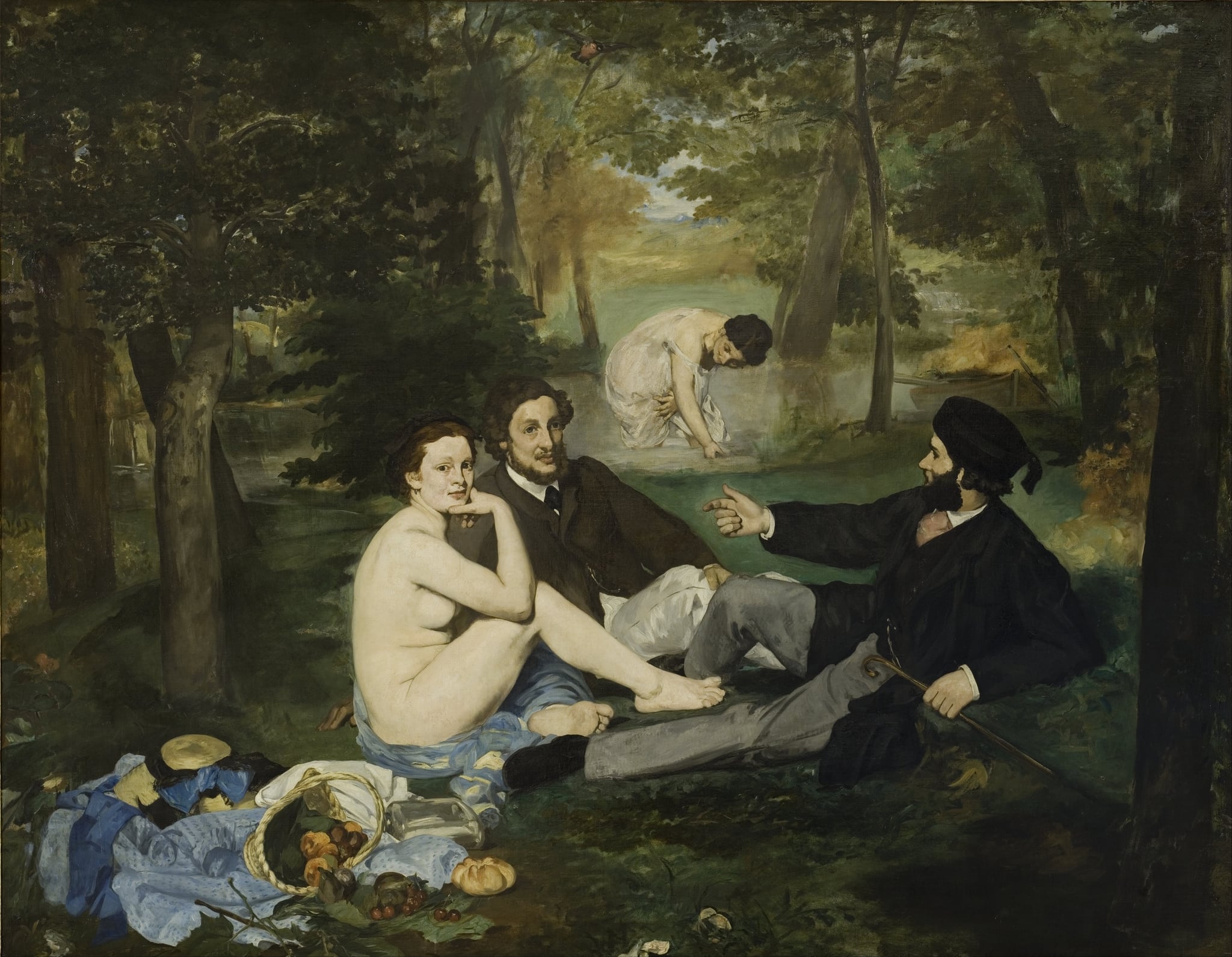
Luncheon on the Grass
Édouard Manet (1863)
Luncheon on the Grass stages a confrontation between <strong>modern Parisian leisure</strong> and <strong>classical precedent</strong>. A nude woman meets our gaze beside two clothed men, while a distant bather and an overturned picnic puncture naturalistic illusion. Manet’s scale and flat, studio-like light convert a park picnic into a manifesto of <strong>modern painting</strong> <sup>[1]</sup><sup>[2]</sup>.

Woman at Her Toilette
Berthe Morisot (1875–1880)
Woman at Her Toilette stages a private ritual of self-fashioning, not a spectacle of vanity. A woman, seen from behind, lifts her arm to adjust her hair as a <strong>black velvet choker</strong> punctuates Morisot’s silvery-violet haze; the <strong>mirror’s blurred reflection</strong> with powders, jars, and a white flower refuses a clear face. Morisot’s <strong>feathery facture</strong> turns a fleeting toilette into modern subjectivity made visible <sup>[1]</sup>.
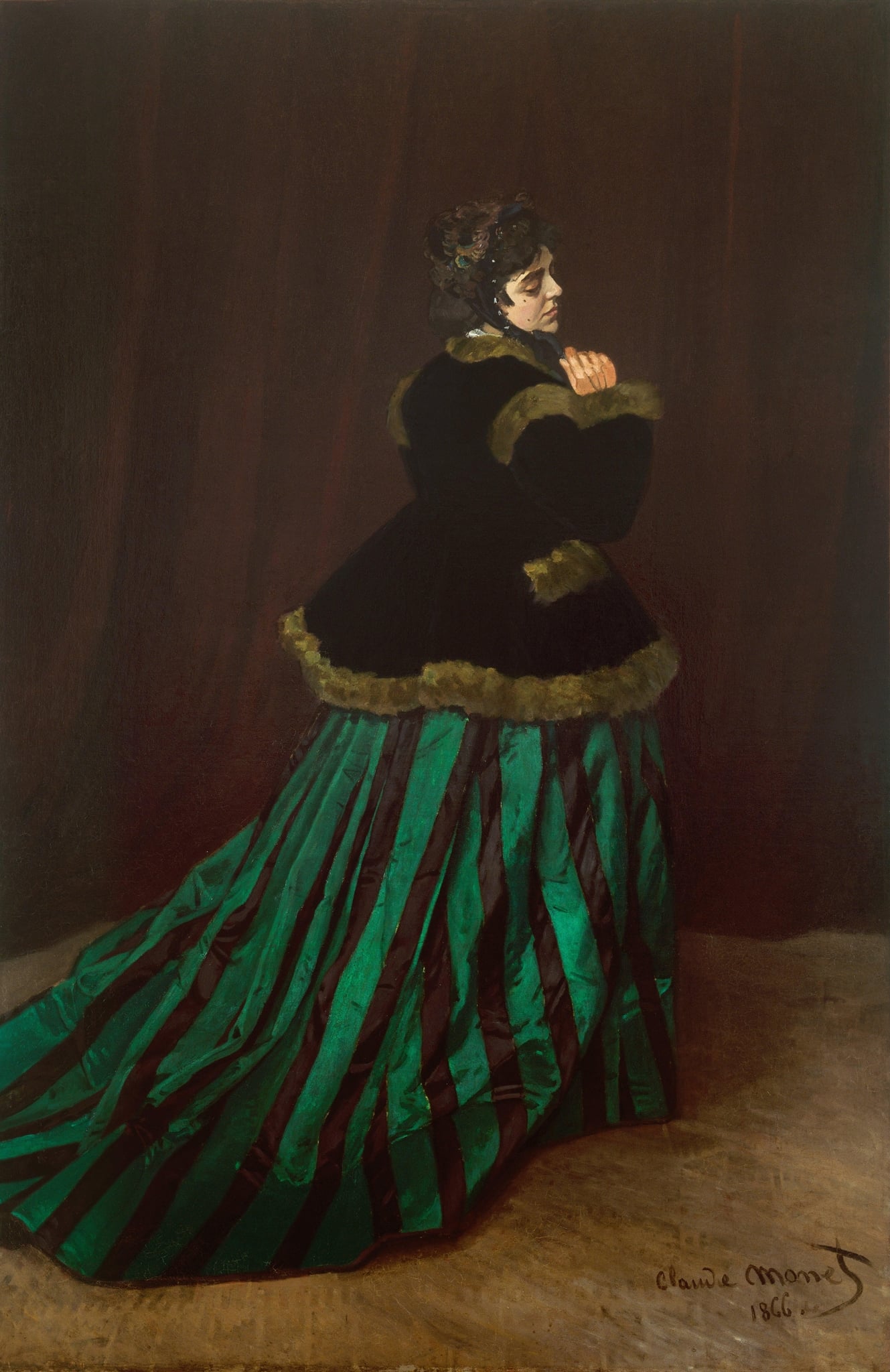
Camille (The Woman in the Green Dress)
Claude Monet (1866)
Monet’s Camille (The Woman in the Green Dress) turns a full-length portrait into a study of <strong>modern spectacle</strong>. The spotlit emerald-and-black skirt, set against a near-black curtain, makes <strong>fashion</strong> the engine of meaning and the vehicle of status.
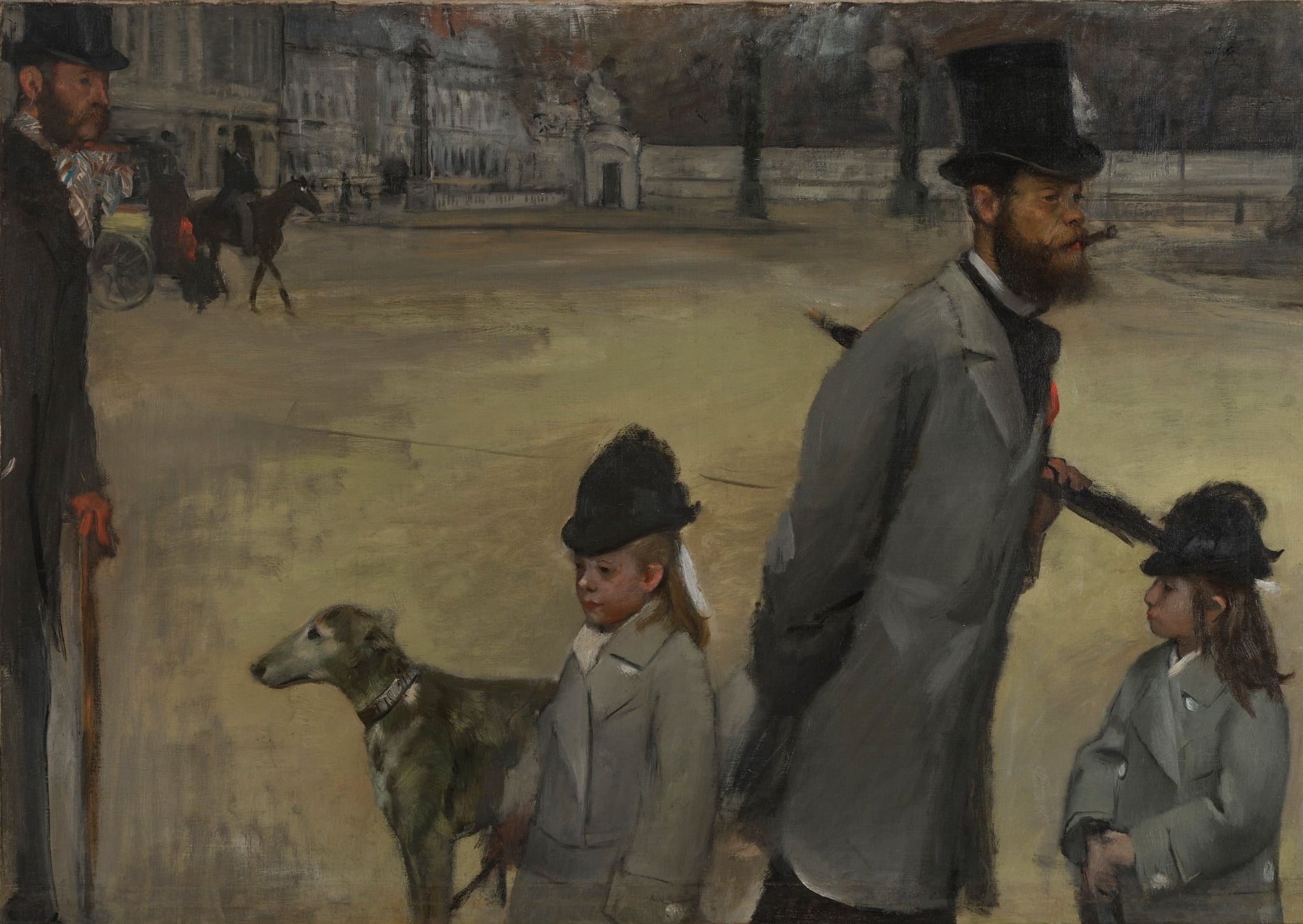
Place de la Concorde
Edgar Degas (1875)
Degas’s Place de la Concorde turns a famous Paris square into a study of <strong>modern isolation</strong> and <strong>instantaneous vision</strong>. Figures stride past one another without contact, their bodies abruptly <strong>cropped</strong> and adrift in a wide, airless plaza—an urban stage where elegance masks estrangement <sup>[1]</sup><sup>[2]</sup>.
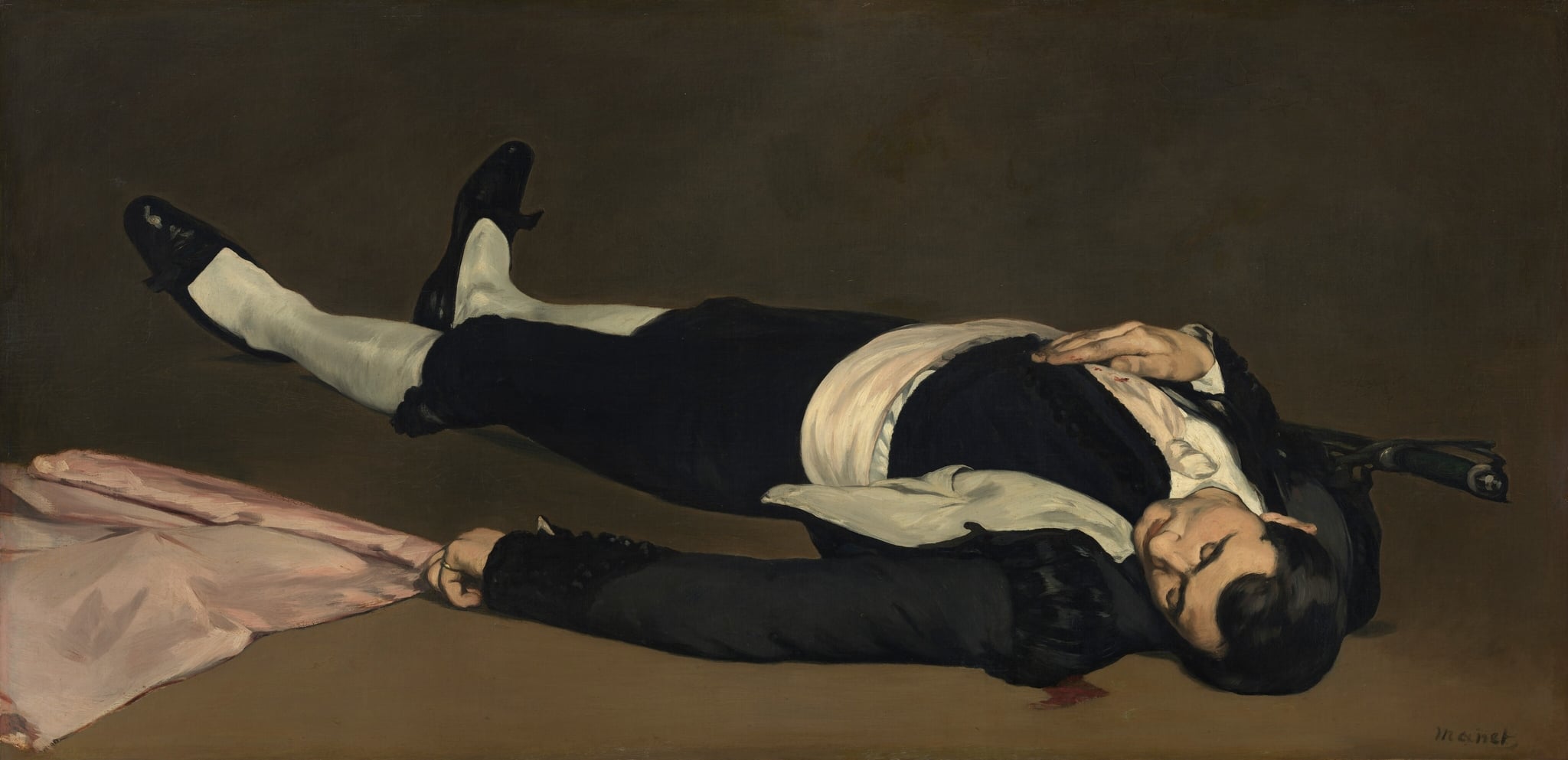
The Dead Toreador
Édouard Manet (probably 1864)
Manet’s The Dead Toreador isolates a matador’s corpse in a stark, horizontal close‑up, replacing the spectacle of the bullring with <strong>silence</strong> and <strong>abrupt finality</strong>. Black costume, white stockings, a pale pink cape, the sword’s hilt, and a small <strong>pool of blood</strong> become the painting’s cool, modern vocabulary of death <sup>[1]</sup>.
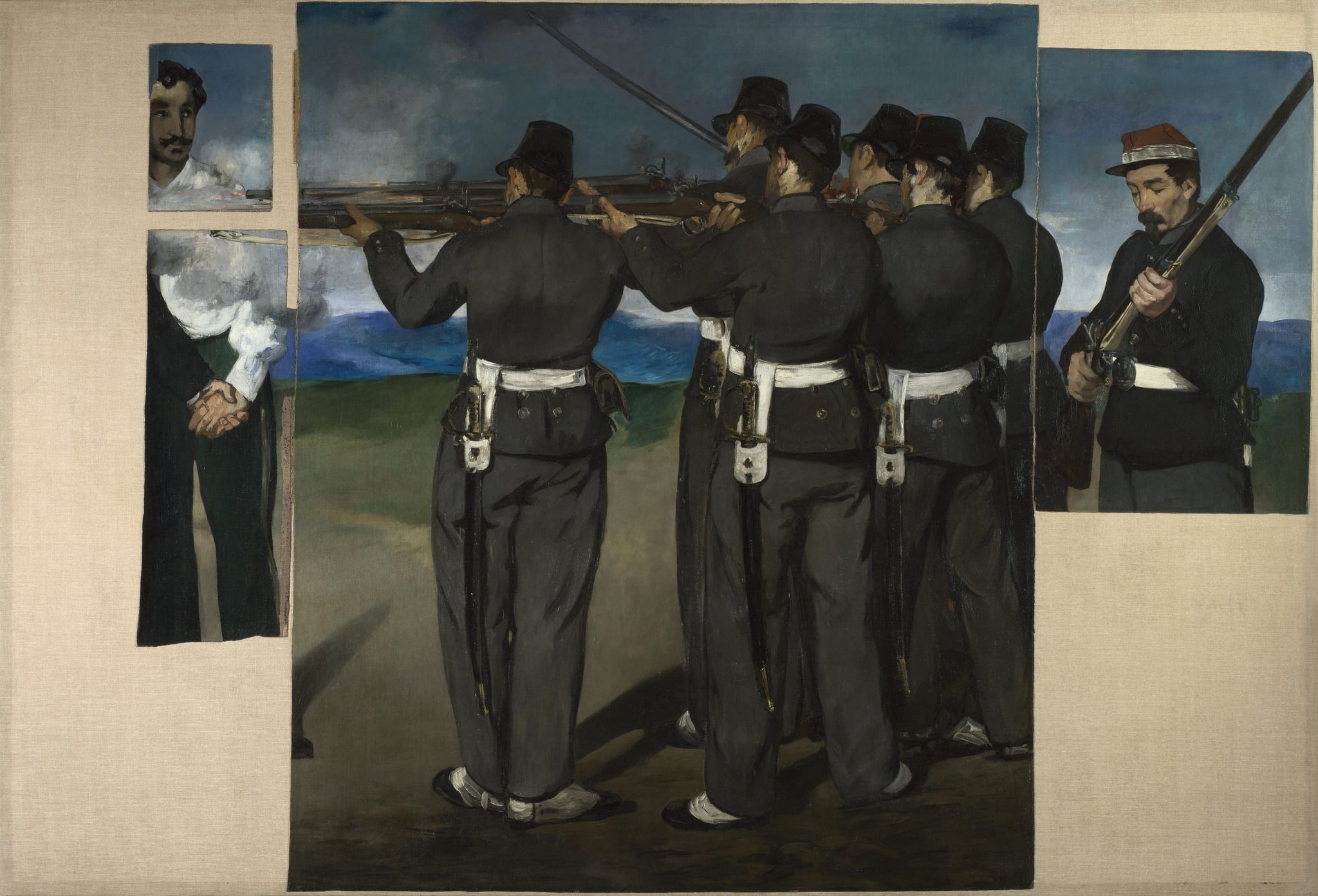
The Execution of Emperor Maximilian
Édouard Manet (1867–1868)
Manet’s The Execution of Emperor Maximilian confronts state violence with a <strong>cool, reportorial</strong> style. The wall of gray-uniformed riflemen, the <strong>fragmented canvas</strong>, and the dispassionate loader at right turn the killing into <strong>impersonal machinery</strong> that implicates the viewer <sup>[1]</sup><sup>[2]</sup>.

Sixty Last Suppers
Andy Warhol (1986)
Andy Warhol’s Sixty Last Suppers multiplies Leonardo’s scene into a vast grid, turning a singular sacred image into <strong>serial</strong> signage. From afar it reads as an architectural surface; up close, silkscreen <strong>variations</strong>—blurs, darker panels, dropped ink—reassert the human trace <sup>[1]</sup><sup>[2]</sup>.
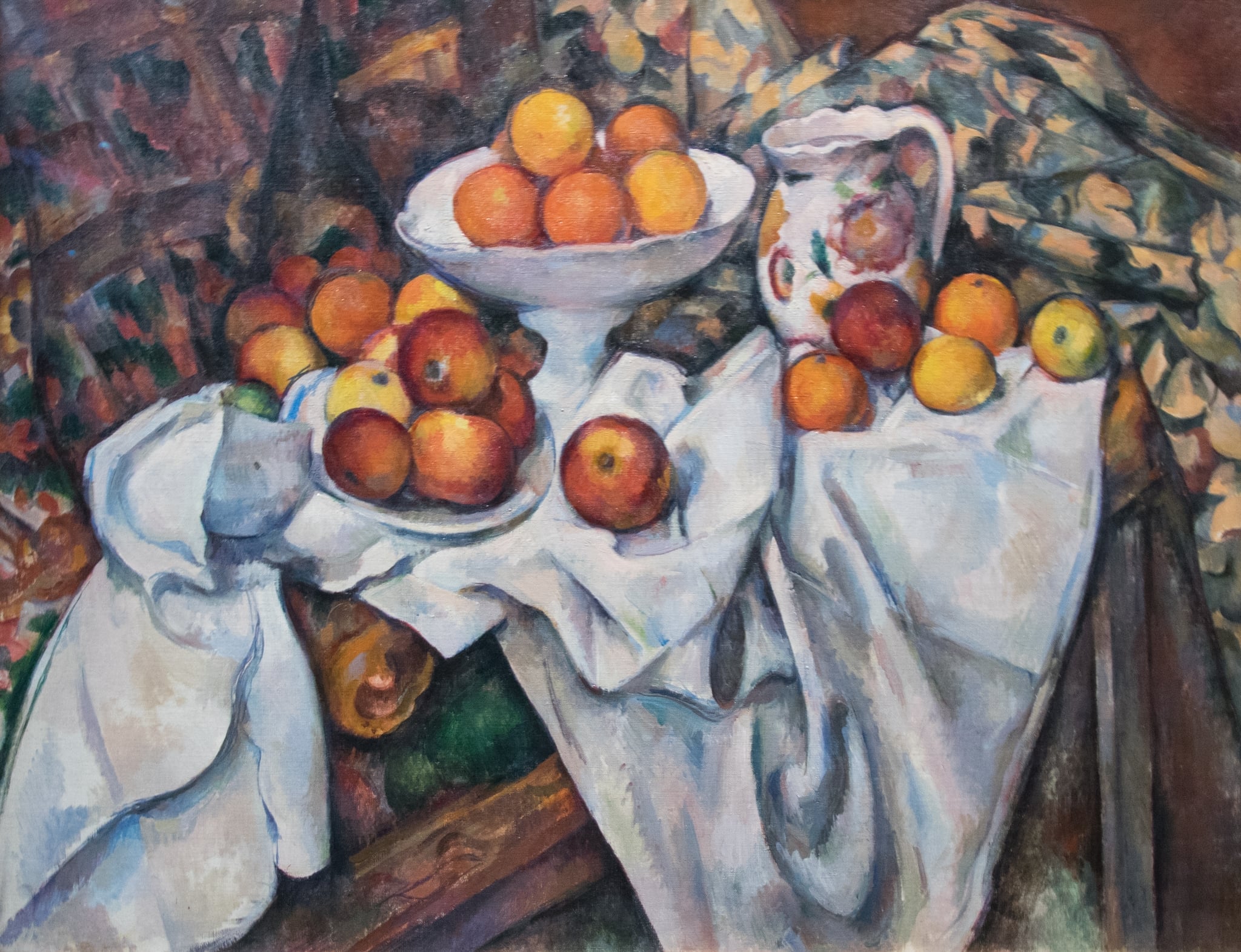
Still Life with Apples and Oranges
Paul Cézanne (c. 1899)
Paul Cézanne’s Still Life with Apples and Oranges builds a quietly monumental world from domestic things. A tilting table, a heaped white compote, a flowered jug, and cascading cloths turn fruit into <strong>durable forms</strong> stabilized by <strong>color relationships</strong> rather than single‑point perspective <sup>[1]</sup><sup>[2]</sup>. The result is a still life that feels both solid and subtly <strong>unstable</strong>, a meditation on how we construct vision.
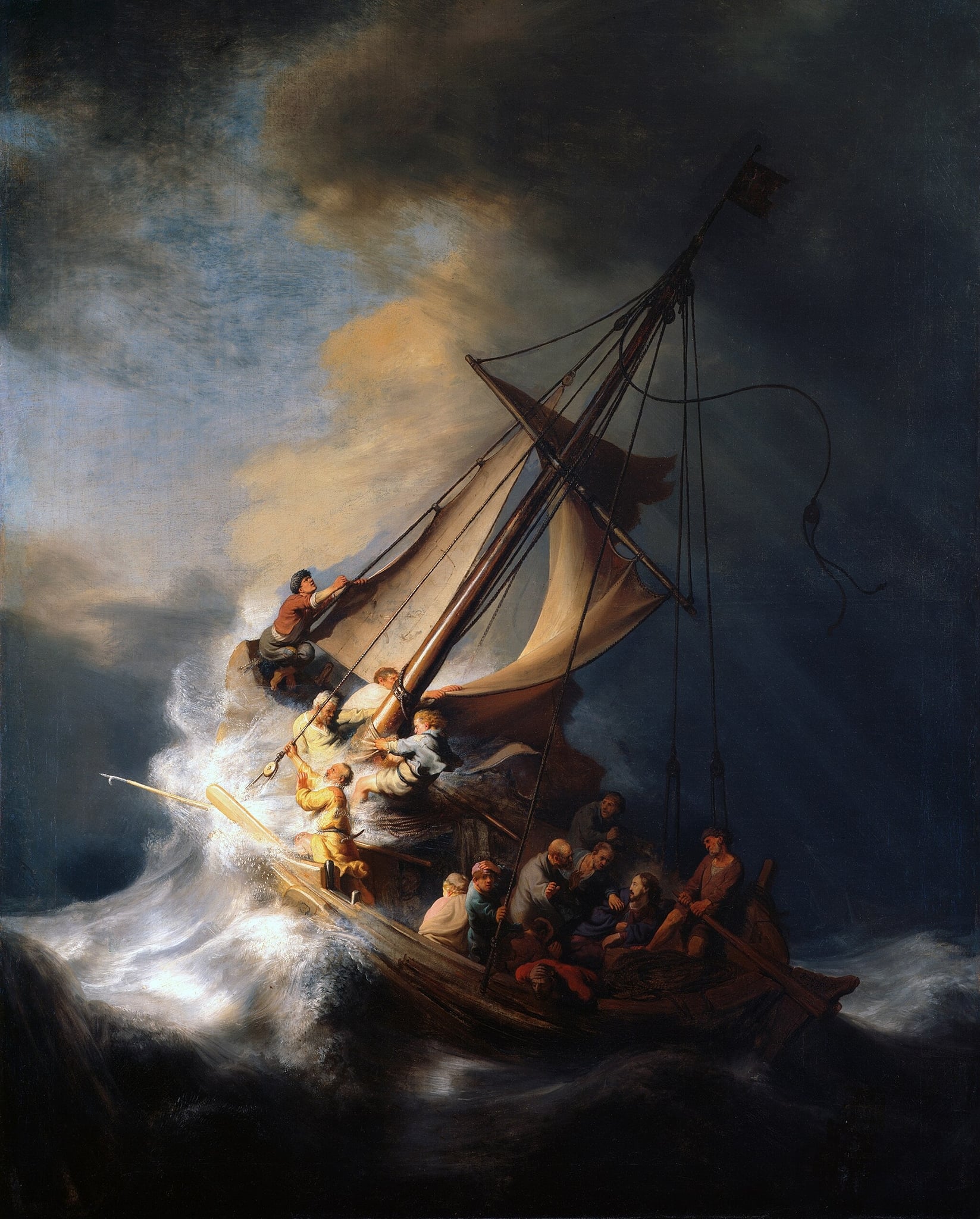
The Storm on the Sea of Galilee
Rembrandt van Rijn (1633)
Rembrandt van Rijn’s The Storm on the Sea of Galilee stages a clash of <strong>human panic</strong> and <strong>divine composure</strong> at the instant before the miracle. A torn mainsail whips across a steeply tilted boat as terrified disciples scramble, while a <strong>serenely lit Christ</strong> anchors a pocket of calm—an image of faith holding within chaos <sup>[1]</sup><sup>[3]</sup>. It is Rembrandt’s only painted seascape, intensifying its dramatic singularity in his oeuvre <sup>[2]</sup>.
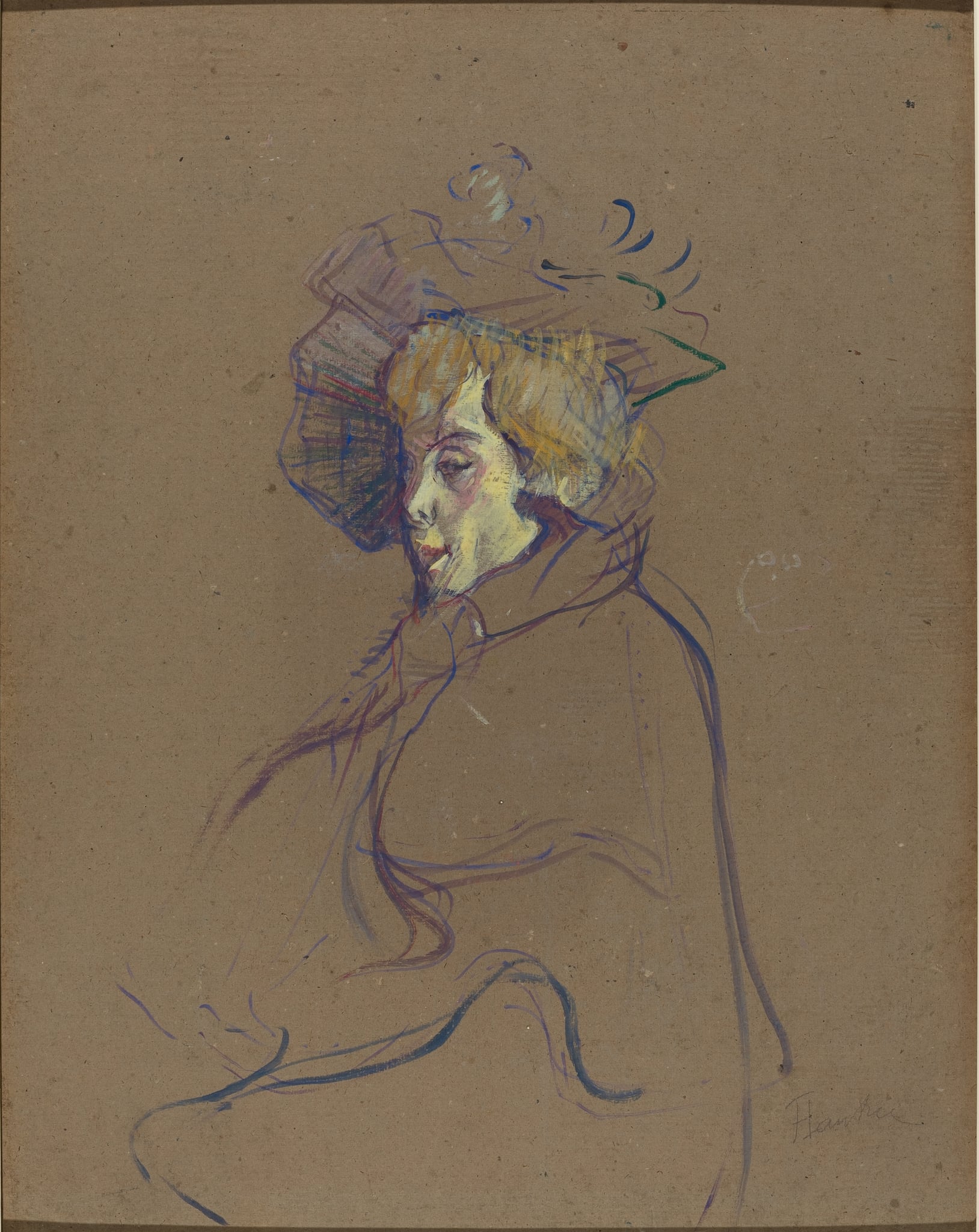
Jane Avril
Henri de Toulouse-Lautrec (c. 1891–1892)
In Jane Avril, Henri de Toulouse-Lautrec crystallizes a public persona from a few <strong>urgent, chromatic strokes</strong>: violet and blue lines whirl into a cloak, while green and indigo dashes crown a buoyant hat. Her face—sharply keyed in <strong>lemon yellow, lilac, and carmine</strong>—hovers between mask and likeness, projecting poise edged with fatigue. The raw brown ground lets her <strong>whiplash silhouette</strong> materialize like smoke from Montmartre’s nightlife.
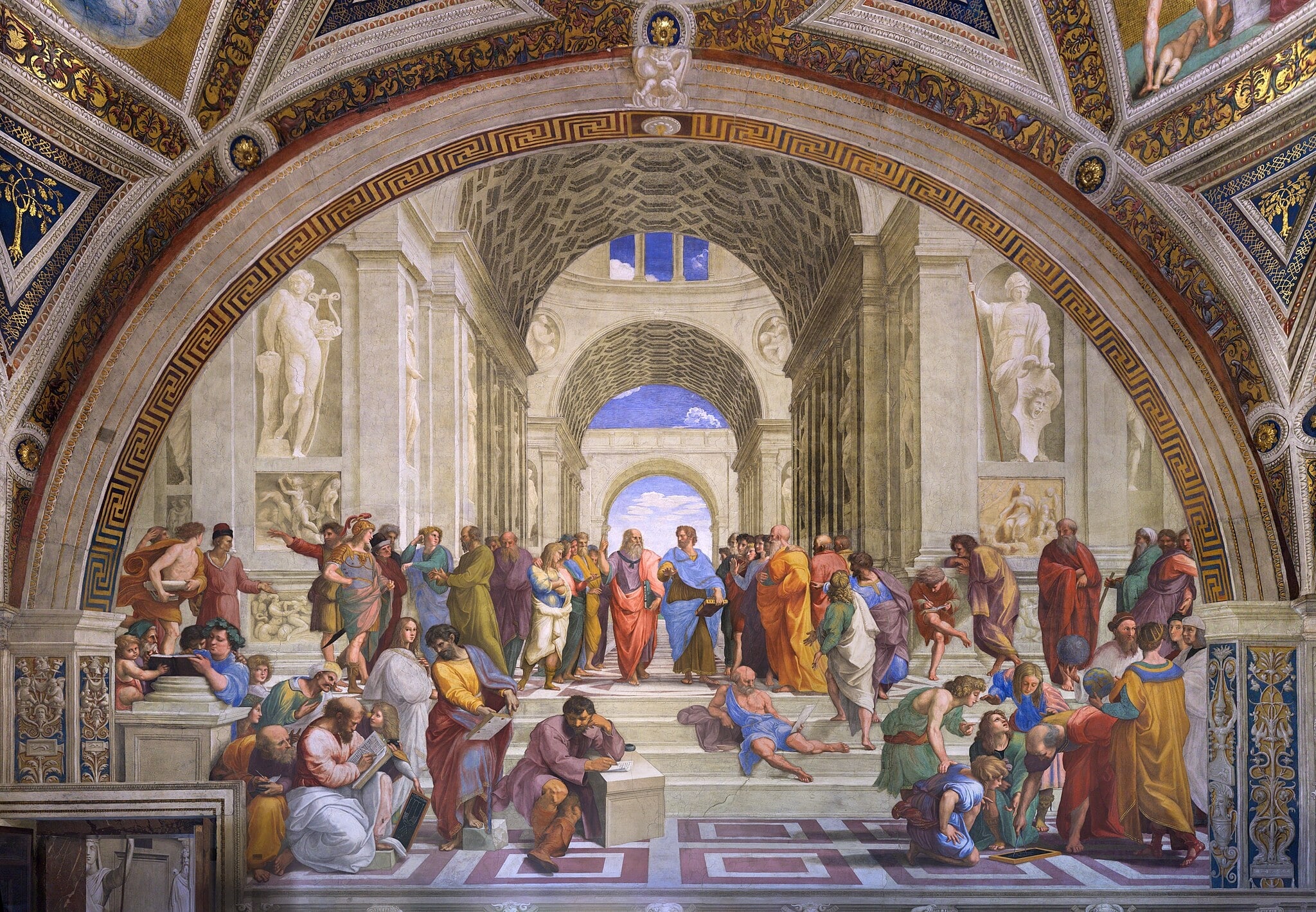
The School of Athens
Raphael (1509–1511)
Raphael’s The School of Athens orchestrates a grand debate on knowledge inside a perfectly ordered, classical hall whose one-point perspective converges on the central pair, <strong>Plato</strong> and <strong>Aristotle</strong>. Their opposed gestures—one toward the heavens, one level to the earth—establish the fresco’s governing dialectic between <strong>ideal forms</strong> and <strong>empirical reason</strong> <sup>[1]</sup><sup>[2]</sup>. Around them, mathematicians, scientists, and poets cluster under statues of <strong>Apollo</strong> and <strong>Athena/Minerva</strong>, turning the room into a temple of <strong>Renaissance humanism</strong> <sup>[1]</sup><sup>[3]</sup>.
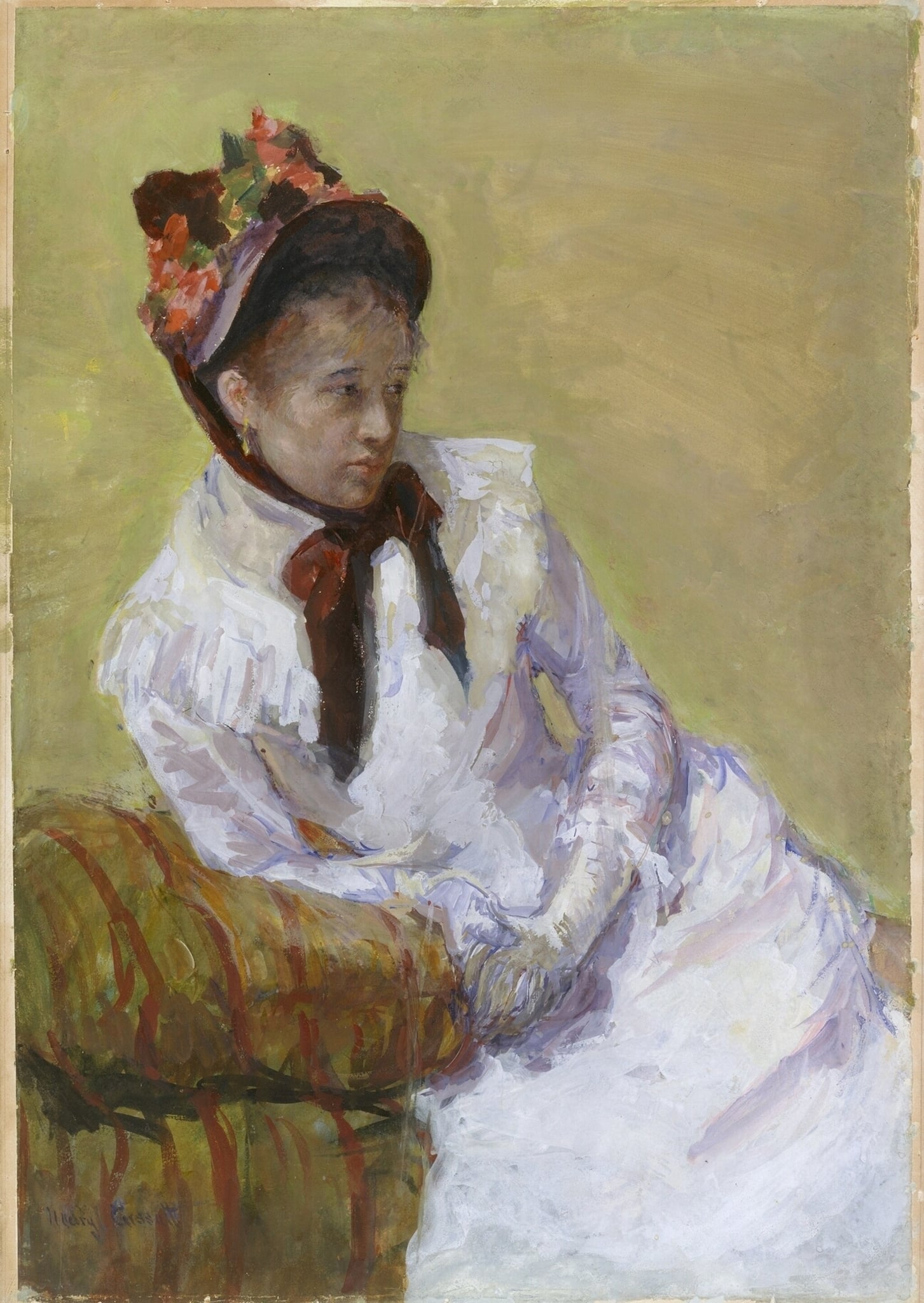
Self-Portrait
Mary Cassatt (1878)
In Self-Portrait, Mary Cassatt presents a poised, <strong>modern woman</strong> angled diagonally across a striped chair, her gaze turned away in <strong>thoughtful reserve</strong>. A <strong>sage-olive ground</strong> and tight crop strip away setting, while the <strong>white dress</strong> flickers with lilacs and blues against a <strong>decisive red ribbon</strong> and floral bonnet. The image asserts <strong>professional selfhood</strong> through restraint, asymmetry, and broken color.<sup>[1]</sup>
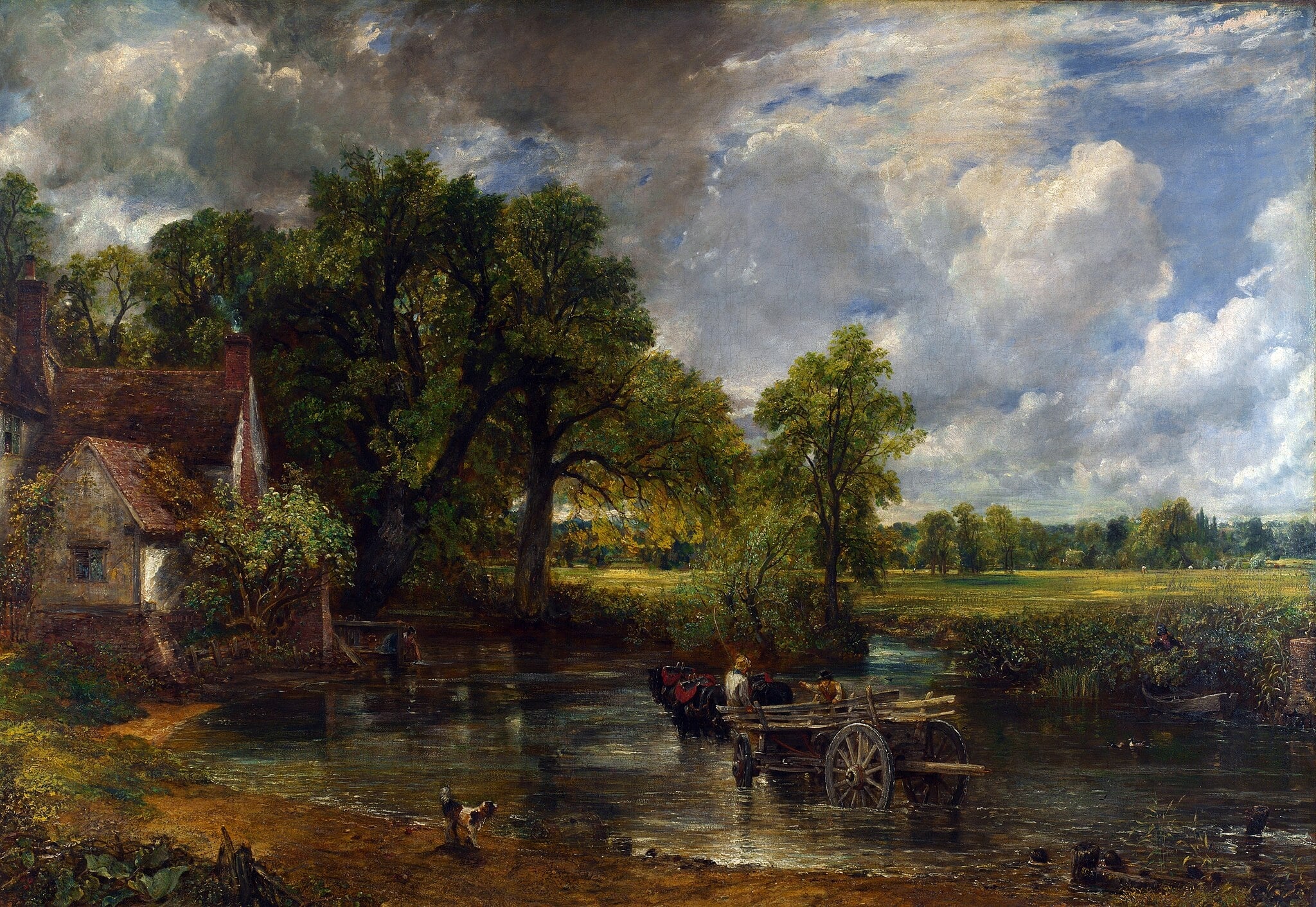
The Hay Wain
John Constable (1821)
Set beside Willy Lott’s cottage on the River Stour, The Hay Wain stages a moment of <strong>unhurried rural labor</strong>: an empty timber cart, drawn by three horses with red-collared tack, pauses mid‑ford as weather shifts above. Constable fuses <strong>empirical observation</strong>—rippling reflections, chimney smoke, flickers of white on leaves—with a composed vista of fields opening to sun. The result is a serene yet alert meditation on <strong>work, weather, and continuity</strong> in the English countryside <sup>[1]</sup><sup>[3]</sup>.
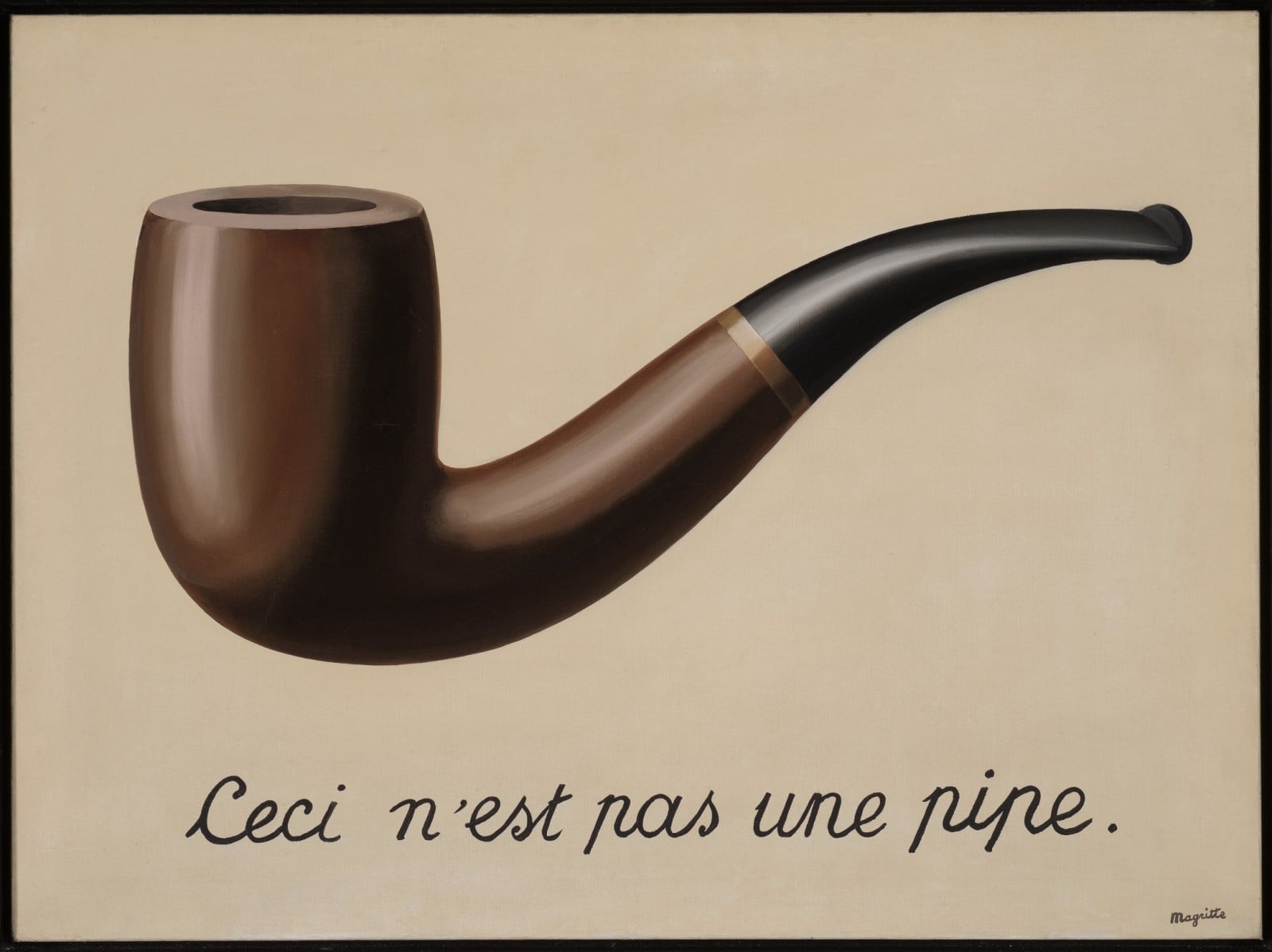
This is Not a Pipe
Rene Magritte (1929)
A crisply modeled tobacco pipe hovers over a blank beige field, while the cursive line "Ceci n’est pas une pipe" coolly denies what the eye assumes. The clash between image and sentence turns a familiar object into a <strong>thought experiment</strong> about signs and things. Magritte’s deadpan exactitude and ad‑like layout stage a <strong>philosophical trap</strong>: you can see a pipe, but you cannot smoke this picture. <sup>[1]</sup><sup>[2]</sup>
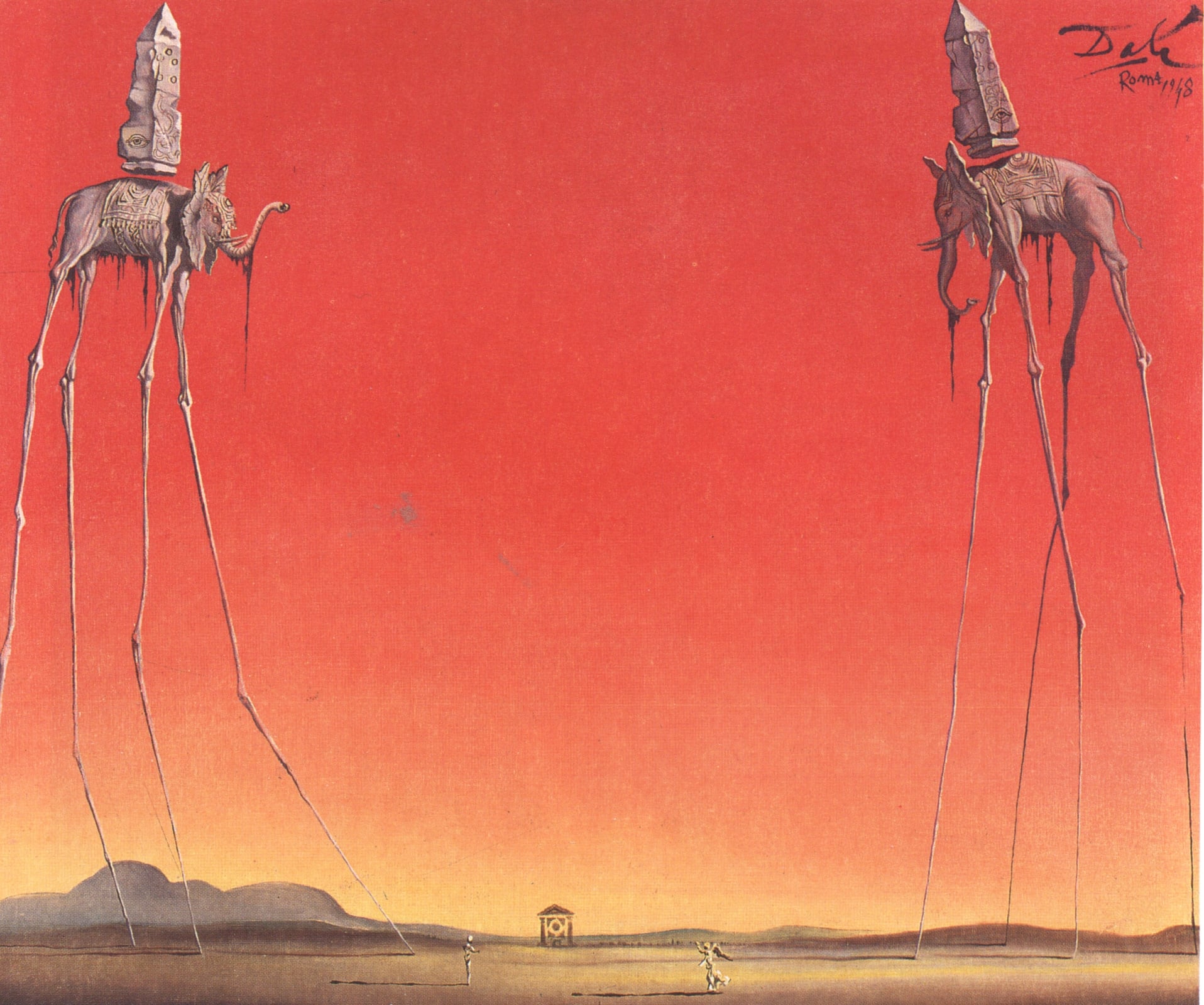
The Elephants
Salvador Dali (1948)
In The Elephants, Salvador Dali distills a stark paradox of <strong>weight and weightlessness</strong>: gaunt elephants tiptoe on <strong>stilt-thin legs</strong> while bearing stone <strong>obelisks</strong>. The blazing red-orange sky and tiny human figures compress ambition into a vision of <strong>precarious power</strong> and time stretched thin <sup>[1]</sup><sup>[2]</sup>.
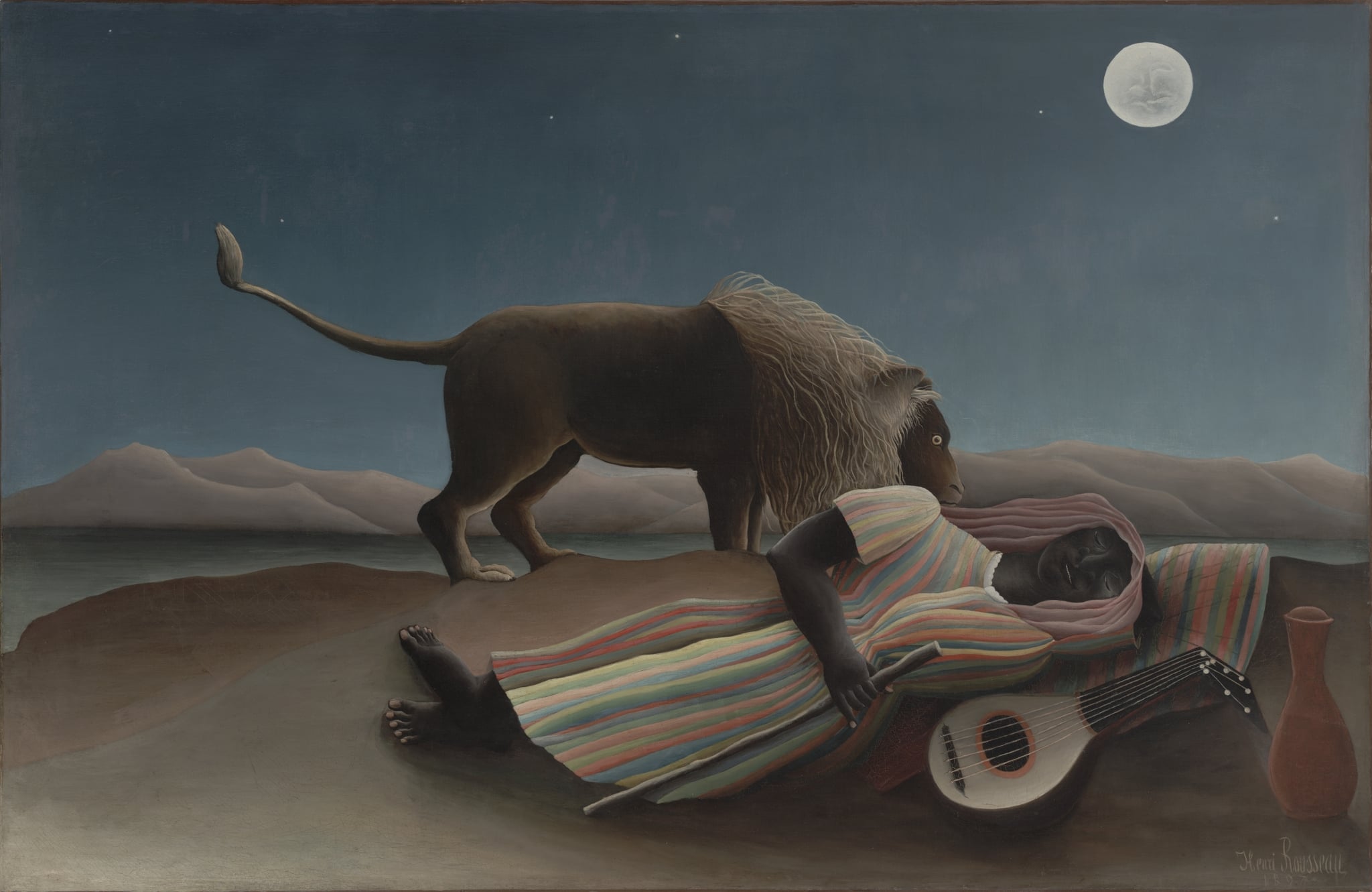
The Sleeping Gypsy
Henri Rousseau (1897)
Under a cold moon, a traveler sleeps in a striped robe as a lion pauses to sniff, not strike—an image of <strong>danger held in suspension</strong> and <strong>imagination as protection</strong>. Rousseau’s polished surfaces, flattened distance, and toy-like clarity turn the desert into a <strong>dream stage</strong> where art (the mandolin) and life (the water jar) keep silent vigil <sup>[1]</sup><sup>[2]</sup>.
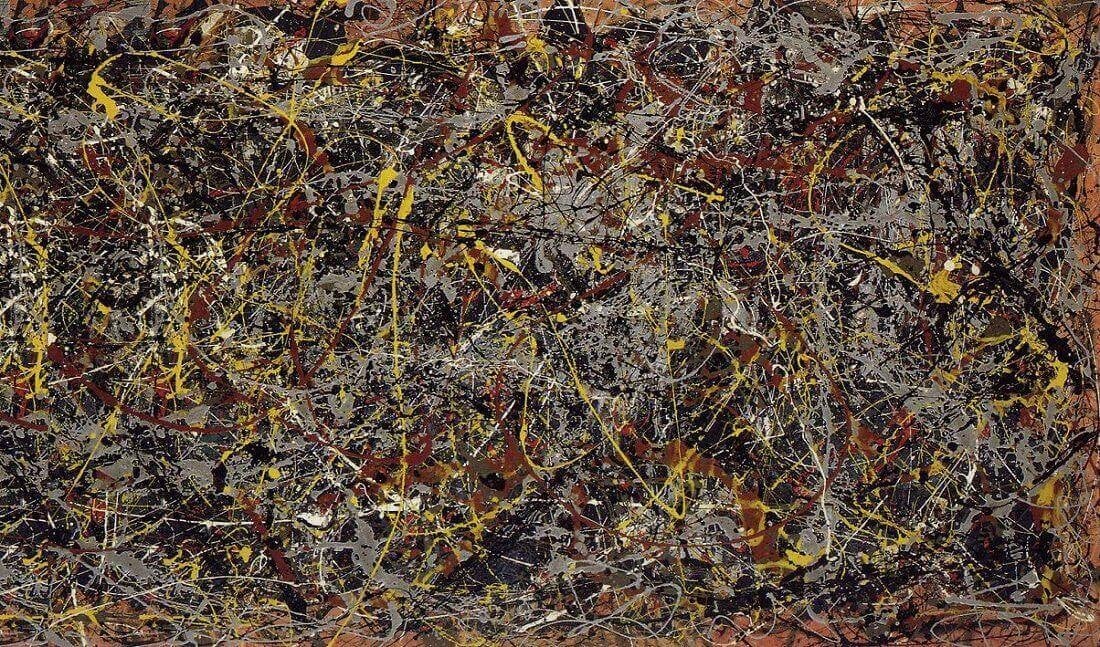
No. 5, 1948
Jackson Pollock (1948)
<strong>No. 5, 1948</strong> is a large, floor‑painted field of poured enamel where tangled skeins of black, gray, umber, and bursts of yellow span the entire support. Its <strong>all‑over</strong> structure rejects a central motif, turning the painting into a record of motion and material behavior. The result is a charged surface that reads as both <strong>image and event</strong> <sup>[1]</sup><sup>[2]</sup><sup>[3]</sup>.
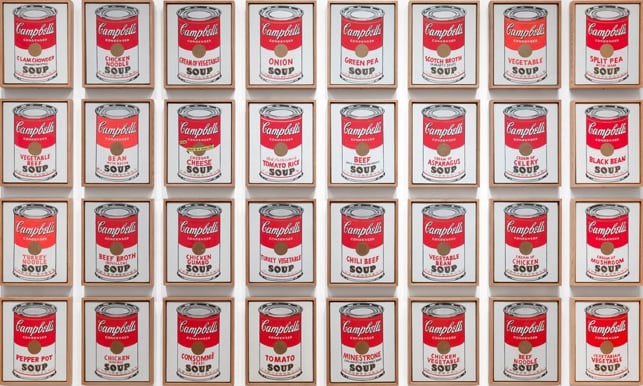
Campbell's Soup Cans
Andy Warhol (1962)
Warhol’s Campbell’s Soup Cans turns a shelf-staple into <strong>art</strong>, using a gridded array of near-identical red-and-white cans to fuse <strong>branding</strong> with <strong>painting</strong>. By repeating 32 flavors—Tomato, Clam Chowder, Chicken Noodle, and more—the work stages a clash between <strong>mass production</strong> and the artist’s hand <sup>[1]</sup><sup>[3]</sup>.
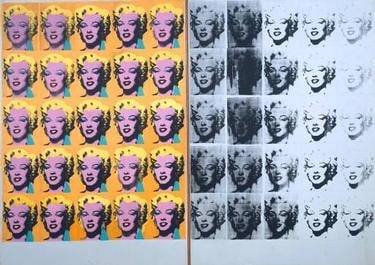
Marilyn Diptych
Andy Warhol (1962)
Marilyn Diptych crystallizes the paradox of fame: <strong>dazzling allure</strong> and <strong>inevitable decay</strong>. Warhol’s 50 repeated silkscreens—color at left, fading grayscale at right—turn a movie-star headshot into a mass-produced <strong>icon</strong> and a memento of mortality <sup>[1]</sup><sup>[2]</sup>.
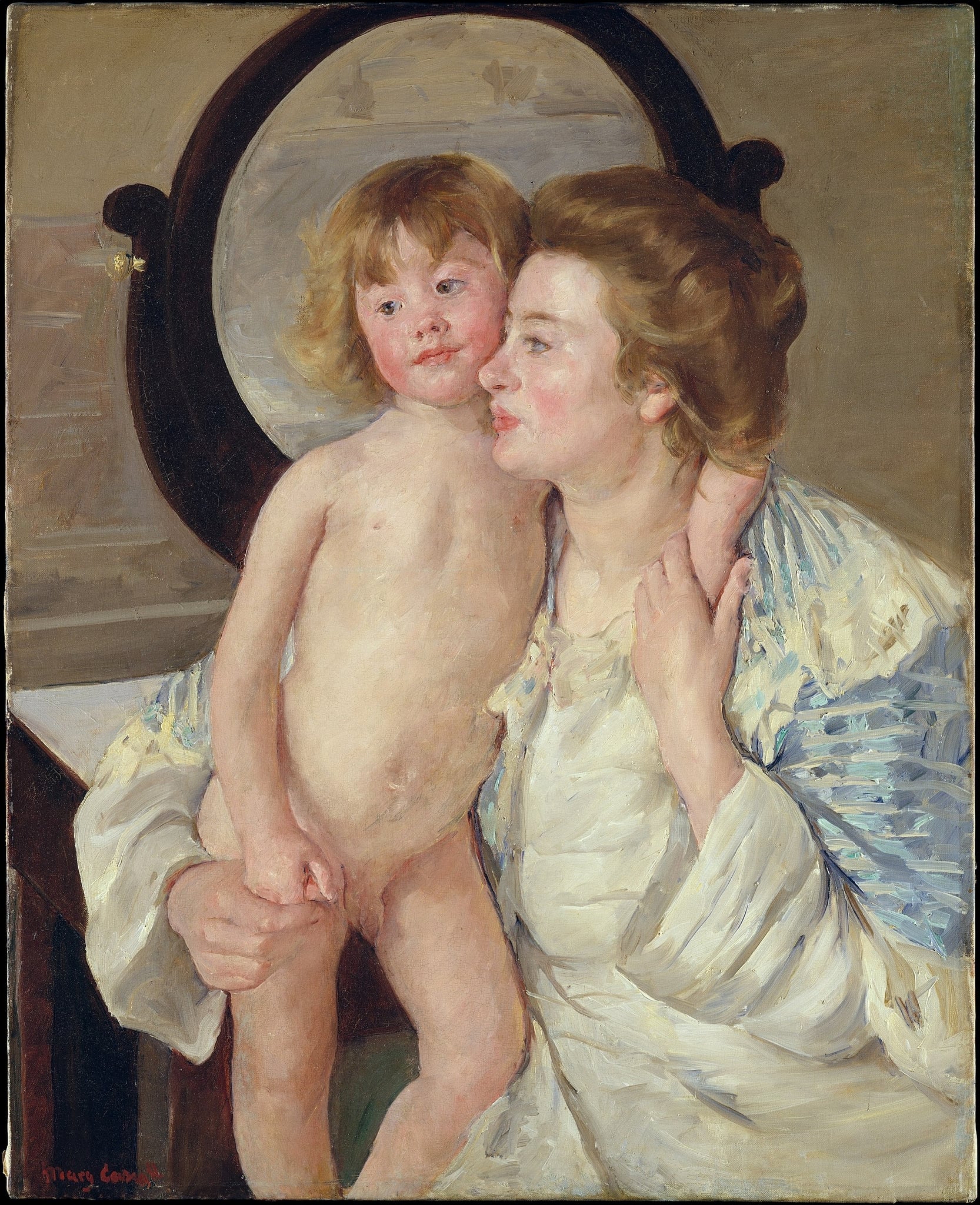
Mother and Child (The Oval Mirror)
Mary Cassatt (ca. 1899)
Mary Cassatt’s Mother and Child (The Oval Mirror) turns a routine act of care into a <strong>modern icon</strong>. An oval mirror <strong>haloes</strong> the child while interlaced hands and close bodies make <strong>touch</strong> the vehicle of meaning <sup>[1]</sup><sup>[3]</sup>.

The Garden of Eden with the Fall of Man
Peter Paul Rubens (c. 1615)
<strong>The Garden of Eden with the Fall of Man</strong> stages the instant Eve passes the forbidden fruit to Adam as the serpent coils above and a teeming paradise encircles them. The panel fuses Peter Paul Rubens’s dramatic nudes with Jan Brueghel the Elder’s encyclopedic fauna and flora, turning Eden into a lush theatre of temptation and consequence <sup>[1]</sup>. Light isolates Eve’s raised arm and golden hair while predators stir at the margins, signaling paradise in the act of unraveling.
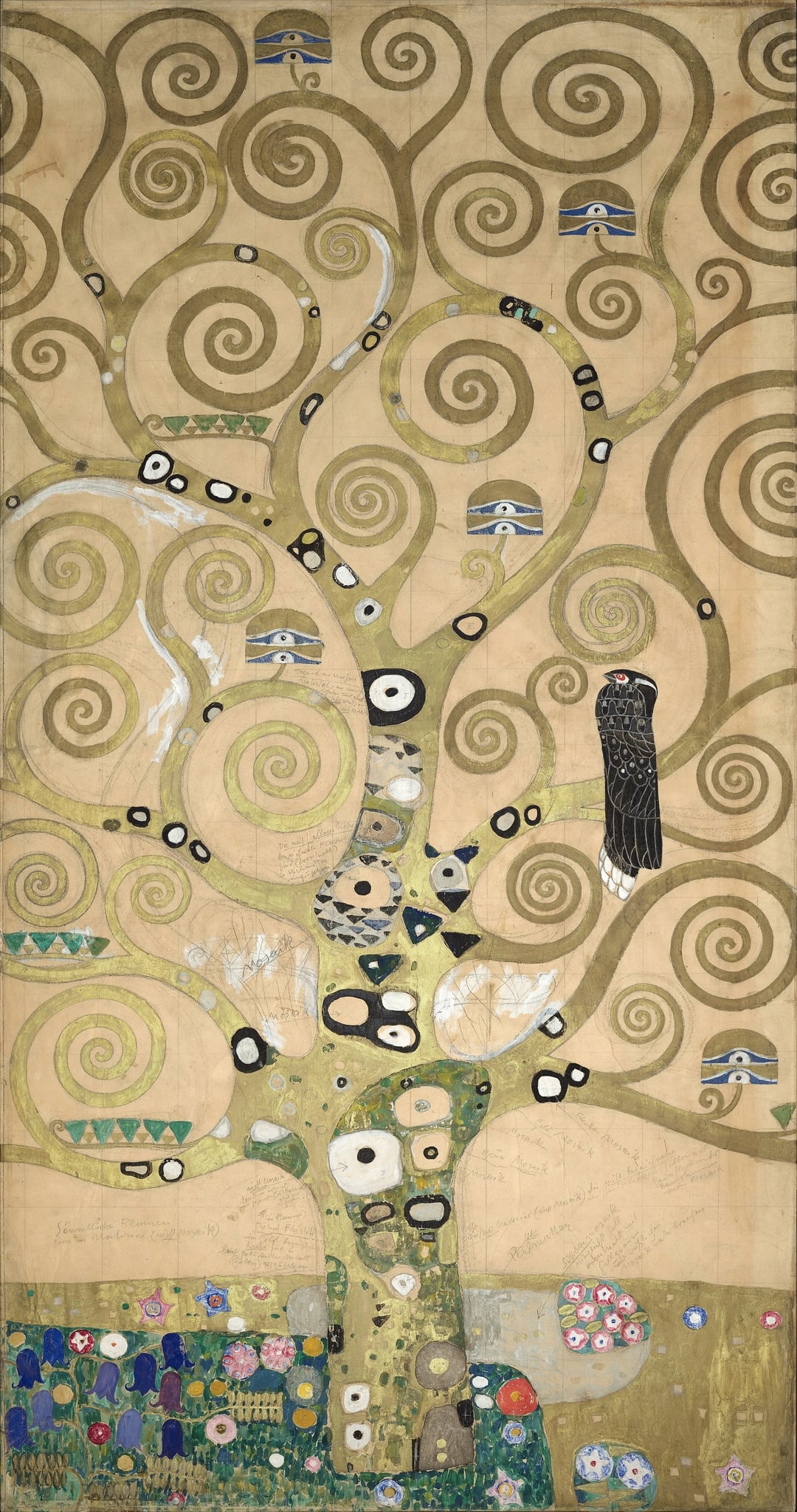
The Tree of Life
Gustav Klimt (1910–1911 (design; mosaic installed 1911))
Gustav Klimt’s The Tree of Life crystallizes a <strong>cosmological axis</strong> in a gilded ornamental language: a rooted trunk erupts into <strong>endless spirals</strong>, embedded with <strong>eye-like rosettes</strong> and shadowed by a black, red‑eyed bird. Designed as part of the Stoclet dining‑room frieze, it fuses <strong>symbolism and luxury materials</strong> to link earthly abundance with timeless transcendence <sup>[1]</sup><sup>[2]</sup>.
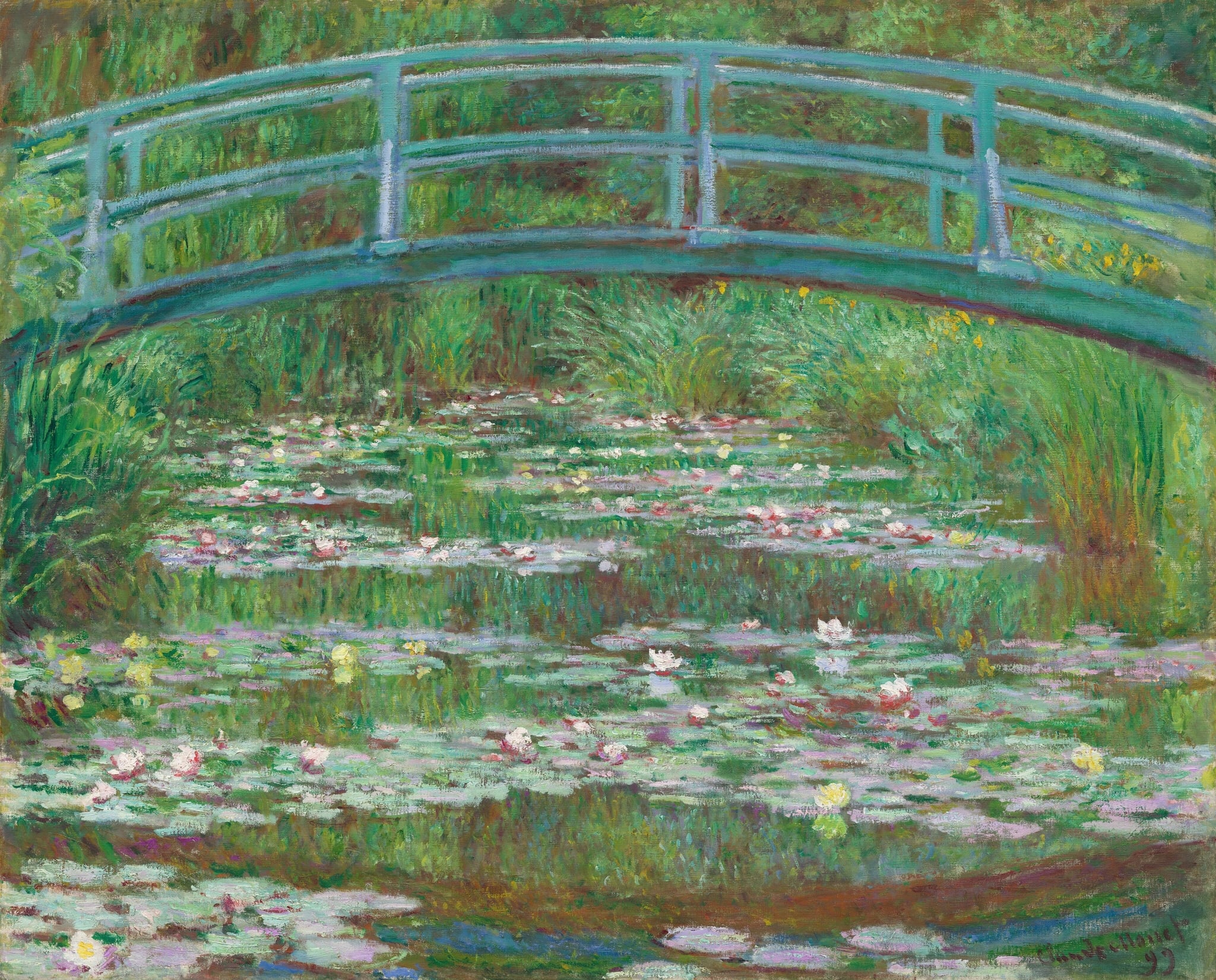
The Japanese Bridge
Claude Monet (1899)
Claude Monet’s The Japanese Bridge centers a pale <strong>blue‑green arch</strong> above a horizonless pond, where water‑lily pads and blossoms punctuate a field of shifting reflections. The bridge reads as both structure and <strong>contemplative threshold</strong>, suspending the eye between surface shimmer and mirrored depths <sup>[1]</sup><sup>[2]</sup>.
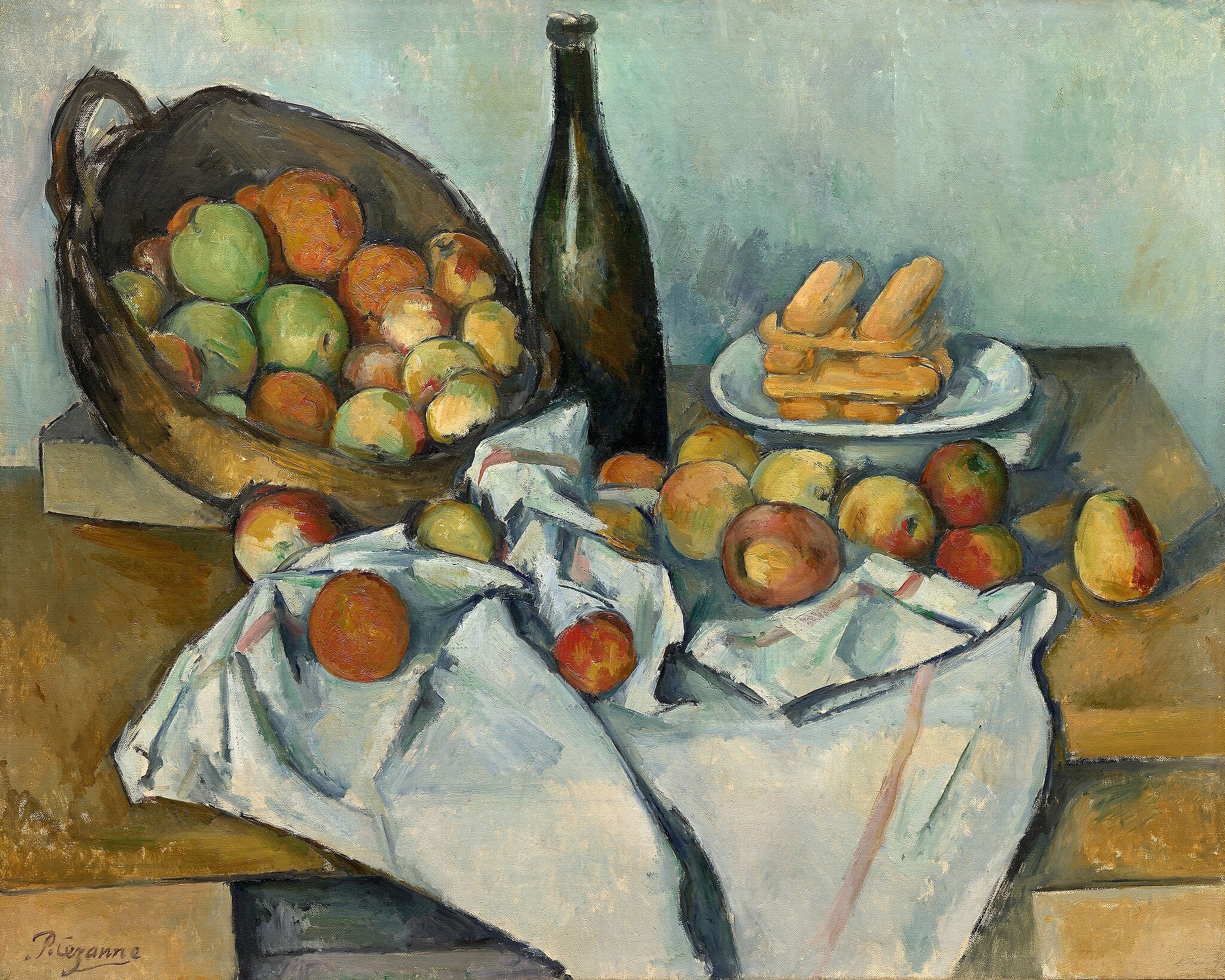
Still Life with a Basket of Apples
Paul Cézanne (c. 1893 (AIC range 1887–1900))
Paul Cezanne’s Still Life with a Basket of Apples stages a quiet crisis of balance: a basket tilts forward, a dark bottle leans, and a rumpled cloth surges like a ridge across the table. Through <strong>purposeful misalignments</strong> and <strong>constructed color</strong>, the painting turns ordinary fruit into an inquiry into how we see over time <sup>[1]</sup><sup>[3]</sup>.

La Japonaise (Camille Monet in Japanese Costume)
Claude Monet (1876)
Claude Monet’s La Japonaise (Camille Monet in Japanese Costume) (1876) stages a witty confrontation between <strong>Parisian modernity</strong> and the fashion for <strong>Japonisme</strong>. A fair-skinned model in a blazing red uchikake preens before a wall tiled with uchiwa fans, lifting a <strong>tricolor</strong> hand fan that asserts Frenchness amid the imported decor. The painting turns costume, props, and gaze into a performance about <strong>desire, display, and identity</strong> <sup>[1]</sup><sup>[2]</sup>.
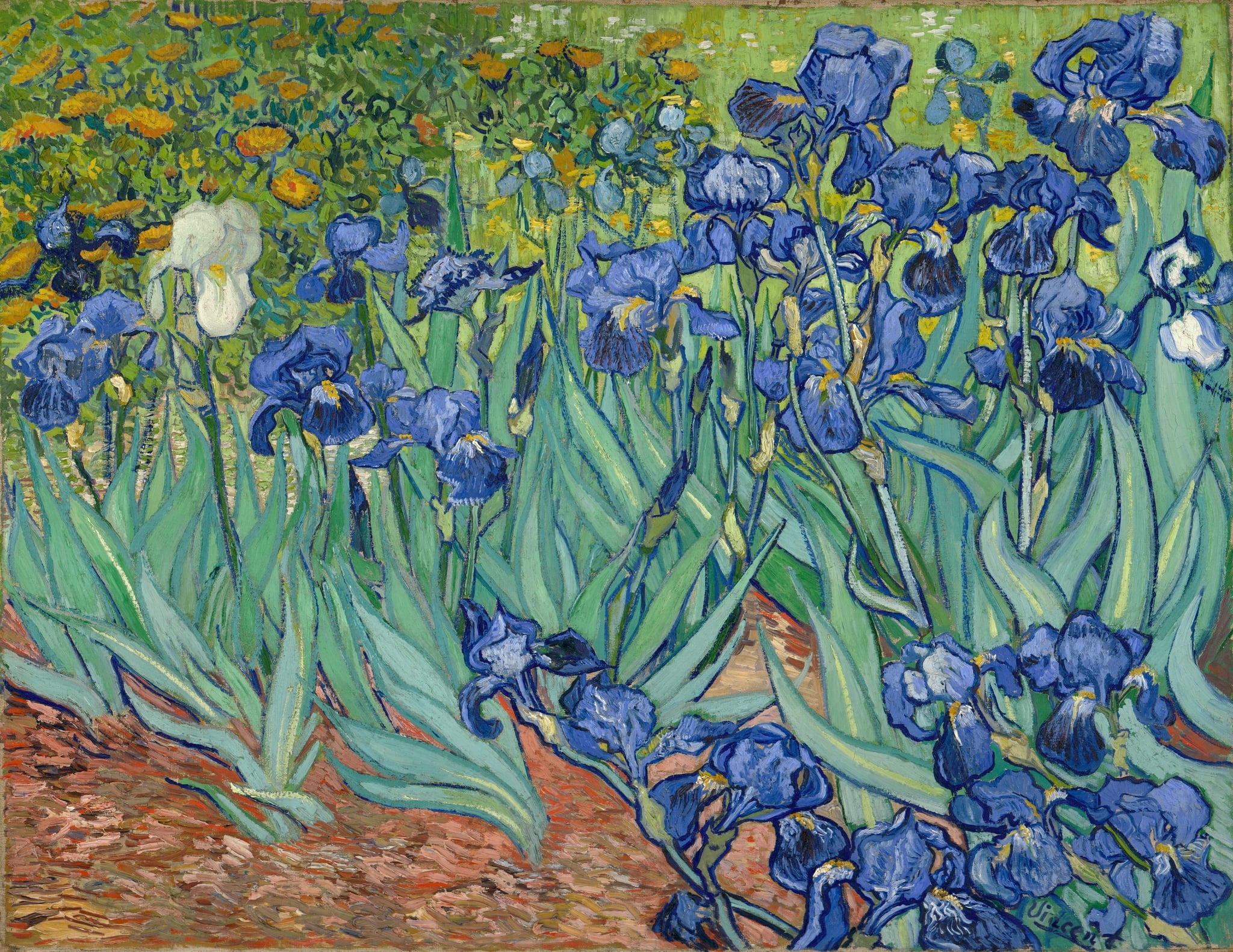
Irises
Vincent van Gogh (1889)
Painted in May 1889 at the Saint-Rémy asylum garden, Vincent van Gogh’s <strong>Irises</strong> turns close observation into an act of repair. Dark contours, a cropped, print-like vantage, and vibrating complements—violet/blue blossoms against <strong>yellow-green</strong> ground—stage a living frieze whose lone <strong>white iris</strong> punctuates the field with arresting clarity <sup>[1]</sup><sup>[2]</sup>.

Chrysanthemums
Claude Monet (1878)
Claude Monet’s Chrysanthemums fixes a burst of late‑season bloom in a <strong>scarlet, plush‑textured vase</strong> against a cool <strong>blue‑gray wall</strong> where faint floral <strong>sprigs</strong> echo the bouquet. The painting privileges <strong>vibration of color</strong> over contour, turning still life into a decorative field. It condenses autumnal abundance and the fleetingness of light into a single, shimmering sensation <sup>[1]</sup><sup>[2]</sup>.
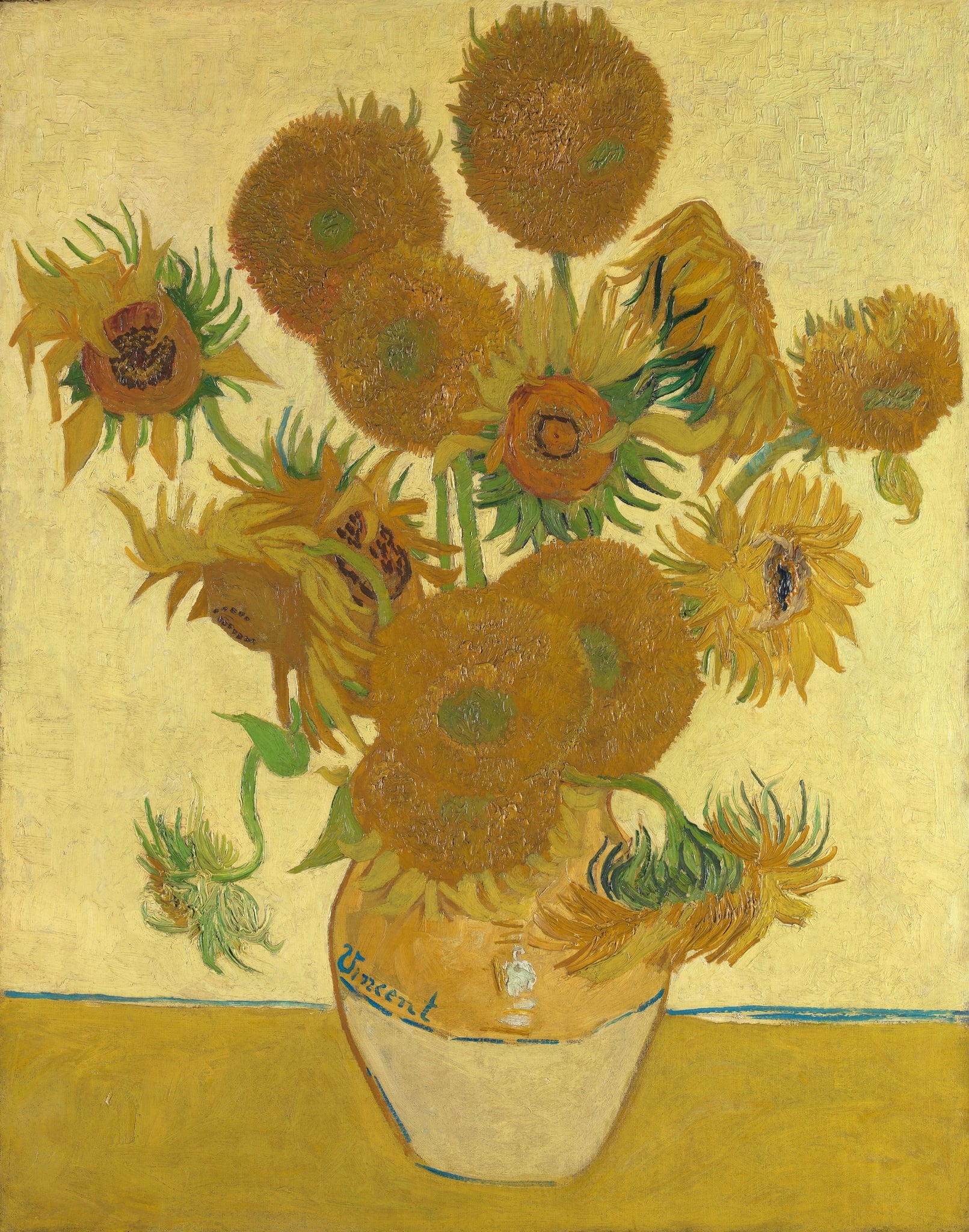
Sunflowers
Vincent van Gogh (1888)
Vincent van Gogh’s Sunflowers (1888) is a <strong>yellow-on-yellow</strong> still life that stages a full <strong>cycle of life</strong> in fifteen blooms, from fresh buds to brittle seed heads. The thick impasto, green shocks of stem and bract, and the vase signed <strong>“Vincent”</strong> turn a humble bouquet into an emblem of endurance and fellowship <sup>[1]</sup><sup>[2]</sup>.
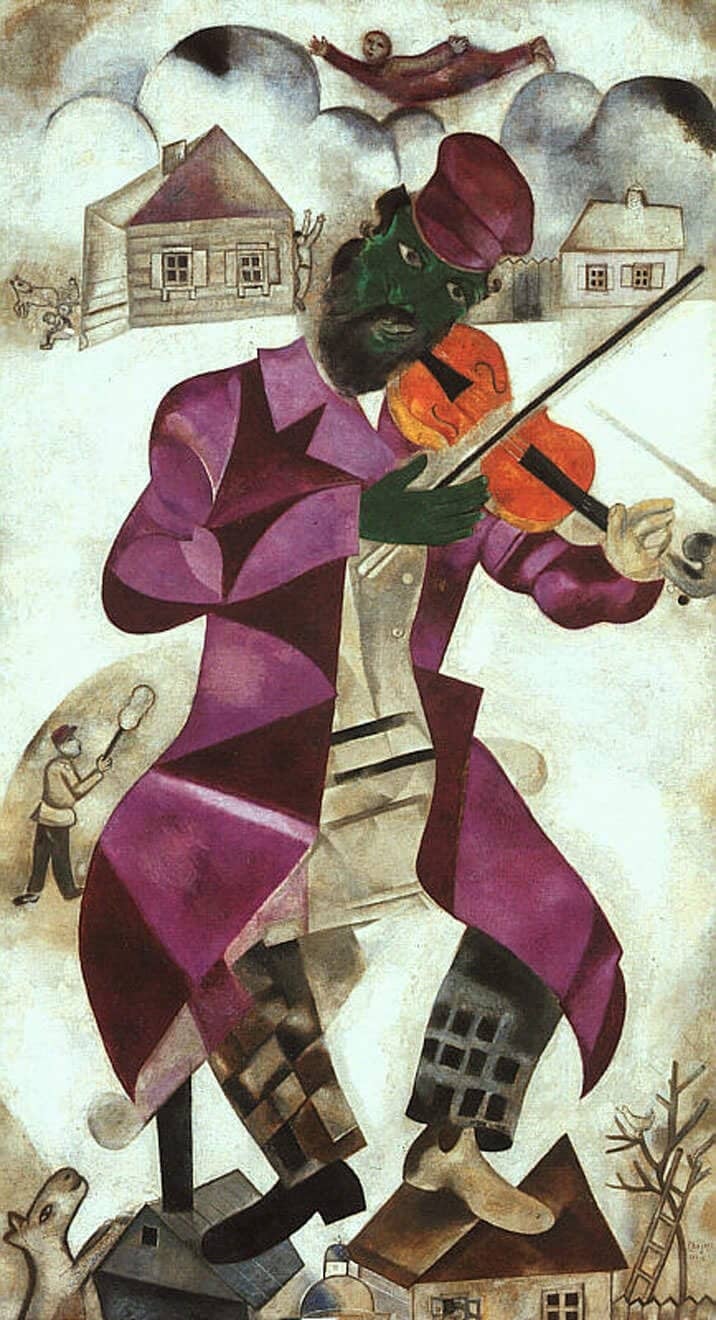
The Green Violinist
Marc Chagall (1923–1924)
The Green Violinist magnifies a village fiddler into a sky‑bridging guardian, his <strong>green face</strong> and <strong>purple coat</strong> turning him into a spiritual emissary rather than a mere entertainer. Striding across crooked <strong>rooftops</strong> without crushing them, he binds the shtetl’s houses, tree, clouds, and wandering figures into one continuous chord. Chagall fuses folkloric memory with modernist facets to assert music as the community’s sustaining force.
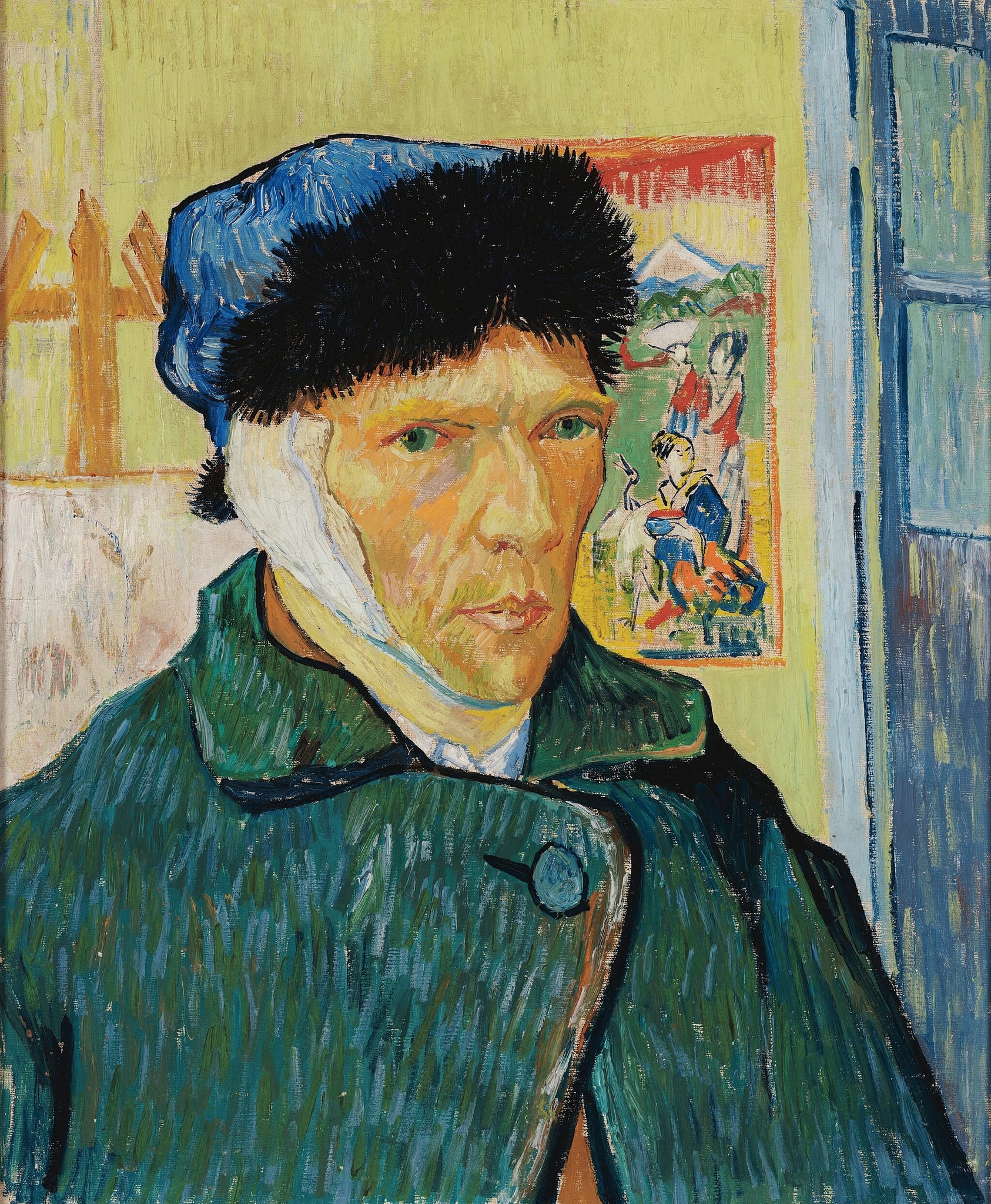
Self-Portrait with Bandaged Ear
Vincent van Gogh (1889)
In Self-Portrait with Bandaged Ear (1889), Vincent van Gogh converts a recent crisis into an image of <strong>resolve</strong>. The frontal, slightly turned pose forces attention to the white bandage at the viewer’s right, while the fur cap, heavy coat, and the nearby <strong>Japanese print</strong> declare persistence and ideals that steady him in the wake of trauma <sup>[1]</sup><sup>[2]</sup>. The painting’s cool, wintry palette and insistent strokes make suffering legible yet disciplined, transforming pain into <strong>artistic purpose</strong> <sup>[2]</sup>.
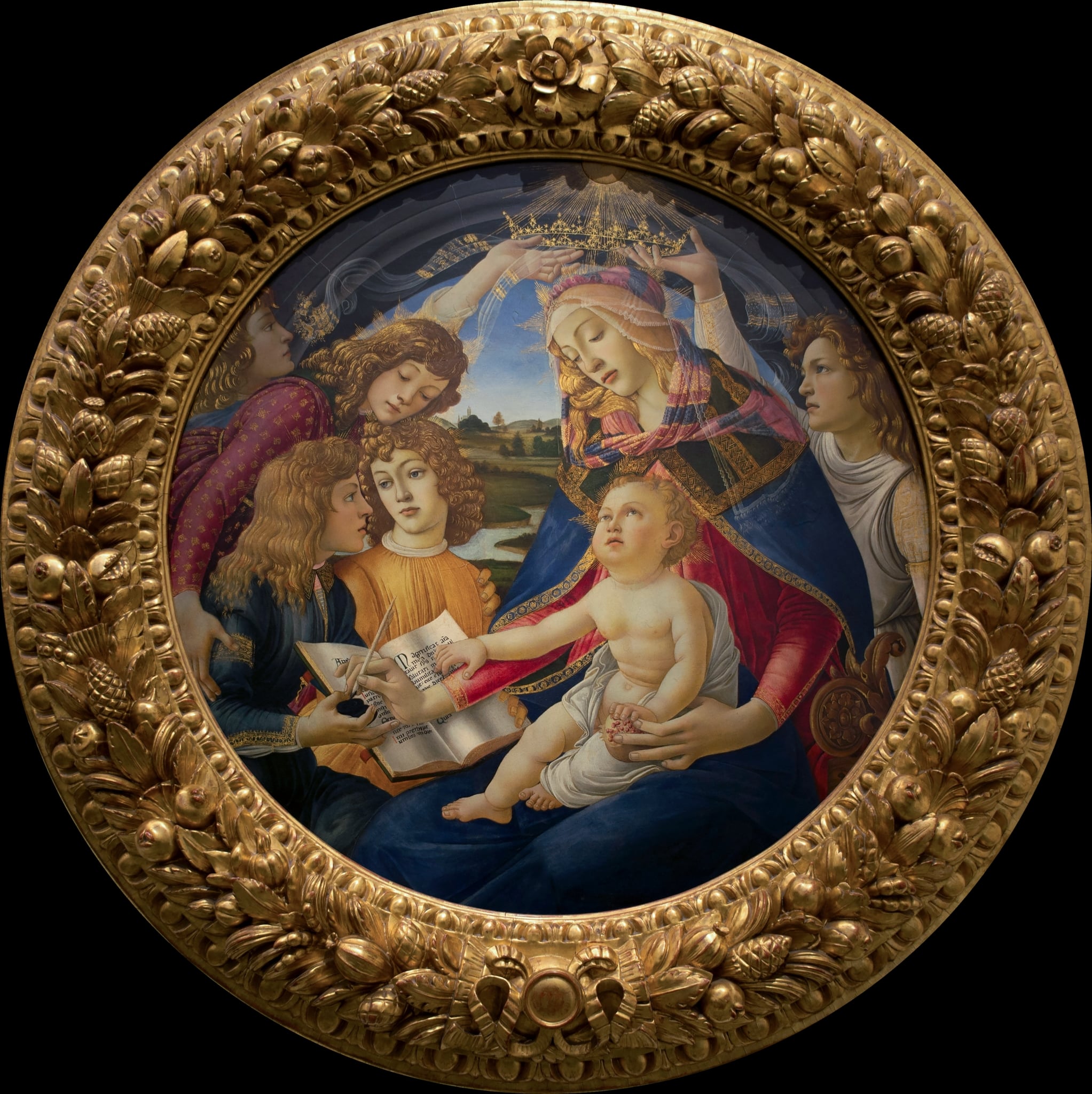
Madonna of the Magnificat
Sandro Botticelli (c. 1483)
Botticelli’s Madonna of the Magnificat is a circular panel where the Virgin, <strong>crowned by angels</strong>, writes the <strong>Magnificat</strong> as the Christ Child guides her hand. A split <strong>pomegranate</strong> in the Child’s grasp prefigures the Passion while the wingless, courtly angels and a Tuscan view bind sacred mystery to Florentine life <sup>[1]</sup><sup>[2]</sup>. The tondo’s swirl of fabrics and gold makes theology visible as a choreography of <strong>praise, prophecy, and sacrifice</strong>.
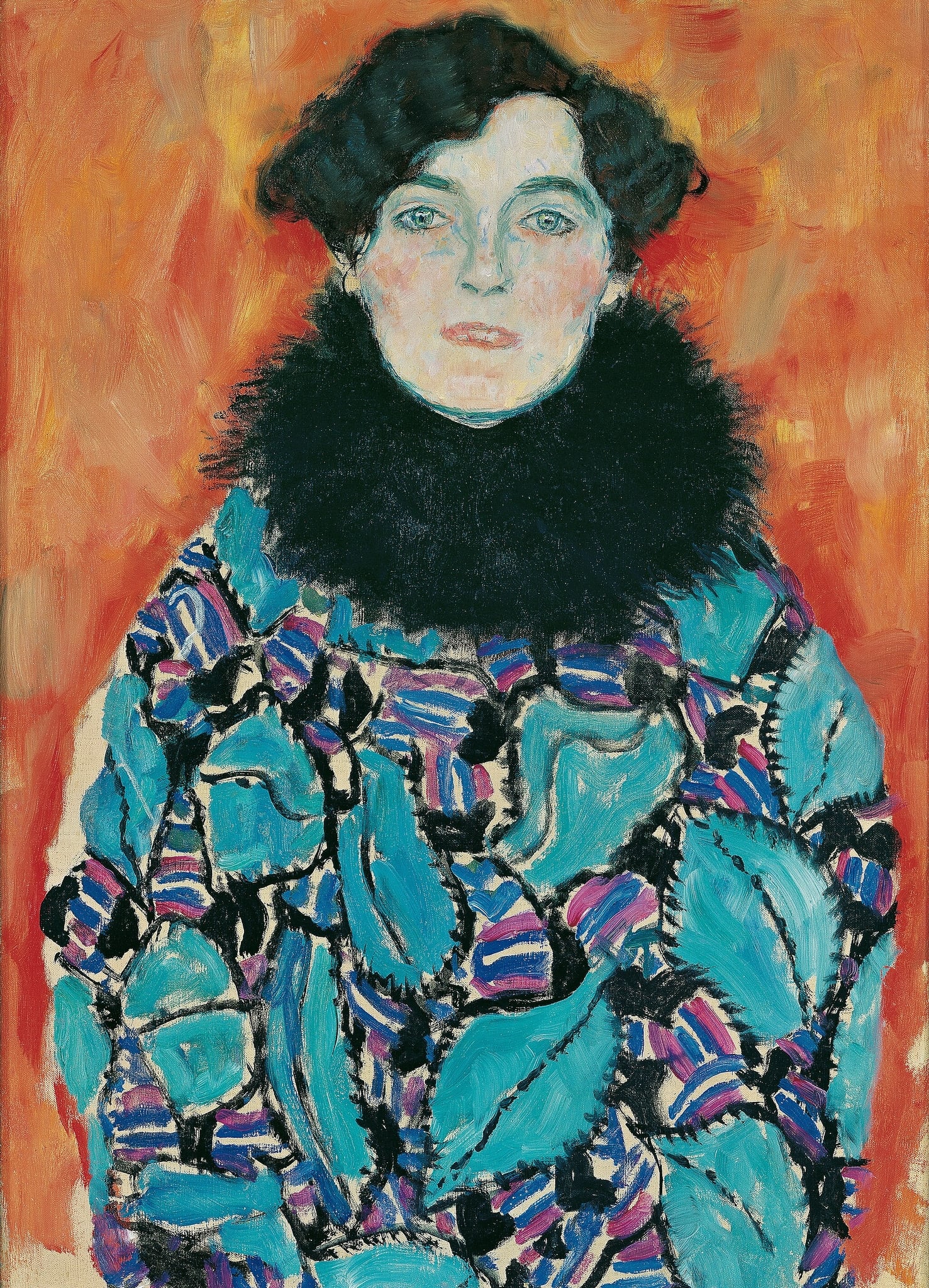
Johanna Staude
Gustav Klimt (1917/1918)
<strong>Johanna Staude</strong> distills Klimt’s late style into a charged encounter between a cool, impassive face and a blazing orange field. The sitter’s head is isolated by a <strong>black feather collar</strong>, while a <strong>Wiener Werkstätte</strong> blouse in turquoise leaves and violet stripes surges forward as a near-abstract surface <sup>[1]</sup><sup>[2]</sup>. Painted in 1917/1918 and left <strong>unfinished</strong> at the mouth, it becomes a poised emblem of modern identity in Vienna on the eve of Klimt’s death <sup>[1]</sup><sup>[2]</sup><sup>[5]</sup>.
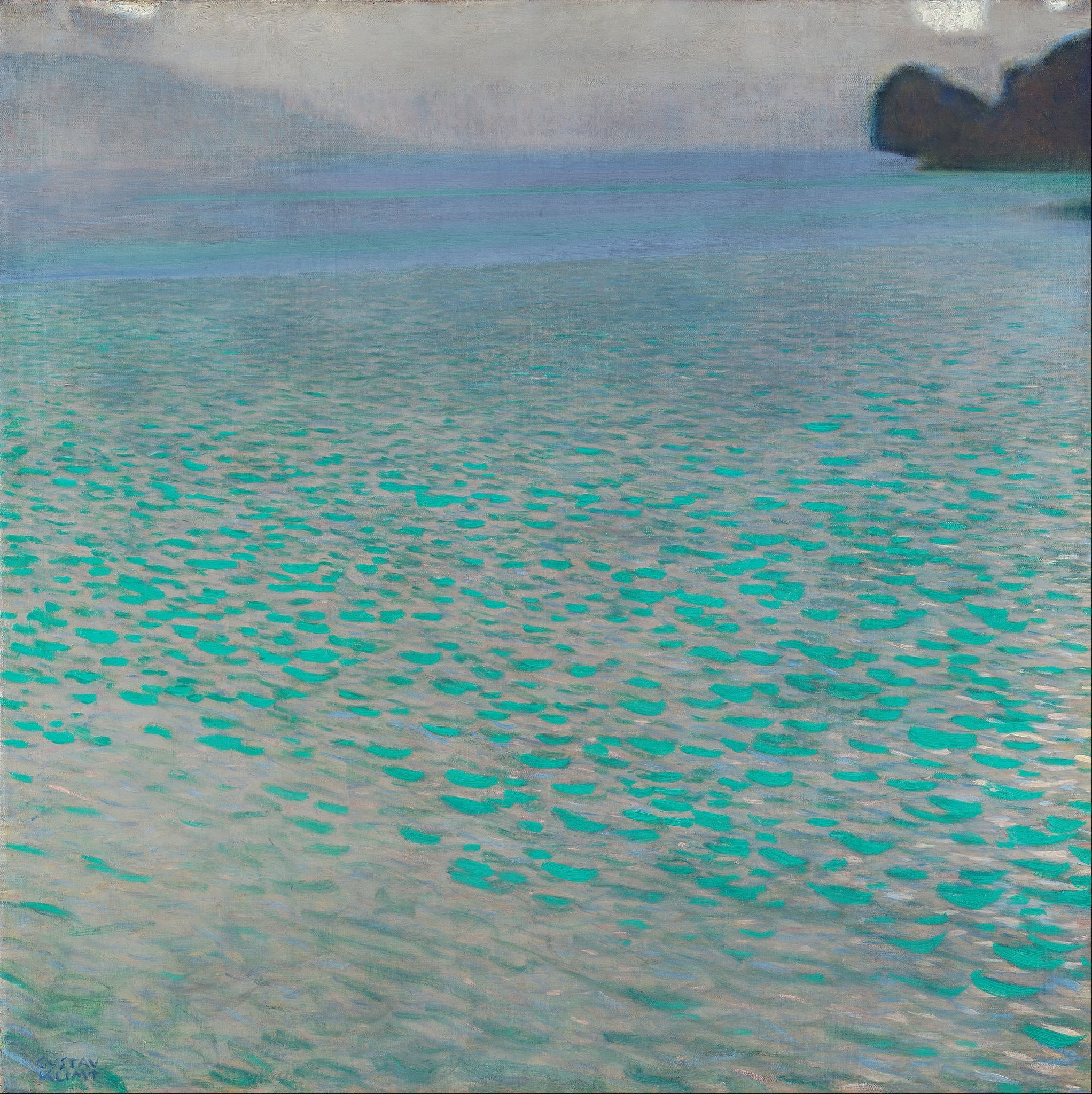
On Lake Attersee
Gustav Klimt (1900)
Gustav Klimt’s On Lake Attersee (1900) turns a summer lake into a <strong>woven field of light</strong>. A square canvas nearly filled with water, it stages a quiet duel between <strong>surface pattern</strong> and <strong>atmospheric depth</strong>, letting a tiny dark headland at the upper right anchor an otherwise hypnotic expanse <sup>[1]</sup><sup>[2]</sup>.
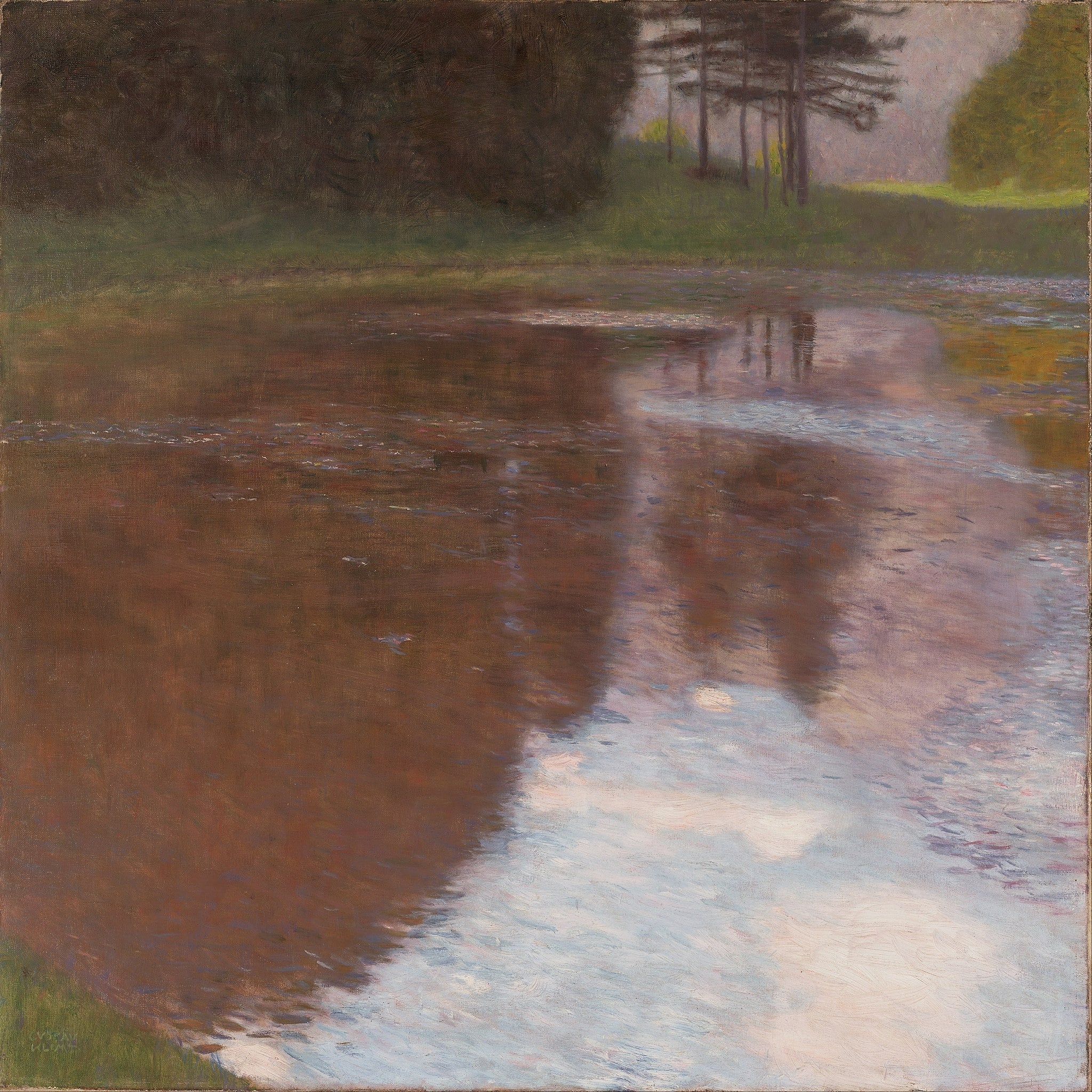
A Morning by the Pond
Gustav Klimt (1899)
A Morning by the Pond turns a quiet Egelsee shoreline into a field of <strong>reflection</strong> where trees, bank, and sky dissolve into one surface. Klimt’s first <strong>square format</strong> landscape compresses depth and makes water the true subject, staging a luminous <strong>threshold</strong> between night and day. The work establishes perception itself—what we see and how—as Klimt’s modern theme.
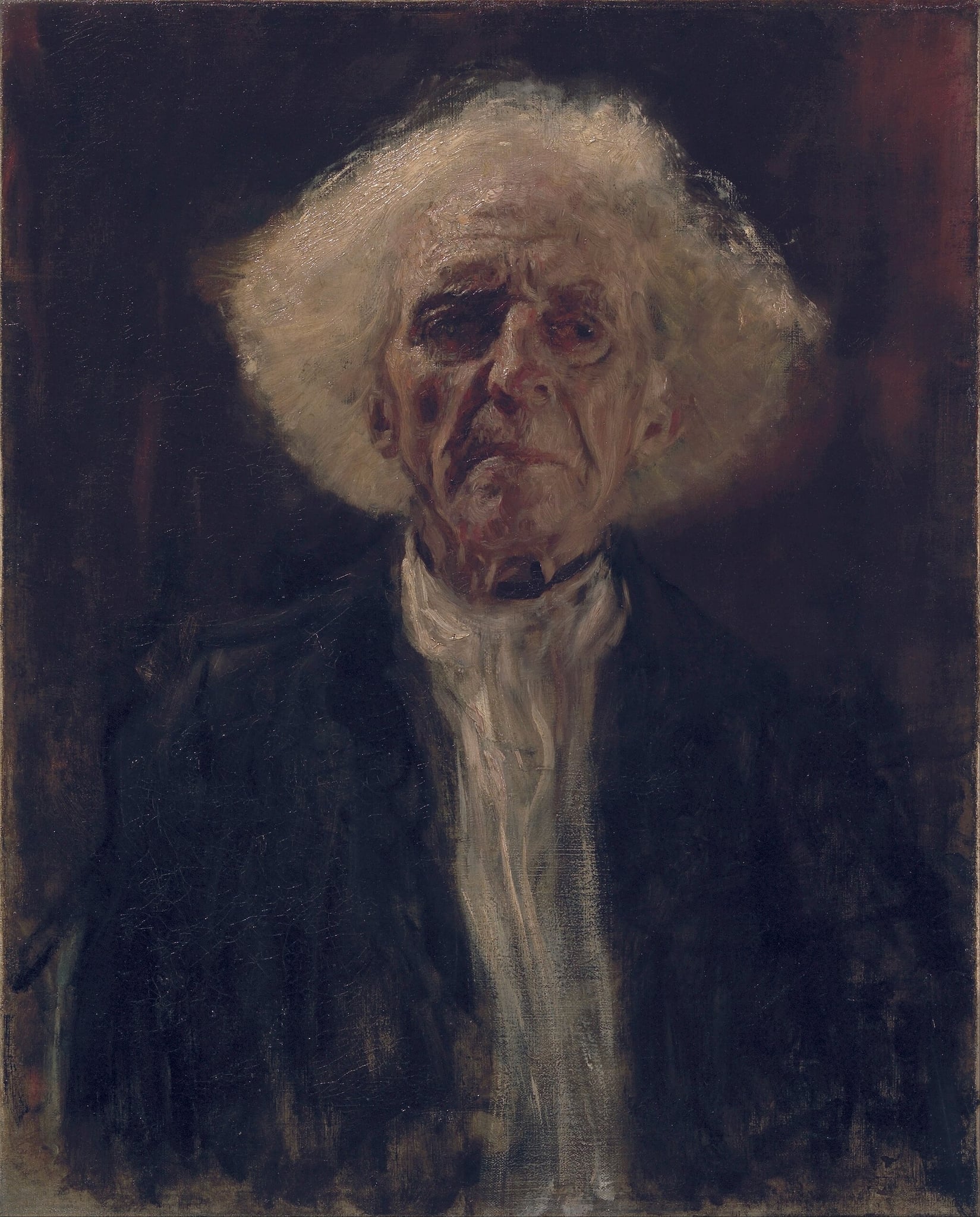
The Blind Man
Gustav Klimt (c. 1896)
Gustav Klimt’s The Blind Man confronts the viewer with a monumental head and torso emerging from a near-black field, where <strong>chiaroscuro</strong>, <strong>tactile paint</strong>, and an <strong>occluded gaze</strong> redirect attention from sight to touch and memory. The dissolving white collar and scumbled halo of hair make the figure feel carved from darkness, asserting <strong>dignity without sentiment</strong> and turning blindness into a form of inward presence <sup>[1]</sup>.
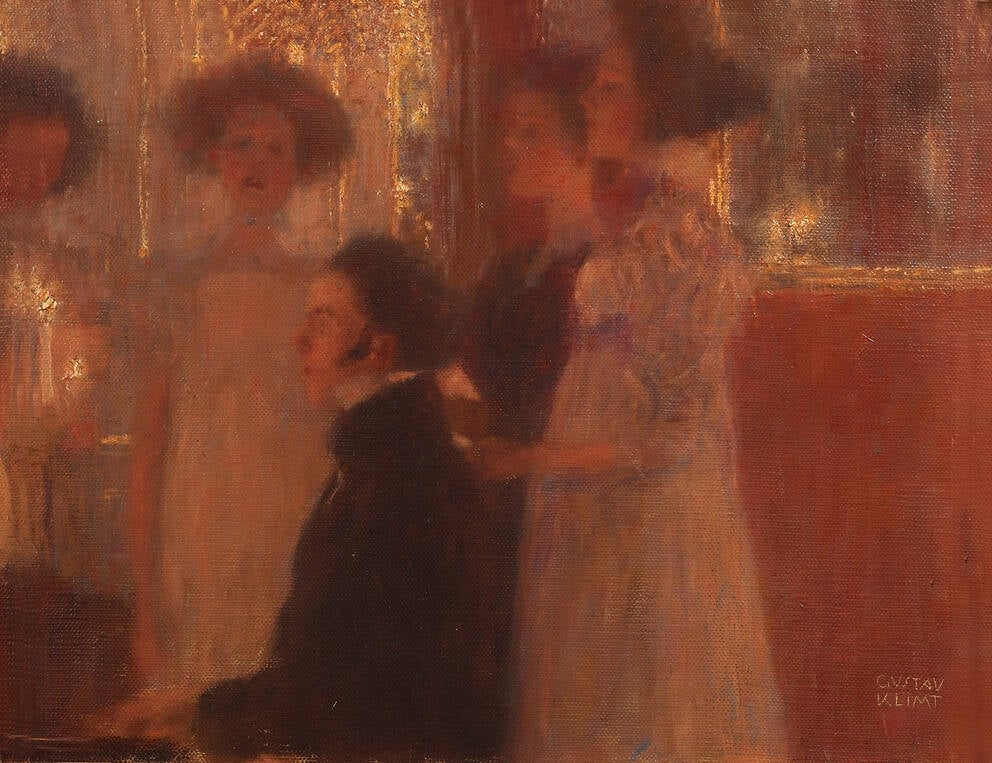
Schubert at the Piano. Design for the music room by Nikolaus Dumba
Gustav Klimt (1896)
Klimt’s 1896 oil study <strong>Schubert at the Piano. Design for the music room by Nikolaus Dumba</strong> turns a domestic recital into a glowing myth of listening. In dim, rosy-gold light, a dark-clad pianist is encircled by a soft choir of women whose blurred faces dissolve into the shimmer of the room. Klimt fuses contour and light so that sound seems to become <strong>radiance</strong>, anticipating his decorative modernism <sup>[1]</sup><sup>[2]</sup>.
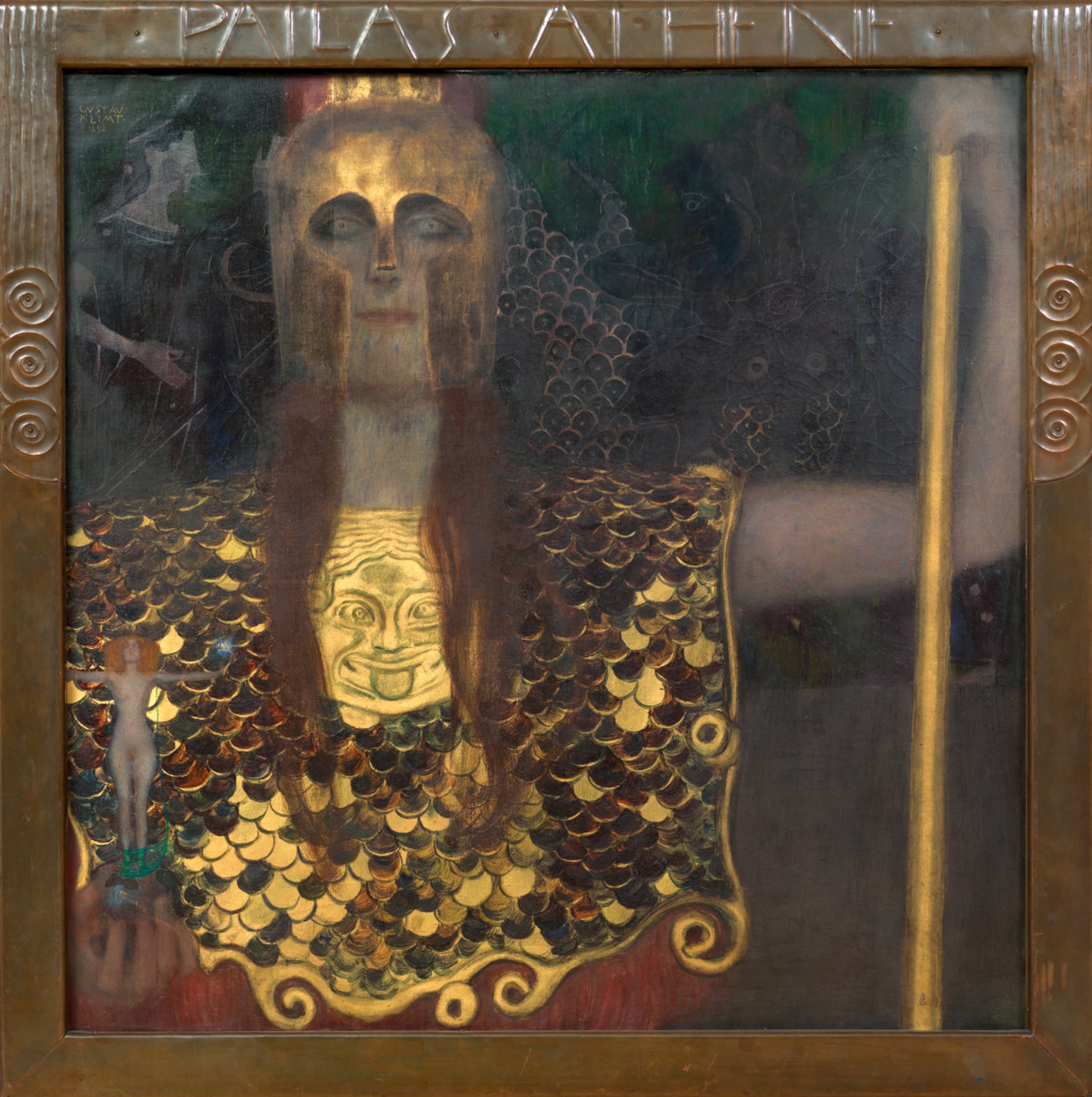
Pallas Athena
Gustav Klimt (1898)
Pallas Athena confronts the viewer as a <strong>frontal icon of power</strong>: helmeted, impassive, and armored in <strong>gleaming scale aegis</strong> crowned by a <strong>gorgoneion</strong>. Klimt fuses archaic authority with modern ornament to proclaim <strong>Vienna Secession</strong> ideals—reason, strategy, and artistic truth held in a single, implacable image <sup>[1]</sup><sup>[2]</sup>.

The Red Studio
Henri Matisse (1911)
Henri Matisse’s The Red Studio (1911) saturates the artist’s workspace in a continuous field of <strong>Venetian red</strong>, collapsing walls, floor, and furniture into a single chromatic plane. Objects and architecture appear as <strong>mustard-yellow reserve lines</strong> that read like drawing, while Matisse’s own paintings and sculptures retain full color, asserting art’s primacy within the room <sup>[1]</sup><sup>[2]</sup><sup>[3]</sup>. The result is a studio that feels like a <strong>mental map</strong> rather than a literal interior.