How Much Is Portrait of an Old Man in Profile (Count Traun?) Worth?
Last updated: April 2, 2026
Quick Facts
- Last Sale
- $5K (1977, Ketterer Kunst, Munich)
- Insurance Value
- $7.0M (Analyst estimate (replacement-cost oriented, above FMV))
- Methodology
- comparable analysis
We estimate Gustav Klimt’s Portrait of an Old Man in Profile (Count Traun?) at $3.5–6.5 million (hypothetical fair market value). The range is anchored to late‑1890s small-format oils on rigid supports by Klimt, adjusted for the subject (male head study) and support (oil on cardboard) versus more coveted female portraits on canvas/board.
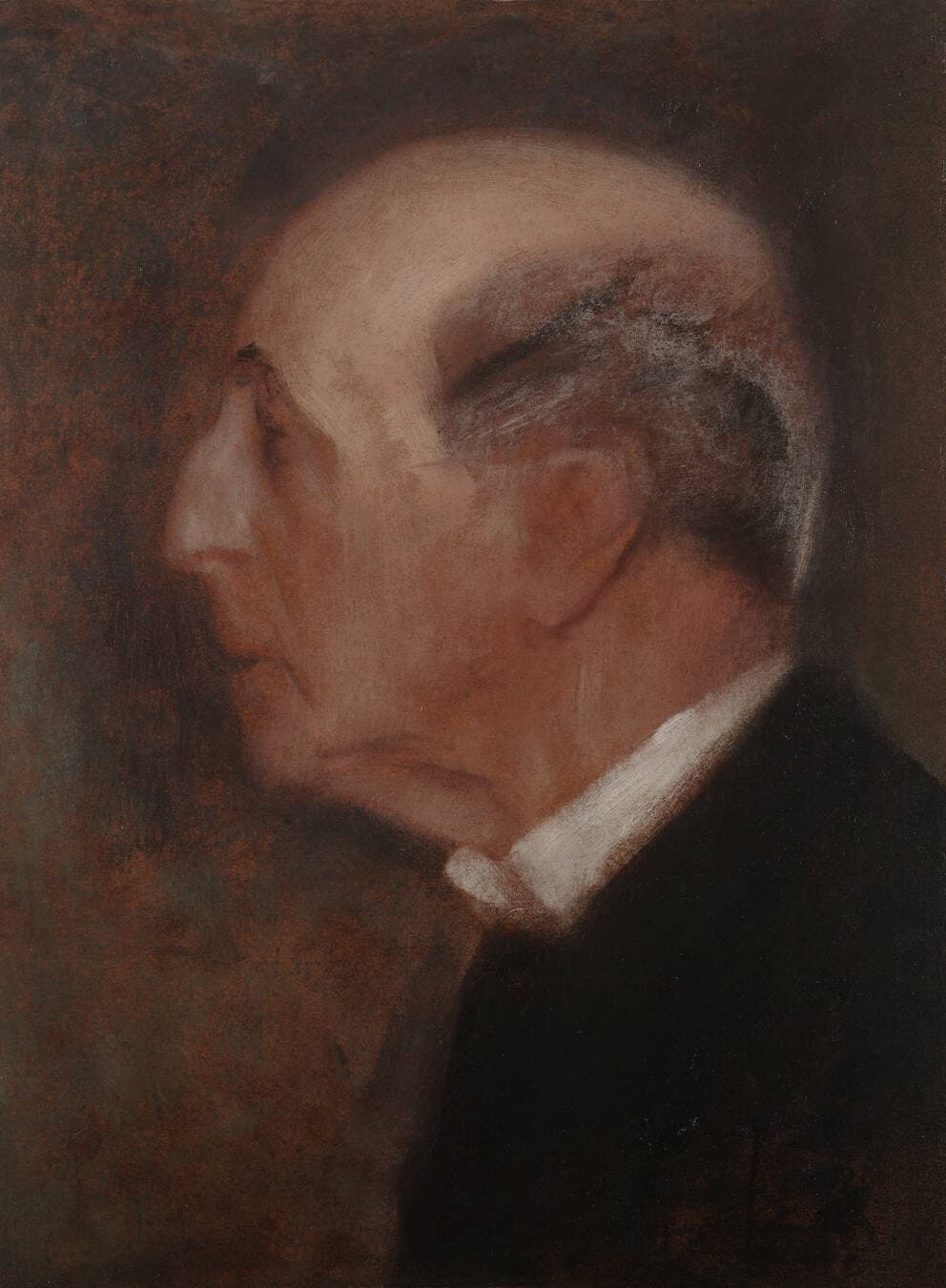
Portrait of an Old Man in Profile (Count Traun?)
Gustav Klimt, c. 1896 • Oil on cardboard
Read full analysis of Portrait of an Old Man in Profile (Count Traun?) →Valuation Analysis
Work and context. Portrait of an Old Man in Profile (Count Traun?), c. 1896, is an intimate, early head study by Gustav Klimt in oil on cardboard, 46 × 35.2 cm, now in the Leopold Museum, Vienna. Its authorship, date, and solid documentation (including catalogue citations and provenance from Klimt’s estate through the Spitzer family to Dr. Rudolf Leopold) are well established in the museum record [1][2]. Within Klimt’s hierarchy, it sits as a refined early study rather than a signature golden‑period masterpiece.
Method and comparables. Our estimate relies on closely related late‑1890s small-format oils by Klimt. At the upper end, Dame im Fauteuil (Woman in an Armchair), 1897–98, oil on board (52 × 52 cm), realized $7,437,500 at Sotheby’s New York in 2017—an elegant female portrait on a rigid support and a strong proxy for refined early oils of intimate scale [3]. A mid anchor is Mädchen im Grünen (Girl in the Foliage), 1896, a small canvas that brought about $5.3 million at Sotheby’s London in 2017 [4]. As a historical floor for the type, a comparably scaled oil on board, Dame en face mit plisiertem Kleid (c. 1898–99), fetched $1,136,000 at Christie’s New York (Day Sale) in 2006 [6].
Adjustments. The subject here (a male head study) and the support (cardboard) typically command less demand than female portraits and oils on canvas/board. Balancing these discounts against the enduring scarcity of authentic Klimt oils and the work’s attractive scale and period, we place fair market value at $3.5–6.5 million. The top of this band presumes strong condition for a cardboard support and robust recent exhibition/literature presence.
Market temperature. Klimt’s brand strength remains exceptional at the top end, underscored by the $236.4 million record for Portrait of Elisabeth Lederer at Sotheby’s New York in November 2025, more than doubling the artist’s prior high and signaling deep global demand for masterpieces [5]. While that apex tier does not directly price a study-like early head, it supports confidence and liquidity for well‑documented, smaller oils across Klimt’s oeuvre.
Provenance, condition, and regulation. The painting sold at Ketterer Kunst, Munich, on May 23, 1977 (Auction 21, Lot 1061) for DM 12,000 (approx. $5,090 at contemporaneous FX), and was acquired by Dr. Rudolf Leopold the same year, entering the Leopold Museum in 1994 [2]. Cardboard supports can be condition‑sensitive; our range assumes museum‑standard stability without material conservation risks. If deaccessioned, Austria’s cultural‑property export regime could constrain a permanent export to non‑EU buyers, a factor some collectors price in; conversely, pre‑cleared export would broaden the buyer pool and may add incremental upside [7].
Conclusion. Based on directly comparable late‑1890s oils on rigid supports, adjusted for subject, medium, provenance, and current market dynamics, we estimate fair market value at $3.5–6.5 million, with a practical insurance/replacement guideline around $7.0 million.
Key Valuation Factors
Art Historical Significance
Medium ImpactDated to around 1896, the work sits at the cusp of Klimt’s transition toward the Vienna Secession (founded 1897), capturing his early interest in incisive characterization and tonal modeling before the ornamental ‘golden period.’ As a male head study, it reflects a less commercially coveted subject than Klimt’s iconic female portraits and allegories, yet it remains a legitimate and well‑documented strand of his portrait practice. Its scale and intimacy appeal to connoisseurs of the early oeuvre, and its presence in a leading Viennese collection reinforces scholarly relevance, though not to the level that would place it among the artist’s market‑defining masterpieces.
Market Comparables and Demand
High ImpactDirectly comparable late‑1890s, small‑format oils on rigid supports have achieved robust results: Dame im Fauteuil (1897–98, oil on board) brought $7.44m at Sotheby’s New York in 2017, and the closely dated Mädchen im Grünen (1896, small canvas) achieved about $5.3m in 2017. A historically lower anchor is the $1.14m achieved in 2006 for a similar‑scale oil on board. Adjusting for the present work’s subject (male head study) and support (cardboard rather than canvas/board), the $3.5–6.5m band reflects today’s mid‑seven‑figure clearing prices for refined early Klimts of intimate scale, with upside if condition and literature prominence prove exceptional.
Medium, Scale, and Condition Sensitivity
Medium ImpactOil on cardboard is historically associated with studies and carries inherent conservation sensitivities (planar warping, edge wear, and vulnerability to humidity). The 46 × 35.2 cm format is attractive for collectors seeking intimate early works, but the support is generally less preferred than canvas or wood panel. Our estimate presumes a stable, well‑conserved surface consistent with museum stewardship; discovery of structural or aesthetic issues (e.g., significant restorations, active distortion) would warrant a discount, while exemplary condition could push the work toward the top of the range.
Provenance, Ownership, and Regulatory Context
High ImpactProvenance from Klimt’s estate to the Spitzer family and acquisition by Dr. Rudolf Leopold in 1977, culminating in the Leopold Museum’s collection, is strong and transparent—an important value driver in a period subject to provenance scrutiny. If the work were deaccessioned, Austria’s cultural‑property export controls could affect marketability outside the EU; permanent export permits may be restricted for works deemed nationally significant. Such friction can narrow the buyer pool or add time/uncertainty to a transaction; conversely, pre‑cleared export could enhance liquidity and competitive tension, modestly improving price outcomes.
Sale History
Ketterer Kunst, Munich
Auction 21, Lot 1061; sold for DM 12,000; per museum dossier and Otto Kallir letter; acquired by Dr. Rudolf Leopold thereafter.
Gustav Klimt's Market
Gustav Klimt is a blue‑chip pillar of the Modern market with exceptionally deep global demand. Masterpiece‑caliber works routinely command eight‑ and nine‑figure prices, culminating in the $236.4 million auction record for Portrait of Elisabeth Lederer at Sotheby’s New York (Nov 2025). Iconic female portraits and golden‑period canvases lead the market, followed by jewel‑like landscapes and select late works; early portraits and studies trade in the mid‑seven figures depending on subject, support, and condition. Asian and Middle Eastern participation has broadened the bidder base at the top end, and high‑profile museum exhibitions continue to reinforce the artist’s cultural prominence and price resilience.
Comparable Sales
Dame im Fauteuil (Woman in an Armchair)
Gustav Klimt
Same artist; late-1890s small-format oil on board (52 × 52 cm) close in date/scale to subject; refined early portrait genre that anchors pricing for small oils on rigid supports.
$7.4M
2017, Sotheby's New York
~$9.7M adjusted
Mädchen im Grünen (Girl in the Foliage)
Gustav Klimt
Same artist; same year (1896); small-scale portrait/figure study (32 × 24 cm) establishing demand for late‑1890s Klimt oils of intimate format.
$5.3M
2017, Sotheby's London
~$6.9M adjusted
Dame en face mit plisiertem Kleid (Damenbildnis en face)
Gustav Klimt
Same artist; c. 1898–99 small oil on board (43.4 × 33.9 cm), nearly identical scale/support to the subject; useful lower‑anchor for the category historically.
$1.1M
2006, Christie's New York
~$1.8M adjusted
Current Market Trends
The fin‑de‑siècle/Vienna Secession segment has benefited from a broad ‘flight to quality,’ with buyers concentrating capital in established names like Klimt. Trophy lots set new highs in 2023–2025, while smaller works with clear authorship and provenance remain reliable. Within Klimt’s spectrum, intimate oils from the 1890s on cardboard or board typically realize mid‑seven figures, with premiums for female sitters and more finished compositions. Heightened due‑diligence standards and, in Austria, potential export constraints are meaningful considerations that can influence pricing and deal structure, but overall demand for authentic, well‑documented Klimts remains robust across market cycles.
Sources
- Leopold Museum Online Collection: Gustav Klimt, Portrait of an Old Man in Profile (Count Traun?)
- Leopold Museum dossier/provenance (includes reference to 1977 Ketterer sale)
- Sotheby’s: Gustav Klimt, Dame im Fauteuil (Woman in an Armchair), New York, 16 May 2017
- The Art Newspaper: Klimt helps Sotheby’s reach auction record in London (Mar 2, 2017)
- The Art Newspaper: Klimt sets new record at Sotheby’s New York (Nov 18, 2025)
- Art.Salon: Gustav Klimt, Damenbildnis en face, Christie’s New York, 9 Nov 2006
- Austrian Federal Monuments Authority (BDA): Export of Cultural Property