How Much Is The Black Bull Worth?
Last updated: April 2, 2026
Quick Facts
- Methodology
- comparable analysis
Estimated fair-market value: $10–18 million. The Black Bull (1900) is a scarce oil-on-canvas by Gustav Klimt with strong museum exposure, but its off-core animal/genre subject sits below the artist’s most coveted portraits and ornamental landscapes.
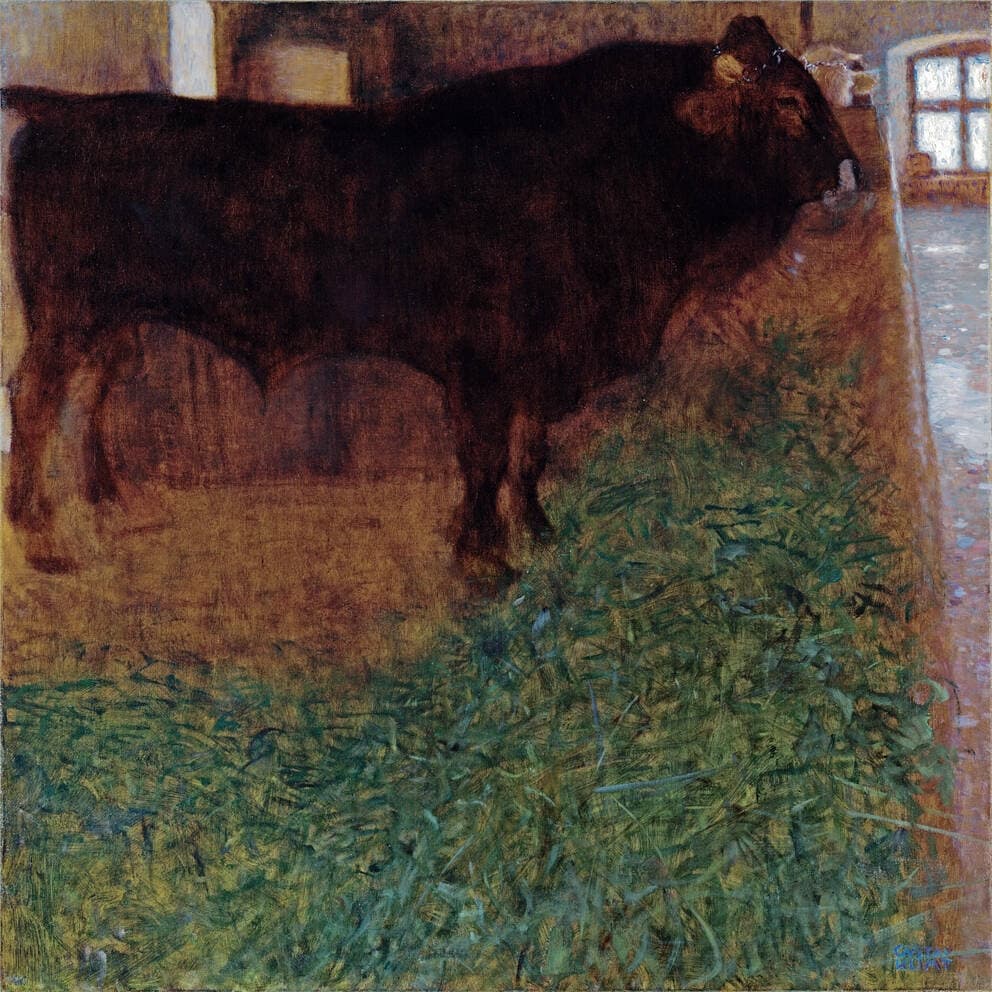
The Black Bull
Gustav Klimt, 1900 (1900–1901 also cited) • Oil on canvas
Read full analysis of The Black Bull →Valuation Analysis
Overview and object context. The Black Bull (Der schwarze Stier), 1900, oil on canvas, 82 × 82 cm, is an authentic, catalogued Klimt painting in a private collection and currently exhibited at the Leopold Museum in Vienna, with references in the standard literature (Natter; Weidinger/Seiser/Winkler; Novotny/Dobai) [1]. Painted during Klimt’s first summer at the Attersee, it depicts an unusually naturalistic animal subject—distinct from the mature ornamental landscapes and golden-period portraits that dominate the market.
Market environment and top-tier benchmarks. Klimt’s market is among the strongest in pre‑War Modernism. In 2025, Sotheby’s set a new auction record for the artist at $236.4m for a full-length portrait, confirming deep demand at the apex of the category [2]. That same season, two prime landscapes achieved $86.0m and $68.3m, respectively [4]. Earlier, Lady with a Fan realized $108.4m in London (2023) [3]; Insel im Attersee, a period‑adjacent landscape (c.1901–02), made $53.2m in New York (2023) [5]; and Birch Forest (1903) achieved $104.6m in 2022 [6]. These results establish the ceiling for Klimt’s signature subjects.
Positioning of The Black Bull within Klimt’s oeuvre. While an oil-on-canvas by Klimt is intrinsically scarce and highly desirable, The Black Bull’s animal/genre motif is outside the artist’s most competitive categories. Collectors have historically paid a premium for golden-phase portraits and mature ornamental Attersee landscapes, with period, finish, and decorative impact driving the lion’s share of nine-figure outcomes [2][3][4][6]. As a result, this work should price materially below top-tier landscapes like Insel im Attersee ($53.2m) [5] and far below the golden or late masterworks that now occupy the $100m–$236m range [2][3][6]. A meaningful discount to these comparables—reflecting off-core subject appeal and narrower trophy demand—supports the $10–18m range.
Derivation of estimate. We anchor the high side of the bracket to the broader scarcity of Klimt oils and the artist’s elevated market baseline since 2022–2025, while the low end reflects subject-driven constraints and the likelihood that bidding depth will trail that for portraits or ornamental landscapes. The square 82 cm format and Attersee period are positives, as are the robust literature/exhibition references and current display at the Leopold Museum (which strengthens curatorial pedigree and buyer confidence) [1]. A 2003 loan insurance figure (~€5.8m) is historical and not indicative of today’s fair market value [8].
Key sensitivities. This estimate presumes good, unrestored condition with no structural issues, and clear, fully documented provenance—particularly across the 1933–45 period—given the heightened scrutiny in the Austrian/Modern context; unresolved claims can depress or derail transactions (cf. the 2024 Lieser portrait sale cancellation) [7]. Optimal sale timing would be a New York marquee evening auction with third‑party guarantee, which currently commands the deepest bidding in this price band [2][4].
Conclusion. On balance of author, medium, date, literature, and museum exposure—tempered by an off‑core subject—The Black Bull’s fair‑market value synthesizes at $10–18 million today, with upside contingent on pristine condition, fully published provenance, and strong cross‑category competition at sale.
Key Valuation Factors
Art Historical Significance
Medium ImpactPainted in 1900 during Klimt’s first Attersee summer, The Black Bull expands our understanding of the artist’s early naturalistic investigations and subject range beyond the portrait and ornamental landscape idioms that came to define his fame. It is documented in key literature and currently exhibited at a leading Viennese institution, which underpins scholarship and visibility. However, from a market perspective, animal/genre interiors are not what drive record prices for Klimt; those are dominated by golden‑phase portraits and mature Attersee landscapes. Thus, while the work is significant within a comprehensive view of Klimt’s practice, it ranks below the artist’s most coveted categories in terms of commercial impact.
Market Positioning and Subject Appeal
Medium ImpactCollectors of Klimt’s oils most aggressively chase golden-ground portraits and highly decorative nature subjects. Recent benchmarks confirm that late portraits and mature landscapes command deep global competition. The Black Bull’s unusual animal subject will appeal to connoisseurs of Viennese Modernism and Klimt specialists, but the broader pool of trophy buyers prioritizes the most iconic motifs. Accordingly, pricing should reflect a discount versus comparables like Insel im Attersee (c.1901–02) at $53.2m, as well as the $68m–$104m+ tier achieved by ornamental landscapes in 2022–2025. This places The Black Bull in a lower, but still robust, eight‑figure band.
Scarcity of Klimt Oils in Private Hands
High ImpactFully realized Klimt oils seldom come to market, and those in private collections are tightly held. Scarcity exerts a powerful floor under pricing, even for non‑signature subjects, as blue‑chip collectors and institutions view any authenticated, well‑provenanced Klimt oil as a rare opportunity. The recent escalation at the top end—punctuated by a $236.4m portrait record and multiple landscape results above $60m–$100m—has lifted the artist’s overall price structure. This rising tide supports a strong baseline for The Black Bull despite its off‑core motif, particularly when presented with museum‑level scholarship and a best‑in‑class sales platform.
Provenance, Condition, and Exhibition History
High ImpactThe work’s literature citations and current Leopold Museum display bolster confidence and desirability. That said, early 20th‑century Austrian works face heightened due‑diligence around 1933–45 provenance; any gaps or claims can materially impact sell‑through and price, as shown by the 2024 Lieser portrait case. Condition is equally pivotal: structural stability, minimal restoration, and original surface integrity are essential to attract top bids. Assuming clean, fully documented title and good condition, exhibition pedigree and published references should translate into stronger bidder engagement and help secure results toward the upper half of the estimated range.
Sale History
The Black Bull has never been sold at public auction.
Gustav Klimt's Market
Gustav Klimt is a blue‑chip pillar of pre‑War Modernism with a market led by golden‑phase portraits and mature ornamental landscapes. Since late 2022, headline prices have reset higher: Birch Forest realized $104.6m (2022), Lady with a Fan $108.4m (2023), and in 2025 Sotheby’s established a new artist record at $236.4m for a full‑length portrait, alongside two top‑tier landscape results at $86.0m and $68.3m. These outcomes confirm global depth among trophy buyers and institutional collectors. Supply is thin, competition is concentrated in New York and London, and third‑party guarantees frequently support marquee consignments, underpinning confidence across the Klimt segment.
Comparable Sales
Insel im Attersee (Island in the Attersee)
Gustav Klimt
Same artist; painted c.1901–02 at the Attersee, essentially contemporaneous with The Black Bull (1900). Oil on canvas, square format, non‑portrait subject—useful as a benchmark for early non‑golden, non‑portrait Klimt oils.
$53.2M
2023, Sotheby's New York
~$56.5M adjusted
Waldabhang bei Unterach am Attersee (Forest Slope in Unterach on the Attersee)
Gustav Klimt
Same artist; non‑portrait oil from the Attersee cycle, similar general scale and decorative appeal. Establishes pricing for highly desirable Klimt nature subjects versus The Black Bull’s off‑core animal/genre motif.
$68.3M
2025, Sotheby's New York
Blumenwiese (Blooming Meadow)
Gustav Klimt
Same artist; top‑tier ornamental nature subject (c.1908), square composition and non‑portrait category. Serves as a ceiling benchmark for decorative, non‑golden Klimt oils compared to the rarer but less market‑preferred animal interior of The Black Bull.
$86.0M
2025, Sotheby's New York
Birch Forest (Buchenwald/Birkenwald)
Gustav Klimt
Same artist; 1903 forest landscape, a core and highly coveted ornamental nature theme. Useful as a category high-water mark against which to discount The Black Bull’s uncommon animal/genre subject.
$104.6M
2022, Christie's New York
~$115.0M adjusted
Portrait of Fräulein Lieser
Gustav Klimt
Same artist; late (1917) non‑golden portrait—below apex golden‑phase but still in a highly desired subject category. Provides a directional mid‑tier Klimt oil benchmark; note the sale was later canceled amid unresolved provenance, so use as indicative only.
$37.0M
2024, im Kinsky, Vienna
~$38.1M adjusted
Current Market Trends
The Modern category rebounded in 2025 at the top end, with New York evening sales capturing an outsized share of $10m+ lots. Klimt’s record‑setting portrait and strong landscape prices underscore sustained appetite for canonical Viennese Secession works with clean provenance and museum‑level quality. While demand remains highly selective—favoring golden‑phase portraits and decorative Attersee landscapes—the scarcity of Klimt oils continues to support firm pricing for secondary subjects. Sellers who align condition, provenance, and venue (ideally with a third‑party guarantee) can expect competitive bidding; buyers prioritize works with robust literature and exhibition histories.
Sources
- Leopold Museum Online Collection: The Black Bull (Der schwarze Stier), 1900
- Sotheby’s: The New York Sales (Nov 2025) – Klimt record result
- Artnet News: Klimt’s Lady with a Fan sets European auction record (2023)
- Sotheby’s: Historic night – Leonard A. Lauder Collection Klimt landscapes (2025)
- Judd Tully: Sotheby’s Modern Evening Sale – Insel im Attersee (2023)
- The Art Newspaper: Paul G. Allen sale – Birch Forest result (2022)
- AP News: Sale of Klimt portrait canceled amid provenance dispute (2024)
- Der Standard: 2003 loan insurance report for The Black Bull