The Flower Meadow Edge in The Kiss
A closer look at this element in Gustav Klimt's 1908 (completed 1909) masterpiece
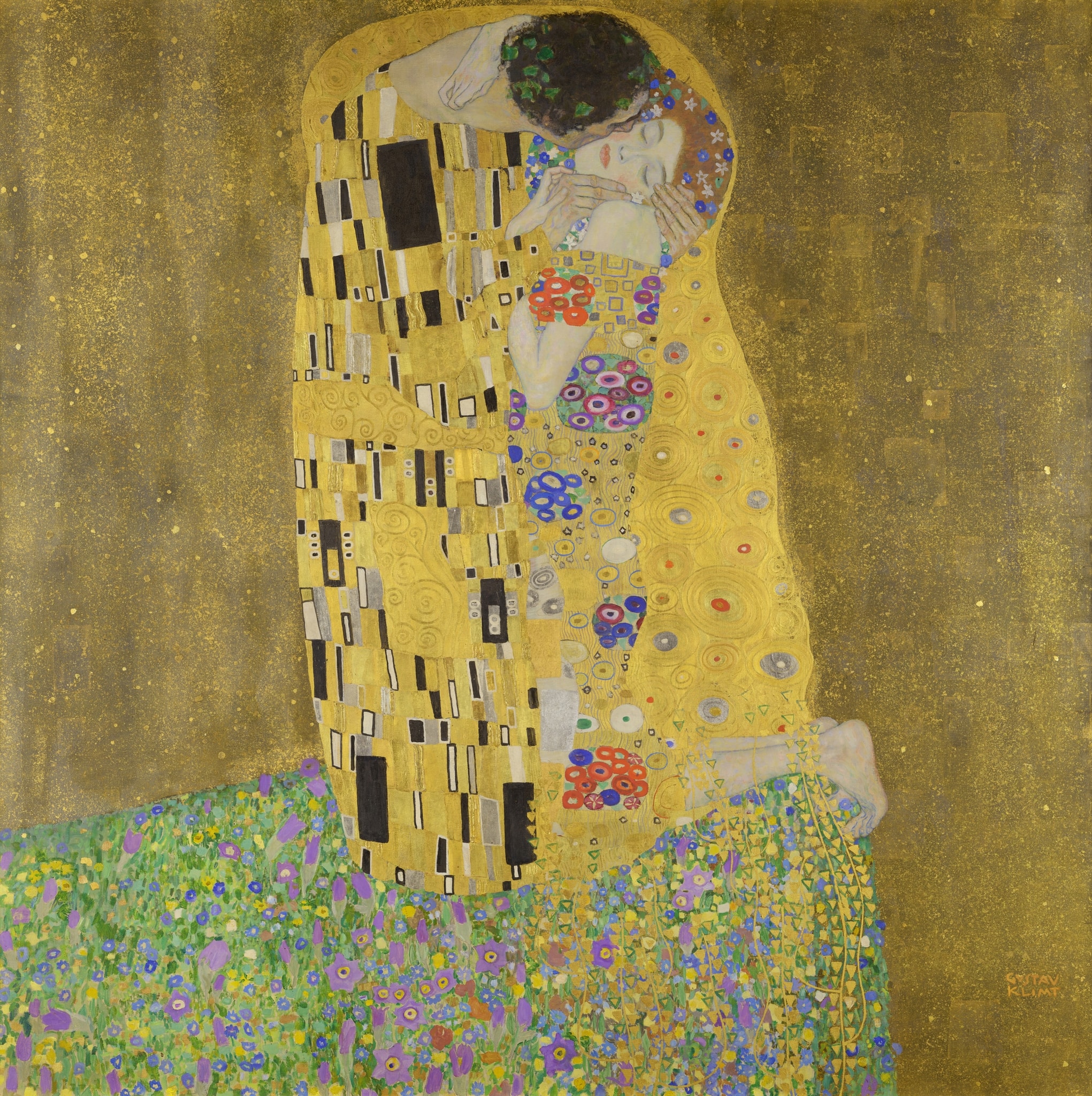
At the base of Klimt’s The Kiss, a dense flower meadow flattens into a patterned carpet that ends in a sudden brink beneath the woman’s curled toes. This cliff-like edge fuses sensual nature with a shimmering, icon-like beyond—an engineered threshold that charges the embrace with risk, fecundity, and transcendence.
Historical Context
Klimt conceived The Kiss in 1908–09 during his Golden Phase, when Byzantine mosaic splendor and Secessionist design led him to merge figures with ornamental grounds. The lower field of flowers anchors that radiant icon to lived nature, aligning the painting with the artist’s summers at the Attersee and his contemporaneous landscapes of flowering meadows 2.
Belvedere curator Franz Smola situates the motif precisely: the lovers kneel on a meadow whose patterned surface ends abruptly, plausibly echoing a lakeshore brink at the Attersee, while the tendrils that creep over the calves evoke aquatic plants. Klimt thus grafts his gilded, timeless embrace onto a specific shoreline ecology he knew intimately, making the “edge” both a topographical cue and a poetic device that binds the painting’s celestial atmosphere to a real, flowered earth 1.
Symbolic Meaning
The flowered brink operates as a charged threshold. Its sudden termination under the woman’s feet places the couple on a precipice between terrestrial life and the enveloping golden cosmos—a staging that amplifies rapture with danger, intimacy with immensity 61. In this liminal zone, love becomes a passage from the measurable world to the timeless, icon-like field that surrounds them.
Equally potent is the meadow’s symbolism of nature’s fecundity. The bed of blossoms and the vine-like shoots that wrap the shins entwine erotic union with vegetal growth, a Symbolist fusion of sexuality and organic vitality. Read with Klimt’s gendered ornament—rectilinear, darker motifs clustering around the man; circular, floral forms concentrating around the woman—the meadow intensifies themes of complementarity and procreation 8.
Some commentaries have overlaid mythic frames—Orpheus and Eurydice, or other Ovidian pairs—so the brink reads as the hinge between ecstasy and loss; while unproven, such readings underscore how the edge dramatizes transition and fate 5. Across these strands, the meadow edge stabilizes the lovers in the world even as it stages their leap into a luminous beyond, synthesizing earthly desire with cosmic aspiration 21.
Artistic Technique
Klimt renders the meadow as a shallow, tapestry-like carpet built from tight, multicolored dabs and discrete floral motifs—more pattern than perspectival ground, in dialogue with Secessionist and Arts & Crafts surface design 4. The chromatic field meets a gilded void constructed with actual metal leaf, whose reflective shimmer collapses depth and turns space into a luminous plane; the seam where polychrome earth meets gold ground is the picture’s fulcrum 2. At the brink he tightens tension: vine tendrils creep over the calves to knit bodies to terrain 1, while the woman’s toes curl and press at the edge, an anatomical accent that counters the sumptuous decor with a jolt of precariousness 3.
Connection to the Whole
The meadow edge is the painting’s hinge—an anchoring strip of nature that sets the embrace on a brink before the gold, unlocatable beyond. It reconciles Klimt’s dual aims: sensual immediacy rooted in earth’s flowering abundance and the transcendence of an infinite, glittering cosmos 21.
Compositionally, the green-violet carpet lifts the figures, concentrates detail at the bottom right, and then releases the eye into the vast, particulate gold field. That guided ascent from ground to radiance mirrors the lovers’ own passage, turning a private kiss into an allegory of crossing from time into eternity—love poised, literally and metaphorically, on the edge 62.
Explore the Full Painting
This is just one fascinating element of The Kiss. Discover the complete interpretation, symbolism, and hidden meanings throughout the entire work.
← View full analysis of The KissSources
- Belvedere Museum (Franz Smola), “The Kiss — Google Arts & Culture”
- Smarthistory, “Gustav Klimt, The Kiss”
- Encyclopaedia Britannica, “The Kiss | painting by Gustav Klimt”
- The Art Story, “Gustav Klimt”
- Wikipedia, “The Kiss (Klimt)”
- Rick Steves Classroom Europe, “Gustav Klimt”
- Sotheby’s, “Blumenwiese (Blooming Meadow)”
- Artsy, “Klimt’s iconic ‘The Kiss’ sparked a sexual revolution in art” (Patrick Bade cited)