The Kiss

by Gustav Klimt

The Kiss stages human love as a sacred union, fusing two figures into a single, gold-clad form against a timeless field. Klimt opposes masculine geometry (black-and-white rectangles) to feminine organic rhythm (spirals, circles, flowers), then resolves them in radiant harmony [1][2].
💰

Market Value

$400-800 million

How much is The Kiss worth?

Study Print Studio

Create a personal study print

Build a companion study sheet around the part of this painting that speaks to you most. Choose a detail, shape an interpretation, and walk away with something personal and display-worthy.

Fast Facts

Year
1908 (completed 1909)
Medium
Oil on canvas
Dimensions
180 × 180 cm
Location
Österreichische Galerie Belvedere (Upper Belvedere), Vienna
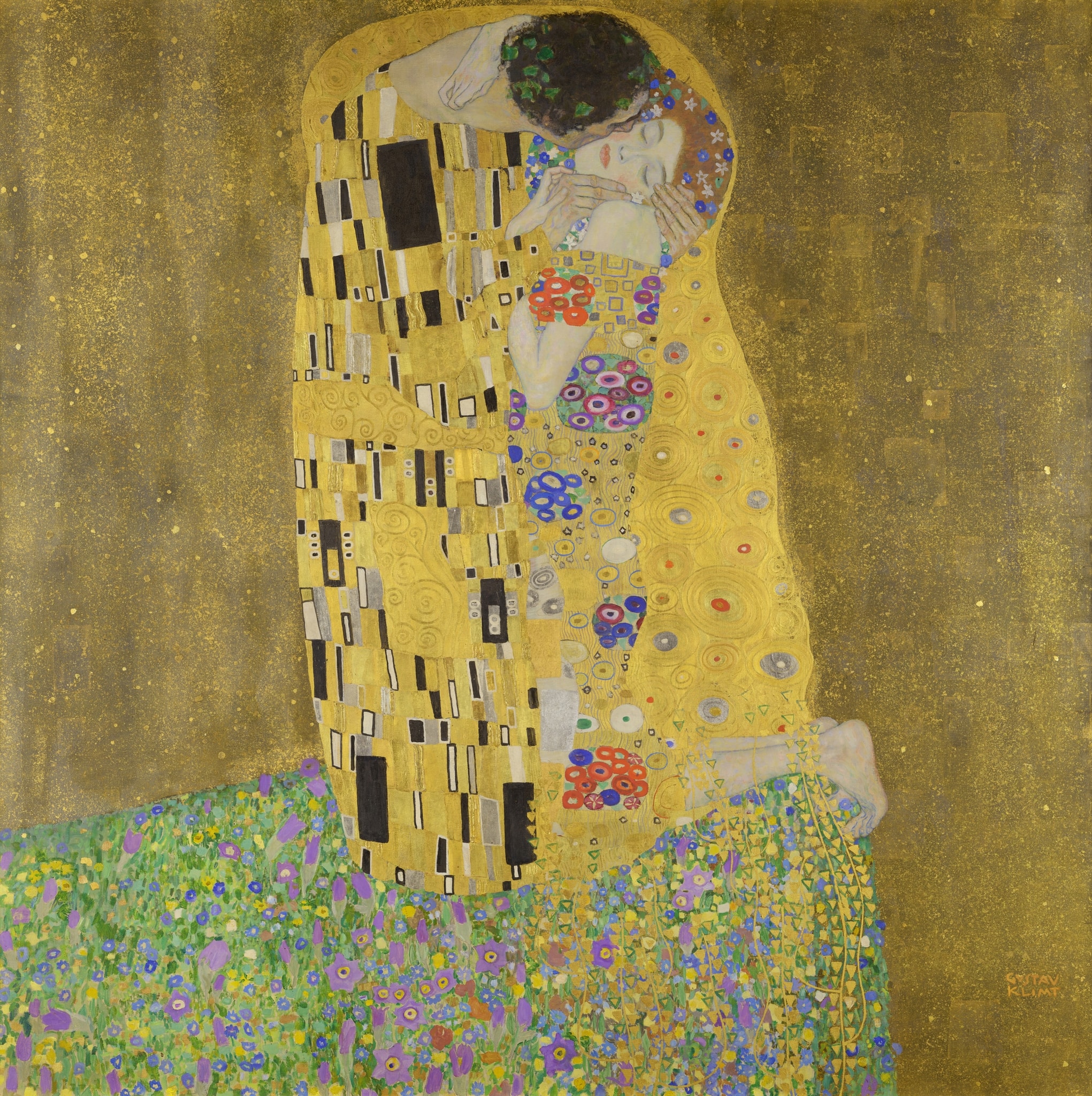
The Kiss by Gustav Klimt (1908 (completed 1909)) featuring Gold aureole/field, Masculine geometry, Feminine organic forms, Flower meadow/ledge

Click on any numbered symbol to learn more about its meaning

Meaning & Symbolism

Klimt builds a theology of touch from material means. The square canvas becomes a shrine in which hammered gold leaf and composition metal shimmer like a Byzantine field, a direct channel to sacred prototypes he studied in Italy; the golden surround functions as an aureole encasing the couple’s union beyond ordinary time and space 12. Within this sanctified zone, the man’s robe arrays rigid black-and-white bars and stacked rectangles, while the woman’s garment blooms with spirals and circular medallions, some concentric red discs that recent scholarship has compared to red blood cells. Whether or not one accepts the biomedical analogy, the visual rhetoric is clear: a polarity of structure and growth, order and fertility, yields to embrace 25. Their naturalistic faces and hands emerge from the mosaic like incarnations—spirit condensing into flesh—so that sensuality and symbolism bind rather than cancel each other. The choreography of bodies tightens the painting’s argument. The man inclines, his hands cupping the woman’s jaw, while she closes her eyes and gathers her hands at his wrist; this clasped counter‑grip signals willing surrender, not passivity, a consent that completes the circuit. At her bare feet, delicate toes curl at the very edge of a narrow meadow, a precarious ledge of wildflowers that dramatizes the risk of falling as the necessary cost of rapture 24. The carpet of blossoms under her dissolving hem visually “roots” the feminine garment in nature, while the man’s vine-leaf crown and her floral wreath announce a rite of union presided over by the vegetative world. The gold mantle flows around both figures, erasing the seam where two bodies meet; individuality blurs into a single icon-like silhouette, the lovers rendered as one radiating form. By refusing perspectival depth and suspending the couple in a flattened void, Klimt withholds narrative time: the kiss does not progress; it abides. This is why The Kiss is important in the story of Viennese modernism. After public scandal over his University of Vienna murals, Klimt reasserted the avant-garde’s legitimacy by staging beauty as a Gesamtkunstwerk: a total environment where ornament equals idea and decoration bears philosophy 3. Exhibited at the 1908 Kunstschau as Liebespaar (The Lovers), the painting quickly became a civic treasure, confirming that a daring, secular icon could stand where ecclesial images once did 123. The work also condenses threads from the Beethoven Frieze—its dream of universal consolation, a “kiss to the whole world”—into a concentrated emblem of ecstatic union 4. Even mythic echoes some scholars hear (from Orpheus and Eurydice to Apollo and Daphne) only reinforce the picture’s claim: the embrace is a threshold where risk, mortality, and desire transform into a golden continuity. In The Kiss, Klimt forges a modern icon in which love is both earthly and exalted—ardor given the dignity of a halo—and the shining surface persuades the eye that devotion can be seen, felt, and believed all at once 124.

Explore Deeper with AI

Ask questions about The Kiss

Popular questions:

Powered by AI • Get instant insights about this artwork

💬 Ask questions about this artwork!

Interpretations

Formal/Technical Analysis

Klimt’s surface is not merely decorative; it is the engine of meaning. The figure-cloak combines gold leaf, silver, and even platinum over oil, while the flat ground is composition metal (Schlagmetall) glazed to a Byzantine shimmer 5. This calibrated contrast—noble metals for incarnate bodies, cheaper alloy for the surrounding field—creates an optical hierarchy that reads like a modern iconostasis. The square format and compressed depth further deny perspectival narrative, making the kiss a continuous present. In this sense, Klimt turns material facture into rhetoric: the painting argues through its own skin, insisting that in modern art, surface can be theology, and ornament can be ontology 125.

Source: Belvedere Museum (technical note) and Encyclopaedia Britannica

Gendered Ornament + Science

The male’s rectangles/bars and the female’s circles/spirals encode a fin‑de‑siècle binary of structure vs. growth, but Klimt complicates the trope with motifs that may index modern science. Recent scholarship reads the concentric red discs on the woman’s garment as visual analogues of red blood cells, inserting histological imagery into erotic symbolism 26. Whether or not one accepts the biomedical identification, the effect is striking: sexuality appears as both ornamental code and a biology of circulation and vitality. The embrace thus fuses Symbolist gender rhetoric with turn‑of‑the‑century scientific imagination, suggesting that modern intimacy is patterned by both culture and corpuscles 26.

Source: Encyclopaedia Britannica; Journal of Korean Medical Science (biomotif hypothesis)

Secular Icon and Civic Religion

Shown at the Kunstschau 1908, The Kiss helped re-legitimize Klimt after the University of Vienna scandal by presenting a Gesamtkunstwerk ethos: an immersive environment where decoration is idea 3. Swiftly acquired for the Belvedere, it became a civic icon, demonstrating that a modern, secular image could occupy cultural space once reserved for religious altarpieces 13. The gilded aureole functions like a halo for the body politic: a public hymn to love that converts scandal into shared pride. In this reading, Klimt invents a new form of civil devotion, with the museum as temple and radiant ornament as a unifying creed 13.

Source: Tate Etc. (Kunstschau 1908 essay); Belvedere Museum

Psychological Tension at the Edge

Look to the woman’s curled toes and the tight hand clasp: beneath the sumptuous surface runs a current of anxiety and control, a proto‑Expressionist charge that intensifies the embrace 2. The lovers kneel on a narrow meadow ledge before a sheer, depthless gold—an image of bliss poised over the void 4. This brink psychology reframes ecstasy as a negotiated surrender, where risk heightens pleasure and the fear of falling sharpens the will to cling. Klimt’s suspension of time (“the kiss abides”) thus reads not as pure stasis but as a held breath—an exquisite, perilous equilibrium 24.

Source: Encyclopaedia Britannica; The Guardian (Jonathan Jones)

Mythic Palimpsest (Debated)

Critics have proposed mythic echoes—Orpheus and Eurydice, or Apollo and Daphne—to parse the veiled face, leafy crown, and vegetal rites, though such identifications remain contested 27. Rather than fix a single narrative, Klimt mobilizes a mythic register that lifts the scene from private moment to archetype: a threshold embrace where loss, metamorphosis, and consolation circulate. The ambiguity is productive; it lets the picture function as a secular myth, a portable rite for modern viewers who recognize the grammar of transformation without subscribing to a singular tale. Myth here is method, not subject—a way to universalize intimacy 27.

Source: Encyclopaedia Britannica; Glasstire (critical survey of Apollo/Daphne reading)

Explore Specific Elements

Dive deeper into individual scenes and details within The Kiss.

Related Themes

About Gustav Klimt

Gustav Klimt (1862–1918), co-founder of the Vienna Secession, pivoted from controversial public commissions to a decorative-symbolist language in his Golden Period. Drawing on Byzantine mosaics and modern design, he fused opulent surfaces with psychological intensity. By 1908–09, he transformed scandal into canon, and The Kiss became Vienna’s emblem of modern love.
View all works by Gustav Klimt

More by Gustav Klimt

Portrait of Adele Bloch-Bauer I by Gustav Klimt

Portrait of Adele Bloch-Bauer I

Gustav Klimt (1907)

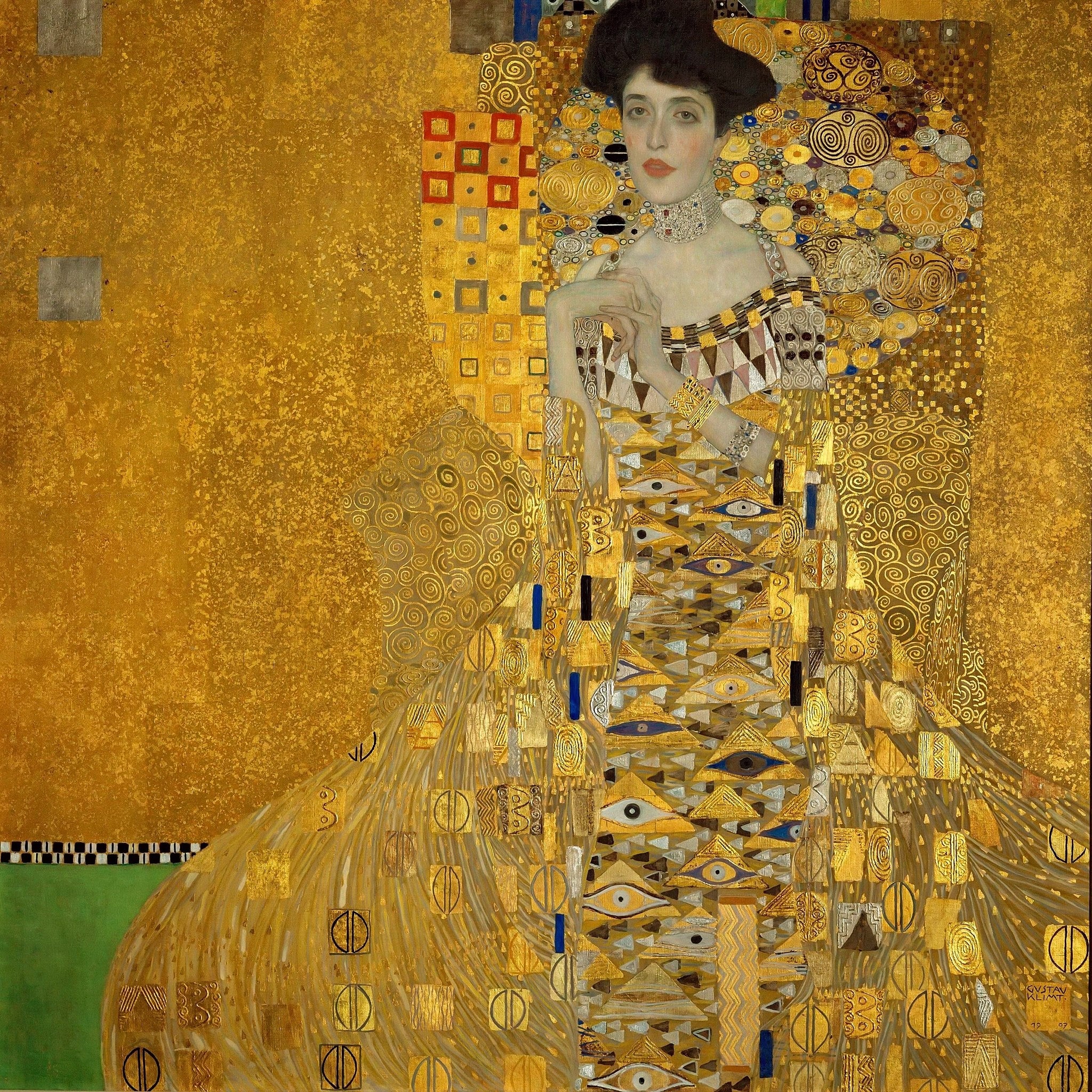
Gustav Klimt’s Portrait of Adele Bloch-Bauer I stages its sitter as a <strong>secular icon</strong>—a living presence suspended in a field of gold that converts space into <strong>pattern and power</strong>. The naturalistic face and hands emerge from a reliquary-like cascade of eyes, triangles, and tesserae, turning light, ornament, and status into the painting’s true subjects <sup>[1]</sup><sup>[2]</sup>.
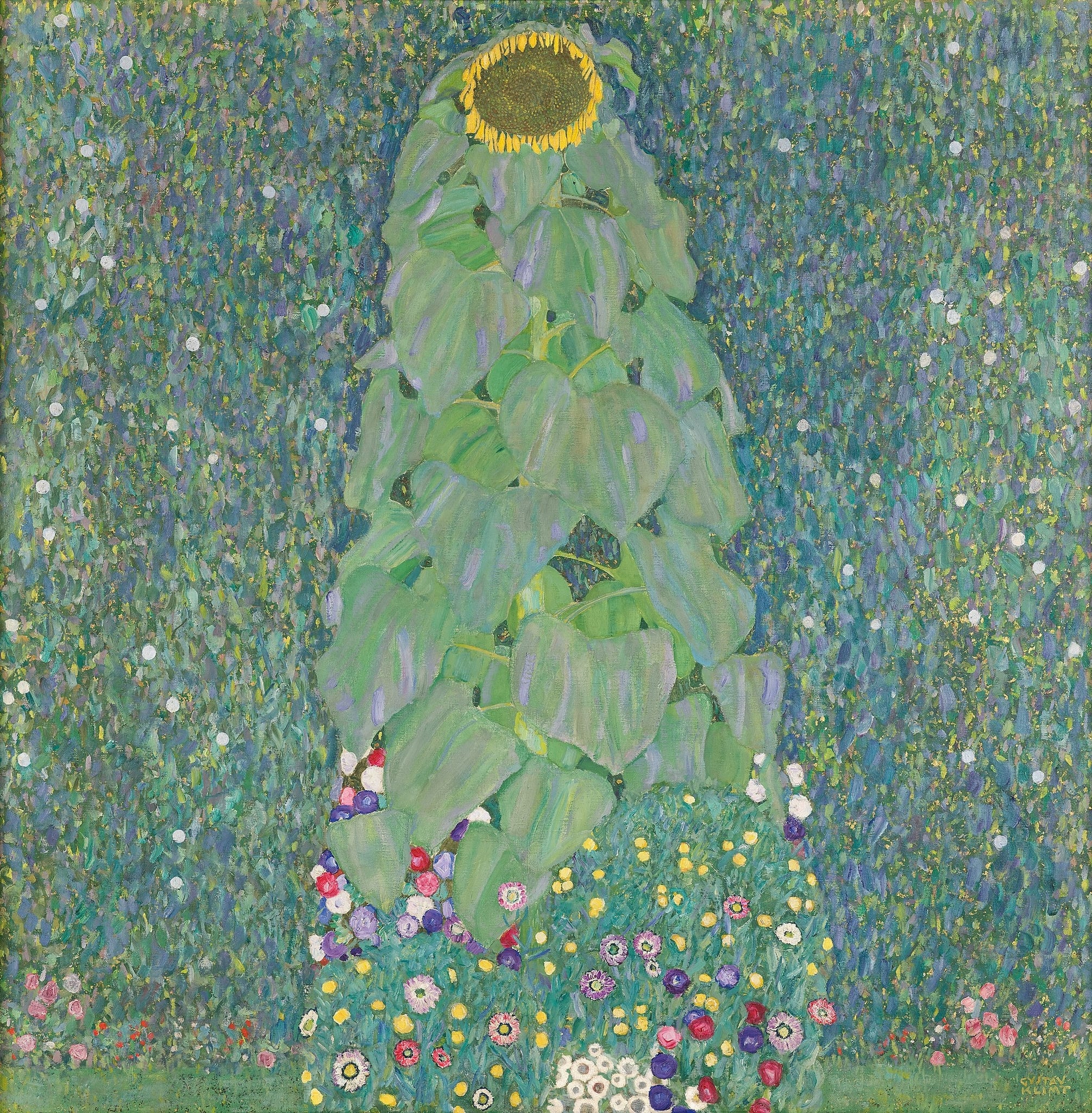
Sunflower by Gustav Klimt

Sunflower

Gustav Klimt (1907/1908)

Gustav Klimt’s Sunflower turns a single bloom into a <strong>monumental, figure-like presence</strong>. A tapering stack of broad, drooping leaves rises from a <strong>mosaic-like carpet of round blossoms</strong>, crowned by a gold-flecked disc that glows against a cool, stippled field. The work fuses <strong>portrait, icon, and landscape</strong> into one emblem of vitality and quiet sanctity <sup>[1]</sup><sup>[2]</sup>.
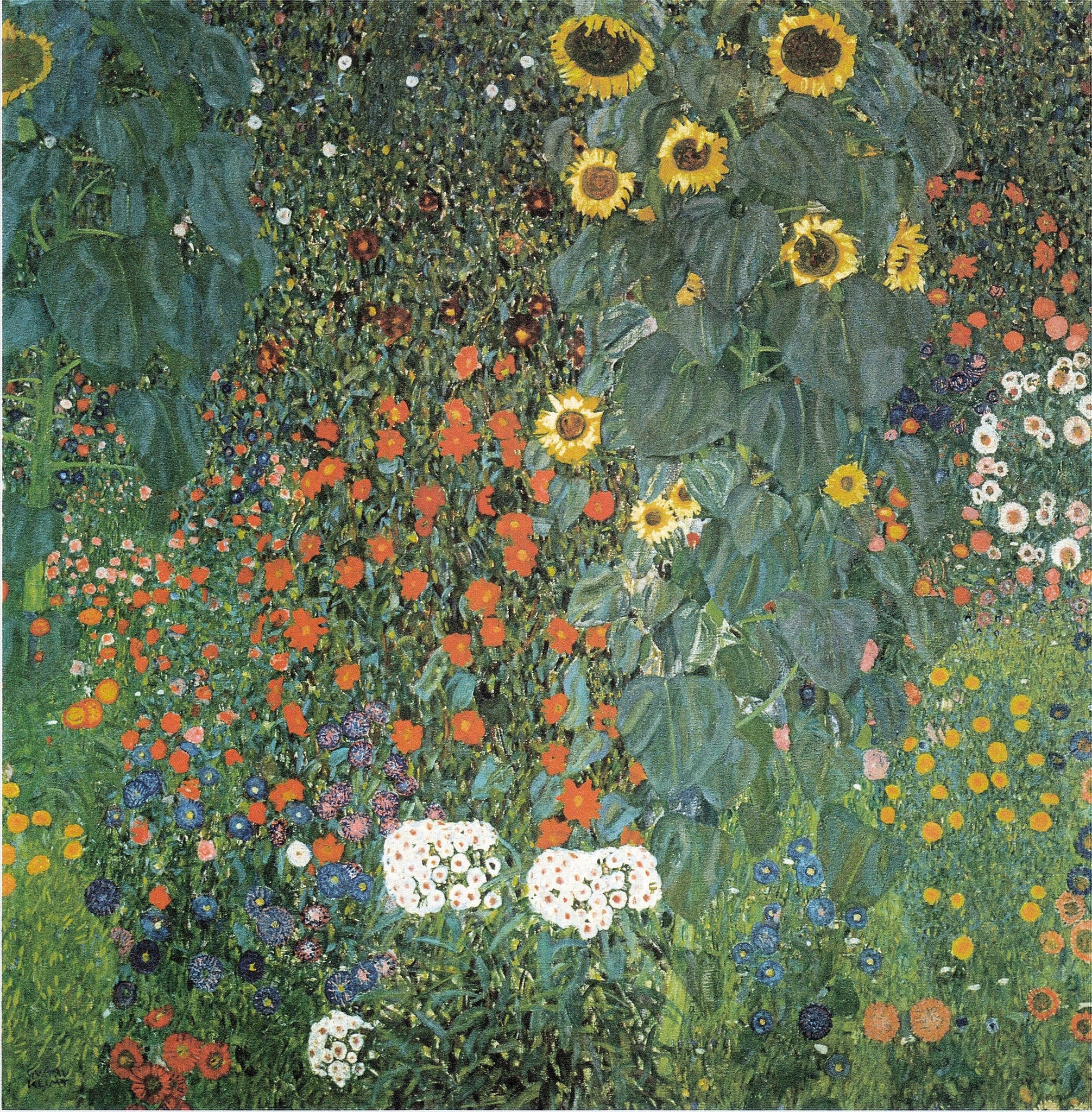
Cottage Garden with Sunflowers by Gustav Klimt

Cottage Garden with Sunflowers

Gustav Klimt (1906–1907 (signed 1907))

Cottage Garden with Sunflowers is a square, horizonless field of blooms where a vertical column of <strong>sunflowers</strong> anchors an all-over weave of color and pattern. Klimt fuses <strong>ornament and nature</strong>, turning a humble Litzlberg cottage plot into a radiant matrix of cyclical life and renewal <sup>[1]</sup><sup>[4]</sup><sup>[5]</sup>.
The Tree of Life by Gustav Klimt

The Tree of Life

Gustav Klimt (1910–1911 (design; mosaic installed 1911))

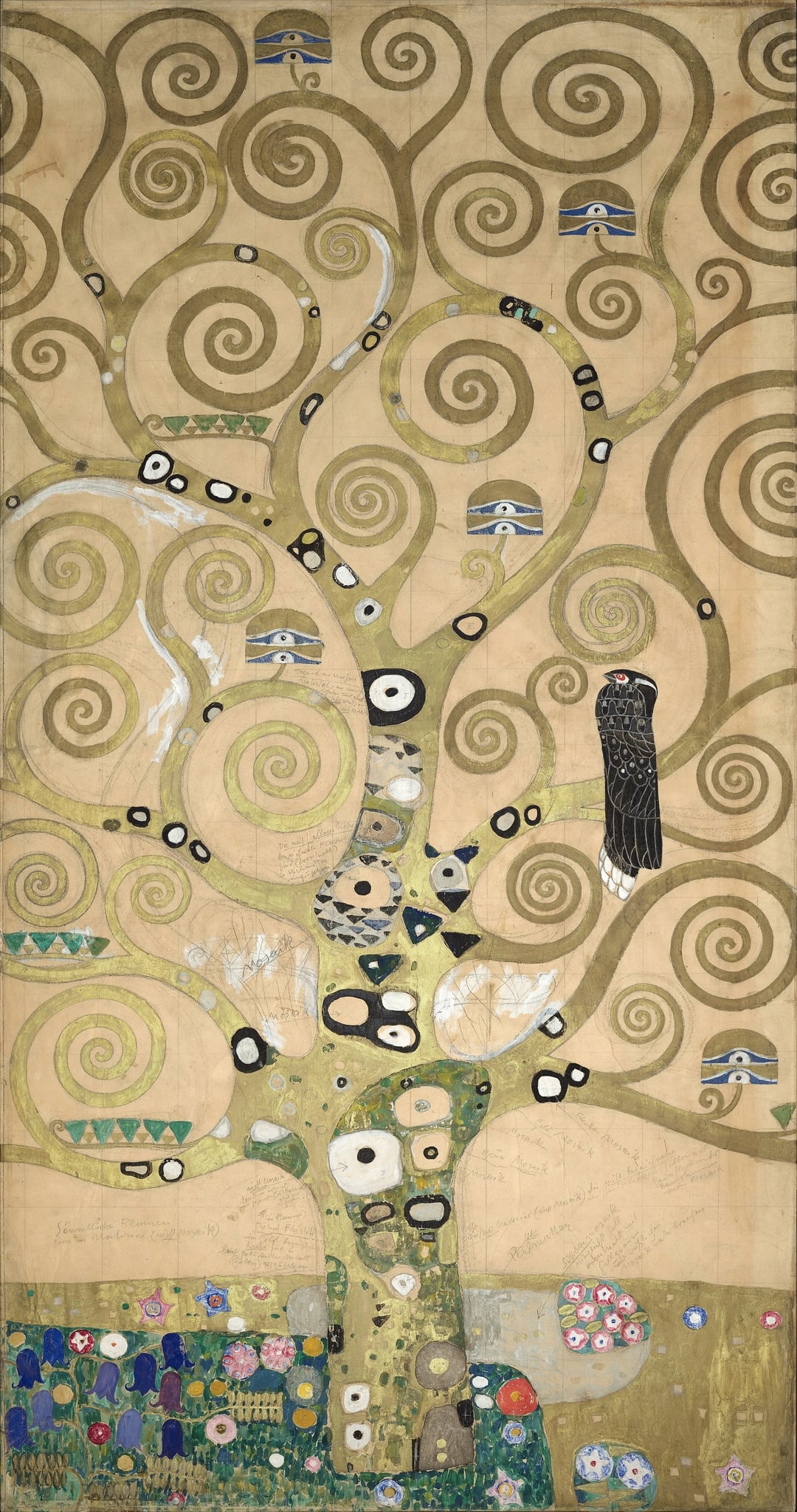
Gustav Klimt’s The Tree of Life crystallizes a <strong>cosmological axis</strong> in a gilded ornamental language: a rooted trunk erupts into <strong>endless spirals</strong>, embedded with <strong>eye-like rosettes</strong> and shadowed by a black, red‑eyed bird. Designed as part of the Stoclet dining‑room frieze, it fuses <strong>symbolism and luxury materials</strong> to link earthly abundance with timeless transcendence <sup>[1]</sup><sup>[2]</sup>.
The Kiss (Lovers) by Gustav Klimt

The Kiss (Lovers)

Gustav Klimt (1907–1908 (Belvedere lists 1908/09))

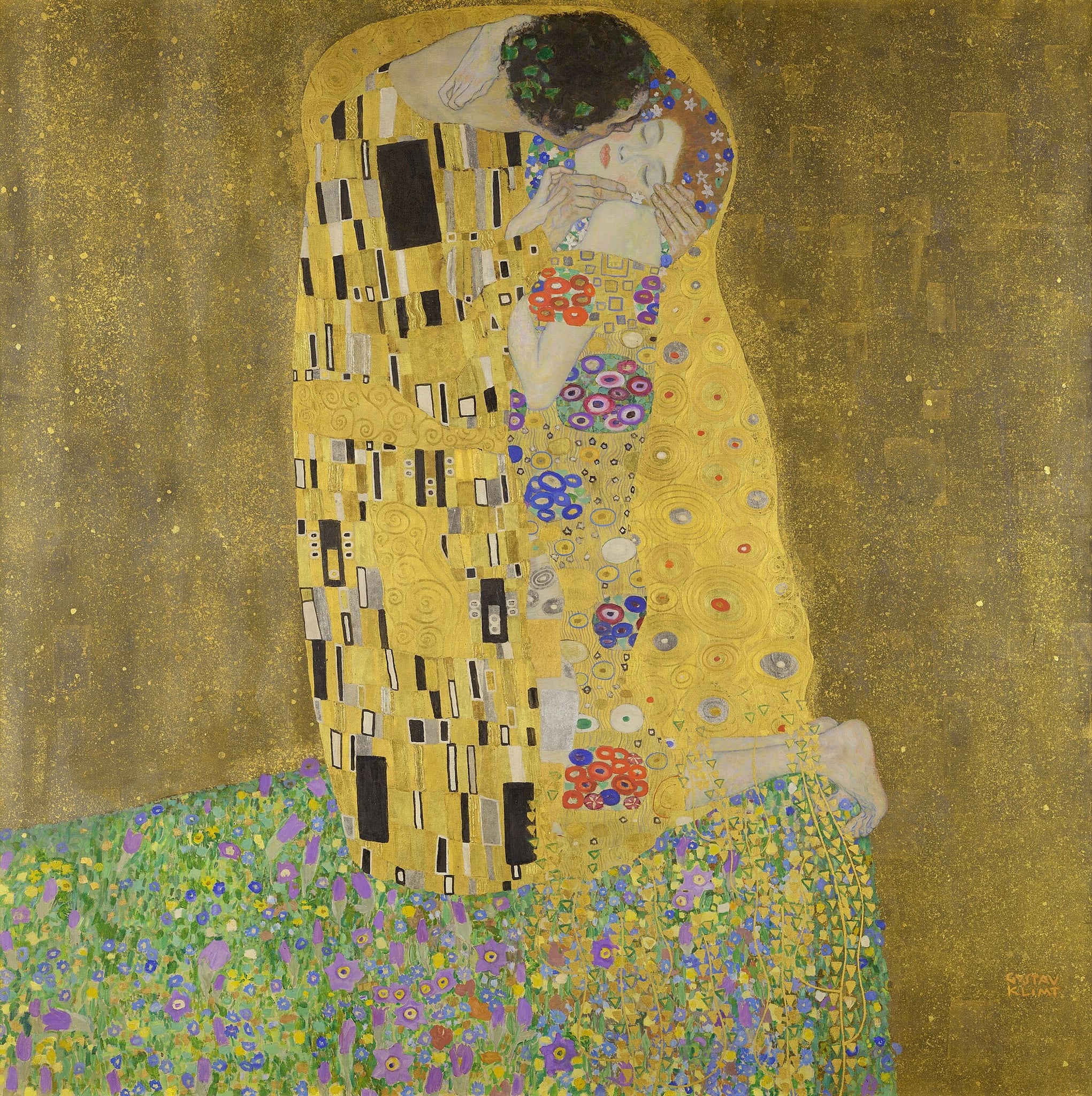
The Kiss (Lovers) crystallizes Klimt’s <strong>Golden Period</strong> ideal: erotic union staged as a sacred vision. Two bodies fuse beneath a single golden mantle, poised on a flowered ledge at the brink of the unknown, where <strong>pattern becomes symbol</strong> and intimacy becomes icon.
Flowering Poppies by Gustav Klimt

Flowering Poppies

Gustav Klimt (1907)

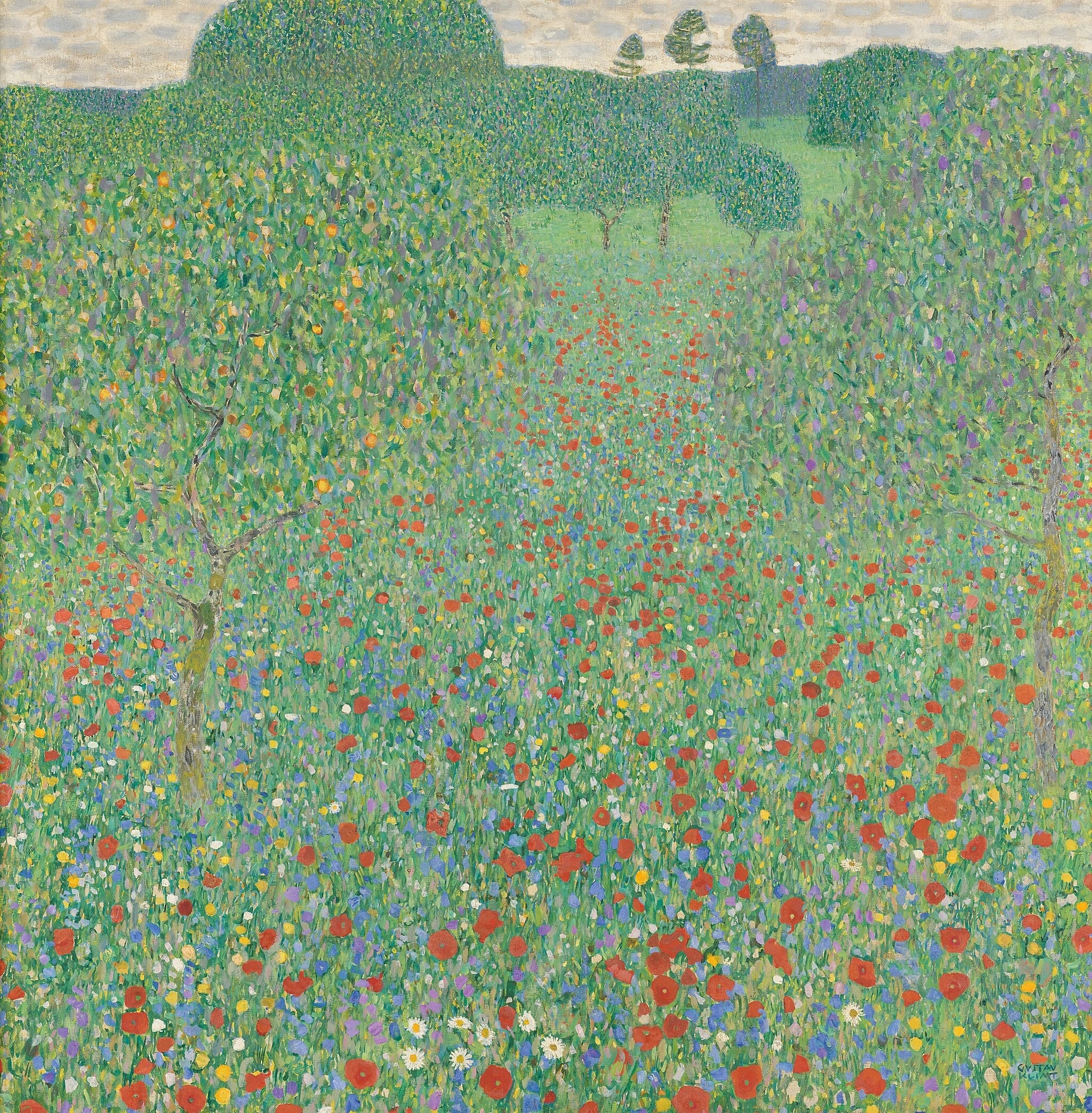
Gustav Klimt’s <strong>Flowering Poppies</strong> (1907) turns a meadow into a shimmering, all-over field where botany becomes <strong>ornament</strong>. A square canvas packed with red poppies, daisies, and fruiting trees compresses depth and invites a drifting gaze rather than linear recession <sup>[1]</sup><sup>[2]</sup>. The result is a sensuous, immersive vision that fuses observed nature with <strong>decorative abstraction</strong> <sup>[2]</sup>.