The Geometric Patterns in The Kiss
A closer look at this element in Gustav Klimt's 1908 (completed 1909) masterpiece
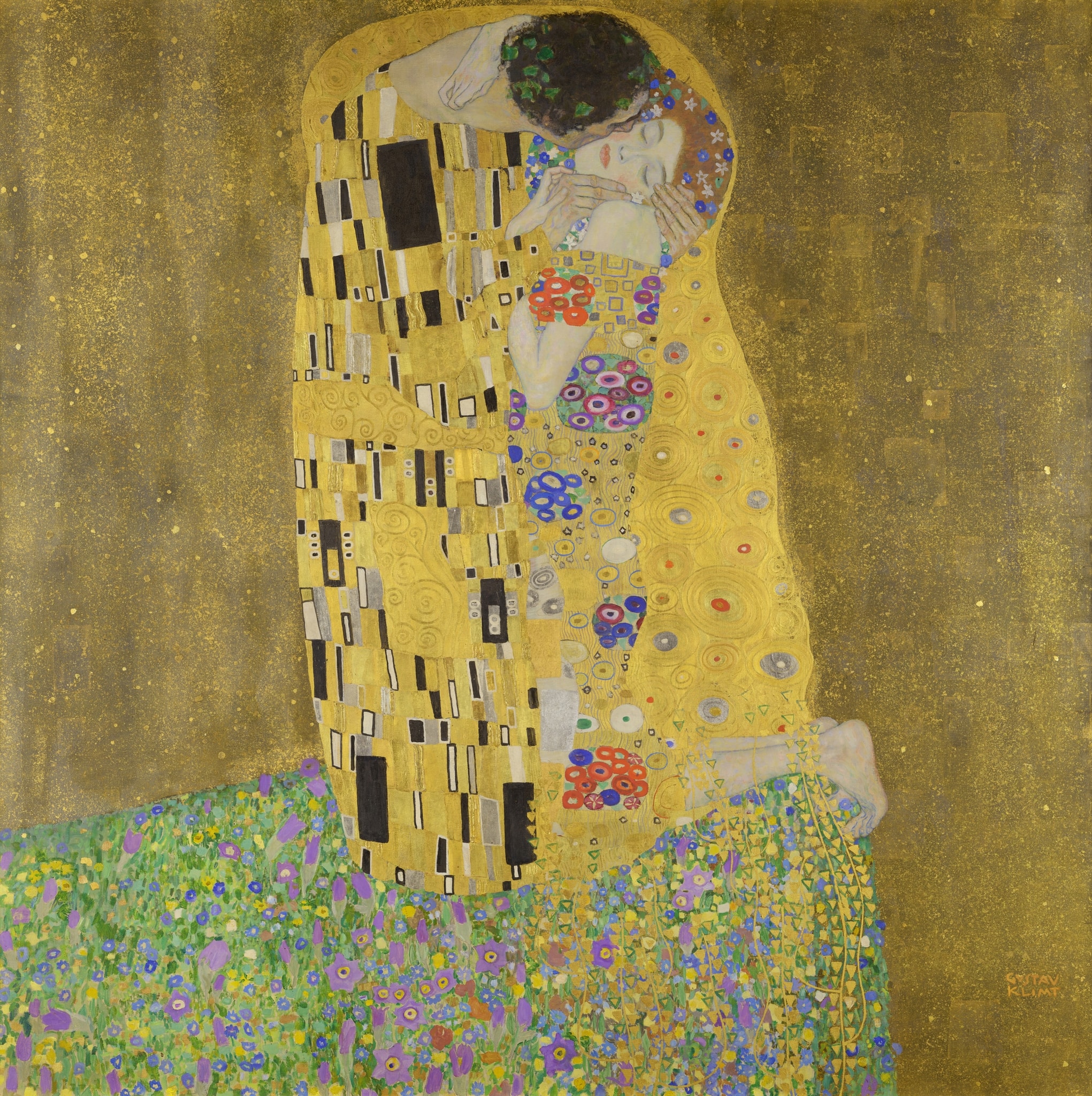
On the man’s robe in The Kiss, Klimt arrays a field of black‑and‑white rectangles that read like inlaid tesserae. These hard-edged motifs, set against the woman’s circular florals, crystallize the painting’s drama: the union of structured, masculine force with organic, feminine flow [2][3].
Historical Context
Painted during Klimt’s Golden Period, The Kiss was created in 1908 and completed in 1909, when the artist was fusing high painting with sumptuous ornament, metal leaf, and design logic; the Belvedere’s record details the work’s dating and materials 1. As a leader of the Vienna Secession, Klimt rejected the old hierarchy that separated fine art from the applied arts, embracing pattern and surface as vehicles of meaning. The geometric robe is a direct expression of this Secessionist credo, turning costume into a designed skin that is as significant as anatomy itself 2.
At this moment Klimt was perfecting a mosaic-like visual language that made figure and ornament interdependent. The severe rectangles on the man’s garment do not merely decorate; they signal a modernist alignment with order, structure, and abstraction while still serving a deeply emotive subject. In the gold ground and stylized dress, Klimt created a timeless stage where ornament could bear narrative weight—an approach that defines The Kiss within his mature production and anchors its place in Viennese modernism 12.
Symbolic Meaning
The geometric blocks on the man’s robe are a visual code for gendered duality. Encyclopaedia Britannica and academic surveys underline the contrast: strong, rectilinear motifs for the male figure versus soft, circular and floral motifs for the female, a binary that the painting resolves into a single, harmonious embrace 23. The rectangles embody ideas of order, structure, and potency; the circles convey organic growth and receptivity. Their interdependence reads as an allegory of complementary forces joined through love.
Several influential interpretations intensify this reading into explicit erotic symbolism: the erect, upright rectangles are seen as phallic; the woman’s concentric circles as vaginal; and the couple’s fused silhouette as a single column enveloped by an oval aureole. In this view, Klimt embeds an allegory of sexual fulfillment directly in the robe’s geometry and the painting’s larger haloed form 4. Whether approached as a gender code or as erotic allegory, the rectangles operate as more than décor—they articulate a modern synthesis of body, desire, and design that aligns with Symbolist aims to make inner states visible through emblematic form 234.
Artistic Technique
Klimt renders the man’s robe as a mosaic of emphatic black, white, and gray rectangles, occasionally punctuated by small spirals, set within a shimmering field of metal leaf. According to the Belvedere, the figural zone combines gold, silver, and platinum leaf with oil‑resin paints; the background is brass leaf (Schlagmetall) glazed over, with scattered metal flakes—materials that produce the robe’s inlaid, tessellated effect 1.
The flattened gold ground compresses depth so the pattern reads graphically, its hard edges and high contrast asserting visual weight against the woman’s polychrome, circular dress. This calculated opposition—rectilinear versus curvilinear, monochrome versus variegated—turns costume into structure, allowing geometry to carry expressive meaning within a carefully balanced composition 16.
Connection to the Whole
The rectangles sharply define the male figure yet work with the woman’s circular motifs to weld the pair into a single, interlocking silhouette. Sources note how these contrasting patterns ultimately fuse the lovers into one formal entity, mirroring the painting’s theme of union 23.
Read alongside the oval aureole and the vertical thrust of the embrace, the rectilinear robe helps build the sensation of a single column enveloping the couple—a compositional and erotic metaphor underscored by scholars who see a phallic/yonic dialogue in the patterns themselves 4. In The Kiss, the geometric garment is not accessory but armature: it anchors the composition’s verticality, clarifies gendered energies, and transforms ornament into the vehicle of the work’s overarching meaning 24.
Explore the Full Painting
This is just one fascinating element of The Kiss. Discover the complete interpretation, symbolism, and hidden meanings throughout the entire work.
← View full analysis of The KissSources
- Belvedere Sammlung Online – Klimt, Der Kuss (Liebespaar), object record
- Encyclopaedia Britannica – The Kiss (Klimt)
- UVU academic text (Gardner’s Art Through the Ages) – Klimt, The Kiss
- Artsy – Why “The Kiss” by Gustav Klimt Is an Erotic Masterpiece
- MAK – Gustav Klimt: Expectation and Fulfillment (Stoclet Frieze cartoons)
- Wikipedia – The Kiss (Klimt) [basic facts; Ravenna context]