The Golden Cloak in The Kiss
A closer look at this element in Gustav Klimt's 1908 (completed 1909) masterpiece
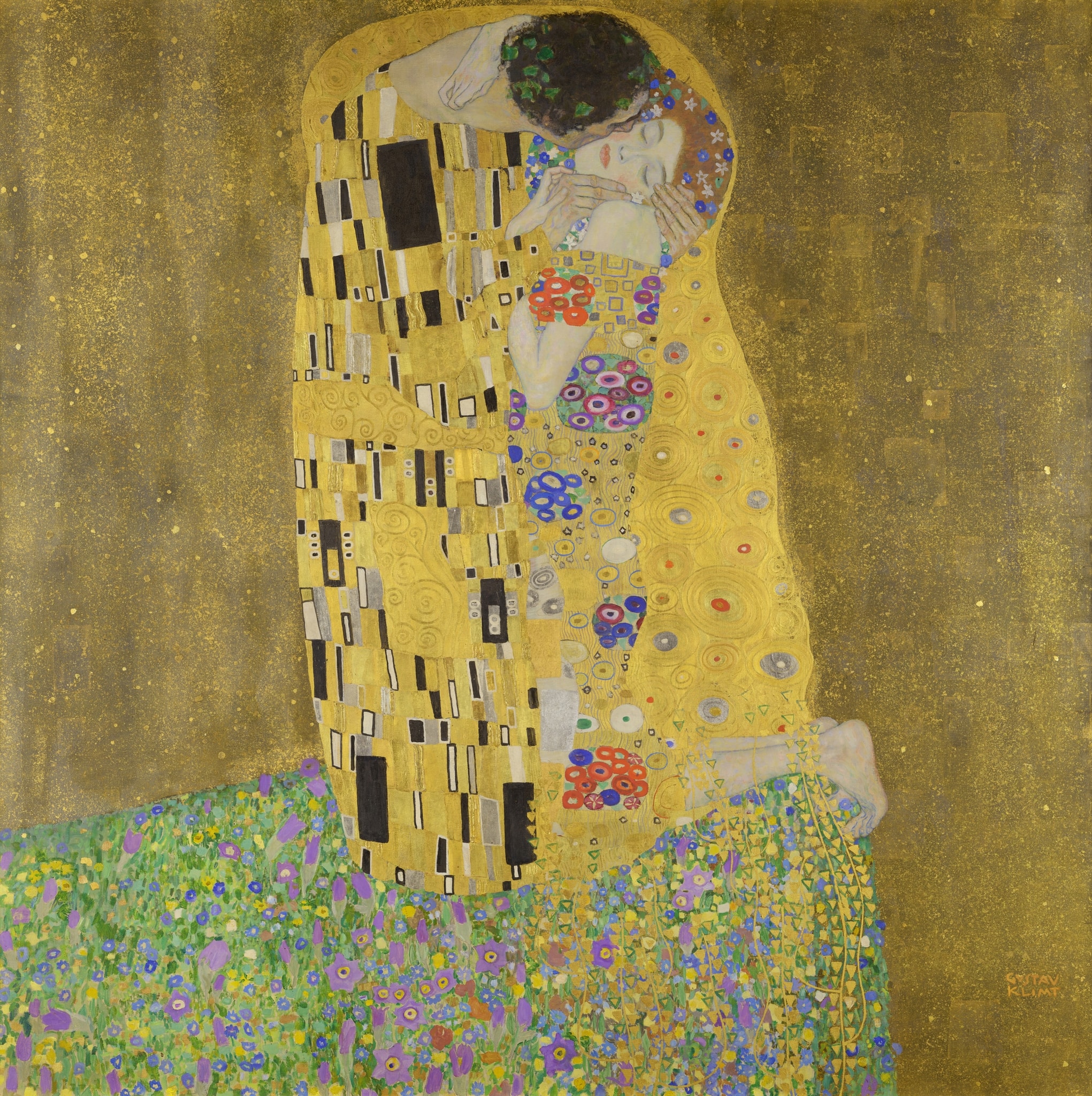
The Golden Cloak in Klimt’s The Kiss is a single, metal‑leaf mantle that fuses two lovers into one radiant figure. Hard black‑and‑white rectangles on his side meet rounded circles and flowers on hers, while the continuous gold turns private embrace into a modern icon.
Historical Context
Gustav Klimt devised the shared, gilded mantle at the height of his Golden Phase, when he was integrating gold and silver leaf into oil painting after close study of the Byzantine mosaics at Ravenna. The Kiss was conceived around 1907–1908 and unveiled at the 1908 Vienna Kunstschau, where the Austrian state immediately purchased it for the Belvedere. The cloak embodies Klimt’s synthesis of Secessionist decorative modernism with the sacral authority of medieval icon surfaces 12.
In this context, the golden garment is not a realistic fabric but a purpose‑built field that collapses figure and ground. Klimt uses it to transpose an embrace—familiar from his frieze projects—into a panel painting whose shimmering metal surface signals timelessness and public monumentality. The Kunstschau debut and state acquisition confirmed the success of this strategy, making the gilded mantle both the painting’s formal engine and an emblem of Vienna 1900’s ambition to join fine art, craft, and symbolism into a single, luminous whole 12.
Symbolic Meaning
The Golden Cloak stages the union of complementary principles. On the man’s side, hard black‑white‑gray rectangles assert a geometric, linear order; on the woman’s, rounded circles and floral motifs evoke organic growth. Art historians read this split as gendered—masculine geometry versus feminine biomorphic forms—reconciled by the continuous sheet of gold that fuses the pair into one body 34.
Gold confers an iconic, sacral aura that lifts the scene beyond everyday love. Klimt’s deliberate recall of Byzantine icon grounds—flat, reflective, otherworldly—casts the embrace as a timeless archetype, consistent with the aspirations of his Golden Phase and Vienna’s Symbolist culture 16. Within this register, ornament is meaning: pattern stands in for psychology and destiny.
The robe’s motifs also carry an erotic and generative subtext. Scholars have linked the rectangular and circular signs to stylized sperm and ova, while the flowered meadow at the hem amplifies ideas of fecundity and fulfillment 5. Alternative mythic identifications for the pair—Orpheus and Eurydice, Apollo and Daphne—have been proposed, but they remain minority readings; the gendered union articulated by the cloak is the consensus interpretation 8.
Artistic Technique
Klimt builds the cloak with oil paint overlaid by wafer‑thin sheets of real gold leaf and accents of silver, producing a reflective, mosaic‑like skin that changes with the viewer’s movement and light 28. Exposed flesh is modeled naturalistically, but the mantle and golden ground are radically flattened, creating a charged friction between three‑dimensional bodies and a two‑dimensional, icon‑like shell 2.
Within this shared envelope he deploys a precise pattern grammar: rectilinear, high‑contrast tiles for the man; polychrome circles and floral rosettes for the woman, all locked into a vertical column of gold that reads as a single vestment 4. Conservators and curators note that such elaborate gilding concentrated in the brief window around 1907–1909, underscoring the cloak as a signature achievement of Klimt’s Golden Phase 7.
Connection to the Whole
The Golden Cloak is the painting’s structural metaphor: it encloses, fuses, and sacralizes the lovers so they register as one radiant emblem rather than two figures in space 3. By sheathing the pair in a continuous gold field that also converses with the background, Klimt collapses figure–ground boundaries and converts private intimacy into a public, iconic image of fulfillment 12.
This mantle also orchestrates the work’s formal drama—the oscillation between lush, planar ornament and sensuous, modeled flesh—so that ornament “behaves like meaning.” It carries forward insights from Klimt’s friezes into a panel format, turning The Kiss from a genre scene into an archetype whose unity and glow depend entirely on the shared, golden vestment 3.
Explore the Full Painting
This is just one fascinating element of The Kiss. Discover the complete interpretation, symbolism, and hidden meanings throughout the entire work.
← View full analysis of The KissSources
- Belvedere/Google Arts & Culture — The Kiss: Main Work of the Golden Phase
- Belvedere/Google Arts & Culture — Zoom Into ‘The Kiss’ (Ravenna influence; purchase at 1908 Kunstschau)
- Klimt‑Datenbank (Klimt‑Foundation) — Gustav Klimt at His Zenith
- Encyclopaedia Britannica — The Kiss (painting by Klimt)
- JAMA (Humanities) — Gustav Klimt’s The Kiss: Art and the Biology of Early Human Development
- The Met, Heilbrunn Timeline — Symbolism
- Belvedere — Gustav Klimt and the Gold (program note; conservation insights)
- Wikipedia — The Kiss (Klimt) (medium details; minority mythic readings)