The Large Bathers

by Pierre-Auguste Renoir

Pierre-Auguste Renoir’s The Large Bathers unites modern bodies with a pastoral grove to stage an Arcadian ideal. Three monumental nudes form interlocking curves and triangles while two background figures splash and groom, fusing sensual warmth with classical order [1][2].

Fast Facts

Year
1884–1887
Medium
Oil on canvas
Dimensions
c. 117.9 × 170.9 cm
Location
Philadelphia Museum of Art, Philadelphia
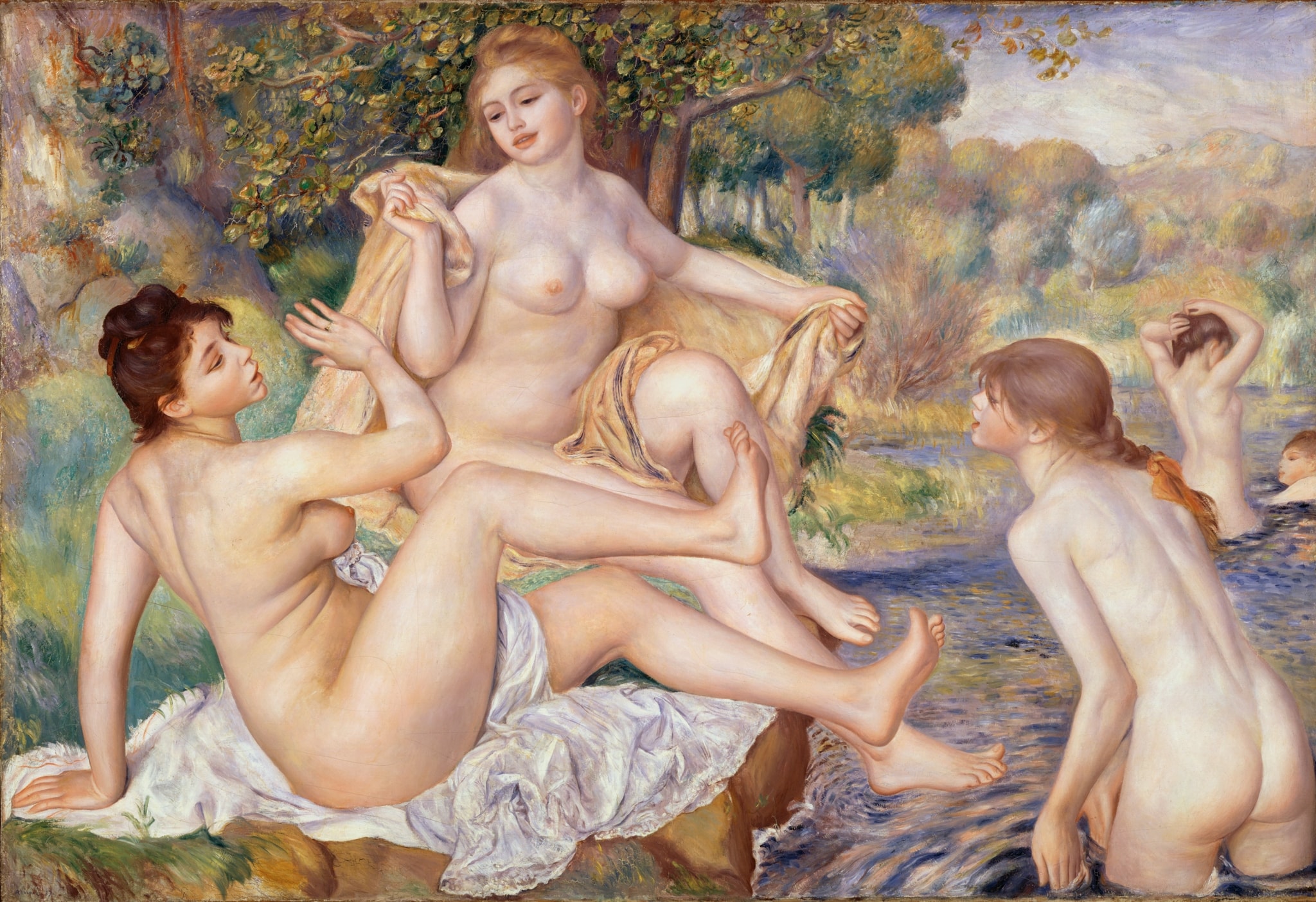
The Large Bathers by Pierre-Auguste Renoir (1884–1887) featuring Flowing stream, Golden drape, Raised, presiding hand/gesture, Splashing hand

Click on any numbered symbol to learn more about its meaning

Meaning & Symbolism

Renoir builds meaning through a choreography of bodies that declares order over accident. The central bather lifts a golden drape like a standard, her raised hand and soft contrapposto presiding over the group. At left, the reclining figure’s extended legs sweep in a continuous S-curve whose arc is mirrored by the kneeling bather at the water’s edge; together they lock the foreground into a triangular, relief-like scaffold. Behind, one figure flips water in a high, decisive gesture while another combs her hair—quotations of baroque and classical bath motifs that anchor the scene in a long tradition of nymphs at a stream 24. Renoir’s dry, polished handling and firm contours—especially along calves, shoulders, and the drapery’s hard edge—resist the broken, vaporous brushwork of orthodox Impressionism, asserting sculptural permanence even as leaves shimmer and the brook glints across the surface 12. Flesh is modeled in warm peaches and pinks that glow against cool greens and blues, a calculated temperature play that dramatizes contact between body and nature without surrendering to optical blur 1. The result is not reportage but idealization: a decorative frieze made from living models yet elevated beyond anecdote. This classicizing program is polemical as well as poetic. After his Italian journey, Renoir sought stronger drawing and a syntax of line he associated with Raphael and Ingres; The Large Bathers is the culmination of that self-imposed discipline, developed through years of studies and full-scale cartoons 23. By disciplining contour, he converts casual leisure into a ritual of renewal: water touches every figure—lapping at the right bather’s shins, streaming beneath the foreground rock, splashing behind—so that bathing functions as purification and bonding rather than mere pastime 1. The golden drape both frames and modestly veils, invoking antique attributes while guiding the eye through the interlocking arcs of arms and legs. The “splashing hand” at back right punctures the idyll with a momentary action, but the composition absorbs it, proving that the ephemeral can be ordered into a timeless design 12. Contemporary responses recognized the wager: Monet admired the synthesis as “superb,” while Pissarro found the system incoherent—evidence that the painting stood at the fault line between avant-garde spontaneity and a resurgent classicism 24. Today, the canvas reads as Renoir’s most articulate statement of Classical Impressionism: the bodies’ sculpted stillness declares continuity with the Old Masters, while the dappled grove and living water affirm the modern experience of light. The Large Bathers thus proposes an Edenic world where touch, companionship, and nature are reconciled—not by mythic narrative, but by the form itself, whose measured rhythms make innocence feel plausible again 123.

Explore Deeper with AI

Ask questions about The Large Bathers

Popular questions:

Powered by AI • Get instant insights about this artwork

💬 Ask questions about this artwork!

Interpretations

Historical Context

Renoir publicly framed this canvas as an “essay in decorative painting,” debuting it at Georges Petit in 1887 with ambitions closer to mural or frieze than easel picture 3. The three‑year, drawing‑intensive genesis—including full‑scale cartoons—signals a deliberate counter to Impressionist spontaneity and a bid for monumental, public‑facing prestige 13. Seen against his Italian sojourn and renewed admiration for Raphael, the project embodies a self‑declared crisis: to reconcile modern light with classical order. Its exhibition positioning announces a career wager—can an Impressionist claim the territory of the Old Masters without abandoning modern sensation? The answer is staged not as narrative, but as decorative architecture in paint, where bodies operate like structural piers in a designed environment 23.

Source: The Morgan Library & Museum; Philadelphia Museum of Art; Clark Art Institute

Formal Analysis (Relief, Frieze, and Source Quotation)

The grouping reads like a low relief transposed to oil: interlocking S‑curves and a triangulated foreground echo sculptural scaffolds, while the back‑right “splashing” motif directly recalls Girardon’s Bath of the Nymphs 24. Renoir’s contours—firm along calves and drapery—participate in an Ingresque lineage; the golden drape functions as both classical attribute and color vector, binding limbs into a frieze. These quotations are not pastiche but structural devices: citations stabilize the scene’s kinetics, converting flicker into measure. By importing baroque/classical bath conventions into a modern grove, Renoir asserts that tradition can still organize perception—an authorship articulated through the selective grafting of canonical poses and relief logic onto living models 24.

Source: Clark Art Institute; Barbara Ehrlich White, The Art Bulletin (1973)

Medium Reflexivity (Surface as Argument)

Renoir’s “dry, polished handling” and fresco‑like finish operate as a thesis about painting itself: contour and controlled impasto promise duration where Impressionism’s broken touch risks evanescence 12. Years of cartooning and redrawing embed drawing as armature, making facture legible as ideology—line as ethics, not just style. The warm‑cool temperature play (peach flesh against cool greens) dramatizes contact without dissolving forms into optical fog, an anti‑vapor stance he embraced after Italy, when he sought stronger drawing and permanence akin to Raphael 26. Technique here is content: the surface declares classicism’s claim to truth—durable, measured, transmissible—while still admitting glints and shimmer as concessions to modern light 126.

Source: Philadelphia Museum of Art; Clark Art Institute; Britannica

Gender & Sexuality (Models, Agency, and the Gaze)

Scholars have plausibly linked Aline Charigot and Suzanne Valadon to principal figures, inflecting the work with the dynamics of the artist–model relationship; Valadon, a model‑turned‑painter, troubles the passive nude stereotype 54. Renoir’s idealization classicizes their bodies, yet the assertive center figure—arm raised with drape like a standard—commands space rather than merely offering it to the gaze. The choreography suggests female sociability rather than seduction: hair‑combing and splashing code intimacy within a closed circle. Still, the polished, museum‑scale presentation domesticates eroticism into an art‑historical ideal. The painting thus stages a negotiation between erotic display and professionalized ideal beauty, filtered through real women whose identities (if indeed present) complicate the fiction of anonymous nymphs 45.

Source: Museums of Cagnes‑sur‑Mer (Renoir Museum); Barbara Ehrlich White, The Art Bulletin (1973)

Reception & Risk (Market, Peers, and Strategy)

The canvas split Renoir’s peers: Monet deemed it “superb,” Pissarro “incoherent,” capturing a rift over whether classicizing structure enriched or betrayed Impressionism’s ethos 2. Clark curators note that this classicizing phase endangered Renoir’s market position, as collectors primed for sparkle confronted an austere, linear program 2. Yet the bet was strategic: by mastering high decorative order, Renoir aimed to claim Old Master gravitas without relinquishing modern light. The mixed critical return clarifies its stakes as career pivot and manifesto—less a detour than a recalibration of means, foregrounding drawing and design as guarantors of value in a volatile late‑19th‑century art economy 26.

Source: Clark Art Institute; Britannica

Symbolic Reading (Pastoral Rite and Secular Sacrality)

Water threads through the composition—lapping, streaming, splashing—so that bathing becomes a ritual of renewal, a secular sacrament that binds the group 1. The controlled rhythm of limbs and the framing drape ritualize touch, while the brook’s glint and dappled leaf‑light refresh without destabilizing forms. This is Arcadia engineered: an Edenic pastoral that confers innocence not by mythic narrative but by form’s measured regularity. The splash injects time’s instant; the frieze absorbs it, promising continuity. In this lens, Renoir’s classicism functions as a technology of consolation, making purity plausible in the modern—the pastoral ideal recoded as a compositional ethic, where design itself performs the work of purification 12.

Source: Philadelphia Museum of Art; Clark Art Institute

Related Themes

About Pierre-Auguste Renoir

Pierre-Auguste Renoir (1841–1919) emerged from craft training into the avant-garde circle around Monet, Sisley, and Bazille, helping to found Impressionism. In the mid‑1870s he focused on outdoor scenes of modern leisure in and around Montmartre, using dappled light and high-chroma color to capture transient sensations [1][2][5].
View all works by Pierre-Auguste Renoir

More by Pierre-Auguste Renoir
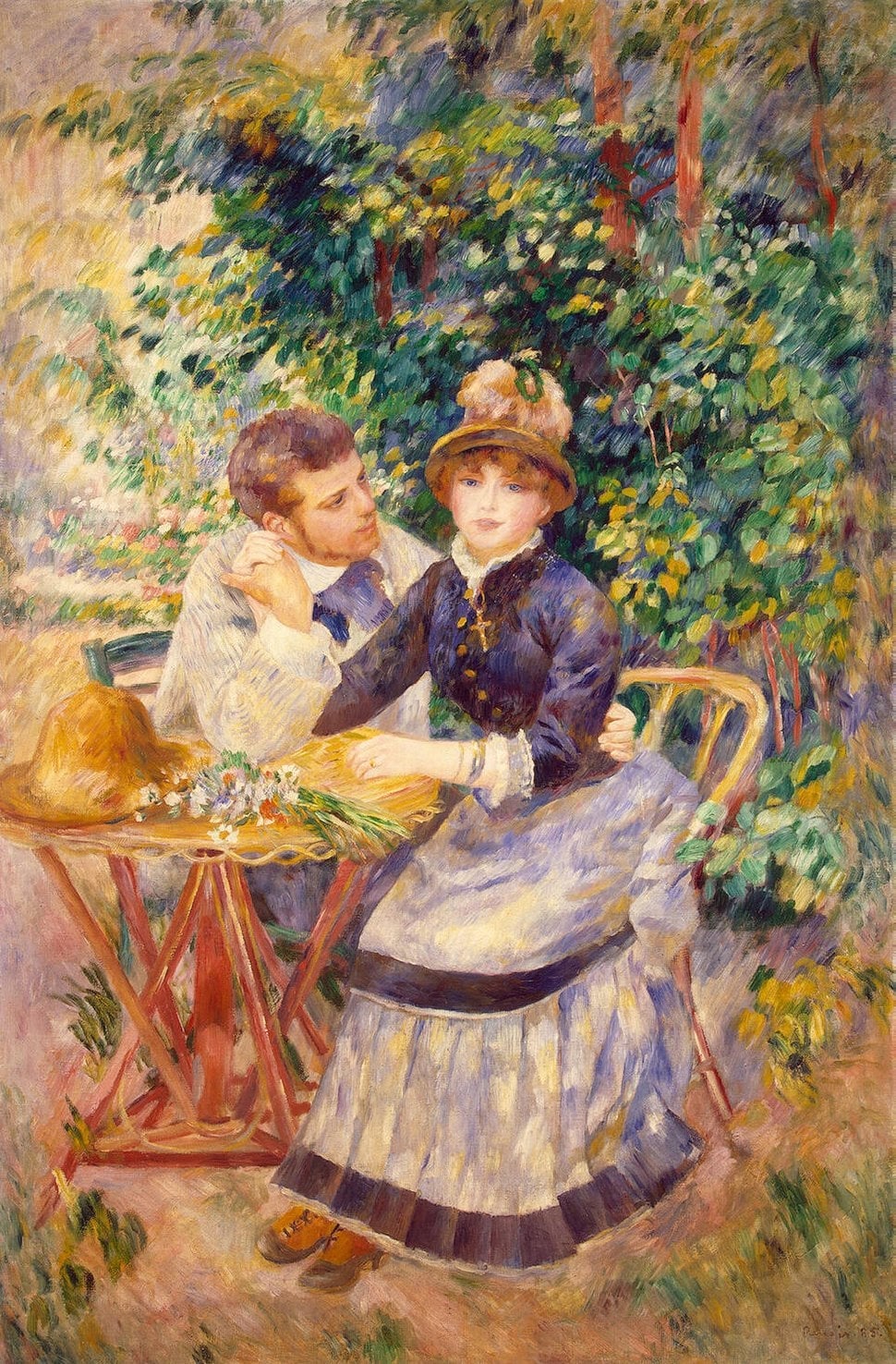
In the Garden by Pierre-Auguste Renoir

In the Garden

Pierre-Auguste Renoir (1885)

In the Garden presents a charged pause in modern leisure: a young couple at a café table under a living arbor of leaves. Their lightly clasped hands and the bouquet on the tabletop signal courtship, while her calm, front-facing gaze checks his lean. Renoir’s flickering brushwork fuses figures and foliage, rendering love as a <strong>transitory, luminous sensation</strong> <sup>[1]</sup><sup>[3]</sup>.
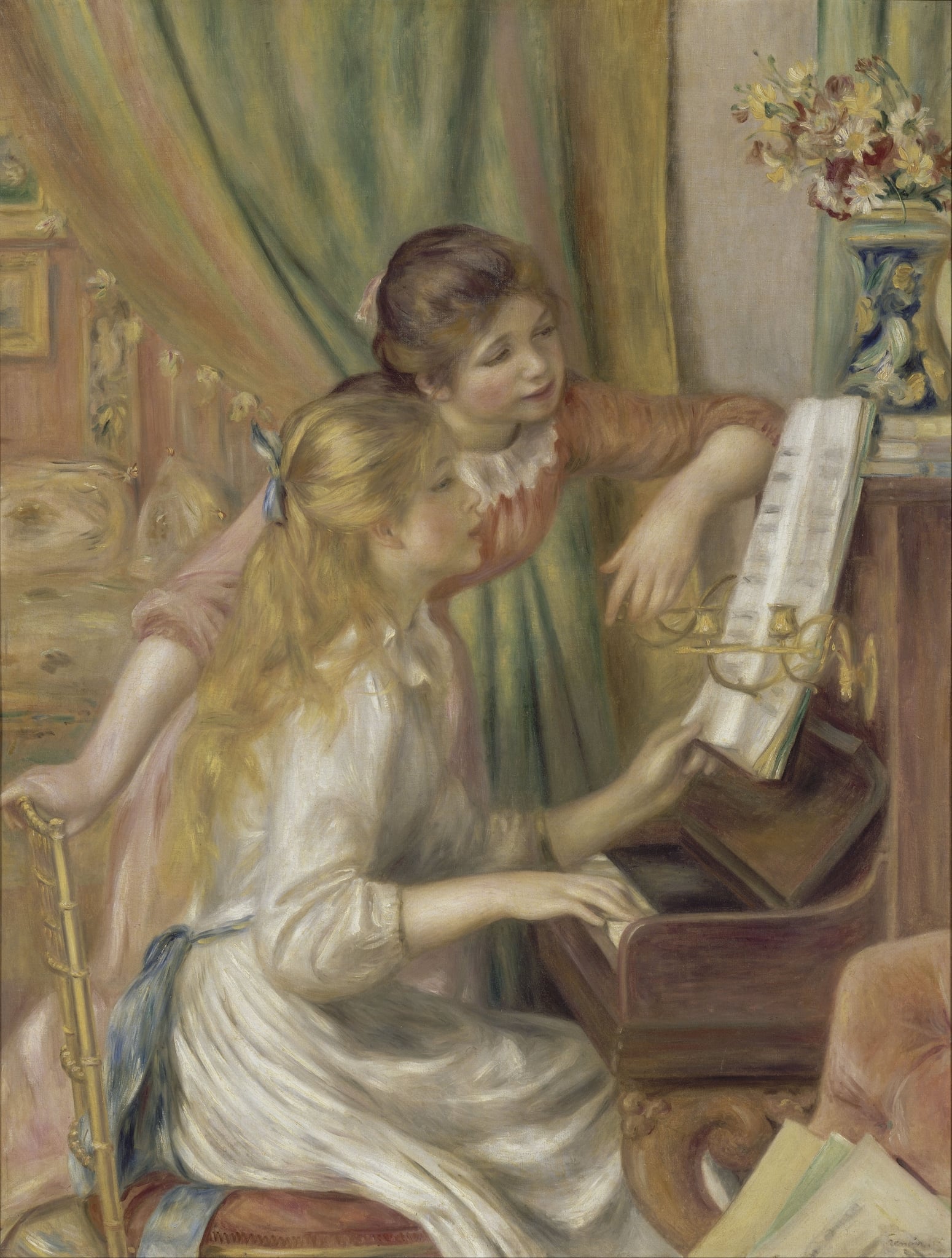
Young Girls at the Piano by Pierre-Auguste Renoir

Young Girls at the Piano

Pierre-Auguste Renoir (1892)

Renoir’s Young Girls at the Piano turns a quiet lesson into a scene of <strong>attunement</strong> and <strong>bourgeois grace</strong>. Two adolescents—one seated at the keys, the other leaning to guide the score—embody harmony between discipline and delight, rendered in Renoir’s late, <strong>luminous</strong> touch <sup>[1]</sup><sup>[2]</sup>.

Pont Neuf Paris by Pierre-Auguste Renoir

Pont Neuf Paris

Pierre-Auguste Renoir (1872)

In Pont Neuf Paris, Pierre-Auguste Renoir turns the oldest bridge in Paris into a stage where <strong>light</strong> and <strong>movement</strong> bind a city back together. From a high perch, he orchestrates crowds, carriages, gas lamps, the rippling Seine, and a fluttering <strong>tricolor</strong> so that everyday bustle reads as civic grace <sup>[1]</sup>.

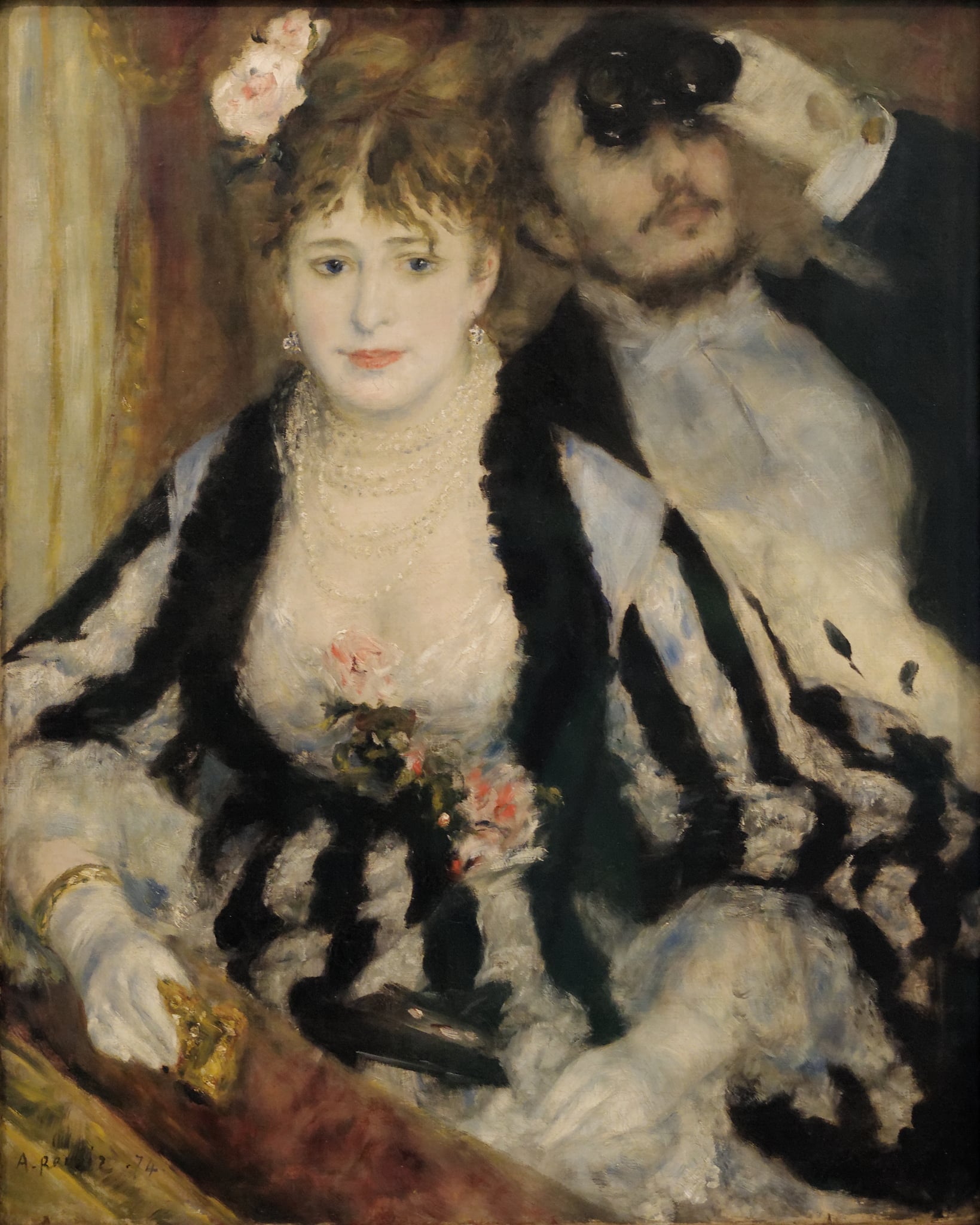
The Loge by Pierre-Auguste Renoir

The Loge

Pierre-Auguste Renoir (1874)

Renoir’s The Loge (1874) turns an opera box into a <strong>stage of looking</strong>, where a woman meets our gaze while her companion scans the crowd through binoculars. The painting’s <strong>frame-within-a-frame</strong> and glittering fashion make modern Parisian leisure both alluring and self-conscious, turning spectators into spectacles <sup>[1]</sup><sup>[2]</sup>.
The Swing by Pierre-Auguste Renoir

The Swing

Pierre-Auguste Renoir (1876)

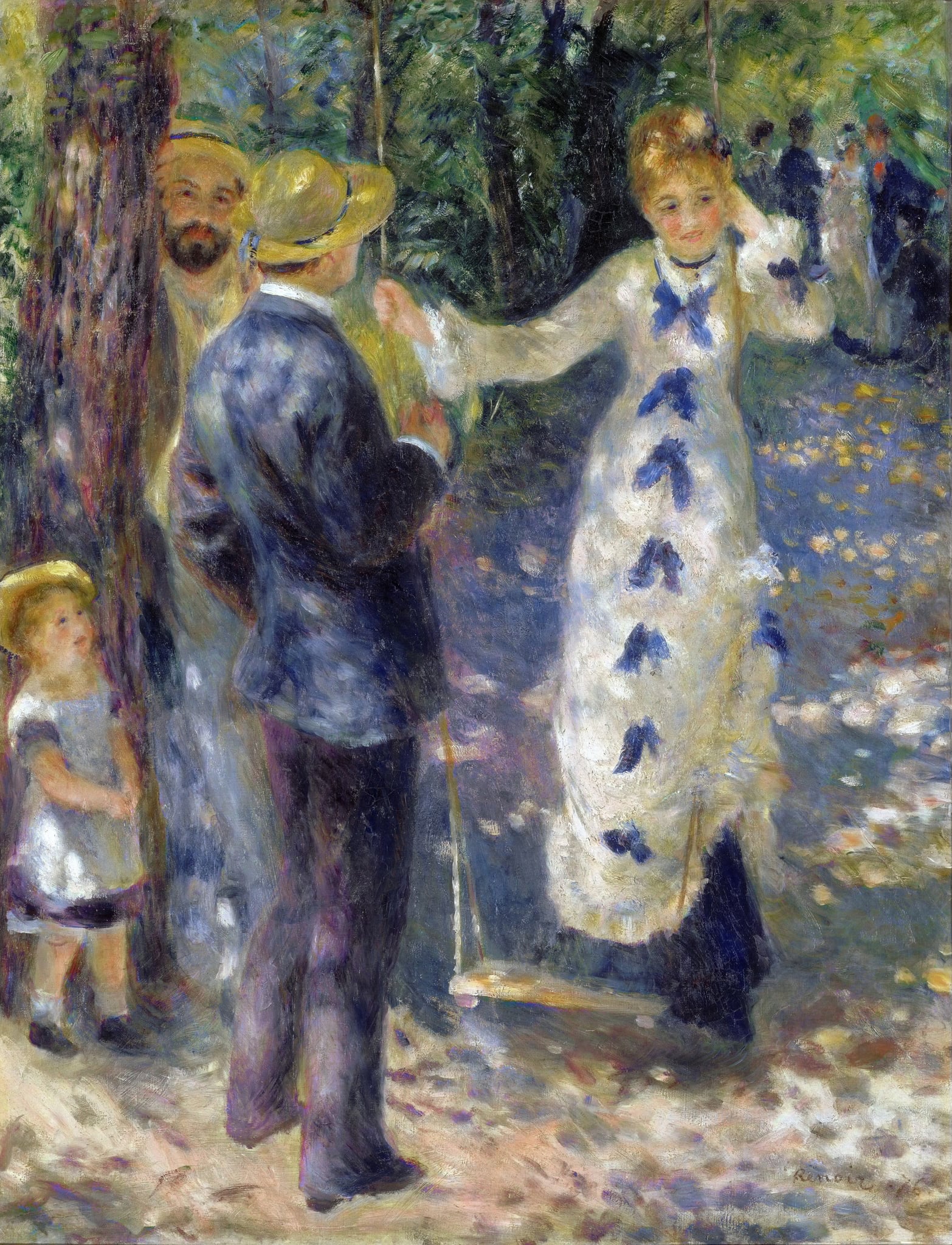
Renoir’s The Swing fixes a fleeting, sun-dappled exchange in a Montmartre garden, where a woman in a white dress with blue bows steadies herself on a swing while a man in a blue jacket addresses her. The scene crystallizes <strong>modern leisure</strong>, <strong>flirtation</strong>, and <strong>optical shimmer</strong>, as broken strokes scatter light over faces, fabric, and ground <sup>[1]</sup><sup>[4]</sup>.

Madame Monet and Her Son by Pierre-Auguste Renoir

Madame Monet and Her Son

Pierre-Auguste Renoir (1874)

Renoir’s 1874 canvas Madame Monet and Her Son crystallizes <strong>modern domestic leisure</strong> and <strong>plein‑air immediacy</strong> in Argenteuil. A luminous white dress pools into light while a child in a pale‑blue sailor suit reclines diagonally; a strutting rooster punctuates the greens with warm color. The brushwork fuses figure and garden so the moment reads as <strong>lived, not staged</strong> <sup>[1]</sup><sup>[2]</sup><sup>[5]</sup>.