In the Garden
Study Print Studio
Create a personal study print
Build a companion study sheet around the part of this painting that speaks to you most. Choose a detail, shape an interpretation, and walk away with something personal and display-worthy.
Fast Facts
- Year
- 1885
- Medium
- Oil on canvas
- Dimensions
- 170.5 × 112.5 cm
- Location
- State Hermitage Museum, Saint Petersburg
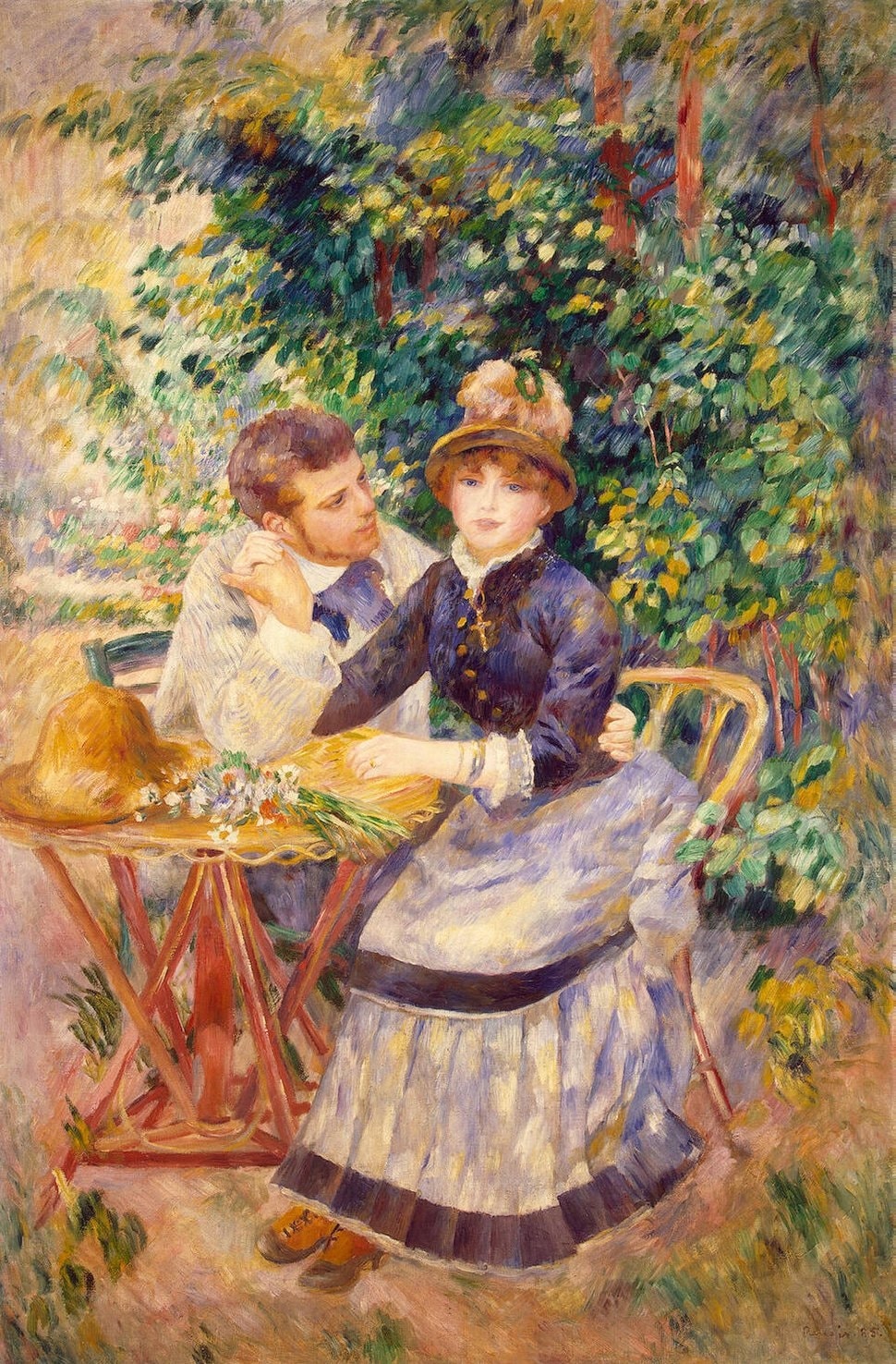
Click on any numbered symbol to learn more about its meaning
Meaning & Symbolism
Explore Deeper with AI
Ask questions about In the Garden
Popular questions:
Powered by AI • Get instant insights about this artwork
Interpretations
Transitional Style: From Flicker to Contour
Source: National Gallery, London; National Gallery Technical Bulletin; Met Museum (Heilbrunn)
Semi‑Public Intimacy: The Café‑Garden as Social Stage
Source: Robert L. Herbert (social history of Impressionism); Met Museum (Heilbrunn)
Gaze, Agency, and Gendered Etiquette
Source: French museum summaries (Hermitage-linked); Robert L. Herbert
Ephemera as Ethics: Flowers, Hats, and Time
Source: Met Museum (Heilbrunn Timeline of Art History)
Afterlives of a Picture: Provenance and Visibility
Source: State Hermitage Museum; French-language summaries citing Kostenevich’s 1995 reveal
Related Themes
About Pierre-Auguste Renoir
More by Pierre-Auguste Renoir
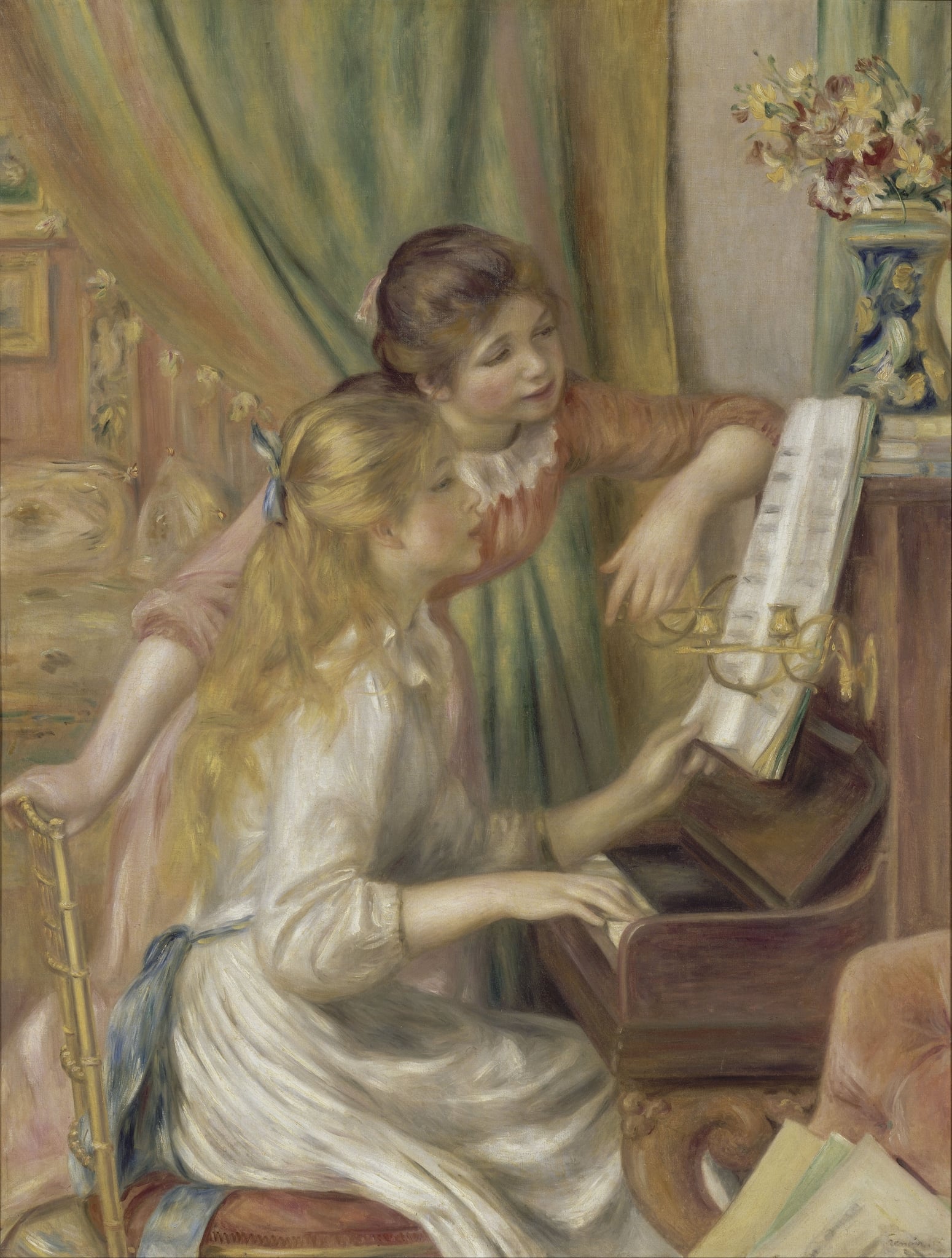
Young Girls at the Piano
Pierre-Auguste Renoir (1892)
Renoir’s Young Girls at the Piano turns a quiet lesson into a scene of <strong>attunement</strong> and <strong>bourgeois grace</strong>. Two adolescents—one seated at the keys, the other leaning to guide the score—embody harmony between discipline and delight, rendered in Renoir’s late, <strong>luminous</strong> touch <sup>[1]</sup><sup>[2]</sup>.

Pont Neuf Paris
Pierre-Auguste Renoir (1872)
In Pont Neuf Paris, Pierre-Auguste Renoir turns the oldest bridge in Paris into a stage where <strong>light</strong> and <strong>movement</strong> bind a city back together. From a high perch, he orchestrates crowds, carriages, gas lamps, the rippling Seine, and a fluttering <strong>tricolor</strong> so that everyday bustle reads as civic grace <sup>[1]</sup>.
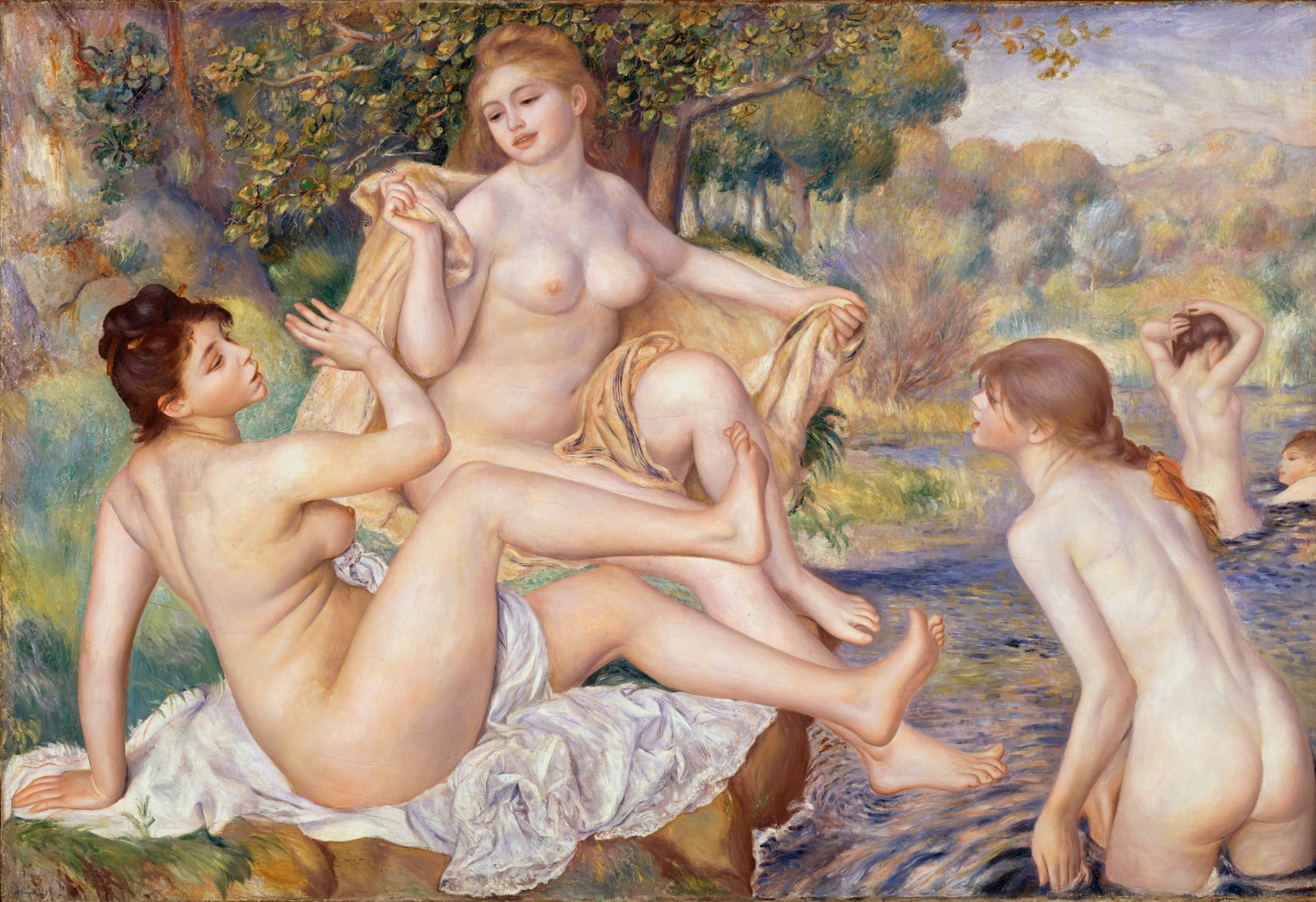
The Large Bathers
Pierre-Auguste Renoir (1884–1887)
Pierre-Auguste Renoir’s The Large Bathers unites modern bodies with a pastoral grove to stage an <strong>Arcadian ideal</strong>. Three monumental nudes form interlocking curves and triangles while two background figures splash and groom, fusing <strong>sensual warmth</strong> with <strong>classical order</strong> <sup>[1]</sup><sup>[2]</sup>.

After the Luncheon
Pierre-Auguste Renoir (1879)
After the Luncheon crystallizes a <strong>suspended instant</strong> of Parisian leisure: coffee finished, glasses dappled with light, and a cigarette just being lit. Renoir’s <strong>shimmering brushwork</strong> and the trellised spring foliage turn the scene into a tapestry of conviviality where time briefly pauses.
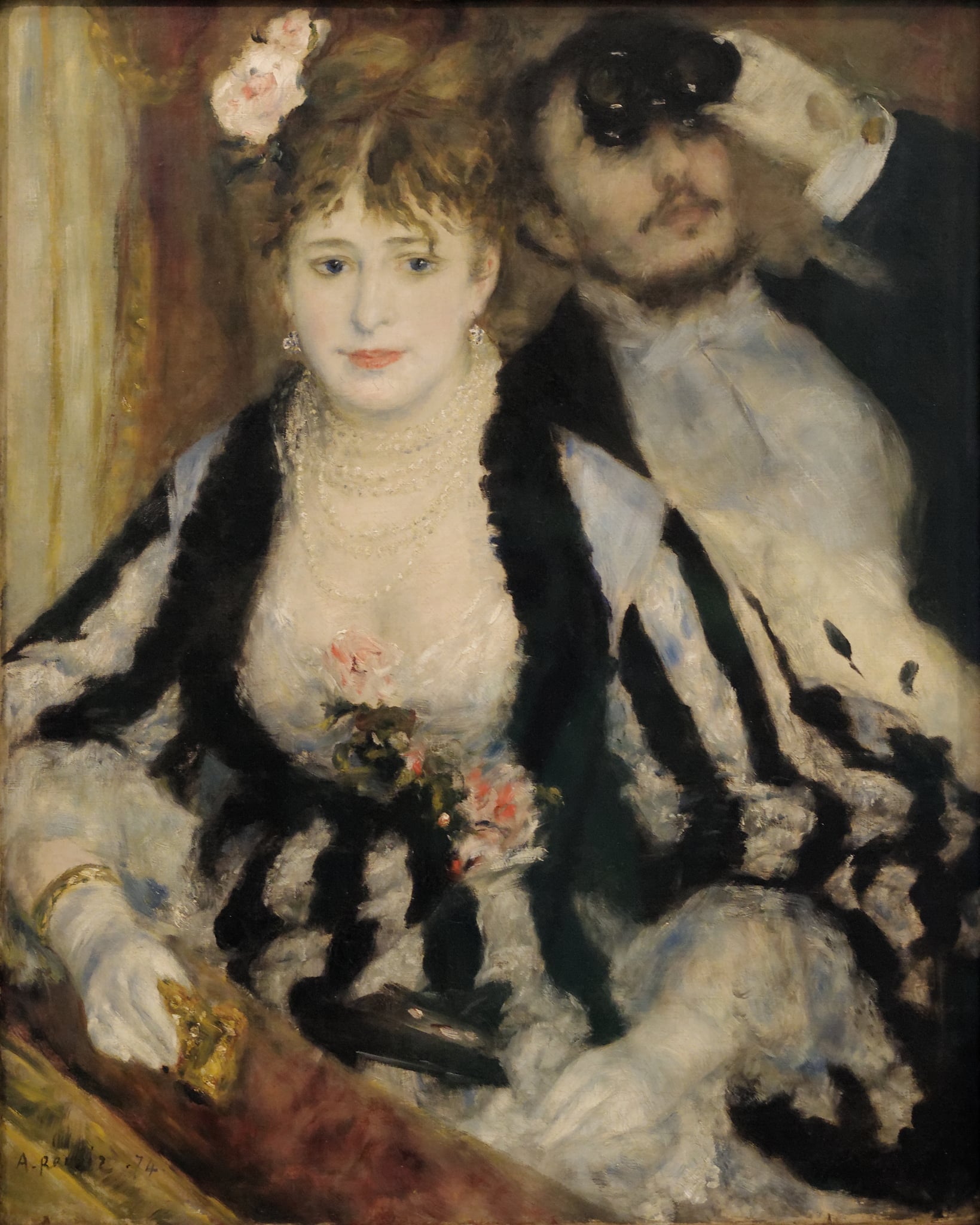
The Loge
Pierre-Auguste Renoir (1874)
Renoir’s The Loge (1874) turns an opera box into a <strong>stage of looking</strong>, where a woman meets our gaze while her companion scans the crowd through binoculars. The painting’s <strong>frame-within-a-frame</strong> and glittering fashion make modern Parisian leisure both alluring and self-conscious, turning spectators into spectacles <sup>[1]</sup><sup>[2]</sup>.
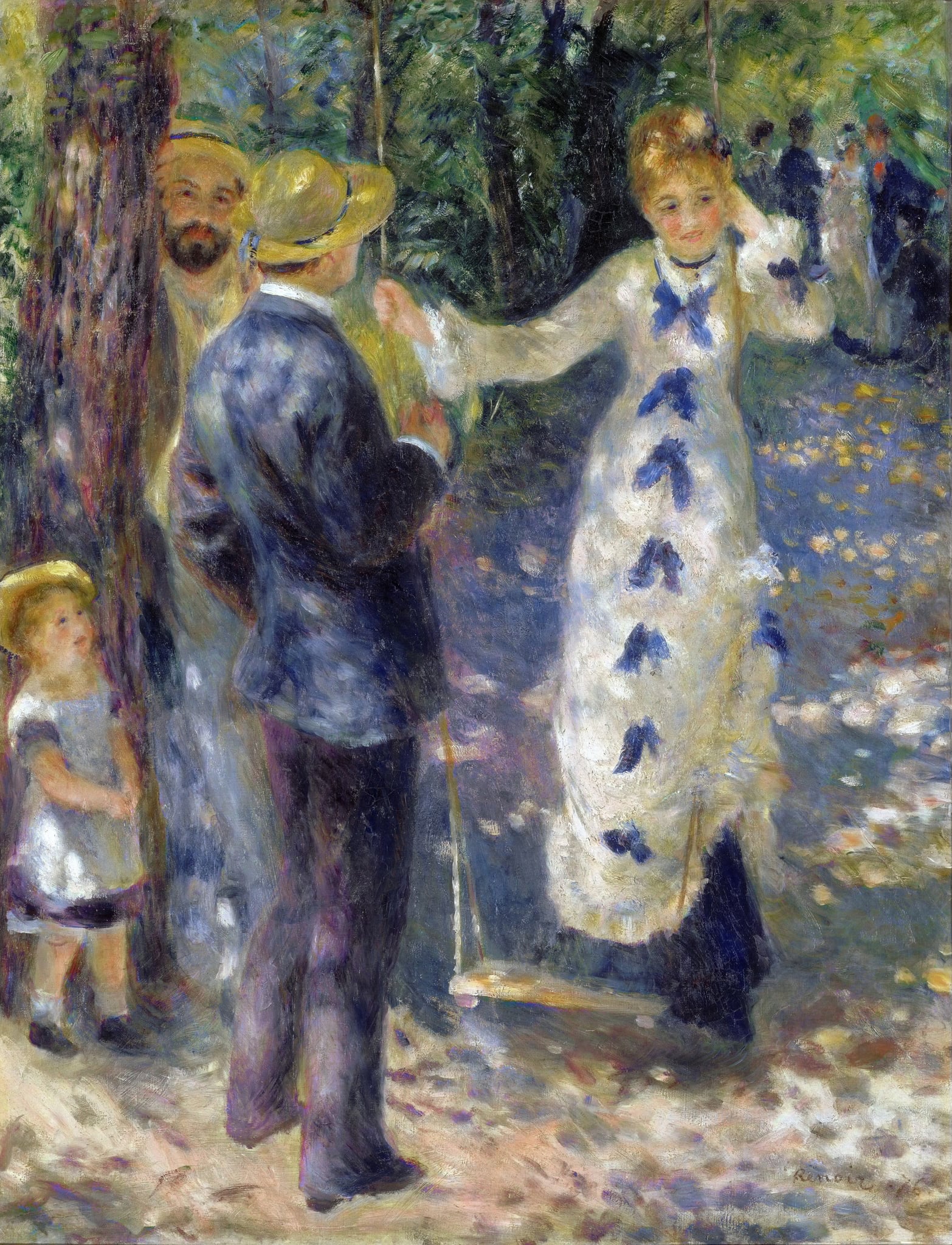
The Swing
Pierre-Auguste Renoir (1876)
Renoir’s The Swing fixes a fleeting, sun-dappled exchange in a Montmartre garden, where a woman in a white dress with blue bows steadies herself on a swing while a man in a blue jacket addresses her. The scene crystallizes <strong>modern leisure</strong>, <strong>flirtation</strong>, and <strong>optical shimmer</strong>, as broken strokes scatter light over faces, fabric, and ground <sup>[1]</sup><sup>[4]</sup>.