The Son of Man

by Rene Magritte

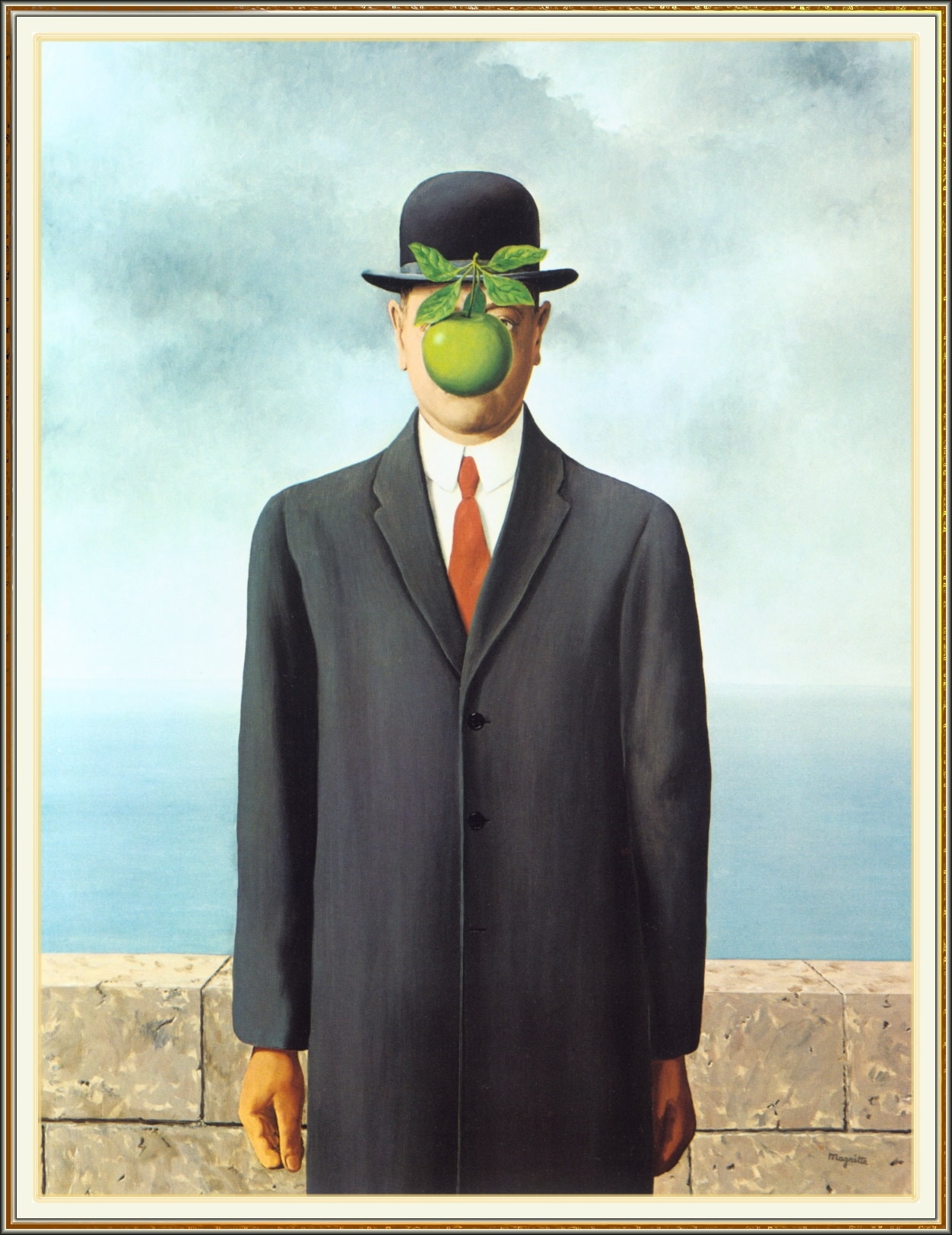
Rene Magritte’s The Son of Man stages a crisp everyman in bowler hat and overcoat before a sea horizon while a green apple hovers to block his face. The tiny glimpse of one eye above the fruit turns a straightforward portrait into a riddle about seeing and knowing [1][2].
💰

Market Value

$100-150 million

How much is The Son of Man worth?

Fast Facts

Year
1964
Medium
Oil on canvas
Dimensions
116 × 89 cm
Location
Private collection
The Son of Man by Rene Magritte (1964) featuring Green apple, Peeking eye, Bowler hat, Black overcoat and red tie

Click on any numbered symbol to learn more about its meaning

Meaning & Symbolism

The painting engineers a conflict between appearance and knowledge with extreme economy. The bowler-hatted figure stands stiffly before a low stone parapet; the cool sea and clouded sky retreat to a distant horizon. These sober, nearly neutral elements create a stage on which a single disruption—a levitating green apple, leaves and stem intact—screens the face. Magritte described this device as a confrontation between the visible that is present and the visible that is hidden, insisting that our urge is to see what lies behind what we see 1. The apple literalizes this urge. It is not symbolic in any single doctrinal sense, yet it cannot avoid symbolic gravity; its Edenic echo is placed not in the hand but across the eyes, shifting temptation from taste to sight—knowledge as seeing, forbidden because it is blocked 14. Magritte intensifies the paradox by granting us a threadbare concession: a sliver of the subject’s eye peers above the apple’s rim. That tiny crescent, both proof of a person and proof of obstruction, turns the viewer into a detective caught between confirmation and denial. The rest of the figure doubles down on anonymity. The black overcoat, pressed collar, and red tie announce bourgeois uniformity, an effect Magritte cultivated with his recurrent bowler-hatted men—avatars of the ordinary who “pose no surprise” and therefore erase individuality 3. Here, conformity is not merely costume; it is an epistemic condition. The uniform says “anyone,” the blocked face says “no one,” and the peeking eye says “someone.” The son of man becomes a trinity of identities at once: type, absence, and singularity. Even the environment participates in this logic. The parapet and horizon, frequent in Magritte’s staging, impart theatrical calm that heightens the cognitive jolt of occlusion 4. The space suggests openness—the sea as distant, cool infinity—yet the wall and apple reiterate limits: boundaries of place, boundaries of sight. A small, often overlooked kink complicates the body’s legibility: the left arm appears subtly anatomically off, as if reversed at the elbow, a quiet dissonance that confirms the world of the painting obeys neither anatomy nor expectation. Magritte’s late-period interest in the gap between seeing and knowing, foregrounded in museum surveys, is compacted here into a single encounter with the viewer’s own desire to unveil 2. Read as a late self-portrait—produced in response to a request for one—the picture’s refusal to disclose a face becomes a declaration of artistic method. The self offered is an idea: a man whose image asserts that images conceal. The title, The Son of Man, courts theological resonance while sidestepping doctrine, aligning with Magritte’s practice of inviting but frustrating fixed allegory 1. That calculated ambiguity is the work’s power. It does not tell us what the apple “means.” It forces us to experience how meaning forms and fails in the act of looking. In that sense the painting is secular and philosophical: a lucid image of modernity’s polished surfaces and the mysteries they mask—where knowledge arrives as a tease, an eye peeking over an obstacle that will never quite move aside 1245.

Explore Deeper with AI

Ask questions about The Son of Man

Popular questions:

Powered by AI • Get instant insights about this artwork

💬 Ask questions about this artwork!

Interpretations

Semiotics and Title as Trap

Magritte mobilizes the title as an instrument of semiotic misdirection. “The Son of Man” steers viewers toward Christian meaning while the image withholds doctrinal clarity, creating a slippage between signifier and signified. The hovering apple becomes a sign that blocks seeing, not a stable symbol to decode. This aligns with Magritte’s broader project—making the ordinary strange to expose how words and images fail to coincide. The painting thus performs a lesson in representation: titles nudge interpretation, images resist closure, and the viewer is left negotiating a gap that is the work’s true subject. Magritte’s own remarks about the visible/hidden and MoMA’s framing of his “mystery of the ordinary” corroborate this semiotic reading 13.

Source: MoMA; Christie’s (quoting Torczyner/Magritte)

Bourgeois Anonymity and Class

The bowler hat and business suit code the figure as bourgeois—an emblem of mid‑century office culture whose power lies in banality. Magritte repeatedly chose this attire because it “poses no surprise,” producing an anyone whose social legibility eclipses individuality. In The Son of Man, that classed uniform meets literal occlusion: the face is screened, intensifying depersonalization while hinting at a resistant, peering subject. The result is a quiet critique of modern identity under capitalism—visibility reduced to a dress code, personhood displaced by role. Artsy’s synthesis of the bowler’s motif and SFMOMA’s emphasis on Magritte’s late investigations into perception support this socio‑iconographic reading 42.

Source: Artsy; SFMOMA

Theological Undertone, Doctrinal Refusal

The picture courts Christian iconography—apple, “Son of Man”—then withholds doctrinal meaning. Christie’s cites Magritte’s repeated denial of theological intent even as David Sylvester notes such objects carry “irredeemable” symbolic charge. The crucial displacement is from taste to sight: the Edenic apple is not grasped but floated before the eyes, recoding temptation as the desire to see what is forbidden. The painting therefore stages theology as an interpretive pressure rather than a message: it demonstrates how symbols bind to images in spectators’ minds, and how a modern artist can both activate and frustrate that binding. The work’s power lies in this double move—invitation and refusal 1.

Source: Christie’s (Sylvester/Torczyner quotations)

Phenomenology of the Gaze

Magritte engineers a scopic puzzle: an eye peeking above a barrier that will not yield. This micro‑visibility triggers the viewer’s urge to unveil, a phenomenological drama where perception and knowledge never fully meet. SFMOMA situates this within Magritte’s late‑career focus on the gap between seeing and knowing; Torczyner’s recorded statement has Magritte insisting that “everything we see hides another thing.” The painting operationalizes this claim, making the spectator’s desire the real scene of action. The hovering apple is less object than apparatus—a device that produces awareness of looking itself, and of the permanent remainder that perception cannot capture 21.

Source: SFMOMA; Christie’s (Torczyner/Magritte)

Stagecraft, Anomaly, and the de Chirico Legacy

The calm parapet, endless sea, and overcast sky form a theatrical proscenium against which a single, irrational event occurs. This deadpan staging descends from the metaphysical chill of de Chirico, whose impact on Magritte was formative. Within this sober set, small breaches—levitation, the subtly reversed left arm—undo naturalism at the edges, proving that logic can collapse without spectacle. MoMA’s account of Magritte’s strategy—making the ordinary extraordinary—meets Britannica’s note on de Chirico’s influence to explain how the painting’s formal mechanics deliver its cognitive shock: restraint first, rupture second 35.

Source: MoMA; Encyclopaedia Britannica

Related Themes

About Rene Magritte

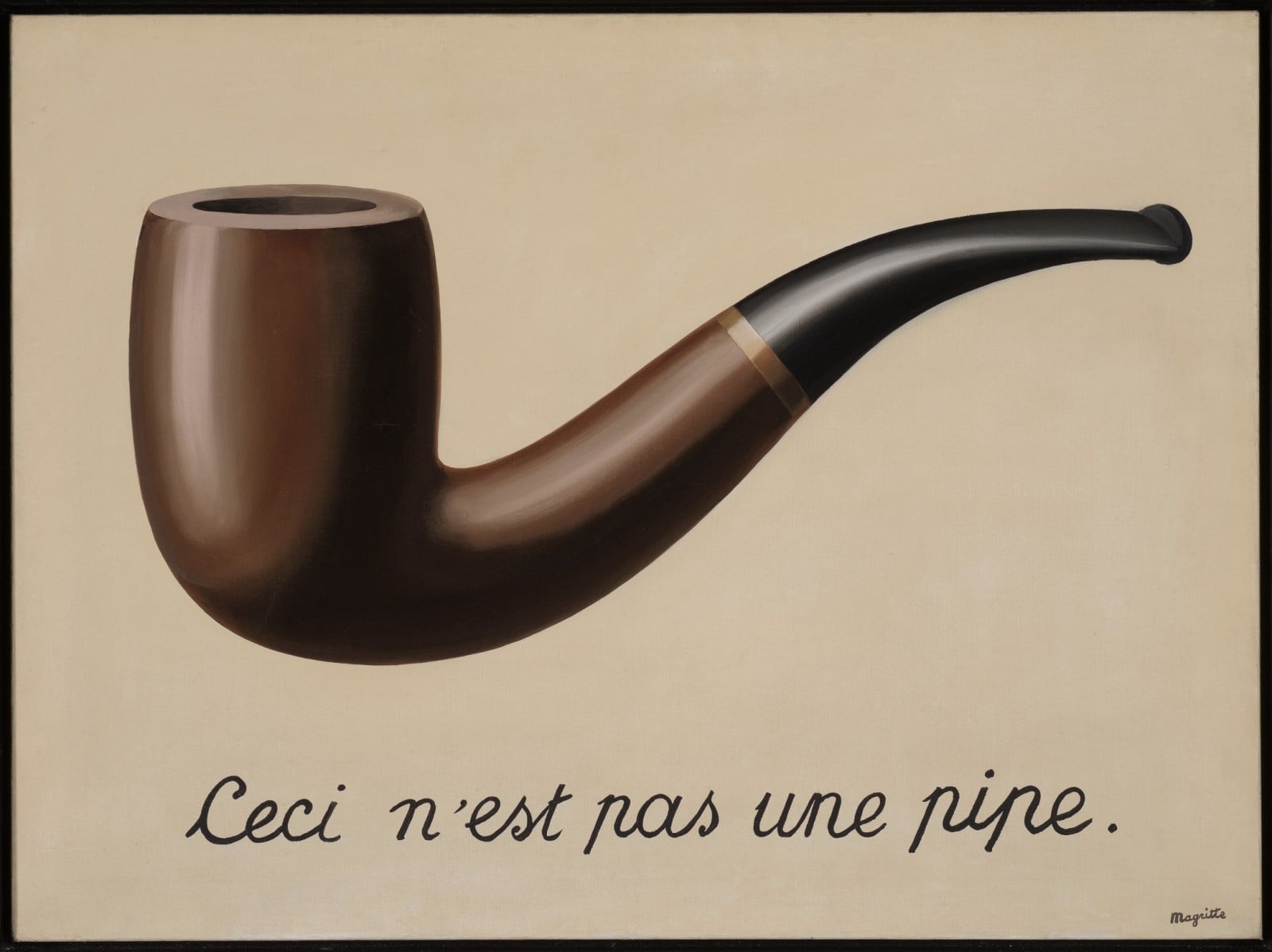
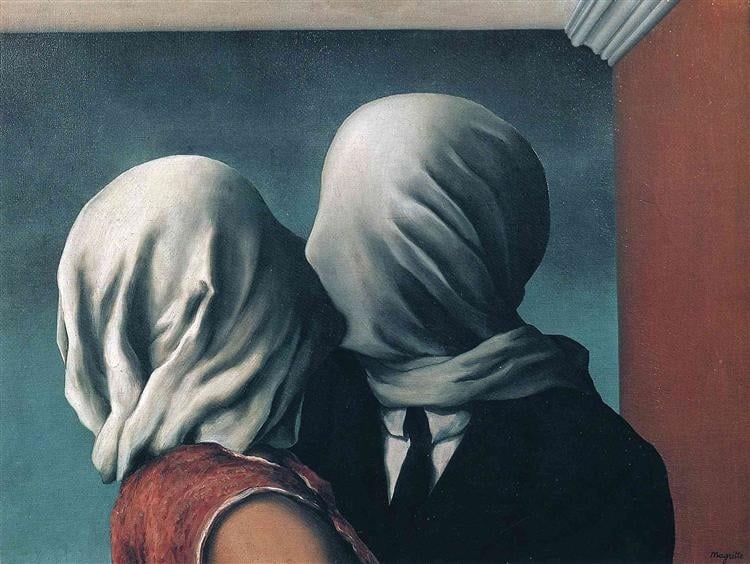
Rene Magritte (1898–1967) was a Belgian Surrealist who transformed ordinary motifs—apples, bowler hats, clouds—into philosophical puzzles about language, vision, and reality [5][4]. Influenced by de Chirico yet fiercely independent, he favored deadpan clarity to expose the mysteries latent in everyday things [4][5].
View all works by Rene Magritte