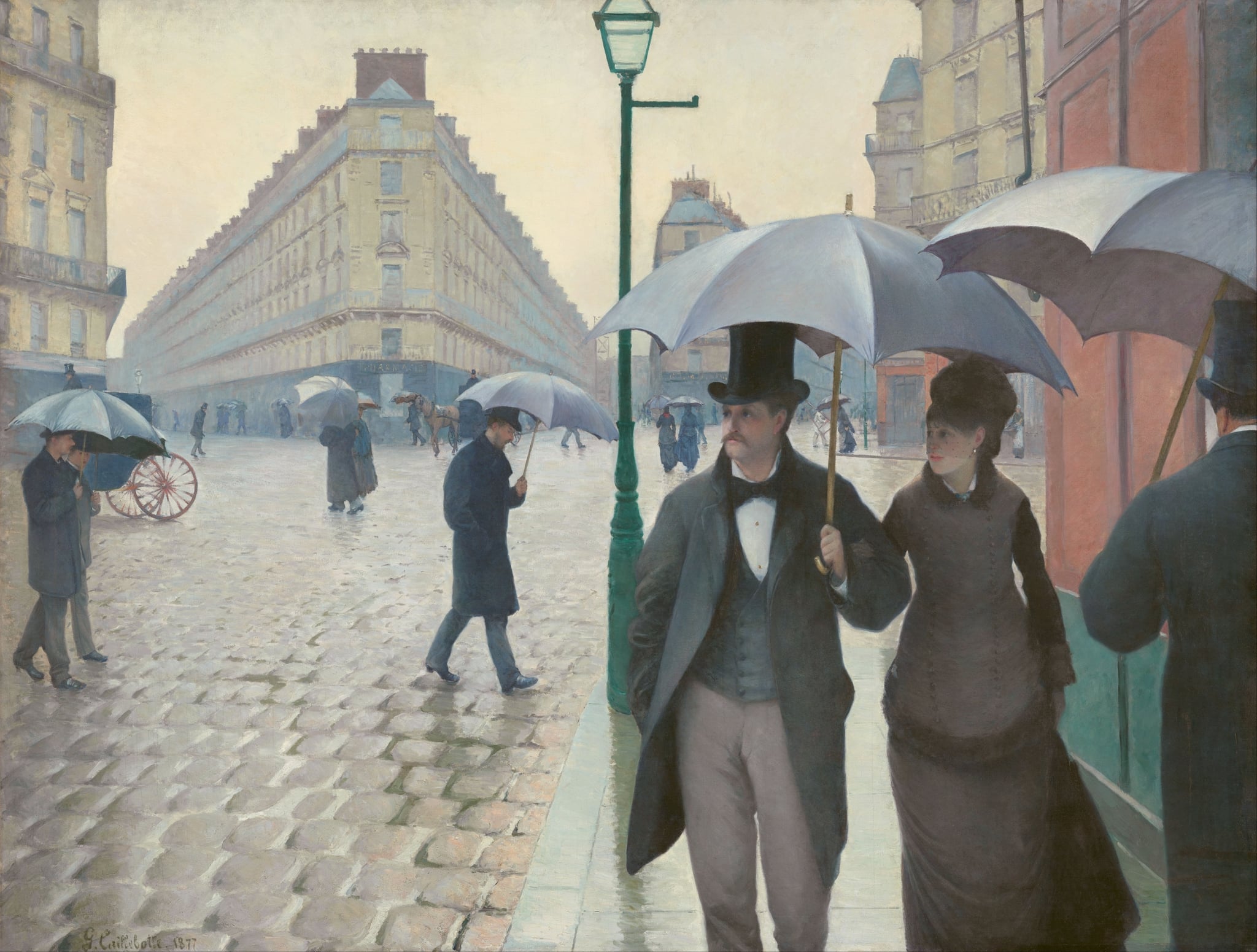
Bourgeois Couple (Flâneur and Companion) Symbolism
The Bourgeois Couple (Flâneur and Companion) denotes middle-class urban modernity: a well-dressed pair whose public promenade conveys leisure, civility, and self-possession. Rooted in the 19th-century city, the motif aligns the flâneur’s detached looking with a companion’s decorous presence to signal modern spectatorship and class identity. Artists deploy it to balance visibility and anonymity on the street.
Bourgeois Couple (Flâneur and Companion) in Paris Street; Rainy Day
In Gustave Caillebotte’s Paris Street; Rainy Day (1877), a centrally placed couple under a single umbrella—his top hat and fitted coat, her fashionable dress—crystallizes the type. Framed by a central gas lamp and the knife-sharp façades that organize the space into measured planes, their poised movement reads as bourgeois decorum within a silvery, rain-soaked order. Spaced from other passersby and echoed by umbrellas that punctuate the atmosphere, they are at once observers of the modern street and anonymous figures within it, embodying detached observation and decorous public presence.