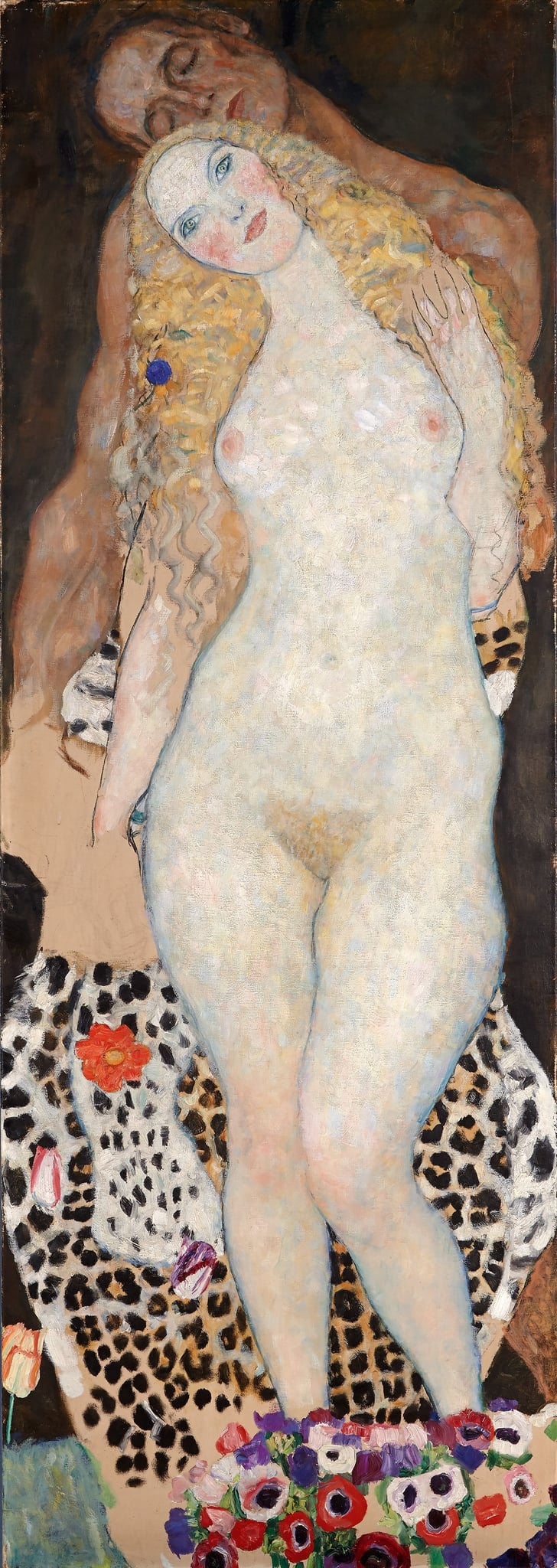
Eve’s luminous body Symbolism
Eve’s luminous body names a motif in which Eve’s radiant, pearly skin concentrates meanings of life-force, sensuality, and generative power. In this usage, luminosity is not merely descriptive light but an allegorical glow that centers the feminine as a source of vitality and daylight, as exemplified in Gustav Klimt’s treatment of the subject.
Eve’s luminous body in Adam and Eve
In Adam and Eve (1916–1918 (unfinished)) by Gustav Klimt, the symbol is explicit: Eve’s opalescent body and direct gaze dominate the scene, while Adam recedes in shadow, enfolding her. This contrast of radiance and darkness makes her luminous skin the work’s symbolic light source, aligning it with erotic vitality and fertility—a reading reinforced by the leopard pelt and the carpet of anemones. Klimt recasts the biblical pair as a sensual, timeless allegory, using Eve’s glow to assert the primacy of the feminine/daylight within the composition.