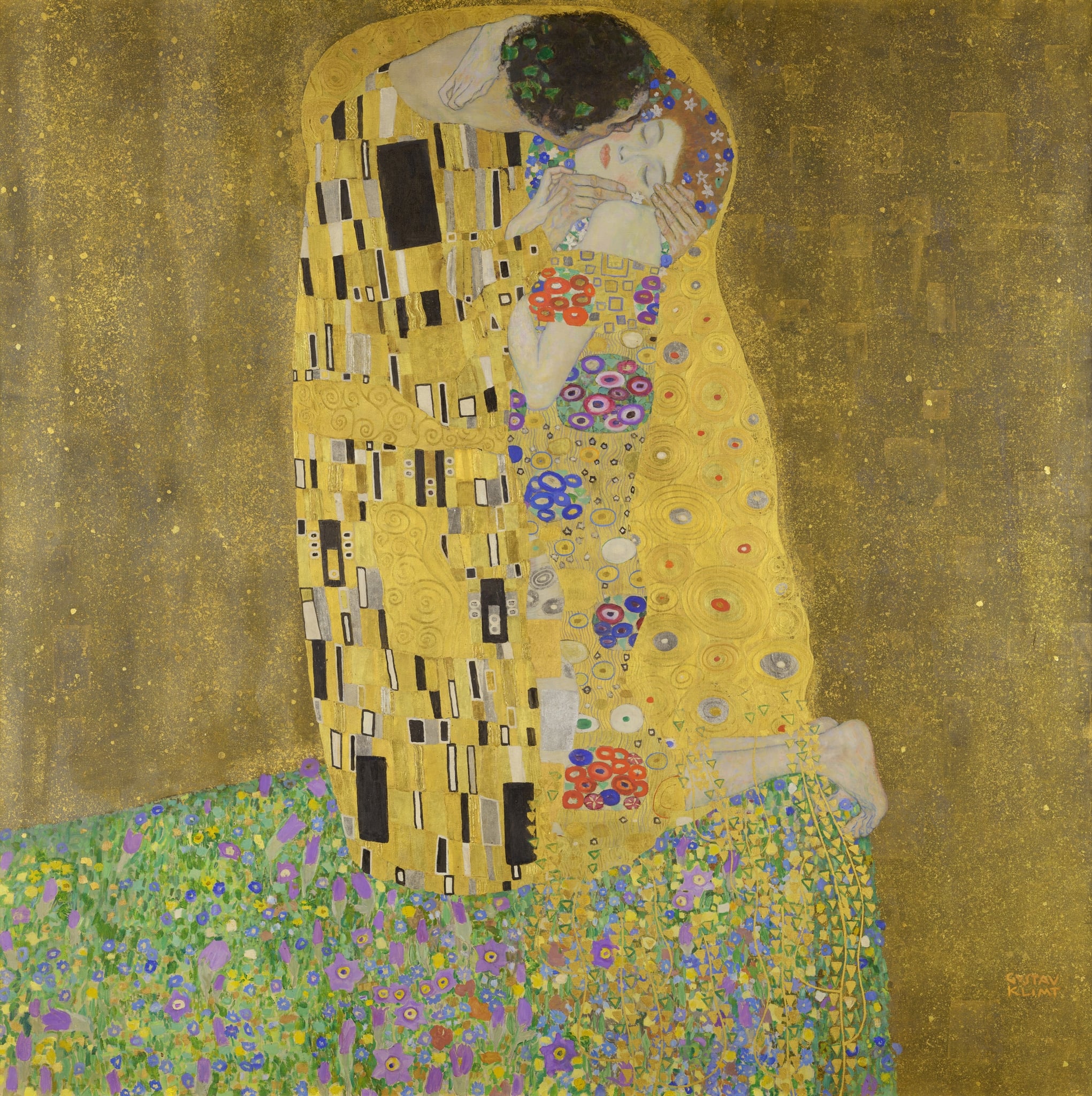
Feminine organic forms Symbolism
Feminine organic forms are curving, plantlike motifs—spirals, circles, and floral patterns—used to evoke growth, fertility, and vital life energy. In art history, especially around Art Nouveau, these biomorphic rhythms often appear in dialogue with angular, rectilinear designs associated with the masculine.
Feminine organic forms in The Kiss
In The Kiss (1908 (completed 1909)) by Gustav Klimt, feminine organic forms appear as spirals, circles, and flowers that gather around the embracing figures. Klimt pointedly opposes these curving, rhythmic motifs to black-and-white rectangles, staging a contrast between feminine organic vitality and masculine geometry. As the two figures fuse into a single gold-clad form, the organic patterning and rectilinear elements resolve in radiant harmony, presenting love as a sacred union animated by life energy.