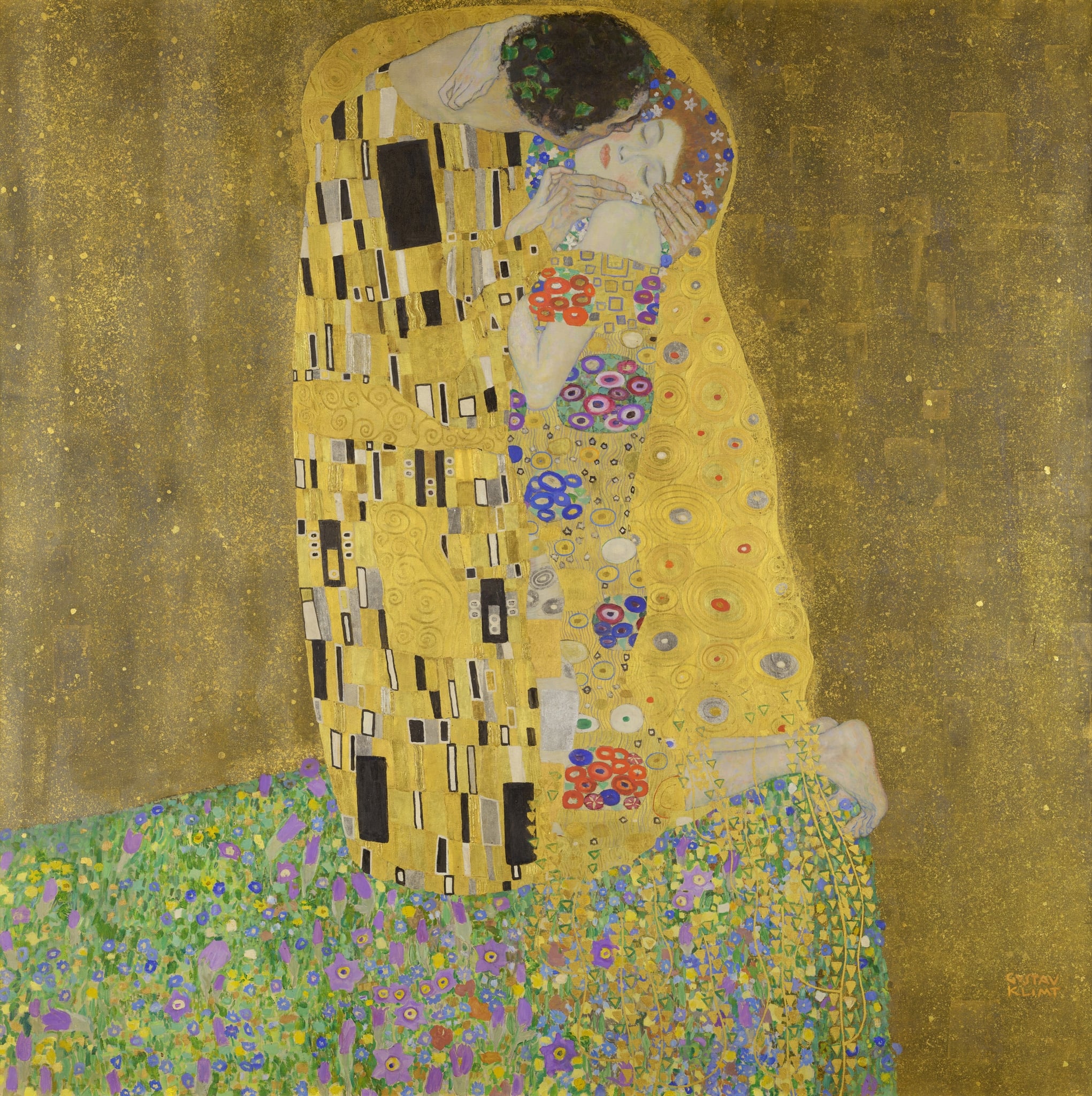
Flower meadow/ledge Symbolism
In art, a flower meadow evokes fertility, harmony, and the generative energies of nature, especially in scenes of love. Set against a ledge or threshold, that floral ground becomes a charged brink where bliss meets uncertainty, joining the earthly to the unknown. In fin-de-siècle Symbolism, such settings often signal a passage from sensual union to a timeless, spiritual plane.
Flower meadow/ledge in The Kiss
In The Kiss (1908 (completed 1909)) by Gustav Klimt, the entwined figures rest on a flower-studded ground that meets a timeless gold field. The meadow anchors their union in nature’s abundance and aligns with the work’s feminine, organic rhythms (spirals, circles, flowers), while the surrounding expanse and rectilinear motifs suggest masculine geometry and transcendence. That meeting line reads as a ledge-like threshold: a narrow verge where corporeal tenderness leans toward the infinite. By fusing the lovers into a single radiant form poised on this floral brink, Klimt makes the meadow/ledge the stage for both union with nature and the ecstatic risk at love’s edge.