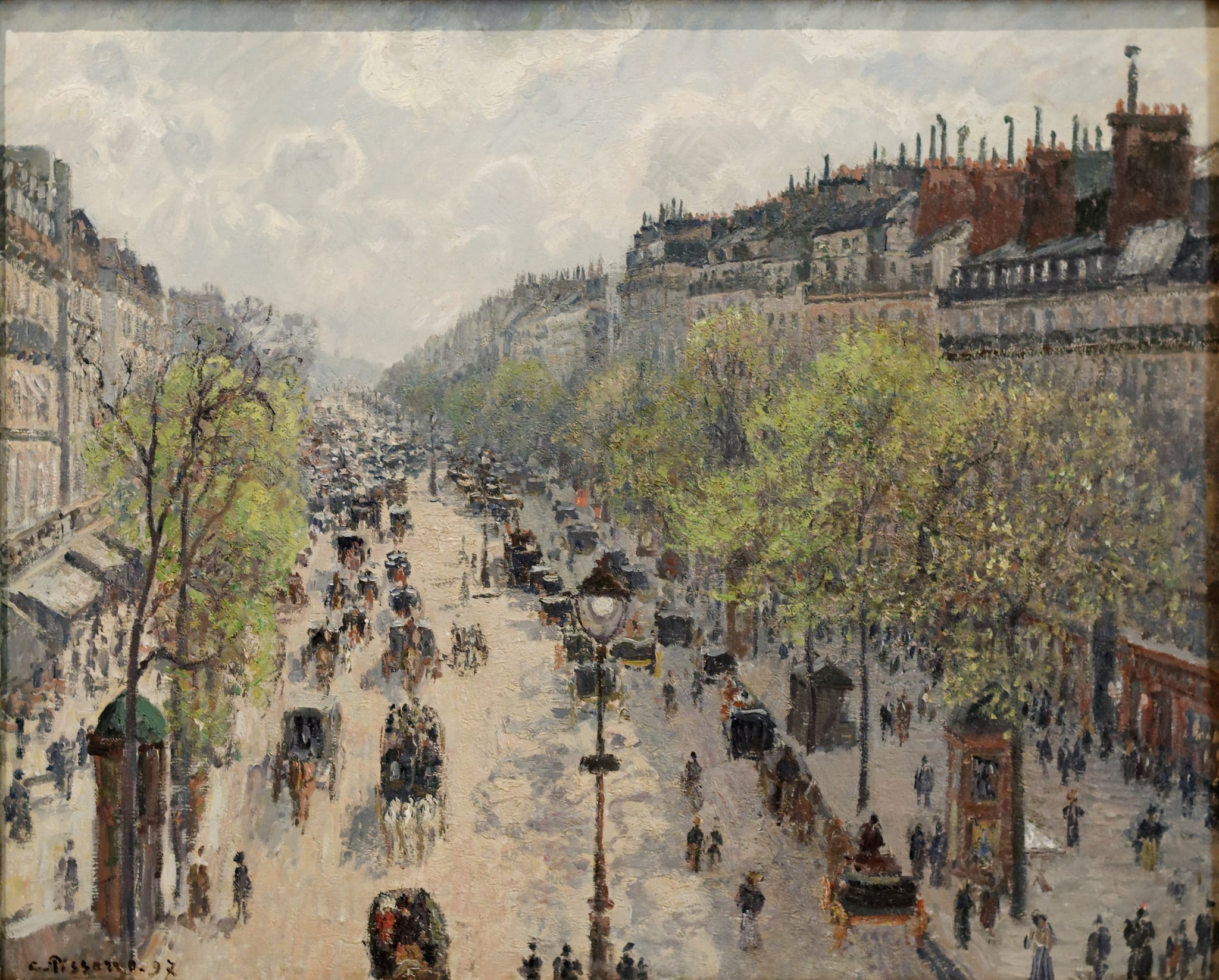
Pale boulevard roadway Symbolism
In depictions of the modern city, a pale-toned boulevard roadway often reads as a luminous channel that organizes urban life. Rendered as a bright, continuous band, it gathers crowds, vehicles, and street fixtures into a shared flow. In Impressionist practice, its shifting light also conveys weather and time.
Pale boulevard roadway in The Boulevard Montmartre on a Spring Morning
In The Boulevard Montmartre on a Spring Morning (1897), Camille Pissarro makes the boulevard’s pale roadway the composition’s luminous spine. Viewed from a high hotel window, the light surface, set against tender greens and iron streetlamps, fuses pedestrians, carriages, and traffic into a single urban current. Pissarro’s flickering brushwork and fixed vantage underscore Impressionism’s attention to time and weather, so the roadway functions both as a conduit of modern movement and as a register of transient light within his serial observation of the site.