Seasons & cycles
Featured Artworks
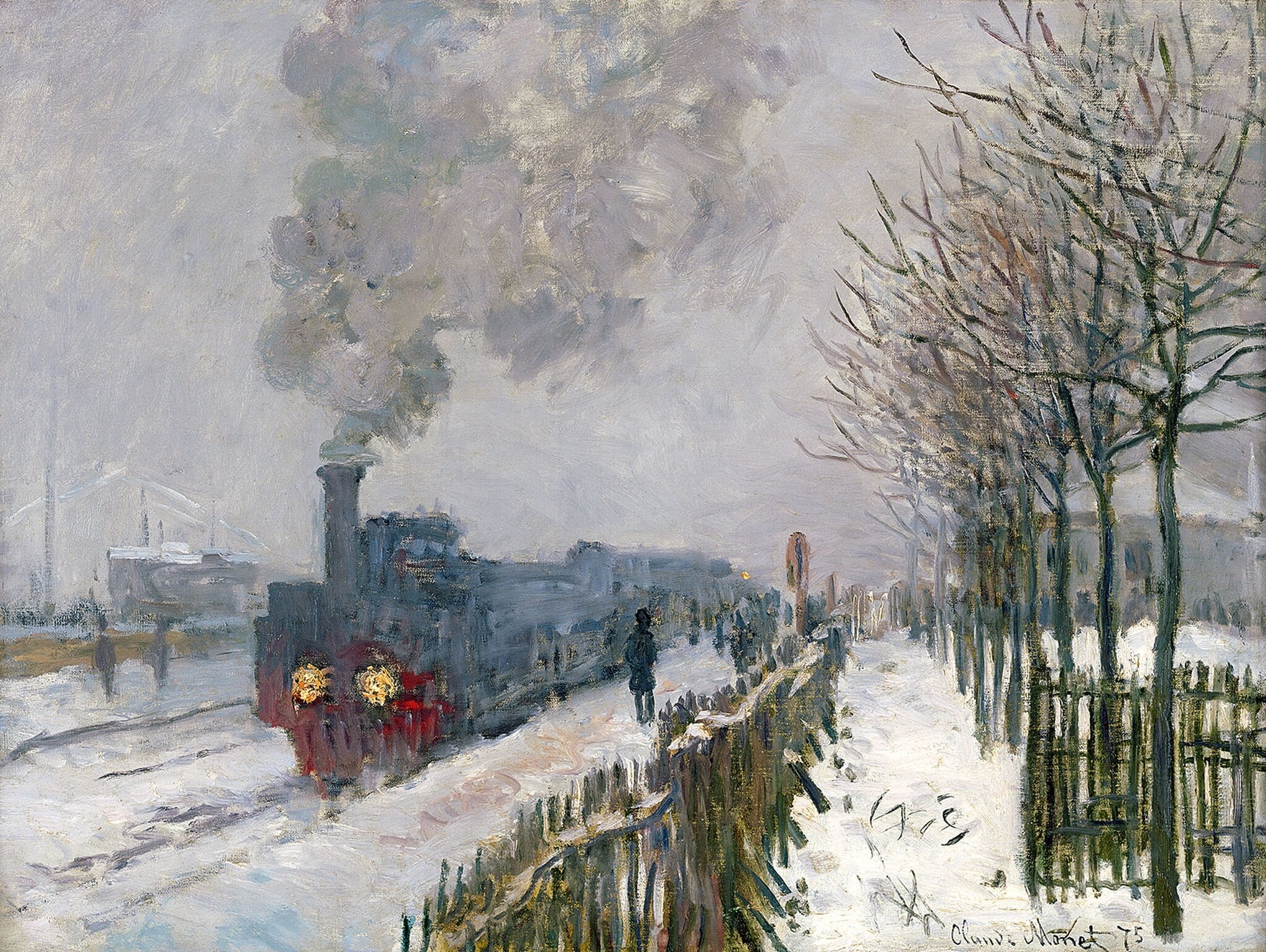
The Train in the Snow (The Locomotive)
Claude Monet (1875)
Claude Monet’s The Train in the Snow (The Locomotive) (1875) turns a suburban winter platform into a study of <strong>modernity absorbed by atmosphere</strong>. The engine’s twin yellow headlights and a smear of red push through a world of greys and violets as steam fuses with the low sky, while the right-hand fence and bare trees drill depth and cadence into the scene <sup>[1]</sup><sup>[4]</sup>. Monet fixes not an object but a <strong>moment of perception</strong>, where industry seems to dematerialize into weather <sup>[1]</sup><sup>[2]</sup>.
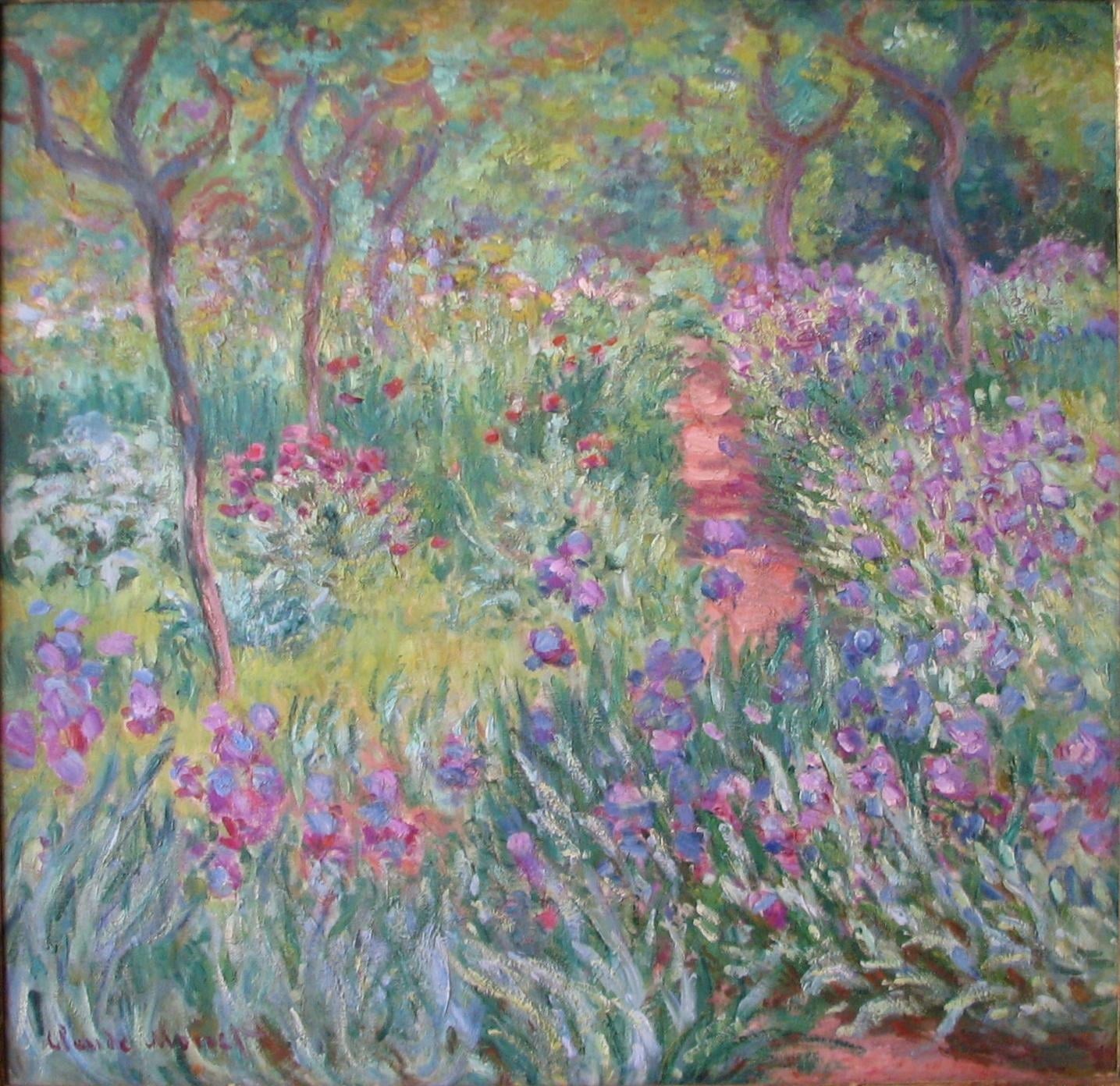
The Artist's Garden at Giverny
Claude Monet (1900)
In The Artist's Garden at Giverny, Claude Monet turns his cultivated Clos Normand into a field of living color, where bands of violet <strong>irises</strong> surge toward a narrow, rose‑colored path. Broken, flickering strokes let greens, purples, and pinks mix optically so that light seems to tremble across the scene, while lilac‑toned tree trunks rhythmically guide the gaze inward <sup>[1]</sup><sup>[3]</sup>.
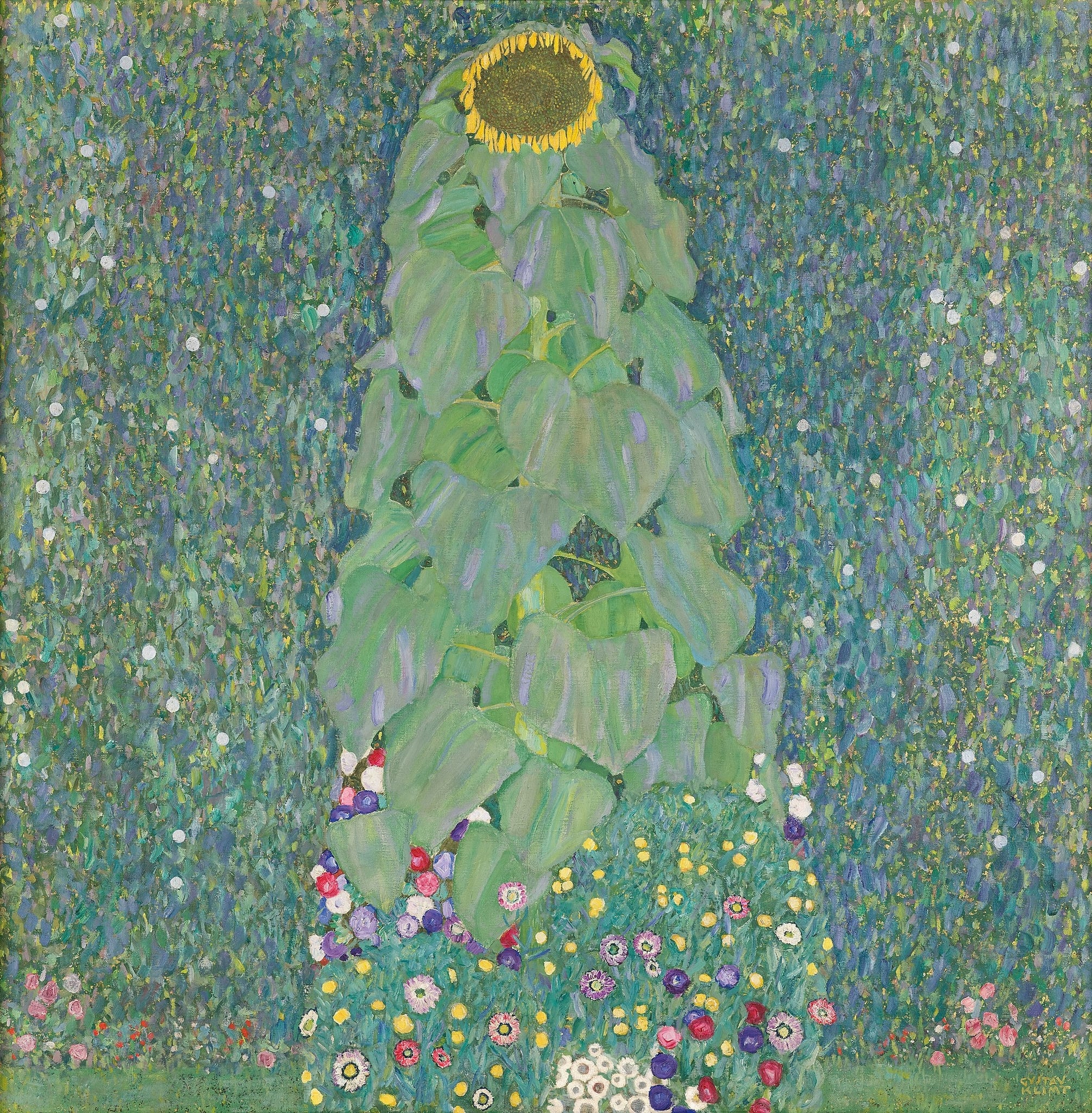
Sunflower
Gustav Klimt (1907/1908)
Gustav Klimt’s Sunflower turns a single bloom into a <strong>monumental, figure-like presence</strong>. A tapering stack of broad, drooping leaves rises from a <strong>mosaic-like carpet of round blossoms</strong>, crowned by a gold-flecked disc that glows against a cool, stippled field. The work fuses <strong>portrait, icon, and landscape</strong> into one emblem of vitality and quiet sanctity <sup>[1]</sup><sup>[2]</sup>.
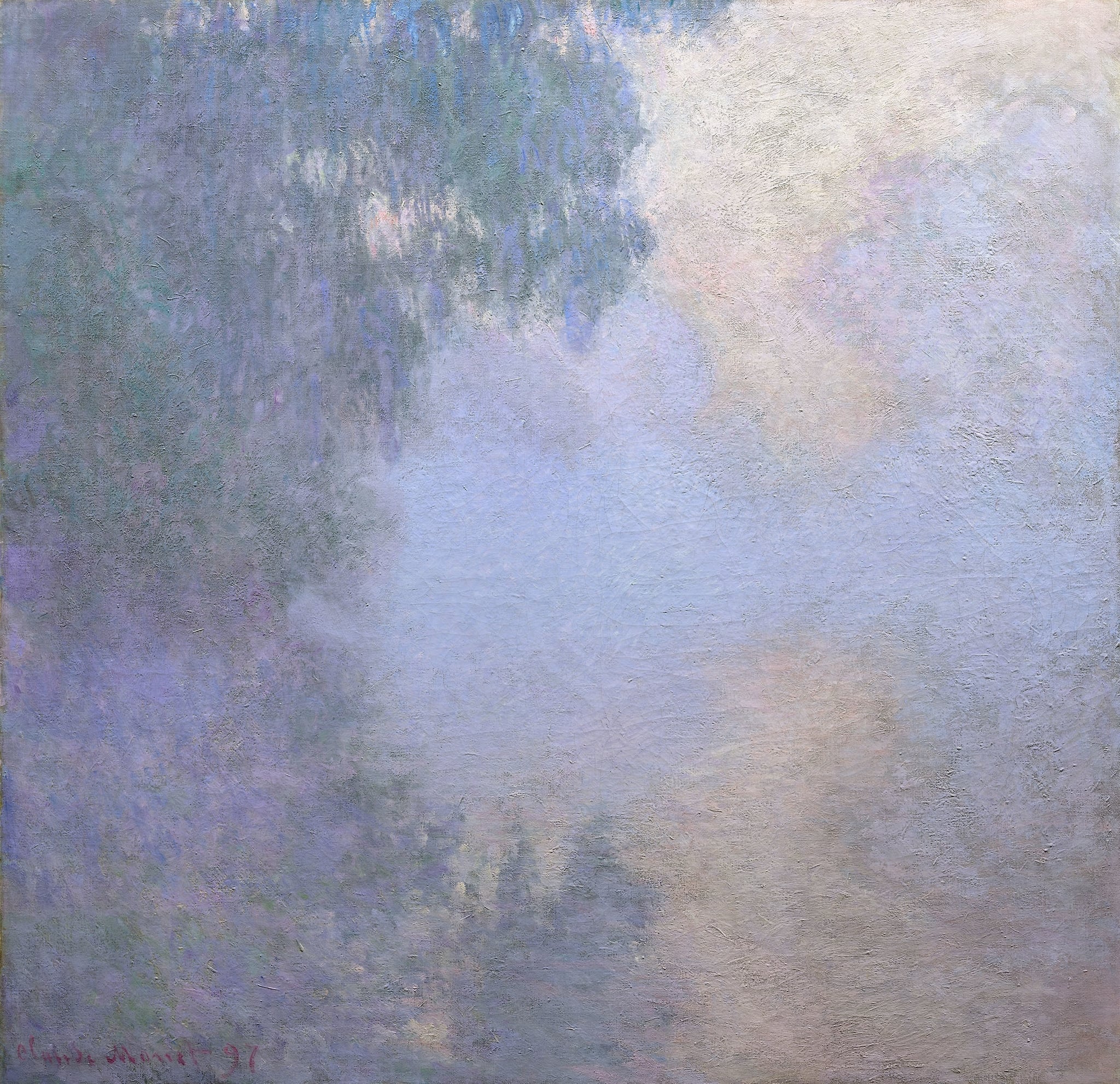
Morning on the Seine (series)
Claude Monet (1897)
Claude Monet’s Morning on the Seine (series) turns dawn into an inquiry about <strong>perception</strong> and <strong>time</strong>. In this canvas, the left bank’s shadowed foliage dissolves into lavender mist while a pale radiance opens at right, fusing sky and water into a single, reflective field <sup>[1]</sup><sup>[2]</sup>.

After the Luncheon
Pierre-Auguste Renoir (1879)
After the Luncheon crystallizes a <strong>suspended instant</strong> of Parisian leisure: coffee finished, glasses dappled with light, and a cigarette just being lit. Renoir’s <strong>shimmering brushwork</strong> and the trellised spring foliage turn the scene into a tapestry of conviviality where time briefly pauses.
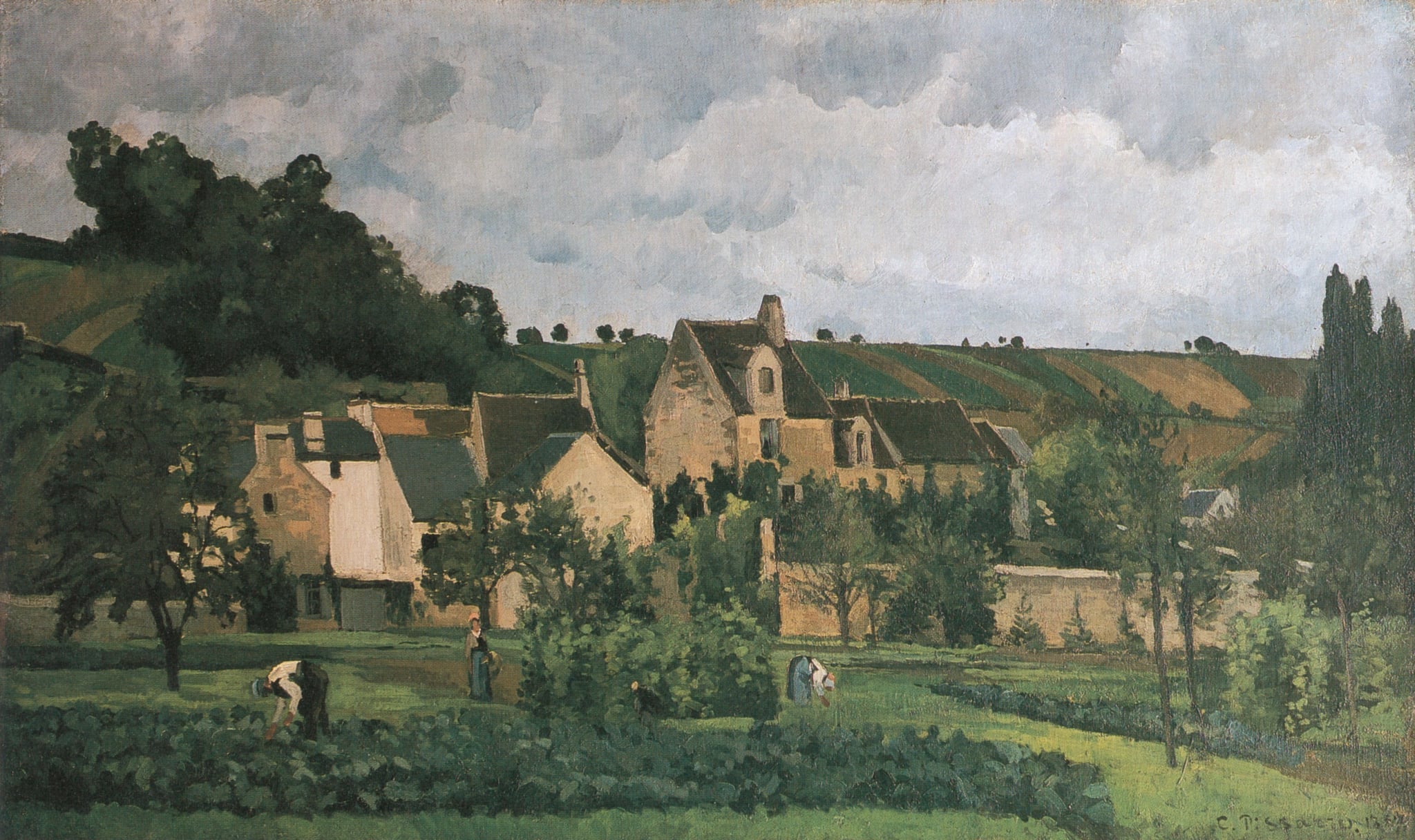
The Hermitage at Pontoise
Camille Pissarro (ca. 1867)
Camille Pissarro’s The Hermitage at Pontoise shows a hillside village interlaced with <strong>kitchen gardens</strong>, stone houses, and workers bent to their tasks under a <strong>low, cloud-laden sky</strong>. The painting binds human labor to place, staging a quiet counterpoint between <strong>architectural permanence</strong> and the <strong>seasonal flux</strong> of fields and weather <sup>[1]</sup><sup>[3]</sup>.

The Valley of the Nervia
Claude Monet (1884)
Claude Monet’s The Valley of the Nervia is a high‑key meditation on <strong>atmosphere as structure</strong>: snow‑lit Maritime Alps rise above a pale, stony riverbed, their mass defined by air and light rather than contour. Through quick, broken strokes of <strong>violet, blue, and lemon</strong>, Monet fuses fleeting afternoon shimmer with the valley’s geologic permanence <sup>[1]</sup><sup>[2]</sup>.
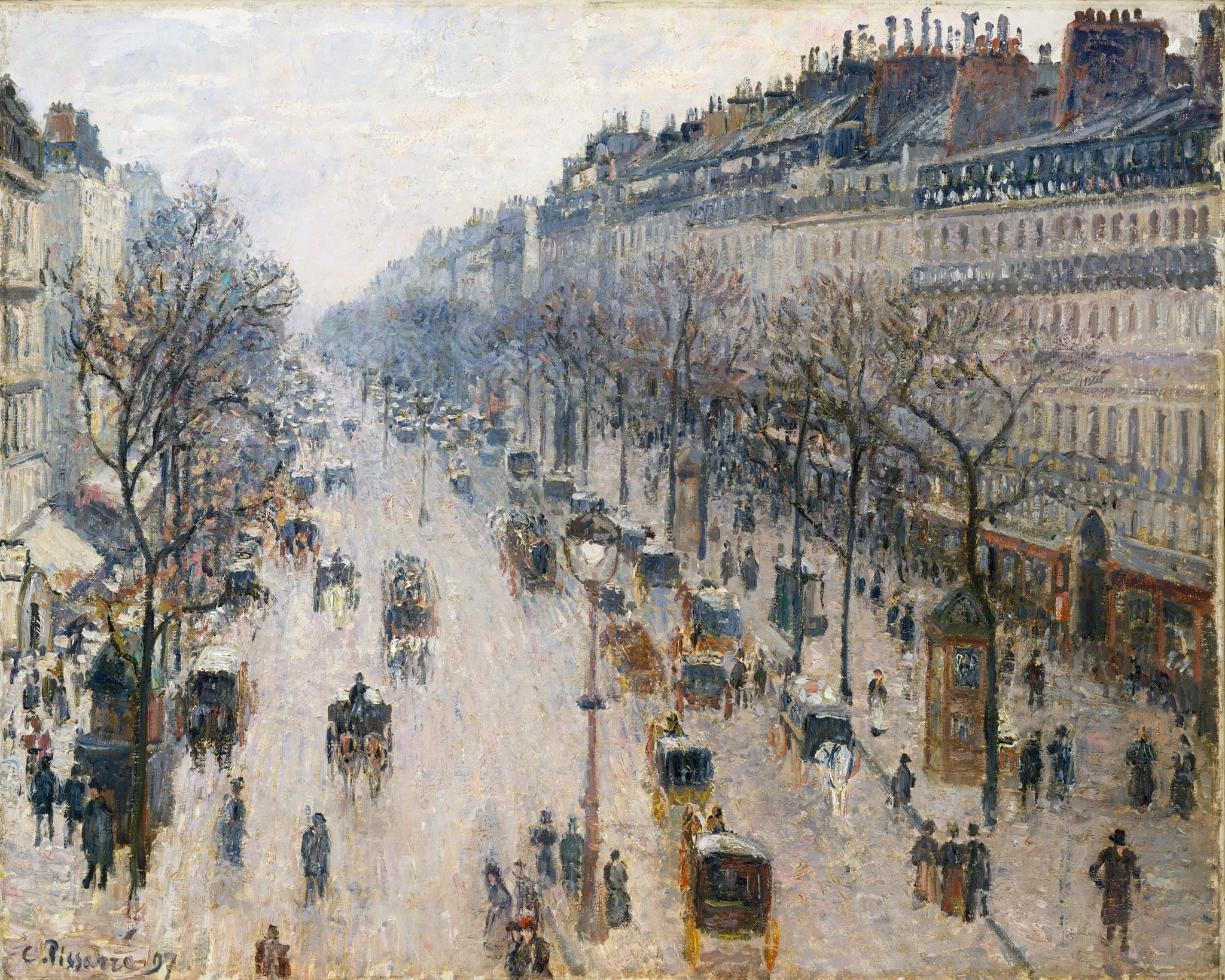
The Boulevard Montmartre on a Winter Morning
Camille Pissarro (1897)
From a high hotel window, Camille Pissarro renders Paris as a living system—its Haussmann boulevard dissolving into winter light, its crowds and vehicles fused into a soft, <strong>rhythmic flow</strong>. Broken strokes in cool grays, lilacs, and ochres turn fog, steam, and motion into <strong>texture of time</strong>, dignifying the city’s ordinary morning pulse <sup>[1]</sup><sup>[3]</sup>.
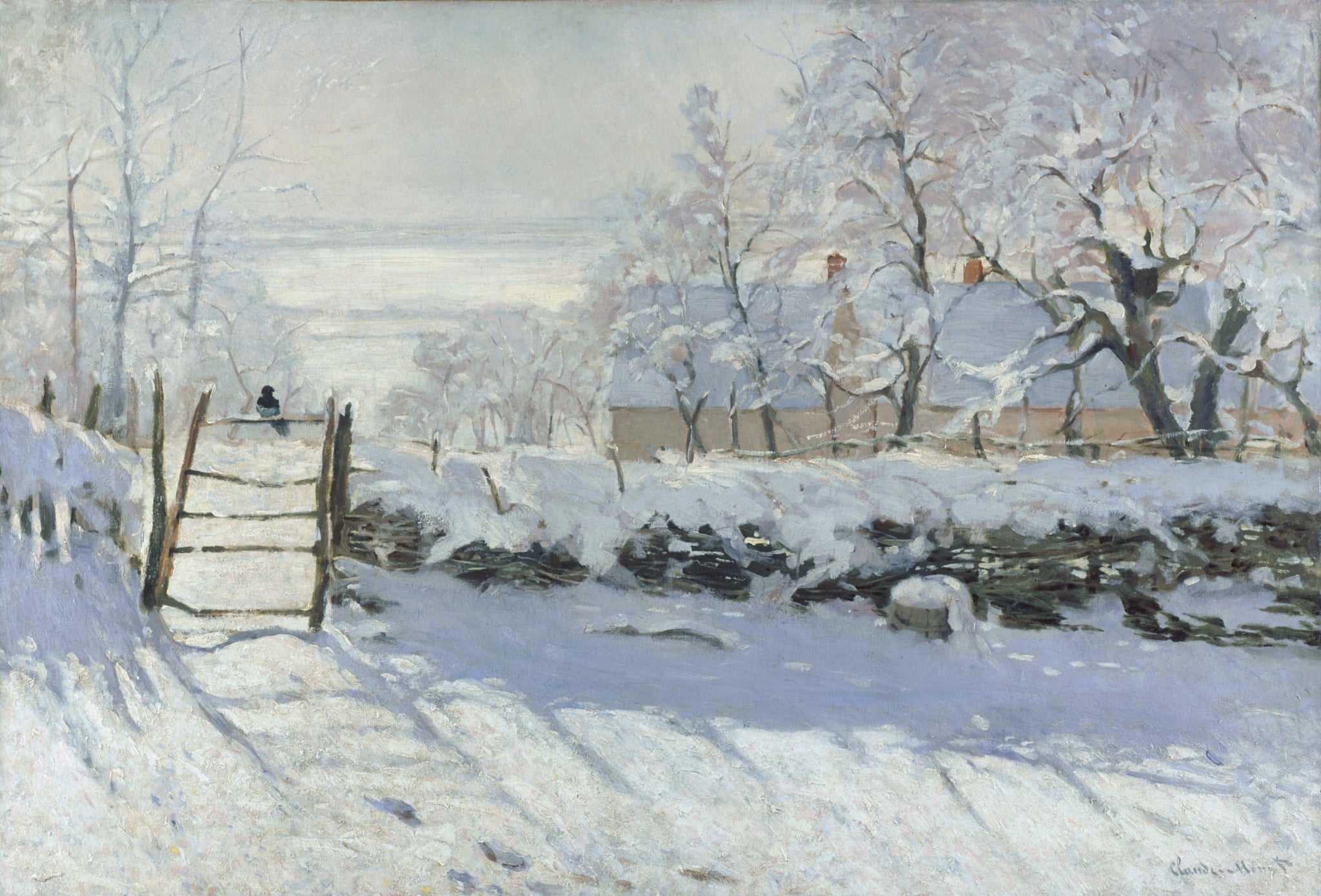
The Magpie
Claude Monet (1868–1869)
Claude Monet’s The Magpie turns a winter field into a study of <strong>luminous perception</strong>, where blue-violet shadows articulate snow’s light. A lone <strong>magpie</strong> perched on a wooden gate punctuates the silence, anchoring a scene that balances homestead and open countryside <sup>[1]</sup>.
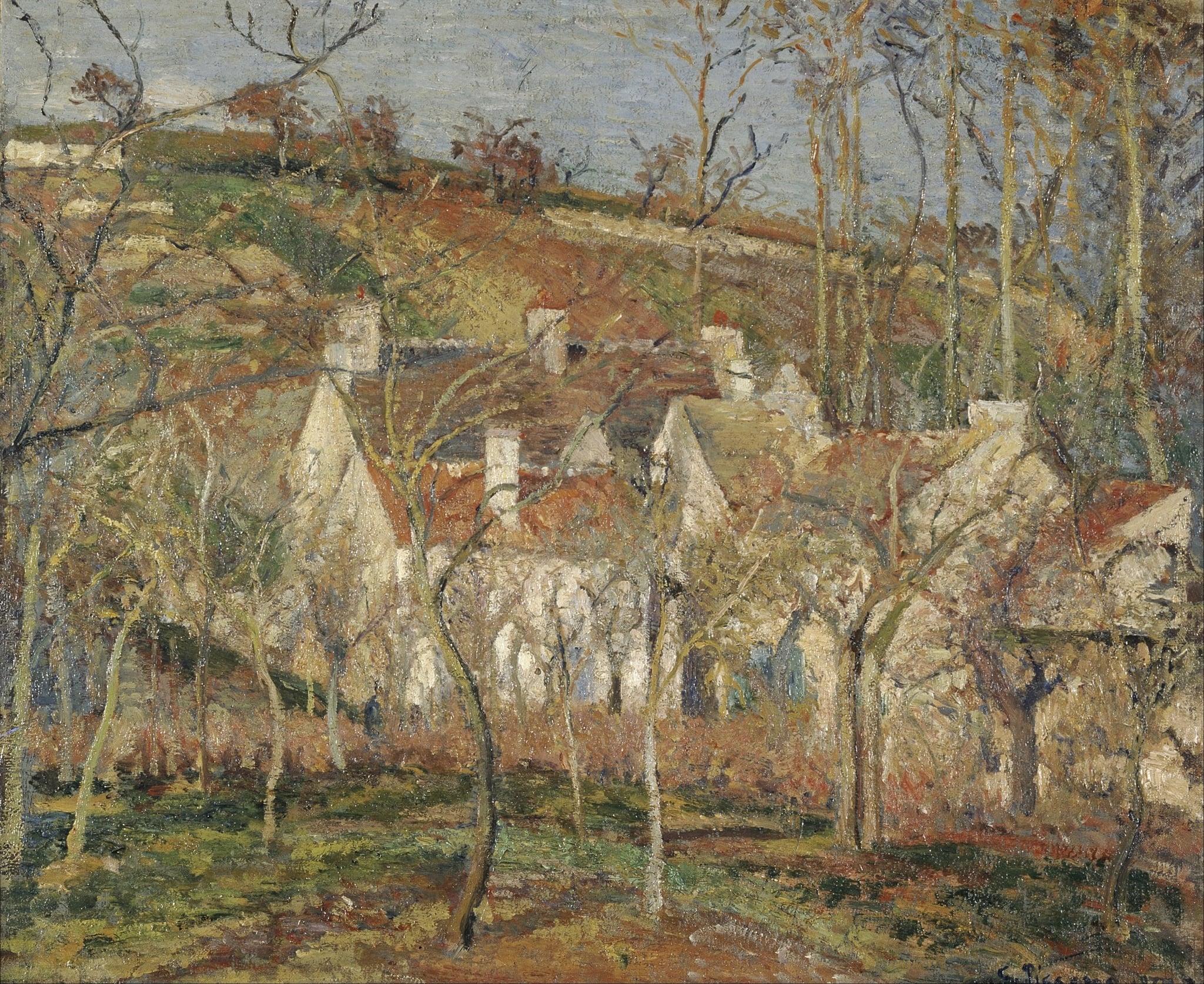
Red Roofs
Camille Pissarro (1877)
In Red Roofs, Camille Pissarro knits village and hillside into a single living fabric through a <strong>screen of winter trees</strong> and vibrating, tactile brushwork. The warm <strong>red-tiled roofs</strong> act as chromatic anchors within a cool, silvery atmosphere, asserting human shelter as part of nature’s rhythm rather than its negation <sup>[1]</sup><sup>[3]</sup>. The composition’s <strong>parallel planes</strong> and color echoes reveal a deliberate structural order that anticipates Post‑Impressionist concerns <sup>[1]</sup><sup>[2]</sup>.

Jeanne (Spring)
Édouard Manet (1881)
Édouard Manet’s Jeanne (Spring) fuses a time-honored allegory with <strong>modern Parisian fashion</strong>: a crisp profile beneath a cream parasol, set against <strong>luminous, leafy greens</strong>. Manet turns couture—hat, glove, parasol—into the language of <strong>renewal and youth</strong>, making spring feel both perennial and up-to-the-minute <sup>[1]</sup><sup>[2]</sup>.
San Giorgio Maggiore at Dusk
Claude Monet (1908–1912)
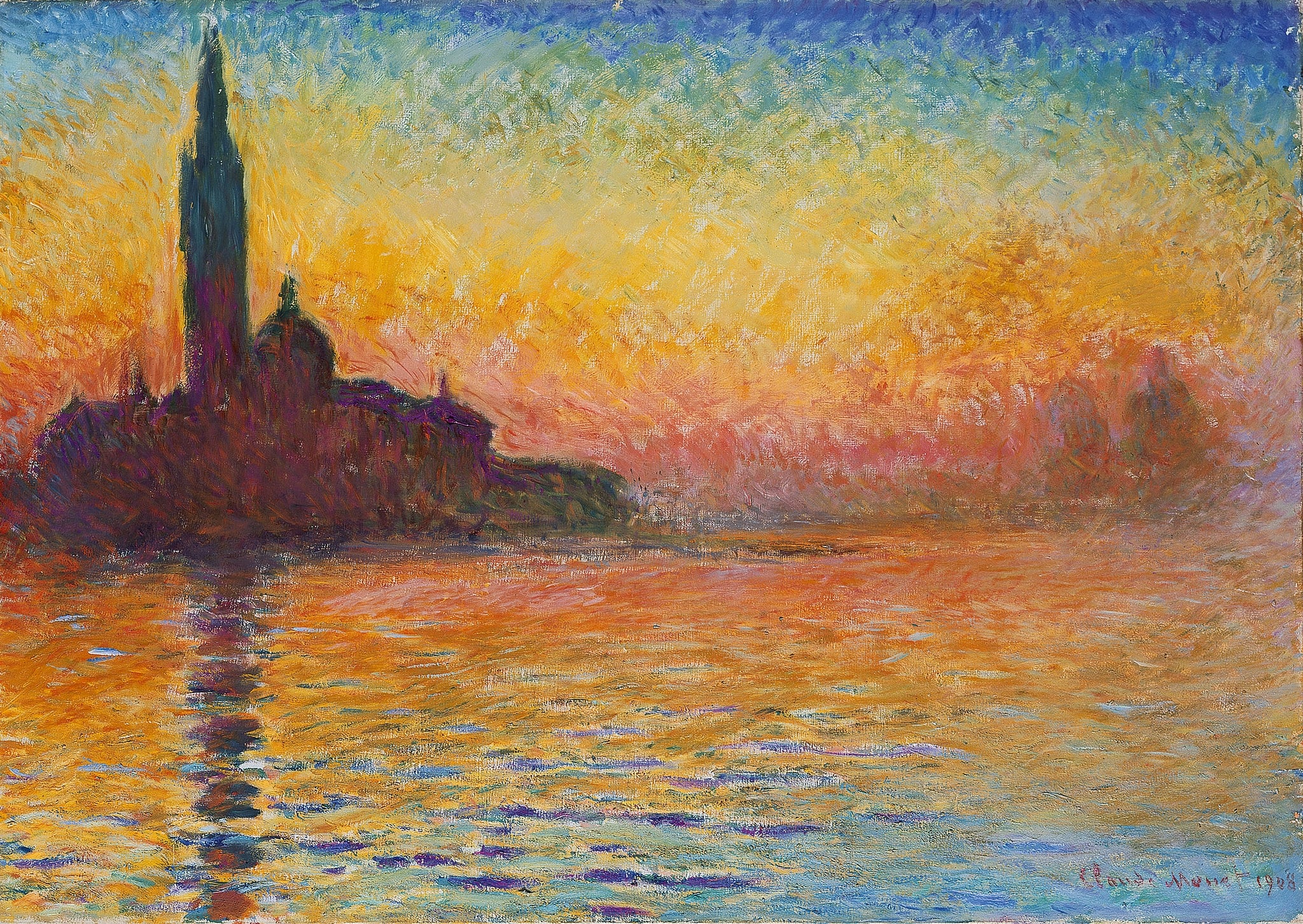
Claude Monet’s San Giorgio Maggiore at Dusk fuses the Benedictine church’s dark silhouette with a sky flaming from apricot to cobalt, turning architecture into atmosphere. The campanile’s vertical and its wavering reflection anchor a sea of trembling color, staging a meditation on <strong>permanence</strong> and <strong>flux</strong>.

The Artist's Garden at Vétheuil
Claude Monet (1881)
Claude Monet’s The Artist’s Garden at Vétheuil stages a sunlit ascent through a corridor of towering sunflowers toward a modest house, where everyday life meets cultivated nature. Quick, broken strokes make leaves and shadows tremble, asserting <strong>light</strong> and <strong>painterly surface</strong> over linear contour. Blue‑and‑white <strong>jardinieres</strong> anchor the foreground, while a child and dog briefly pause on the path, turning the garden into a <strong>domestic sanctuary</strong> <sup>[1]</sup><sup>[2]</sup>.
Snow at Argenteuil
Claude Monet (1875)
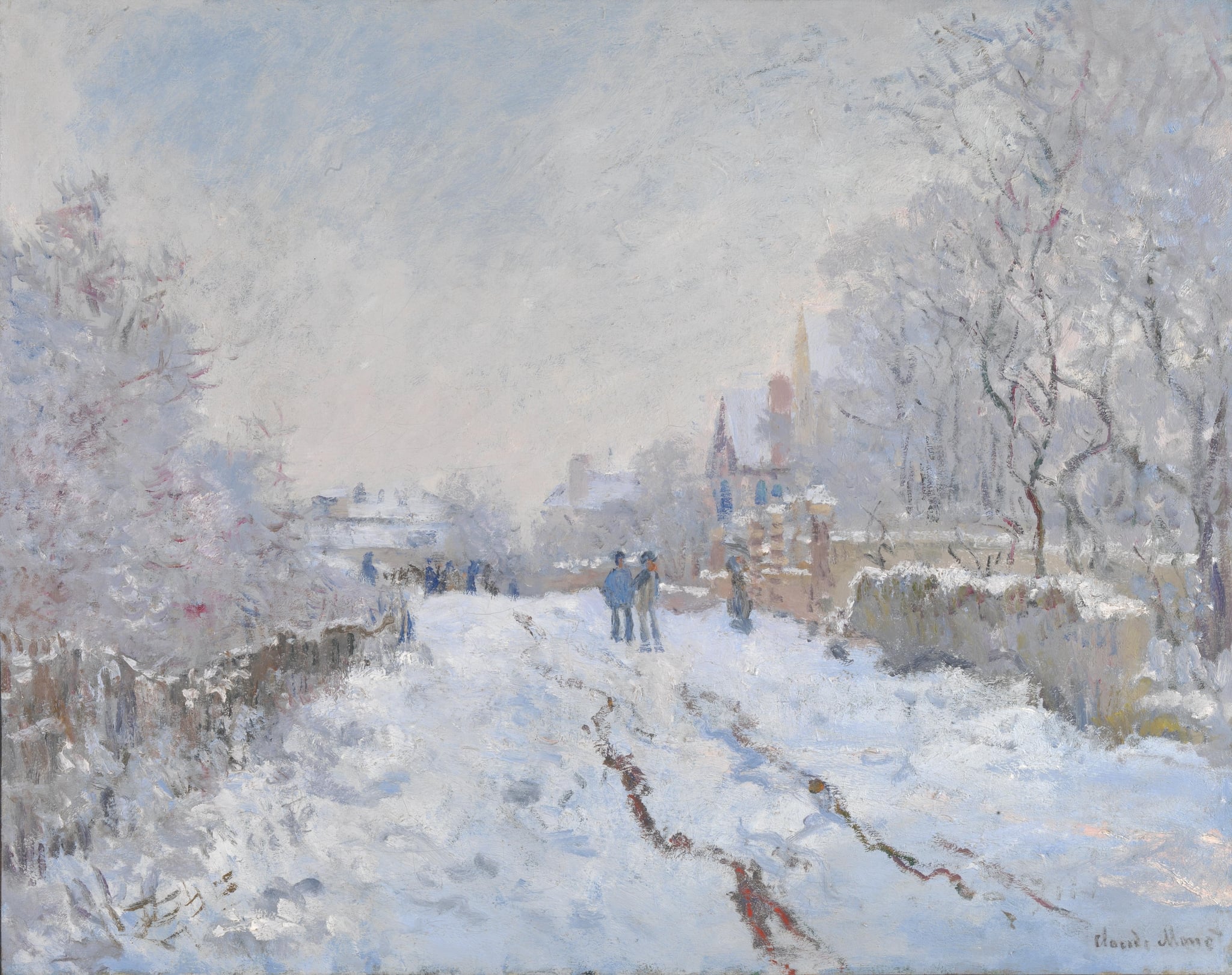
<strong>Snow at Argenteuil</strong> renders a winter boulevard where light overtakes solid form, turning snow into a luminous field of blues, violets, and pearly pinks. Reddish cart ruts pull the eye toward a faint church spire as small, blue-gray figures persist through the hush. Monet elevates atmosphere to the scene’s <strong>protagonist</strong>, making everyday passage a meditation on time and change <sup>[1]</sup><sup>[2]</sup>.
Portrait of Félix Fénéon
Paul Signac (1890)
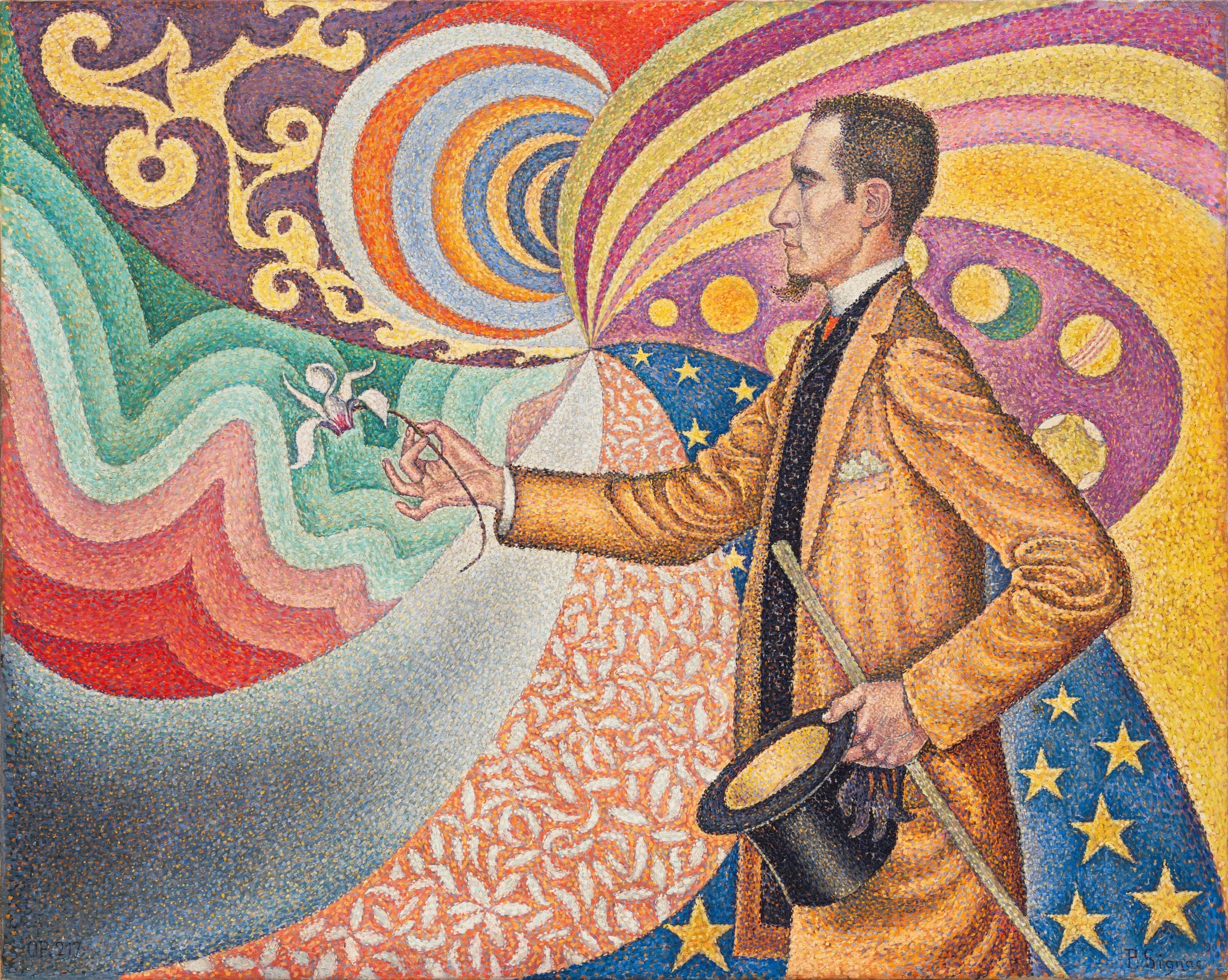
Portrait of Félix Fénéon turns a critic into a <strong>conductor of color</strong>: a dandy in a yellow coat proffers a delicate cyclamen as concentric disks, whiplash arabesques, stars, and palette-like circles whirl around him. Rendered in precise <strong>Pointillist</strong> dots, the scene stages the fusion of <strong>art, science, and modern style</strong>.<sup>[1]</sup><sup>[2]</sup>
Flood at Port-Marly
Alfred Sisley (1876)
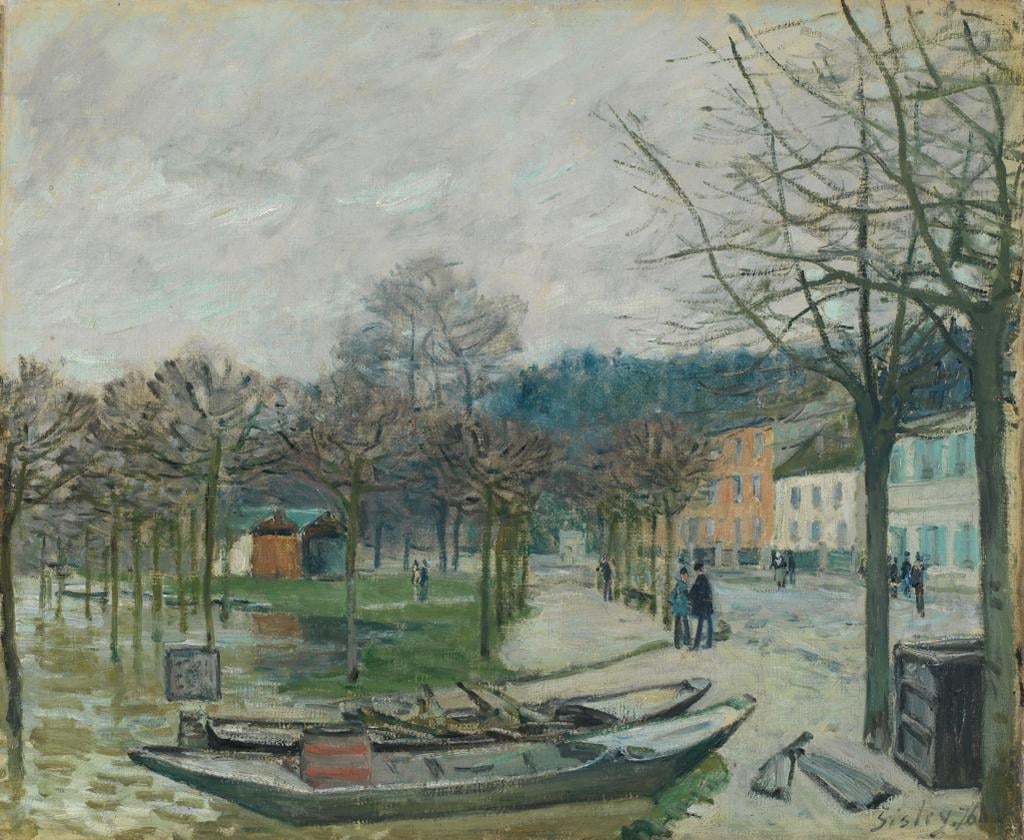
In Flood at Port-Marly, Alfred Sisley turns a flooded street into a reflective stage where <strong>human order</strong> and <strong>natural flux</strong> converge. The aligned, leafless trees function like measuring rods against the water, while flat-bottomed boats replace carriages at the curb. With cool, silvery strokes and a cloud-laden sky, Sisley asserts that the scene’s true drama is <strong>atmosphere</strong> and <strong>adaptation</strong>, not catastrophe <sup>[1]</sup><sup>[2]</sup><sup>[4]</sup>.
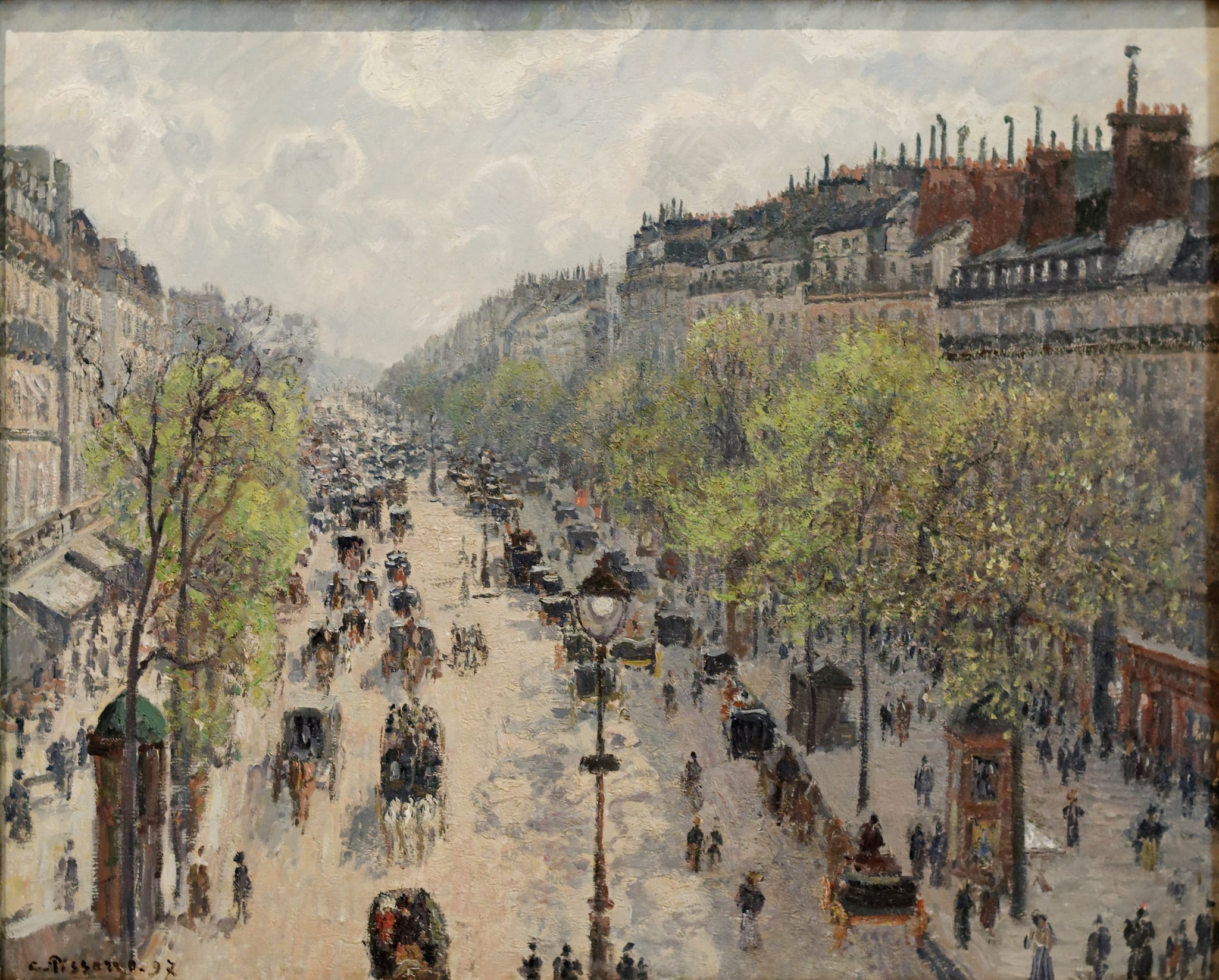
The Boulevard Montmartre on a Spring Morning
Camille Pissarro (1897)
From a high hotel window, Camille Pissarro turns Paris’s grands boulevards into a river of light and motion. In The Boulevard Montmartre on a Spring Morning, pale roadway, <strong>tender greens</strong>, and <strong>flickering brushwork</strong> fuse crowds, carriages, and iron streetlamps into a single urban current <sup>[1]</sup><sup>[2]</sup>. The scene demonstrates Impressionism’s commitment to time, weather, and modern life, distilled through a fixed vantage across a serial project <sup>[1]</sup><sup>[3]</sup>.

The Church at Moret
Alfred Sisley (1894)
Alfred Sisley’s The Church at Moret turns a Flamboyant Gothic façade into a living barometer of light, weather, and time. With <strong>cool blues, lilacs, and warm ochres</strong> laid in broken strokes, the stone seems to breathe as tiny townspeople drift along the street. The work asserts <strong>permanence meeting transience</strong>: a communal monument held steady while the day’s atmosphere endlessly remakes it <sup>[1]</sup><sup>[2]</sup><sup>[3]</sup>.
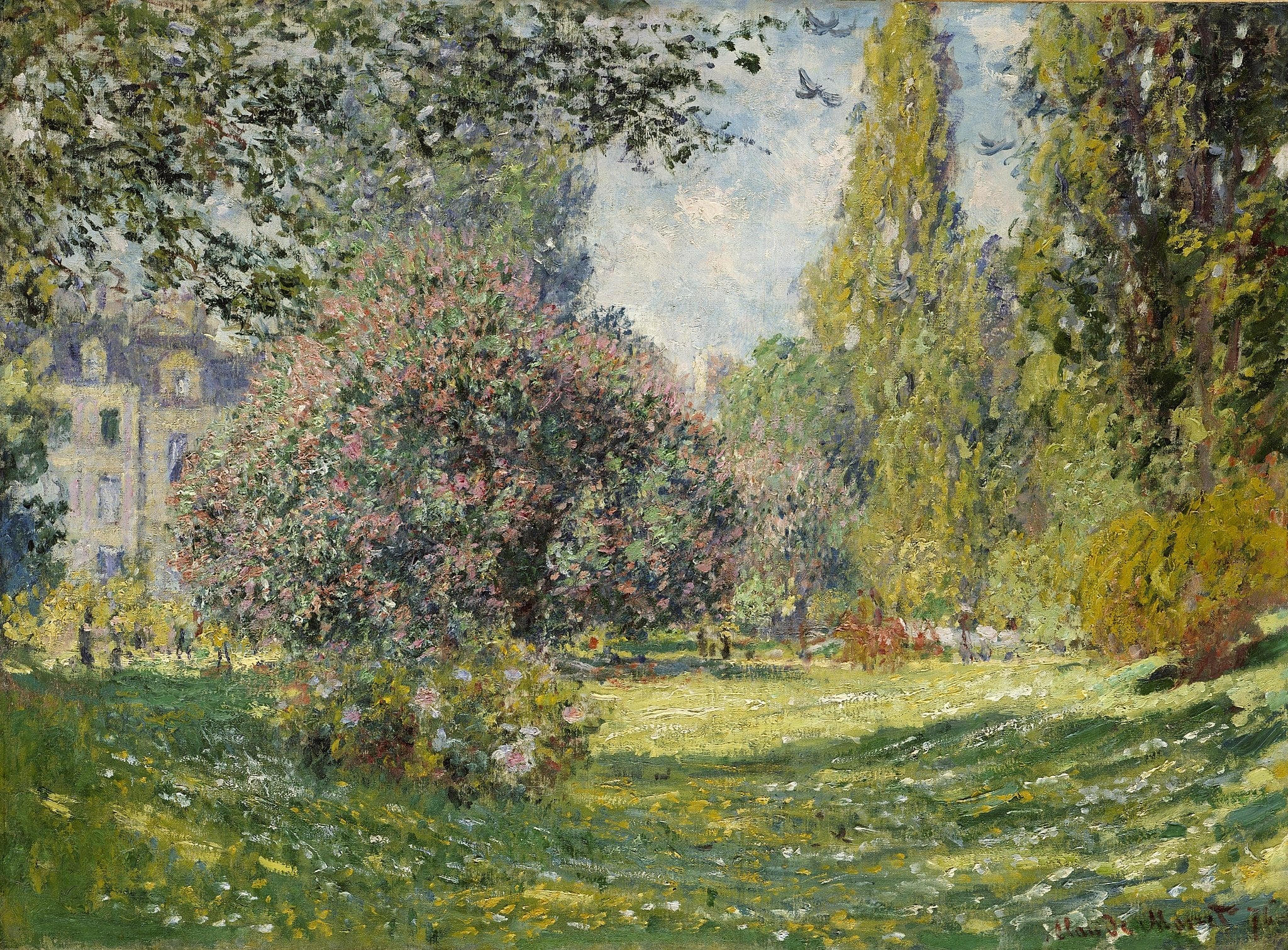
Landscape: The Parc Monceau
Claude Monet (1876)
Claude Monet’s Landscape: The Parc Monceau distills a spring afternoon into a choreography of <strong>flickering light</strong> and <strong>urban leisure</strong>. A diagonal of brightness pulls the eye from the shaded foreground toward a radiant lawn, where a voluminous, flowering shrub anchors the scene and a softened townhouse tethers nature to the city <sup>[1]</sup>. Monet turns perception itself into subject, making <strong>time and weather</strong> the picture’s active protagonists <sup>[5]</sup>.
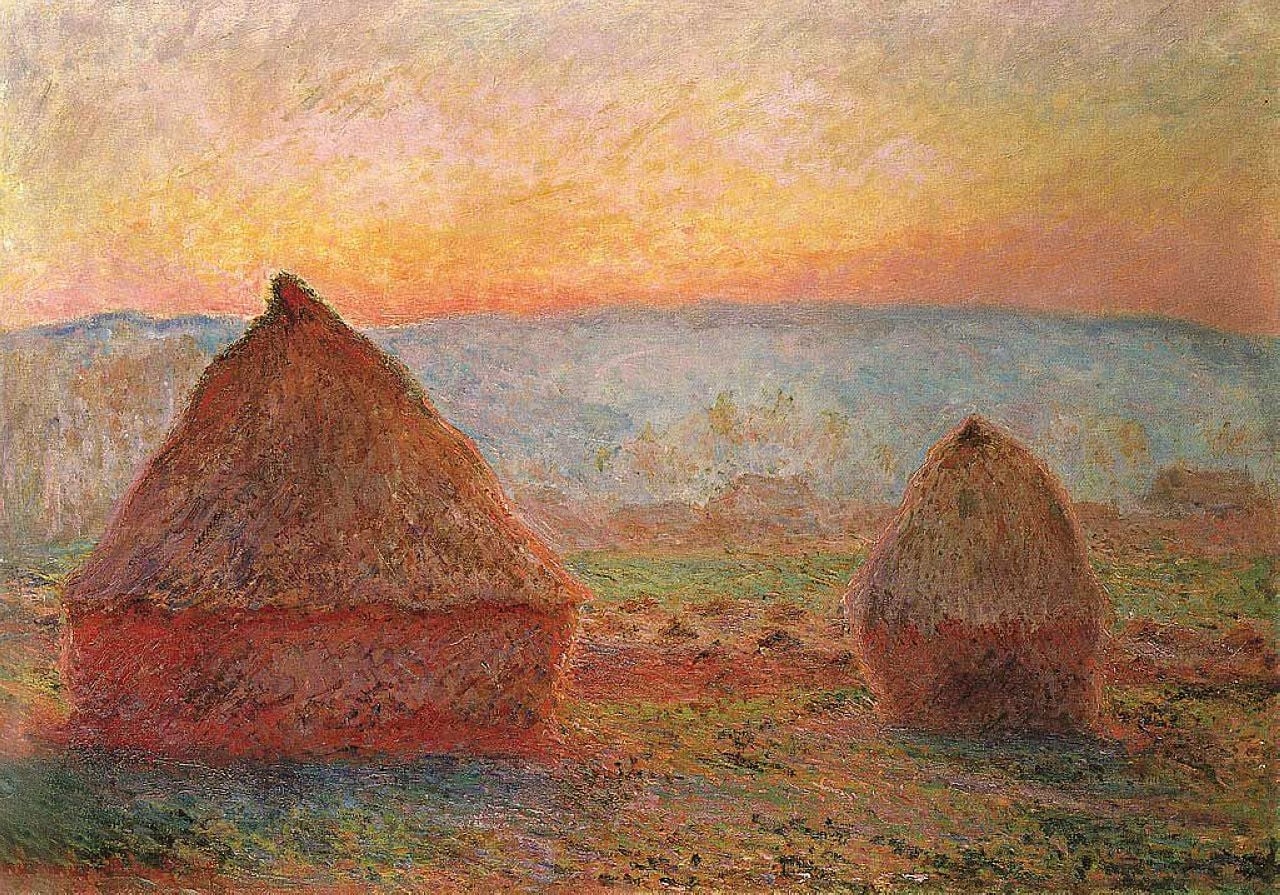
Haystack, Sunset
Claude Monet (1891)
Two conical stacks blaze against a cooling horizon, turning stored grain into a drama of <strong>light, time, and rural wealth</strong>. Monet’s broken strokes fuse warm oranges and cool violets so the stacks seem to glow from within, embodying the <strong>transience</strong> of a single sunset and the <strong>endurance</strong> of agrarian cycles <sup>[1]</sup><sup>[2]</sup><sup>[3]</sup>.
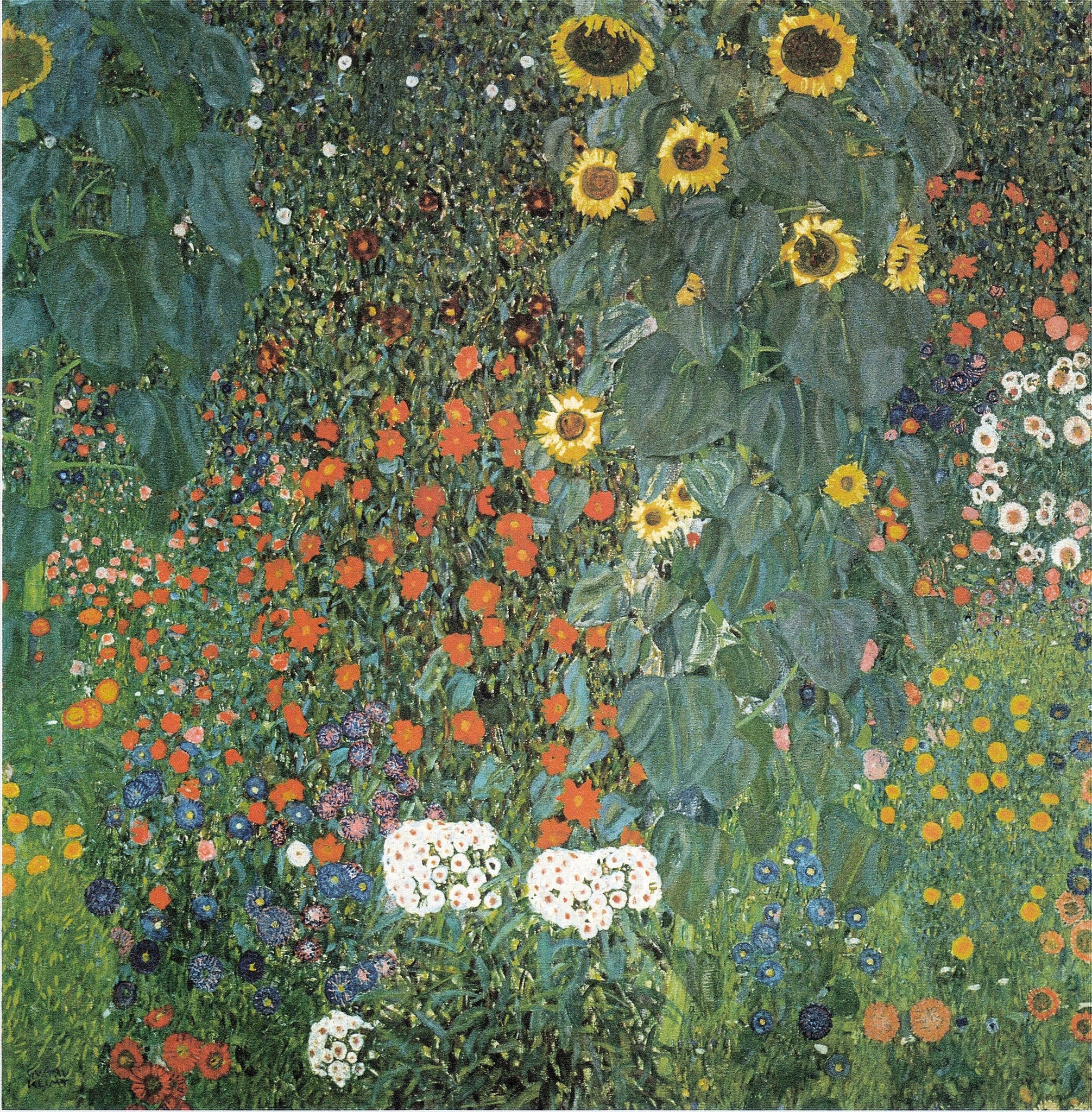
Cottage Garden with Sunflowers
Gustav Klimt (1906–1907 (signed 1907))
Cottage Garden with Sunflowers is a square, horizonless field of blooms where a vertical column of <strong>sunflowers</strong> anchors an all-over weave of color and pattern. Klimt fuses <strong>ornament and nature</strong>, turning a humble Litzlberg cottage plot into a radiant matrix of cyclical life and renewal <sup>[1]</sup><sup>[4]</sup><sup>[5]</sup>.
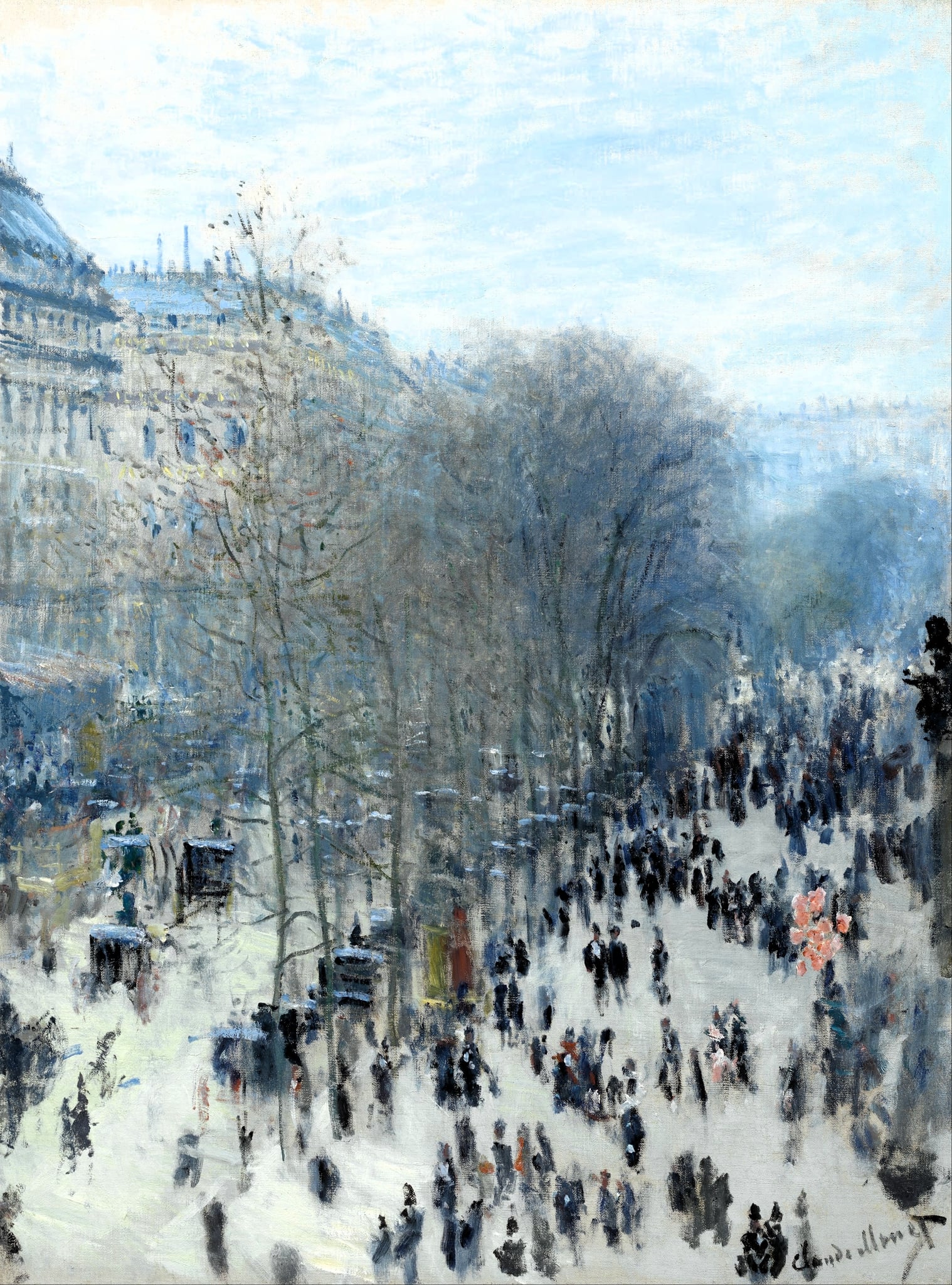
Boulevard des Capucines
Claude Monet (1873–1874)
From a high perch above Paris, Claude Monet turns the Haussmann boulevard into a living current of <strong>light, weather, and motion</strong>. Leafless trees web the view, crowds dissolve into <strong>flickering strokes</strong>, and a sudden <strong>pink cluster of balloons</strong> pierces the cool winter scale <sup>[1]</sup><sup>[2]</sup>.

Still Life with Flowers
Pierre-Auguste Renoir (1885)
Pierre-Auguste Renoir’s Still Life with Flowers (1885) sets a jubilant bouquet in a pale, crackled vase against softly dissolving wallpaper and a wicker screen. With quick, clear strokes and a centered, oval mass, the painting unites <strong>Impressionist color</strong> with a <strong>classical, post-Italy structure</strong> <sup>[1]</sup><sup>[2]</sup><sup>[4]</sup>. The slight droop of blossoms turns the domestic scene into a gentle <strong>vanitas</strong>—a savoring of beauty before it fades <sup>[5]</sup>.
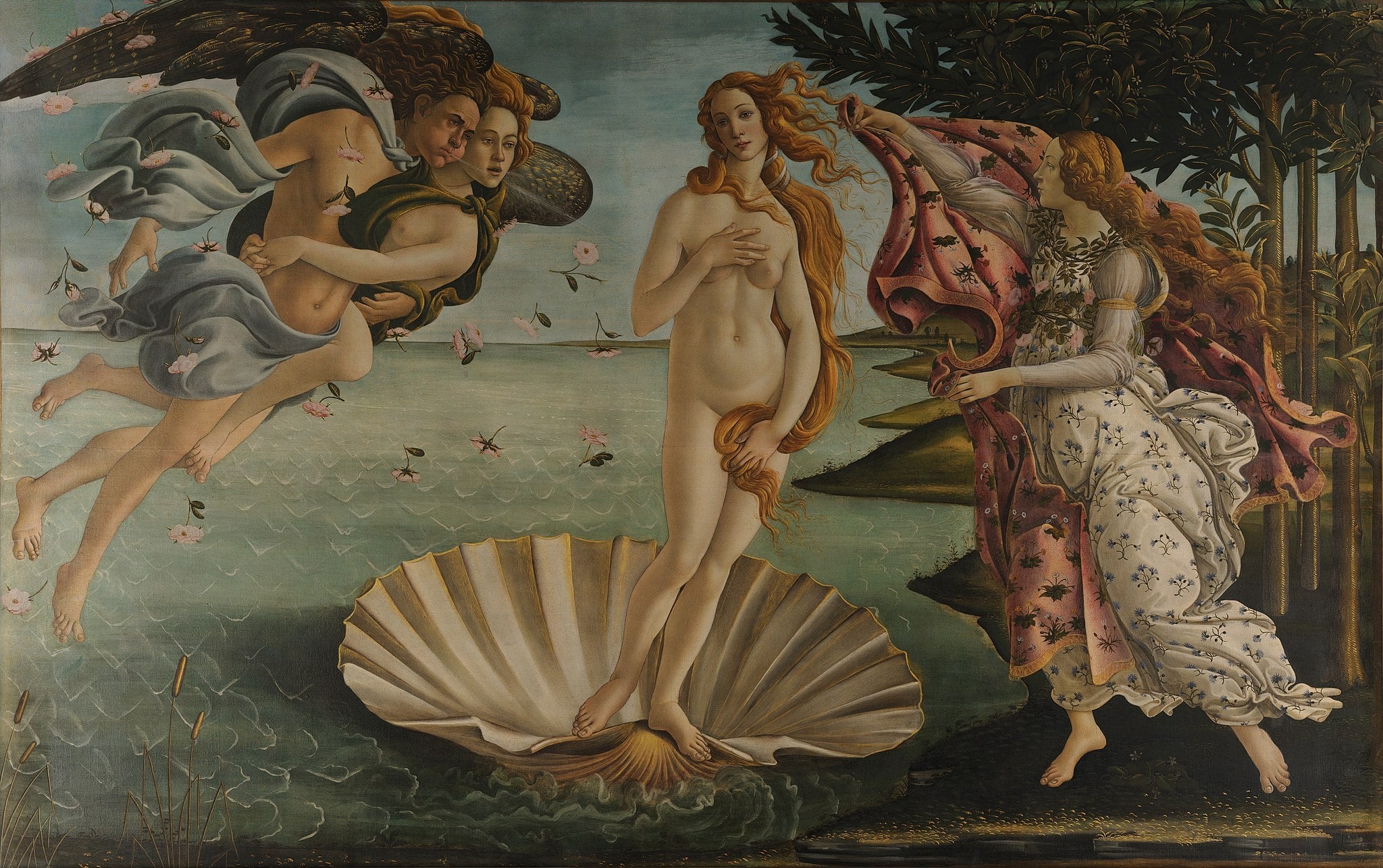
The Birth of Venus
Sandro Botticelli (c. 1484–1486)
In The Birth of Venus, <strong>Sandro Botticelli</strong> stages the sea-born goddess arriving on a <strong>scallop shell</strong>, blown ashore by intertwined <strong>winds</strong> and greeted by a flower-garlanded attendant who lifts a <strong>rose-patterned mantle</strong>. The painting’s crisp contours, elongated figures, and gilded highlights transform myth into an <strong>ideal of beauty</strong> that signals love, spring, and renewal <sup>[1]</sup><sup>[2]</sup>.
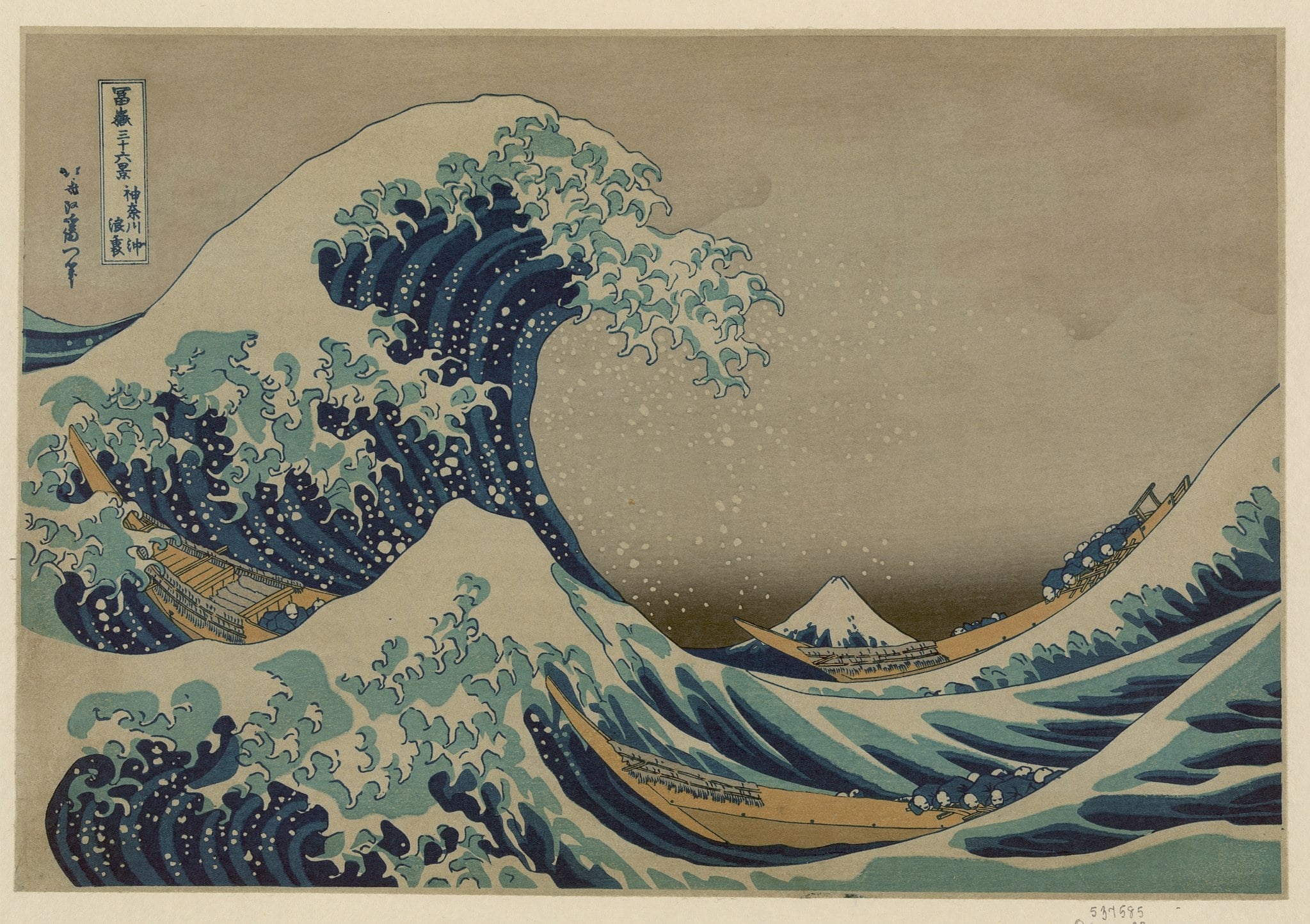
The Great Wave off Kanagawa
Hokusai (ca. 1830–32)
The Great Wave off Kanagawa distills a universal drama: fragile laboring boats face a <strong>towering breaker</strong> while <strong>Mount Fuji</strong> sits small yet immovable. Hokusai wields <strong>Prussian blue</strong> to sculpt depth and cold inevitability, fusing ukiyo‑e elegance with Western perspective to stage nature’s power against human resolve <sup>[1]</sup><sup>[3]</sup>.
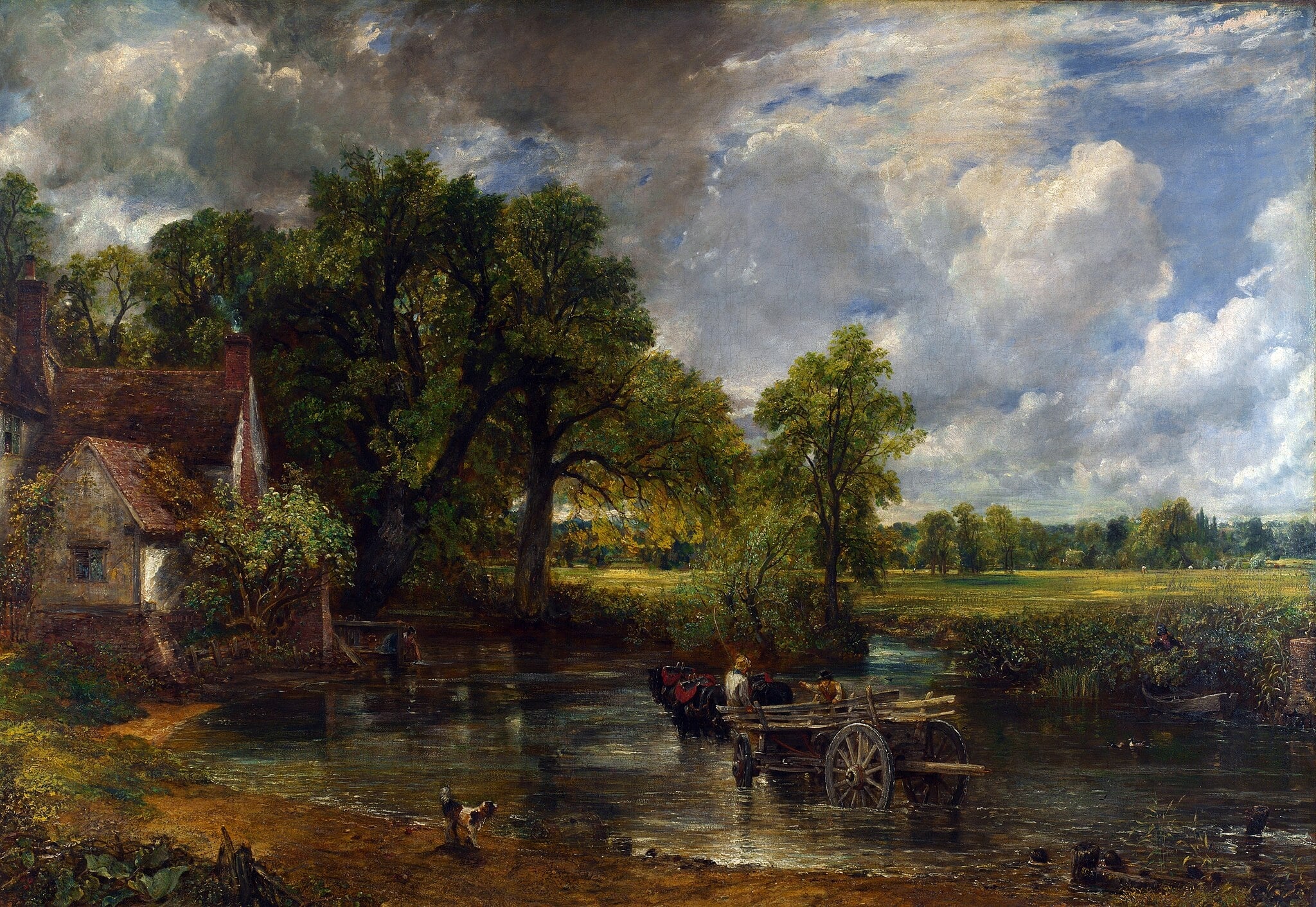
The Hay Wain
John Constable (1821)
Set beside Willy Lott’s cottage on the River Stour, The Hay Wain stages a moment of <strong>unhurried rural labor</strong>: an empty timber cart, drawn by three horses with red-collared tack, pauses mid‑ford as weather shifts above. Constable fuses <strong>empirical observation</strong>—rippling reflections, chimney smoke, flickers of white on leaves—with a composed vista of fields opening to sun. The result is a serene yet alert meditation on <strong>work, weather, and continuity</strong> in the English countryside <sup>[1]</sup><sup>[3]</sup>.

Water Lilies (triptych)
Claude Monet (1914–1926)
Water Lilies (triptych) dissolves banks and horizon into an <strong>immersive field</strong> of reflected sky and water. Across three mural‑scale panels, <strong>layered blues and greens</strong> are punctuated by floating pads while <strong>peach‑lavender light</strong> gathers at the right, turning the pond into a living mirror <sup>[1]</sup><sup>[3]</sup>.
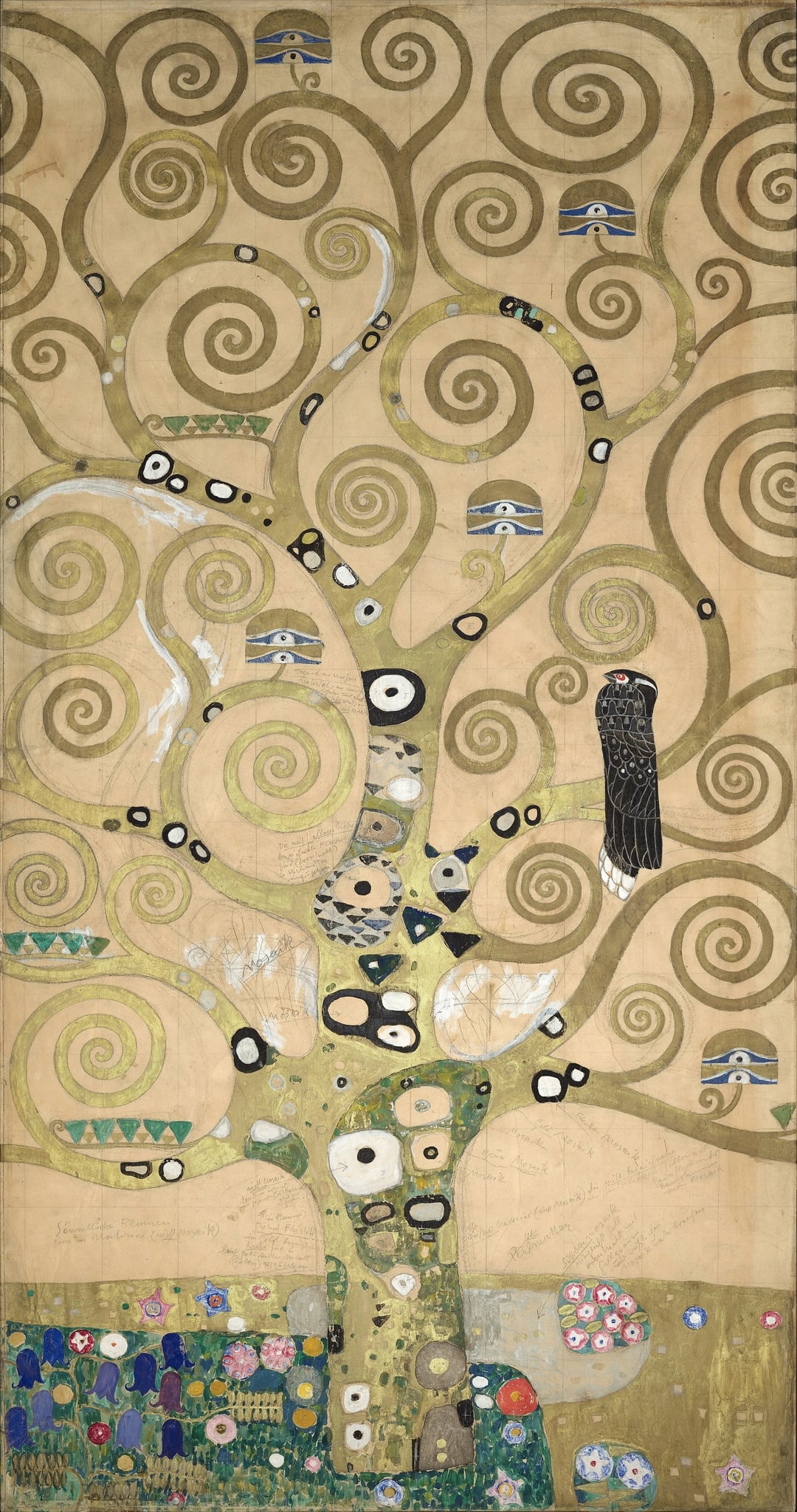
The Tree of Life
Gustav Klimt (1910–1911 (design; mosaic installed 1911))
Gustav Klimt’s The Tree of Life crystallizes a <strong>cosmological axis</strong> in a gilded ornamental language: a rooted trunk erupts into <strong>endless spirals</strong>, embedded with <strong>eye-like rosettes</strong> and shadowed by a black, red‑eyed bird. Designed as part of the Stoclet dining‑room frieze, it fuses <strong>symbolism and luxury materials</strong> to link earthly abundance with timeless transcendence <sup>[1]</sup><sup>[2]</sup>.
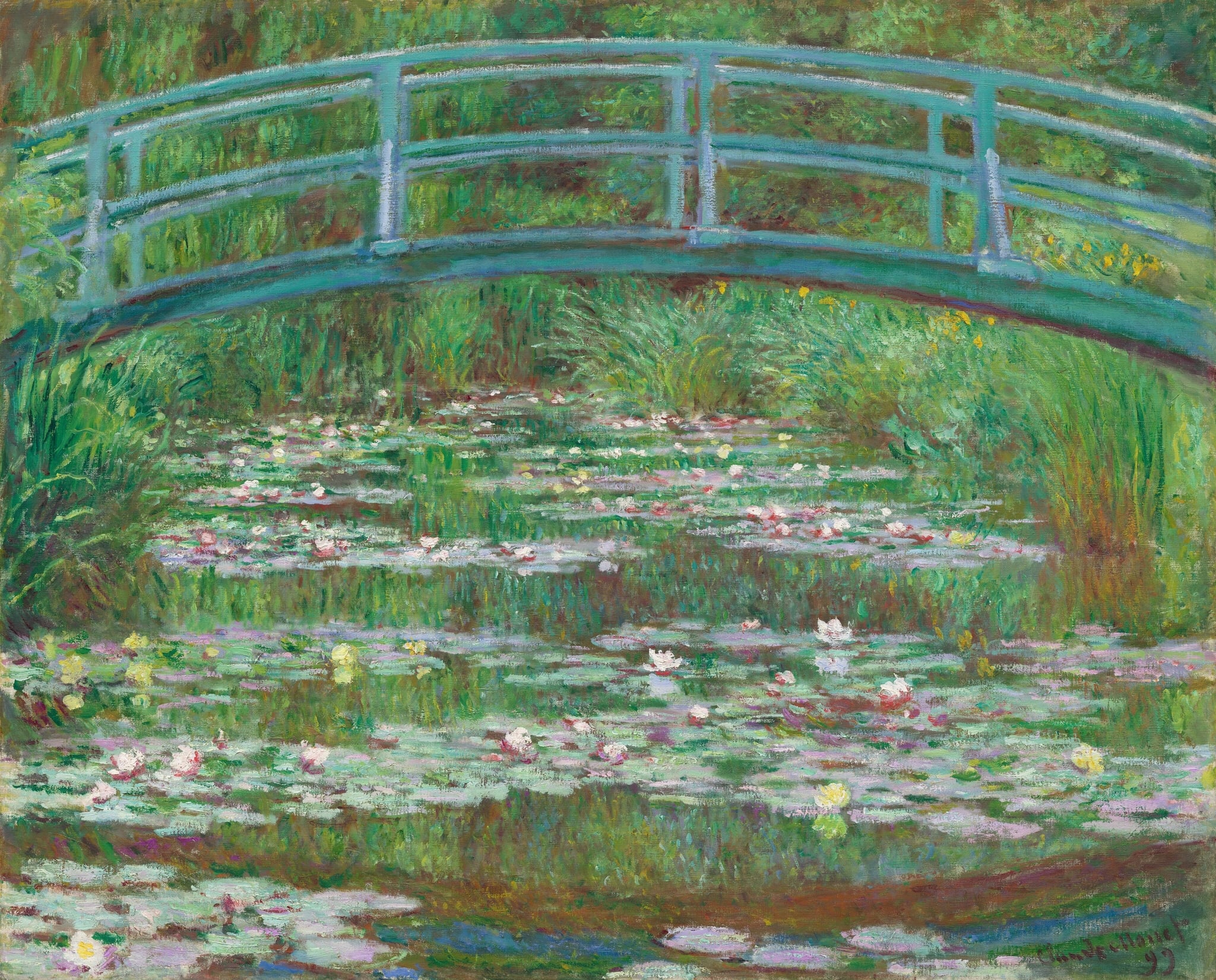
The Japanese Bridge
Claude Monet (1899)
Claude Monet’s The Japanese Bridge centers a pale <strong>blue‑green arch</strong> above a horizonless pond, where water‑lily pads and blossoms punctuate a field of shifting reflections. The bridge reads as both structure and <strong>contemplative threshold</strong>, suspending the eye between surface shimmer and mirrored depths <sup>[1]</sup><sup>[2]</sup>.
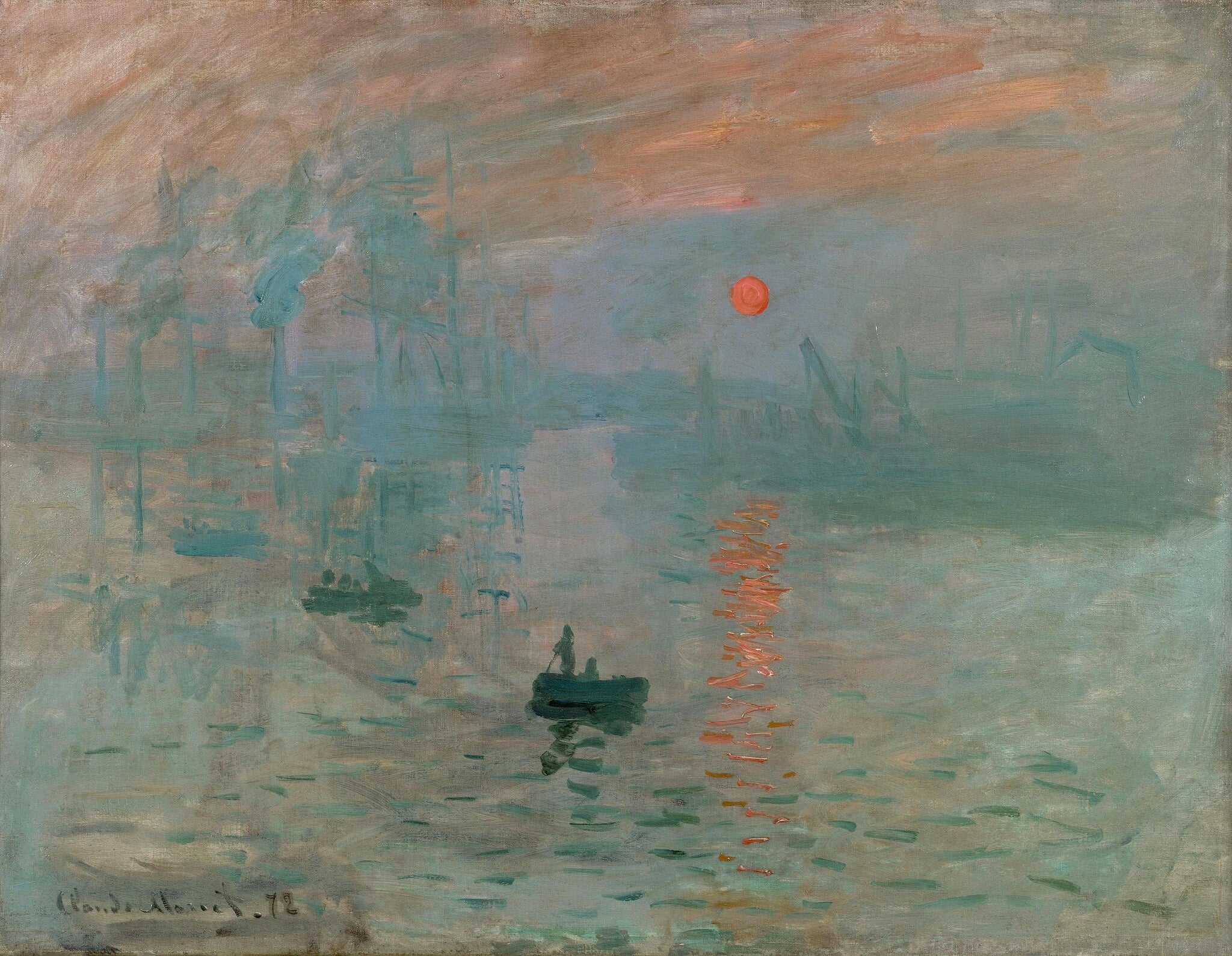
Impression, Sunrise
Claude Monet (1872)
In Impression, Sunrise, Claude Monet turns Le Havre’s fog-bound harbor into an experiment in <strong>immediacy</strong> and <strong>modernity</strong>. Cool blue-greens dissolve cranes, masts, and smoke, while a small skiff cuts the water beneath a blazing, <strong>equiluminant</strong> orange sun whose vertical reflection stitches the scene together <sup>[1]</sup><sup>[3]</sup>. The effect is a poised dawn where industry meets nature, a quiet <strong>awakening</strong> rendered through light rather than line.
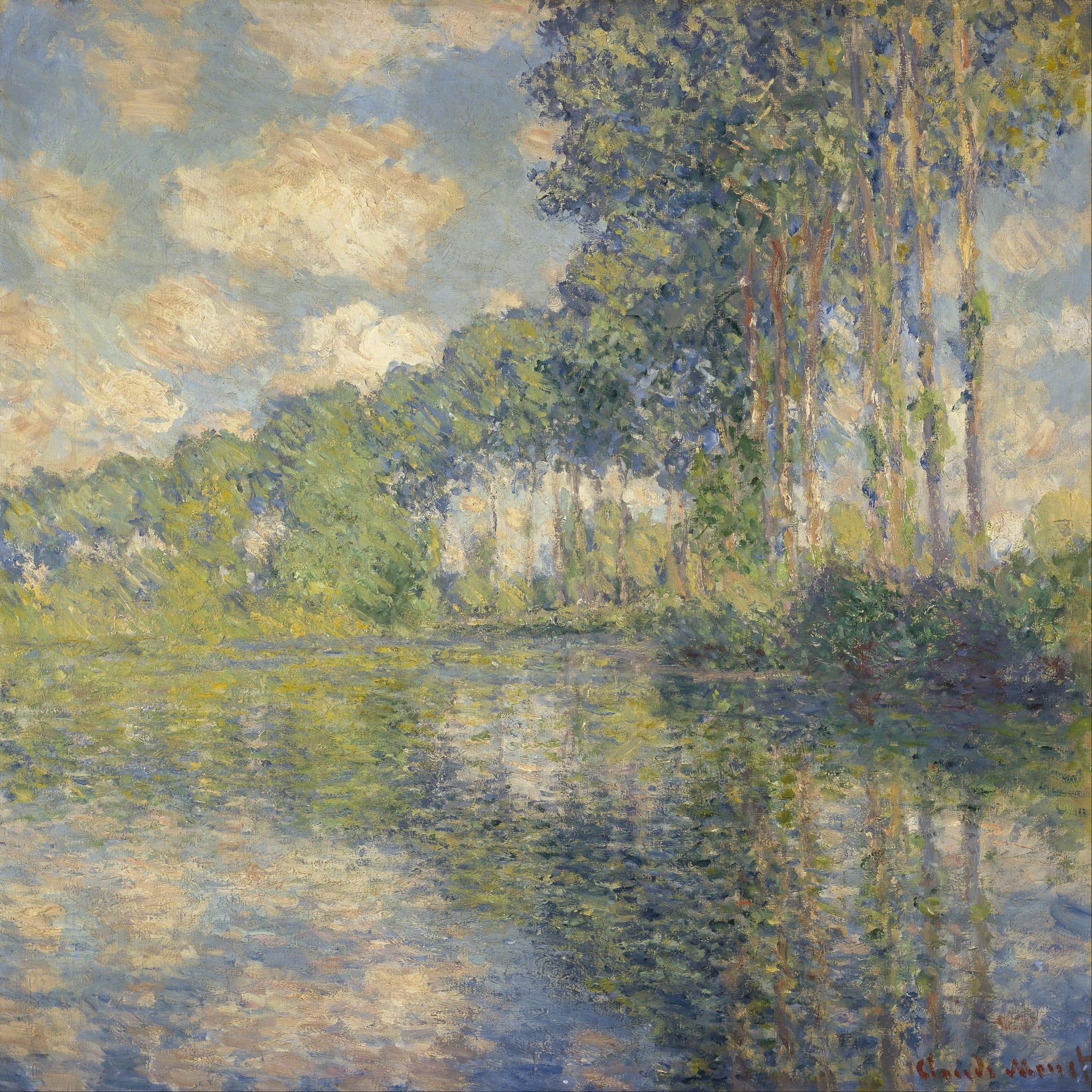
Poplars on the Epte
Claude Monet (1891)
Claude Monet’s Poplars on the Epte turns a modest river bend into a meditation on <strong>time, light, and perception</strong>. Upright trunks register as steady <strong>vertical chords</strong>, while their broken, shimmering reflections loosen form into <strong>pure sensation</strong>. The image stages a tension between <strong>order and flux</strong> that anchors the series within Impressionism’s core aims <sup>[1]</sup><sup>[2]</sup>.
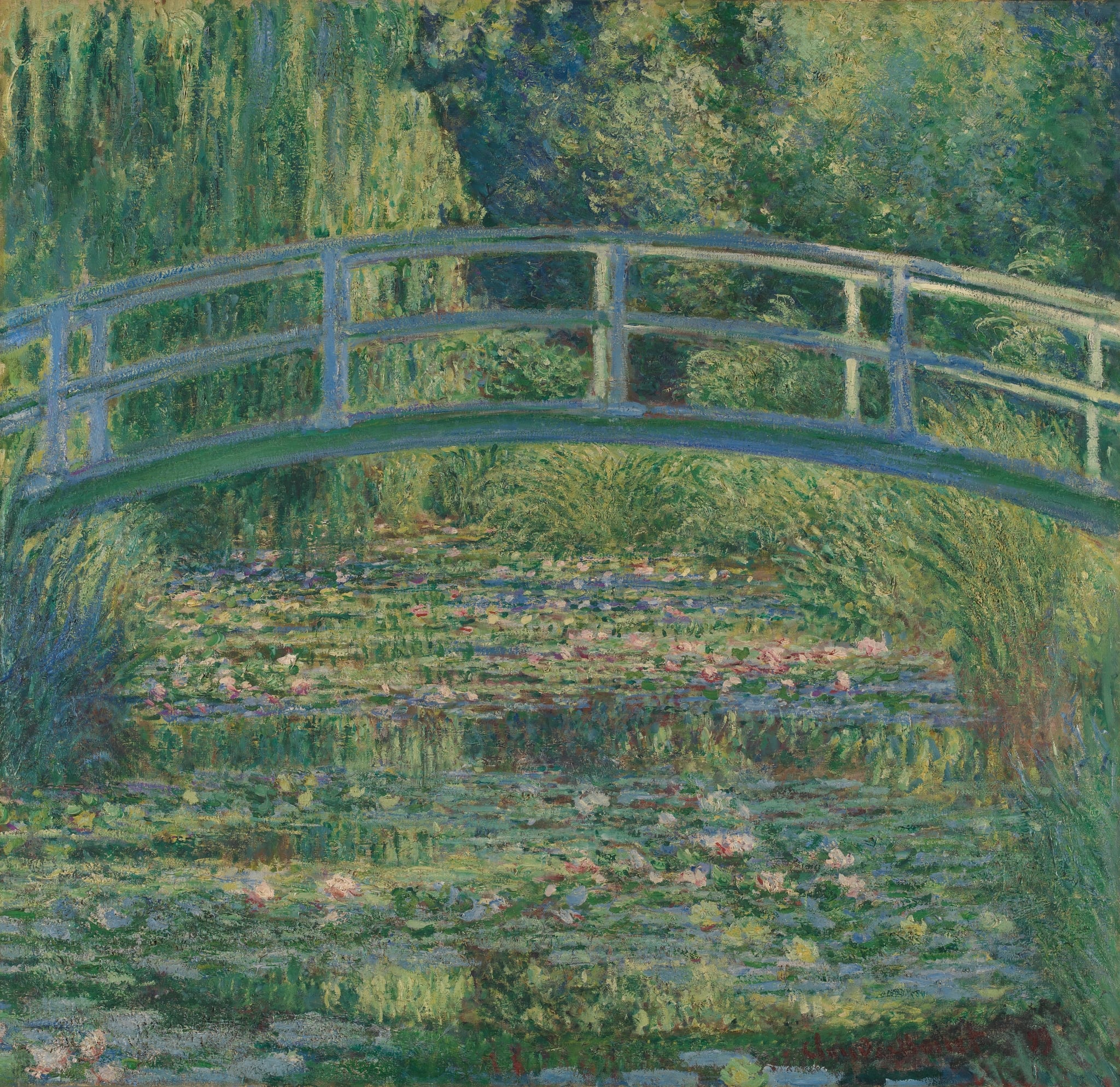
The Water Lily Pond
Claude Monet (1899)
Claude Monet’s The Water Lily Pond transforms a designed garden into a theater of <strong>perception and reflection</strong>. The pale, arched <strong>Japanese bridge</strong> hovers over a surface where lilies, reeds, and mirrored willow fronds dissolve boundaries between water and sky, proposing <strong>seeing itself</strong> as the subject <sup>[1]</sup><sup>[3]</sup>.
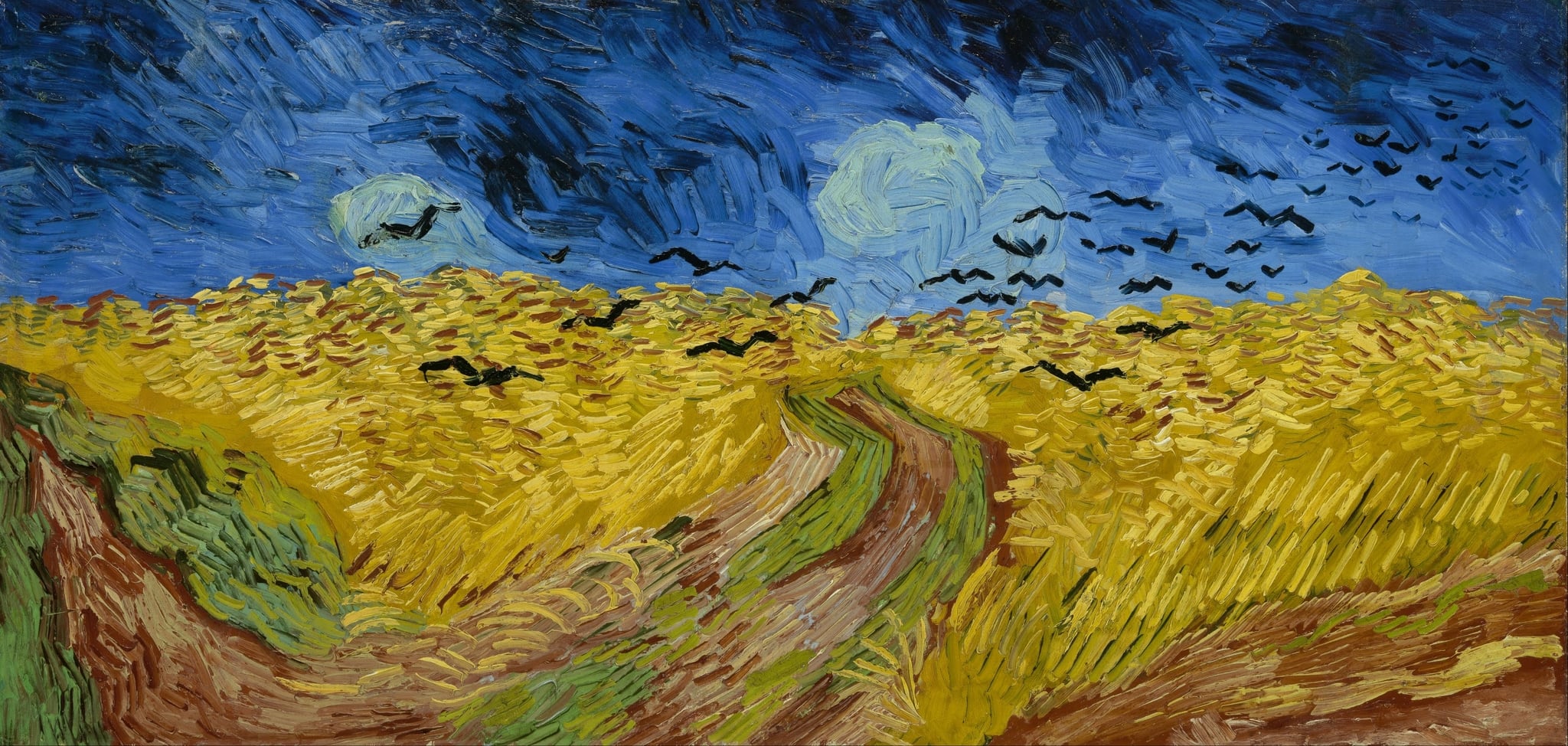
Wheatfield with Crows
Vincent van Gogh (1890)
A panoramic wheatfield splits around a rutted track under a storm-charged sky while black crows rush toward us. Van Gogh drives complementary blues and yellows into collision, fusing <strong>nature’s vitality</strong> with <strong>inner turbulence</strong>.
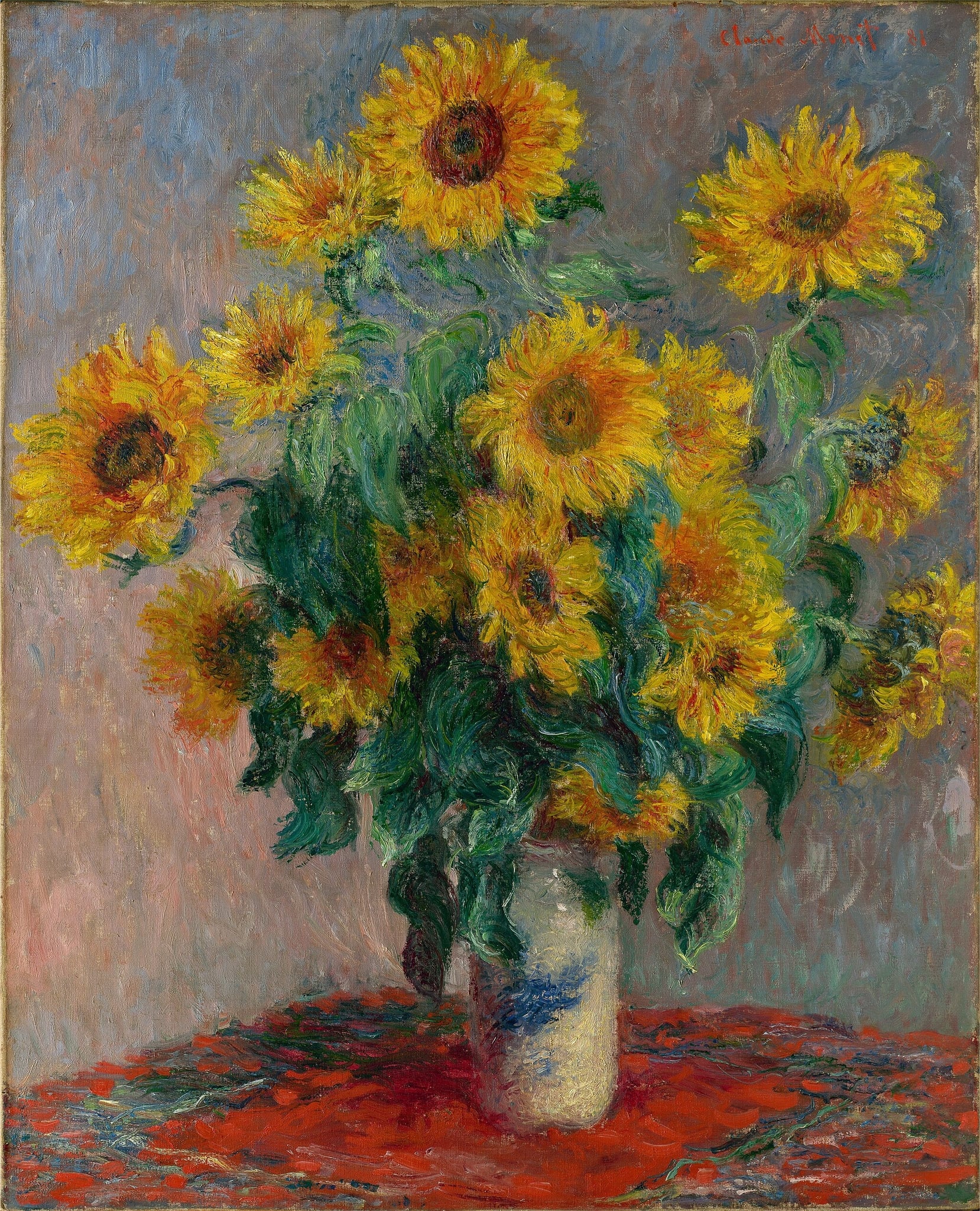
Bouquet of Sunflowers
Claude Monet (1881)
Claude Monet’s Bouquet of Sunflowers detonates with <strong>solar color</strong> and <strong>restless brushwork</strong>: yellow heads flare from a pale vase, thrust forward by a blazing red cloth against a cool, lilac‑gray wall. The painting converts a domestic bouquet into an arena where <strong>light, time, and touch</strong> supersede contour, staging blooms from vigor to fray in a single, pulsing image <sup>[1]</sup><sup>[2]</sup>.

Chrysanthemums
Claude Monet (1878)
Claude Monet’s Chrysanthemums fixes a burst of late‑season bloom in a <strong>scarlet, plush‑textured vase</strong> against a cool <strong>blue‑gray wall</strong> where faint floral <strong>sprigs</strong> echo the bouquet. The painting privileges <strong>vibration of color</strong> over contour, turning still life into a decorative field. It condenses autumnal abundance and the fleetingness of light into a single, shimmering sensation <sup>[1]</sup><sup>[2]</sup>.

Ice Floes
Claude Monet (1893)
Claude Monet’s Ice Floes turns a thawing Seine into a <strong>theater of transition</strong>: pale ice plates drift over mint‑green water beneath a <strong>high horizon</strong> and a <strong>russet clump of trees</strong> that warms the scene’s chill palette. With short, glancing strokes, Monet makes the floes <strong>shimmer between stillness and motion</strong>, converting a winter morning into a meditation on change and endurance.
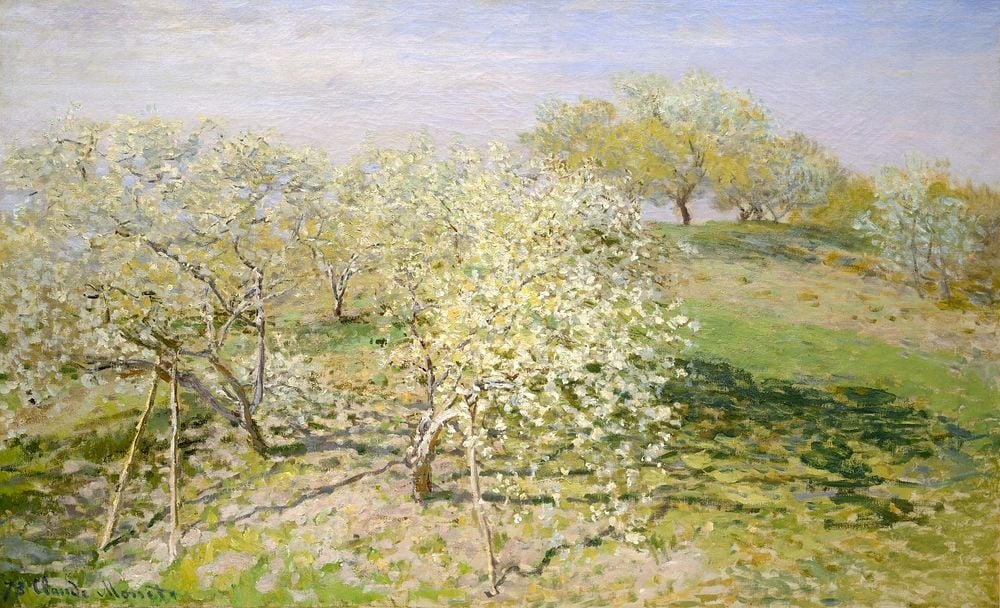
Spring (Fruit Trees in Bloom)
Claude Monet (1873)
Claude Monet’s Spring (Fruit Trees in Bloom) captures a hillside orchard at Argenteuil where pale blossoms flicker across a diagonal slope under a <strong>pearly, breathable sky</strong>. The canvas privileges <strong>light over contour</strong>, letting trunks, stakes, and petal-clusters resolve through vibrating touches of color that register passing air and sun <sup>[1]</sup><sup>[2]</sup>. The scene fixes a <strong>radiant instant</strong> while acknowledging its fragility.
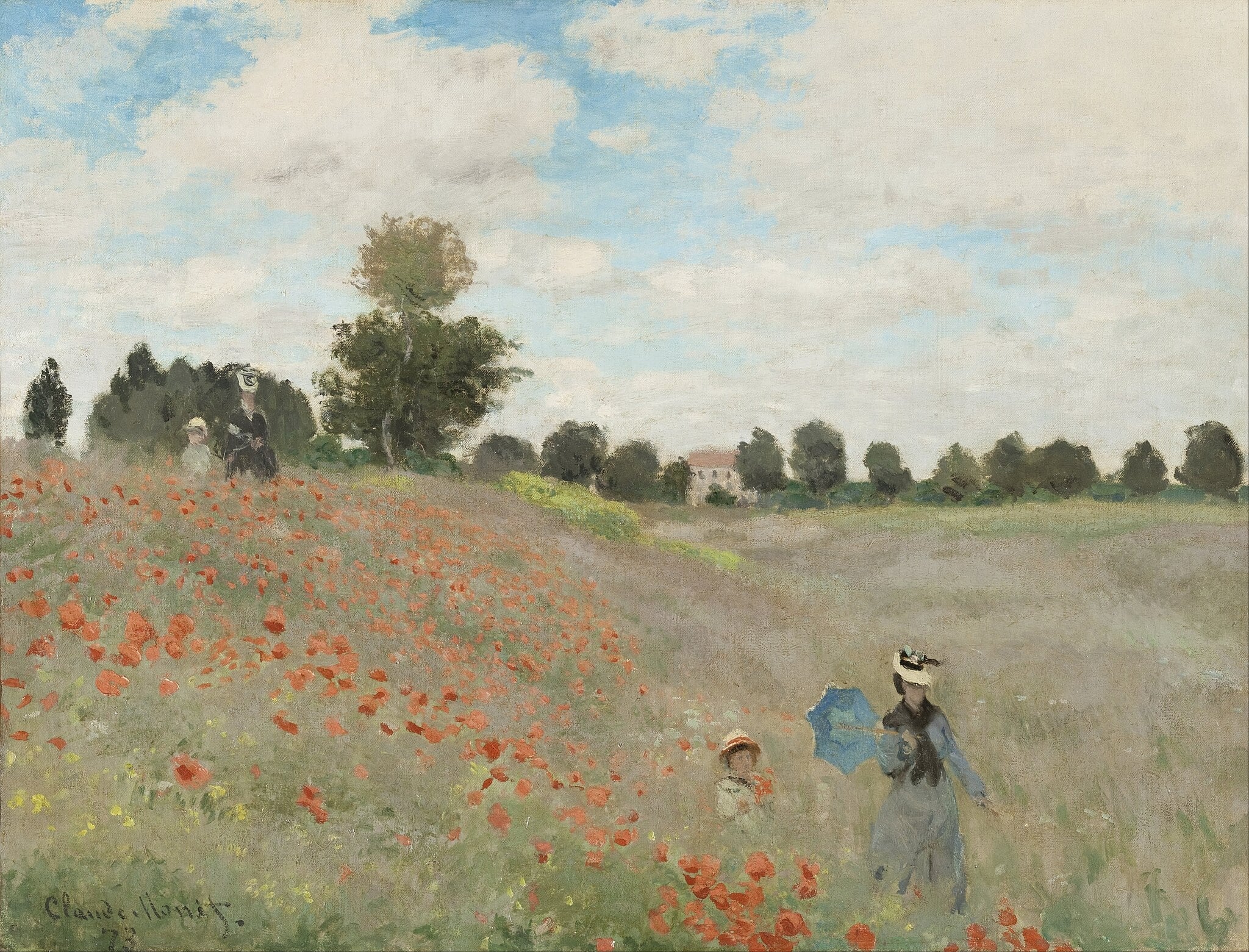
Poppy Fields near Argenteuil
Claude Monet (1873)
A modern pastoral where <strong>color and weather become the subject</strong>: in Poppy Fields near Argenteuil (1873), Monet arrays red poppies along a diagonal slope beneath an immense, changeable sky. Two promenading figures recur across the hill, turning a stroll into a <strong>rhythm of time and movement</strong> <sup>[1]</sup><sup>[2]</sup>.
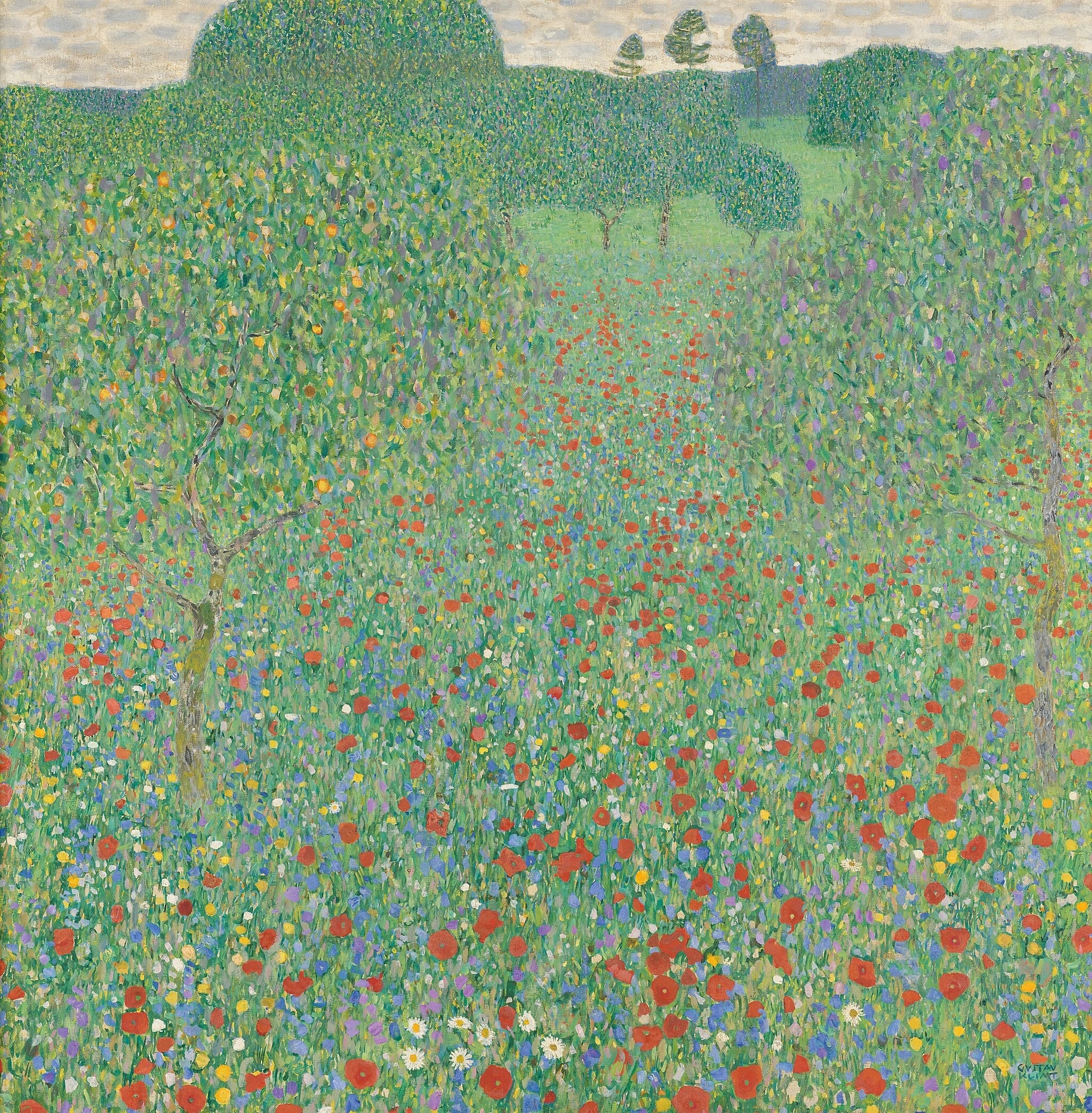
Flowering Poppies
Gustav Klimt (1907)
Gustav Klimt’s <strong>Flowering Poppies</strong> (1907) turns a meadow into a shimmering, all-over field where botany becomes <strong>ornament</strong>. A square canvas packed with red poppies, daisies, and fruiting trees compresses depth and invites a drifting gaze rather than linear recession <sup>[1]</sup><sup>[2]</sup>. The result is a sensuous, immersive vision that fuses observed nature with <strong>decorative abstraction</strong> <sup>[2]</sup>.
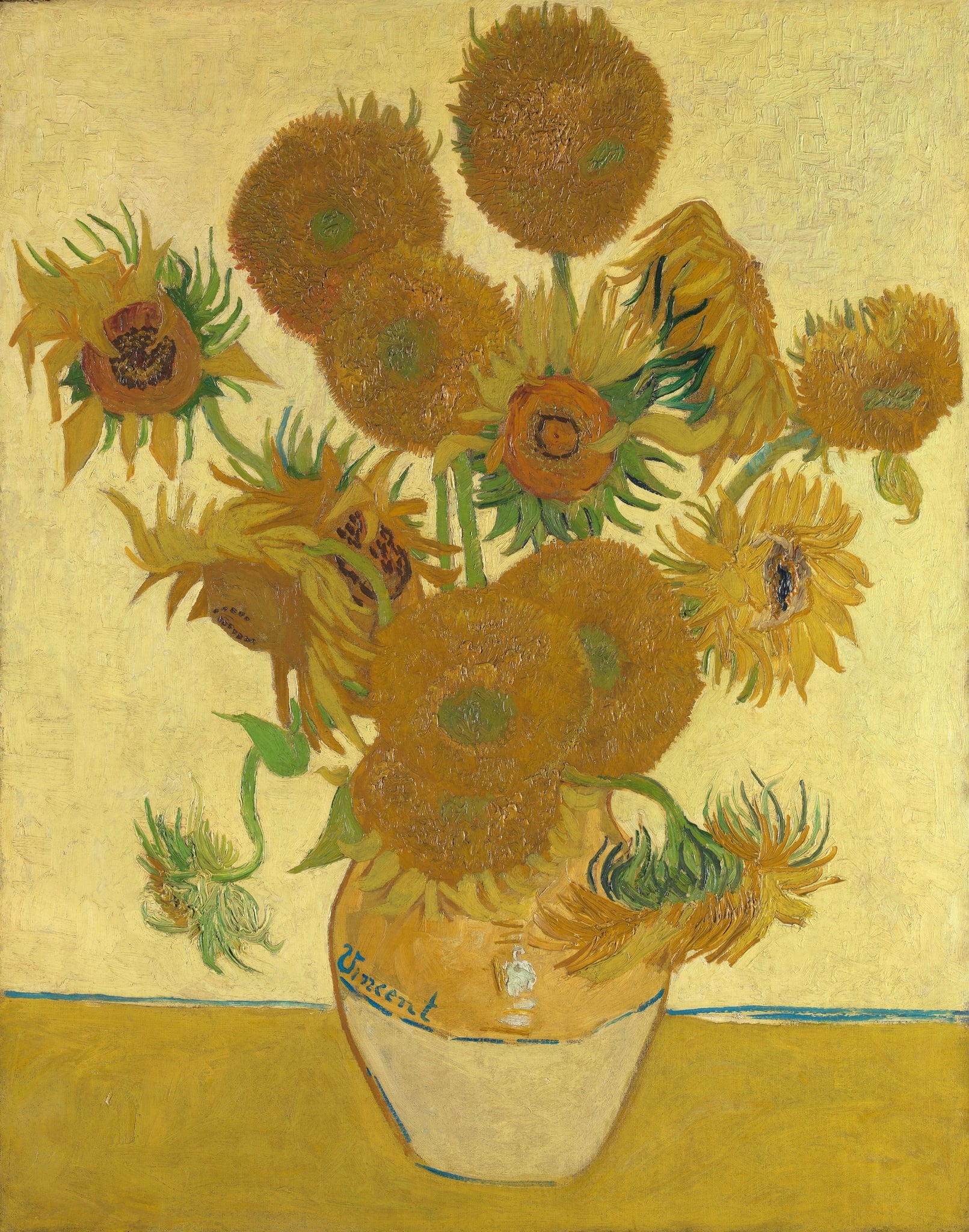
Sunflowers
Vincent van Gogh (1888)
Vincent van Gogh’s Sunflowers (1888) is a <strong>yellow-on-yellow</strong> still life that stages a full <strong>cycle of life</strong> in fifteen blooms, from fresh buds to brittle seed heads. The thick impasto, green shocks of stem and bract, and the vase signed <strong>“Vincent”</strong> turn a humble bouquet into an emblem of endurance and fellowship <sup>[1]</sup><sup>[2]</sup>.
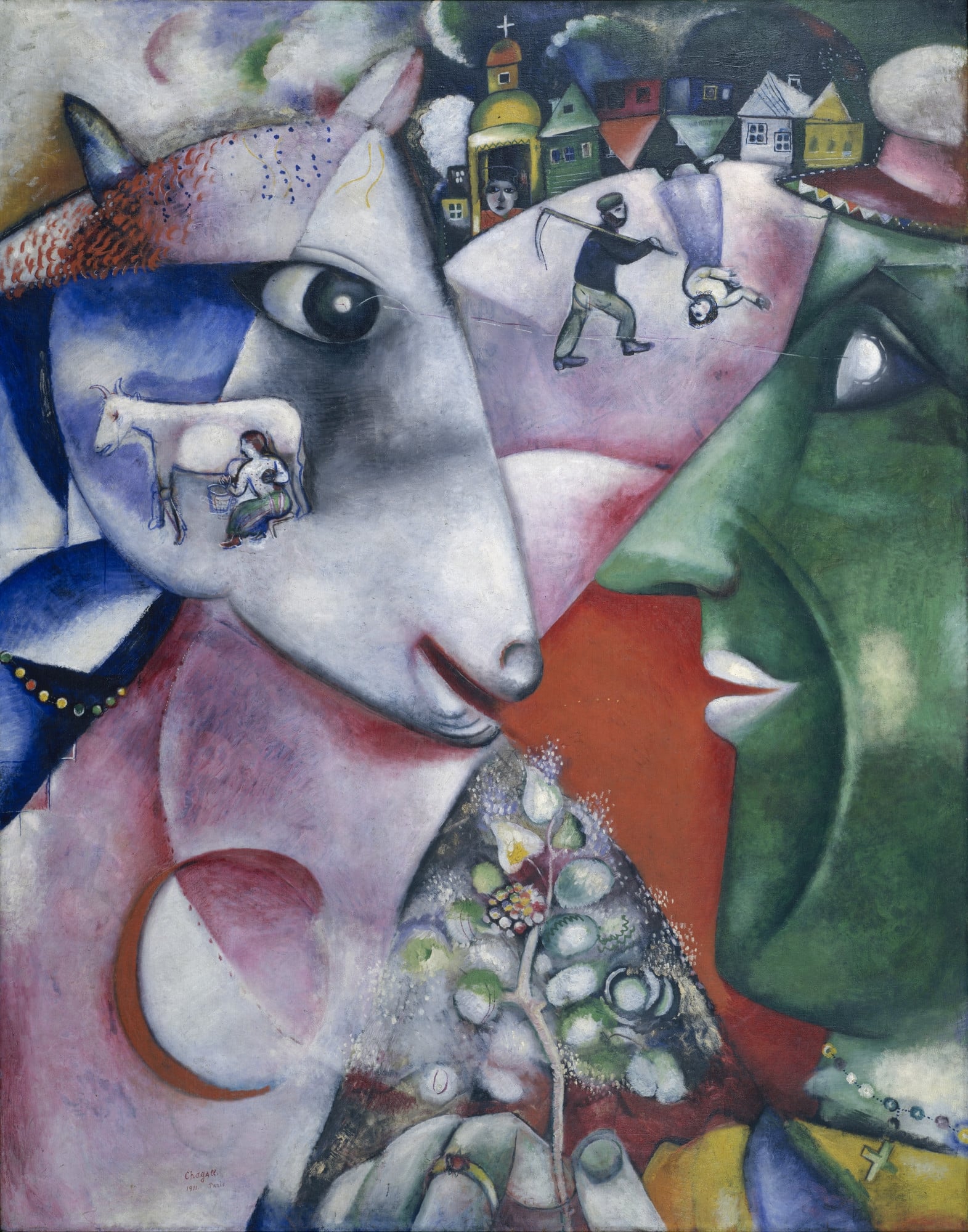
I and the Village
Marc Chagall (1911)
In I and the Village, Marc Chagall fuses <strong>memory, myth, and rural ritual</strong> into a dream‑logic tableau where a green‑faced villager and a pale bovine meet <strong>eye‑to‑eye</strong>. Concentric forms, prismatic color, and floating figures turn Vitebsk’s everyday life into a <strong>cosmic community</strong> where work, faith, and imagination coexist <sup>[1]</sup><sup>[3]</sup>.

The Palazzo Ducale, Seen from San Giorgio Maggiore
Claude Monet (1908)
In The Palazzo Ducale, Seen from San Giorgio Maggiore, Claude Monet turns Venice into a theater of <strong>light and time</strong>. The Doge’s Palace glows as a pale, honeyed rectangle while the <strong>lagoon’s rippling violets and blues</strong> swallow stone into shimmer. A <strong>dark triangular quay</strong> in the foreground steadies the eye, making the city seem to hover above water.
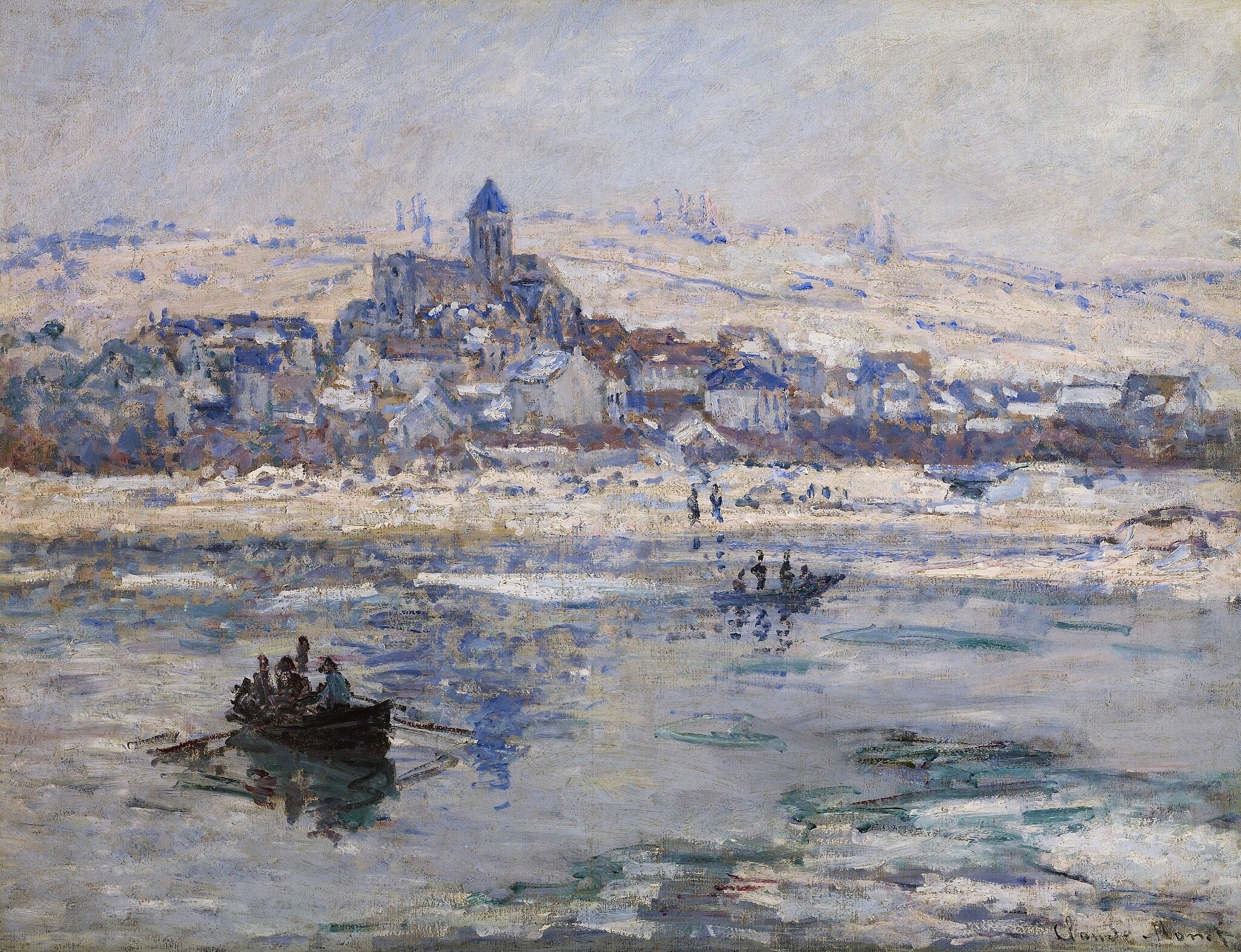
Vétheuil in Winter
Claude Monet (1878–79)
Claude Monet’s Vétheuil in Winter renders a riverside village in a <strong>silvery, frost-laden light</strong>, where the Seine carries <strong>broken ice</strong> past clustered houses and the tall church tower. The scene’s <strong>granular blue-green palette</strong> and softened edges make the town appear to crystallize out of air and water, while small boats and figures signal quiet persistence.
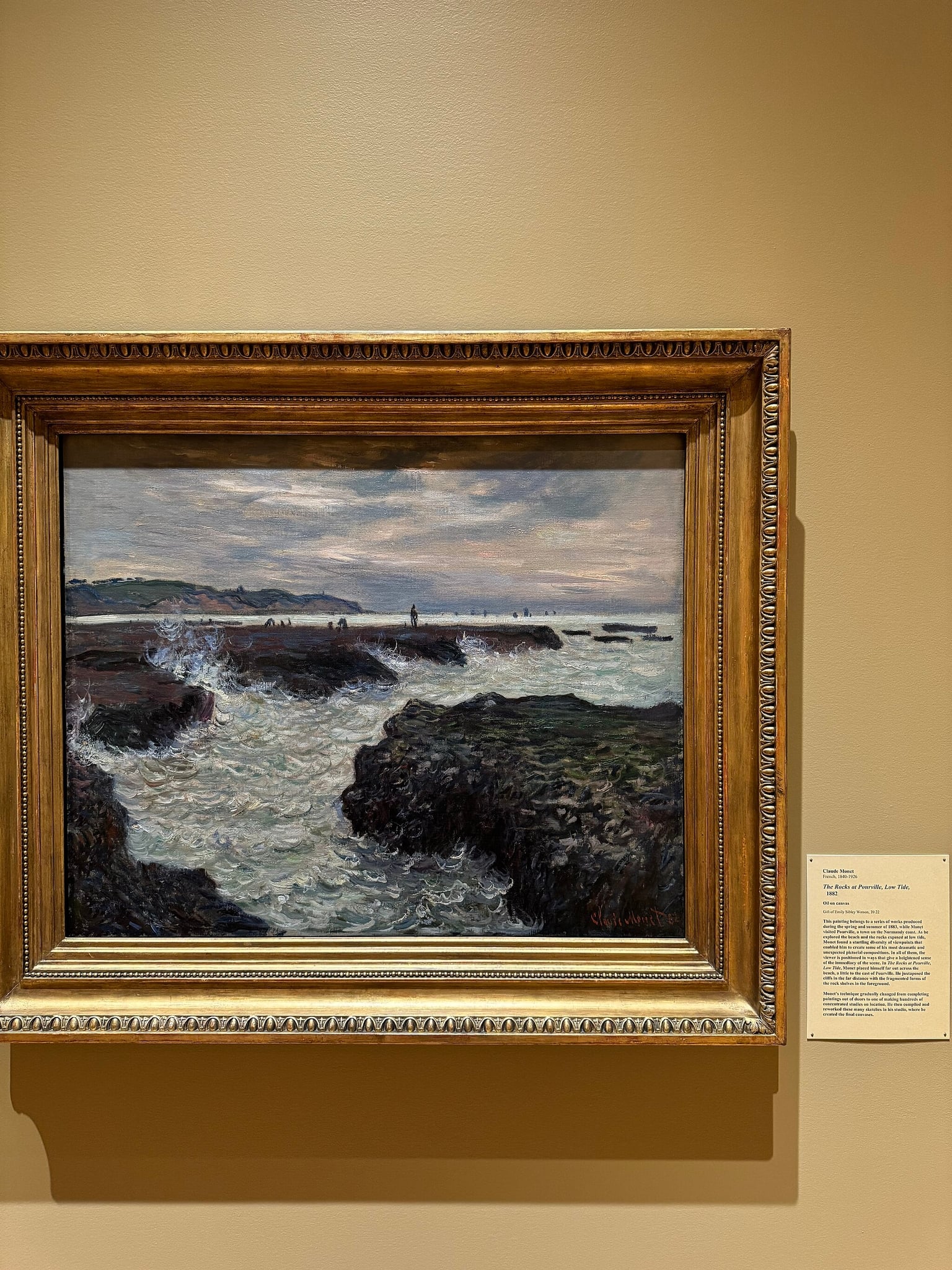
The Rocks at Pourville, Low Tide
Claude Monet (1882)
Claude Monet’s The Rocks at Pourville, Low Tide renders the Normandy foreshore as a meeting of <strong>endurance and flux</strong>—dark, seaweed-laden rocks cleave through <strong>foaming, mobile surf</strong> beneath a cool, <strong>pewter sky</strong>. Tiny silhouettes along the horizon reduce human presence to scale and rhythm, centering nature’s <strong>temporal pulse</strong>.
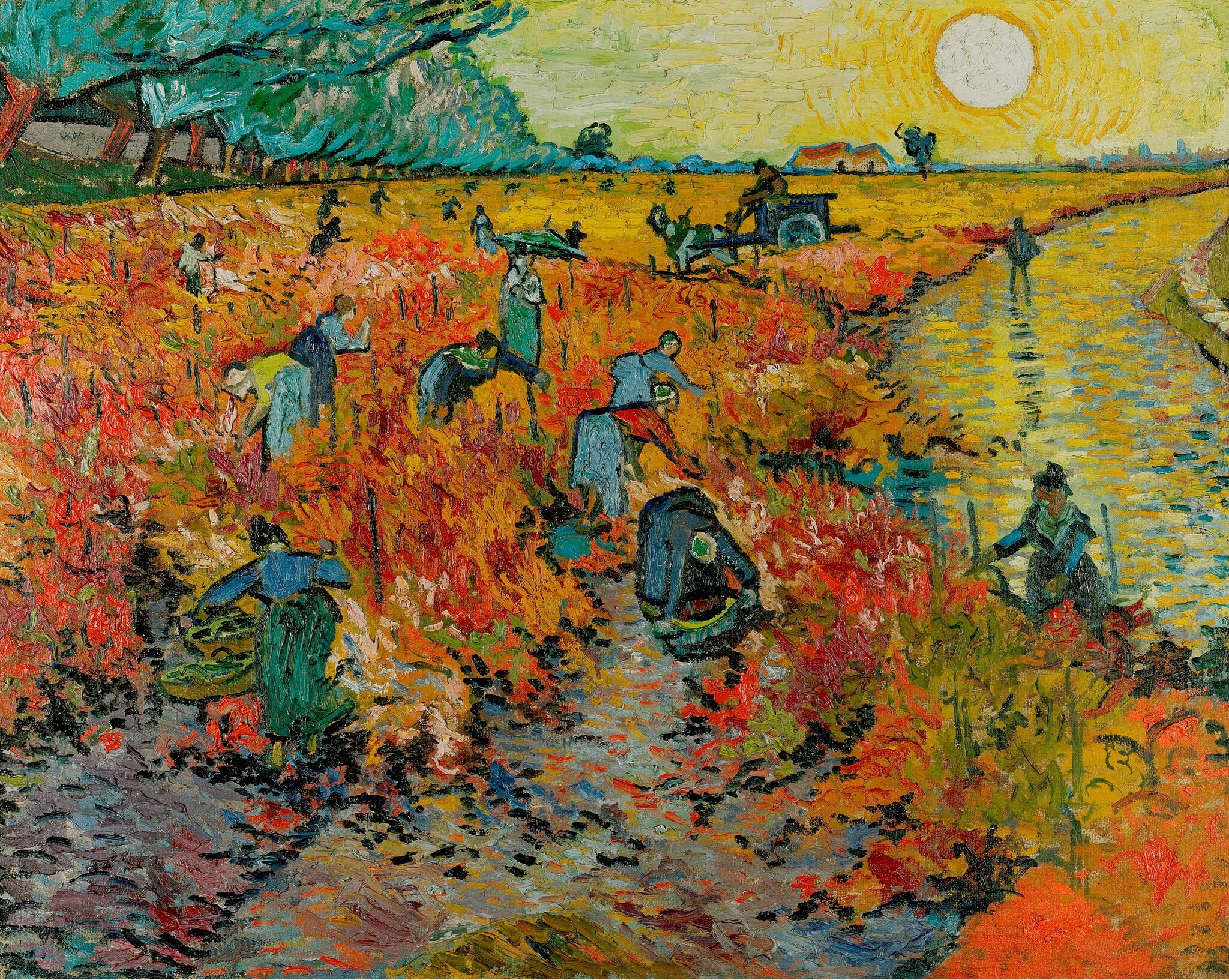
The Red Vineyard
Vincent van Gogh (1888)
In The Red Vineyard, Vincent van Gogh forges a vision of <strong>autumn labor under a blazing sun</strong>, where harvesters flow diagonally through scarlet vines while a band of <strong>yellow light</strong> flares along a reflective roadway. The scene fuses <strong>exhaustion and ripeness</strong>, turning work into a rhythmic, almost liturgical procession <sup>[1]</sup><sup>[3]</sup>.
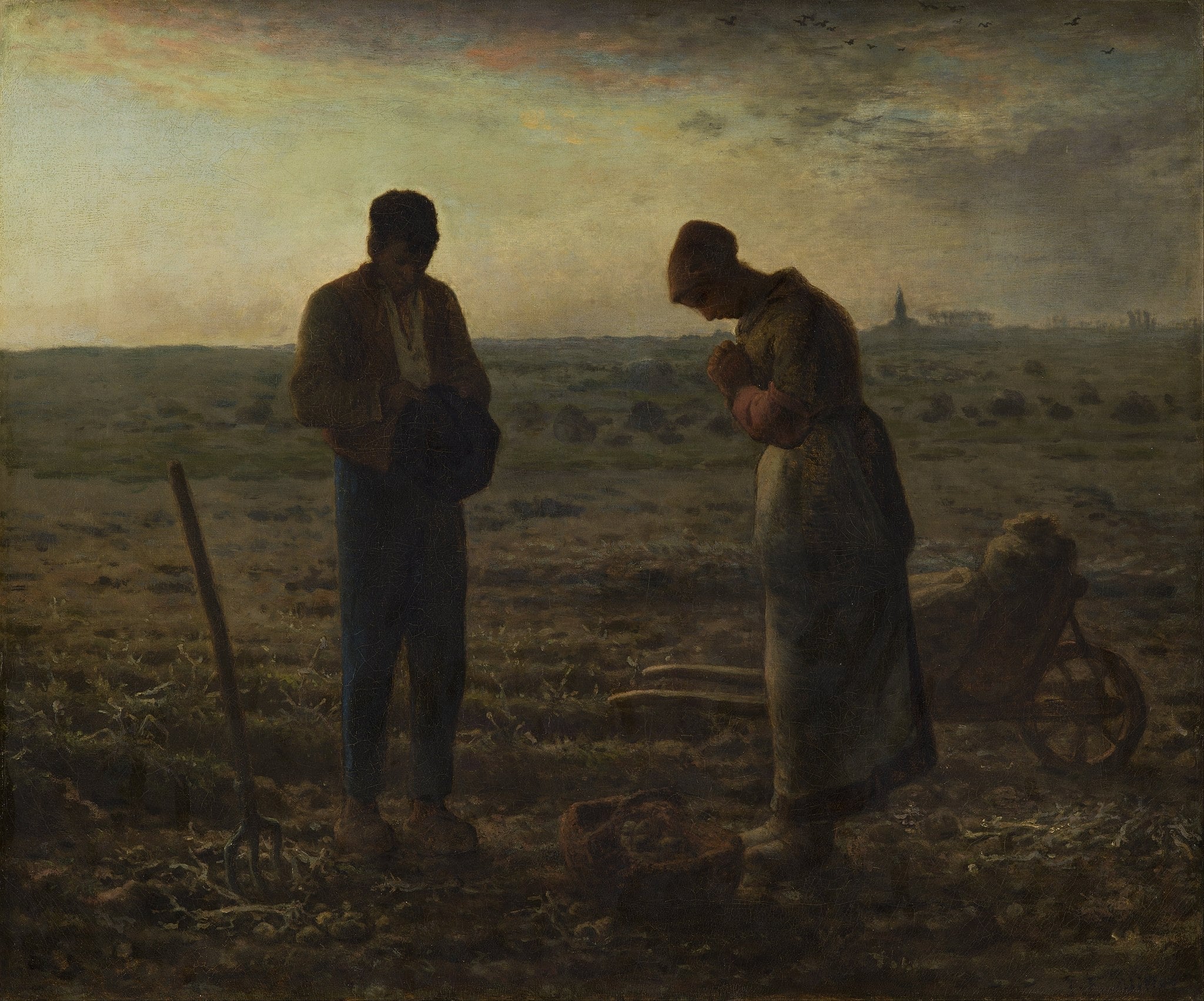
The Angelus
Jean-Francois Millet (1857–1859)
Jean-Francois Millet’s The Angelus (1857–1859) fuses <strong>devotion</strong> and <strong>labor</strong>: two peasants pause at dusk, heads bowed, as the Angelus bell sounds from a distant steeple. With a <strong>low horizon</strong>, earthen palette, and monumental silhouettes, the painting makes a brief pause in fieldwork feel timeless and sacred <sup>[1]</sup><sup>[2]</sup>.
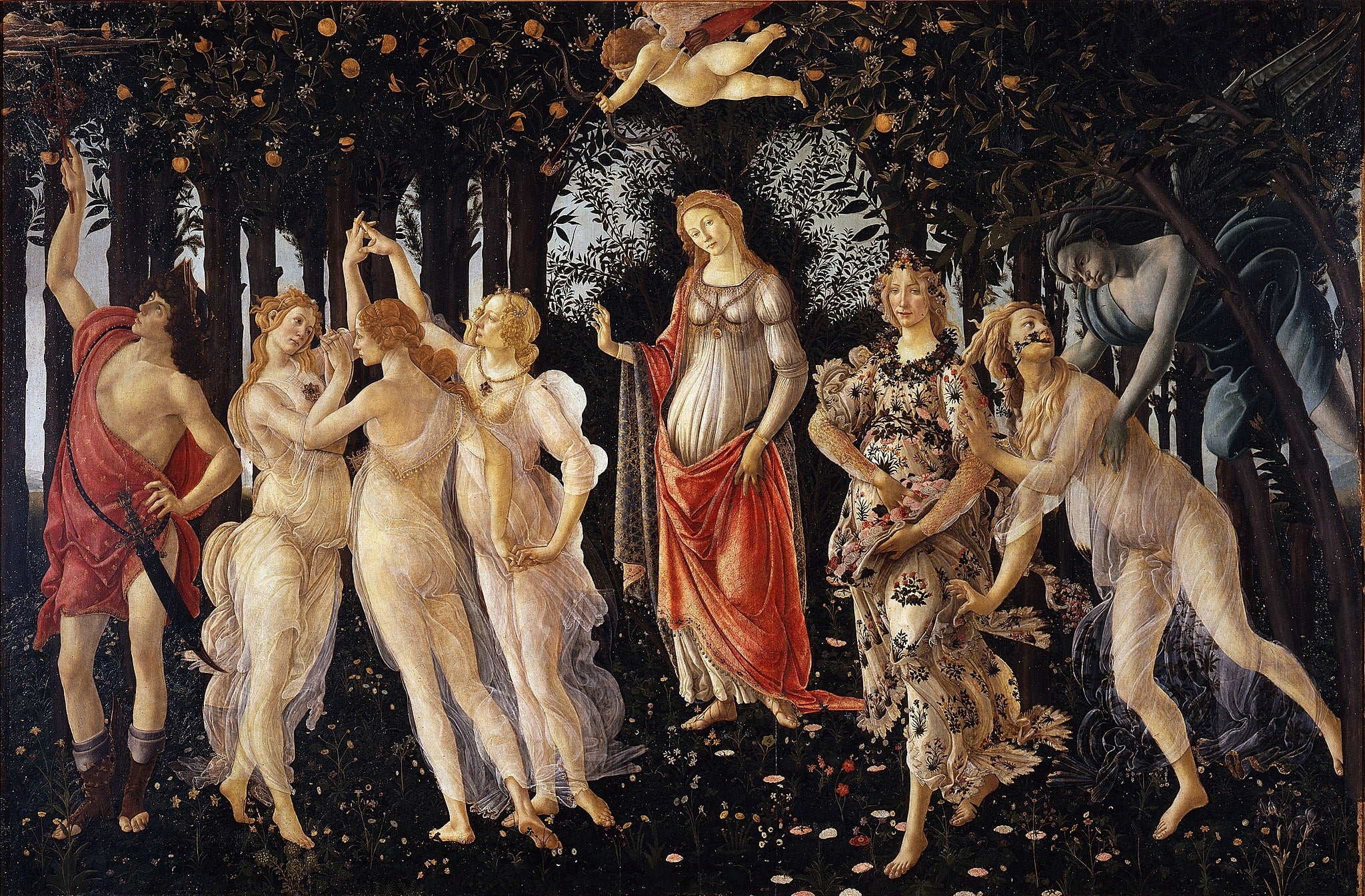
Primavera
Sandro Botticelli (c. 1480 (1477–1482))
Primavera stages a mythic procession of <strong>Spring</strong> in an orange and laurel grove: <strong>Venus</strong> presides beneath a myrtle canopy as <strong>Cupid</strong> looses an arrow, <strong>Mercury</strong> clears the last clouds, the <strong>Three Graces</strong> dance, and <strong>Zephyrus</strong> pursues <strong>Chloris</strong>, who blossoms into <strong>Flora</strong>. The carpet of more than a hundred identifiable flowers and the Medici-laden orchard declare <strong>fertility, peace, and ordered prosperity</strong> under Venus’s benign rule <sup>[1]</sup><sup>[2]</sup>.
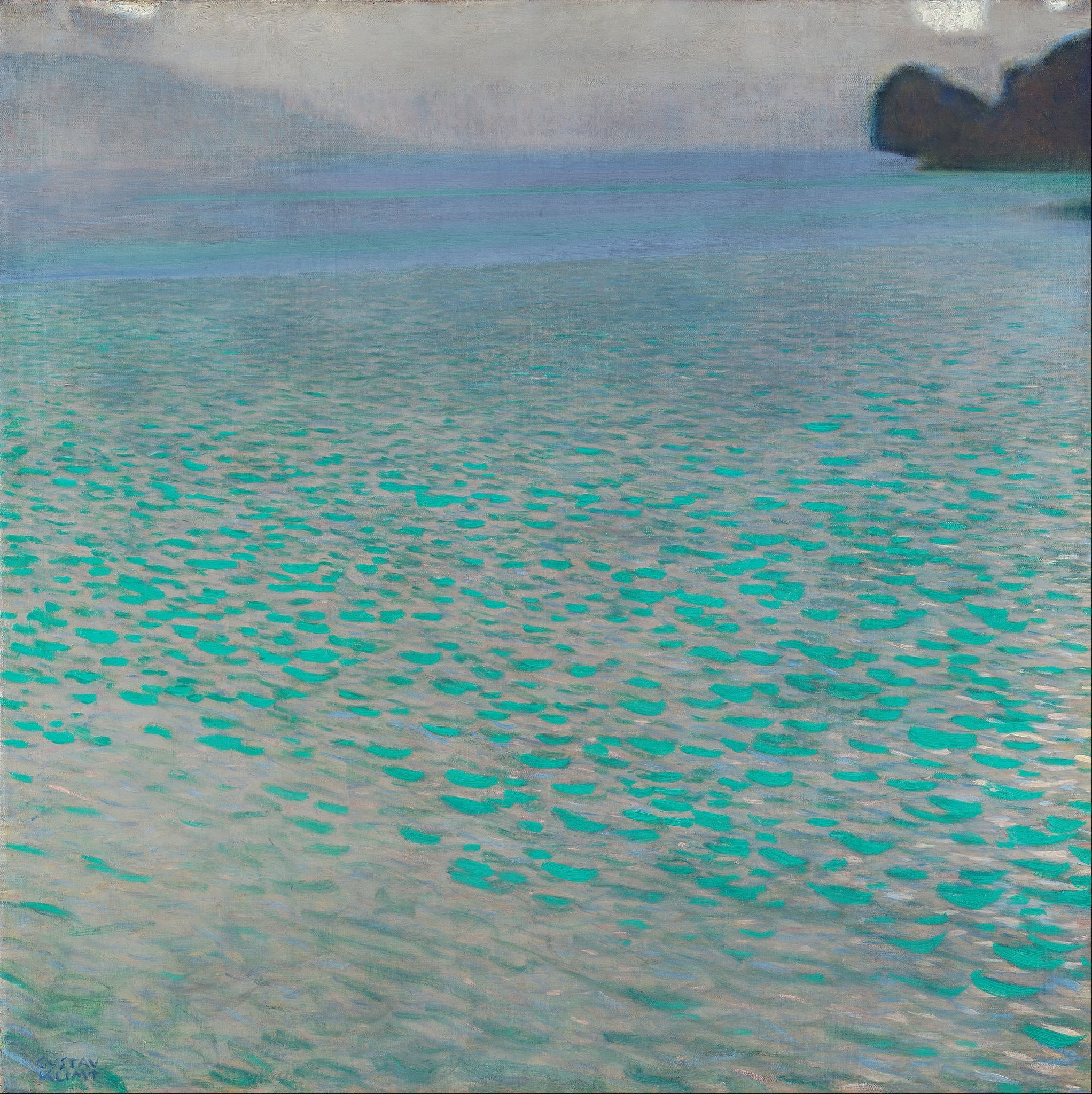
On Lake Attersee
Gustav Klimt (1900)
Gustav Klimt’s On Lake Attersee (1900) turns a summer lake into a <strong>woven field of light</strong>. A square canvas nearly filled with water, it stages a quiet duel between <strong>surface pattern</strong> and <strong>atmospheric depth</strong>, letting a tiny dark headland at the upper right anchor an otherwise hypnotic expanse <sup>[1]</sup><sup>[2]</sup>.
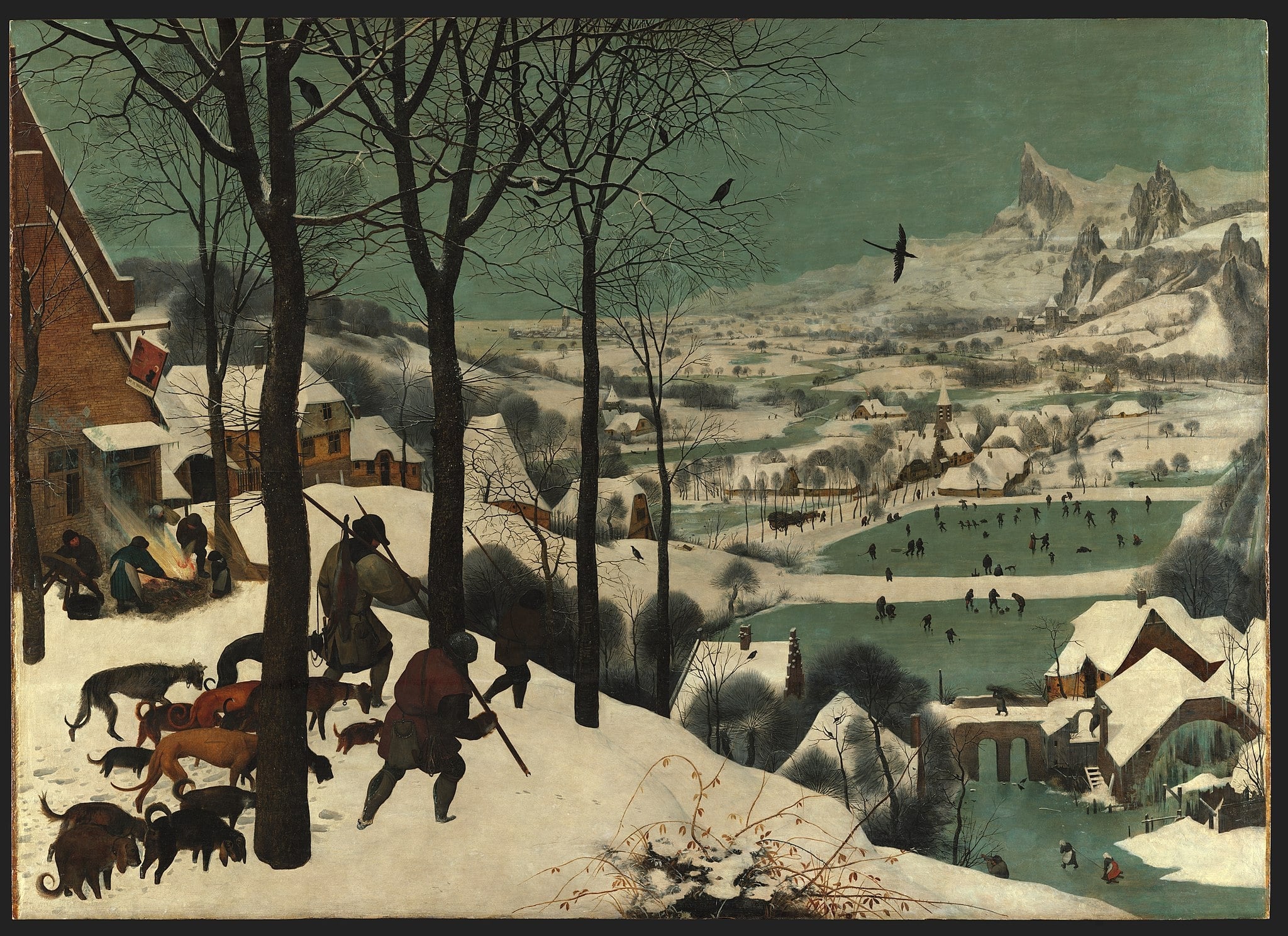
The Return of the Hunters
Pieter Bruegel the Elder (1565)
In The Return of the Hunters, Pieter Bruegel the Elder stages a wintry descent where three exhausted hunters and their dogs enter a valley alive with skaters and village chores. The painting forges a panoramic drama of <strong>hardship and resilience</strong>, contrasting scant game with communal play beneath a cold, teal sky <sup>[1]</sup><sup>[2]</sup>.
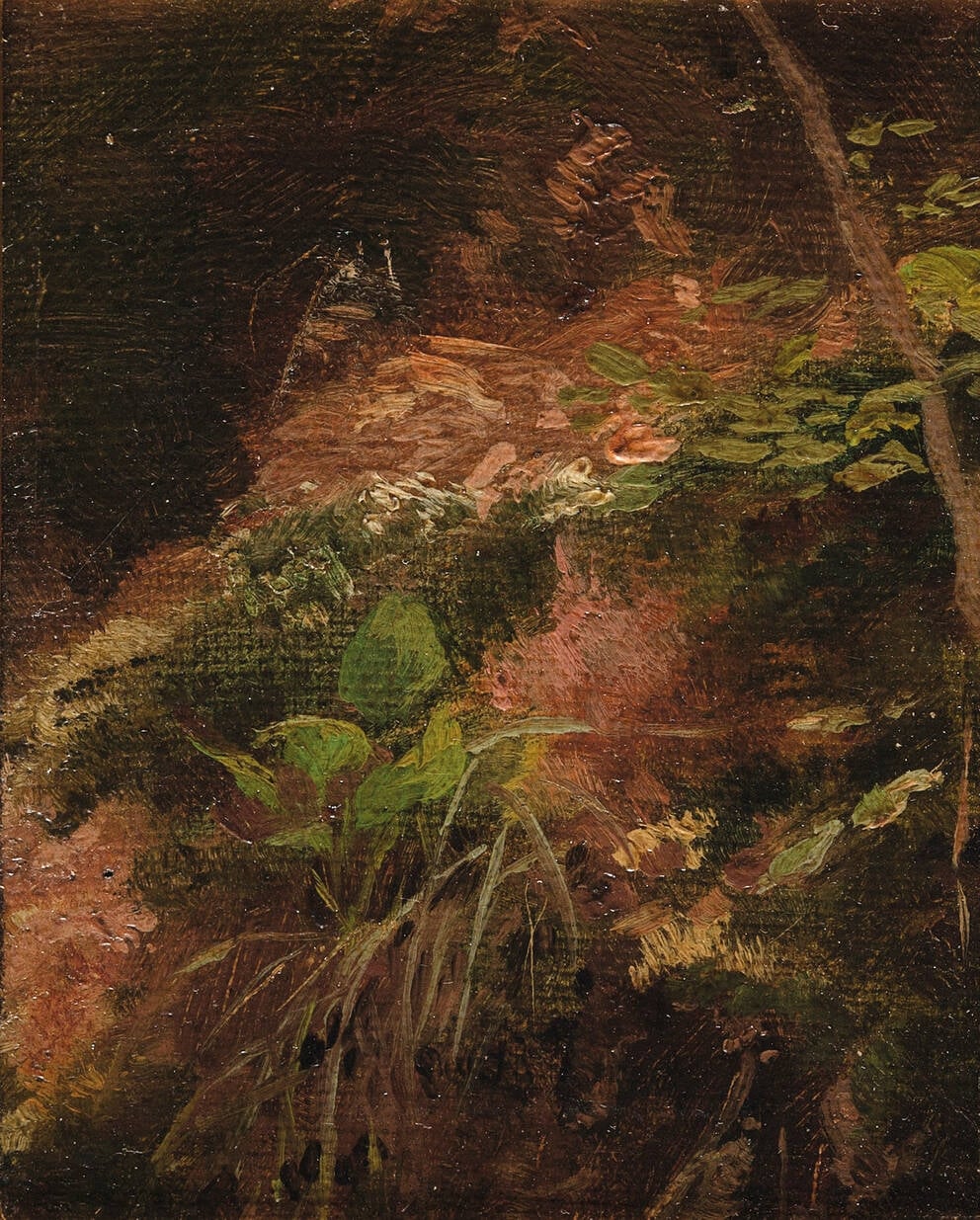
Forest Floor
Gustav Klimt (c. 1881/1882)
Forest Floor concentrates the eye on a miniature world of soil, moss, and leaf-litter rendered in tactile strokes and dark-to-amber light. Klimt frames a diagonal bank with a small sapling and sprouting leaves, turning the ground into a <strong>living tapestry</strong> of decay and renewal <sup>[1]</sup>. As an early oil sketch, it fuses <strong>academic chiaroscuro</strong> with a proto-decorative rhythm that hints at later developments <sup>[1]</sup>.
The Peasant Wedding
Pieter Bruegel the Elder (1568)
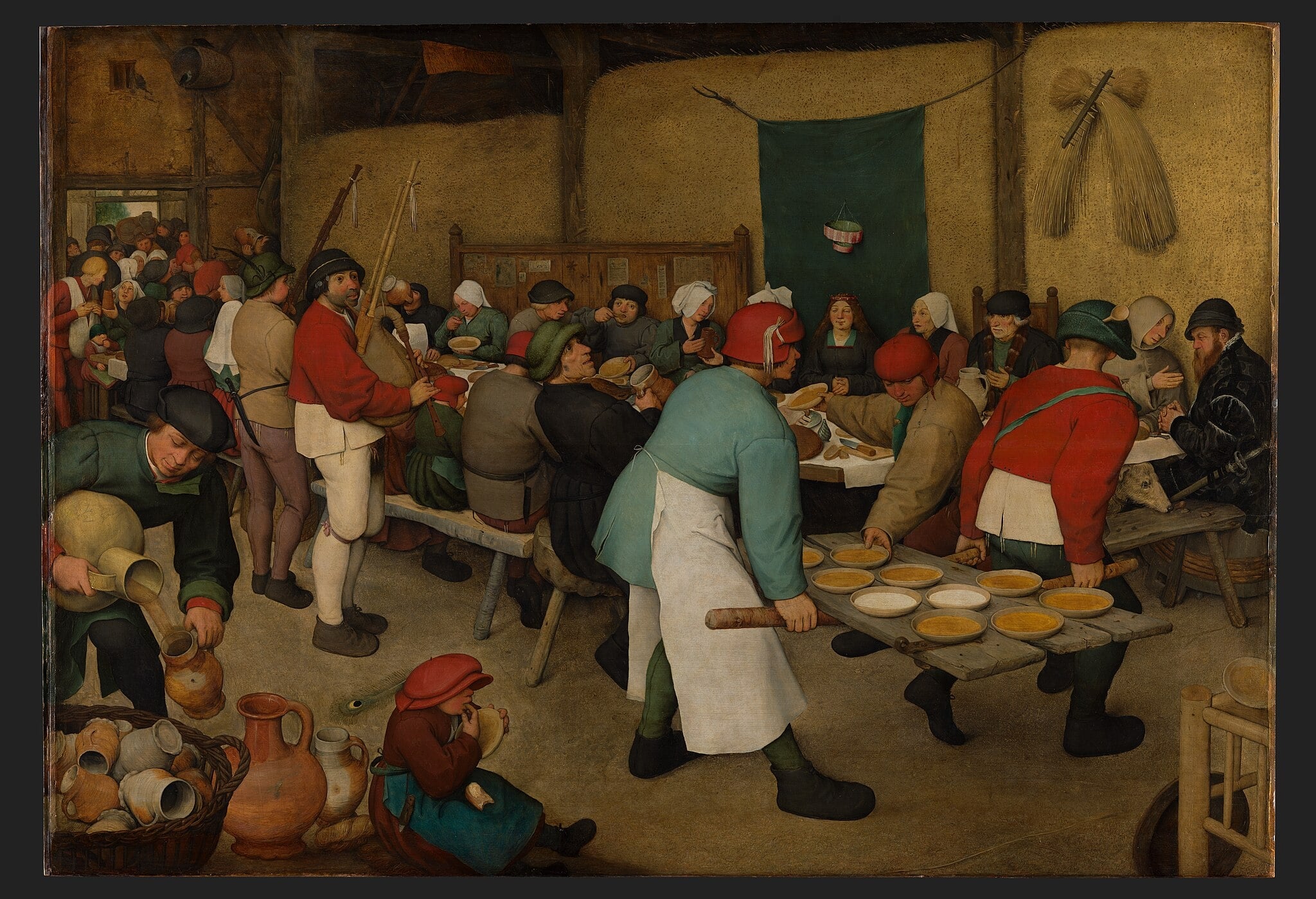
In The Peasant Wedding, Pieter Bruegel the Elder stages a <strong>communal rite</strong> inside a barn, where humble ingenuity and shared labor become the true spectacle. A bride sits beneath a <strong>green cloth of honor</strong> with a paper crown above, as servers balance bowls of porridge on a <strong>door turned into a tray</strong>, beer flows, and a bagpiper looks on <sup>[1]</sup><sup>[2]</sup>.
Hunters in the Snow
Pieter Bruegel the Elder (1565)
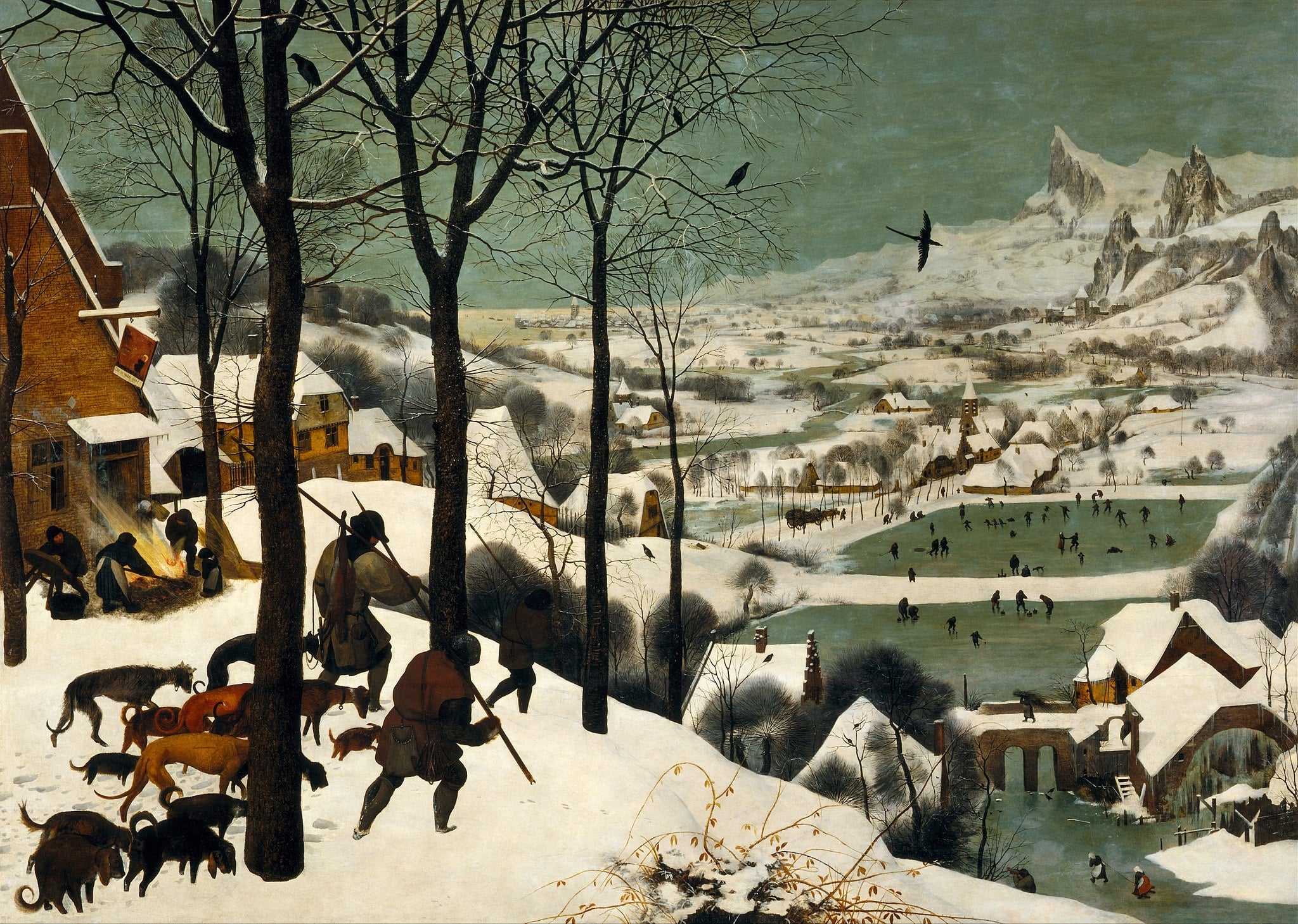
In Pieter Bruegel the Elder’s <strong>Hunters in the Snow</strong> (1565), a trio of tired hunters and <strong>gaunt dogs</strong> descend past an inn toward a vast frozen valley where villagers <strong>work, play, and endure</strong>. Bruegel fuses <strong>winter scarcity</strong> (a single fox, bare trees, crows) with <strong>communal resilience</strong> (pig-singeing fire, skaters, mill smoke) to stage a world ordered by the season’s cycle.
The Harvesters
Pieter Bruegel the Elder (1565)
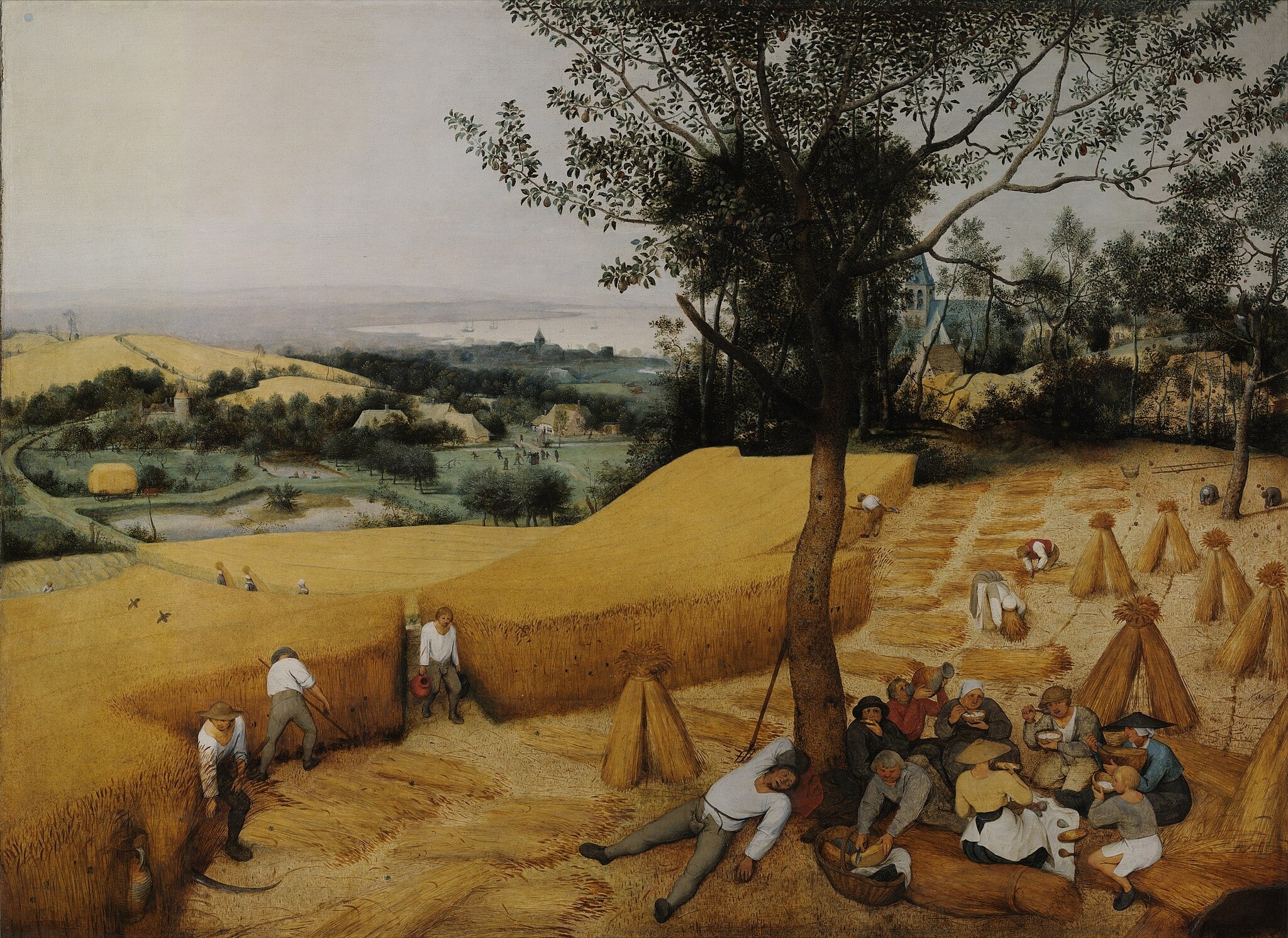
The Harvesters distills late summer into a seamless weave of <strong>labor and reward</strong>: reapers bend to wheat while others eat and doze beneath a tree, and the world opens to roads, a village, and ships. Bruegel dignifies every action with <strong>even light</strong> and a democratic gaze, turning a specific day’s work into an image of <strong>cyclical time</strong> and shared sustenance <sup>[1]</sup><sup>[4]</sup>.
The Lady of Shalott
John William Waterhouse (1888)
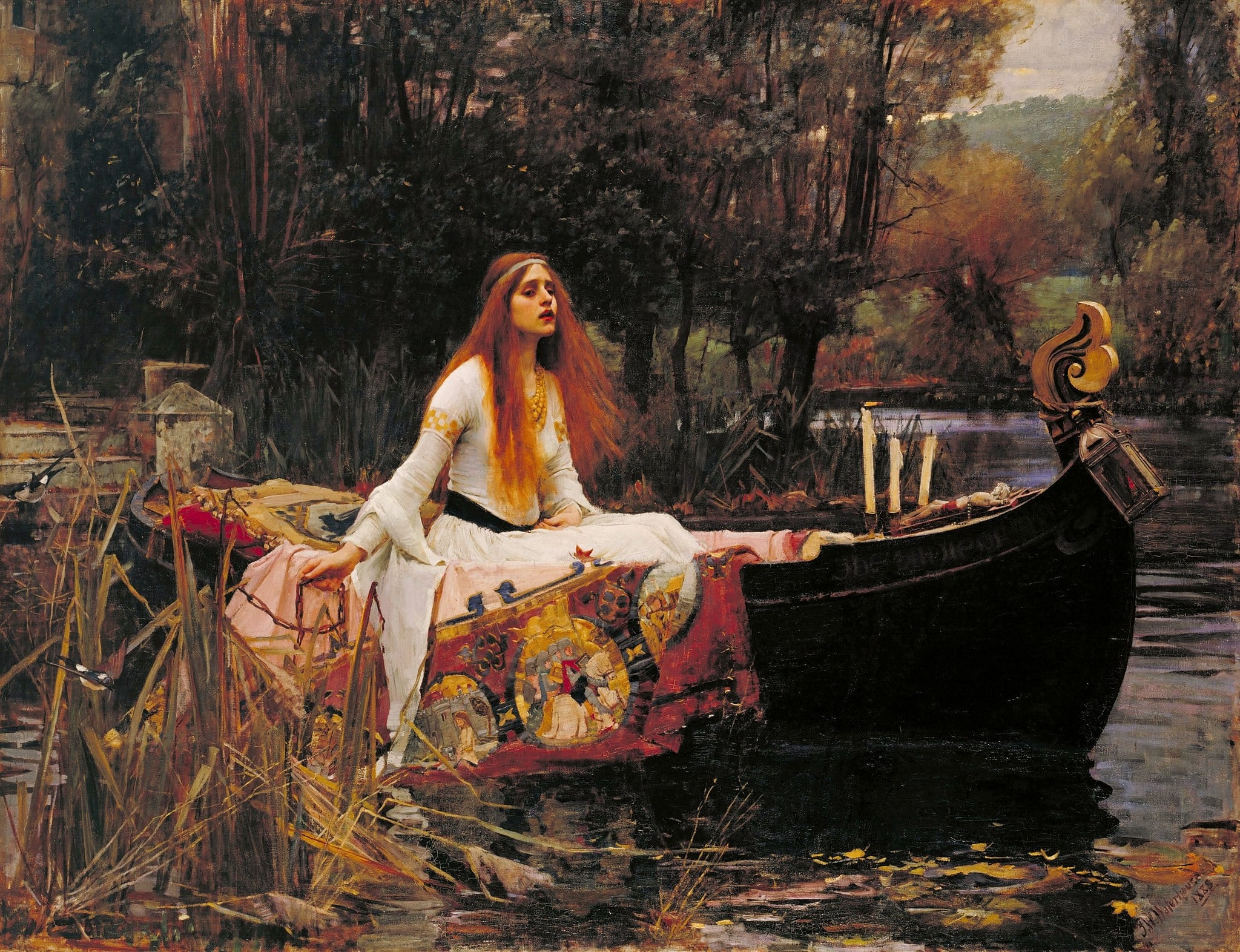
John William Waterhouse’s The Lady of Shalott fixes the tragic instant when the cursed Lady chooses to loose her mooring and drift toward Camelot. The released <strong>chain</strong>, the guttering <strong>candles</strong>, and the tapestry spilling over the boat narrate a passage from sheltered artifice to fatal reality. Waterhouse fuses late <strong>Pre-Raphaelite</strong> symbolism with elegiac atmosphere to stage beauty caught between <strong>agency</strong> and <strong>doom</strong> <sup>[1]</sup><sup>[2]</sup><sup>[3]</sup>.
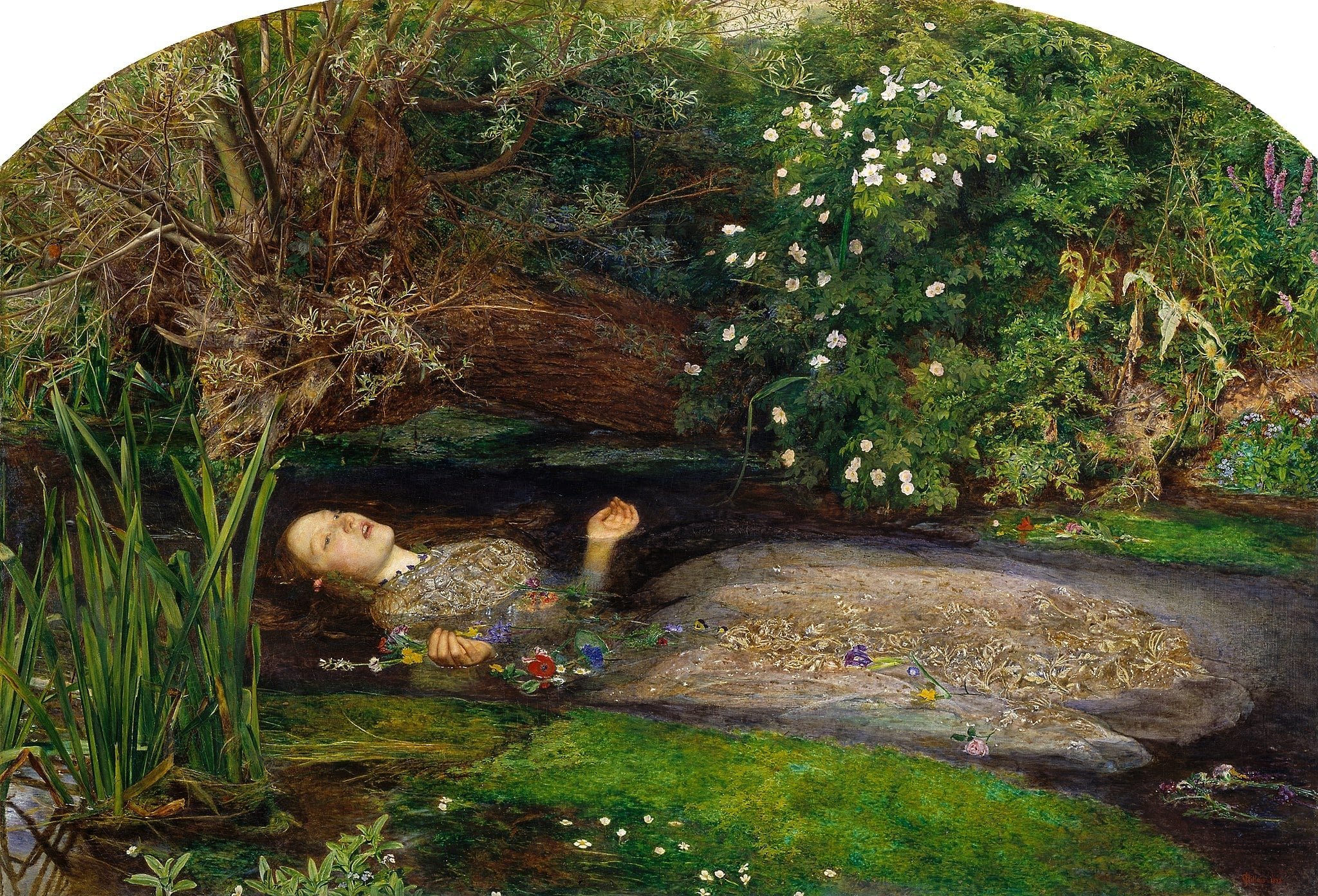
Ophelia
John Everett Millais (1851–1852)
John Everett Millais’s Ophelia shows Shakespeare’s heroine floating in a narrow stream, her jeweled dress both buoying and engulfing her. Millais renders the riverbank with <strong>forensic botanical precision</strong>, so that reeds, willow, briars, nettles, and a scatter of emblematic flowers surround a face slack in mid‑song and hands raised in <strong>open‑palmed surrender</strong> <sup>[1]</sup><sup>[3]</sup>.
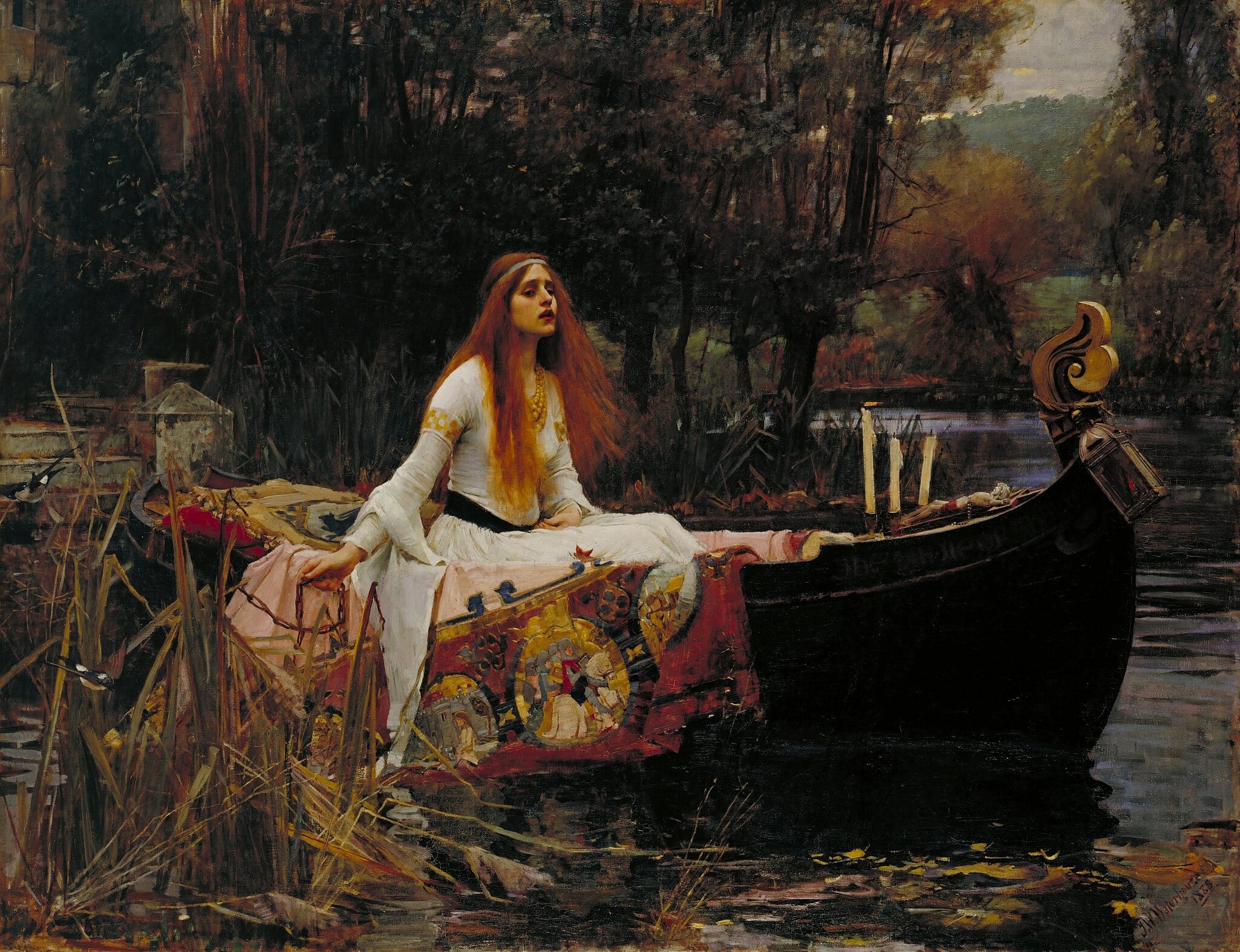
The Lady of Shallot
John William Waterhouse (1888)
John William Waterhouse’s The Lady of Shallot (1888) fixes on the instant the cursed heroine releases her chain and sets her black, coffinlike boat adrift. The extinguished candles, the small crucifix, and the tapestry trailing into the water stage a <strong>funerary voyage</strong> toward Camelot and a choice of <strong>experience over enclosure</strong> <sup>[1]</sup><sup>[2]</sup>.