Umbrellas Symbolism
In art, umbrellas often signify shelter and the delicate boundary between the individual and the public world. In modern urban scenes, especially of the nineteenth century, they act as portable enclosures that create personal space within the crowd. As repeating forms, umbrellas can also organize the picture plane, guiding the eye and articulating depth.
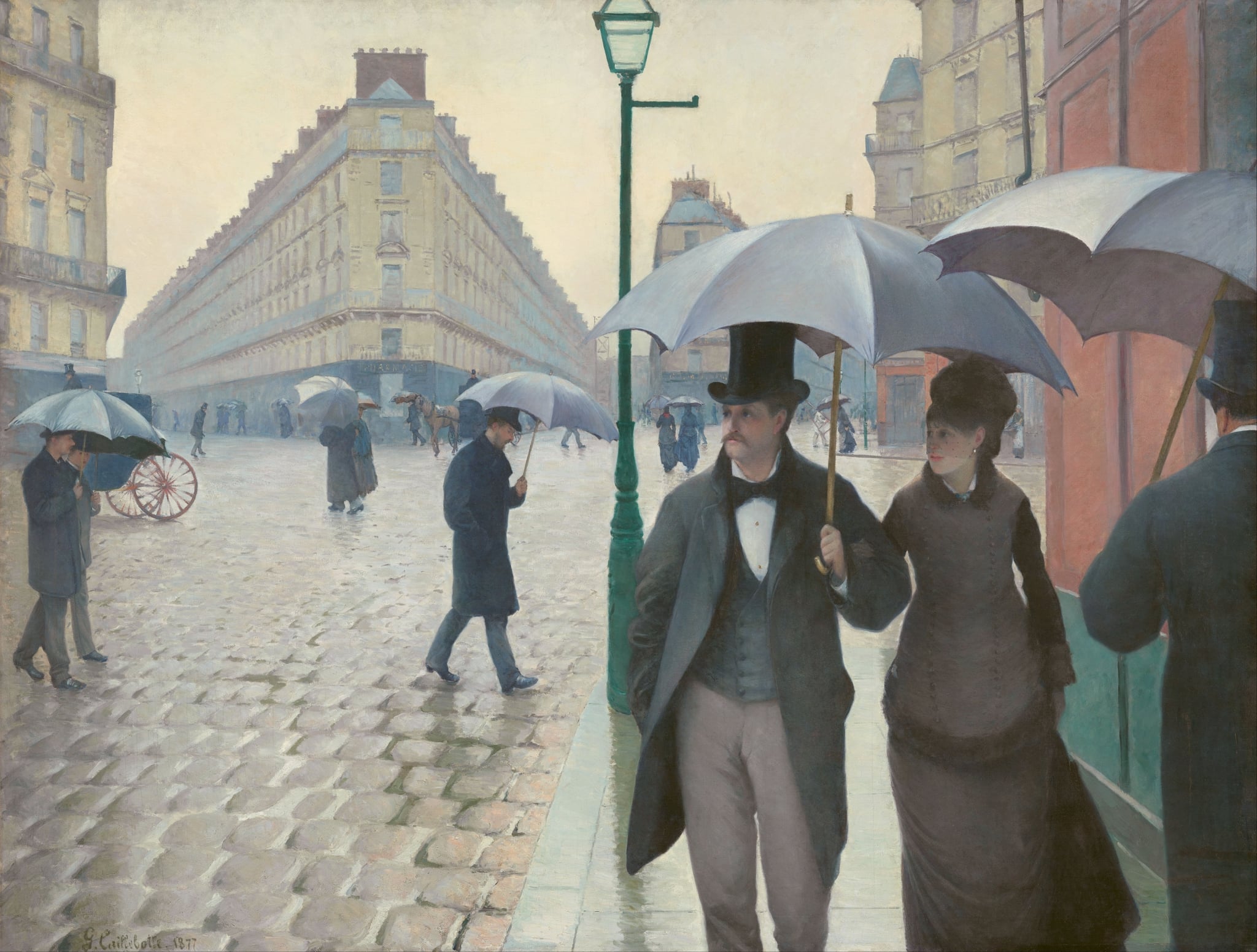
Umbrellas in Paris Street; Rainy Day
In Gustave Caillebotte’s Paris Street; Rainy Day (1877), umbrellas punctuate a silvery atmosphere and reinforce the measured geometry of Haussmann’s Paris. Arrayed along the receding façades and orthogonals, their dark arcs repeat across the canvas, helping to organize space into planes while standardizing the appearance of passersby. The central couple moves beneath a shared umbrella, and other figures do the same, each briefly enclosed in a private zone of shelter. Together, these portable canopies underscore the city’s urban anonymity: they separate individuals even as they group them into a coordinated flow shaped by the grid of streets and the central gas lamp.