The Great Wave off Kanagawa
by Hokusai
The Great Wave off Kanagawa distills a universal drama: fragile laboring boats face a towering breaker while Mount Fuji sits small yet immovable. Hokusai wields Prussian blue to sculpt depth and cold inevitability, fusing ukiyo‑e elegance with Western perspective to stage nature’s power against human resolve [1][3].
Fast Facts
- Year
- ca. 1830–32
- Medium
- Polychrome woodblock print (nishiki‑e); ink and color on paper with Prussian blue
- Dimensions
- c. 25 x 38 cm (oban yoko‑e; varies by impression)
- Location
- Multiple impressions worldwide; e.g., The Metropolitan Museum of Art, New York (JP2972)
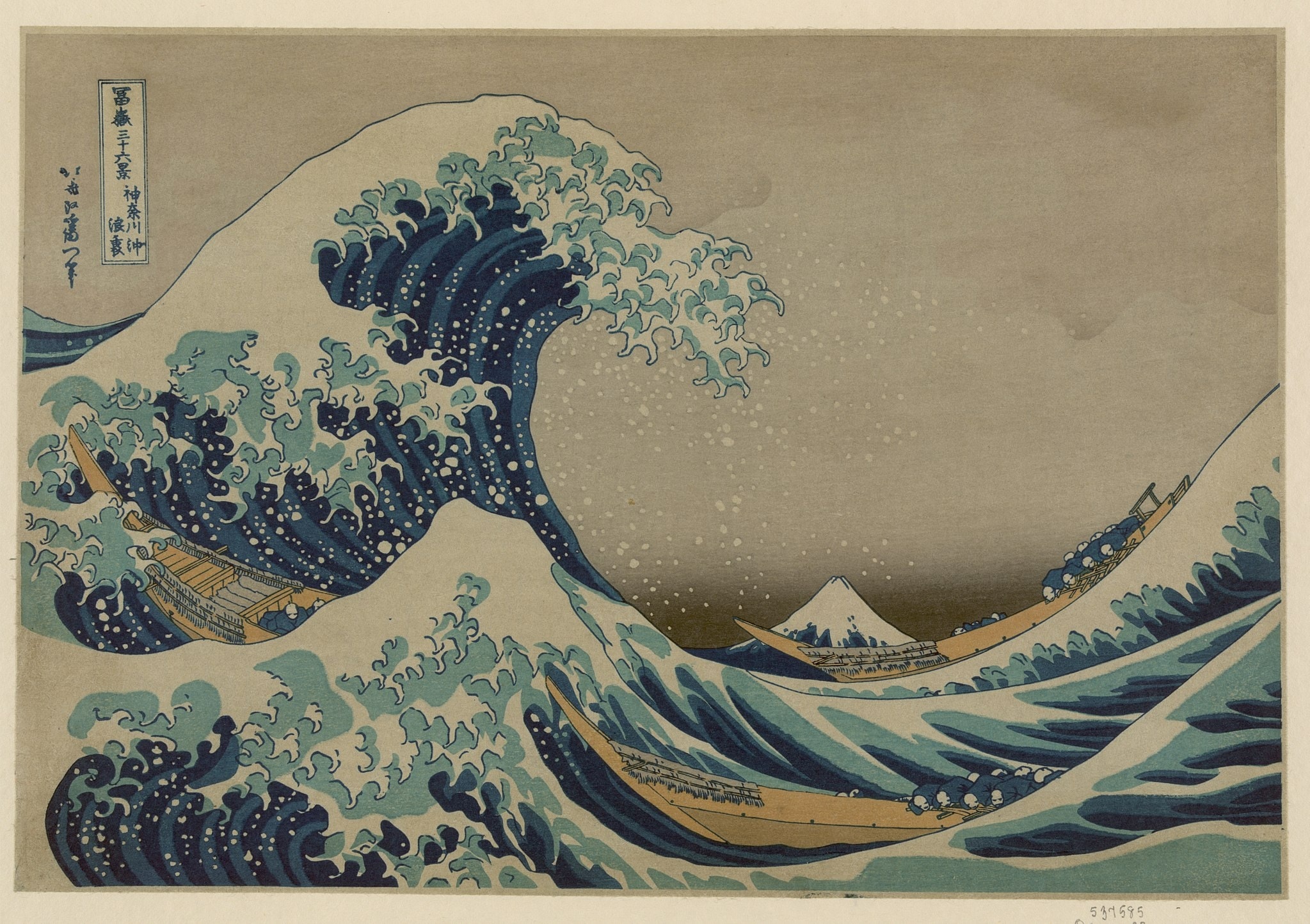
Click on any numbered symbol to learn more about its meaning
Meaning & Symbolism
Hokusai engineers a conflict of forces and scales to declare a philosophy of endurance. The left‑leaning plunging breaker lifts like a hinged door, its clawed foam strands splayed into talons and spray that drift across the sky; the boats arc in parallel troughs, their prows spearing forward even as oarsmen bend low, nearly fused to their hulls 2. By miniaturizing Fuji—a pale triangle snug in the hollow beneath the crest—Hokusai asserts a paradox: permanence can be small, even quiet, yet it holds the composition together. Fuji’s snowcap visually rhymes with the falling foam beads, binding mountain and sea into one water cycle and proposing that what threatens also sustains 2. The wave is not a shoreline cataclysm but a steep, open‑water breaker/rogue wave, a reading supported by fluid‑dynamics analysis; this matters because the scene is suspense, not apocalypse—disaster narrowly averted through skill, timing, and communal labor 4.
Color and craft bear the argument. Early impressions double‑print indigo and the new Prussian blue, stepping tones from near‑black to silvery aqua to model volume and a chill, metallic light; the result is a sculptural sea whose weight we feel before it falls 13. Hokusai’s low horizon and Western‑inflected perspective telescope space so that the viewer sits inside the trough, looking through the arch of water toward Fuji—an imported optics that makes Edo’s workday sublime and modern 35. The long, low oshiokuri‑bune (fast fish carriers) are not generic boats; they name a market economy in motion, crews synchronized by necessity, backs curved like the surrounding swells 2. Their repetition across three waves turns endurance into a rhythm: bend, push, pass. The picture argues that survival is collective form—bodies echoing boats, boats echoing waves, waves echoing Fuji’s profile.
Hokusai also scripts auspiciousness inside peril. The crest frames Fuji like a protective halo while the foam “snow” anticipates winter on its slopes; the mountain’s calm, centered mass pulls the eye and the mind toward a promise of constancy beyond the surge 2. This is why the image could travel so widely: it fuses local devotion (Fuji‑kō culture), global materials (Berlin blue), and a cosmopolitan pictorial grammar into an emblem that can signify perseverance, ecological awe, or modern speed with equal clarity 16. In short, the print asserts that nature’s shock is cyclical, not final; technique—of rowing, printing, and seeing—channels that shock into passage. The wave will break; the boats may pass; Fuji endures. The argument is ethical as much as aesthetic: align with the larger rhythms, and you live through the crest.
Explore Deeper with AI
Ask questions about The Great Wave off Kanagawa
Popular questions:
Powered by AI • Get instant insights about this artwork
💬 Ask questions about this artwork!
Interpretations
Technical-Material History
The print’s argument rides on a pigment revolution. Hokusai and his printer exploit Prussian blue—a synthetic import moving through Dutch–Chinese trade—to achieve saturated shadows, crisp contours, and cool, metallic highlights that indigo alone could not deliver. Early impressions show double‑printing and tone‑stepping that sculpt the breaker’s mass and the trough’s sheen, turning color into kinesis and weight. This is more than optics: it signals Edo’s insertion into global supply chains, where a Berlin‑born dye becomes the vehicle of a Japanese sublime. Material choice equals meaning—blue reads as depth, distance, and even durability because Prussian blue is unusually lightfast, letting the sea’s form endure on paper as Fuji endures in view 1.
Source: The Metropolitan Museum of Art (Conservation/Technical Study)
Economic History of the Sea
Those are not generic boats but oshiokuri‑bune, fast carriers that ferried fresh fish to Edo before spoilage. Their speed, low freeboard, and tightly spaced oarsmen index a high‑stakes commodity chain whose value is measured in hours. Hokusai composes three boats across three swells to visualize logistical rhythm—a relay of labor, risk, and timing. The sea is thus not a romantic void but a working surface, where price, perishability, and weather converge. Reading the image as a proto‑infrastructure diagram helps explain its modernity: the sublime becomes an everyday externality of markets, and survival a function of collective coordination under volatile conditions 2.
Source: British Museum (Curatorial Commentary)
Cross-Cultural Optics and Maritime Sublime
The image’s spatial drama owes a debt to Western‑inflected perspective and to visual tropes circulating via Rangaku and Dutch prints. Scholars have noted affinities with Northern European maritime scenes where peril is framed against a providential calm. Here, tiny Fuji functions as an auspicious counterforce—an emblem of order set against a moment of near‑disaster. The result is a hybrid sublime: Japanese subject matter, European depth cues, and a moralized tension between hazard and hope. Hokusai’s wave looks forward to global modernity not only in pigment but in pictorial grammar, recoding imported optics into a distinctly Edo theology of luck, skill, and timing 42.
Source: Timon Screech (Japan Review) with British Museum context
Icon Biography and Interpretive Mobility
As Christine Guth argues, the Great Wave is a paradigmatic mobile image—its meanings travel with its reproductions. Fuji devotion, urban commerce, and cutting‑edge pigment became, in later receptions, emblems for resilience, ecological awe, or even brand identity. This interpretive fluidity stems from Hokusai’s design choices: scalable silhouette, crisp value structure, and a modular narrative (peril/skill/endurance) legible across cultures. The work’s afterlives—from fine‑art canons to currency—demonstrate how an Edo print became a global logo without losing its local DNA. Rather than fix a single message, the composition invites reprogramming, making the wave a platform for changing publics and crises 3.
Source: Christine M. E. Guth (Oxford/Hawai‘i Scholarship)
Ecology and Fluid Dynamics
Recent analyses identify the wave as a steep plunging breaker/rogue wave, not a shoreward tsunami—a distinction that shifts the narrative from apocalypse to navigational crisis. That scientific reading dovetails with the image’s ecological poetics: Fuji’s snowcap rhymes with falling foam, yoking mountain, weather, and sea into a single water cycle. The print thus models a system where the same forces that threaten also sustain—winds drive commerce; meltwater feeds rivers; storms replenish fisheries. The physics clarifies the stakes (open‑water seamanship) while the iconography frames an ethic: align with cyclical energy flows, and you pass the crest rather than perish beneath it 52.
Source: Proceedings (fluid-dynamics study) and British Museum
Related Themes
About Hokusai
Hokusai (1760–1849) was a prolific Edo‑period print designer and painter who helped pivot ukiyo‑e from actor/beauty subjects to landscape. In his seventies he produced Thirty‑Six Views of Mount Fuji, a mature synthesis of technical daring, popular piety, and cross‑cultural pictorial ideas [1].
View all works by Hokusai →