Light
In Western painting, light functions as a central symbolic system through which artists translate theological revelation, modern technology, labor, and atmospheric perception into visible form, continually renegotiating the boundary between material illumination and metaphorical insight.
Member Symbols
Featured Artworks
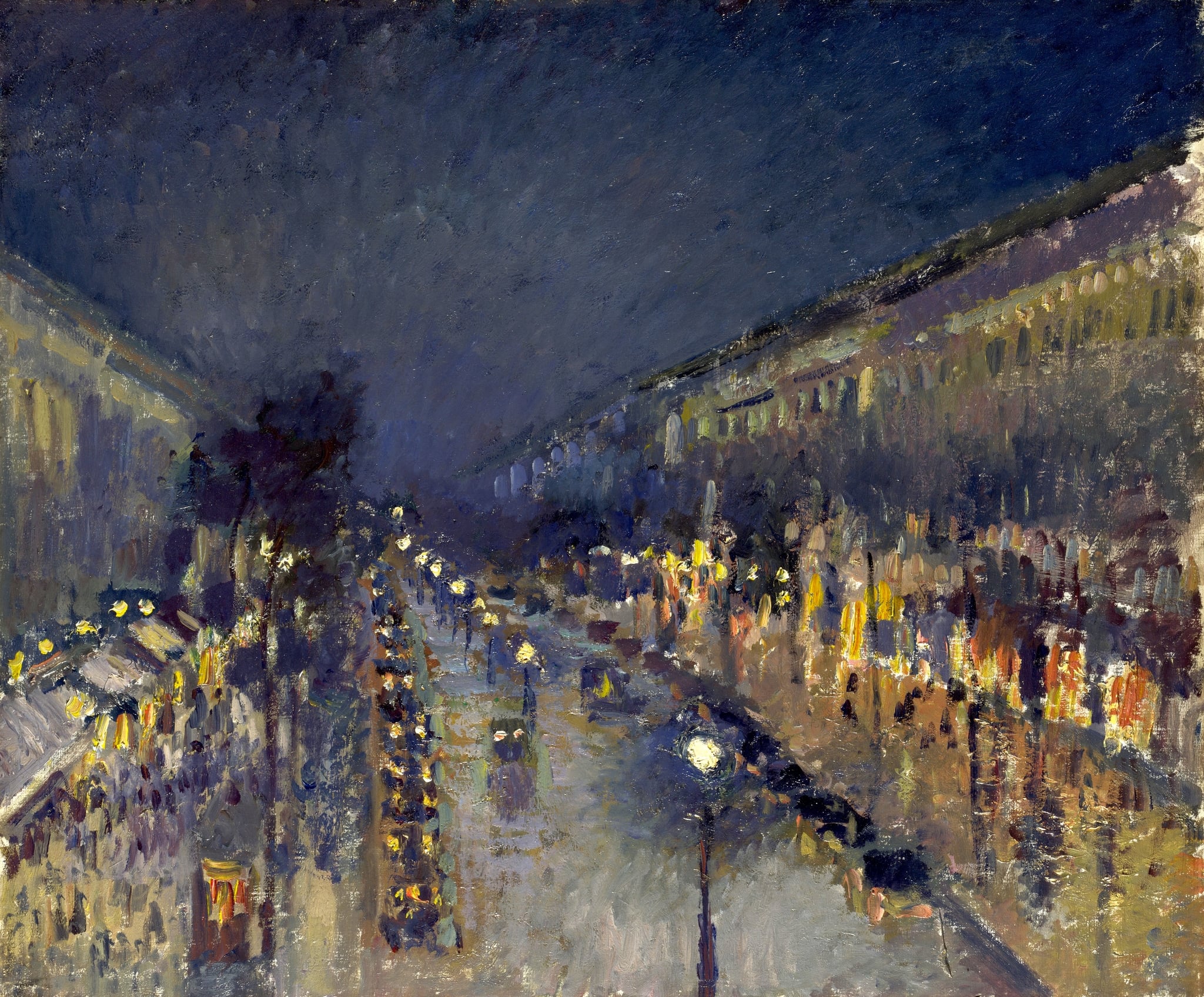
Boulevard Montmartre at Night
Camille Pissarro (1897)
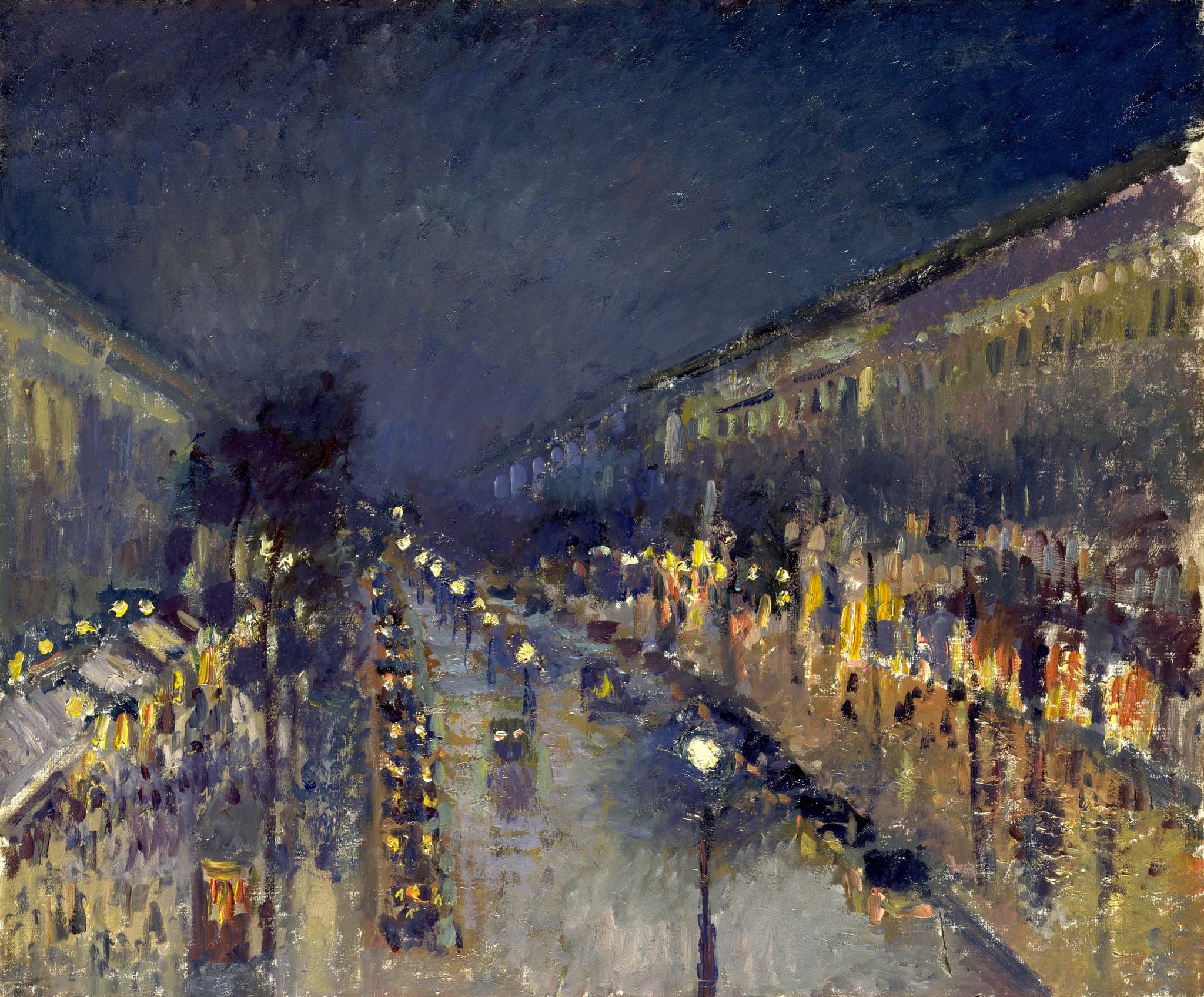
A high window turns Paris into a flowing current: in Boulevard Montmartre at Night, Camille Pissarro fuses <strong>modern light</strong> and <strong>urban movement</strong> into a single, restless rhythm. Cool electric halos and warm gaslit windows shimmer across rain‑slick stone, where carriages and crowds dissolve into <strong>pulse-like blurs</strong> <sup>[1]</sup><sup>[2]</sup>.
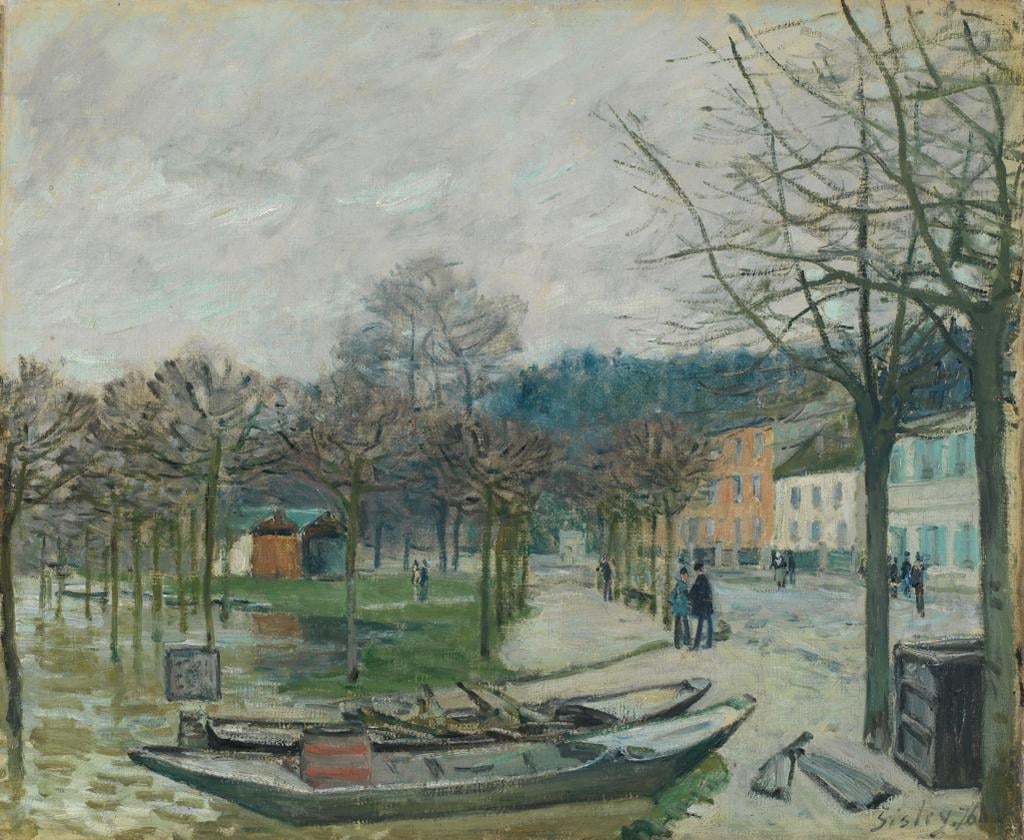
Flood at Port-Marly
Alfred Sisley (1876)
In Flood at Port-Marly, Alfred Sisley turns a flooded street into a reflective stage where <strong>human order</strong> and <strong>natural flux</strong> converge. The aligned, leafless trees function like measuring rods against the water, while flat-bottomed boats replace carriages at the curb. With cool, silvery strokes and a cloud-laden sky, Sisley asserts that the scene’s true drama is <strong>atmosphere</strong> and <strong>adaptation</strong>, not catastrophe <sup>[1]</sup><sup>[2]</sup><sup>[4]</sup>.
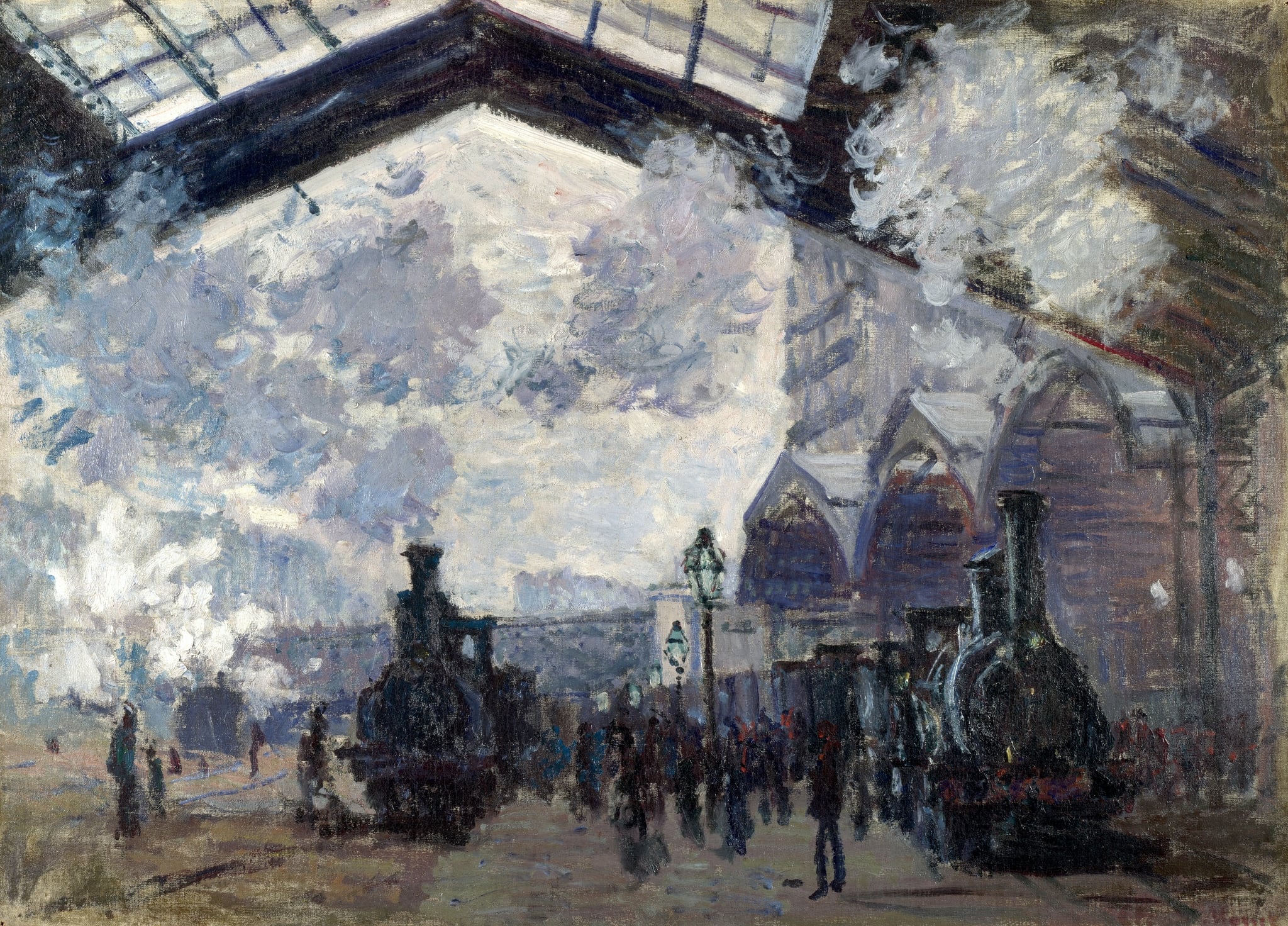
Gare Saint-Lazare
Claude Monet (1877)
Monet’s Gare Saint-Lazare turns an iron-and-glass train shed into a theater of <strong>steam, light, and motion</strong>. Twin locomotives, gas lamps, and a surge of figures dissolve into bluish vapor under the diagonal canopy, recasting industrial smoke as <strong>luminous atmosphere</strong> <sup>[1]</sup><sup>[2]</sup>.

Houses of Parliament
Claude Monet (1903)
Claude Monet’s Houses of Parliament renders Westminster as a <strong>dissolving silhouette</strong> in a wash of peach, mauve, and pale gold, where stone and river are leveled by <strong>luminous fog</strong>. Short, vibrating strokes turn architecture into <strong>atmosphere</strong>, while a tiny boat anchors human scale amid the monumental scene.
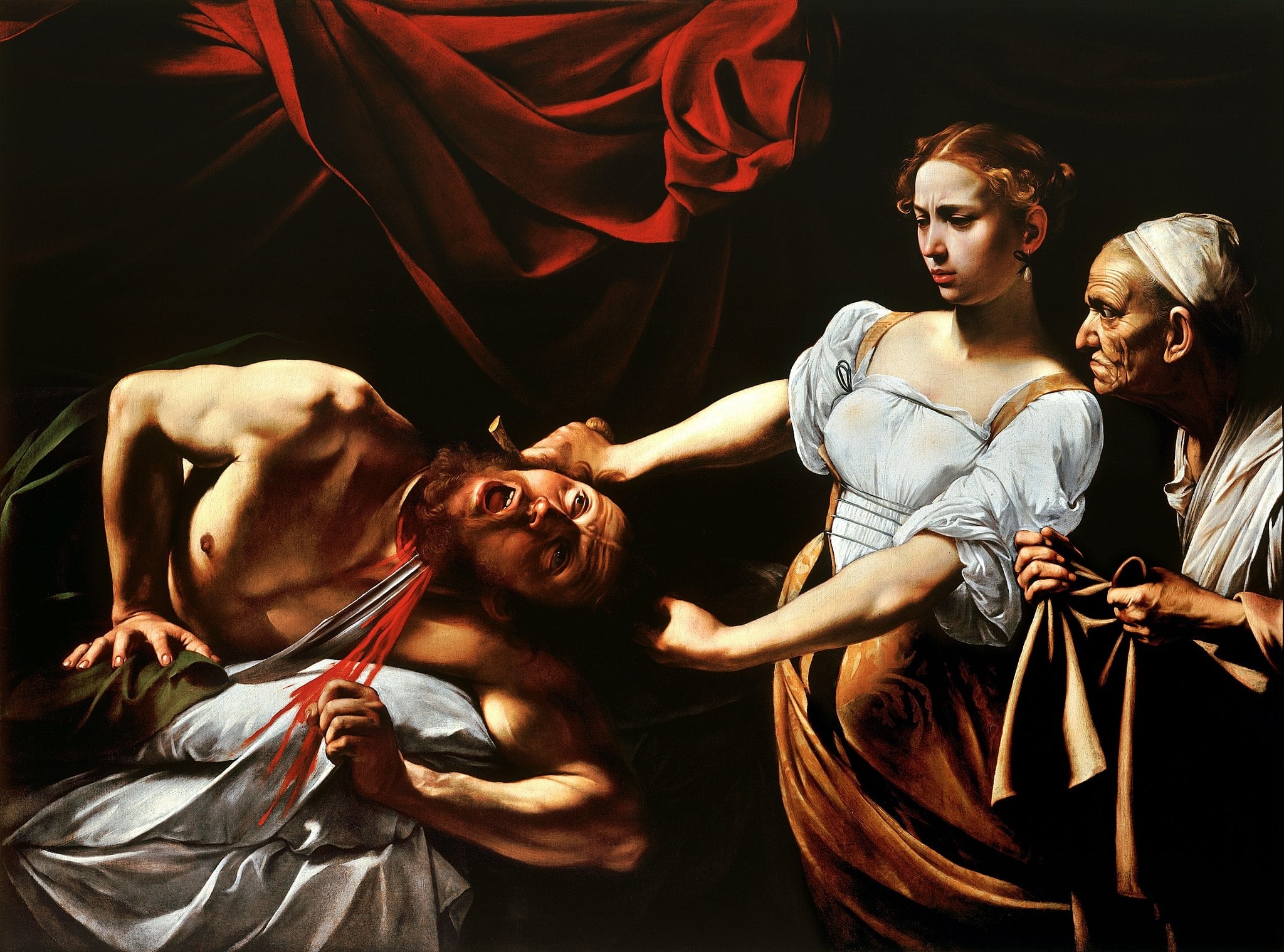
Judith Beheading Holofernes
Caravaggio (1599)
Caravaggio’s Judith Beheading Holofernes stages the biblical execution as a shocking present-tense event, lit by a raking beam that cuts figures from darkness. The <strong>red curtain</strong> frames a moral spectacle in which <strong>virtue overthrows tyranny</strong>, as Judith’s cool determination meets Holofernes’ convulsed resistance. Radical <strong>naturalism</strong>—from tendon strain to ribboning blood—makes deliverance feel material and irreversible.
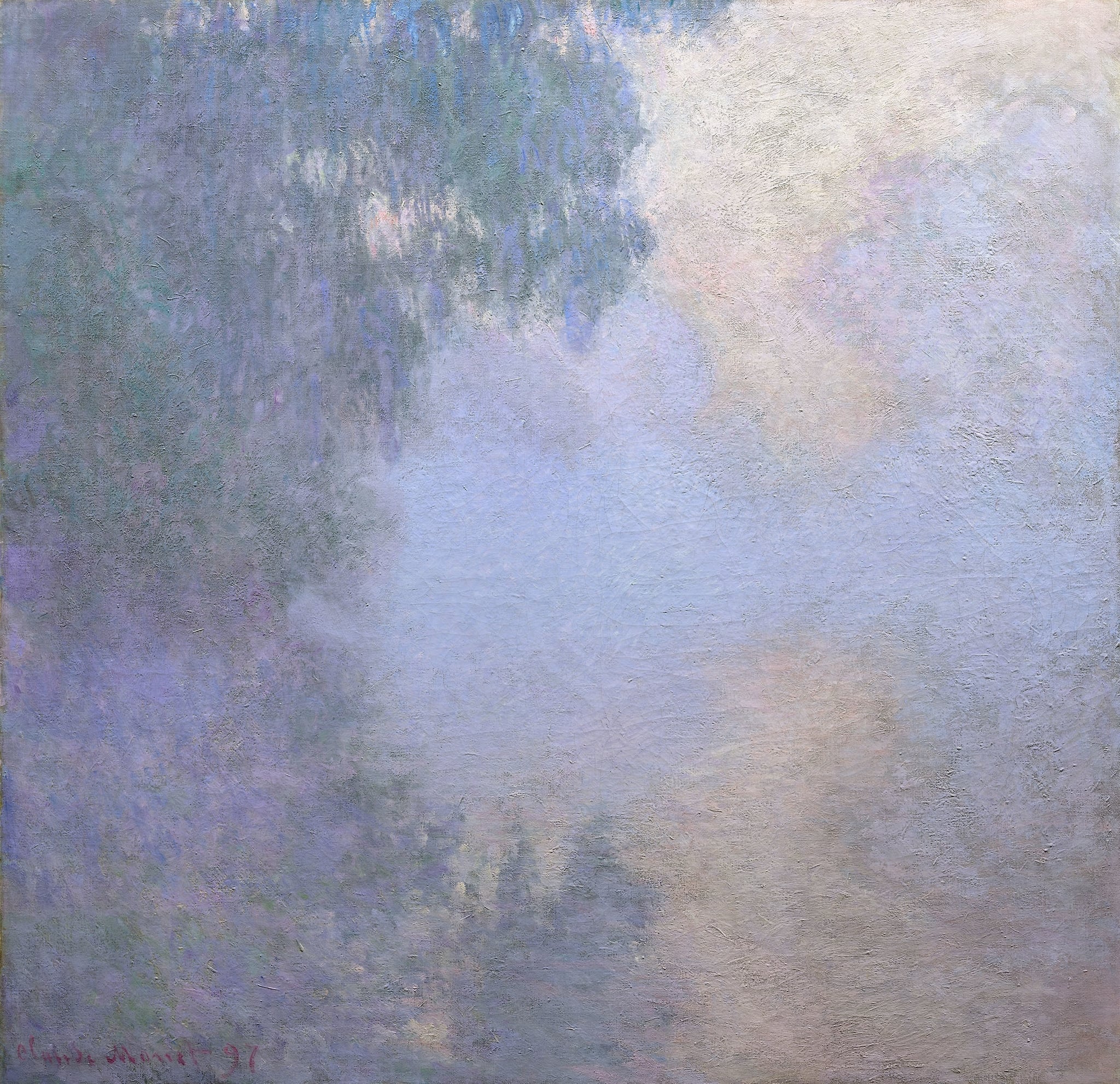
Morning on the Seine (series)
Claude Monet (1897)
Claude Monet’s Morning on the Seine (series) turns dawn into an inquiry about <strong>perception</strong> and <strong>time</strong>. In this canvas, the left bank’s shadowed foliage dissolves into lavender mist while a pale radiance opens at right, fusing sky and water into a single, reflective field <sup>[1]</sup><sup>[2]</sup>.
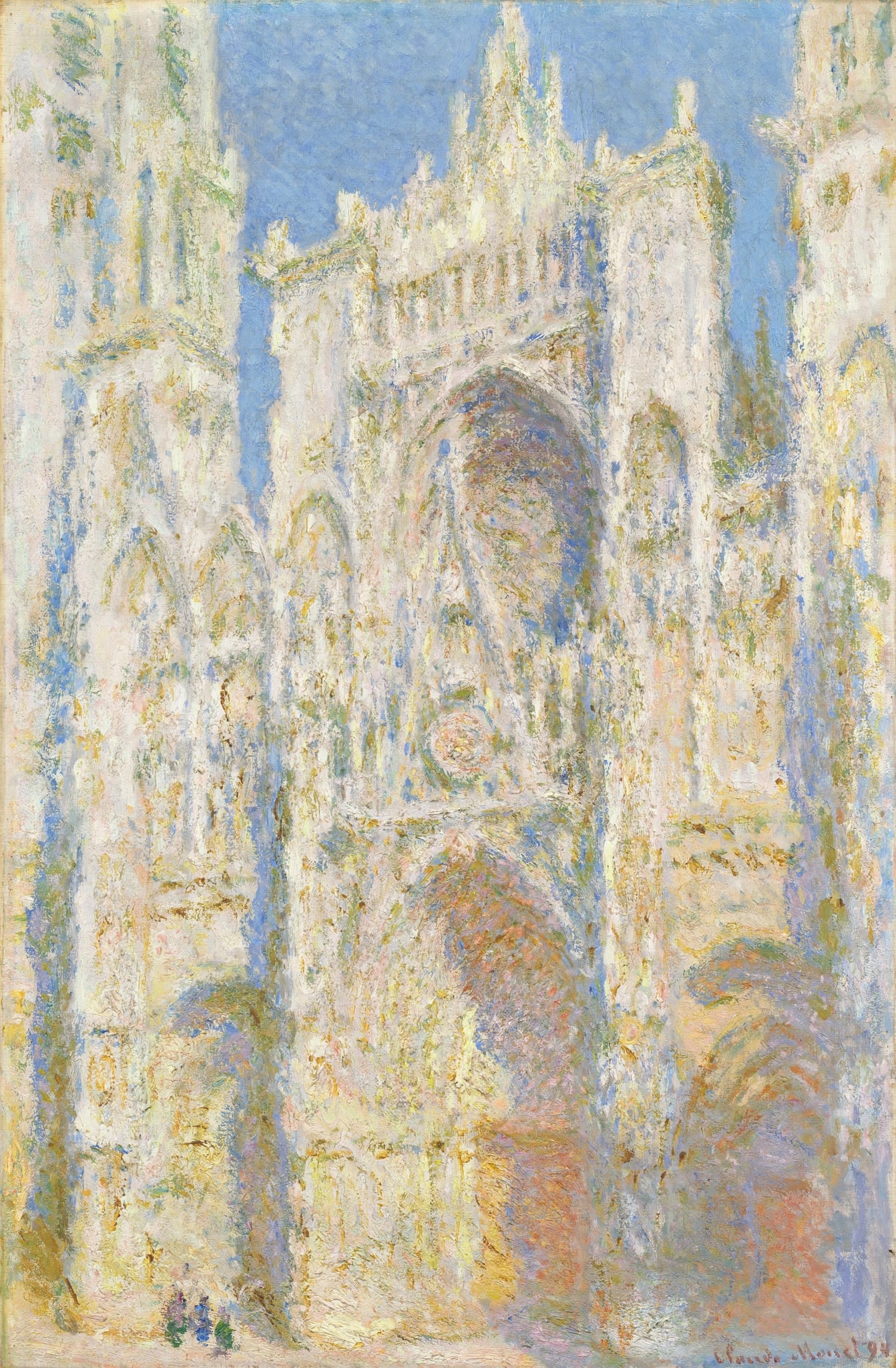
Rouen Cathedral Series
Claude Monet (1894)
Claude Monet’s Rouen Cathedral Series (1892–94) turns a Gothic monument into a laboratory of <strong>light, time, and perception</strong>. In this sunstruck façade, portals, gables, and a warm, orange-tinged rose window flicker in pearly violets and buttery yellows against a crystalline blue sky, while tiny figures at the base anchor the scale. The painting insists that <strong>light—not stone—is the true subject</strong> <sup>[1]</sup><sup>[2]</sup>.
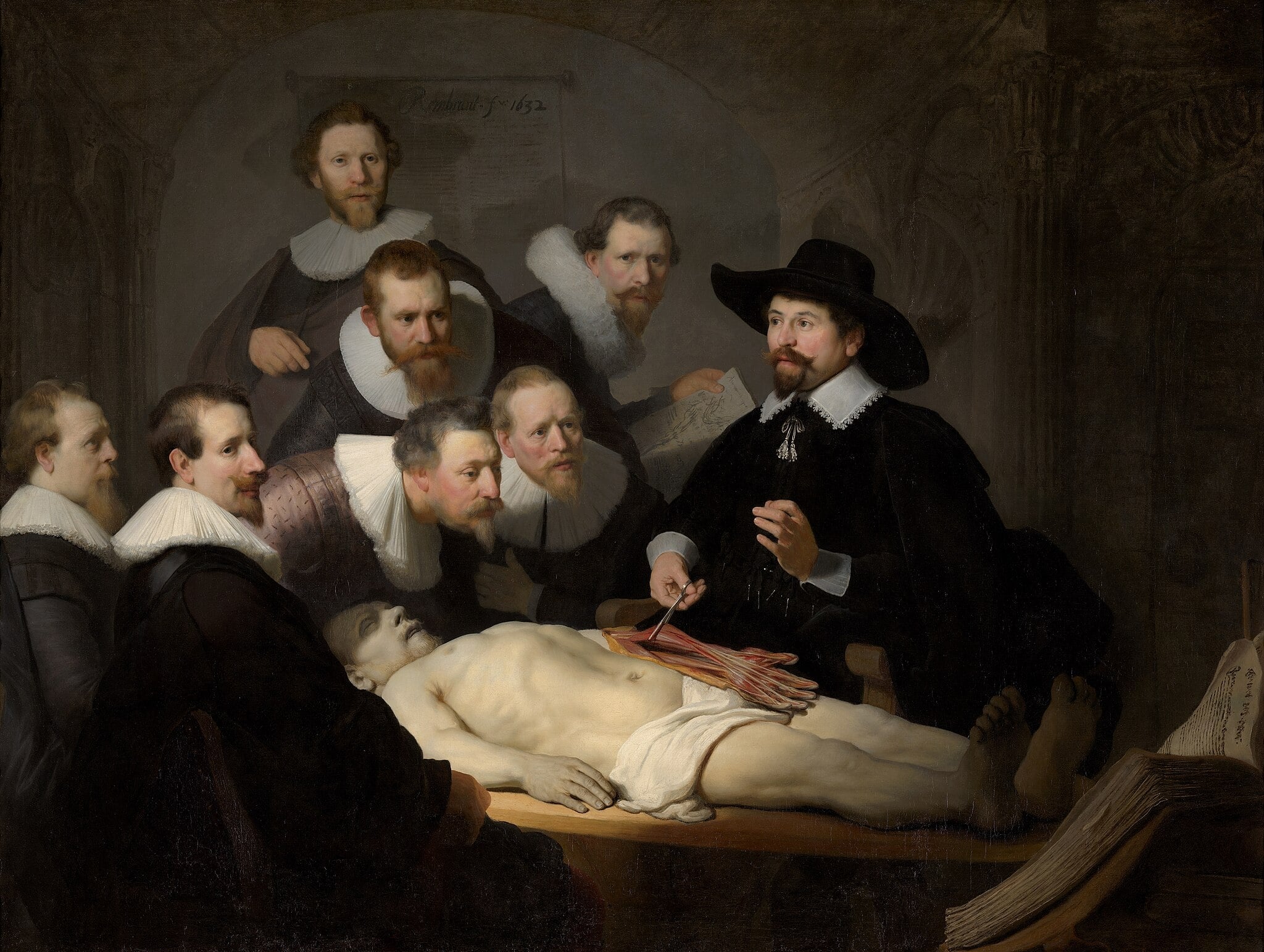
The Anatomy Lesson of Dr. Nicolaes Tulp
Rembrandt van Rijn (1632)
Rembrandt van Rijn turns a civic commission into a drama of <strong>knowledge made visible</strong>. A cone of light binds the ruff‑collared surgeons, the pale cadaver, and Dr. Tulp’s forceps as he raises the <strong>forearm tendons</strong> to explain the hand. Book and body face each other across the table, staging the tension—and alliance—between <strong>textual authority</strong> and <strong>empirical observation</strong> <sup>[1]</sup><sup>[2]</sup>.
The Elevation of the Cross
Peter Paul Rubens (1609–1610)
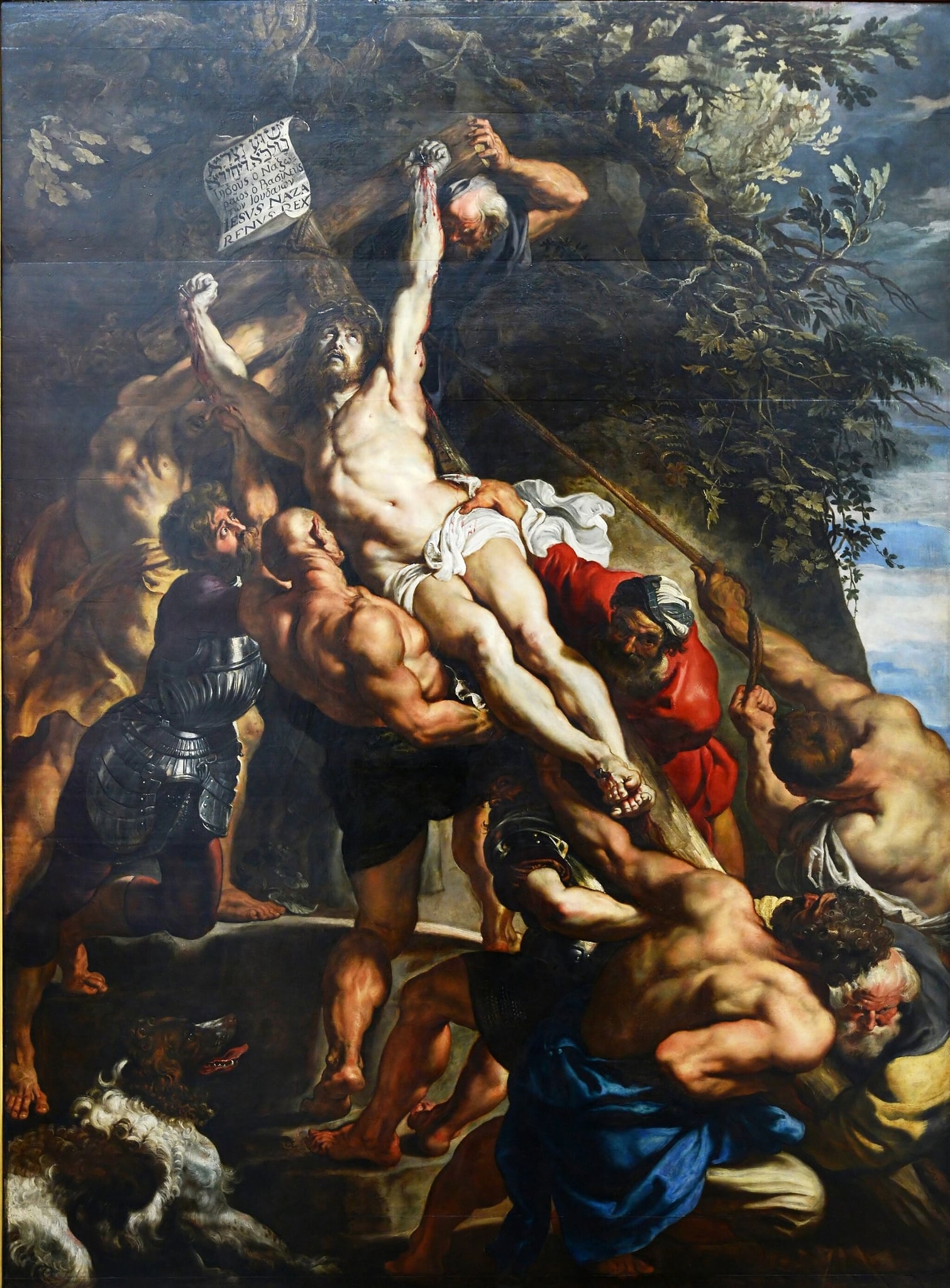
A single, surging diagonal drives The Elevation of the Cross as straining executioners heave the timber while Christ’s pale body becomes the calm, radiant fulcrum. Rubens fuses muscular anatomy, flashing armor, taut ropes, and storm-dark landscape into a Baroque crescendo where <strong>divine light</strong> confronts <strong>human violence</strong> <sup>[1]</sup><sup>[3]</sup>.

The Fighting Temeraire
J. M. W. Turner (1839)
In The Fighting Temeraire, J. M. W. Turner sets a <strong>ghostly man‑of‑war</strong> against a <strong>sooty steam tug</strong> under a blazing, emblematic sunset. The pale ship’s towering masts and slack rigging read like memory, while the tug’s black smoke cuts through the rigging where a flag once flew, signaling <strong>power passing from sail to steam</strong> <sup>[1]</sup><sup>[2]</sup>. A crescent moon and a humble buoy punctuate a river turned to molten gold, marking both ending and beginning <sup>[3]</sup><sup>[4]</sup>.

The Floor Scrapers
Gustave Caillebotte (1875)
Gustave Caillebotte’s The Floor Scrapers stages three shirtless workers planing a parquet floor as shafts of light pour through an ornate balcony door. The painting fuses <strong>rigorous perspective</strong> with <strong>modern urban labor</strong>, turning curls of wood and raking light into a ledger of time and effort <sup>[1]</sup><sup>[3]</sup>. Its cool, gilded interior makes visible how bourgeois elegance is built on bodily work.
The Gross Clinic
Thomas Eakins (1875)
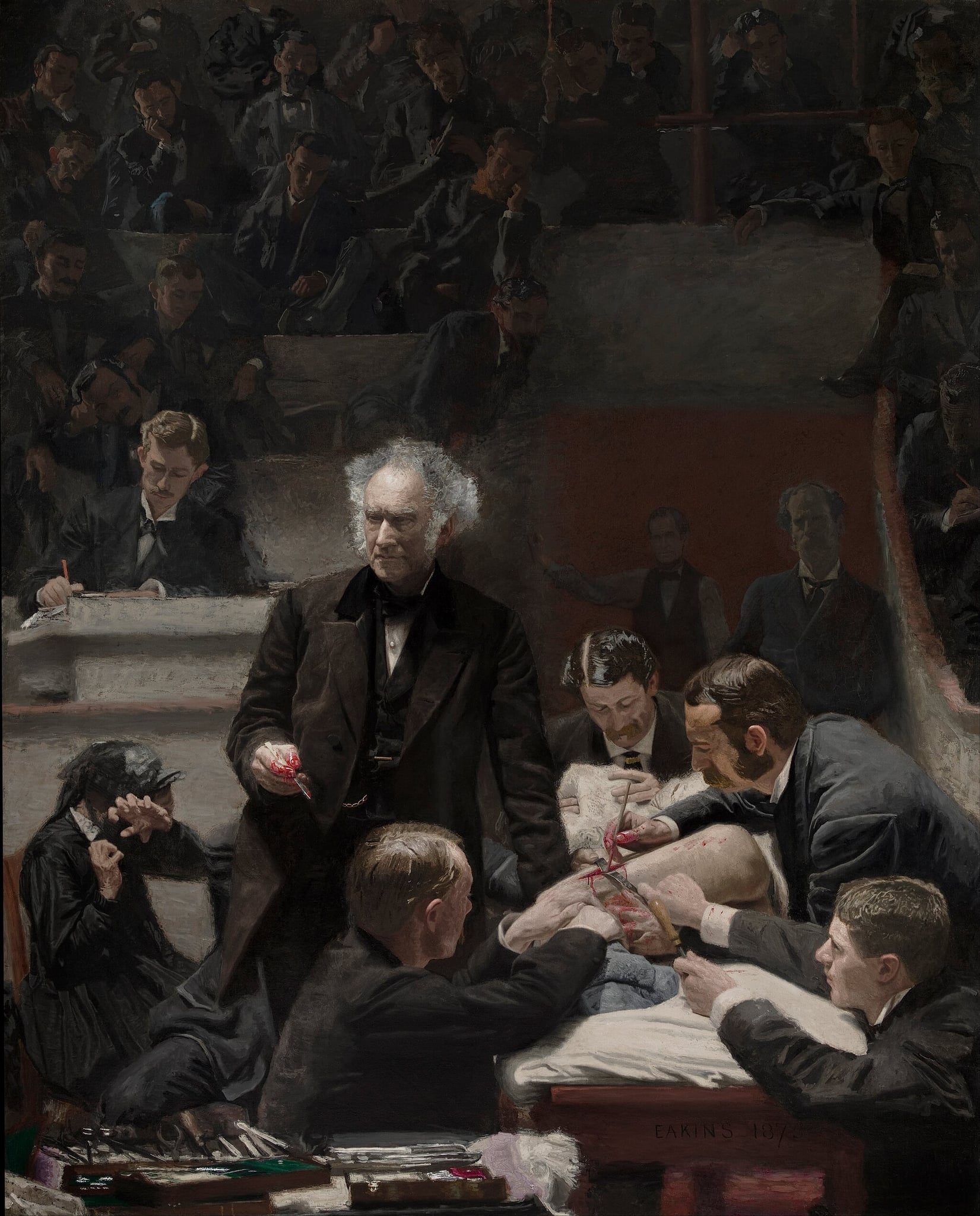
Thomas Eakins’s The Gross Clinic turns a surgical lesson into civic drama, casting a blaze of light on the surgeon’s white hair and bloodied fingers while students fade into shadow. With the veiled woman recoiling at left and a clerk calmly recording at right, the painting frames <strong>science as spectacle</strong> and <strong>witness as ethics</strong> <sup>[1]</sup><sup>[2]</sup>.
The Magpie
Claude Monet (1868–1869)
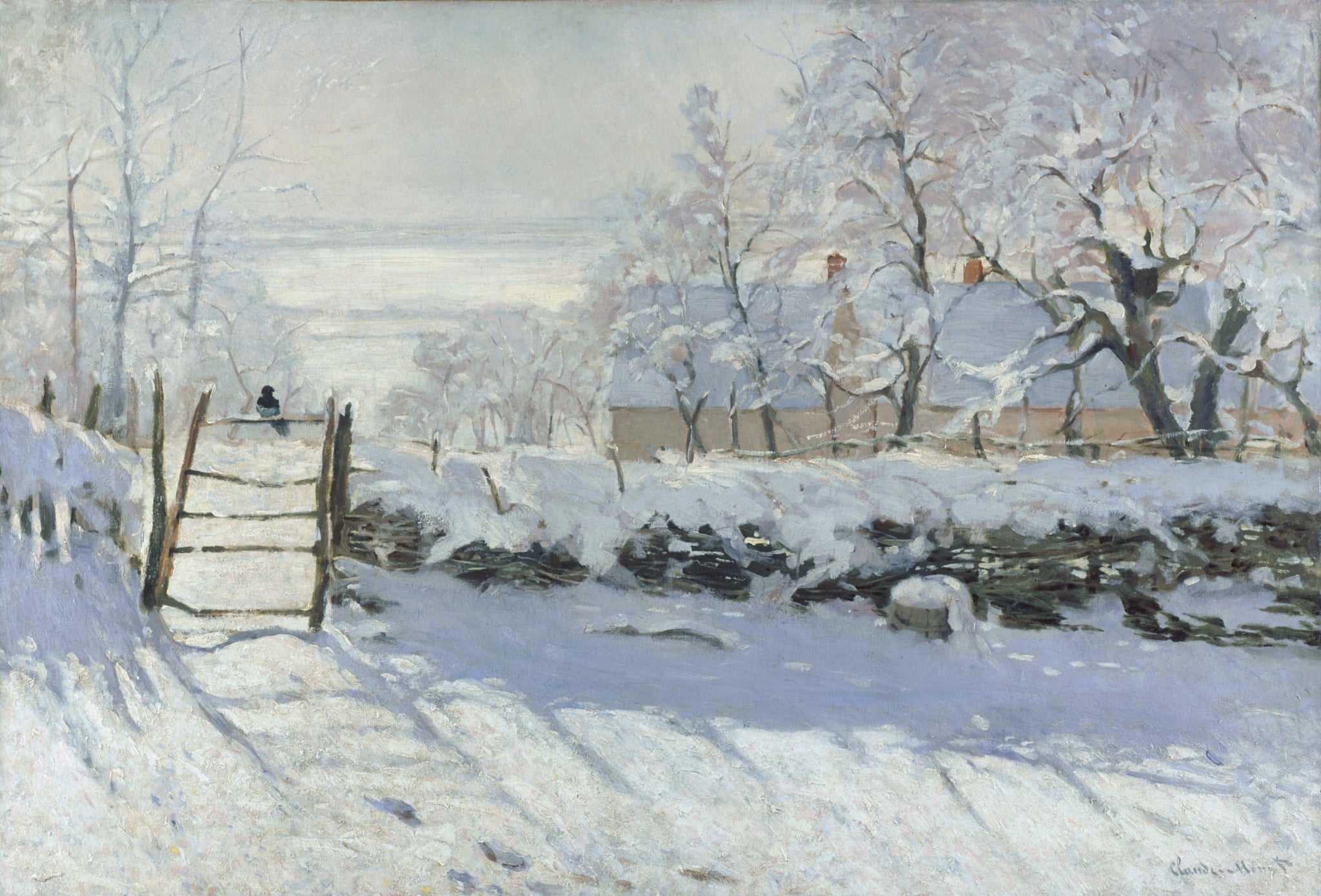
Claude Monet’s The Magpie turns a winter field into a study of <strong>luminous perception</strong>, where blue-violet shadows articulate snow’s light. A lone <strong>magpie</strong> perched on a wooden gate punctuates the silence, anchoring a scene that balances homestead and open countryside <sup>[1]</sup>.
The Opera Orchestra by Edgar Degas | Analysis
Edgar Degas
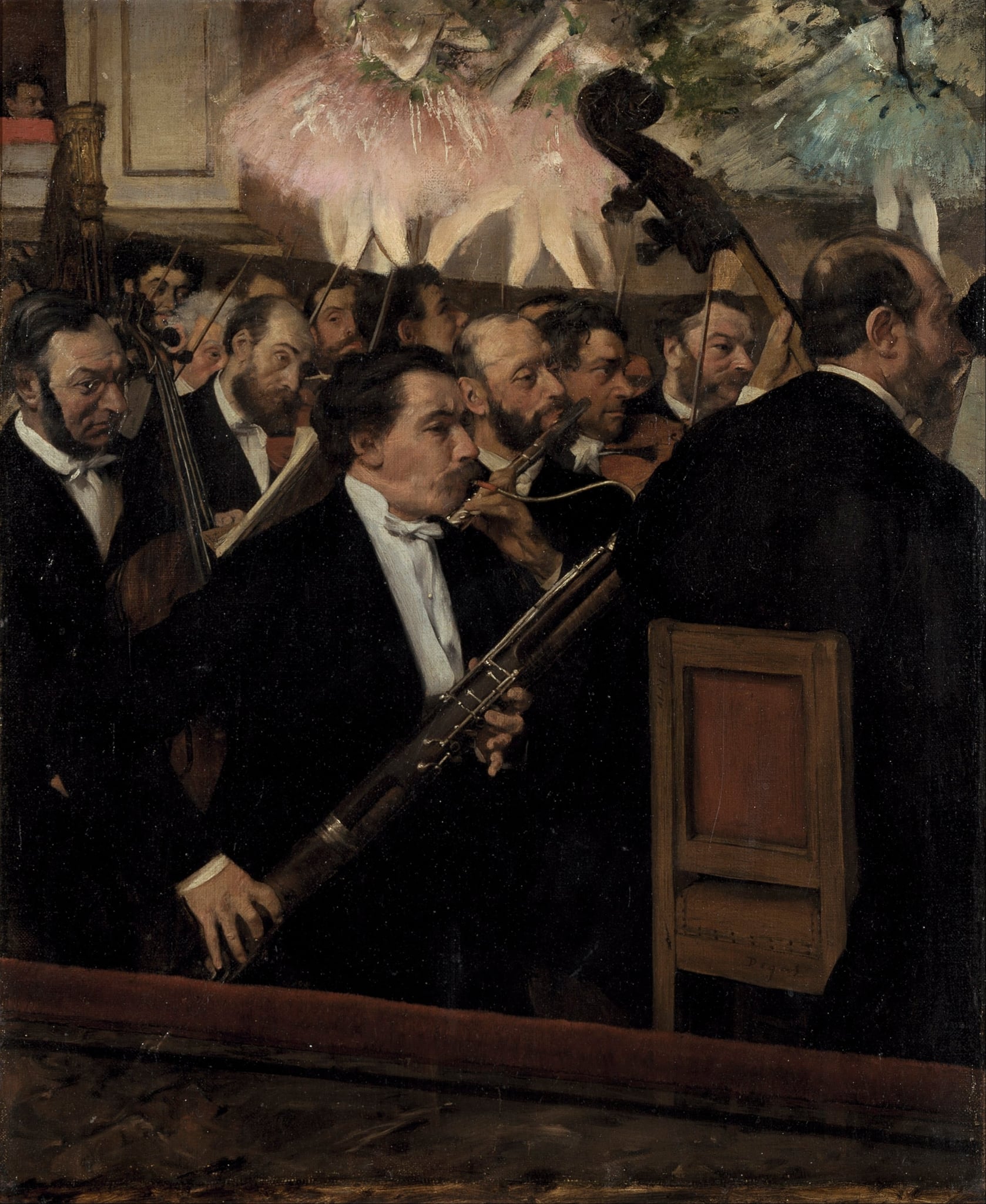
In The Opera Orchestra, Degas flips the theater’s hierarchy: the black-clad pit fills the frame while the ballerinas appear only as cropped tutus and legs, glittering above. The diagonal <strong>bassoon</strong> and looming <strong>double bass</strong> marshal a dense field of faces lit by footlights, turning backstage labor into the subject and spectacle into a fragment <sup>[1]</sup><sup>[2]</sup>.
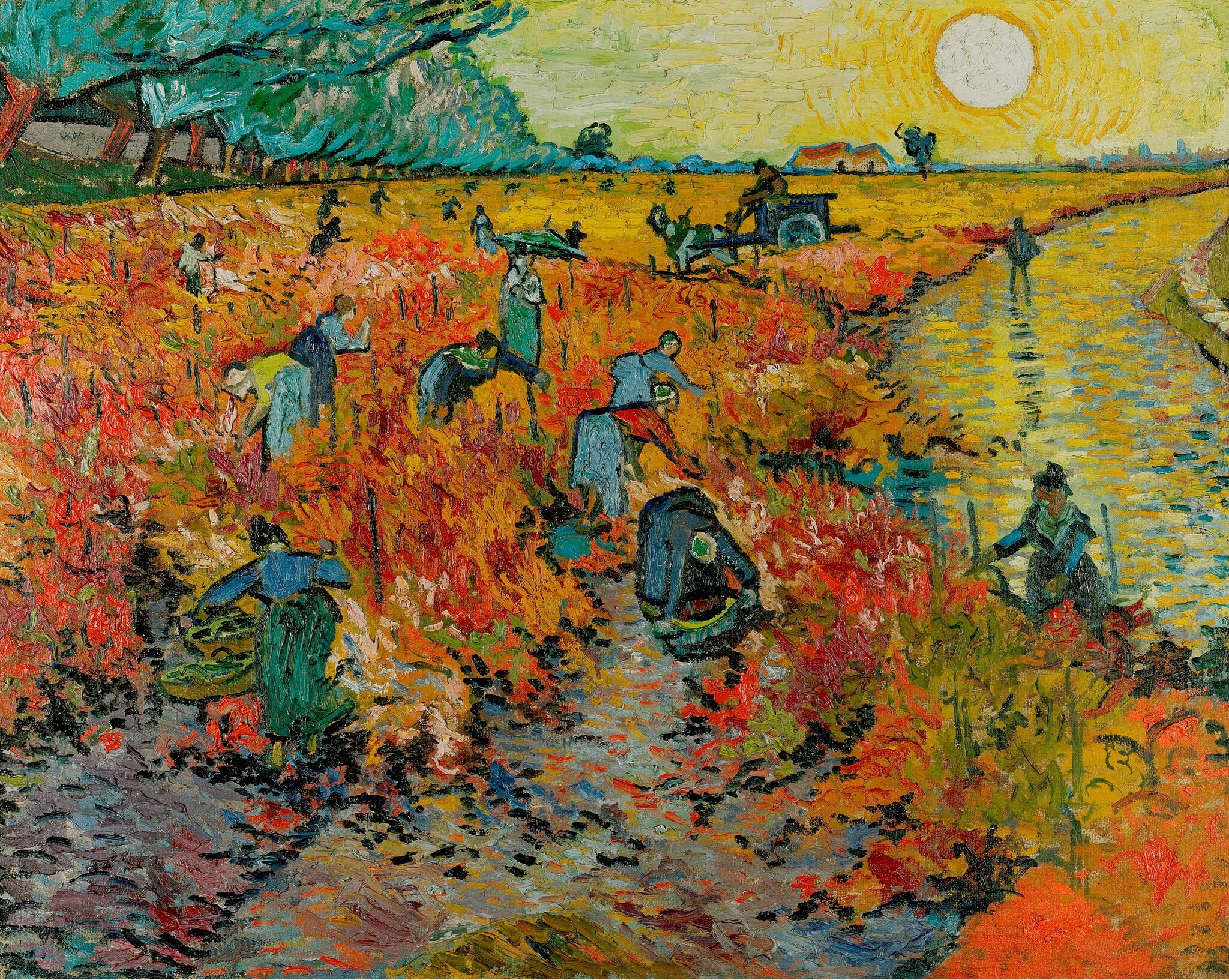
The Red Vineyard
Vincent van Gogh (1888)
In The Red Vineyard, Vincent van Gogh forges a vision of <strong>autumn labor under a blazing sun</strong>, where harvesters flow diagonally through scarlet vines while a band of <strong>yellow light</strong> flares along a reflective roadway. The scene fuses <strong>exhaustion and ripeness</strong>, turning work into a rhythmic, almost liturgical procession <sup>[1]</sup><sup>[3]</sup>.
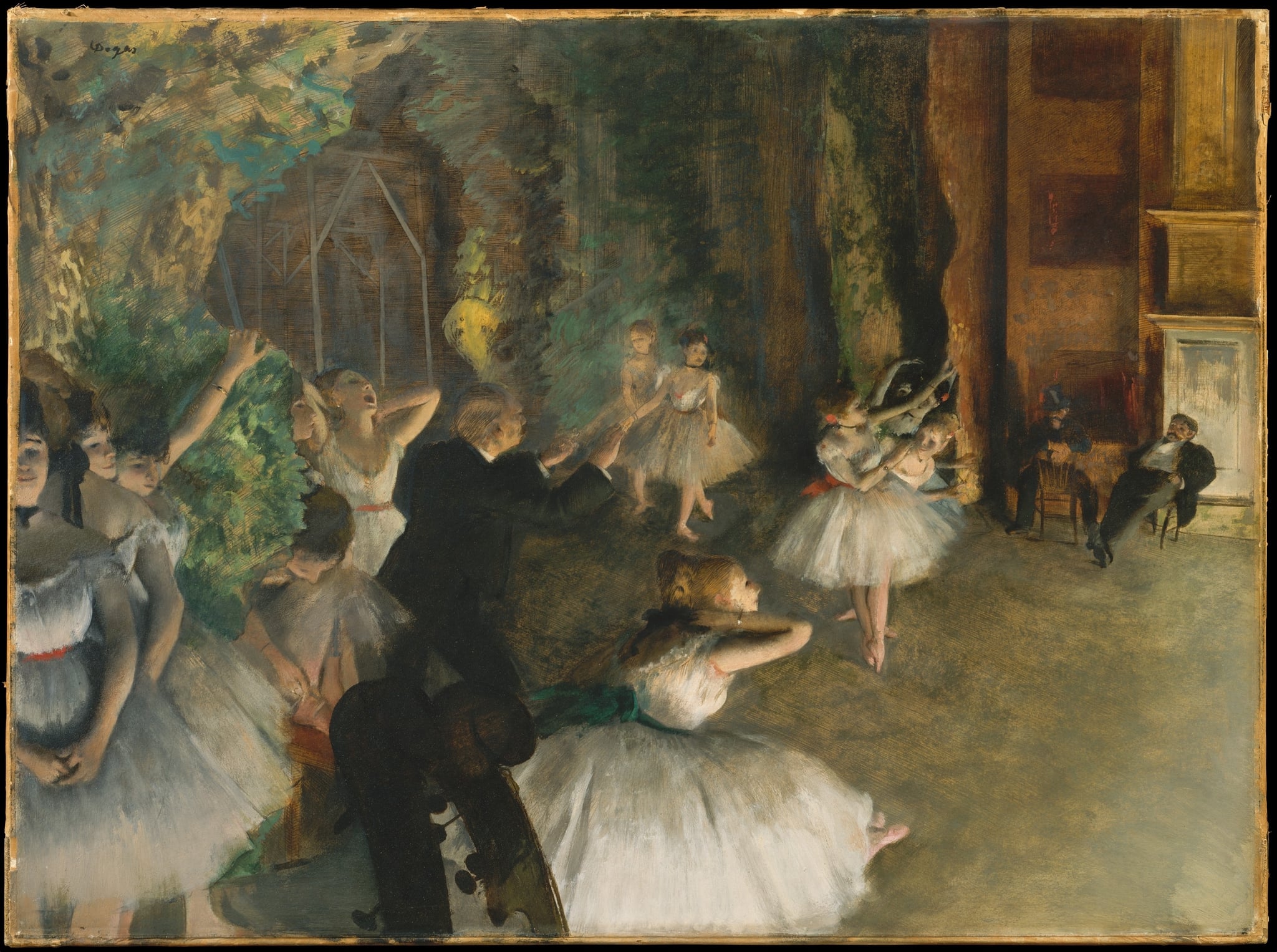
The Rehearsal of the Ballet Onstage
Edgar Degas (ca. 1874)
Degas’s The Rehearsal of the Ballet Onstage turns a moment of practice into a modern drama of work and power. Under <strong>harsh footlights</strong>, clustered ballerinas stretch, yawn, and repeat steps as a <strong>ballet master/conductor</strong> drives the tempo, while <strong>abonnés</strong> lounge in the wings and a looming <strong>double bass</strong> anchors the labor of music <sup>[1]</sup><sup>[3]</sup><sup>[4]</sup>.
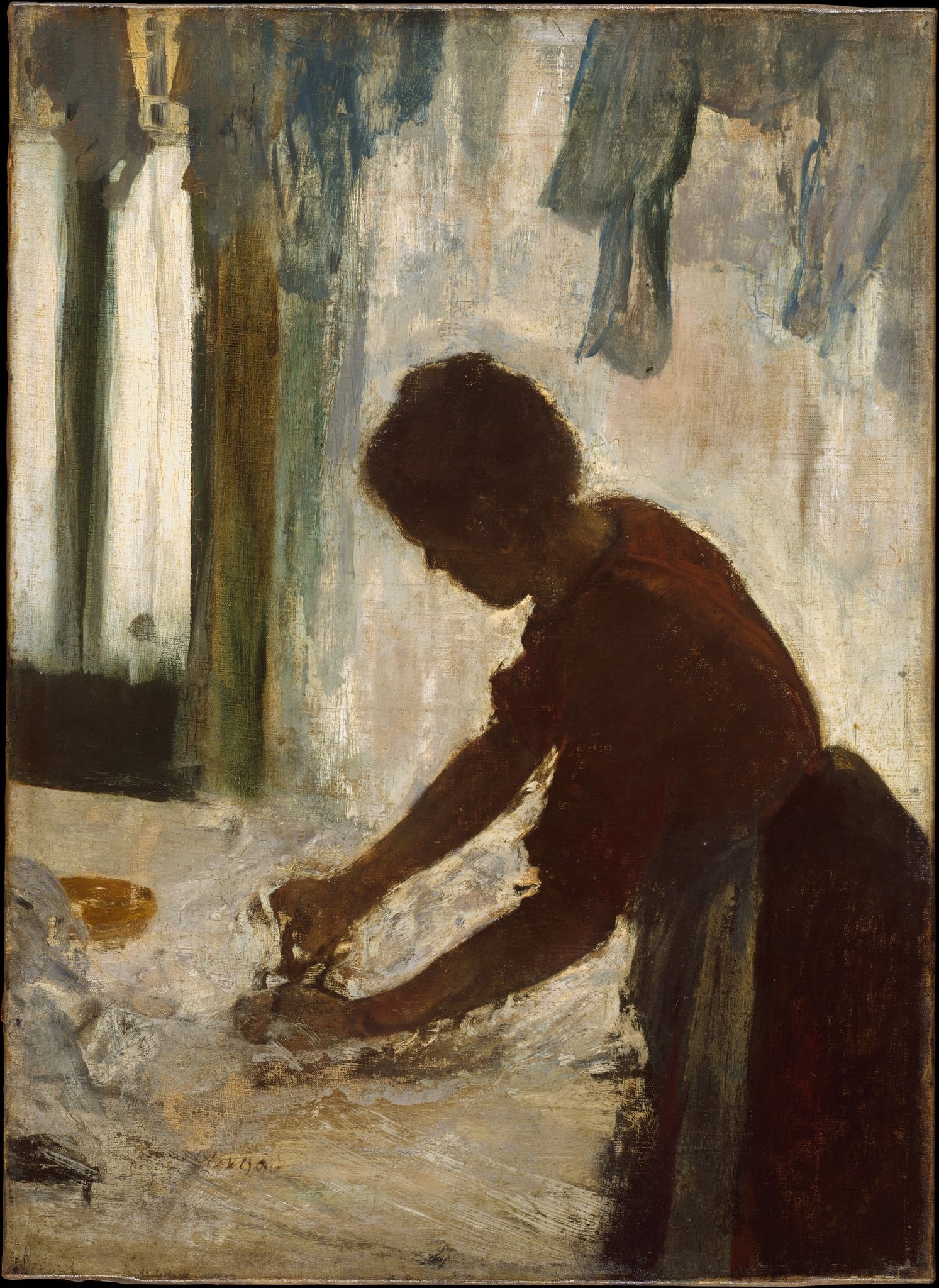
Woman Ironing
Edgar Degas (c. 1876–1887)
In Woman Ironing, Degas builds a modern icon of labor through <strong>contre‑jour</strong> light and a forceful diagonal from shoulder to iron. The worker’s silhouette, red-brown dress, and the cool, steamy whites around her turn repetition into <strong>ritualized transformation</strong>—wrinkled cloth to crisp order <sup>[1]</sup><sup>[2]</sup>.
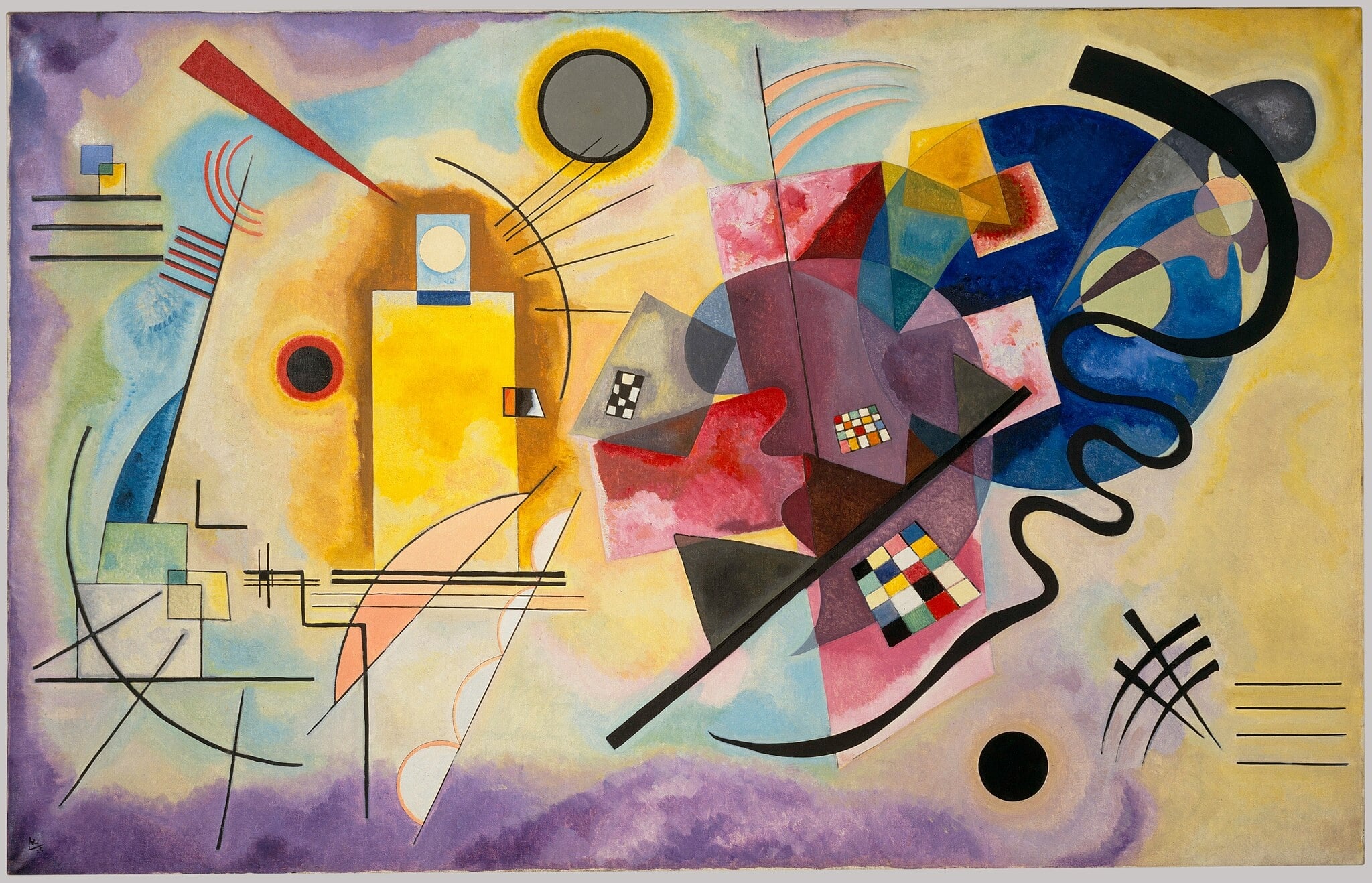
Yellow-Red-Blue
Wassily Kandinsky (1925)
Yellow-Red-Blue stages a collision of <strong>order and impulse</strong> through primary color and geometry. A lucid field of yellow rectangles and orthogonals confronts a vortex of blues, reds, circles, and a serpentine black line, all bound by a commanding black diagonal. The canvas reads like a <strong>spiritual score</strong>, balancing tensions into dynamic equilibrium.
Related Themes
Related Symbolism Categories
Color
Color symbolism in art history encapsulates emotional intensity, cultural nuance, and artistic experimentation, with artists leveraging hues to convey complex narratives and atmospheres.
Object
Object symbolism charts how seemingly ordinary tools, vessels, and furnishings—books, bottles, clocks, tables, instruments—become dense sign-carriers of labor, leisure, desire, and modern perception from early modern iconography to Impressionist and post‑Impressionist painting.
Intimacy
In the 'Intimacy' category, late nineteenth‑century artists redeploy traditional emblems of affection, care, and erotic exchange—hands, flowers, mirrors, and children—to probe the fragile, negotiated character of closeness in an age of public leisure, urban spectacle, and modern subjectivity.
Within Western painting, light has served less as a neutral condition of visibility than as a primary bearer of meaning. From sacred radiance to industrial glare, from chromatic haze to theatrical footlights, artists have continually reworked illumination into a symbolic language that articulates power, labor, modernity, and perception itself. The works gathered here chart a long arc: Caravaggio’s tenebrist beam, Rubens’s sacrificial radiance, and Rembrandt’s cone of knowledge stand at one pole; Monet, Sisley, Pissarro, and Turner transform light into atmosphere, technological event, or historical allegory at the other. Across these shifts, light remains a semiotic hinge where ontology and metaphor meet: a painted beam or haze is at once a physical effect and a signifying device that orders the viewer’s moral, social, or temporal understanding of the scene.
In the early modern works, light operates in a resolutely hierarchical way, as a selective, directional force that distinguishes truth from error and sanctity from violence. Caravaggio’s Judith Beheading Holofernes depends on raking light/tenebrism, a stark beam that carves three figures from an enveloping black void. This light is not merely descriptive; it is a moral instrument that “reveals truth and exposes guilt; separates virtue from vice.” The beam crowns Judith in whiteness—her starched sleeves and illuminated face—while brutally exposing Holofernes’s contorted body and “ribboning blood.” The semiotic function is double: light establishes a privileged zone of legibility in which the decisive act of justice unfolds, and it withholds the surrounding world in darkness, insisting that the revelation is local, concentrated, and inescapable.
Rubens’s The Elevation of the Cross advances a related but more expansive theology of illumination. Here, divine light on Christ makes his body the “calm, radiant fulcrum” around which the composition’s surging diagonal turns. The executioners strain in broken, shadowed anatomies; Christ, by contrast, “glows in a cool, even light,” his contour continuous and unfractured. Light thus articulates a Christological paradox: he is materially embedded in the scene—his weight the pivot of the heaving timber—yet optically set apart. Theologically, the radiance stands for grace “overcoming darkness”; pictorially, it constructs a hierarchy of forms in which illumination is equivalent to doctrinal centrality. Even in the absence of an explicit aureole, Rubens’s handling anticipates the logic of the ‘negative halo’, in which sanctity emerges from a differential field of light and shadow rather than a painted disk.
Rembrandt’s The Anatomy Lesson of Dr. Nicolaes Tulp secularizes this revelatory beam into a cone of light that functions as epistemological rather than theological illumination. The sharply focused triangle of brightness that “binds the ruff-collared surgeons, the pale cadaver, and Dr. Tulp’s forceps” stages “illumination as knowledge—reason and observation revealing truth while leaving the periphery in shadow/unknown.” The cadaver’s flayed forearm, the rapt faces, and the open book are knitted into a single diagram of inquiry. Where Rubens’s radiance descends from an implied divine source, Rembrandt’s light emanates from nowhere explicitly indicated; it behaves like the neutrality of scientific observation, even as its selectivity belies that neutrality. Semiotically, the light cone is a visual metaphor for enlightenment discourse avant la lettre: what is lit is what can be known, debated, and socially ratified.
As the chronology advances, illumination becomes increasingly immanent to environment and technology. Turner’s The Fighting Temeraire demonstrates an intermediate, Romantic mode in which solar light acquires historical and allegorical charge. The canvas stages a confrontation between a “blazing sunset and molten path of light” and a “pale ship” towed by a sooty tug. The sunset’s exaggerated, emblematic intensity—“an ending that the ships must cross”—is not meteorological description alone; it marks “closure of one era and passage toward dissolution,” as sail yields to steam. The “blazing red‑orange sky” carries “a postwar/atomic atmosphere of crisis” in later readings, but already for Turner it is an apocalyptic register: day’s end, empire’s waning, and the obsolescence of the man-of-war. Light here is historical time made visible, a chromatic allegory through which the river is turned into a “molten” threshold.
Impressionism radicalizes this turn by detaching light from narrative climax and installing it as the very subject of painting. In Monet’s Gare Saint-Lazare, clouds of steam/smoke and a luminous fog/smog diffused under the glass canopy transform industrial exhaust into “luminous atmosphere; flux, transition, and the ephemerality of modern experience.” The gas lamps and locomotive headlights are subordinated to a general vaporous field that “recasts industrial smoke as luminous atmosphere,” aligning the train shed with a clouded sky. Light here is not a spotlight of revelation but a mediating substance that dissolves solid forms; its symbolic value lies in its capacity to analogize modernity itself as an ever-shifting, perceptual environment rather than a stable order.
Monet’s Houses of Parliament makes this dematerialization explicit. A “pearly, vaporous sky” and “luminous fog/smog” reduce Westminster to a silhouette suspended in “a wash of peach, mauve, and pale gold, where stone and river are leveled by luminous fog.” Light is no longer merely an external agent illuminating power; it is the condition through which power can be seen at all. The text is explicit: “power is perceived through light, not masonry.” The institution becomes a chromatic event, its authority filtered through “pollution‑tinted haze” and the contingencies of time of day. Semiotic emphasis shifts from localized beams (as in Rembrandt or Caravaggio) to distributed tonal fields; from revelation of fixed truths to the staging of perception as historically and environmentally contingent.
The series Morning on the Seine and Rouen Cathedral intensify this project. In Morning on the Seine, the atmospheric veil of light and pearly dawn glow erase the horizon, fusing sky and water into “a single, reflective field.” Light is not simply that which illuminates objects; it is the very fabric that momentarily organizes “temperature, value, and vapor.” In the Rouen Cathedral canvases, “blue sky (negative space)” and “lemon‑tinged sunlight/air” function not as backdrops but as structuring agents that render the façade itself provisional, a mere surface on which different “events of light/time” can register. These works align with the definition of “diffused sun” as “a leveling force turning stone into tone.” Iconographically, the sacred monument is recoded as an optical instrument; semiotically, the halo migrates outward, so that the entire surface becomes a field of secularized, perceptual sanctity.
The more socially oriented Impressionists and their heirs mobilize light to articulate modern urban experience. Pissarro’s Boulevard Montmartre at Night orchestrates “electric arc lamps,” “gas lamps,” and “gaslit shopfronts and windows” into a complex hierarchy of artificial illumination. Cool electric halos form a central string of white orbs, while warm shopfronts burn at street level; together they “reorder the night into a new system of visibility and desire.” The semiotic differentiation between bluish electric light—coded as civic, regulated technology—and orange gaslight—coded as intimate consumption and “private warmth within the city night”—constructs a new urban iconography in which technologies of light map social functions and zones of activity. Individuals dissolve into this system as “pulse-like blurs”: light events replace stable figures as the primary carriers of meaning.
A comparable logic governs Monet’s train-station and Sisley’s Flood at Port-Marly, though in different registers. In Sisley, an “overcast, cloud-laden sky” and “moist, overcast” atmosphere “reduce contrast and broaden the tonal register into greys, greens, and silvers,” unifying built and natural elements. Light’s symbolism rests in its evenness: catastrophe is visually subdued, recoded as cyclical “atmosphere and adaptation, not catastrophe.” Monet’s station, by contrast, is punctuated by “locomotive headlights” and “gas lamps” that signal “human control, and the pulse of modern technology cutting through obscurity,” yet these points of light are continually absorbed into steam. In both cases, illumination negotiates between order and flux—marking rational infrastructure while acknowledging the enveloping, dissolving power of weather and vapor.
Across this corpus, then, one can trace several interlinked transformations. First, directional, focused light associated with divine or epistemic revelation (Caravaggio, Rubens, Rembrandt) gives way to ambient, atmospheric light that collapses figure-ground hierarchies and turns institutions into transient silhouettes (Monet, Sisley). Second, sources of light become thematized as modern technologies—gas jets, electric bulbs, locomotive headlights—whose semiotic charge encompasses surveillance, labor, consumption, and civic order, as in Pissarro’s boulevard and Monet’s station. Third, the halo, once confined to Christ’s head, is dispersed: in the absence of explicit nimbuses, sanctity or value is relocated into generalized radiance (Turner’s sunset, Monet’s dawn haze) or into localized “crowning light” on the surgeon or worker, as in Rembrandt’s anatomist or later depictions of “blessing light on faces and hands.”
In sum, the symbolism of light evolves from a vertical model—illumination descending from a transcendent elsewhere to pick out moral actors—to a horizontal and environmental one in which atmosphere, weather, and technological glare structure perception itself. Yet the underlying semiotic principle remains constant: wherever light is made visibly operative, it functions as a principle of selection, hierarchy, and value. Whether isolating Judith’s decisive act, sanctifying Christ’s suspended body, dignifying Dr. Tulp’s rational demonstration, or dissolving Parliament into fog, these works show that to paint light is always to articulate a theory of what, in a given historical moment, deserves to be seen and how.