Urbanity
Urbanity symbolism charts how modern artists turned lamps, boulevards, bridges, canopies, and crowds into a visual language for municipal order, technological illumination, and the new, anonymous sociability of the nineteenth- and early twentieth‑century city.
Member Symbols
Featured Artworks
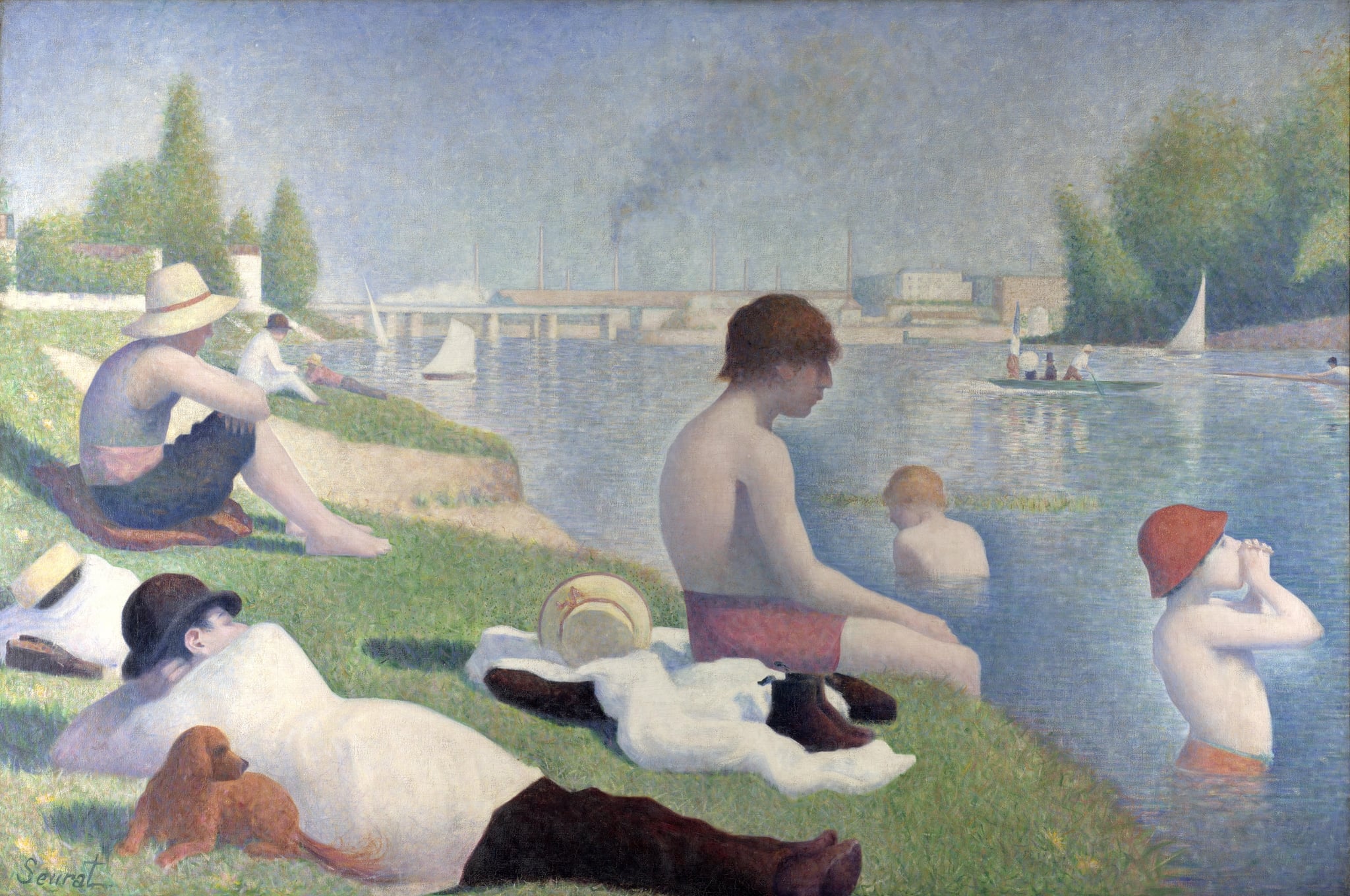
Bathers at Asnières
Georges Seurat (1884)
Bathers at Asnières stages a scene of <strong>modern leisure</strong> on the Seine, where workers recline and wade beneath a hazy, unified light. Seurat fuses <strong>classicizing stillness</strong> with an <strong>industrial backdrop</strong> of chimneys, bridges, and boats, turning ordinary rest into a monumental, ordered image of urban life <sup>[1]</sup><sup>[3]</sup>. The canvas balances soft greens and blues with geometric structures, producing a calm yet charged harmony.
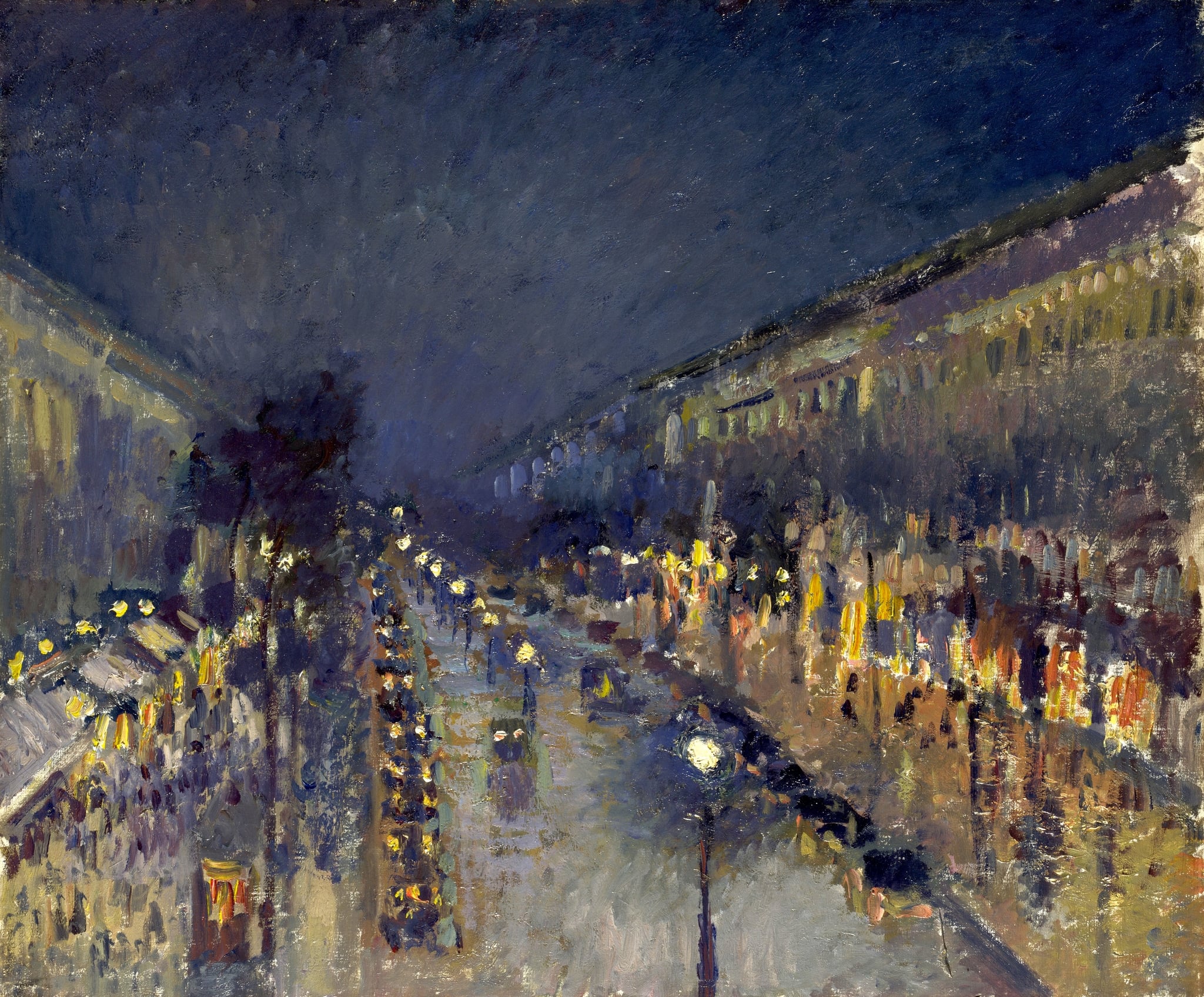
Boulevard Montmartre at Night
Camille Pissarro (1897)
A high window turns Paris into a flowing current: in Boulevard Montmartre at Night, Camille Pissarro fuses <strong>modern light</strong> and <strong>urban movement</strong> into a single, restless rhythm. Cool electric halos and warm gaslit windows shimmer across rain‑slick stone, where carriages and crowds dissolve into <strong>pulse-like blurs</strong> <sup>[1]</sup><sup>[2]</sup>.
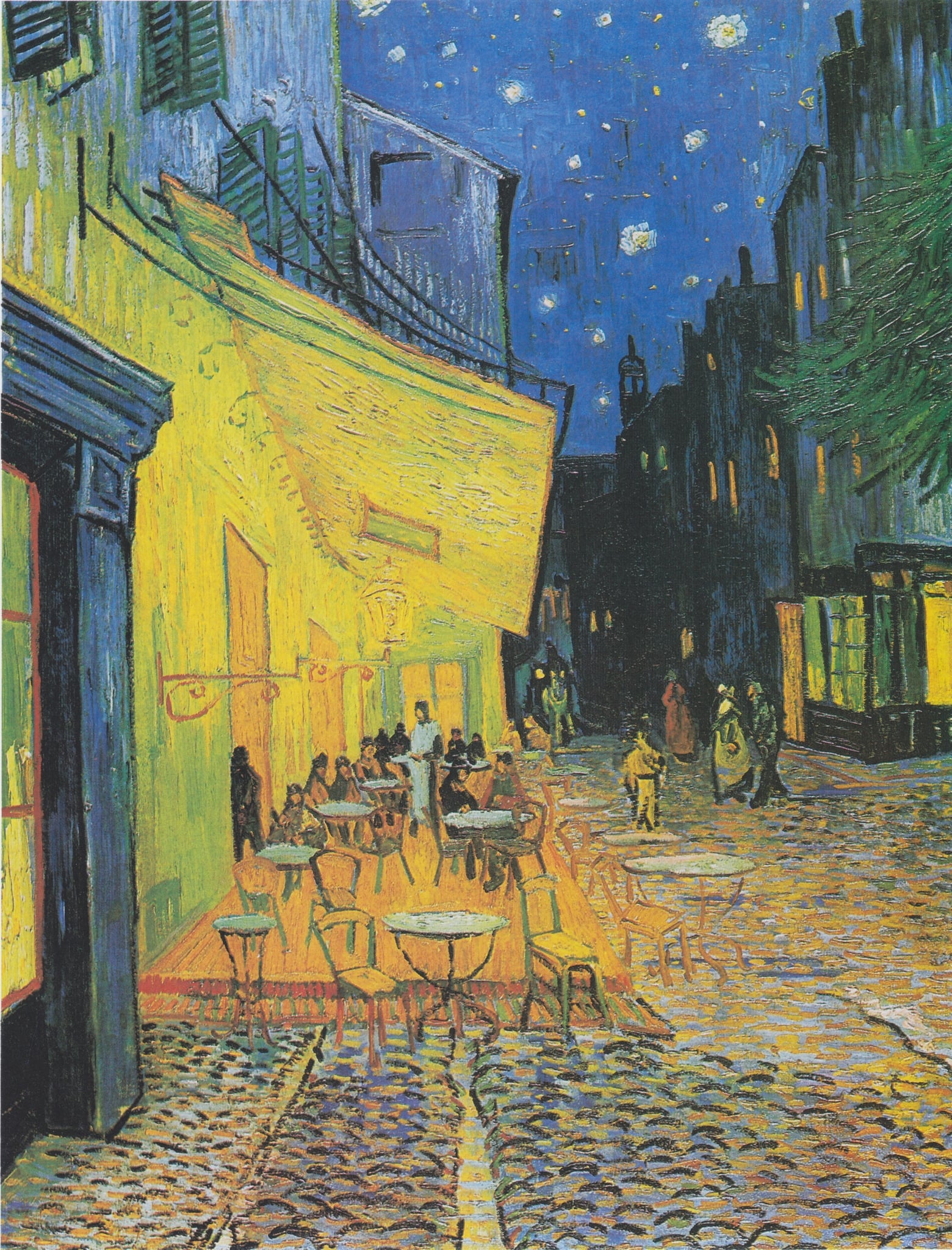
Café Terrace at Night
Vincent van Gogh (1888)
In Café Terrace at Night, Vincent van Gogh turns nocturne into <strong>luminous color</strong>: a gas‑lit terrace glows in yellows and oranges against a deep <strong>ultramarine sky</strong> pricked with stars. By building night “<strong>without black</strong>,” he stages a vivid encounter between human sociability and the vastness overhead <sup>[1]</sup><sup>[2]</sup>.
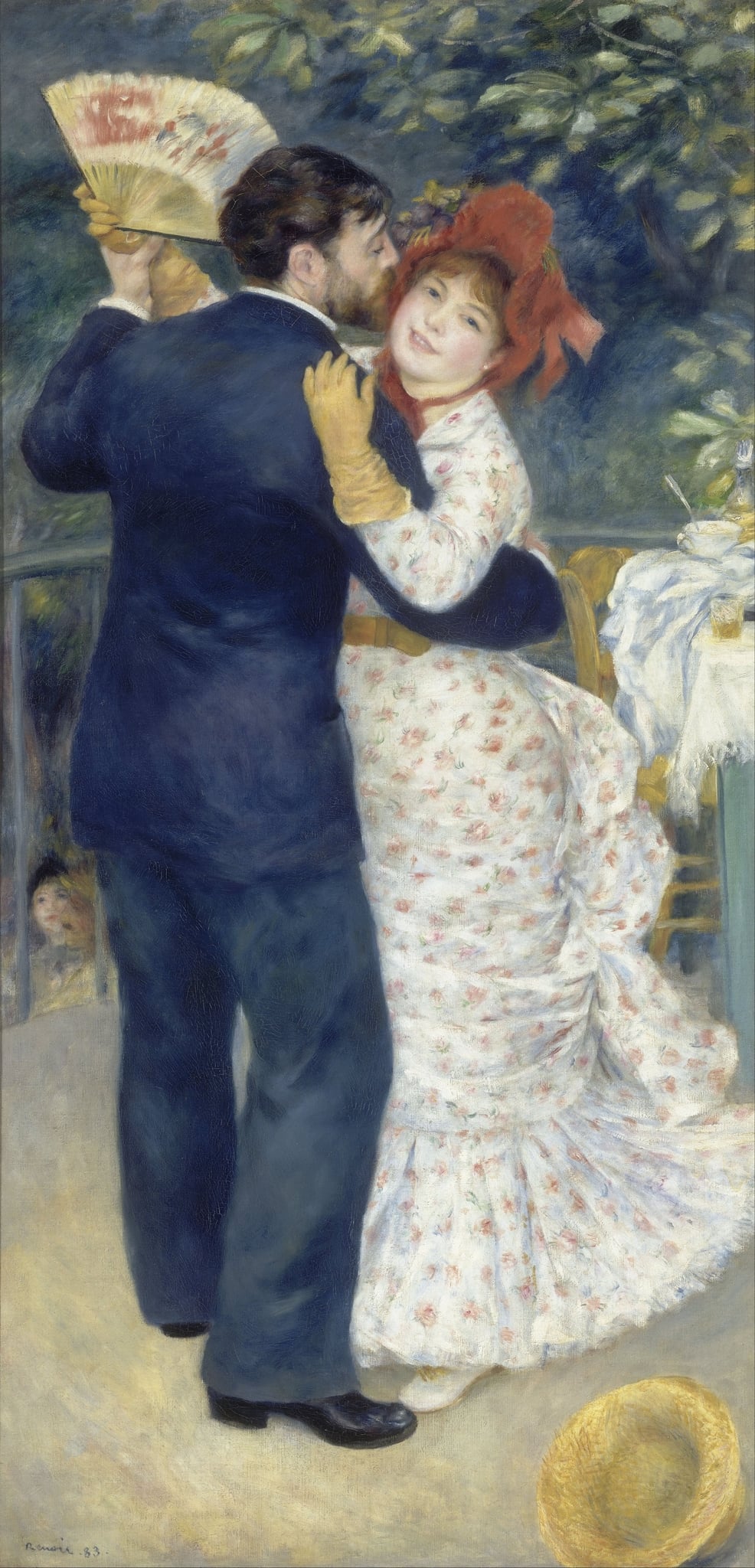
Dance in the Country
Pierre-Auguste Renoir (1883)
Dance in the Country shows a couple swept into a close embrace on a café terrace, their bodies turning in a soft spiral as foliage and sunlight dissolve into <strong>dappled color</strong>. Renoir orchestrates <strong>bourgeois leisure</strong>—the tossed straw boater, a small table with glass and napkin, the woman’s floral dress and red bonnet—to stage a moment where decorum and desire meet. The result is a modern emblem of shared pleasure, poised between Impressionist shimmer and a newly <strong>firm, linear touch</strong>.
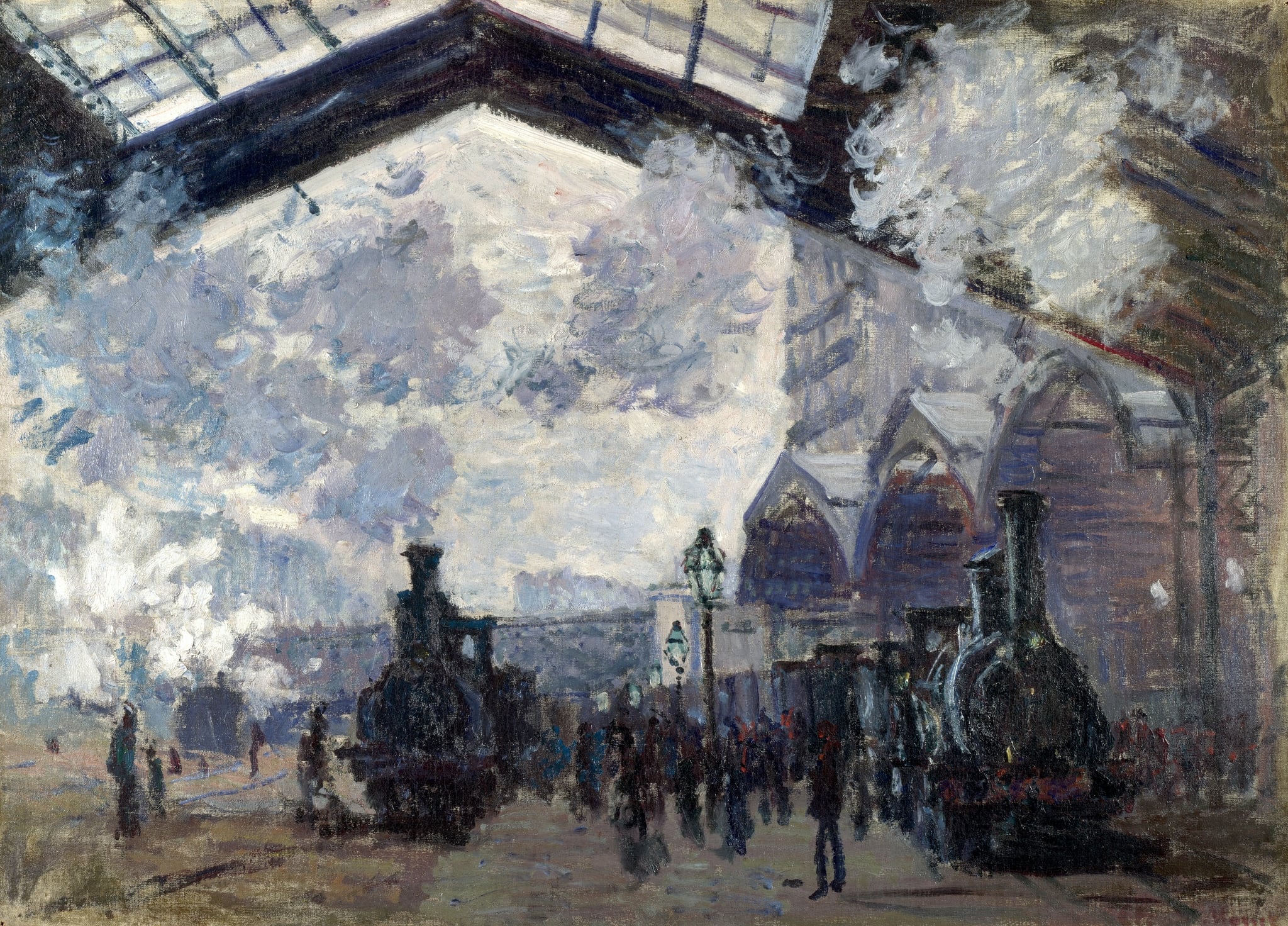
Gare Saint-Lazare
Claude Monet (1877)
Monet’s Gare Saint-Lazare turns an iron-and-glass train shed into a theater of <strong>steam, light, and motion</strong>. Twin locomotives, gas lamps, and a surge of figures dissolve into bluish vapor under the diagonal canopy, recasting industrial smoke as <strong>luminous atmosphere</strong> <sup>[1]</sup><sup>[2]</sup>.

Houses of Parliament
Claude Monet (1903)
Claude Monet’s Houses of Parliament renders Westminster as a <strong>dissolving silhouette</strong> in a wash of peach, mauve, and pale gold, where stone and river are leveled by <strong>luminous fog</strong>. Short, vibrating strokes turn architecture into <strong>atmosphere</strong>, while a tiny boat anchors human scale amid the monumental scene.
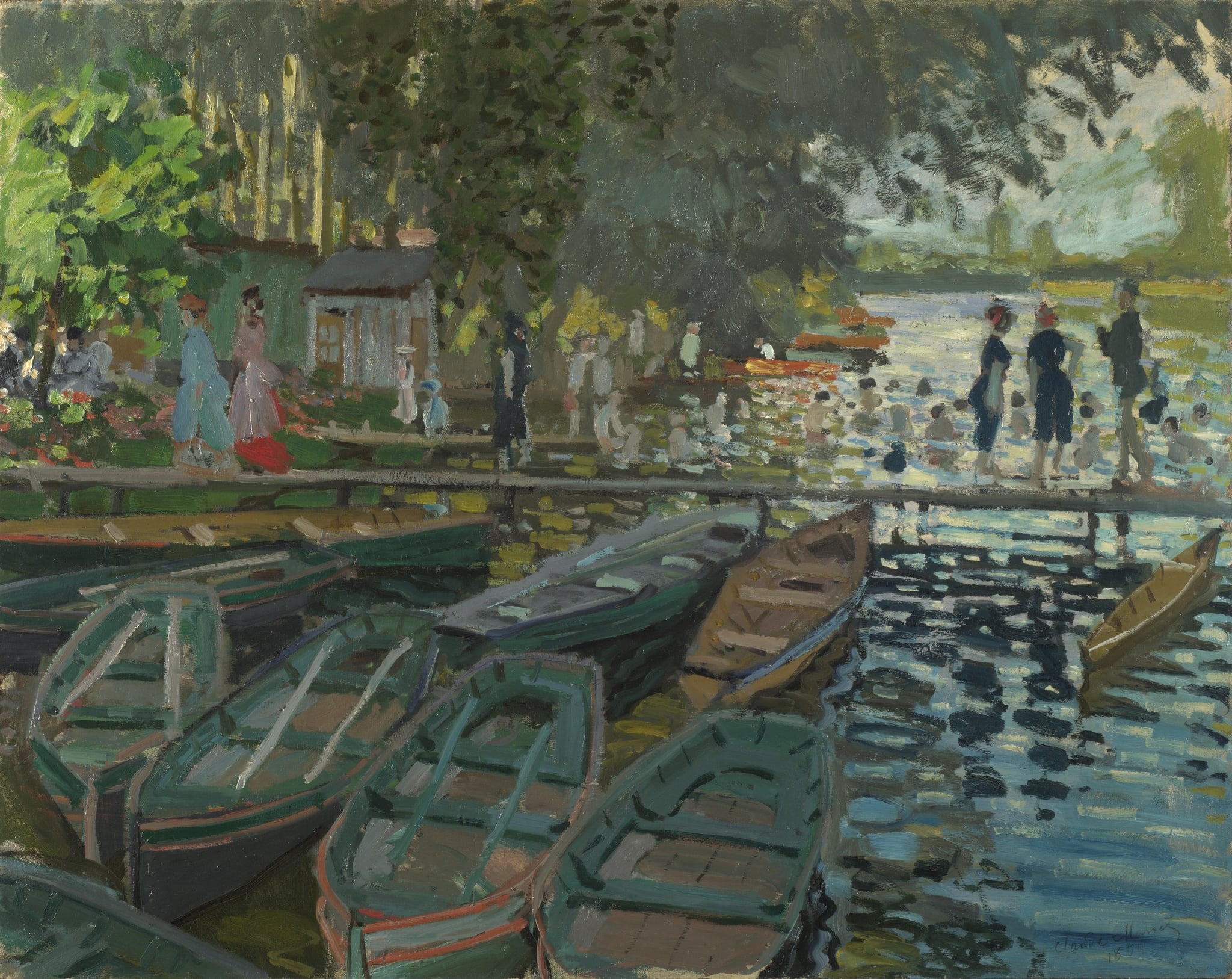
La Grenouillère
Claude Monet (1869)
Monet’s La Grenouillère crystallizes the new culture of <strong>modern leisure</strong> on the Seine: crowded bathers, promenading couples, and rental boats orbit a floating resort. With <strong>flickering brushwork</strong> and a high-key palette, Monet turns water, light, and movement into the true subjects, suspending the scene at the brink of dissolving.

Mont Sainte-Victoire
Paul Cézanne (1902–1906)
Cézanne’s Mont Sainte-Victoire renders the Provençal massif as a constructed order of <strong>planes and color</strong>, not a fleeting impression. Cool blues and violets articulate the mountain’s facets, while <strong>ochres and greens</strong> laminate the fields and blocky houses, binding atmosphere and form into a single structure <sup>[2]</sup><sup>[4]</sup>.
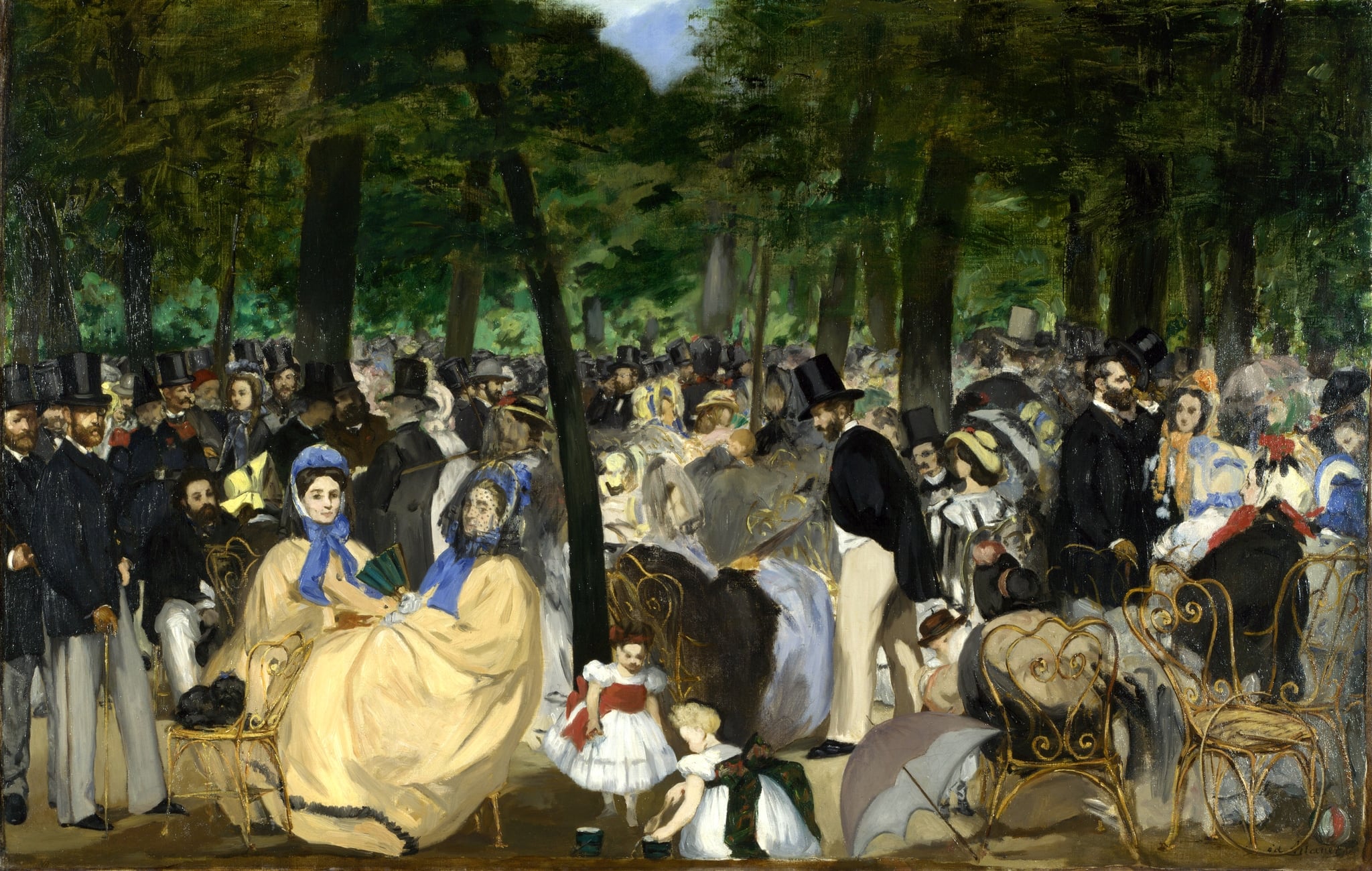
Music in the Tuileries
Édouard Manet (1862)
Édouard Manet’s Music in the Tuileries turns a Sunday concert into a manifesto of <strong>modern life</strong>: a frieze of top hats, crinolines, and iron chairs flickering beneath <strong>toxic green</strong> foliage. Instead of a hero or center, the painting disperses attention across a restless crowd, making <strong>looking itself</strong> the drama of the scene <sup>[1]</sup><sup>[2]</sup>.
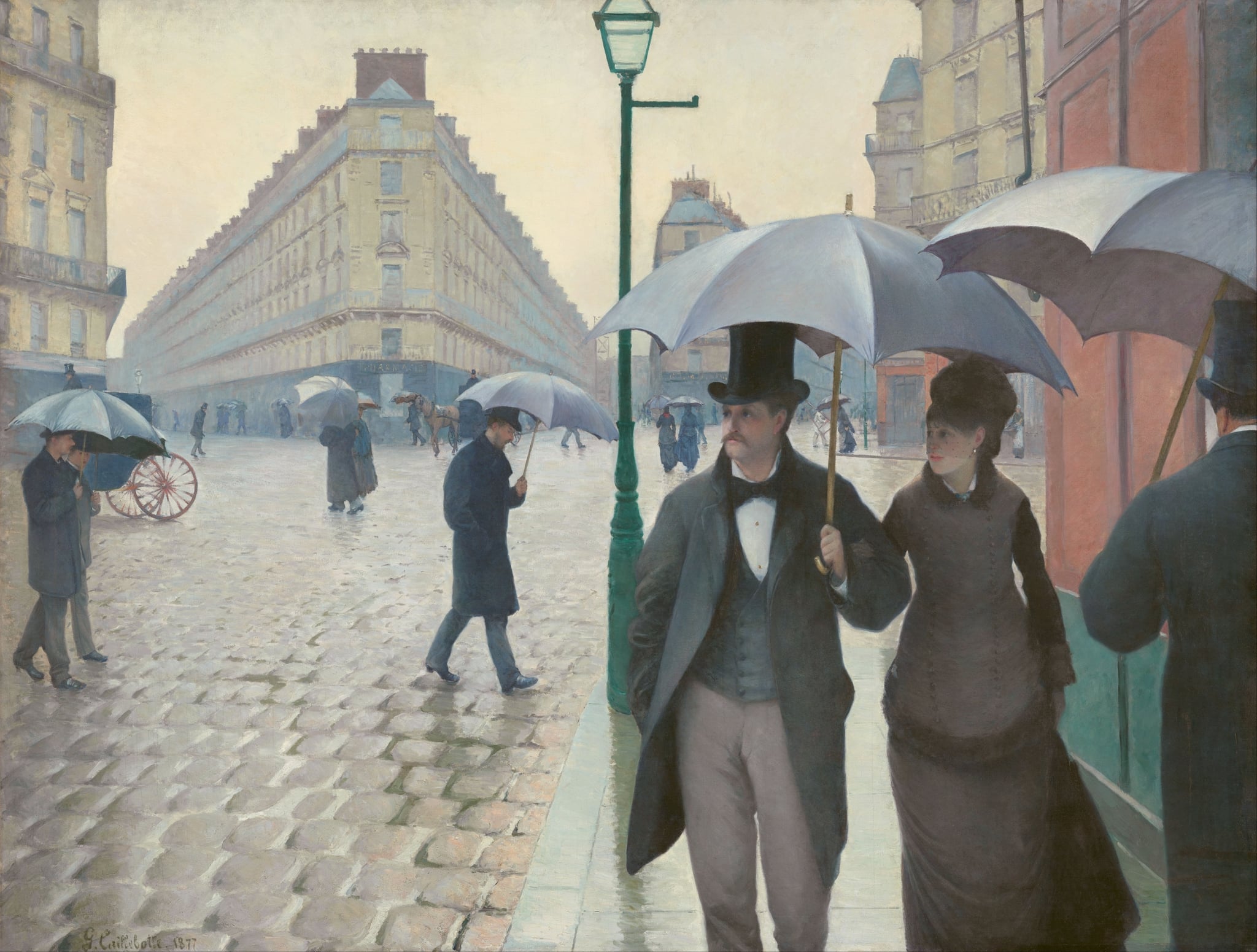
Paris Street; Rainy Day
Gustave Caillebotte (1877)
Gustave Caillebotte’s Paris Street; Rainy Day renders a newly modern Paris where <strong>Haussmann’s geometry</strong> meets the <strong>anonymity of urban life</strong>. Umbrellas punctuate a silvery atmosphere as a <strong>central gas lamp</strong> and knife-sharp façades organize the space into measured planes <sup>[1]</sup><sup>[2]</sup>.
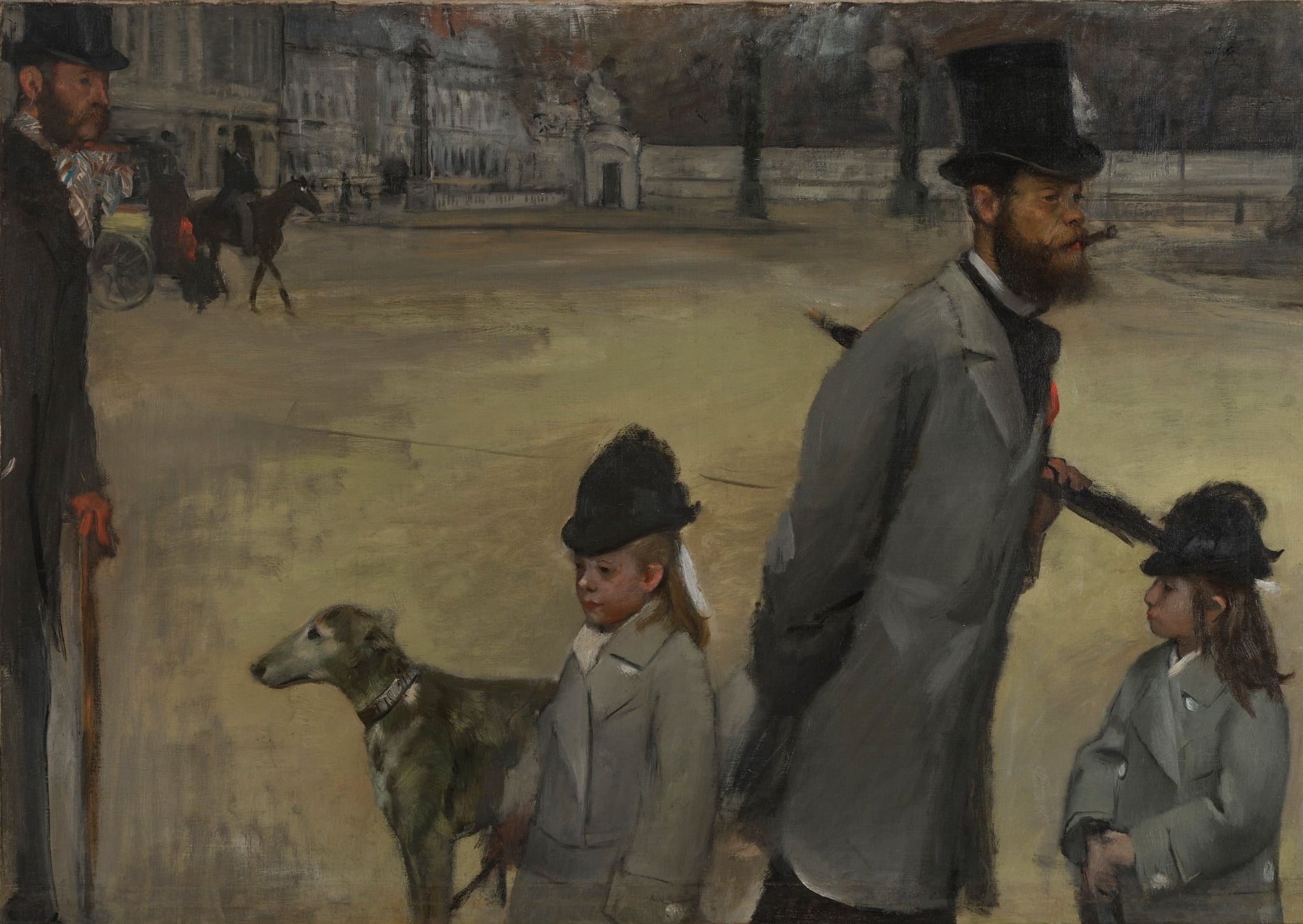
Place de la Concorde
Edgar Degas (1875)
Degas’s Place de la Concorde turns a famous Paris square into a study of <strong>modern isolation</strong> and <strong>instantaneous vision</strong>. Figures stride past one another without contact, their bodies abruptly <strong>cropped</strong> and adrift in a wide, airless plaza—an urban stage where elegance masks estrangement <sup>[1]</sup><sup>[2]</sup>.

Pont Neuf Paris
Pierre-Auguste Renoir (1872)
In Pont Neuf Paris, Pierre-Auguste Renoir turns the oldest bridge in Paris into a stage where <strong>light</strong> and <strong>movement</strong> bind a city back together. From a high perch, he orchestrates crowds, carriages, gas lamps, the rippling Seine, and a fluttering <strong>tricolor</strong> so that everyday bustle reads as civic grace <sup>[1]</sup>.
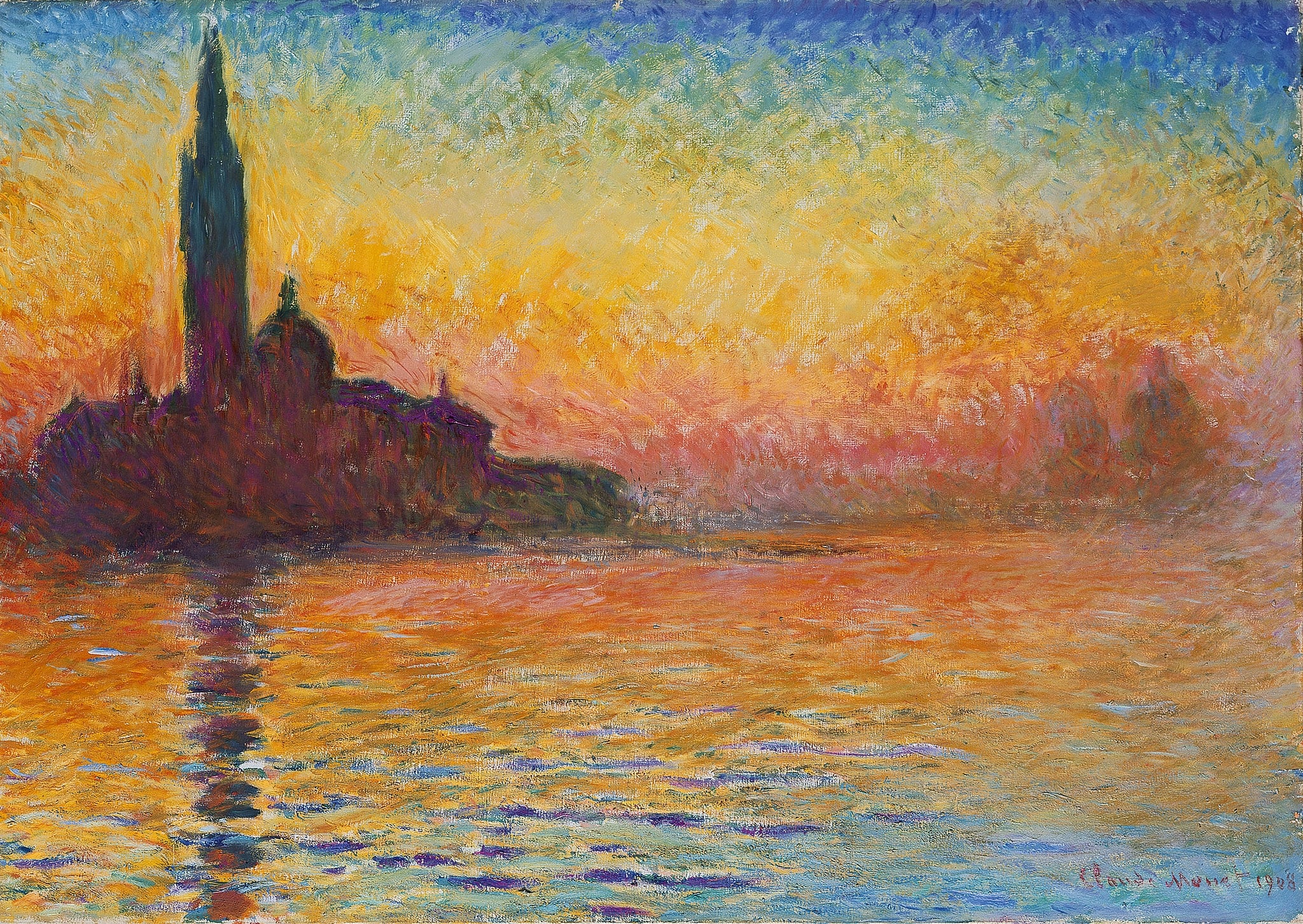
San Giorgio Maggiore at Dusk
Claude Monet (1908–1912)
Claude Monet’s San Giorgio Maggiore at Dusk fuses the Benedictine church’s dark silhouette with a sky flaming from apricot to cobalt, turning architecture into atmosphere. The campanile’s vertical and its wavering reflection anchor a sea of trembling color, staging a meditation on <strong>permanence</strong> and <strong>flux</strong>.
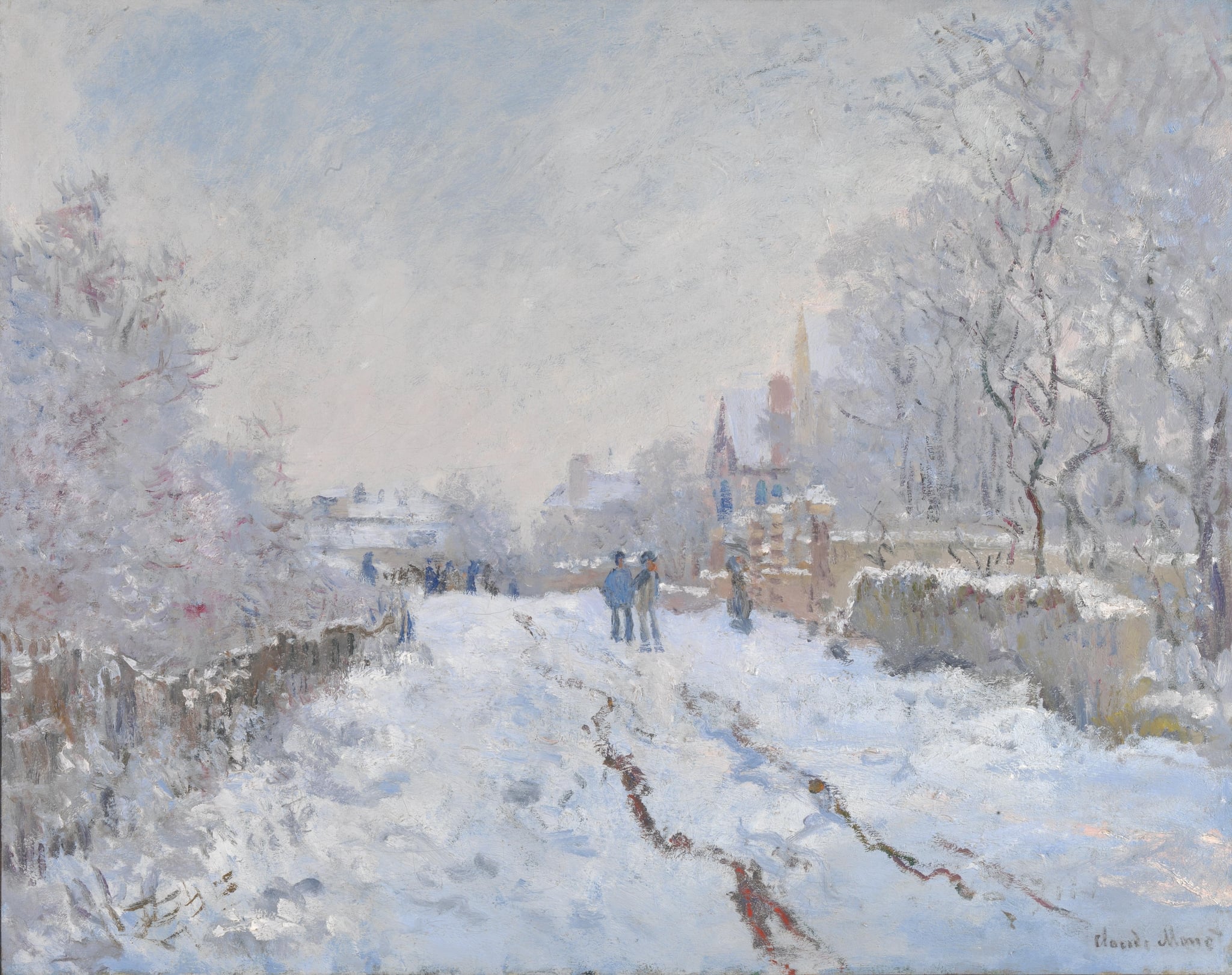
Snow at Argenteuil
Claude Monet (1875)
<strong>Snow at Argenteuil</strong> renders a winter boulevard where light overtakes solid form, turning snow into a luminous field of blues, violets, and pearly pinks. Reddish cart ruts pull the eye toward a faint church spire as small, blue-gray figures persist through the hush. Monet elevates atmosphere to the scene’s <strong>protagonist</strong>, making everyday passage a meditation on time and change <sup>[1]</sup><sup>[2]</sup>.
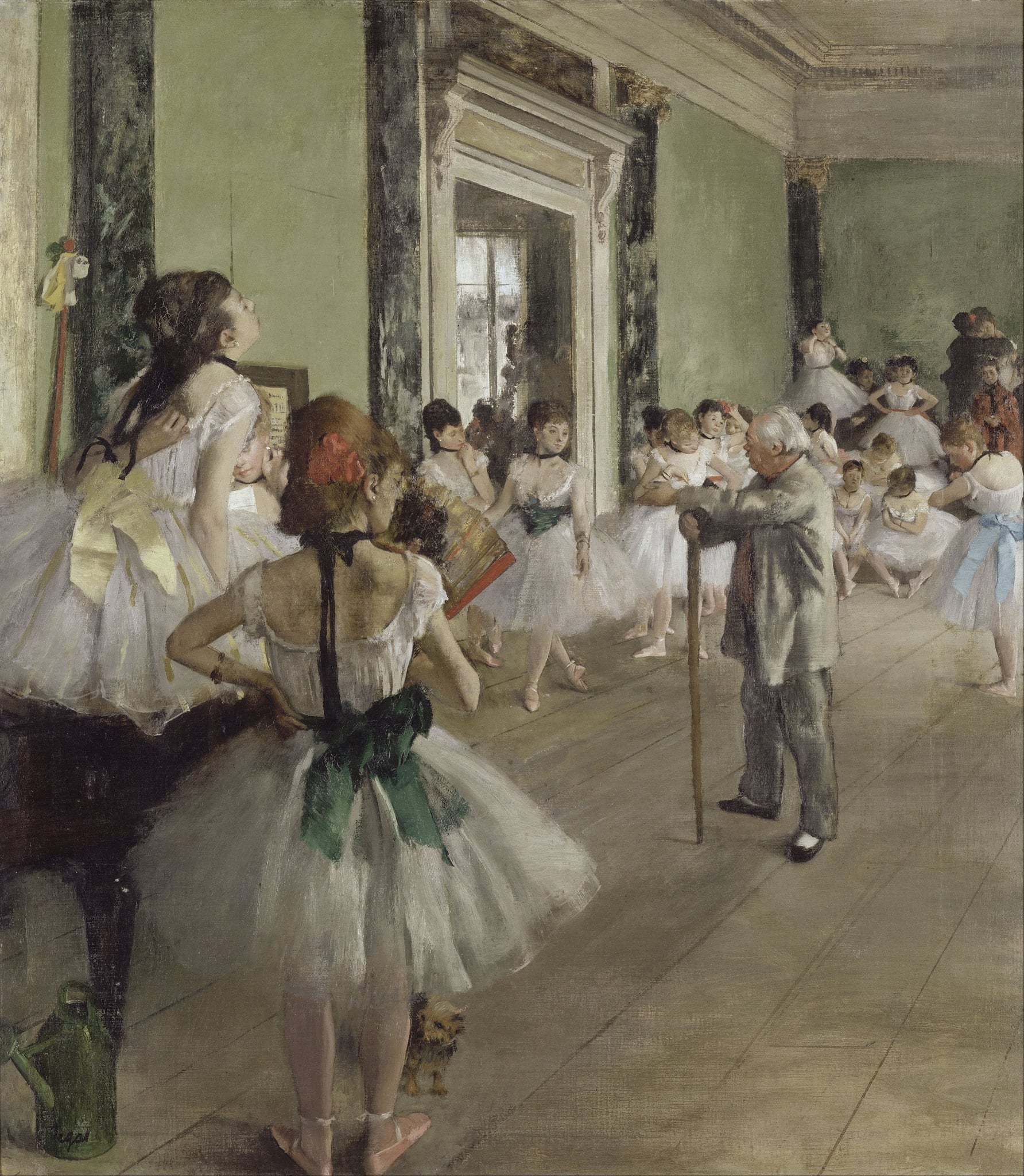
The Ballet Class
Edgar Degas (1873–1876)
<strong>The Ballet Class</strong> shows the work behind grace: a green-walled studio where young dancers in white tutus rest, fidget, and stretch while the gray-suited master stands with his cane. Degas’s diagonal floorboards, cropped viewpoints, and scattered props—a watering can, a music stand, even a tiny dog—stage a candid vision of routine rather than spectacle. The result is a modern image of discipline, hierarchy, and fleeting poise.
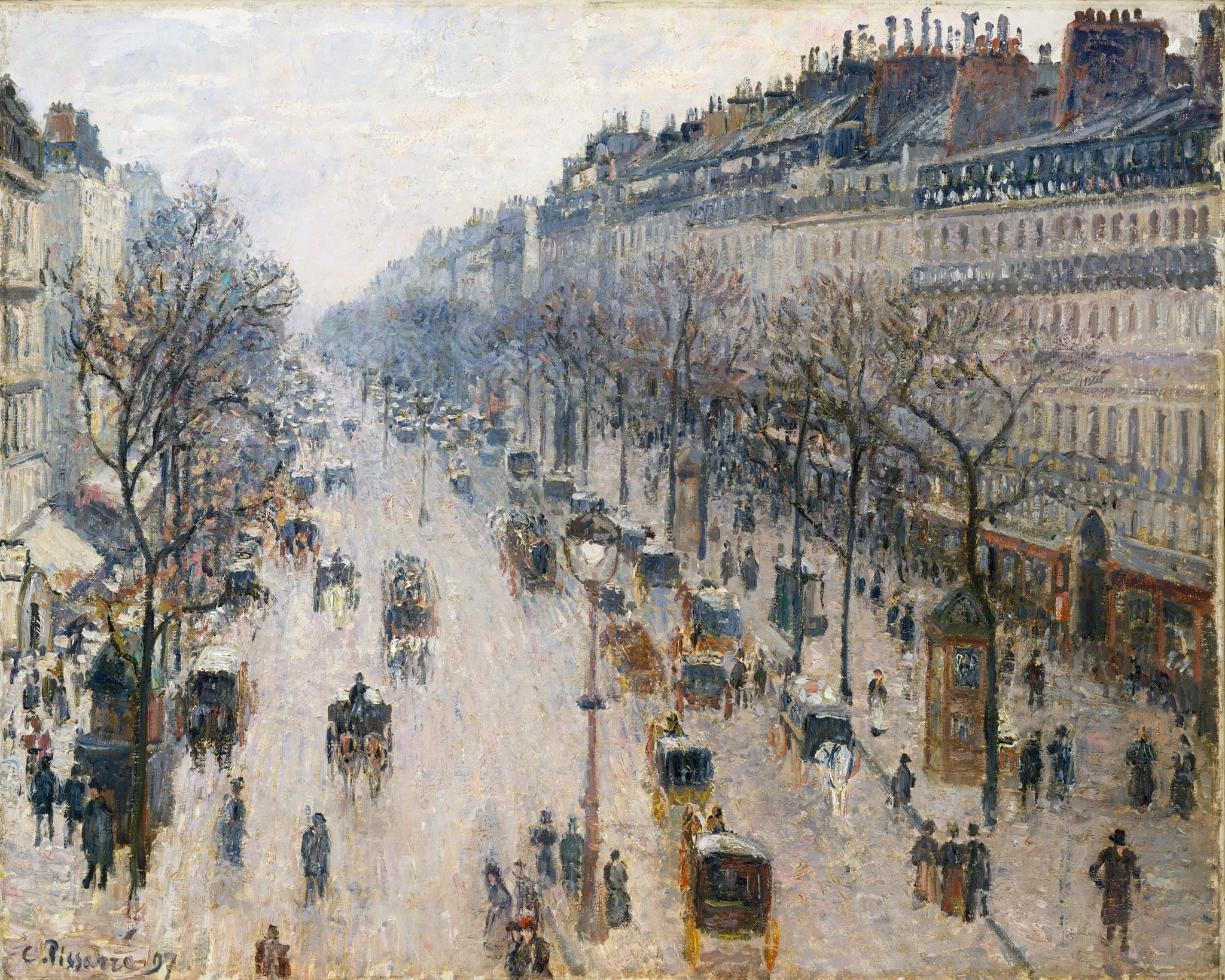
The Boulevard Montmartre on a Winter Morning
Camille Pissarro (1897)
From a high hotel window, Camille Pissarro renders Paris as a living system—its Haussmann boulevard dissolving into winter light, its crowds and vehicles fused into a soft, <strong>rhythmic flow</strong>. Broken strokes in cool grays, lilacs, and ochres turn fog, steam, and motion into <strong>texture of time</strong>, dignifying the city’s ordinary morning pulse <sup>[1]</sup><sup>[3]</sup>.
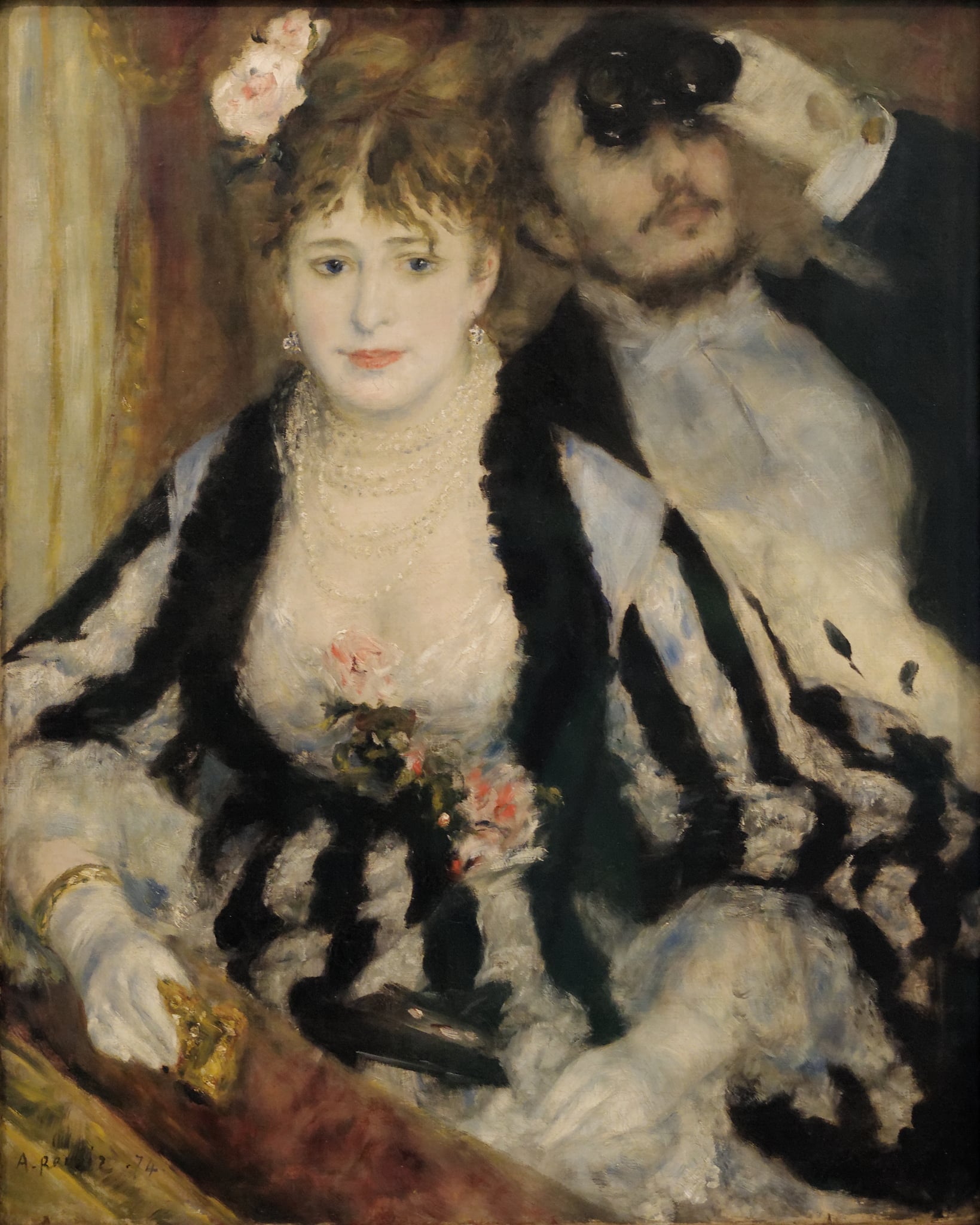
The Loge
Pierre-Auguste Renoir (1874)
Renoir’s The Loge (1874) turns an opera box into a <strong>stage of looking</strong>, where a woman meets our gaze while her companion scans the crowd through binoculars. The painting’s <strong>frame-within-a-frame</strong> and glittering fashion make modern Parisian leisure both alluring and self-conscious, turning spectators into spectacles <sup>[1]</sup><sup>[2]</sup>.
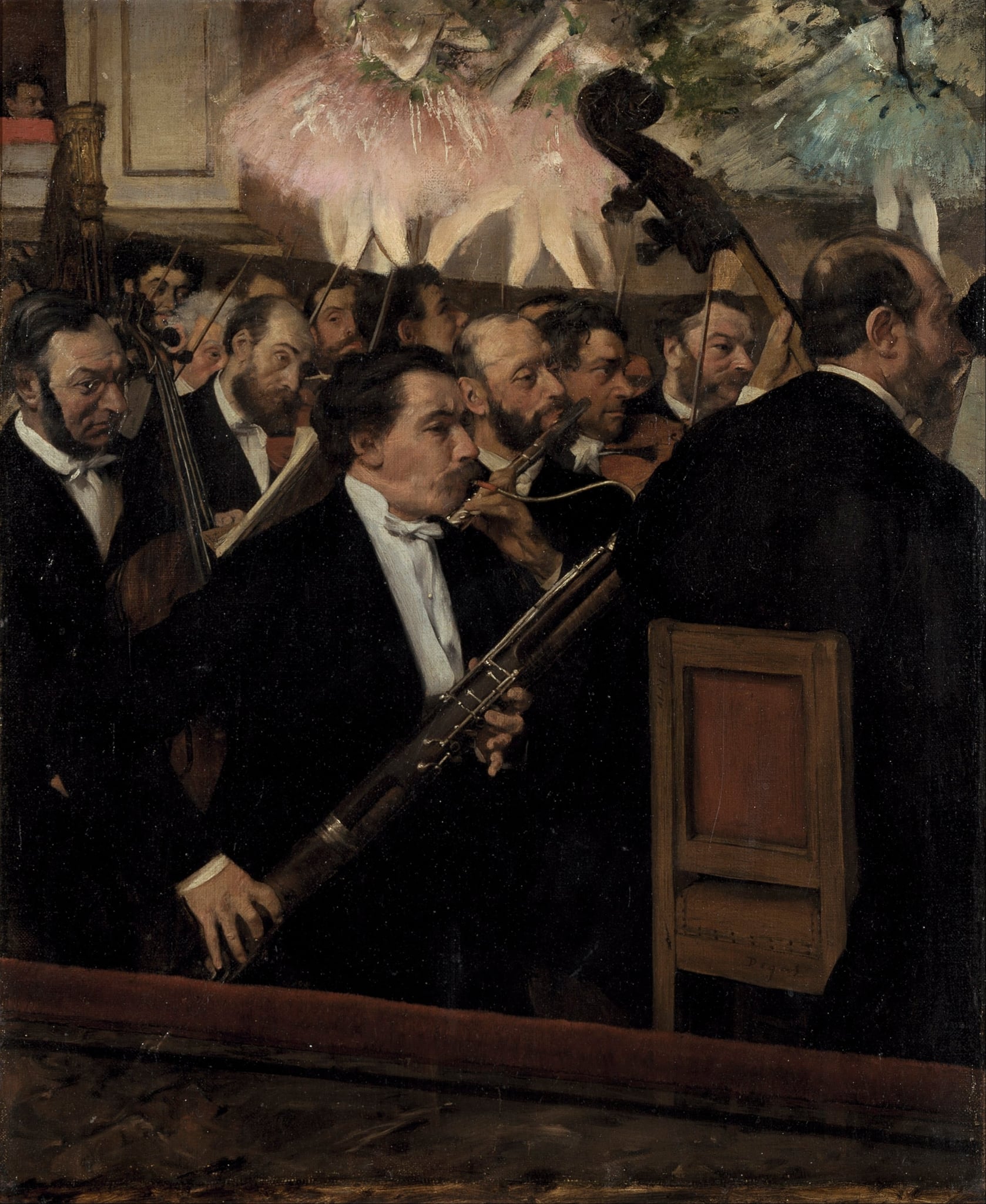
The Opera Orchestra by Edgar Degas | Analysis
Edgar Degas
In The Opera Orchestra, Degas flips the theater’s hierarchy: the black-clad pit fills the frame while the ballerinas appear only as cropped tutus and legs, glittering above. The diagonal <strong>bassoon</strong> and looming <strong>double bass</strong> marshal a dense field of faces lit by footlights, turning backstage labor into the subject and spectacle into a fragment <sup>[1]</sup><sup>[2]</sup>.
The Railway
Édouard Manet (1873)
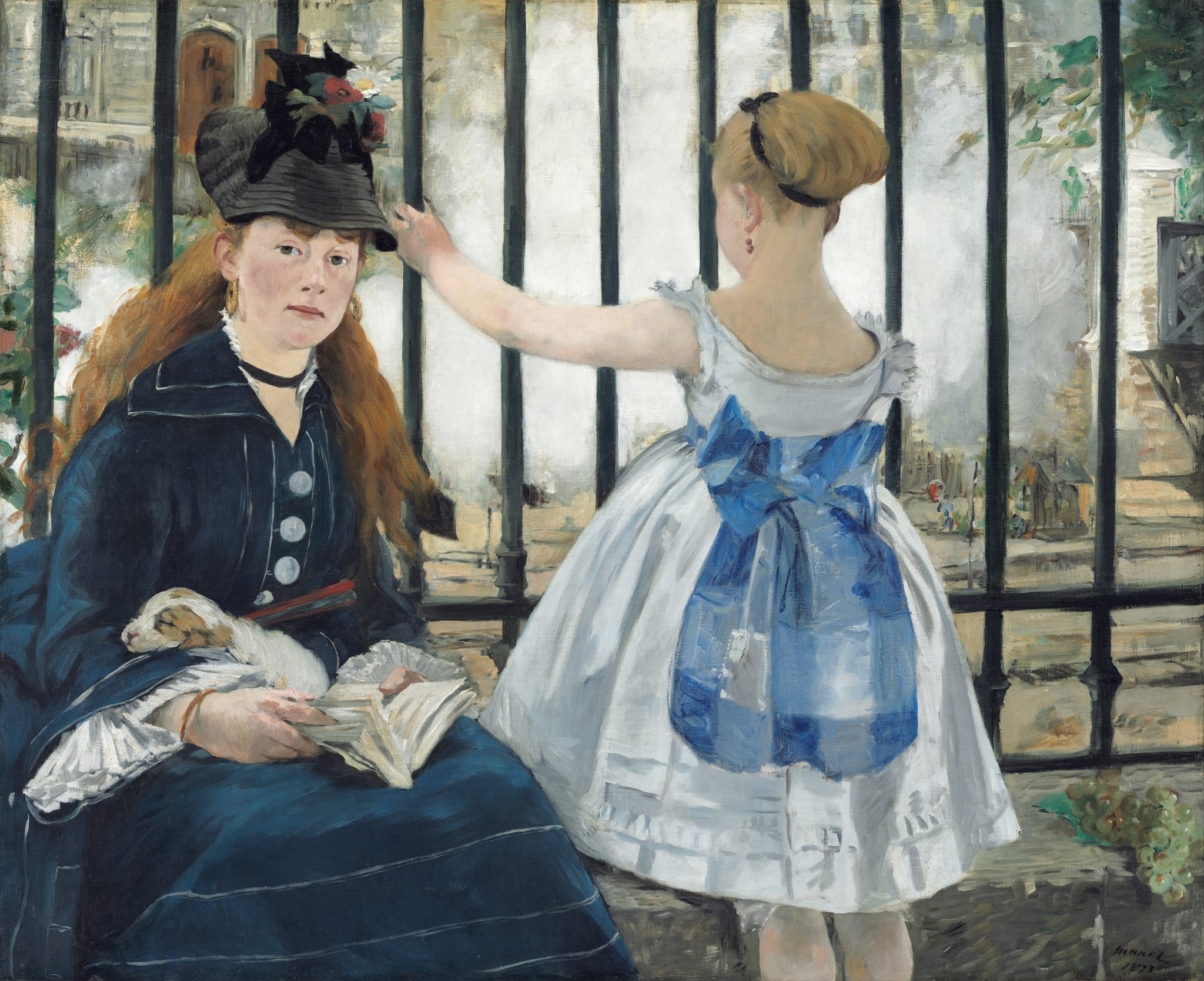
Manet’s The Railway is a charged tableau of <strong>modern life</strong>: a composed woman confronts us while a child, bright in <strong>white and blue</strong>, peers through the iron fence toward a cloud of <strong>steam</strong>. The image turns a casual pause at the Gare Saint‑Lazare into a meditation on <strong>spectatorship, separation, and change</strong> <sup>[1]</sup><sup>[3]</sup>.
The Rehearsal of the Ballet Onstage
Edgar Degas (ca. 1874)
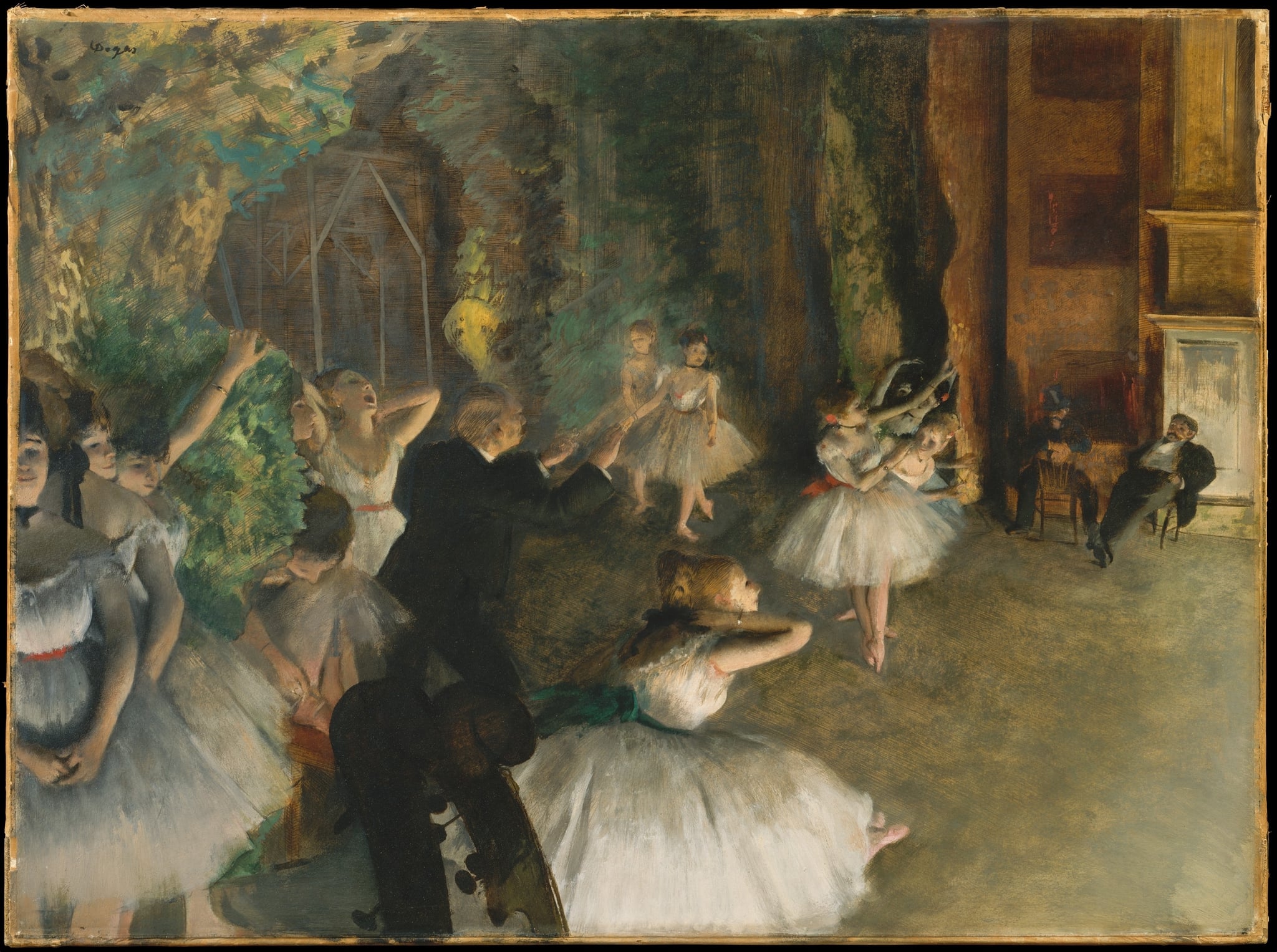
Degas’s The Rehearsal of the Ballet Onstage turns a moment of practice into a modern drama of work and power. Under <strong>harsh footlights</strong>, clustered ballerinas stretch, yawn, and repeat steps as a <strong>ballet master/conductor</strong> drives the tempo, while <strong>abonnés</strong> lounge in the wings and a looming <strong>double bass</strong> anchors the labor of music <sup>[1]</sup><sup>[3]</sup><sup>[4]</sup>.
Related Themes
Related Symbolism Categories
Urban
Urban symbolism in modern painting transforms streets, stations, and squares into coded fields where infrastructure, light, and crowd dynamics visualize the social logics of the nineteenth- and early twentieth‑century city.
Architecture
Architectural motifs in modern painting operate as charged thresholds between private and public, nature and culture, and individual perception and collective order, translating built form into a language for negotiating modernity’s social and psychological stakes.
Objecthood
The “Objecthood” symbolism category traces how seemingly ordinary implements—bottles, clocks, mirrors, gloves, café tableware—become charged mediators of labor, time, spectacle, and selfhood in modern painting, shifting from stable attributes to critical signs of fractured, commodity-driven experience.
Within nineteenth- and early twentieth-century art, urbanity is not simply a matter of subject matter—streets, stations, cafés—but of a new symbolic grammar that renders the city as system. Painters of modern life repeatedly seized on infrastructural elements and public behaviors as sign-bearing forms: gas lamps and electric globes, Haussmann façades and iron-and-glass sheds, crowds dissolved into silhouettes. These motifs operate semiotically as indices of modernization and as icons of new social relations, binding technological rationalization to altered modes of seeing and being seen. The urban image becomes a field in which order, circulation, and anonymity are not just depicted but allegorized through recurring visual signs.
Central to this symbolic lexicon are lighting devices that convert darkness into an administered visual regime. In Camille Pissarro’s Boulevard Montmartre at Night (1897), electric arc lamps and gaslit shopfronts are not mere accessories of nocturnal description. The central bead-string of cool white orbs reads iconographically as municipal infrastructure—electric arc lamps that embody “modern civic technology and order; cold, regulated illumination of the metropolis.” Their even spacing along the boulevard semiotically encodes standardization and temporal discipline, while the warmer, fractured band of gaslit windows below materializes commerce and desire. The painting’s meaning hinges on this dual circuitry: the high, blue-white system of public control versus the low, amber circuitry of private consumption. Pissarro’s loose touch differentiates these technologies of light even as it fuses them into a single rhythm, so that illumination itself becomes the city’s pulse.
Van Gogh’s Café Terrace at Night (1888) reorients this symbolism from institutional order to existential choice. Here the solitary gas lantern generates an amber cone of sociability, articulated through “gaslit shopfronts and windows” and the dense array of “café tableware” that denotes “consumption and nightlife commerce; intoxication as social lubricant and cost.” Opposed to this is the receding “blue street/avenue,” defined as “freedom, risk, and the unknown beyond the circle of hospitality.” Semiologically, Van Gogh constructs a chromatic syntax: yellow light as the signifier of communal warmth and ritualized café culture, blue darkness as the signifier of open-ended, even perilous, modern freedom. The absence of black underscores that the urban night is not void but a differentiated field of colored zones, each carrying distinct social valences.
If light marks the city’s new temporal regime, bridges and canopies figure its spatial rationalization. In Seurat’s Bathers at Asnières (1884), the distant bridges—one a road span, one a railway—are reduced to “horizontal bridge band” and “bridges (rail and road),” emblems of “modern infrastructure and connection; order structuring the landscape.” Their measured horizontals and the “bridge reflection/shadow” across the Seine introduce an abstract geometry that counterpoints the classically poised bathers. Semiologically, these forms function as stabilizing axes: they flatten industry into a calm band that both frames and qualifies leisure, insisting that working-class respite occurs under the sign of transit and connectivity rather than in a timeless Arcadia. The bridge’s reflection, described as “a doubled form suggesting passage between worlds and the instability of solids,” extends this symbolism into the register of perception, reminding viewers that modern passage is always mediated by optical and atmospheric conditions.
Claude Monet radicalizes this infrastructural imagery in Gare Saint-Lazare (1877), where the iron-and-glass train shed becomes a secular nave. The “iron-and-glass canopy (V-shaped roof truss)” and “iron-and-glass train shed” read iconographically as the “framework of modernity and order—a secular ‘nave’ that organizes and contains industrial forces.” Their hard, receding diagonals impose a perspectival discipline amid dissolving steam, framing the locomotives—“industrial modernity and man-made power; speed as a new sublime force”—as quasi-liturgical actors entering an arena of modern pilgrimage. “Hanging station lamps” punctuate this nave as instruments of “scheduling and synchronization,” while the “crowd of passengers and workers” condenses into a frieze of transient marks. Monet’s composition thus stages a hierarchy of symbols: the shed as overarching order, the locomotive as engine of progress, the lamps as timekeepers, and the crowd as human tempo, collectively transforming the station into an icon of urbanity as orchestrated flux.
Street architecture and circulation furnish a complementary register of urban symbolism, centered on façades and crowds. Gustave Caillebotte’s Paris Street; Rainy Day (1877) is organized around a “Haussmann Wedge Block” and “Haussmann façades” that signify “rational urban planning and geometric order imposed on Paris.” The sharp, triangulating block and “converging façades and vanishing point” turn the rebuilt city into an optical device that channels movement and vision into a controlled trajectory. The centrally placed “Central Gas Lamppost” acts as a visual and semantic pivot: a sign of “modern infrastructure and standardization” that divides the canvas into two calibrated spatial fields. Within this grid, the “Bourgeois Couple (Flâneur and Companion)” emerges as the human emblem of urban modernity—figures of decorous, detached observation whose very poise reveals the psychological corollary of Haussmann’s planning. Around them, a “crowd of black-clad pedestrians” and “crowds and horse-drawn traffic” index the “anonymity and tempo of the modern metropolis.” Their blurred, umbrella-topped silhouettes refuse portraiture, aligning instead with the category of “anonymous crowd silhouettes”—a recurring shorthand for the collective public body in which individual identity yields to circulation.
Pissarro’s aerial view in Boulevard Montmartre at Night intensifies this semiotics of the crowd. Seen from above, the “crowds and carriage traffic” merge into continuous bands of motion keyed to light. The bourgeois promenade becomes inseparable from infrastructural regularity; human presence is legible less through faces than through the rhythmic spacing of cab-lights and umbrella-like dots. In both Caillebotte and Pissarro, urbanity is symbolized as a negotiation between the structuring will of the street—lamps, façades, vanishing points—and the fluid, anonymous mass that those structures contain.
Even when the city retreats to the horizon, its symbolic apparatus persists. In Monet’s La Grenouillère (1869), “factory chimneys and smoke” on the distant bank signal “industry and labor; the modern city’s presence framing leisure,” while the “guinguette pavilion/hut” functions as “the commercial infrastructure of leisure—pleasure as an organized, purchasable experience.” Boats and the narrow gangplank operate together with this pavilion as a suburban echo of the bridge and the boulevard: paid mobility, threshold spaces, and commodified recreation extend urban logic into apparently natural settings. Seurat’s Bathers at Asnières likewise uses “industrial smokestacks” and “factory chimneys and smoke” to embed working-class bodies in an atmosphere literally shaped by production. In both cases, the city is no longer confined to a bounded topography; it is a diffuse system manifesting itself as haze, traffic, and commercial huts along the river.
Across these works, urban symbols evolve from descriptive props into abstractions of modern experience. Mid-century pictures such as La Grenouillère still distinguish, however tenuously, between natural and constructed environments. By the time of Monet’s Houses of Parliament (1903), elements like the “Houses of Parliament and clock tower” and “Parliament silhouette” have been almost entirely absorbed into light. Institutional authority survives as a dark vertical “softened into something provisional by light,” its solidity undone by the same atmospheric forces—industrial haze, riverine reflection—that earlier artists had used to frame the city’s outskirts. The lamp, bridge, shed, façade, and crowd gradually lose their anecdotal particularity and become, instead, a shared iconographic vocabulary for urbanity as such: a world of engineered visibility, regulated circulation, and collective anonymity in which perception itself is reorganized by infrastructure.