Nature
In nineteenth- and twentieth-century painting, natural motifs ranging from Arcadian groves and grainstacks to broken ice floes and barren trees operate as a flexible symbolic system through which artists negotiate time, modernity, and the shifting relation between human life and the environment.
Member Symbols
Featured Artworks
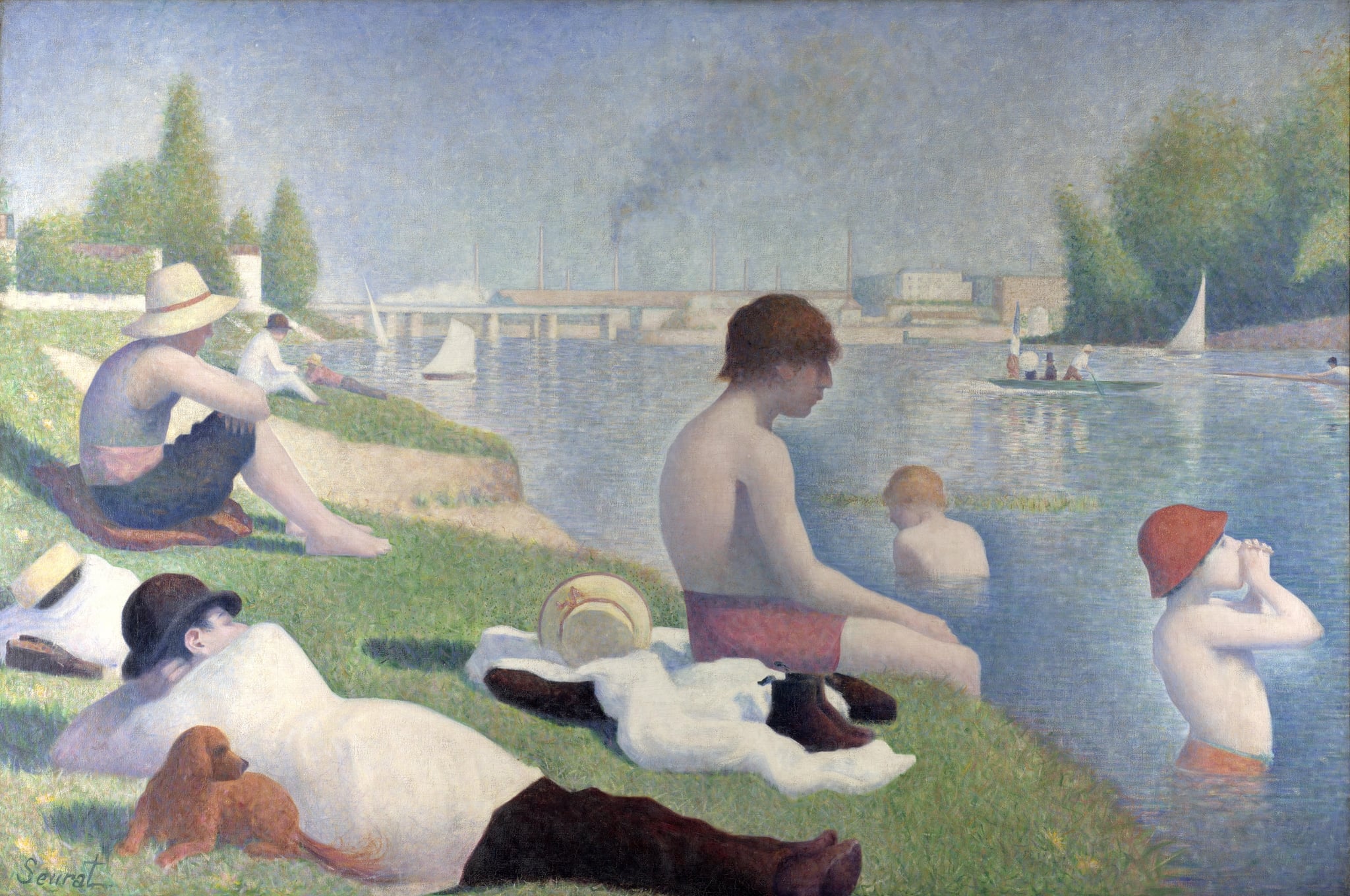
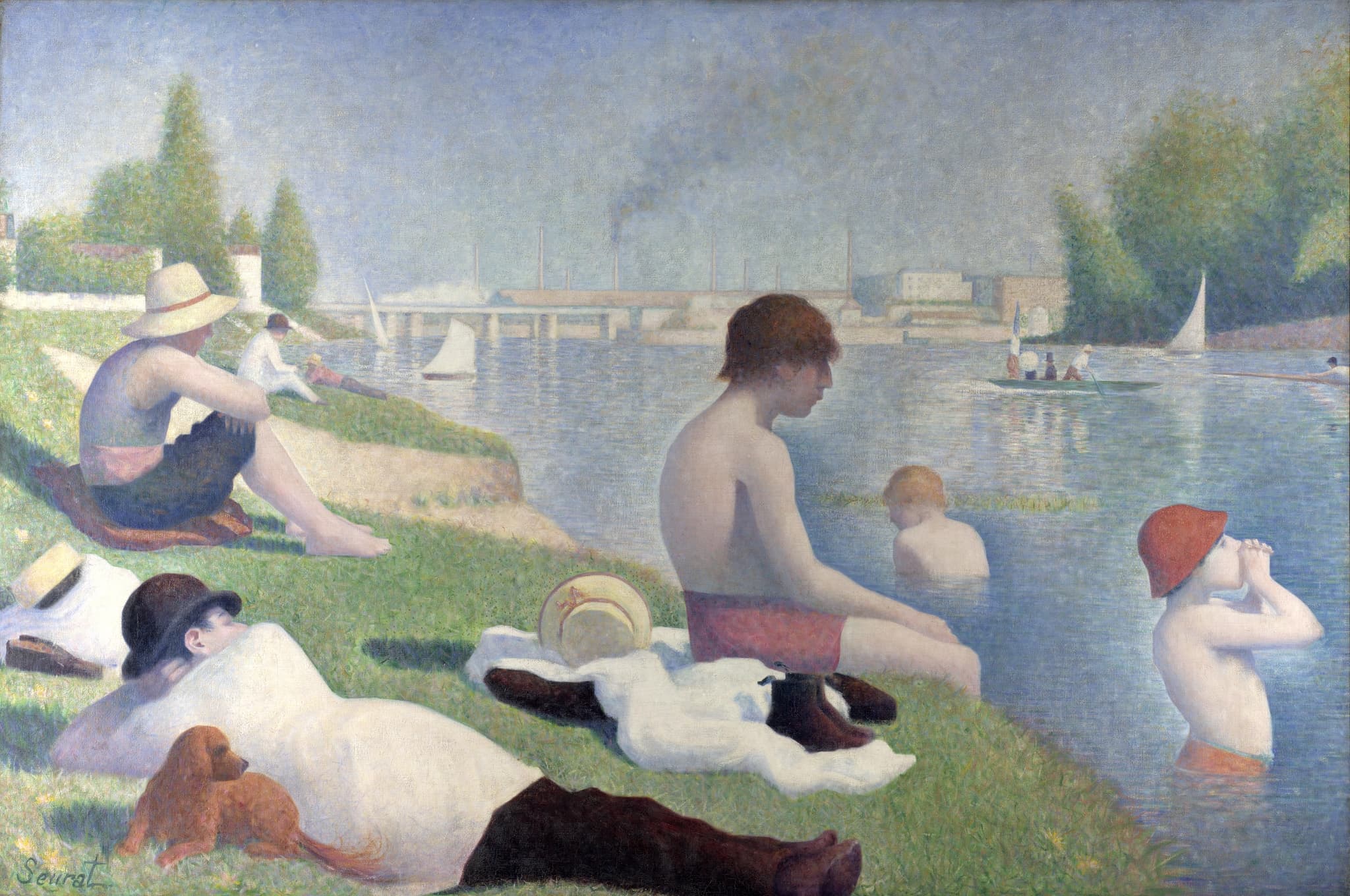
Bathers at Asnières
Georges Seurat (1884)
Bathers at Asnières stages a scene of <strong>modern leisure</strong> on the Seine, where workers recline and wade beneath a hazy, unified light. Seurat fuses <strong>classicizing stillness</strong> with an <strong>industrial backdrop</strong> of chimneys, bridges, and boats, turning ordinary rest into a monumental, ordered image of urban life <sup>[1]</sup><sup>[3]</sup>. The canvas balances soft greens and blues with geometric structures, producing a calm yet charged harmony.
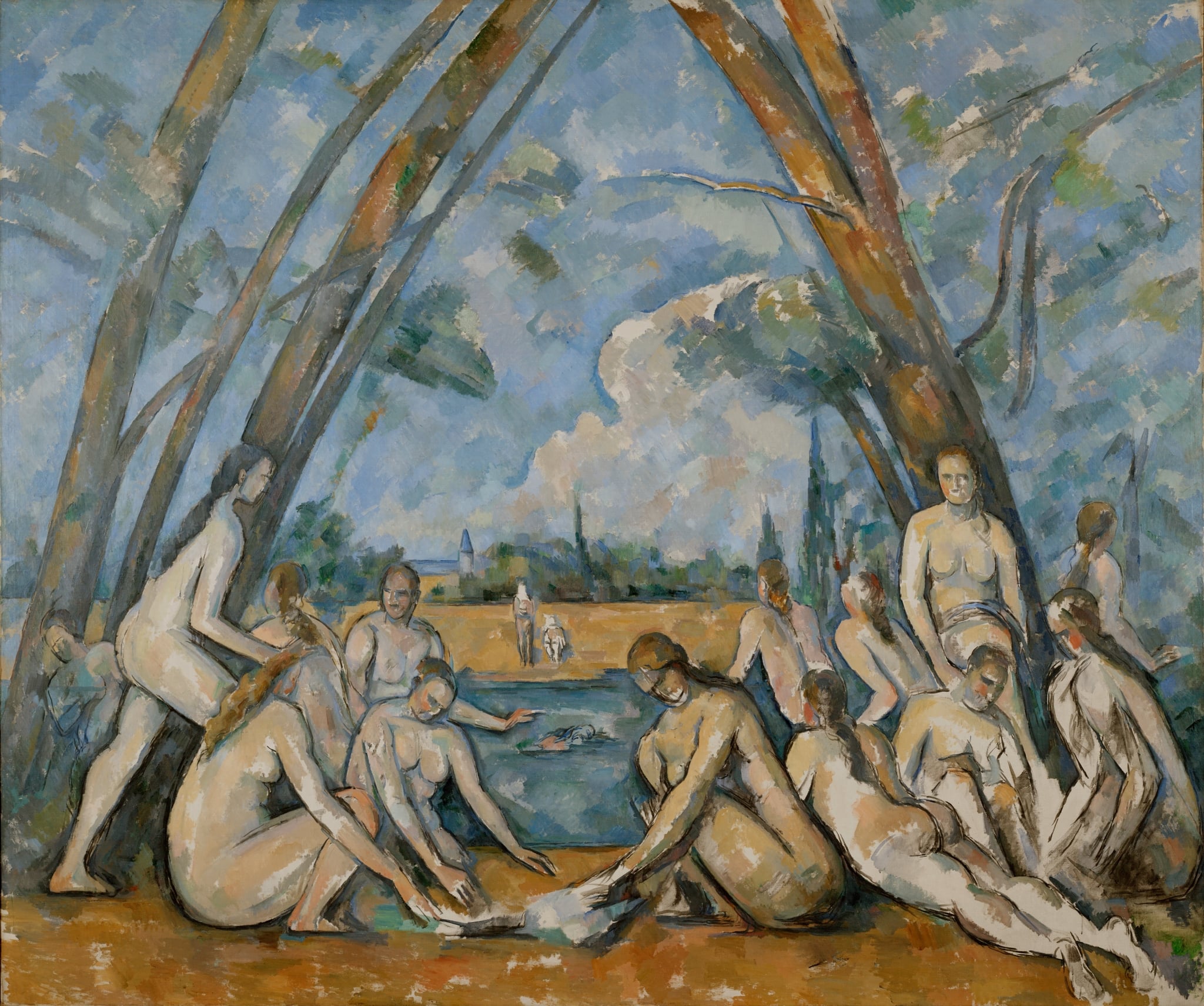
Bathers by Paul Cézanne: Geometry of the Modern Nude
Paul Cézanne
In Bathers, Paul Cézanne arranges a circle of generalized nudes beneath arching trees that meet like a <strong>natural vault</strong>, staging bathing as a timeless rite rather than a specific story. His <strong>constructive brushwork</strong> fuses bodies, water, and sky into one geometric order, balancing cool blues with warm ochres. The scene proposes a measured <strong>harmony between figure and landscape</strong>, a culmination of Cézanne’s search for enduring structure <sup>[1]</sup><sup>[2]</sup>.
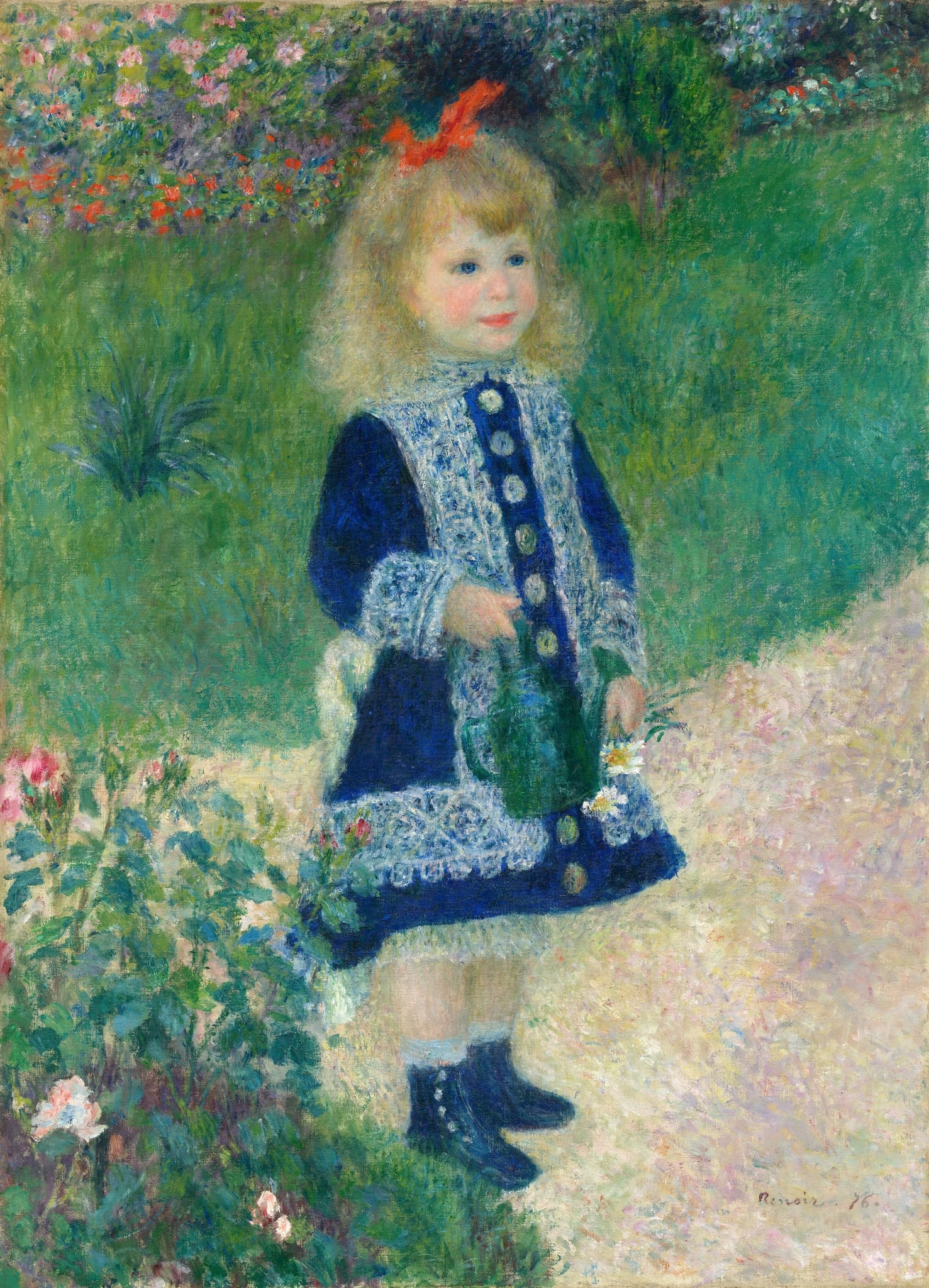
Girl with a Watering Can
Pierre-Auguste Renoir (1876)
Renoir’s 1876 Girl with a Watering Can fuses a crisply perceived child with a dissolving garden atmosphere, using <strong>prismatic color</strong> and <strong>controlled facial modeling</strong> to stage innocence within modern leisure <sup>[1]</sup>. The cobalt dress, red bow, and green can punctuate a haze of pinks and greens, making nurture and growth the scene’s quiet thesis.
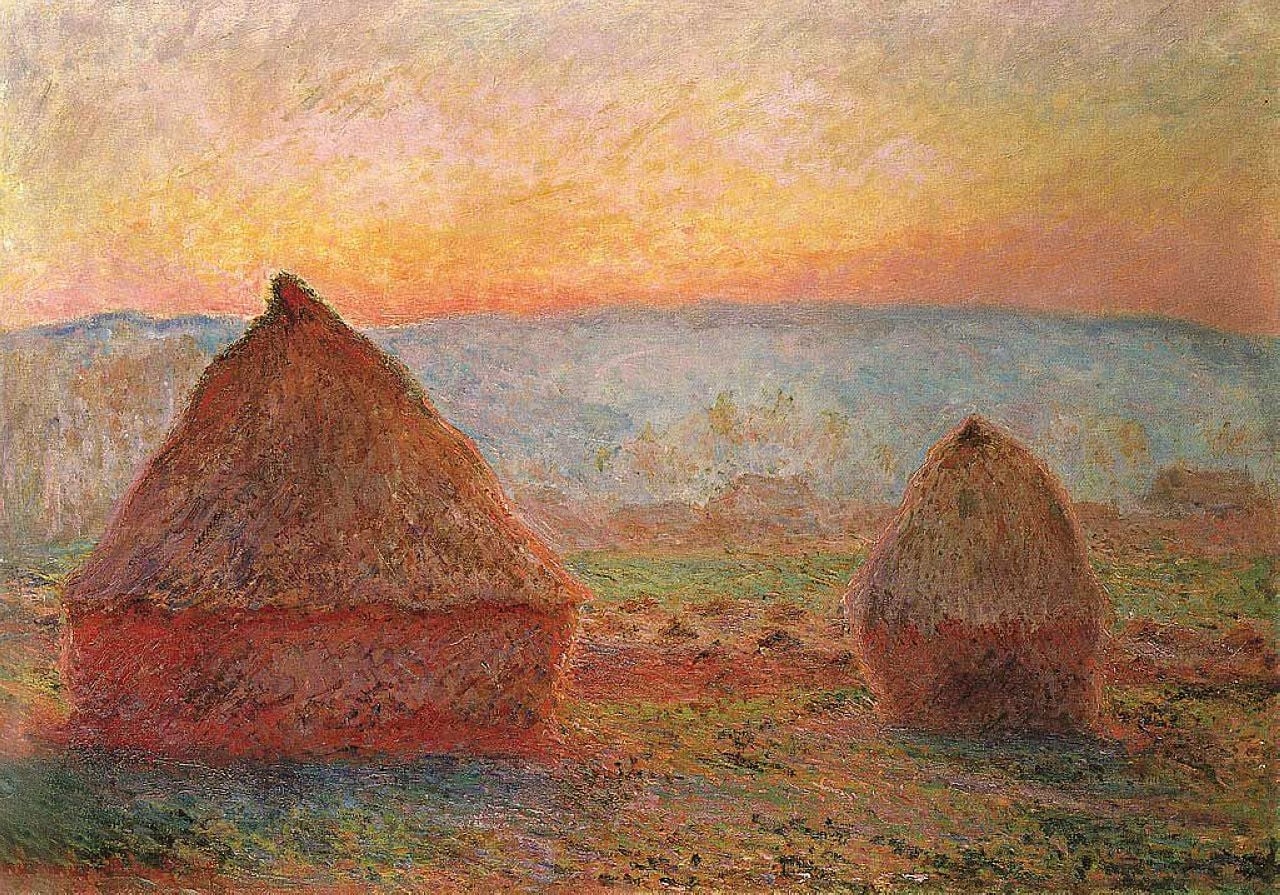
Haystack, Sunset
Claude Monet (1891)
Two conical stacks blaze against a cooling horizon, turning stored grain into a drama of <strong>light, time, and rural wealth</strong>. Monet’s broken strokes fuse warm oranges and cool violets so the stacks seem to glow from within, embodying the <strong>transience</strong> of a single sunset and the <strong>endurance</strong> of agrarian cycles <sup>[1]</sup><sup>[2]</sup><sup>[3]</sup>.
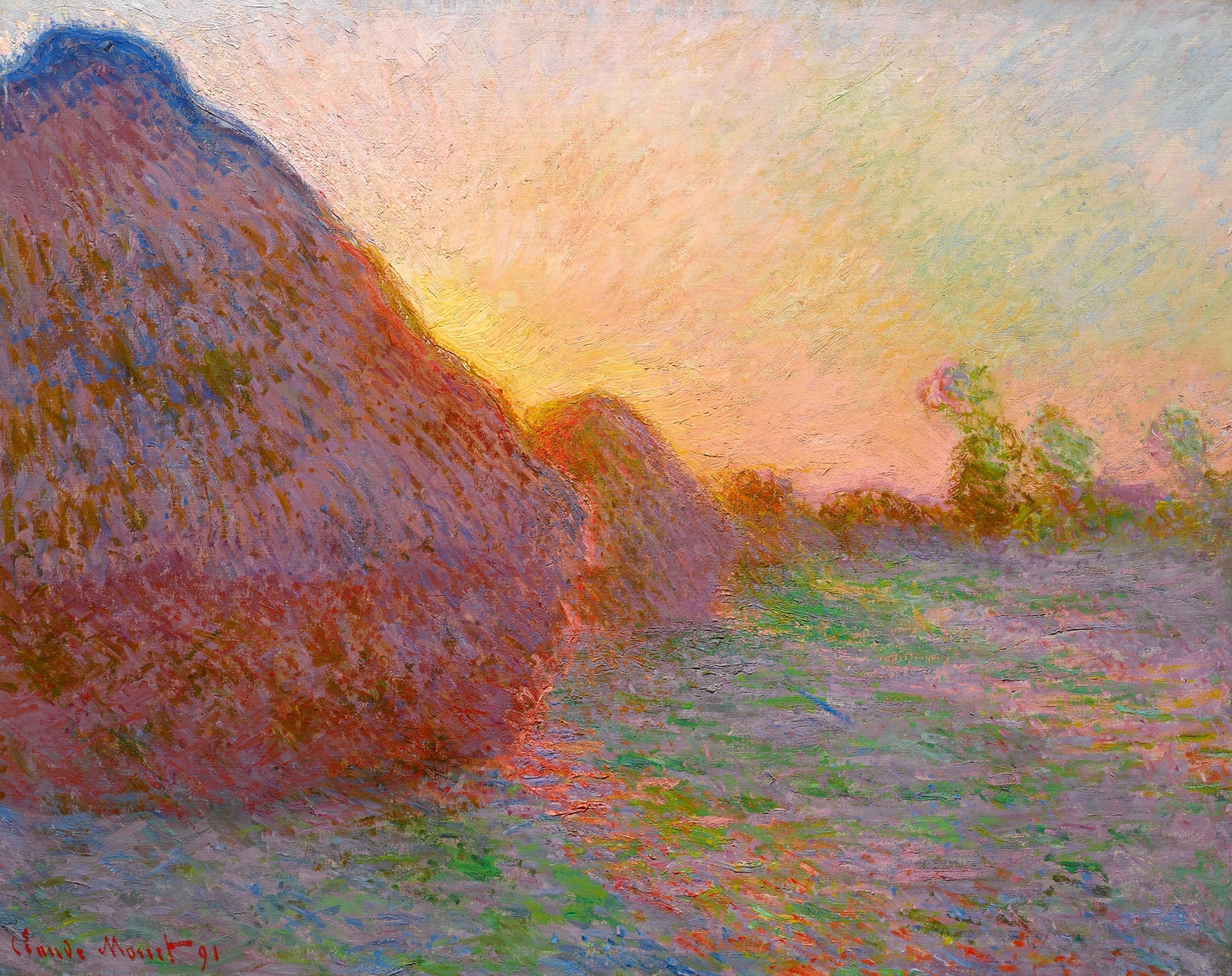
Haystacks Series by Claude Monet | Light, Time & Atmosphere
Claude Monet
Claude Monet’s <strong>Haystacks Series</strong> transforms a routine rural subject into an inquiry into <strong>light, time, and perception</strong>. In this sunset view, the stacks swell at the left while the sun burns through the gap, making the field shimmer with <strong>apricot, lilac, and blue</strong> vibrations.

Ice Floes
Claude Monet (1893)
Claude Monet’s Ice Floes turns a thawing Seine into a <strong>theater of transition</strong>: pale ice plates drift over mint‑green water beneath a <strong>high horizon</strong> and a <strong>russet clump of trees</strong> that warms the scene’s chill palette. With short, glancing strokes, Monet makes the floes <strong>shimmer between stillness and motion</strong>, converting a winter morning into a meditation on change and endurance.
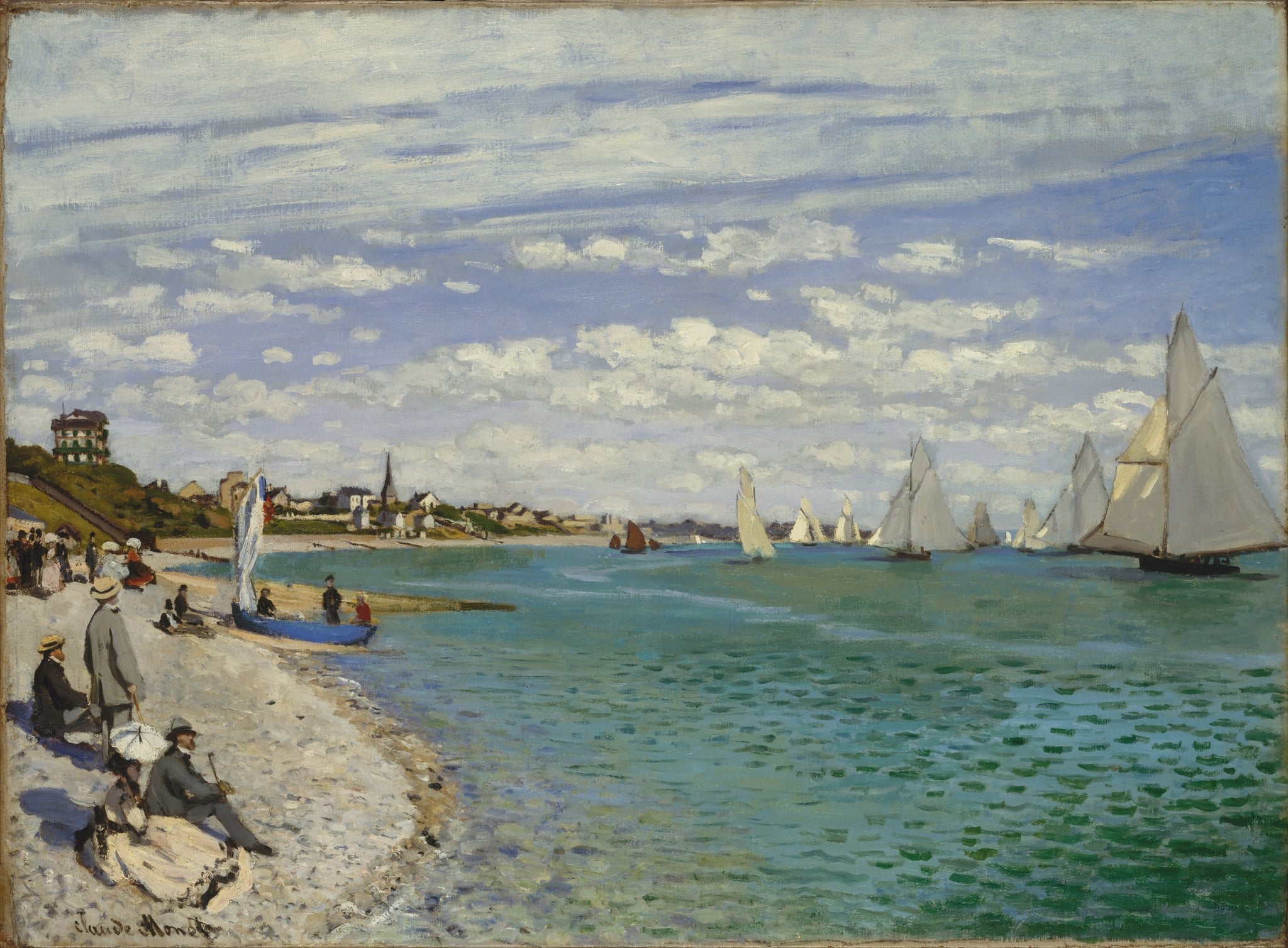
Regatta at Sainte-Adresse
Claude Monet (1867)
On a brilliant afternoon at the Normandy coast, a diagonal <strong>pebble beach</strong> funnels spectators with parasols toward a bay scattered with <strong>white-sailed yachts</strong>. Monet’s quick, broken strokes set <strong>wind, water, and light</strong> in synchrony, turning a local regatta into a modern scene of leisure held against the vastness of sea and sky <sup>[1]</sup><sup>[2]</sup>.
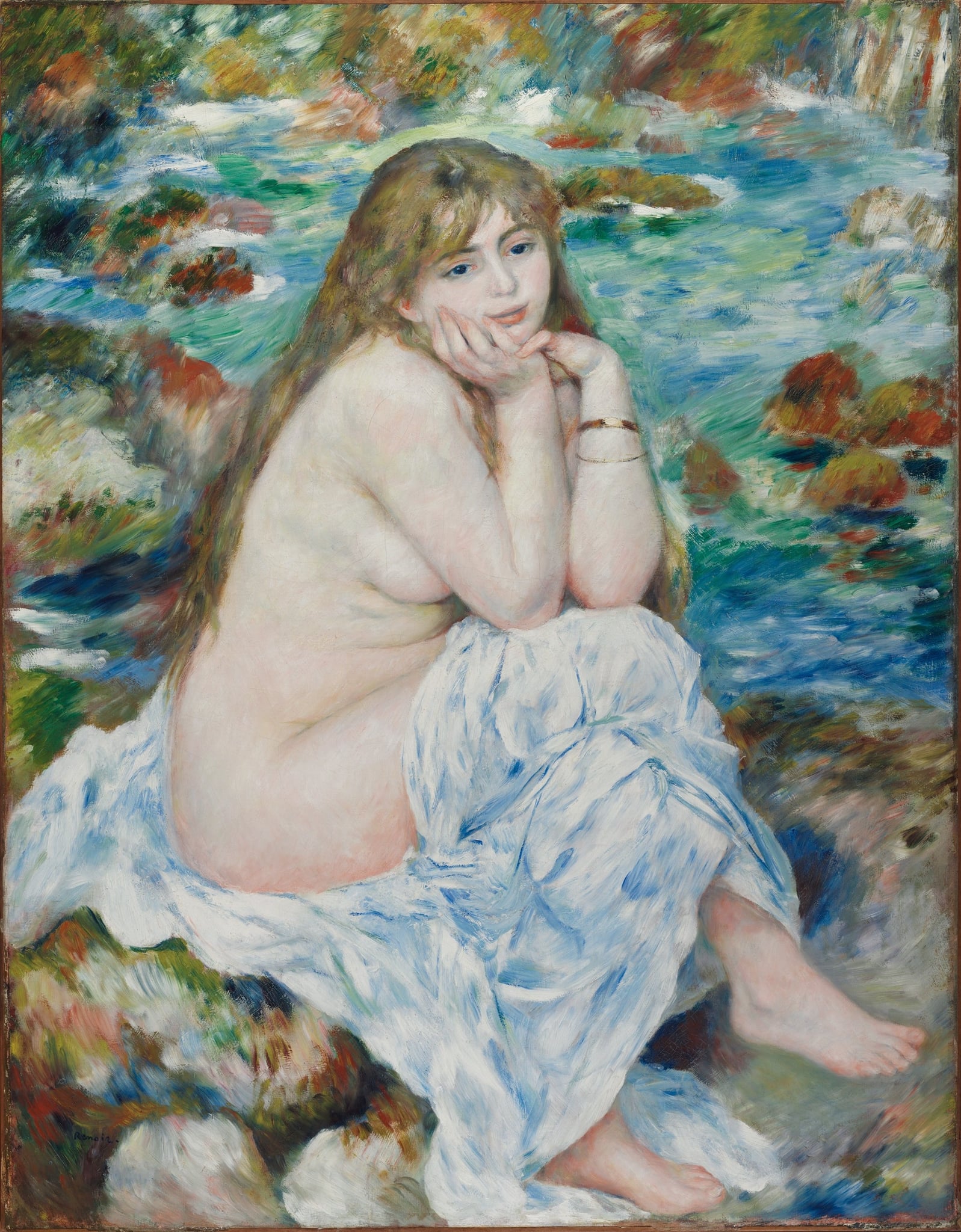
Seated Bather
Pierre-Auguste Renoir
Renoir’s Seated Bather stages a quiet pause between bathing and reverie, fusing the model’s pearly flesh with the flicker of stream and stone. The white drapery pooled around her hips and the soft, frontal gaze convert a simple toilette into a <strong>modern Arcadia</strong> where body and landscape dissolve into light. In this late-Impressionist idiom, Renoir refines the nude as a <strong>timeless ideal</strong> felt through color and touch <sup>[1]</sup><sup>[2]</sup>.

Still Life with Flowers
Pierre-Auguste Renoir (1885)
Pierre-Auguste Renoir’s Still Life with Flowers (1885) sets a jubilant bouquet in a pale, crackled vase against softly dissolving wallpaper and a wicker screen. With quick, clear strokes and a centered, oval mass, the painting unites <strong>Impressionist color</strong> with a <strong>classical, post-Italy structure</strong> <sup>[1]</sup><sup>[2]</sup><sup>[4]</sup>. The slight droop of blossoms turns the domestic scene into a gentle <strong>vanitas</strong>—a savoring of beauty before it fades <sup>[5]</sup>.
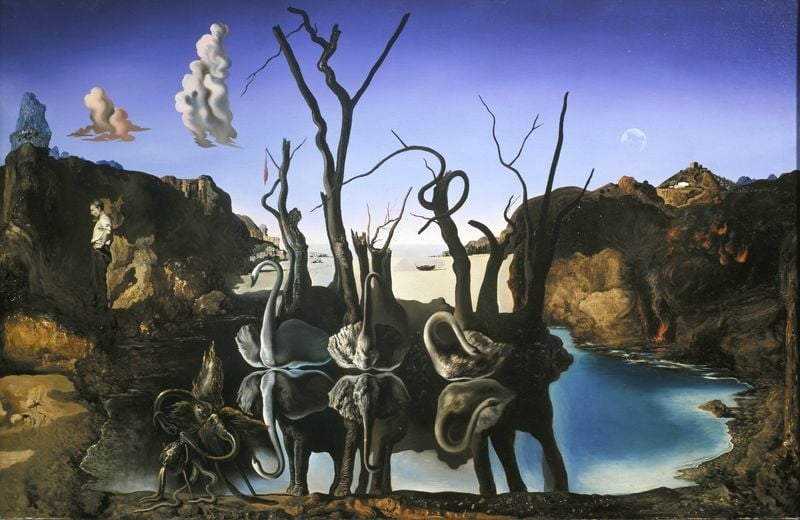
Swans Reflecting Elephants
Salvador Dali (1937)
Swans Reflecting Elephants stages a calm Catalan lagoon where three swans and a thicket of bare trees flip into monumental <strong>elephants</strong> in the mirror of water. Salvador Dali crystallizes his <strong>paranoiac-critical</strong> method: a meticulously painted illusion that makes perception generate its own doubles <sup>[1]</sup><sup>[2]</sup>. The work locks grace to gravity, surface to depth, turning the lake into a theater of <strong>metamorphosis</strong>.
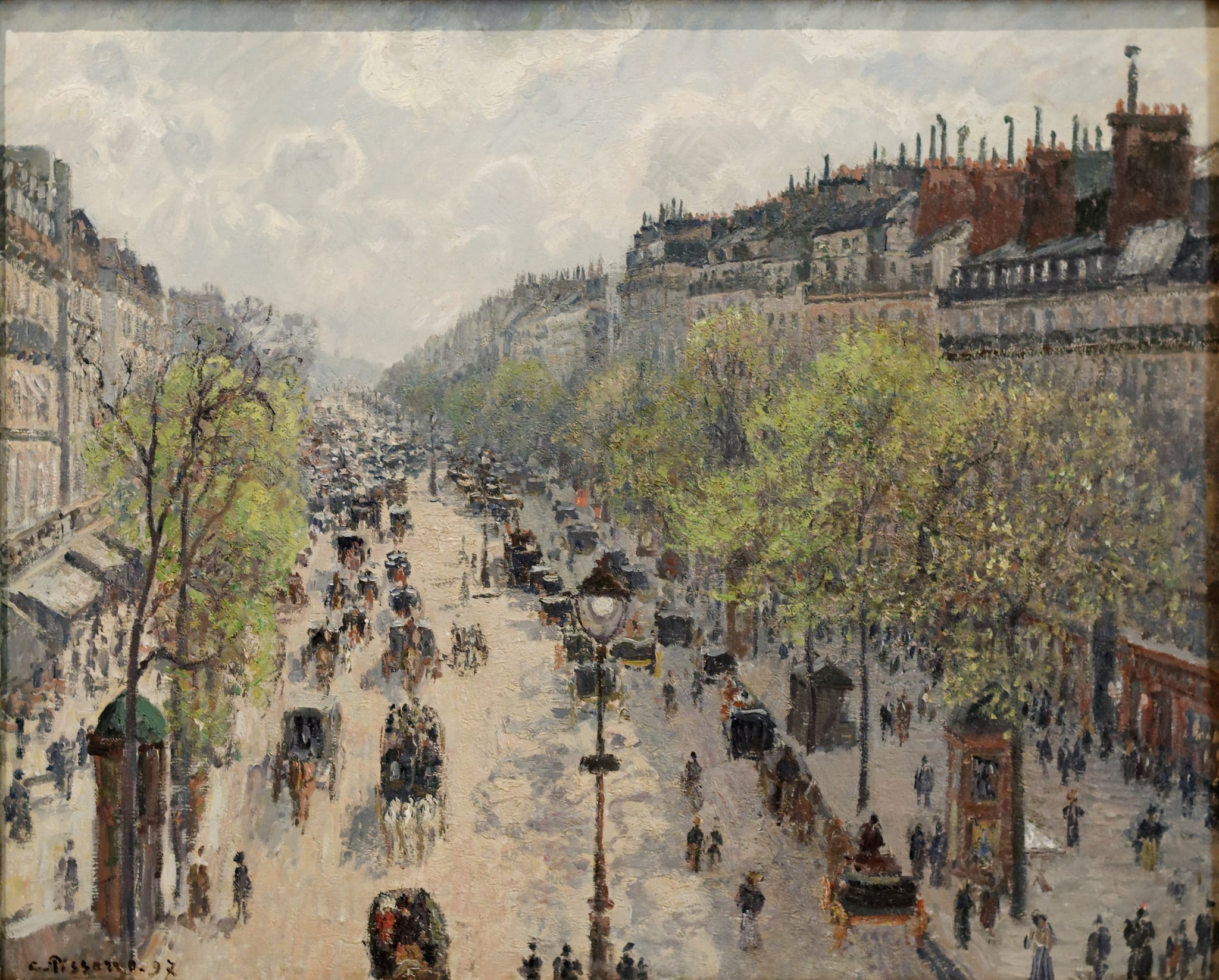
The Boulevard Montmartre on a Spring Morning
Camille Pissarro (1897)
From a high hotel window, Camille Pissarro turns Paris’s grands boulevards into a river of light and motion. In The Boulevard Montmartre on a Spring Morning, pale roadway, <strong>tender greens</strong>, and <strong>flickering brushwork</strong> fuse crowds, carriages, and iron streetlamps into a single urban current <sup>[1]</sup><sup>[2]</sup>. The scene demonstrates Impressionism’s commitment to time, weather, and modern life, distilled through a fixed vantage across a serial project <sup>[1]</sup><sup>[3]</sup>.
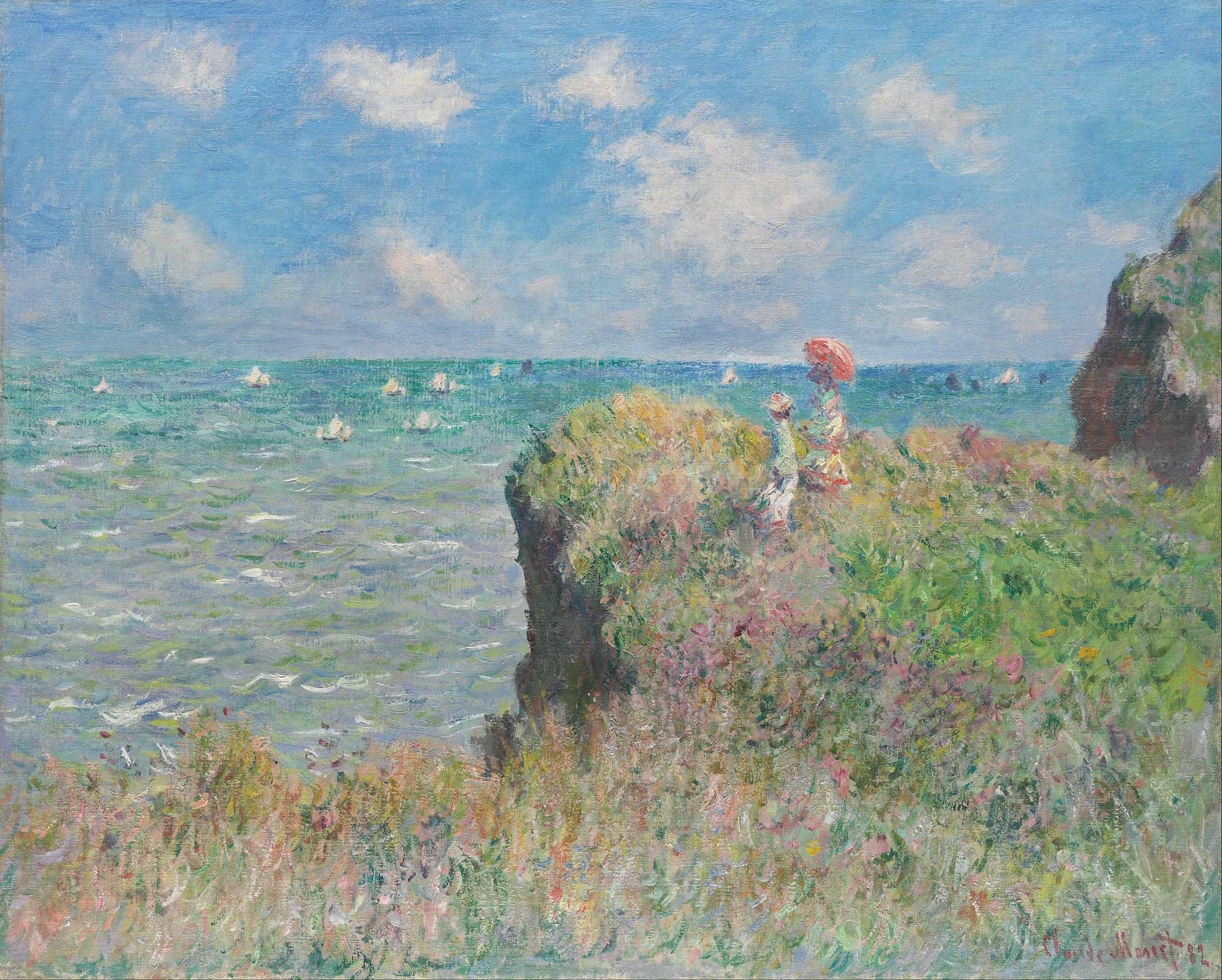
The Cliff Walk at Pourville
Claude Monet (1882)
Claude Monet’s The Cliff Walk at Pourville renders wind, light, and sea as interlocking forces through <strong>shimmering, broken brushwork</strong>. Two small walkers—one beneath a pink parasol—stand near the <strong>precipitous cliff edge</strong>, their presence measuring the vastness of turquoise water and bright sky dotted with white sails. The scene fuses leisure and the <strong>modern sublime</strong>, making perception itself the subject <sup>[1]</sup><sup>[2]</sup>.
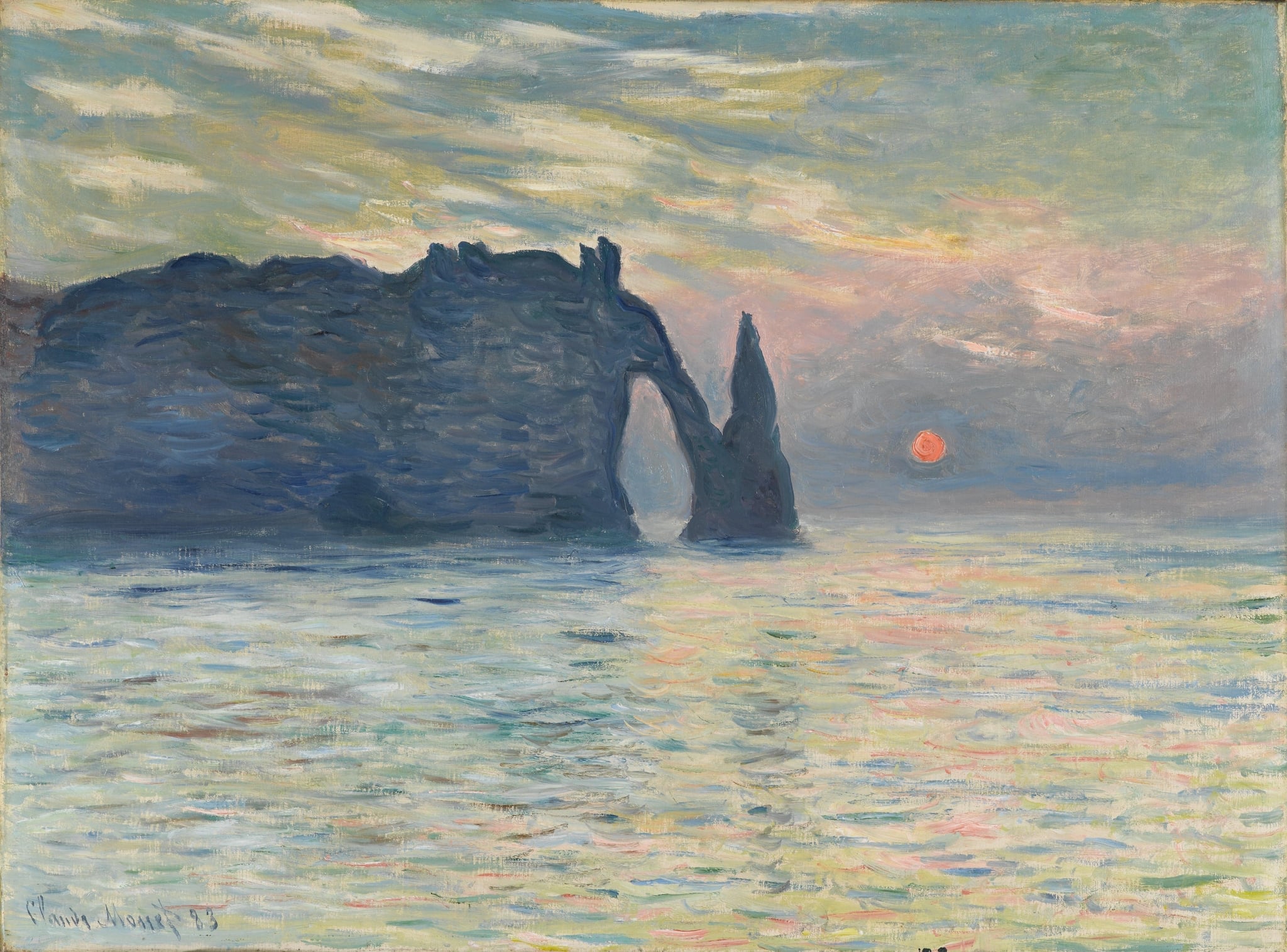
The Cliff, Etretat
Claude Monet (1882–1883)
<strong>The Cliff, Etretat</strong> stages a confrontation between <strong>permanence and flux</strong>: the dark mass of the arch and needle holds like a monument while ripples of coral, green, and blue light skate across the water. The low <strong>solar disk</strong> fixes the instant, and Monet’s fractured strokes make the sea and sky feel like time itself turning toward dusk. The arch reads as a <strong>threshold</strong>—an opening to the unknown that organizes vision and meaning <sup>[1]</sup><sup>[2]</sup>.
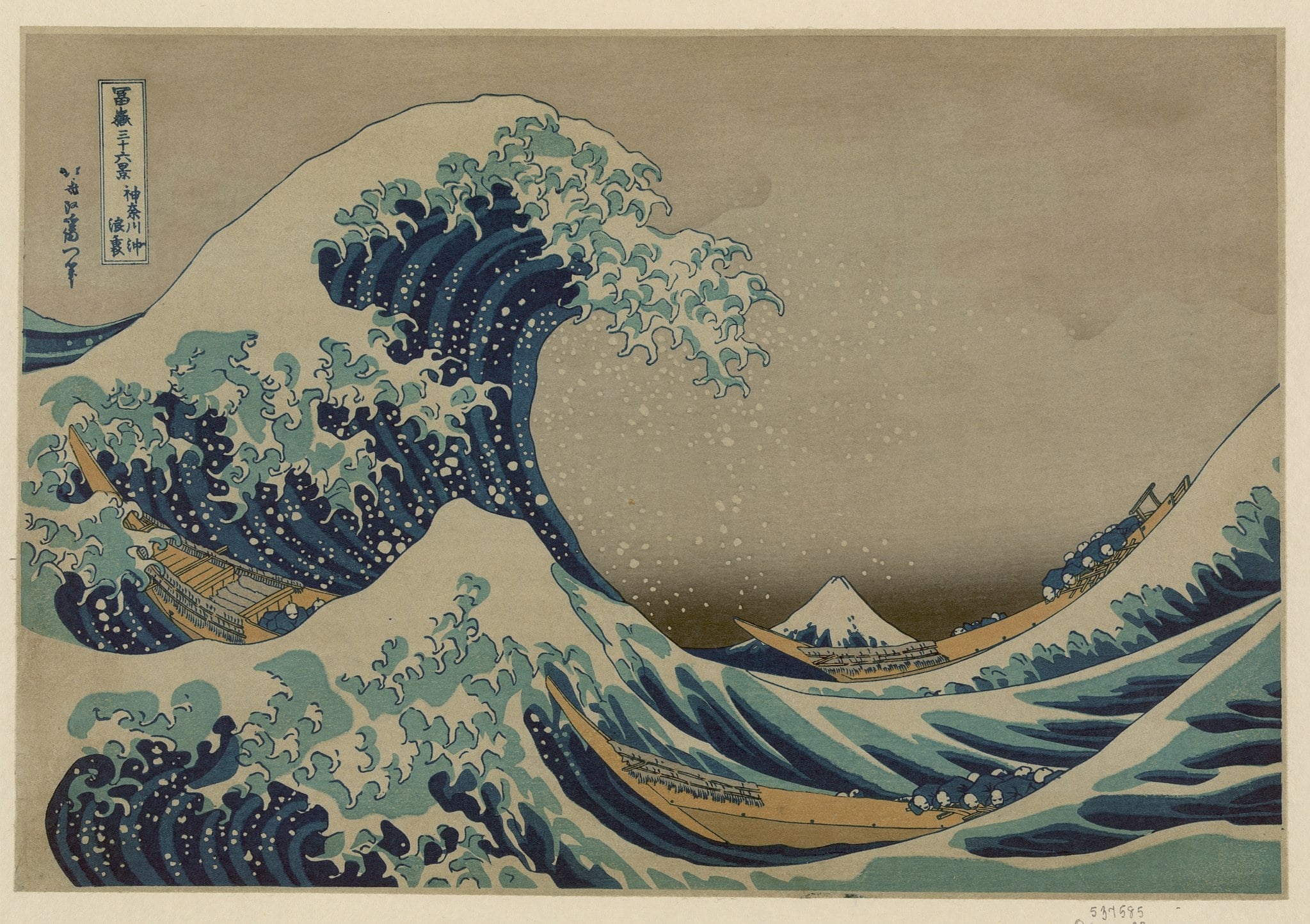
The Great Wave off Kanagawa
Hokusai (ca. 1830–32)
The Great Wave off Kanagawa distills a universal drama: fragile laboring boats face a <strong>towering breaker</strong> while <strong>Mount Fuji</strong> sits small yet immovable. Hokusai wields <strong>Prussian blue</strong> to sculpt depth and cold inevitability, fusing ukiyo‑e elegance with Western perspective to stage nature’s power against human resolve <sup>[1]</sup><sup>[3]</sup>.
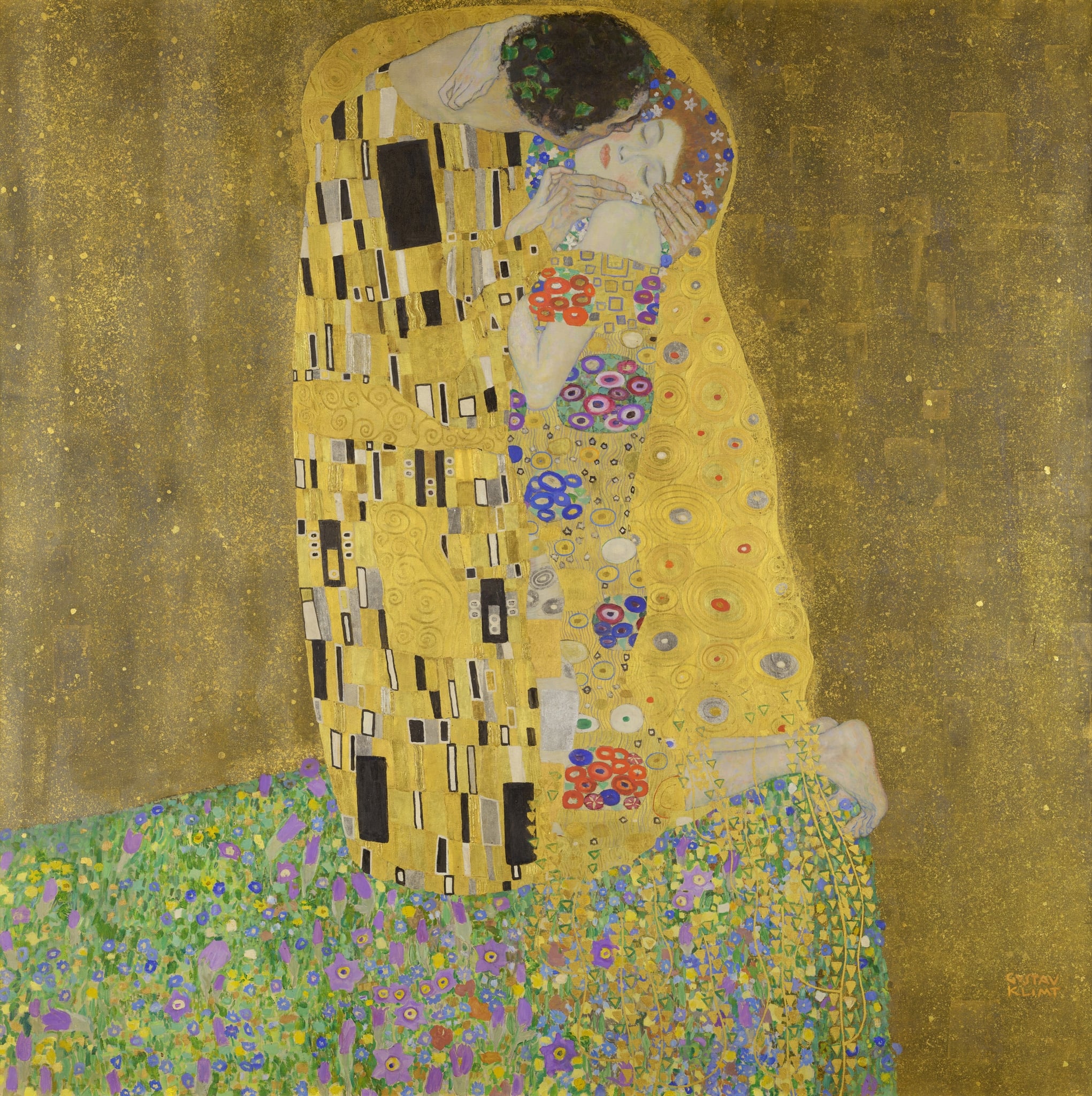
The Kiss
Gustav Klimt (1908 (completed 1909))
The Kiss stages human love as a <strong>sacred union</strong>, fusing two figures into a single, gold-clad form against a timeless field. Klimt opposes <strong>masculine geometry</strong> (black-and-white rectangles) to <strong>feminine organic rhythm</strong> (spirals, circles, flowers), then resolves them in radiant harmony <sup>[1]</sup><sup>[2]</sup>.
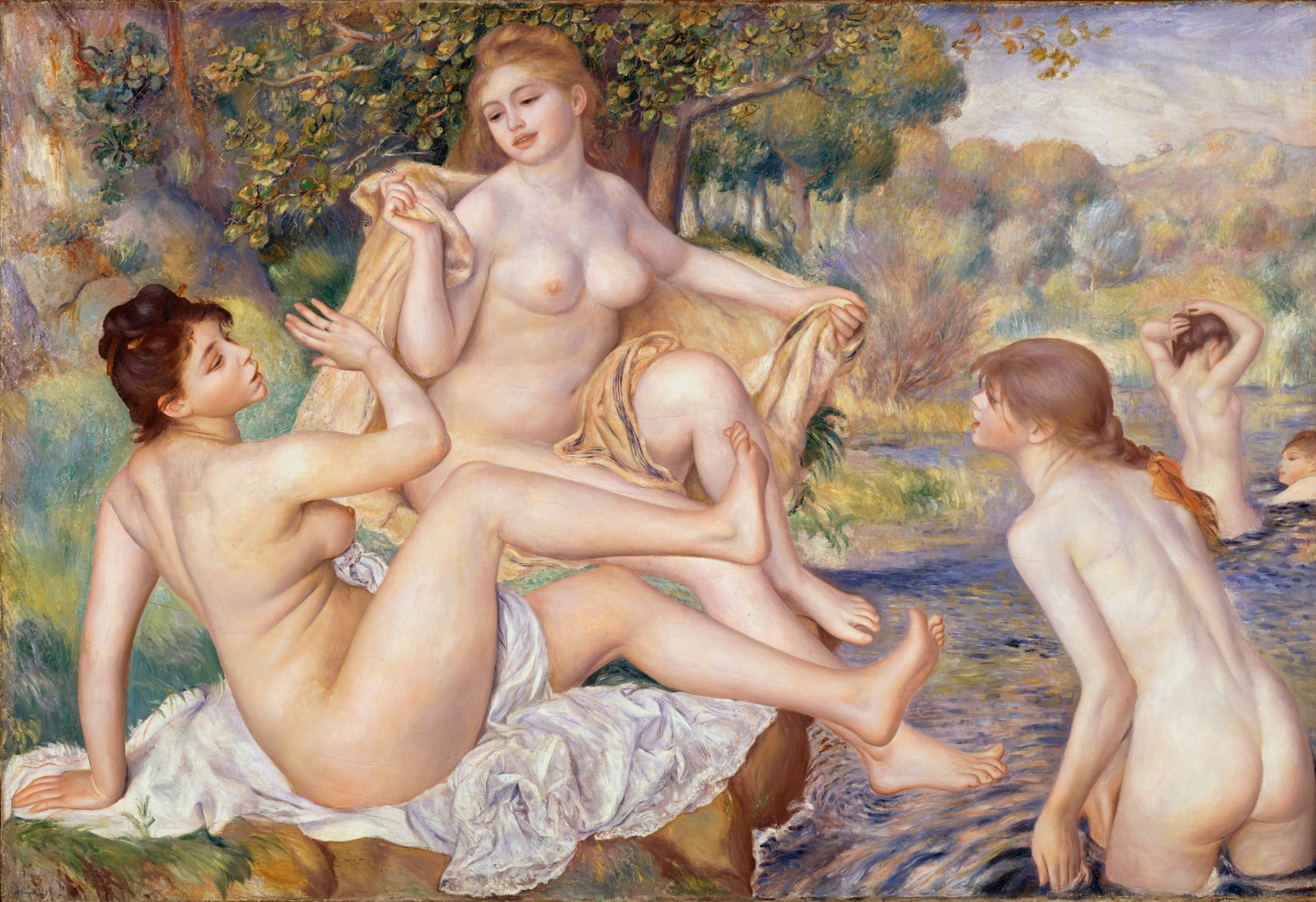
The Large Bathers
Pierre-Auguste Renoir (1884–1887)
Pierre-Auguste Renoir’s The Large Bathers unites modern bodies with a pastoral grove to stage an <strong>Arcadian ideal</strong>. Three monumental nudes form interlocking curves and triangles while two background figures splash and groom, fusing <strong>sensual warmth</strong> with <strong>classical order</strong> <sup>[1]</sup><sup>[2]</sup>.
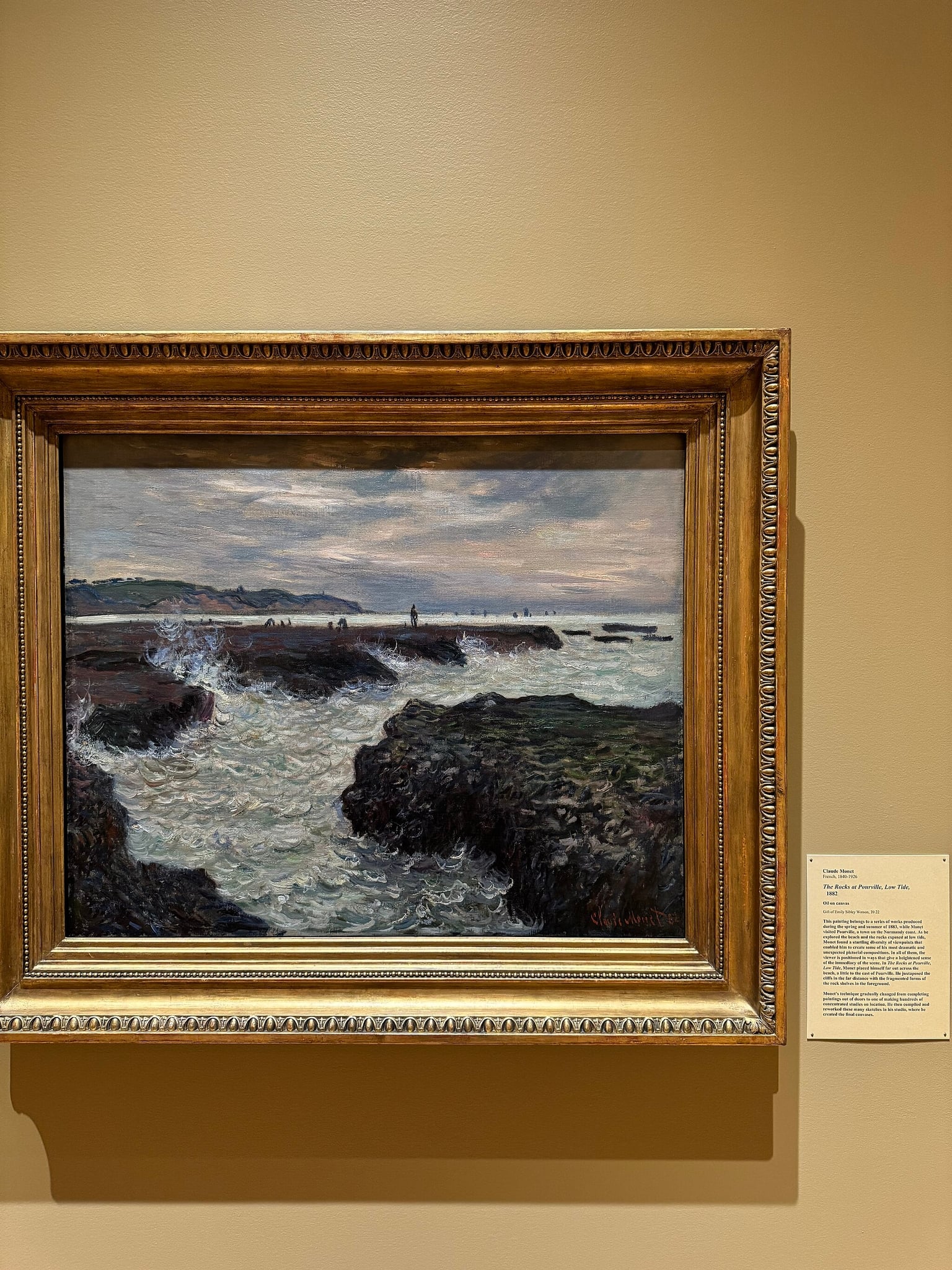
The Rocks at Pourville, Low Tide
Claude Monet (1882)
Claude Monet’s The Rocks at Pourville, Low Tide renders the Normandy foreshore as a meeting of <strong>endurance and flux</strong>—dark, seaweed-laden rocks cleave through <strong>foaming, mobile surf</strong> beneath a cool, <strong>pewter sky</strong>. Tiny silhouettes along the horizon reduce human presence to scale and rhythm, centering nature’s <strong>temporal pulse</strong>.
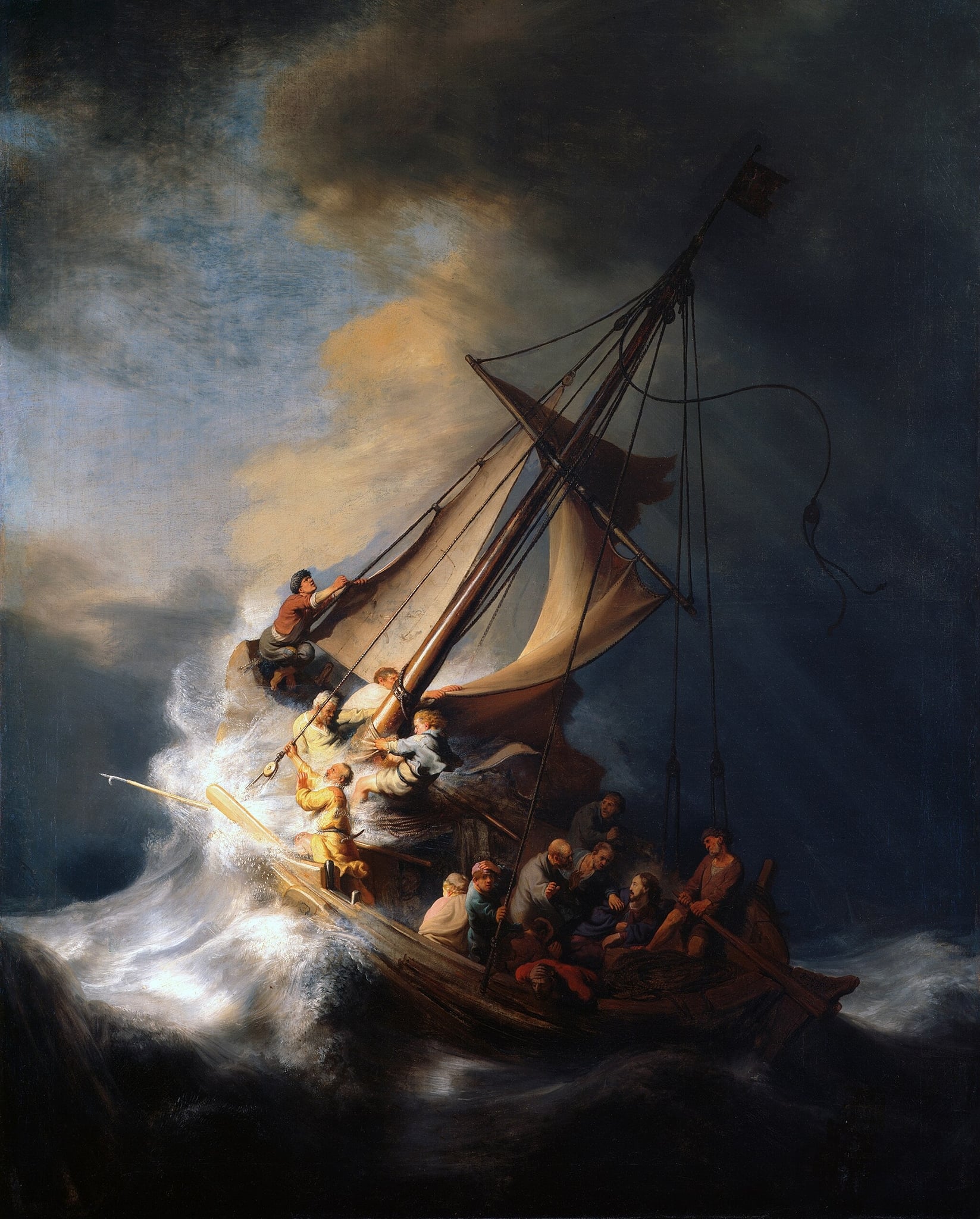
The Storm on the Sea of Galilee
Rembrandt van Rijn (1633)
Rembrandt van Rijn’s The Storm on the Sea of Galilee stages a clash of <strong>human panic</strong> and <strong>divine composure</strong> at the instant before the miracle. A torn mainsail whips across a steeply tilted boat as terrified disciples scramble, while a <strong>serenely lit Christ</strong> anchors a pocket of calm—an image of faith holding within chaos <sup>[1]</sup><sup>[3]</sup>. It is Rembrandt’s only painted seascape, intensifying its dramatic singularity in his oeuvre <sup>[2]</sup>.
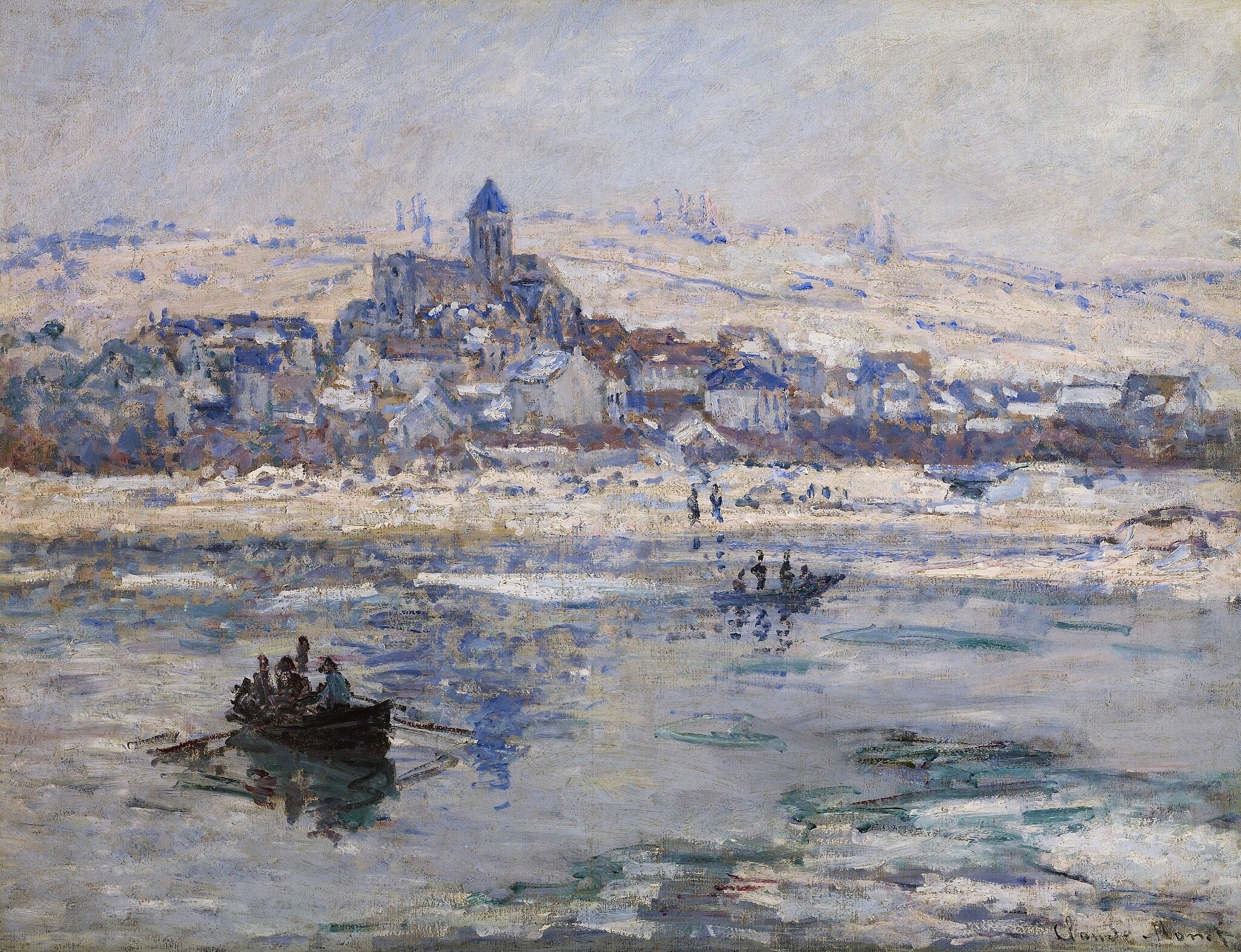
Vétheuil in Winter
Claude Monet (1878–79)
Claude Monet’s Vétheuil in Winter renders a riverside village in a <strong>silvery, frost-laden light</strong>, where the Seine carries <strong>broken ice</strong> past clustered houses and the tall church tower. The scene’s <strong>granular blue-green palette</strong> and softened edges make the town appear to crystallize out of air and water, while small boats and figures signal quiet persistence.
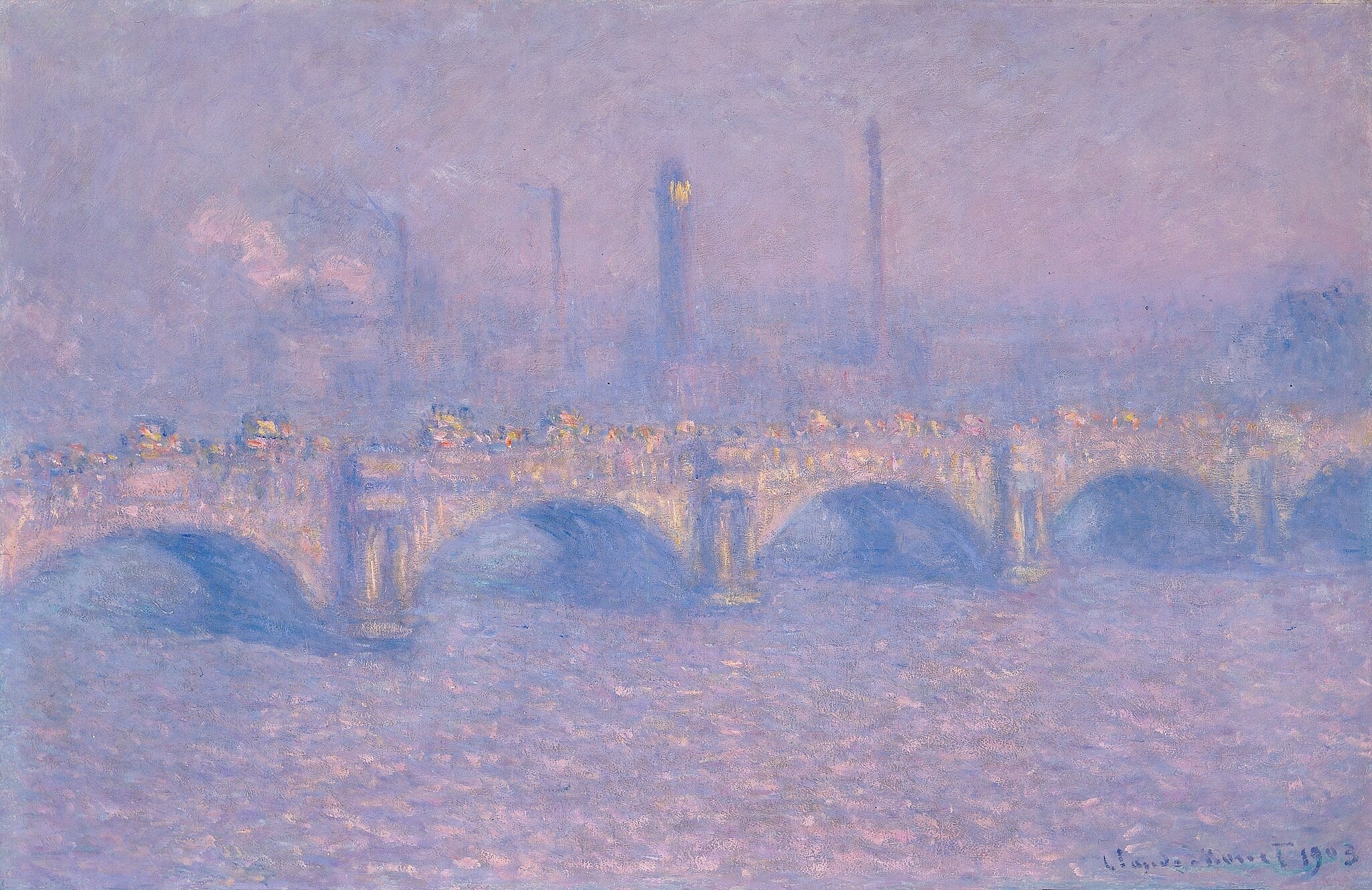
Waterloo Bridge, Veiled Sun
Claude Monet (1903)
Claude Monet’s Waterloo Bridge, Veiled Sun renders London as a field of vibrating color where <strong>atmosphere</strong> overtakes architecture. The bridge’s cool violet arches and the tiny <strong>veiled sun</strong>—a gold pin of light above the parapet—stage a dialogue between urban <strong>modernity</strong> and shifting light.
Related Themes
Related Symbolism Categories
Within the history of Western painting, nature has rarely functioned as a neutral backdrop. From Arcadian landscapes to Symbolist thresholds and modernist investigations of perception, specific natural motifs accrue semiotic weight, becoming legible codes for time, social order, erotic energy, and psychic states. The symbols gathered under this category—trees in various seasonal guises, flowing water, floral meadows, grainstacks, rock ledges, and atmospheric effects—demonstrate how artists mobilize recurring natural forms as a flexible iconographic language. Rather than offering a fixed allegorical lexicon, these works show nature’s imagery being continually re-inscribed: pastoral emblems of harmony, signs of productive labor, and structures of desolation are each retooled to address industrial modernity, psychological depth, or optical inquiry.
At one pole of this symbolic spectrum lies the Arcadian grove and its close relative, the natural vault of trees. In Paul Cézanne’s Bathers, arching trunks and foliage converge into a vaulted canopy that reads like an open-air nave. Iconographically, this translation of trees into architecture casts nature as a quasi-sacred enclosure: the grove becomes a “cathedral” in which bathing is reimagined as a rite rather than anecdotal bathing. Semiotic force accrues through structure. The two flanking trunks operate as “flying buttresses,” while the bodies below form piers in a unified load-bearing system. The natural vault of trees thus signifies more than pleasant shade; it encodes an ideal of order where human nudity, often a site of vulnerability or sensuality, is stabilized within a timeless, classical continuum. The grove here is not escapist fantasy but a proposition: enduring structure—both formal and ethical—may still be found in nature amidst the uncertainties of modernity.
This Arcadian coding of nature is interlaced with water imagery that similarly balances sensual immediacy and symbolic depth. In Renoir’s Seated Bather, the flowing stream and flowing water/stream at the model’s feet signify renewal, sensuality, and passage between states. Renoir’s interwoven strokes of blue-green in water and stone, and rosy warmth in skin, dissolve hard contours so that the body seems to participate in the stream’s motion. Semiologically, the water functions as a liminal medium: it marks the transition from clothed to unclothed, from mundane toilette to a “modern Arcadia.” Iconographically, it invokes classical bathing scenes in which running water connotes purification and communal ritual. Here, however, the rite is individualized and introspective; the model’s inward gaze and resting pose redirect the baptismal symbolism toward a private, psychological threshold.
A related yet more explicitly social Arcadia appears in Seurat’s Bathers at Asnières. While the description foregrounds class and industrial background, the riverside setting implicitly draws on pastoral conventions: water as a plane of refreshment, grassy banks as quasi-Arcadian ground. The Seine operates as a modernized flowing water symbol—no longer a remote mythic stream but an urban river whose boats and bridges articulate class contrast and mobility. The bathers’ sculptural stillness counterpoints the river’s implied motion, reinforcing a semiotic opposition between human repose and the ceaseless flow of industrial time. River and grove—so central to pastoral tradition—are thus recoded as sites where working-class leisure is briefly monumentalized against the relentless movement of capital and machinery.
Floral and arboreal symbols articulate another axis of meaning, oscillating between fecundity and transience. Renoir’s Girl with a Watering Can stages a child within a dissolving garden of border shrubs and scattered daisies. Here the daisies’ conventional association with innocence and simplicity is corroborated by their placement in the child’s hand, visually and conceptually aligned with her cobalt dress and the green watering can. Nature’s fertility is gently domesticated: the blooming shrub and dotted lawn become a cultivated microcosm in which nurture (the watering can) and growth (garden and child) are mutually reflective. The garden’s flickering, almost immaterial brushwork contrasts with the more firmly modeled face, semiotically privileging human subjectivity while suggesting that innocence persists only within, and because of, a carefully tended environment.
Renoir’s Still Life with Flowers redirects this floral symbolism inward, compressing the garden into a bouquet whose crown imperials crest the arrangement. These regal fritillaria signify cultivated status and showy glory; yet their slight droop, and the crackled stability of the vase, inflect the scene with vanitas overtones. Iconographically, the bouquet rehearses a long European tradition where cut flowers stand for mortality and the vanity of worldly display. Renoir softens this into what might be termed a domestic vanitas: earthly abundance and aesthetic pleasure fill the pictorial field, but the flowers’ imminent decay haunts the composition. The floral symbol thus operates at a double register—affirming bourgeois refinement while quietly attesting to the brevity of such blooms, whether botanical or social.
Monet’s grainstacks introduce yet another dimension of nature-symbolism: rural labor and temporal endurance. In Haystack, Sunset and the Haystacks Series, the conical mounds are more precisely grainstacks—stored harvest, emblems of agrarian wealth, prudence, and fertility. Semiotic meaning is anchored in form: the stacks’ monumental cones read as provisional architecture erected by labor to withstand winter scarcity. Yet Monet’s chromatic treatment subjects these solid signs of stability to the volatility of light. In Haystack, Sunset, afterglow floods their flanks with complementary reds and violets; in the series canvas, the sun’s triangular blaze cuts between them, dissolving contours. The grainstacks thus become mediators between permanence and flux: iconographically rooted in rural sustenance, they are simultaneously instruments in an optical experiment where no color, shadow, or outline remains fixed. Nature here is both economic resource and perceptual event.
At the opposite end from Arcadian groves and fruitful stacks stand symbols of rupture and desolation. Monet’s Ice Floes turns a thawing Seine into an arena of broken ice floes and mint-green open water. The cracked plates signify change, fragility, and a pivot between stillness and motion: winter’s apparent solidity fractures, giving way to underlying continuity of life. Semiologically, the river’s surface becomes a grid that rivals traditional depth cues; the viewer’s eye oscillates between recession and planar pattern, mirroring the scene’s unstable equilibrium between freeze and thaw. The russet clump of trees against pervasive icy hues underscores the contest of temperatures that drives seasonal cycle. If the Arcadian stream promised cyclical renewal, this winter river dramatizes that cycle’s precariousness, exposing the violence implicit in seasonal transformation.
Surrealism radicalizes this threshold logic through the emblem of barren trees. In Dalí’s Swans Reflecting Elephants, a charred thicket of trunks along a calm lagoon functions as an armature for metamorphosis. Iconographically, leafless trees have long connoted death and desolation; Dalí retains that skeletal clarity but retools it as a structural hinge. In reflection, the pale swans’ bodies become elephant ears, their necks trunks, and the bare trees harden into monumental legs. The lifeless structures thus “flip identity,” generating new forms through the paranoiac-critical gaze. Nature’s dead husk—the barren copse—is paradoxically the engine of transformation. The symbol’s semiotic work is twofold: it marks a threshold between lifeless stillness and visionary activity, and it thematizes perception itself as a site where meanings bifurcate. The calm lake, like Monet’s river, mediates between states, but now the passage is not seasonal but psychic.
Across these works, certain recurrent structures emerge. Edges and thresholds—the riverbank in Seurat and Renoir, the winter melt in Monet, the reflective shore in Dalí—are persistently charged. Cliff edges and precipices, articulated elsewhere as emblems of the modern sublime, have their analogues here in the brink where floral meadow meets gold void in Klimt (cited in the general definition), or where grainstacks meet dissolving sky in Monet. In each case, natural motifs signal an encounter between the measurable and the immeasurable: between bodily pleasure and transcendence, stored labor and evanescent light, skeletal death and hallucinatory rebirth.
Historically, these symbols trace a shift from relatively stable allegorical systems to more open, process-oriented significations. Nineteenth-century painters like Renoir and early Monet still operate within recognizable iconographic frames—Arcadian groves, vanitas florals, harvest emblems—even as they inflect them with Impressionist concern for light and momentary sensation. Seurat and Cézanne subject pastoral codes to structural and social analysis, aligning natural motifs with new forms of order (geometric composition, classed leisure). By the time of Dalí, traditional tree and water symbols are no longer anchored in moral allegory or rural cycle; instead, they become catalysts for mental events, their “meaning” inseparable from the viewer’s own double vision. The nature symbolism gathered here thus charts not only changing attitudes toward landscape and environment, but also a broader transformation in art’s semiotic regimes—from fixed emblem to mutable structure, from coded message to open field of perceptual and psychic negotiation.