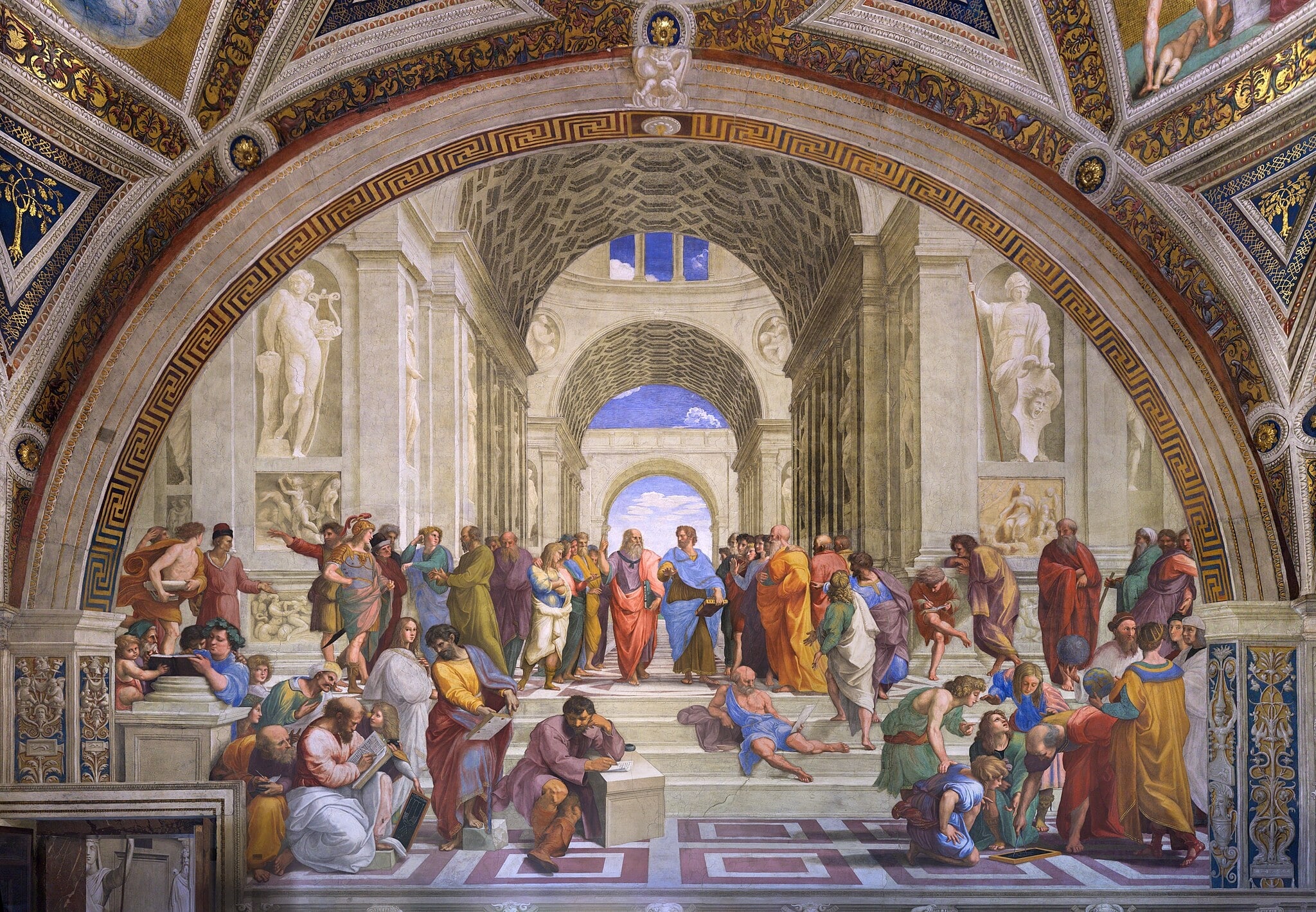
Aristotle’s level hand and the book Ethics Symbolism
In art, Aristotle’s level hand, often paired with the book Ethics, signals a philosophy oriented to the here-and-now: knowledge drawn from observation and ethics grounded in practical action. This iconography contrasts with gestures that point upward to transcendent forms, marking the Aristotelian side of a classical debate central to Western thought.
Aristotle’s level hand and the book Ethics in The School of Athens
In Raphael’s The School of Athens (1509–1511), Aristotle stands at the compositional center beside Plato; he extends a level hand while holding a volume identified with the Ethics. These attributes succinctly embody empirical reason and practical wisdom, counterbalancing Plato’s skyward gesture and establishing the fresco’s governing dialectic. Placed amid mathematicians and scientists beneath statues of Apollo and Athena/Minerva, Aristotle’s grounded sign becomes a keystone of the work’s Renaissance humanism, aligning philosophical inquiry with the observable world.