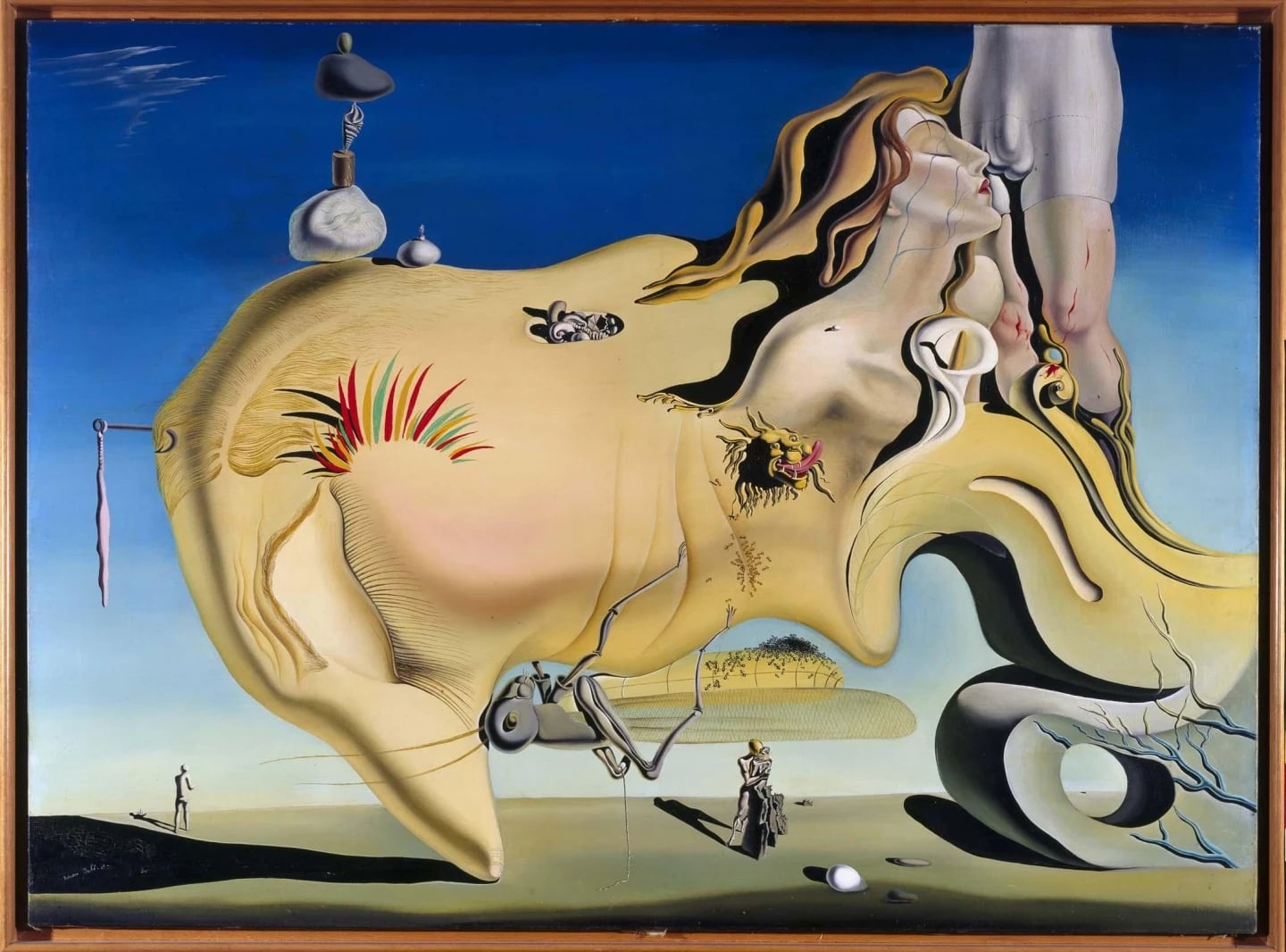
Bleeding knees (faceless male torso) Symbolism
Bleeding knees, especially on an anonymized or faceless body, mark the point where desire becomes injury. In Surrealist art, the body frequently carries psychic conflict; a wounded joint can function as the site where eros meets decay, as Salvador Dalí makes clear in The Great Masturbator (1929). The symbol condenses arousal with abasement and pain.
Bleeding knees (faceless male torso) in The Great Masturbator
In The Great Masturbator (1929), Salvador Dalí stages a bleeding knee among ants, a gaping grasshopper, a lion’s tongue, crutches, stones, and an egg, fusing bodily harm with erotic charge. Within this precisely arranged confession, the bleeding knee operates as a literal wound inside a field of desire and disgust, helping script the painting’s declaration that eros and decay are inseparable. Anchored by a faceless, biomorphic head, the image turns autobiography into a map of compulsion; the wounded knee functions as a hinge between arousal and injury in that terrain.