Cliff edge/precipice Symbolism
In art, the cliff edge or precipice marks a decisive threshold between safety and exposure, a site where human presence confronts vast natural forces. Long associated with the sublime—from Romantic precedents to modern explorations—it compresses risk, scale, and heightened perception into a single, vertiginous boundary.
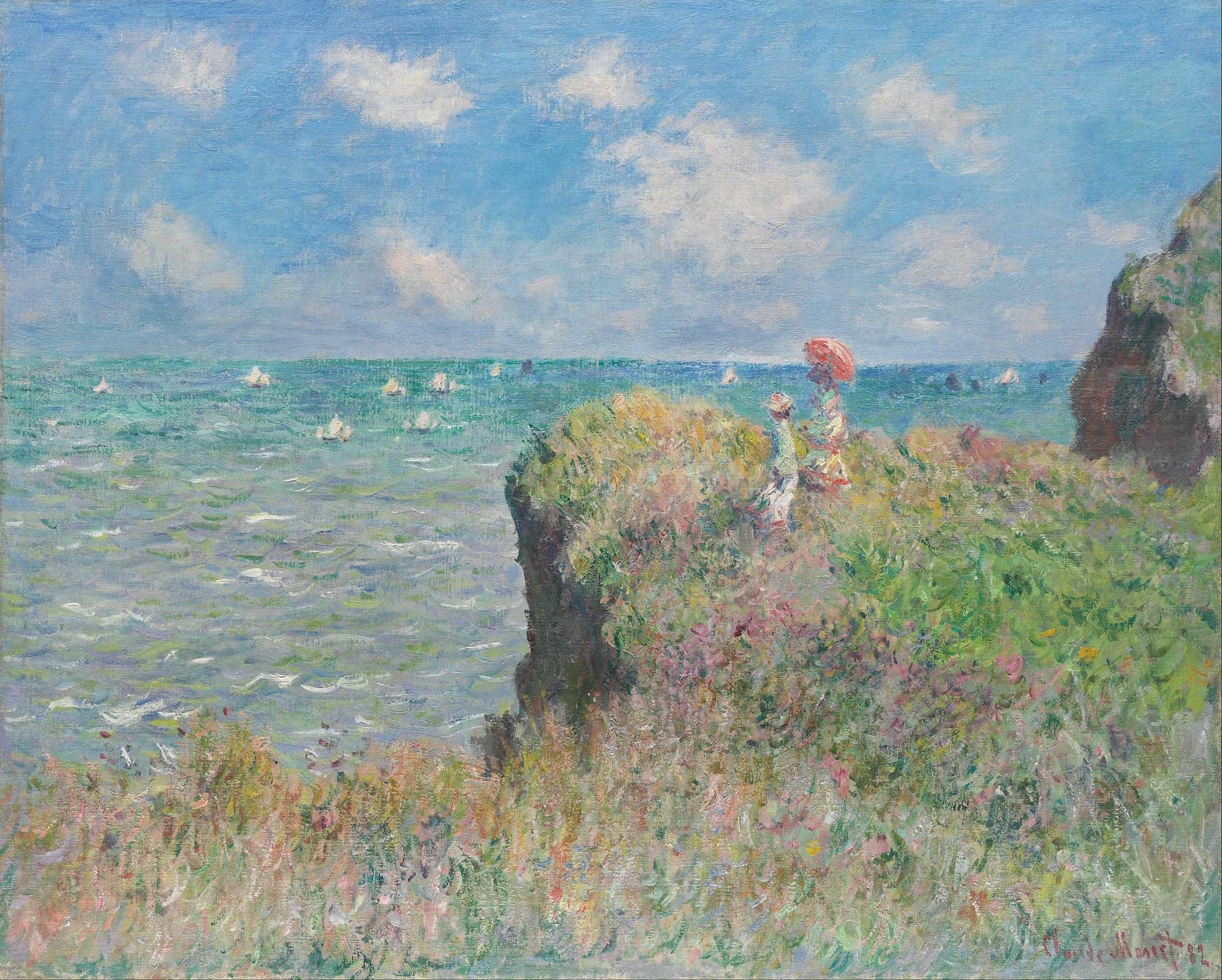
Cliff edge/precipice in The Cliff Walk at Pourville
In The Cliff Walk at Pourville (1882), Claude Monet makes the precipice a spatial and perceptual hinge. Two small walkers—one shaded by a pink parasol—stand near the brink; their reduced scale measures the expanse of turquoise water and a bright sky dotted with white sails. Here the edge is both vantage and limit, fusing seaside leisure with the modern sublime. Monet’s shimmering, broken brushwork lets wind, light, and sea act as interlocking forces, so the threshold at the cliff’s rim becomes a catalyst for seeing itself.