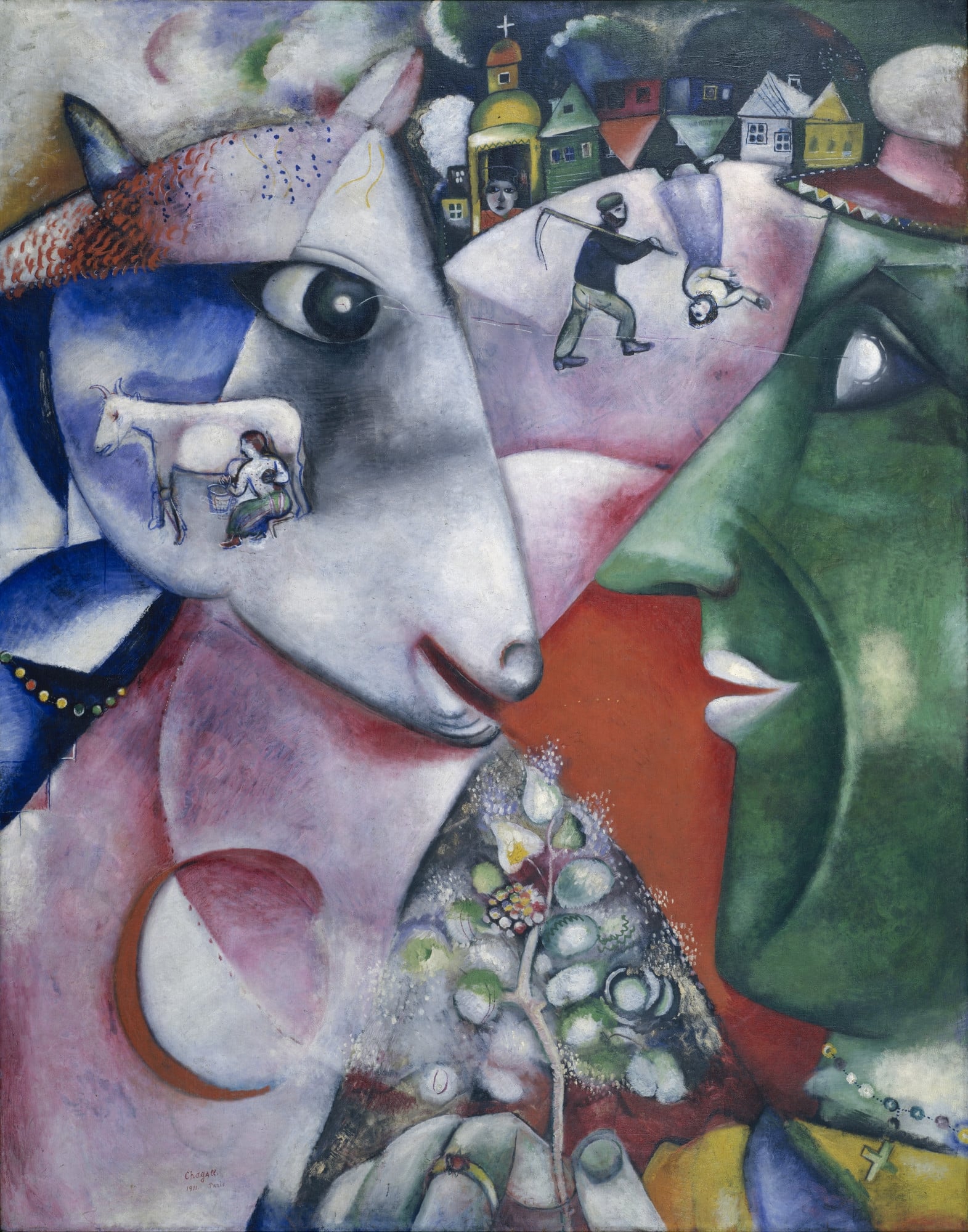
Fruit-bearing sprig (tree-of-life) Symbolism
A fruit-bearing sprig—often treated as a compact tree-of-life—signals renewal, growth, and the cyclical return of the seasons. In art it condenses ideas of vitality and continuity: life persisting even when forms or narratives are fractured.
Fruit-bearing sprig (tree-of-life) in I and the Village
In Marc Chagall’s I and the Village (1911), a green-faced villager grasps a leafy sprig that reads as a miniature tree-of-life. Set amid the painting’s prismatic color and floating figures, the sprig punctuates the eye-to-eye meeting of human and animal and gathers the work’s themes of rural labor, faith, and imagination into a living cycle.
The tender branch asserts seasonal renewal and ongoing growth, a counterpoint to the composition’s fractured geometry. Within Chagall’s dream-logic tableau, the sprig stands as a concise emblem of continuity—life carried forward through memory, ritual, and community despite rupture.