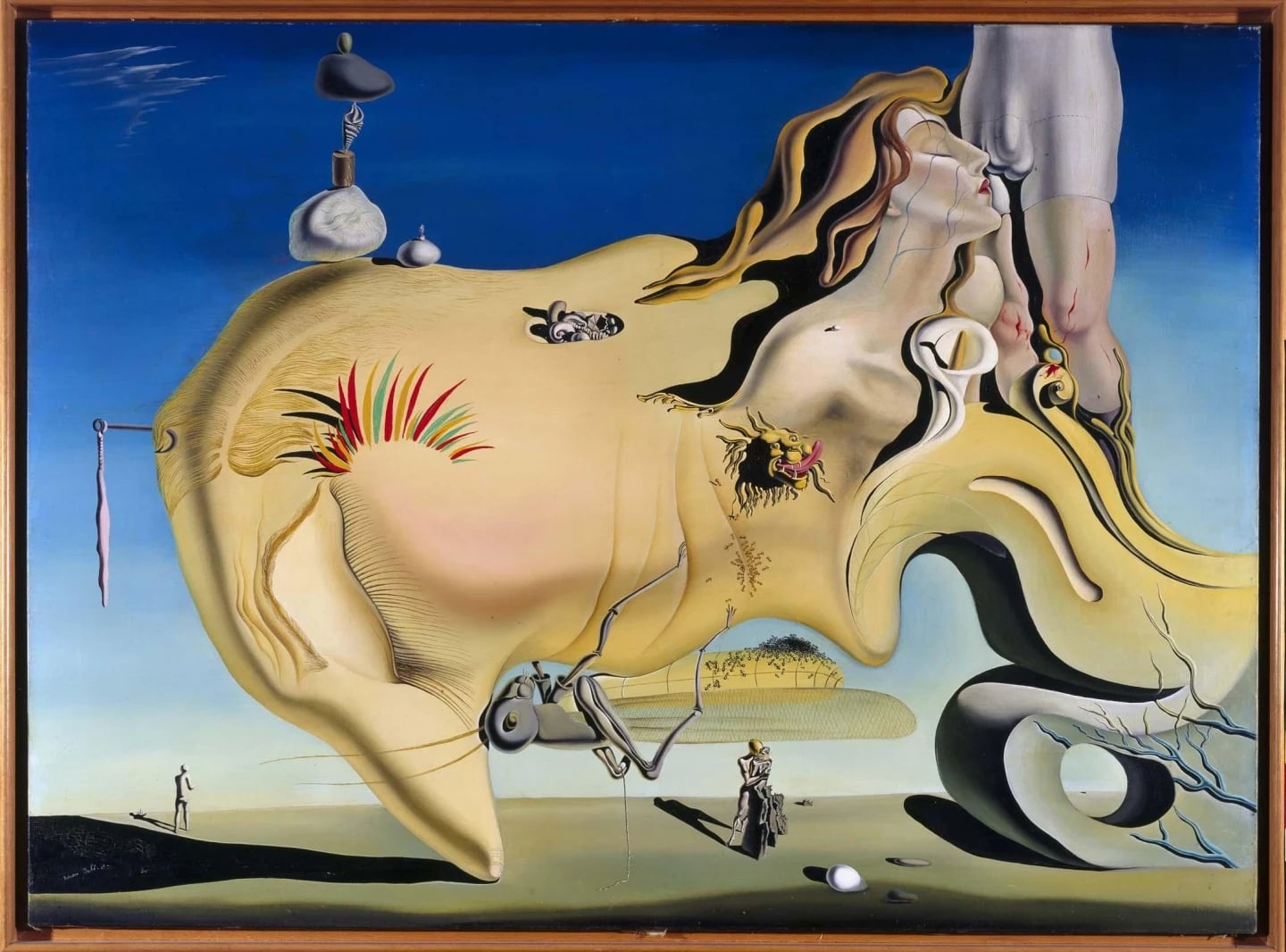
Grasshopper with ants Symbolism
Grasshopper with ants names a Surrealist pairing that concentrates fear, disgust, and erotic unease in a single motif. In Salvador Dalí’s imagery, ants signify putrefaction and the panic of bodily dissolution, while the grasshopper carries a childhood phobia that makes desire feel threatening. Together they bind decay to sexuality, visualizing the unconscious as both lure and menace.
Grasshopper with ants in The Great Masturbator
In The Great Masturbator (1929) by Salvador Dalí, a gaping grasshopper and a cluster of ants are set against a biomorphic head under a crystalline Catalan sky. The insects interrupt a scene charged with eros—near the lion’s tongue, a bleeding knee, crutches, stones, and an egg—so that arousal is shadowed by rot. Dalí lets the grasshopper embody terror and the ants signal putrefaction; in combination they turn his confession of sexual compulsion into an image where desire and decay are inseparable.