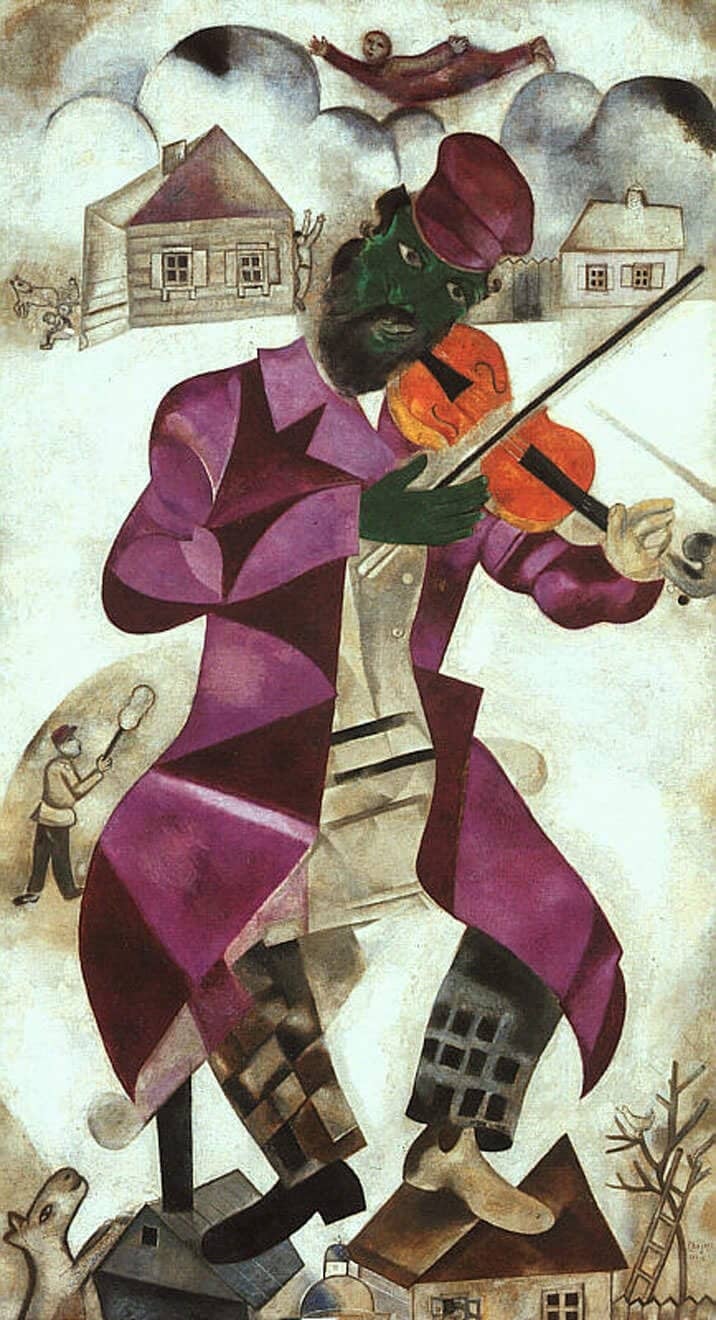
Green face Symbolism
In art, a green face often marks a figure as otherworldly, signaling spiritual agency and a role as mediator between everyday life and the sacred. Especially in modernist contexts, unconventional skin color is used not for realism but to convey visionary presence and symbolic function. The hue’s blend of vitality and strangeness helps set such figures apart from ordinary time and space.
Green face in The Green Violinist
In Marc Chagall’s The Green Violinist (1923–1924), the musician’s green face, paired with a purple coat and monumental scale, transforms him from entertainer into a spiritual emissary. Striding across crooked rooftops without crushing them, he becomes a sky-bridging guardian who visually gathers the shtetl’s houses, tree, clouds, and wandering figures into a single, sustaining chord.
Within this work, the green face is the key sign of mediation: it separates the fiddler from everyday villagers while aligning him with the painting’s fusion of folkloric memory and modernist facets, underscoring music as the community’s binding, quasi-sacred force.