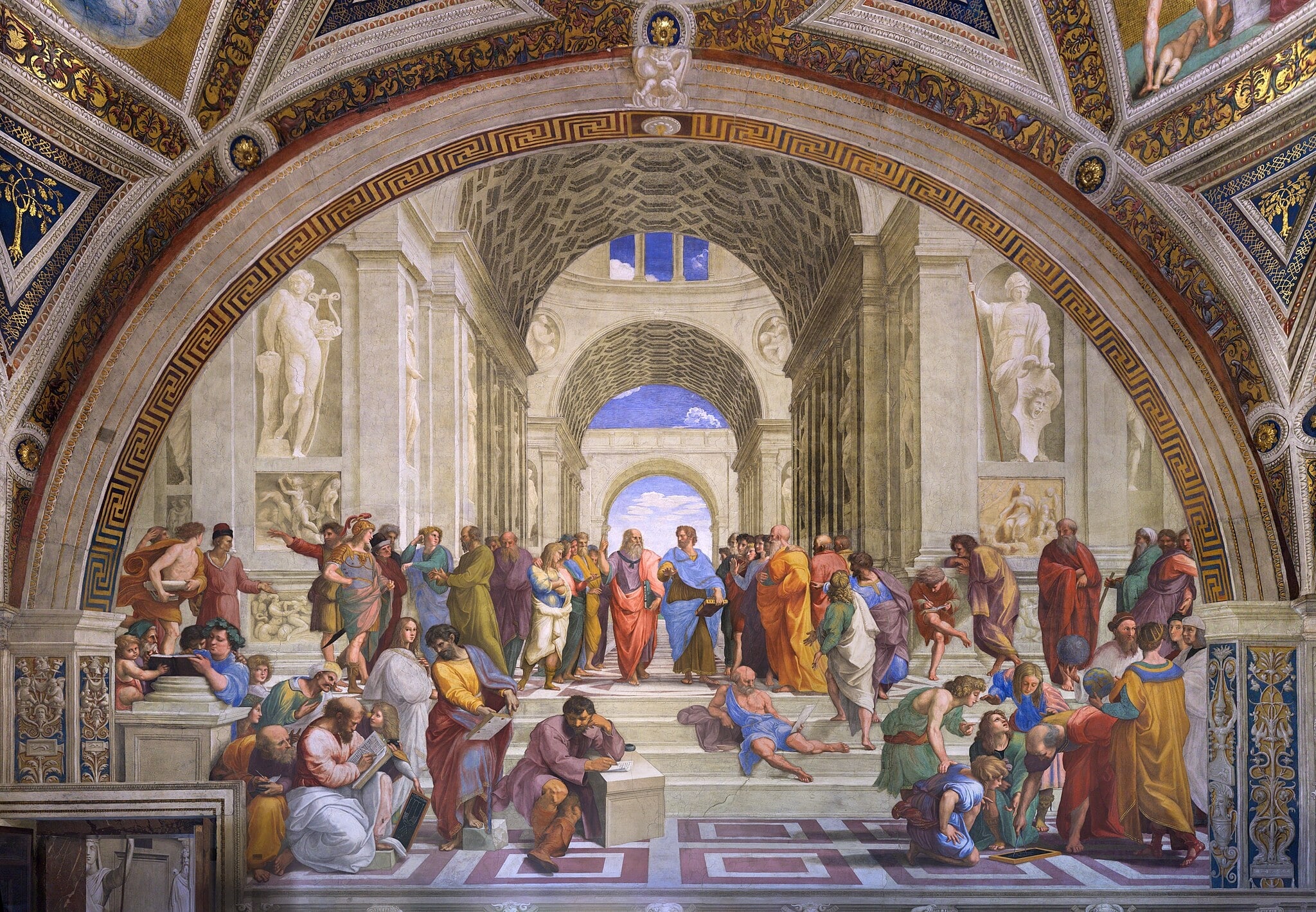
Plato’s upward gesture and the book Timaeus Symbolism
Plato’s raised hand and his book Timaeus together signal a turn toward transcendent Forms and the ordering principles of the cosmos. In Renaissance art, this pairing functions as a concise visual code for Platonic metaphysics: the upward gesture points beyond the sensible world, while the named text grounds that ascent in philosophical doctrine.
Plato’s upward gesture and the book Timaeus in The School of Athens
In Raphael’s The School of Athens (1509–1511), Plato stands at the compositional center, raising his hand toward the heavens and holding the Timaeus. This pairing anchors the fresco’s governing dialectic: his upward motion and cosmological text direct viewers to eternal, ideal principles, while Aristotle’s level gesture answers with an orientation to the empirical. Raphael’s one-point perspective converging on the central pair, and the assembly of mathematicians, scientists, and poets beneath Apollo and Athena/Minerva, amplify this reading—casting Plato’s upward sign as the axis of metaphysical inquiry within a grand temple of humanist knowledge.