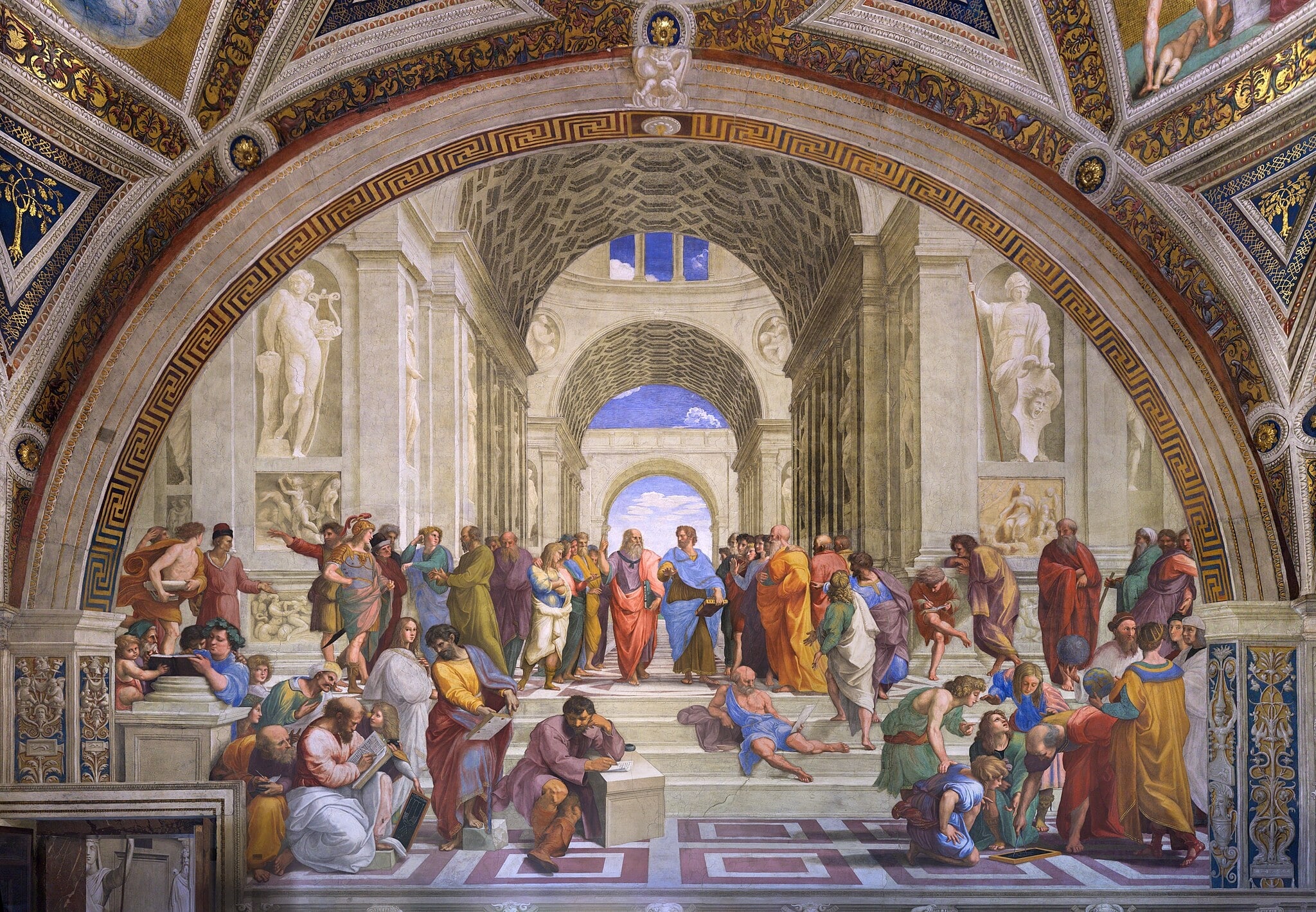
Statue of Apollo with lyre Symbolism
The statue of Apollo with lyre represents harmony, music, and measured poetic inspiration—the arts governed by proportion and reason. In Renaissance art, as in Raphael’s The School of Athens, Apollo embodies the ordering power of the arts alongside philosophical inquiry.
Statue of Apollo with lyre in The School of Athens
In Raphael’s The School of Athens (1509–1511), the learned assembly gathers under statues of Apollo and Athena/Minerva. Apollo’s presence frames the vast hall as a temple of Renaissance humanism and aligns the fresco’s central debate between ideal forms and empirical reason with the harmonizing force of the arts. Positioned above mathematicians, scientists, and poets, the statue serves as a visual guarantor of balance and measure, qualities reinforced by the painting’s classically ordered architecture and lucid one-point perspective.