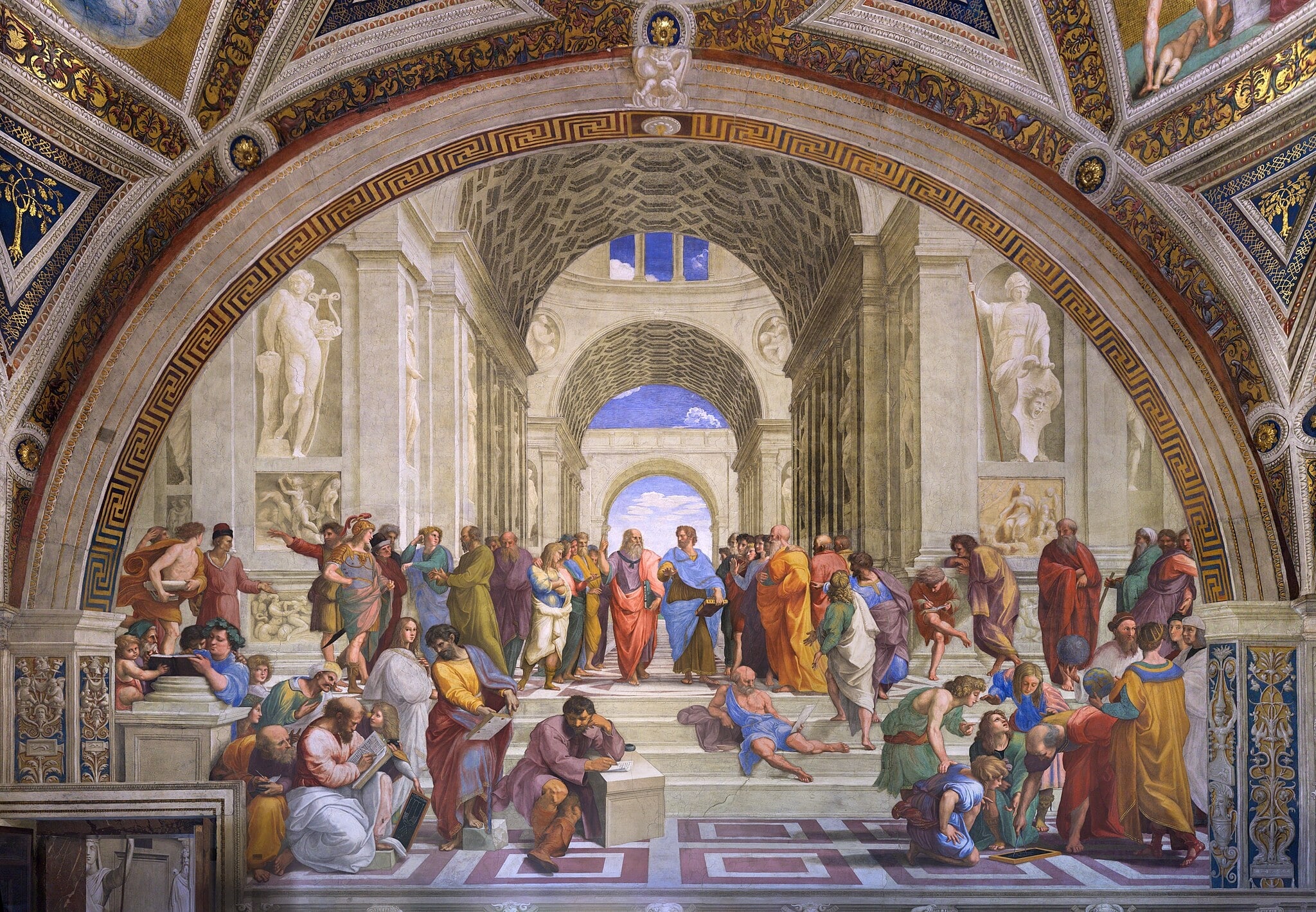
The School of Athens
Raphael (1509–1511)
Raphael’s The School of Athens orchestrates a grand debate on knowledge inside a perfectly ordered, classical hall whose one-point perspective converges on the central pair, <strong>Plato</strong> and <strong>Aristotle</strong>. Their opposed gestures—one toward the heavens, one level to the earth—establish the fresco’s governing dialectic between <strong>ideal forms</strong> and <strong>empirical reason</strong> <sup>[1]</sup><sup>[2]</sup>. Around them, mathematicians, scientists, and poets cluster under statues of <strong>Apollo</strong> and <strong>Athena/Minerva</strong>, turning the room into a temple of <strong>Renaissance humanism</strong> <sup>[1]</sup><sup>[3]</sup>.