Whiplash arabesque Symbolism
The whiplash arabesque is the sinuous, whiplike curve that became a signature of Art Nouveau at the turn of the twentieth century. Its elastic, asymmetrical line suggests organic growth and continuous motion, binding ornament, figure, and space into a rhythmic flow. Artists used it to translate modern decorative energy into visual form.
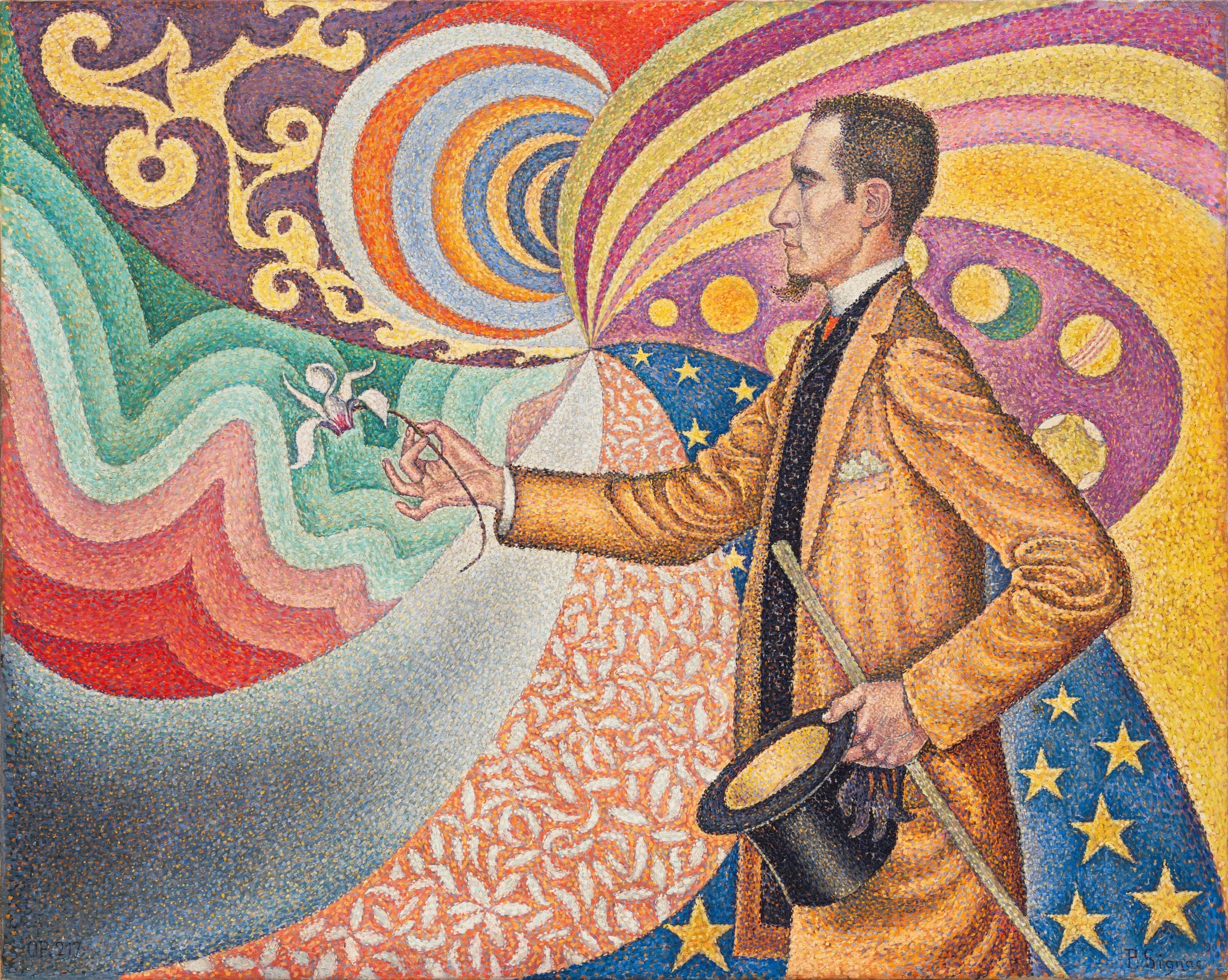
Whiplash arabesque in Portrait of Félix Fénéon
In Portrait of Félix Fénéon (1890), Paul Signac sets the critic against a background where concentric disks, stars, palette-like circles, and whiplash arabesques whirl around him. Rendered in precise Pointillist dots, these sinuous curves enact Art Nouveau’s “living line,” animating the field and merging decorative rhythm with Neo-Impressionist color science.
Here the whiplash arabesque functions as both ornament and force: it arcs around the figure like a vortex, turning Fénéon into a “conductor of color” and staging the fusion of art, science, and modern style. The line’s continuous sweep binds disparate motifs into a unified, modern decor, demonstrating how the motif conveys motion and vitality within a strictly ordered technique.