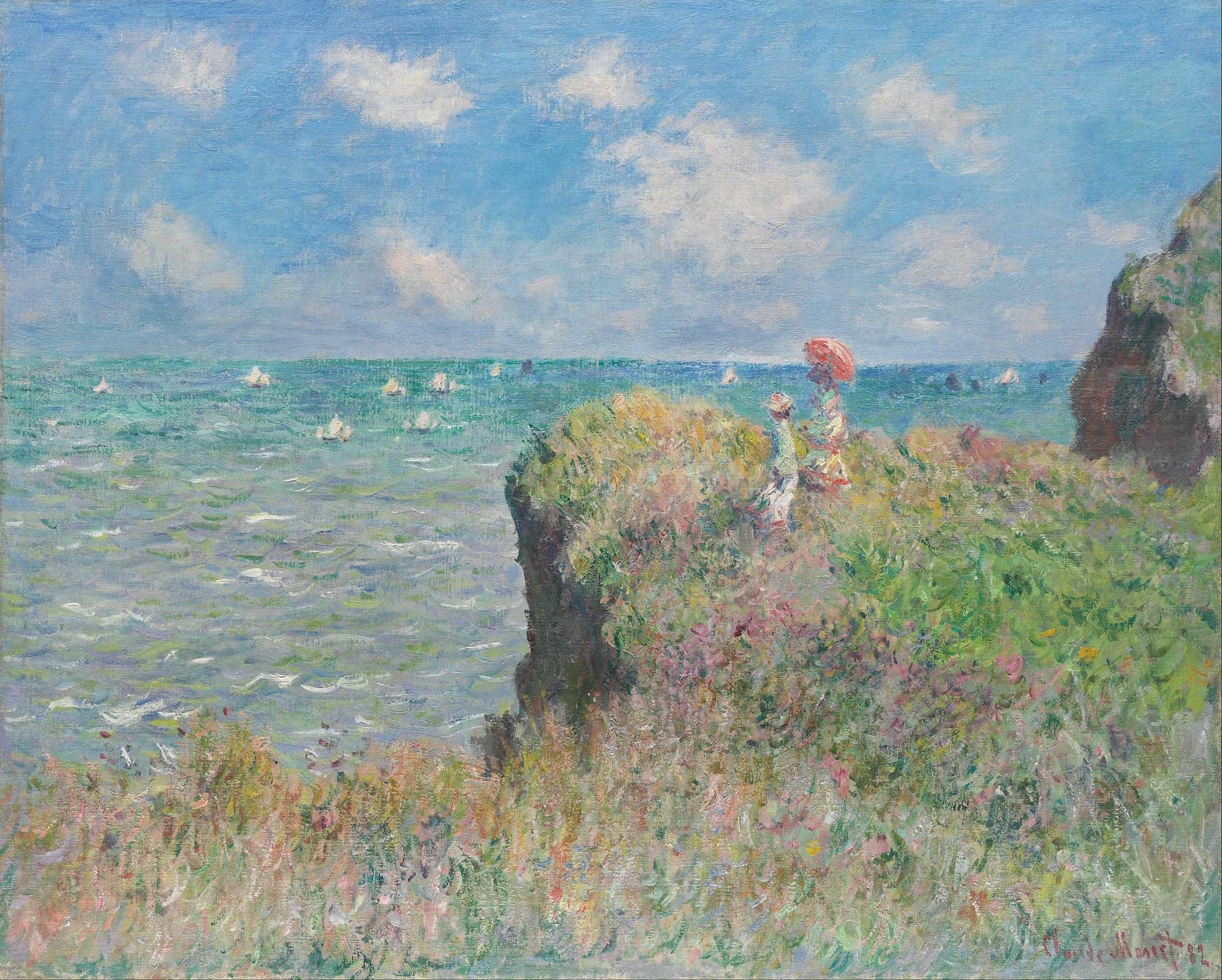
White sails/boatlets Symbolism
White sails and small boatlets often mark human presence within vast seascapes. In European painting, especially within Impressionism, they signal modern leisure and coastal traffic while serving as crisp markers of distance, light, and weather. Their bright, geometric forms punctuate horizons and help the viewer gauge scale against sea and sky.
White sails/boatlets in The Cliff Walk at Pourville
In Claude Monet’s The Cliff Walk at Pourville (1882), white sails speckle the luminous expanse of sea beneath a bright sky, their small size measuring the breadth of the Channel and the height of the cliffs. These boatlets register contemporary coastal leisure while also acting as visual units that calibrate depth and atmosphere within Monet’s shimmering, wind-swept setting.
Paired with the two small walkers—one beneath a pink parasol—the sails extend the painting’s dialogue between intimate pastime and the modern sublime. Catching light and implying wind, they link offshore activity to the gusts that animate the cliff top, underscoring how tiny human pursuits unfold against an immense natural field.