Romantic love
Featured Artworks
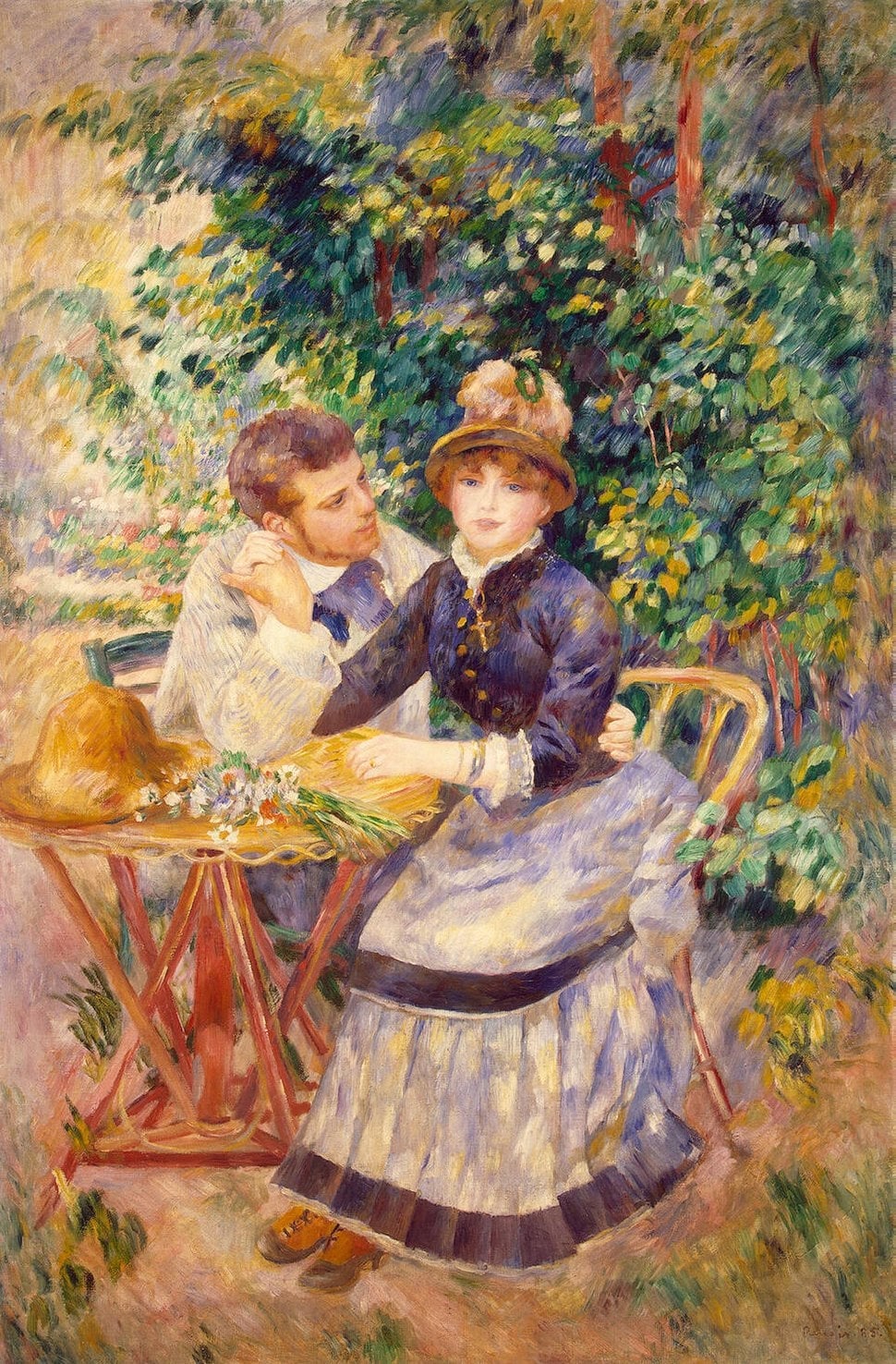
In the Garden
Pierre-Auguste Renoir (1885)
In the Garden presents a charged pause in modern leisure: a young couple at a café table under a living arbor of leaves. Their lightly clasped hands and the bouquet on the tabletop signal courtship, while her calm, front-facing gaze checks his lean. Renoir’s flickering brushwork fuses figures and foliage, rendering love as a <strong>transitory, luminous sensation</strong> <sup>[1]</sup><sup>[3]</sup>.
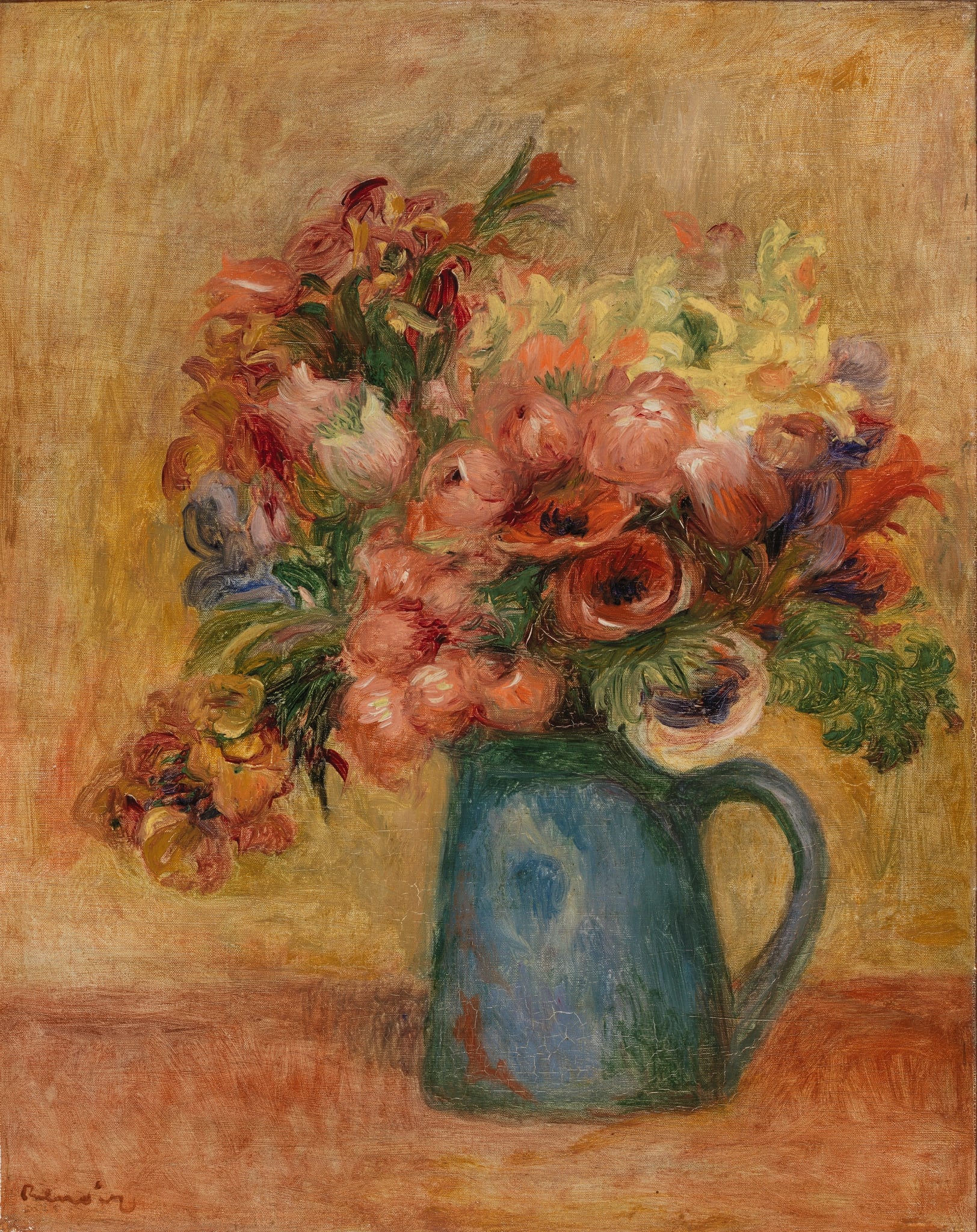
Vase of Flowers
Pierre-Auguste Renoir (c. 1889)
Vase of Flowers is a late‑1880s still life in which Pierre-Auguste Renoir turns a humble blue‑green jug and a tumbling bouquet into a <strong>laboratory of color and touch</strong>. Against a warm ocher wall and reddish tabletop, coral and vermilion blossoms flare while cool greens and violets anchor the mass, letting <strong>color function as drawing</strong> <sup>[1]</sup><sup>[4]</sup>. The work affirms Renoir’s belief that flower painting was a space for bold experimentation that fed his figure art.

Dance in the City
Pierre-Auguste Renoir (1883)
Pierre-Auguste Renoir’s Dance in the City stages an urban waltz where decorum and desire briefly coincide. A couple’s close embrace—his black tailcoat enclosing her luminous white satin gown—creates a <strong>cool, elegant</strong> harmony against potted palms and marble. Renoir’s refined, post‑Impressionist touch turns social ritual into <strong>sensual modernity</strong> <sup>[1]</sup><sup>[2]</sup>.
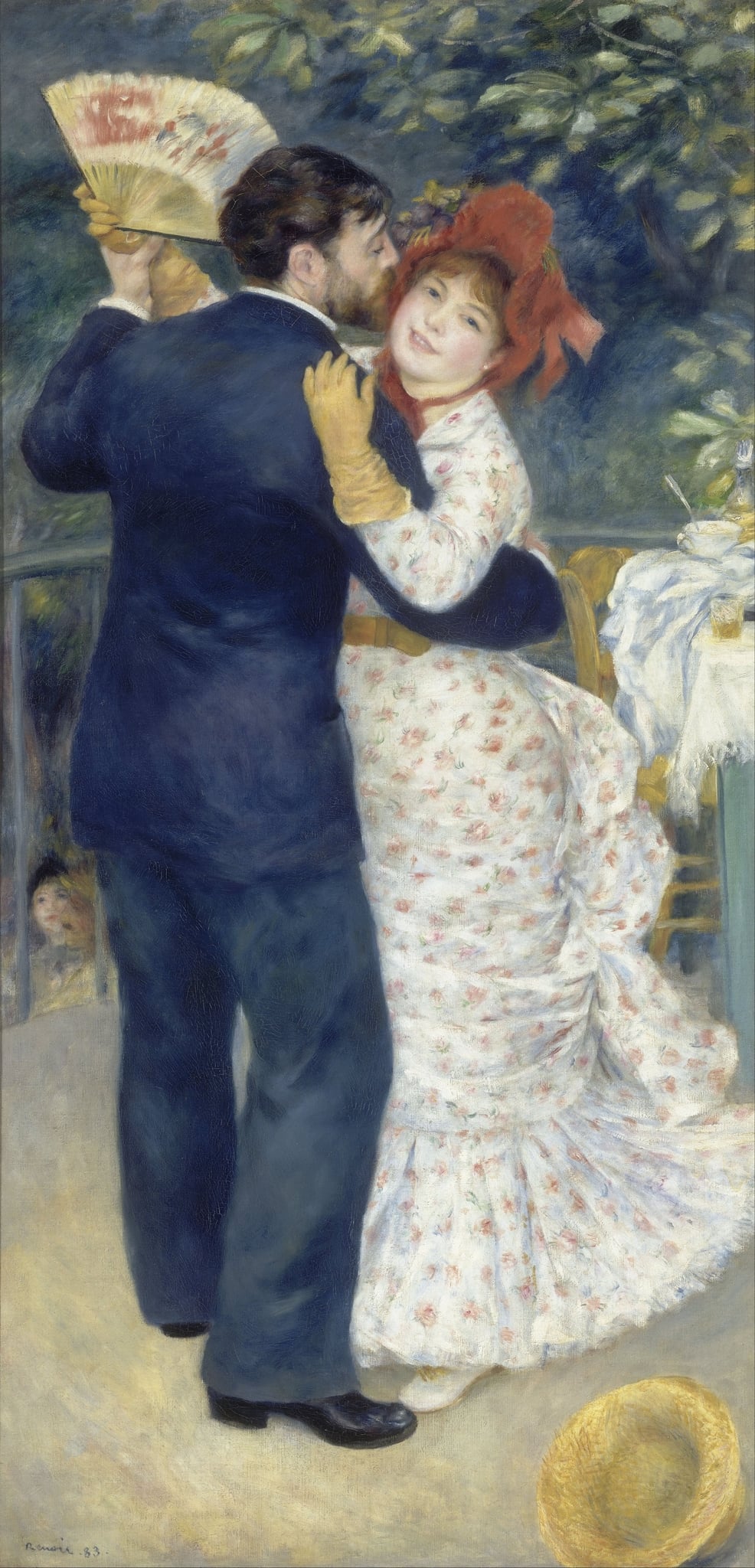
Dance in the Country
Pierre-Auguste Renoir (1883)
Dance in the Country shows a couple swept into a close embrace on a café terrace, their bodies turning in a soft spiral as foliage and sunlight dissolve into <strong>dappled color</strong>. Renoir orchestrates <strong>bourgeois leisure</strong>—the tossed straw boater, a small table with glass and napkin, the woman’s floral dress and red bonnet—to stage a moment where decorum and desire meet. The result is a modern emblem of shared pleasure, poised between Impressionist shimmer and a newly <strong>firm, linear touch</strong>.
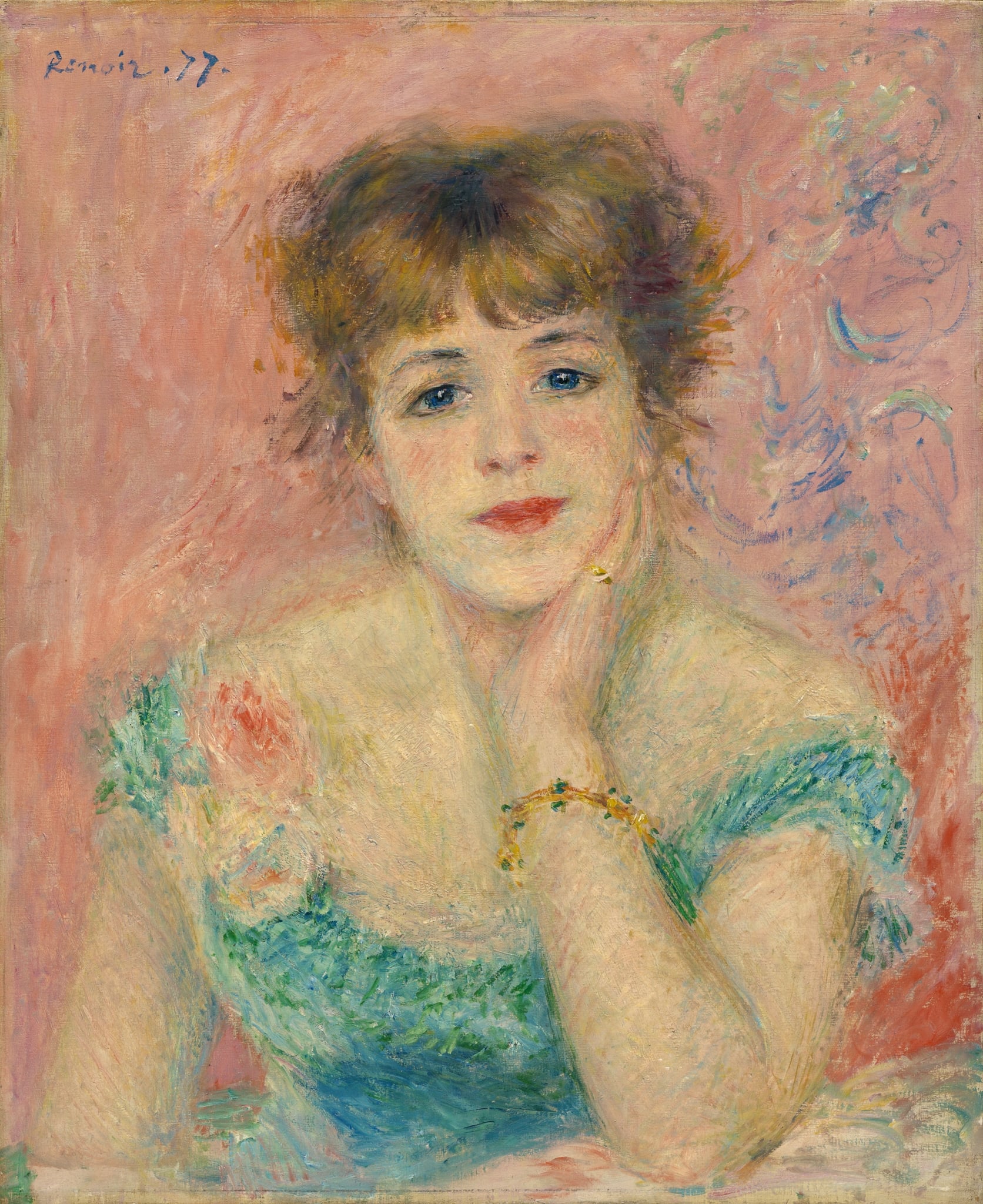
Portrait of Jeanne Samary
Pierre-Auguste Renoir (1877)
Renoir’s Portrait of Jeanne Samary (1877) turns a modern actress into a study of <strong>radiance and immediacy</strong>, fusing figure and air with shimmering strokes. Cool blue‑green dress notes spark against a warm <strong>coral-pink atmosphere</strong>, while the cheek‑in‑hand pose crystallizes a moment of intimate poise <sup>[1]</sup><sup>[4]</sup>.
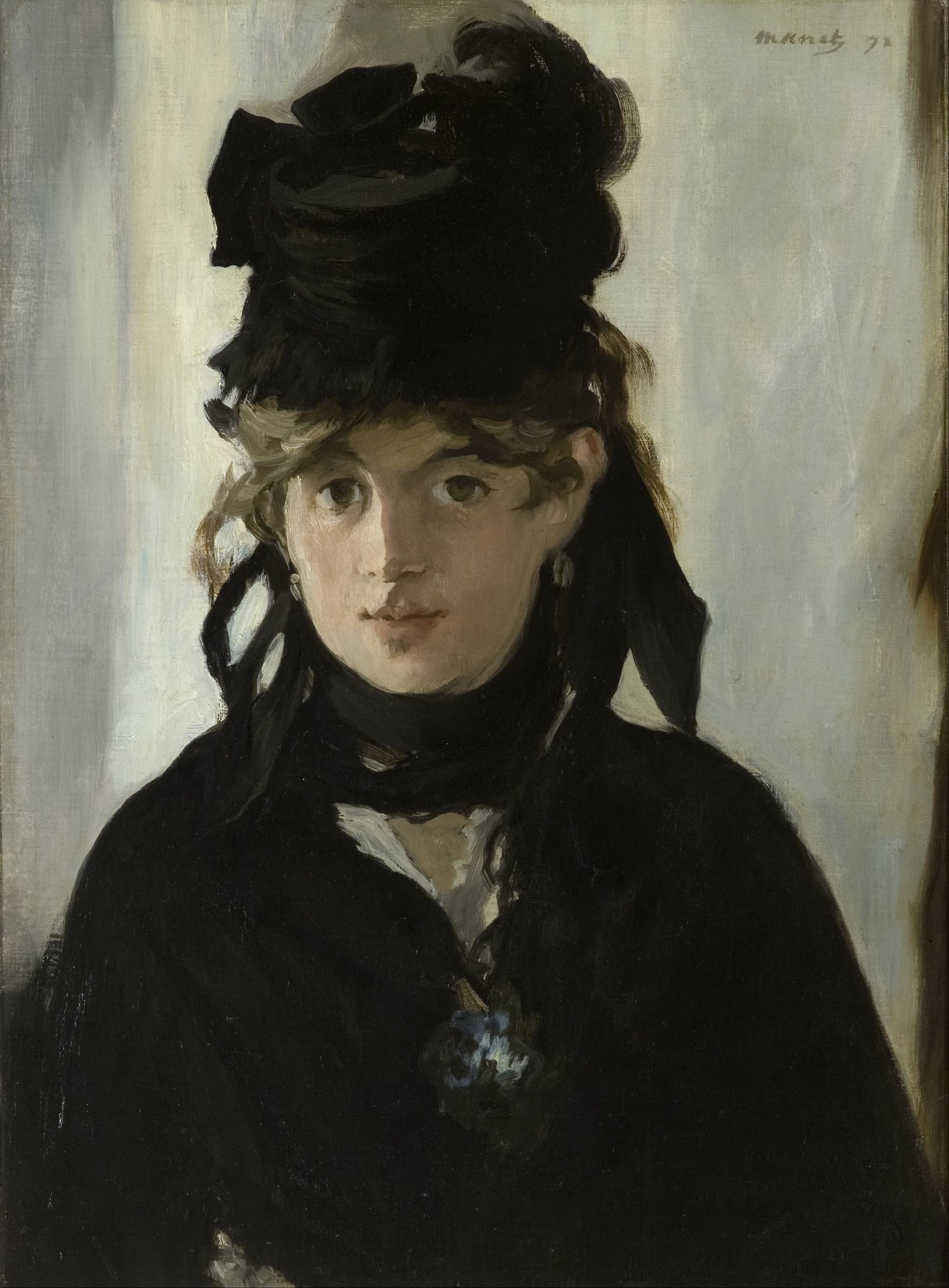
Berthe Morisot with a Bouquet of Violets
Édouard Manet (1872)
Édouard Manet’s Berthe Morisot with a Bouquet of Violets is a close, modern portrait built as a <strong>symphony in black</strong> punctuated by a tiny violet knot. Side‑light chisels the face from a cool, silvery ground while hat, scarf, and coat merge into one dark silhouette, and the eyes are painted strikingly <strong>black</strong> for effect <sup>[1]</sup>. The single touch of violets introduces a discreet, coded <strong>tenderness</strong> within the portrait’s refined restraint <sup>[1]</sup><sup>[3]</sup><sup>[4]</sup>.
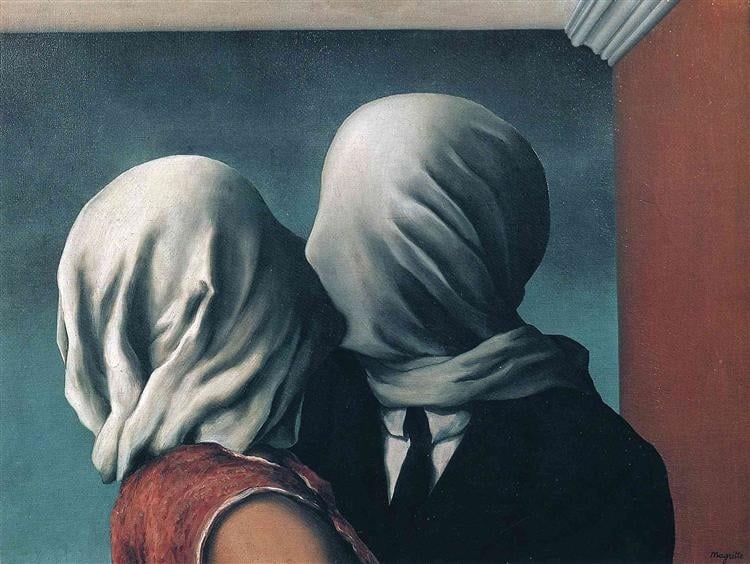
The Lovers
Rene Magritte (1928)
René Magritte’s The Lovers turns a kiss into an emblem of <strong>desire obstructed</strong>: two figures—she in red, he in a dark suit—press together while their heads are swathed in <strong>white cloth</strong>. Within a cool blue‑grey interior bounded by crown molding and a rust-red wall, intimacy becomes an image of <strong>opacity</strong> rather than revelation <sup>[1]</sup>.
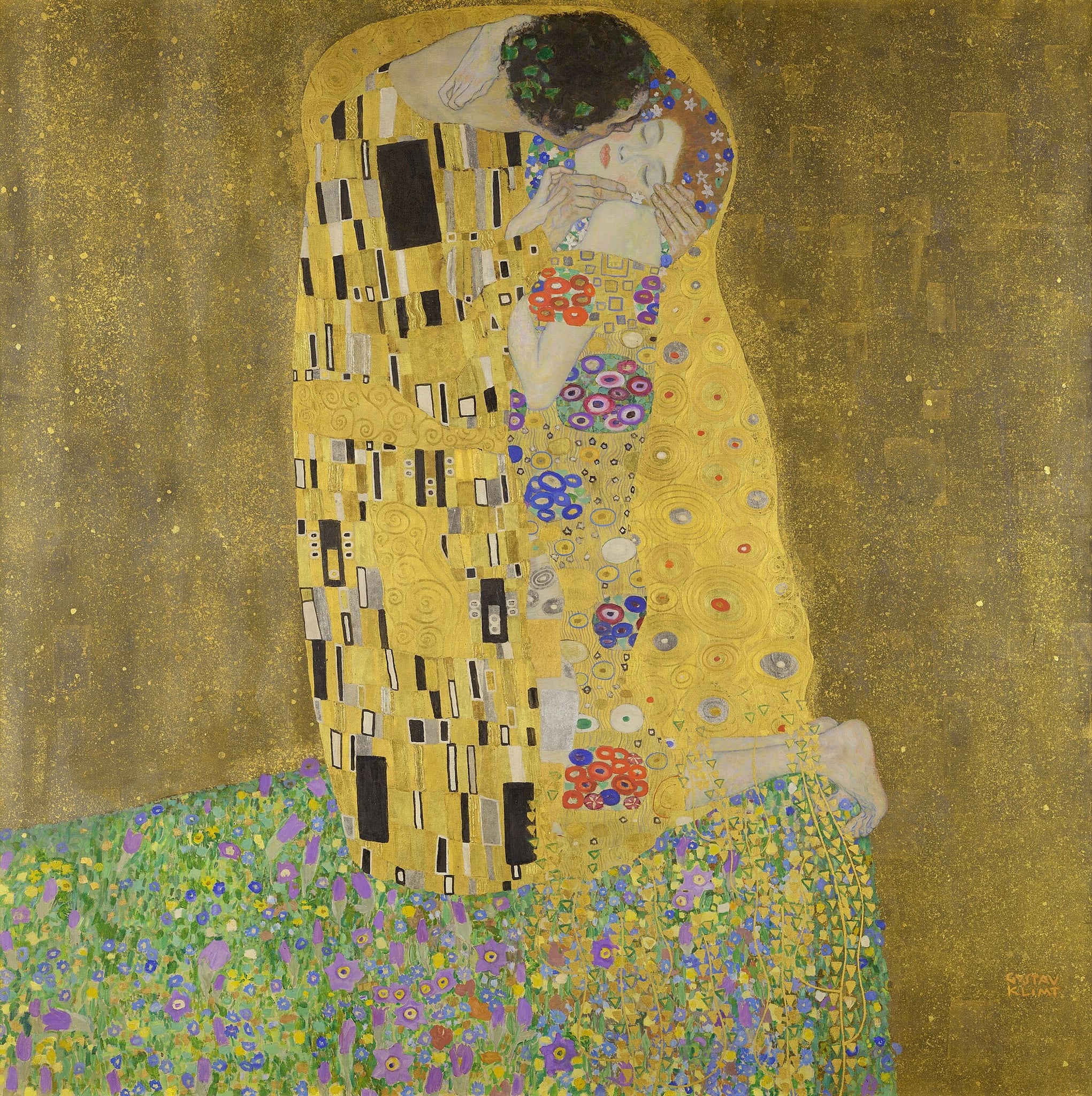
The Kiss (Lovers)
Gustav Klimt (1907–1908 (Belvedere lists 1908/09))
The Kiss (Lovers) crystallizes Klimt’s <strong>Golden Period</strong> ideal: erotic union staged as a sacred vision. Two bodies fuse beneath a single golden mantle, poised on a flowered ledge at the brink of the unknown, where <strong>pattern becomes symbol</strong> and intimacy becomes icon.
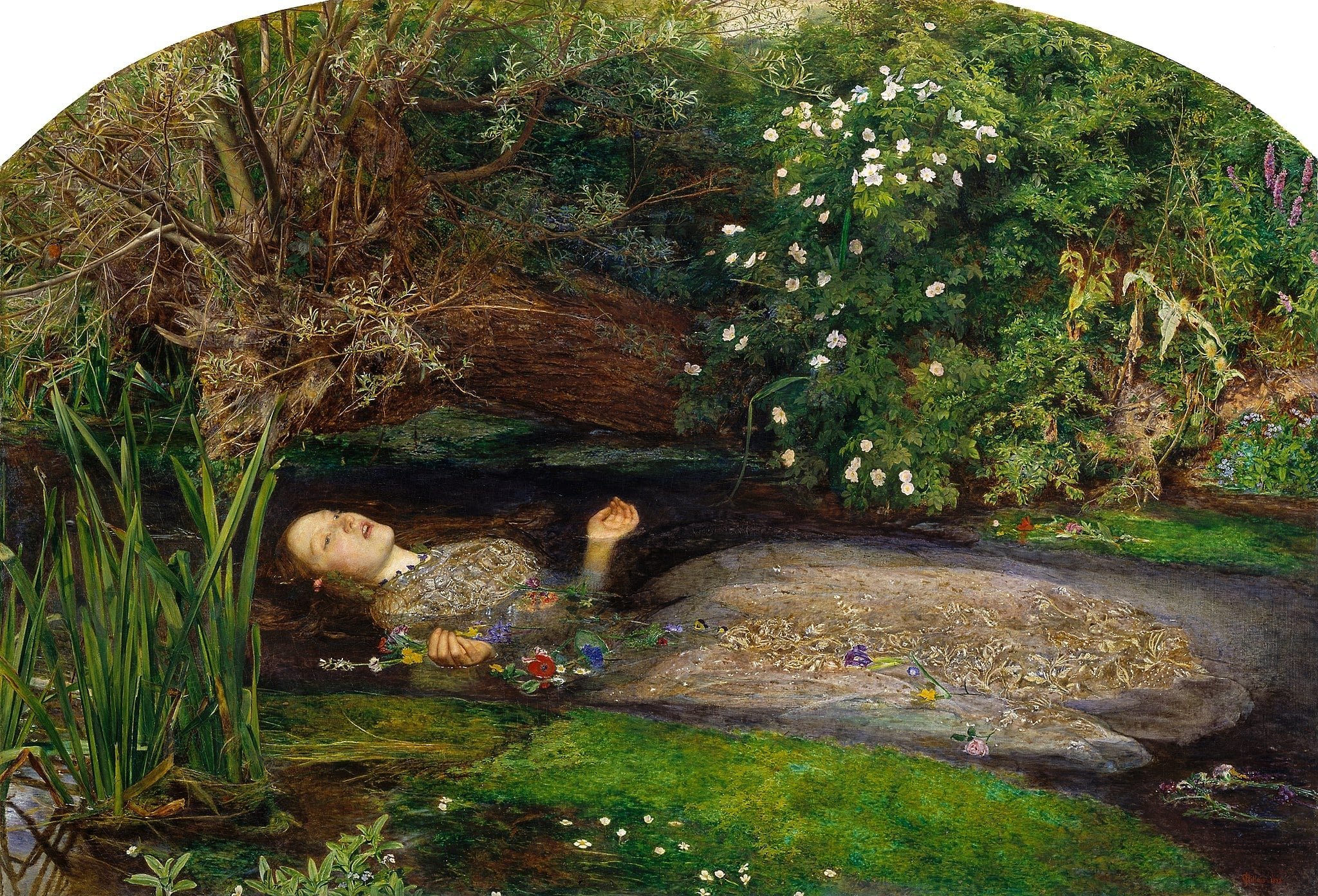
Ophelia
John Everett Millais (1851–1852)
John Everett Millais’s Ophelia shows Shakespeare’s heroine floating in a narrow stream, her jeweled dress both buoying and engulfing her. Millais renders the riverbank with <strong>forensic botanical precision</strong>, so that reeds, willow, briars, nettles, and a scatter of emblematic flowers surround a face slack in mid‑song and hands raised in <strong>open‑palmed surrender</strong> <sup>[1]</sup><sup>[3]</sup>.
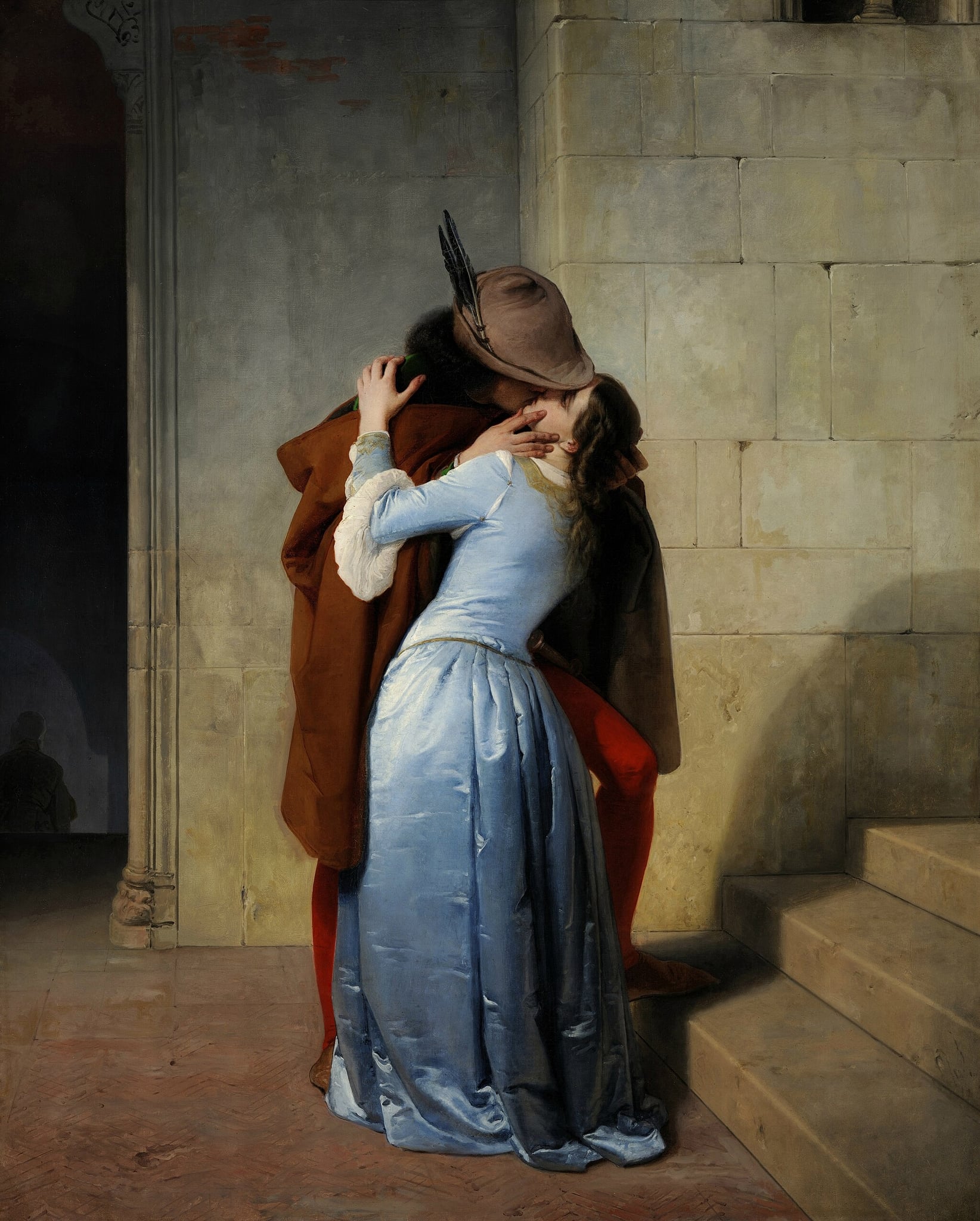
The Kiss (Hayez)
Francesco Hayez (1859)
Francesco Hayez’s The Kiss (Hayez) fuses intimate passion with <strong>political resolve</strong>: a clandestine embrace staged on a cold stone threshold as departure looms. The man’s <strong>outward-angled foot</strong> on the stair and the flash of a <strong>dagger</strong> compress time to a final instant before flight, while tricolour cues fold love into the Risorgimento alliance of 1859 <sup>[1]</sup>. The painting’s cool masonry and <strong>theatrical light</strong> make private tenderness read as public courage.