Portrait of Adele Bloch-Bauer I

by Gustav Klimt

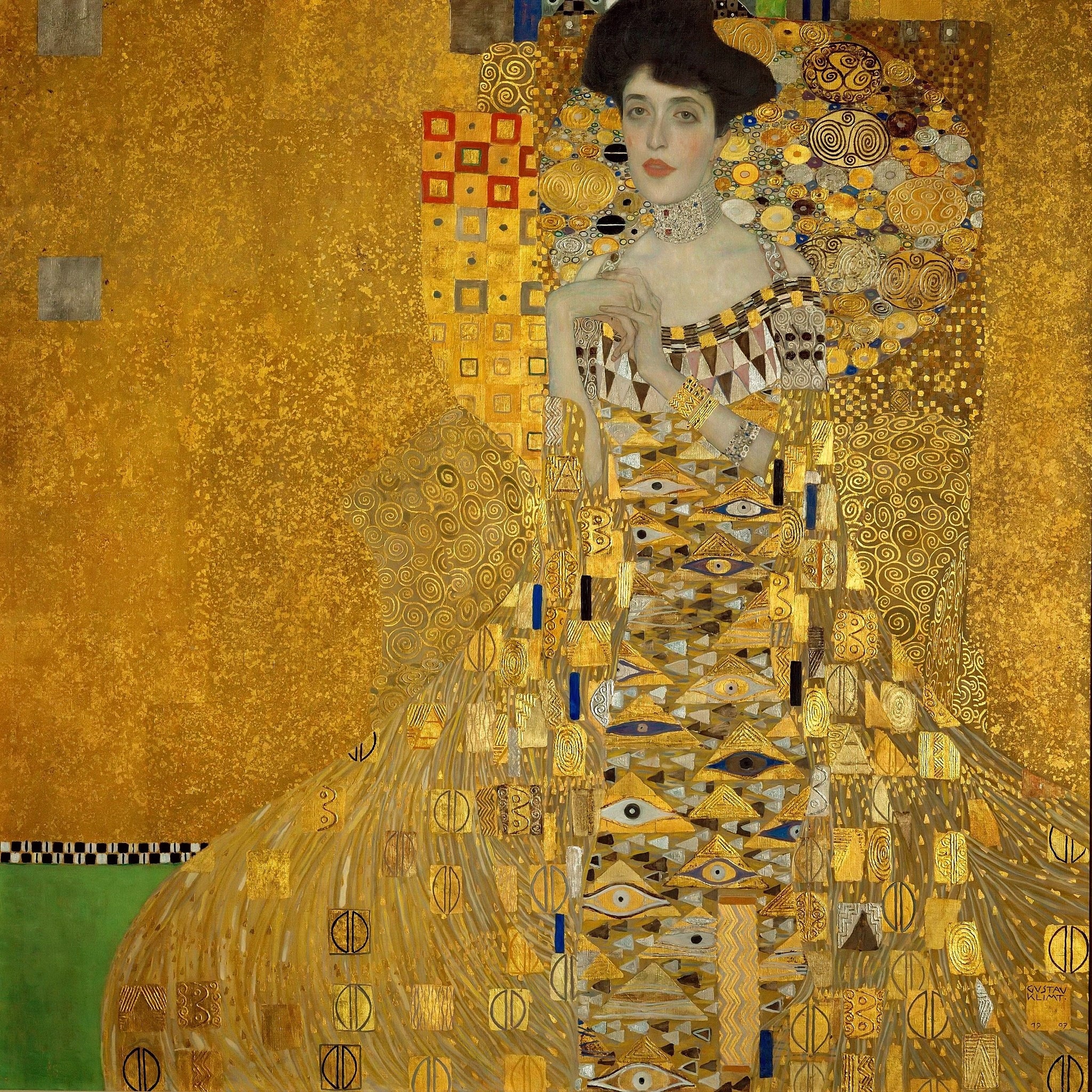
Gustav Klimt’s Portrait of Adele Bloch-Bauer I stages its sitter as a secular icon—a living presence suspended in a field of gold that converts space into pattern and power. The naturalistic face and hands emerge from a reliquary-like cascade of eyes, triangles, and tesserae, turning light, ornament, and status into the painting’s true subjects [1][2].

Study Print Studio

Create a personal study print

Build a companion study sheet around the part of this painting that speaks to you most. Choose a detail, shape an interpretation, and walk away with something personal and display-worthy.

Fast Facts

Year
1907
Medium
Oil, silver, and gold on canvas
Dimensions
140 x 140 cm
Location
Neue Galerie New York
Portrait of Adele Bloch-Bauer I by Gustav Klimt (1907) featuring Halo-like nimbus of roundels, Squares and rectangles (mosaic tesserae)

Click on any numbered symbol to learn more about its meaning

Meaning & Symbolism

Klimt builds a theology of modernity in gold. The painting’s field operates like a Byzantine ground—non-spatial, luminous, and absolute—yet the face and hands are modeled with cool naturalism, creating a charged seam between flesh and icon. Around the head, a halo-like nimbus of circular roundels elevates the sitter into a saint of fin-de-siècle taste, while the squared, mosaic-like blocks at left and the spiral tiles at right echo Ravenna’s visual grammar that Klimt studied in 1903. Across the gown and cloak, Klimt arrays a lexicon of motifs: all-seeing eyes and golden triangles, rectilinear tesserae, and raised initials “AB,” asserting identity while dissolving the body into ornament. The choker and stacked bracelets, glinting like regalia, secure the alliance between erotic charisma and social command. A thin green strip along the base acknowledges the fiction of space and then refuses it, pinning this apparition to a constructed stage. In short, the painting declares that in Vienna 1900, visibility itself—curated, adorned, and ritualized—was power 124. The orchestration of shapes codifies a drama of gendered energies and control. Squares and rectangles cluster near the left shoulder and backdrop; ovals, eyes, and triangles surge down the dress. Critics have long read such pairings as a tension between order and sensuality, with the squared matrices suggesting structure and the ovoid/triangular signs channeling desire. Yet Klimt does not resolve the opposition; he enthrones it. The sitter’s poised but distant gaze—cool, frontal, slightly above the viewer—keeps the person legible while allowing ornament to speak as loudly as physiognomy. Only the face and hands are conventionally painted; everything else is a composite of oil, silver, and gold worked into relief-like surfaces, so that the portrait behaves like a jewel-object as much as a painting. Klimt’s original frame by Josef Hoffmann completes the total artwork, embedding the portrait in Wiener Werkstätte design culture where art, fashion, and interiors formed a single aesthetic ecosystem. In this register, the meaning of Portrait of Adele Bloch-Bauer I is less biography than proposition: that modern identity can be minted from surface, pattern, and light itself 1345. Why Portrait of Adele Bloch-Bauer I is important also rests on its historical itineraries. It is a summit of Klimt’s Golden Style—a canon-defining counterpart to The Kiss—where metal leaf becomes not decoration but a metaphysics of seeing. Its early reception recognized the work’s liturgical aura (“an idol in a golden shrine”) and its provocation (“more brass than Bloch”), proof that Klimt knowingly courted the politics of luxury in a bourgeois, Jewish-patroned salon culture that powered Viennese modernism. The painting’s Nazi-era seizure and 2006 restitution to the heirs, followed by a record-setting acquisition for the Neue Galerie, have further transformed it into an emblem of memory, justice, and the market’s valuation of cultural loss and recovery. Those trajectories, however, only amplify what the picture already proclaims: that glamour—densely patterned, cosmopolitan, and strategic—is a modern sacred, and that painting can make that sacred visible, palpable, and permanent 23678.

Explore Deeper with AI

Ask questions about Portrait of Adele Bloch-Bauer I

Popular questions:

Powered by AI • Get instant insights about this artwork

💬 Ask questions about this artwork!

Interpretations

Religious/Secular Iconography: Theodora Transposed

The image leverages Byzantine visual theology—gold grounds, frontal hieratic poise, and a halo-like nimbus—but secularizes sanctity into a cult of modern taste. Klimt’s 1903 encounter with Ravenna’s mosaics, notably Empress Theodora, supplied a grammar of tesserae, spirals, and aureoles; he adapts it to consecrate Adele as a saint of fin‑de‑siècle cosmopolitanism. The liturgical aura that early viewers sensed (“an idol in a golden shrine”) attests to the painting’s ritual charge, even as jewelry and couture recast relic into luxury. Thus, the portrait navigates between devotion and display, proposing glamour itself as a modern sacred—and doing so with an icon’s rhetoric deployed in a bourgeois salon world 12.

Source: Neue Galerie (exhibition page); Neue Galerie (Google Arts & Culture)

Formal Analysis: Gold as Structure, Not Skin

Klimt’s metalwork is not mere veneer but architectural: the gold and silver articulate planes, suspend depth, and convert background into an active, non-spatial matrix. The painting’s body is engineered as much as depicted—gessoed low relief catches raking light, animating motifs (eyes, triangles) as tactile data rather than flat pattern. Critically, only the face and hands are conventionally painted, so mimesis is ring-fenced within a field that behaves like mosaic. The original Josef Hoffmann frame completes a Wiener Werkstätte total design, declaring the object a calibrated artifact—part icon, part jewel, part wall-architecture. In this register, Klimt tests how far a portrait can drift toward ornament before ceasing to be portraiture at all, a quintessential Secessionist probe of surface and structure 2359.

Source: LACMA; Neue Galerie (Google Arts & Culture); Britannica (Sezession); Antiques and the Arts Weekly

Symbolic Reading: Gendered Ornament as Semiotic System

The distribution of forms doubles as a gendered semiotics: rectilinear grids align with restraint and order near the shoulder and ground, while ovals, eyes, and triangles quicken the dress with sensual flux. Rather than resolving binary codes, Klimt enthrones their friction, so ornament becomes a script for regulated desire. The eye motif—amuletic in some readings—compounds surveillance with seduction: the dress looks back. Triangles oscillate between geometric rationality and erotic sign (pubic delta, directional vectors), staging desire as patterned intelligence rather than chaos. This aligns with Klimt’s broader practice of fusing decorative systems with the erotics of the female figure, a hallmark of his Golden period’s symbolic language 24.

Source: Neue Galerie (Google Arts & Culture); Britannica (Klimt biography)

Historical Context: Salon Modernity and the Politics of Luxury

Adele’s Jewish bourgeois salon—networked with Mahler and Zweig—provided the social circuitry that made such spectacular visibility consequential. Commissioned by industrial wealth, the portrait’s opulence was legible as cultural capital, hence polarized reception: from rapture to barbed quips about “brass.” The work internalizes that debate, flaunting expense (metal leaf, jewels) while codifying restraint in its gridded passages—luxury as both provocation and discipline. In Vienna 1900, this was not decorative excess but a strategic aesthetic ideology, projecting cosmopolitan modernity against anxious, often antisemitic, cultural politics. Klimt’s picture thereby performs class and identity as an art-historical argument, not a backdrop 268.

Source: Neue Galerie (Google Arts & Culture); Jewish Women’s Archive; The New Yorker (Peter Schjeldahl)

Provenance and Memory Politics: From Idol to Evidence

The painting’s afterlife—Nazi seizure, Altmann v. Austria, arbitration, and the 2006 record purchase—reframed it as a site of memory where aesthetics, justice, and markets intersect. Restitution did not merely restore ownership; it transformed the image into evidence of cultural dispossession and the price of repair. Display at LACMA before acquisition staged a public reckoning, while the Neue Galerie’s purchase fixed the work as a New York totem of Viennese modernity and restitution-era prestige. These trajectories sharpen the portrait’s original thesis about visibility and power: what was once a salon icon became a legal and economic emblem, its gold now reading as both splendor and scar tissue 378.

Source: LACMA; The Art Newspaper; The New Yorker (Peter Schjeldahl)

Related Themes

About Gustav Klimt

Gustav Klimt (1862–1918), co-founder of the Vienna Secession, pivoted from controversial public commissions to a decorative-symbolist language in his Golden Period. Drawing on Byzantine mosaics and modern design, he fused opulent surfaces with psychological intensity. By 1908–09, he transformed scandal into canon, and The Kiss became Vienna’s emblem of modern love.
View all works by Gustav Klimt

More by Gustav Klimt

Sunflower by Gustav Klimt

Sunflower

Gustav Klimt (1907/1908)

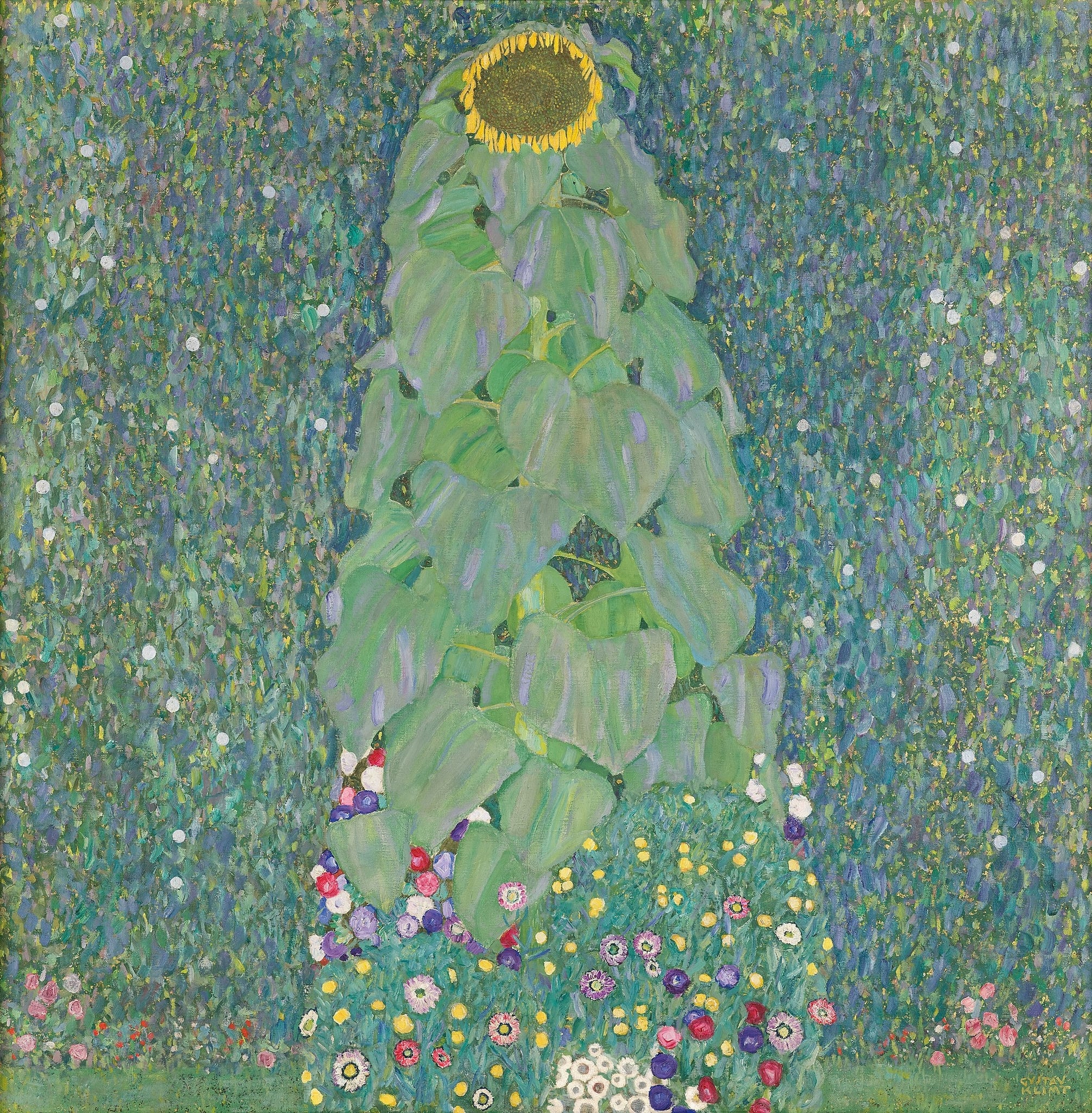
Gustav Klimt’s Sunflower turns a single bloom into a <strong>monumental, figure-like presence</strong>. A tapering stack of broad, drooping leaves rises from a <strong>mosaic-like carpet of round blossoms</strong>, crowned by a gold-flecked disc that glows against a cool, stippled field. The work fuses <strong>portrait, icon, and landscape</strong> into one emblem of vitality and quiet sanctity <sup>[1]</sup><sup>[2]</sup>.
Cottage Garden with Sunflowers by Gustav Klimt

Cottage Garden with Sunflowers

Gustav Klimt (1906–1907 (signed 1907))

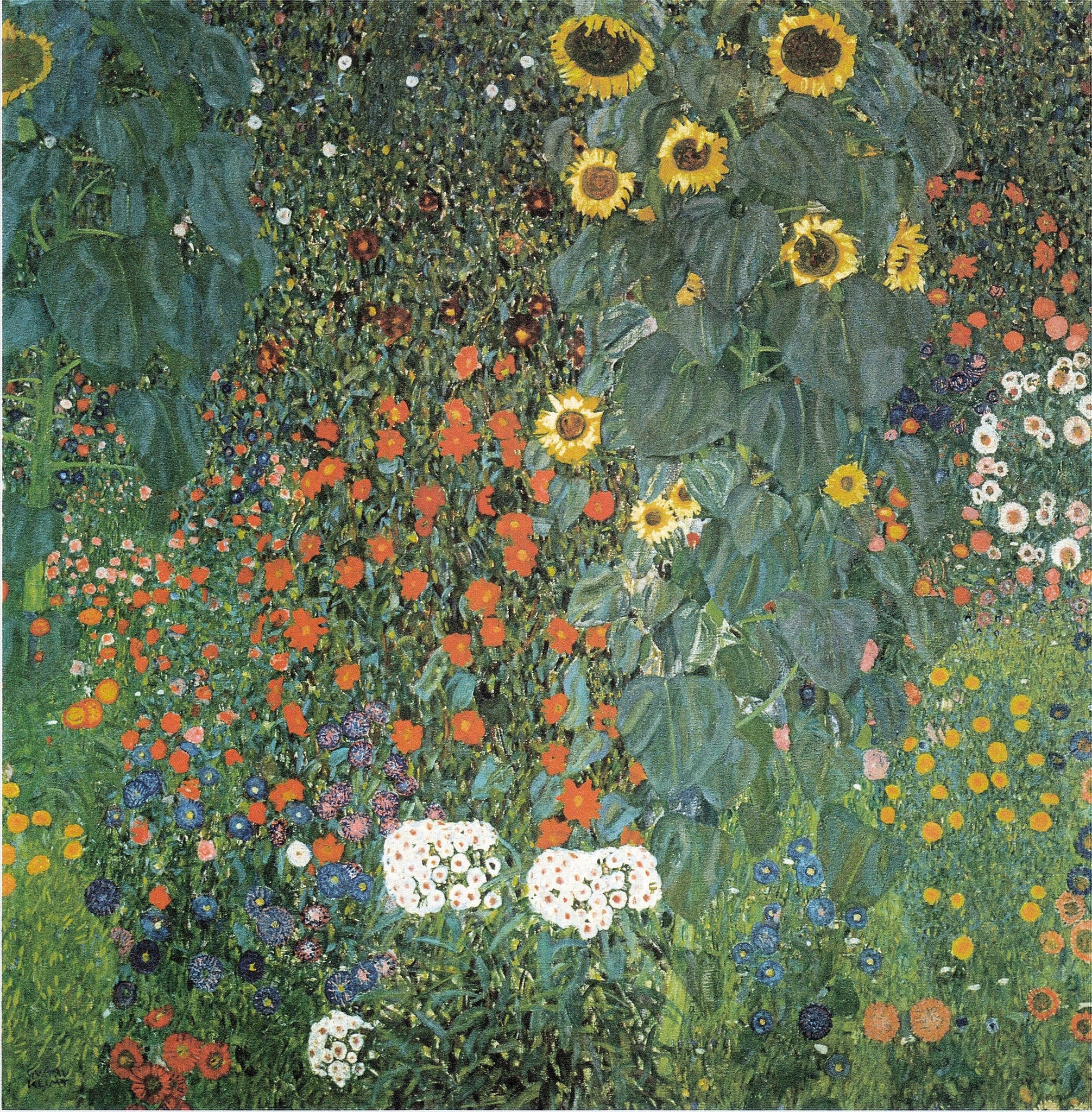
Cottage Garden with Sunflowers is a square, horizonless field of blooms where a vertical column of <strong>sunflowers</strong> anchors an all-over weave of color and pattern. Klimt fuses <strong>ornament and nature</strong>, turning a humble Litzlberg cottage plot into a radiant matrix of cyclical life and renewal <sup>[1]</sup><sup>[4]</sup><sup>[5]</sup>.
The Kiss by Gustav Klimt

The Kiss

Gustav Klimt (1908 (completed 1909))

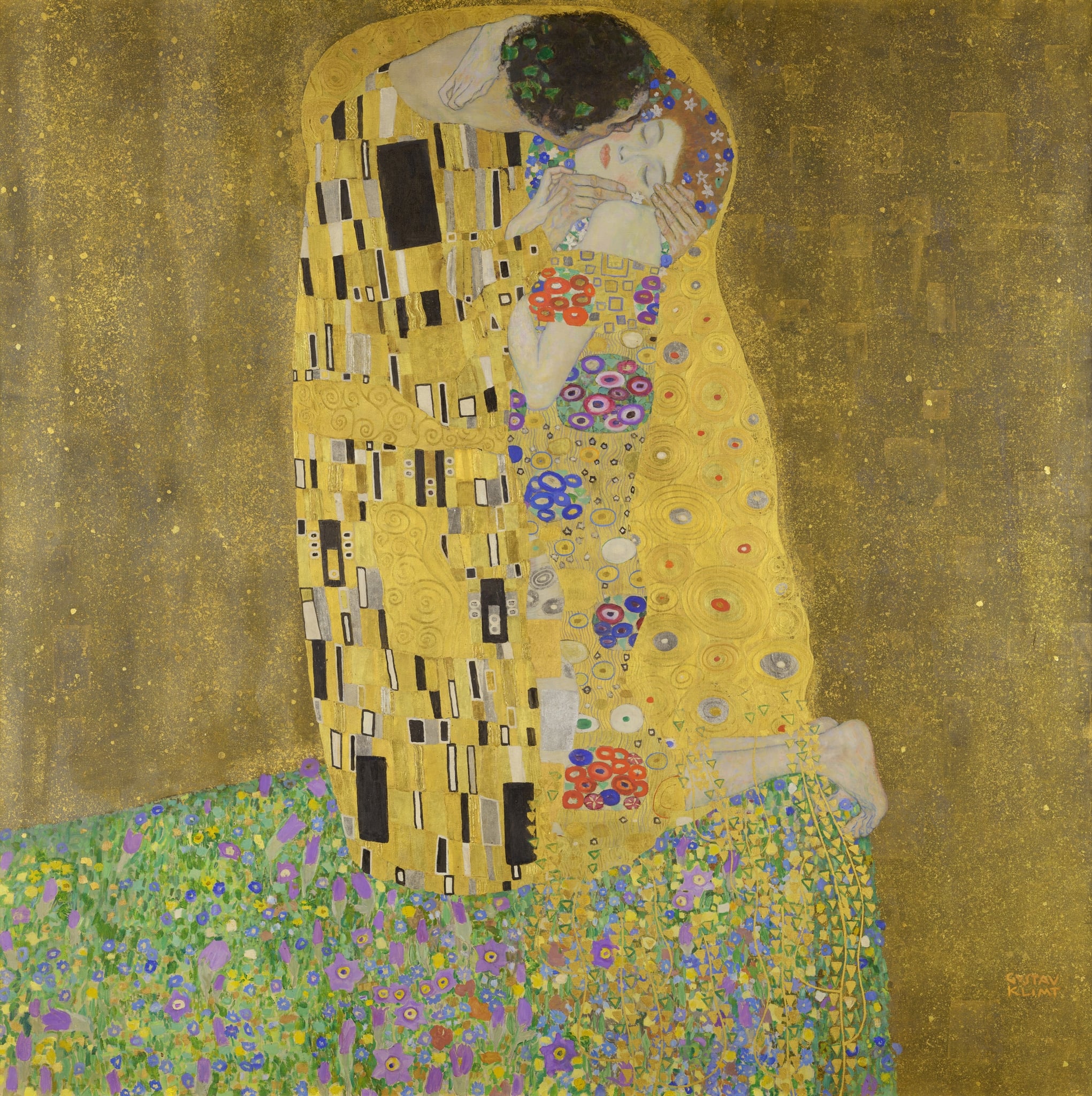
The Kiss stages human love as a <strong>sacred union</strong>, fusing two figures into a single, gold-clad form against a timeless field. Klimt opposes <strong>masculine geometry</strong> (black-and-white rectangles) to <strong>feminine organic rhythm</strong> (spirals, circles, flowers), then resolves them in radiant harmony <sup>[1]</sup><sup>[2]</sup>.
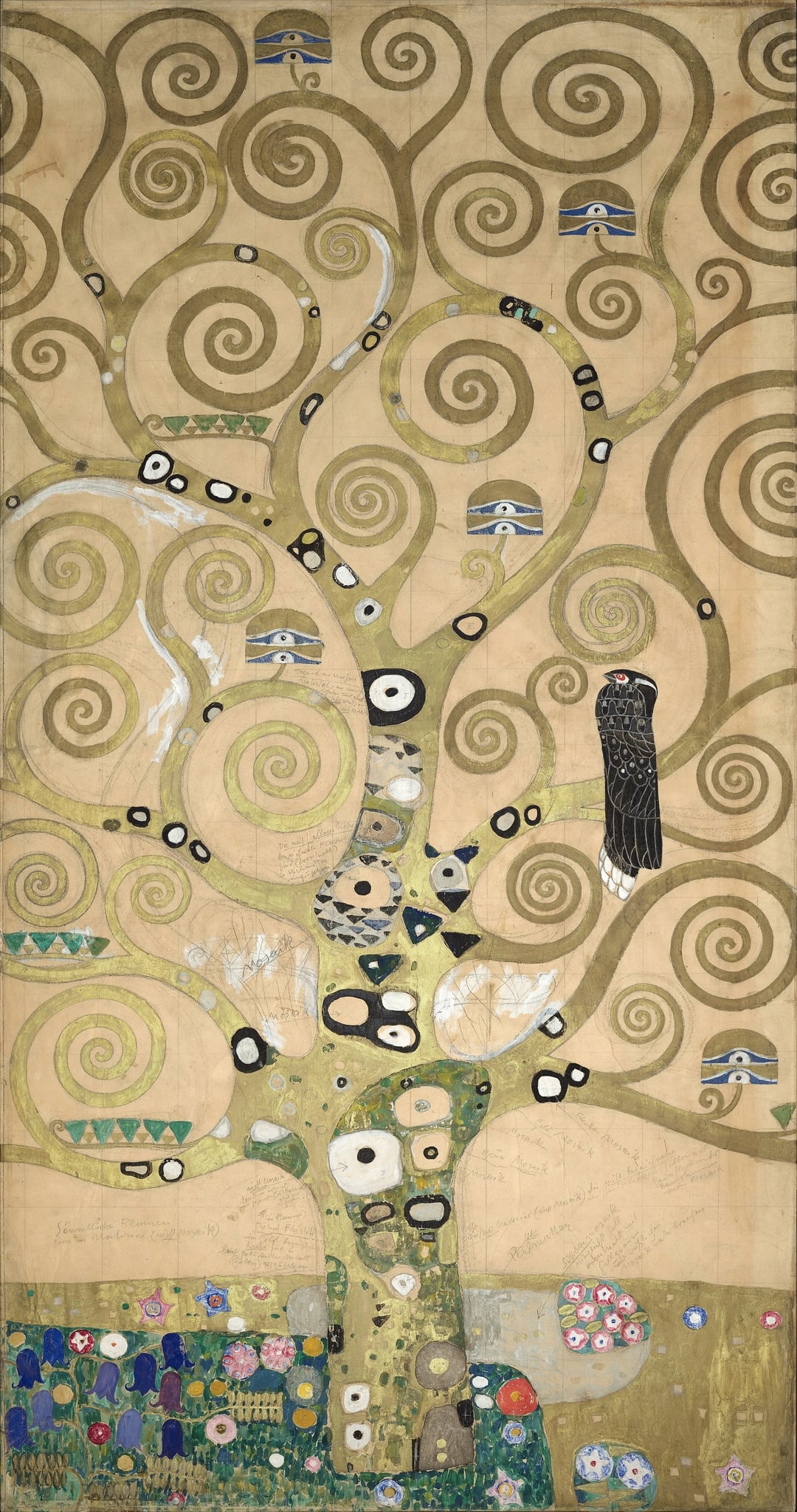
The Tree of Life by Gustav Klimt

The Tree of Life

Gustav Klimt (1910–1911 (design; mosaic installed 1911))

Gustav Klimt’s The Tree of Life crystallizes a <strong>cosmological axis</strong> in a gilded ornamental language: a rooted trunk erupts into <strong>endless spirals</strong>, embedded with <strong>eye-like rosettes</strong> and shadowed by a black, red‑eyed bird. Designed as part of the Stoclet dining‑room frieze, it fuses <strong>symbolism and luxury materials</strong> to link earthly abundance with timeless transcendence <sup>[1]</sup><sup>[2]</sup>.
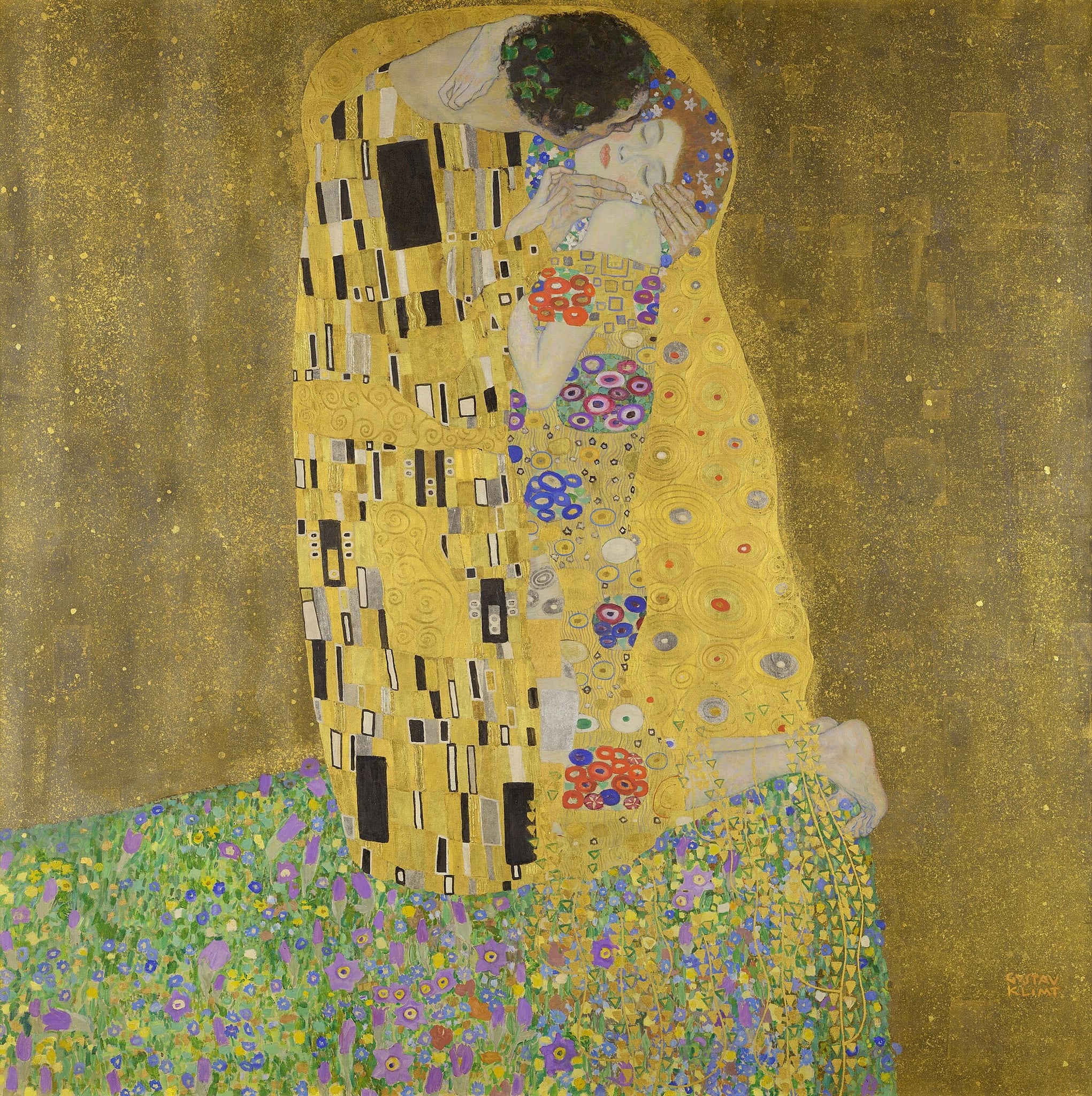
The Kiss (Lovers) by Gustav Klimt

The Kiss (Lovers)

Gustav Klimt (1907–1908 (Belvedere lists 1908/09))

The Kiss (Lovers) crystallizes Klimt’s <strong>Golden Period</strong> ideal: erotic union staged as a sacred vision. Two bodies fuse beneath a single golden mantle, poised on a flowered ledge at the brink of the unknown, where <strong>pattern becomes symbol</strong> and intimacy becomes icon.
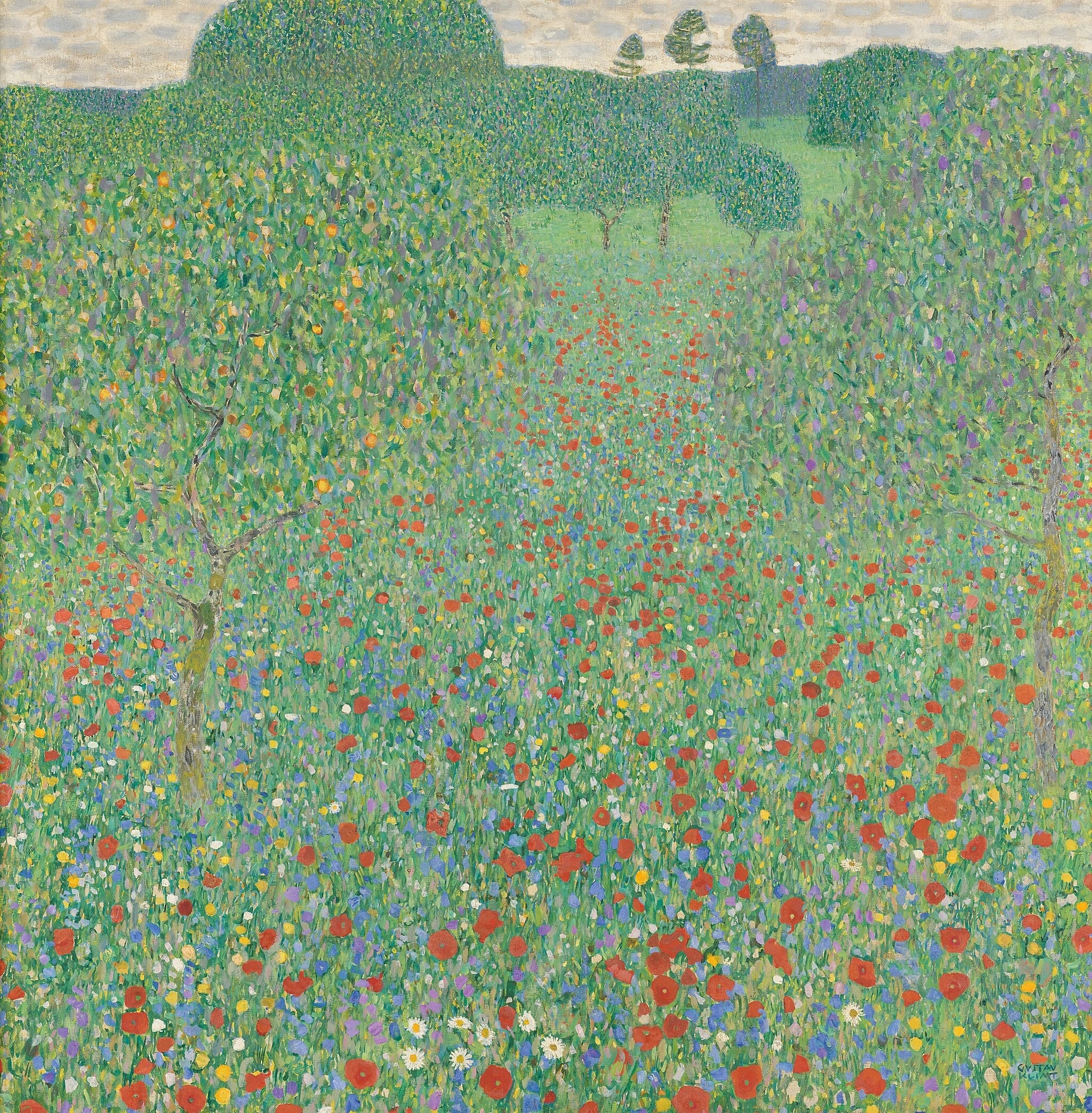
Flowering Poppies by Gustav Klimt

Flowering Poppies

Gustav Klimt (1907)

Gustav Klimt’s <strong>Flowering Poppies</strong> (1907) turns a meadow into a shimmering, all-over field where botany becomes <strong>ornament</strong>. A square canvas packed with red poppies, daisies, and fruiting trees compresses depth and invites a drifting gaze rather than linear recession <sup>[1]</sup><sup>[2]</sup>. The result is a sensuous, immersive vision that fuses observed nature with <strong>decorative abstraction</strong> <sup>[2]</sup>.