The Kiss (Lovers)

by Gustav Klimt

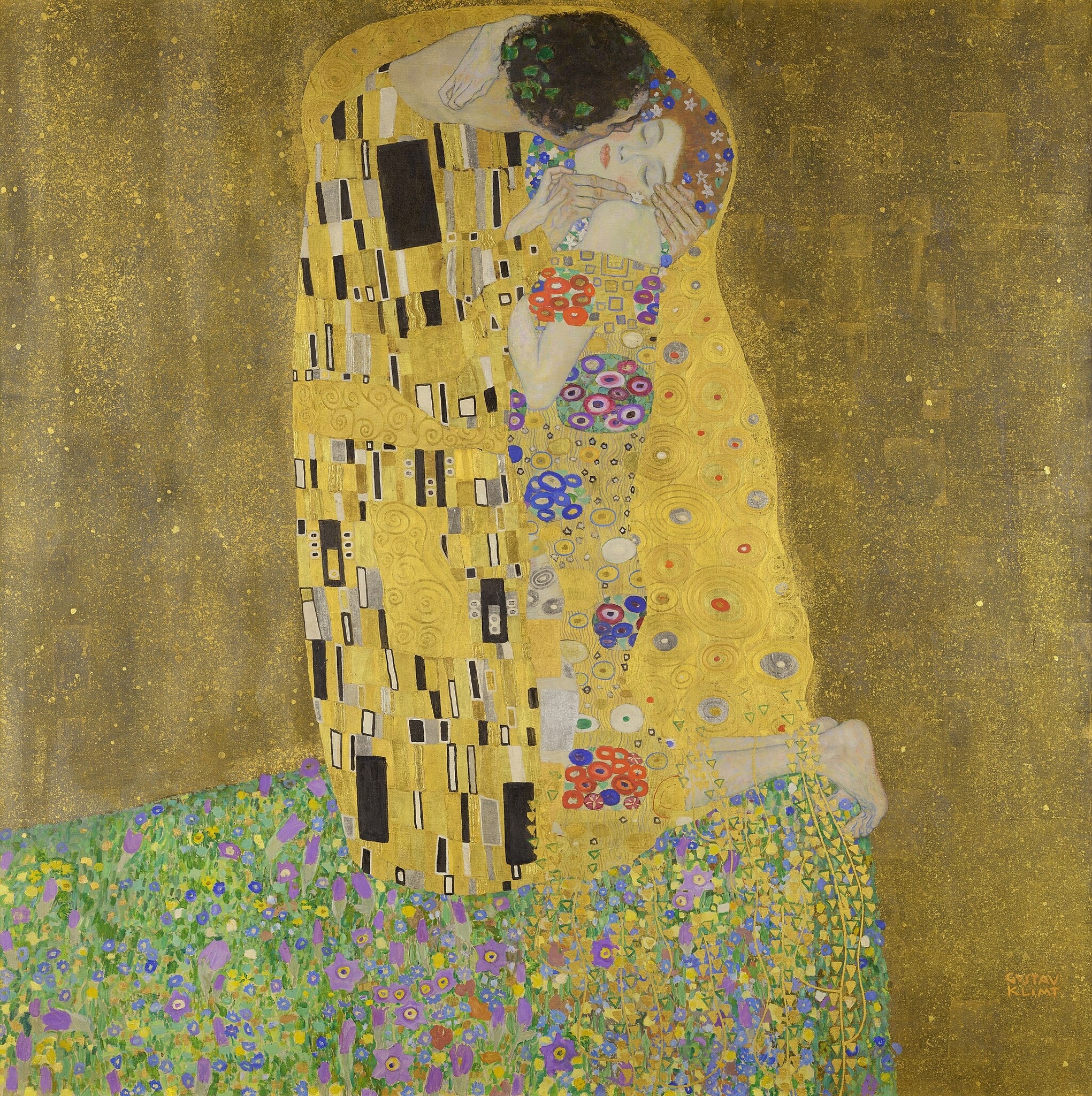
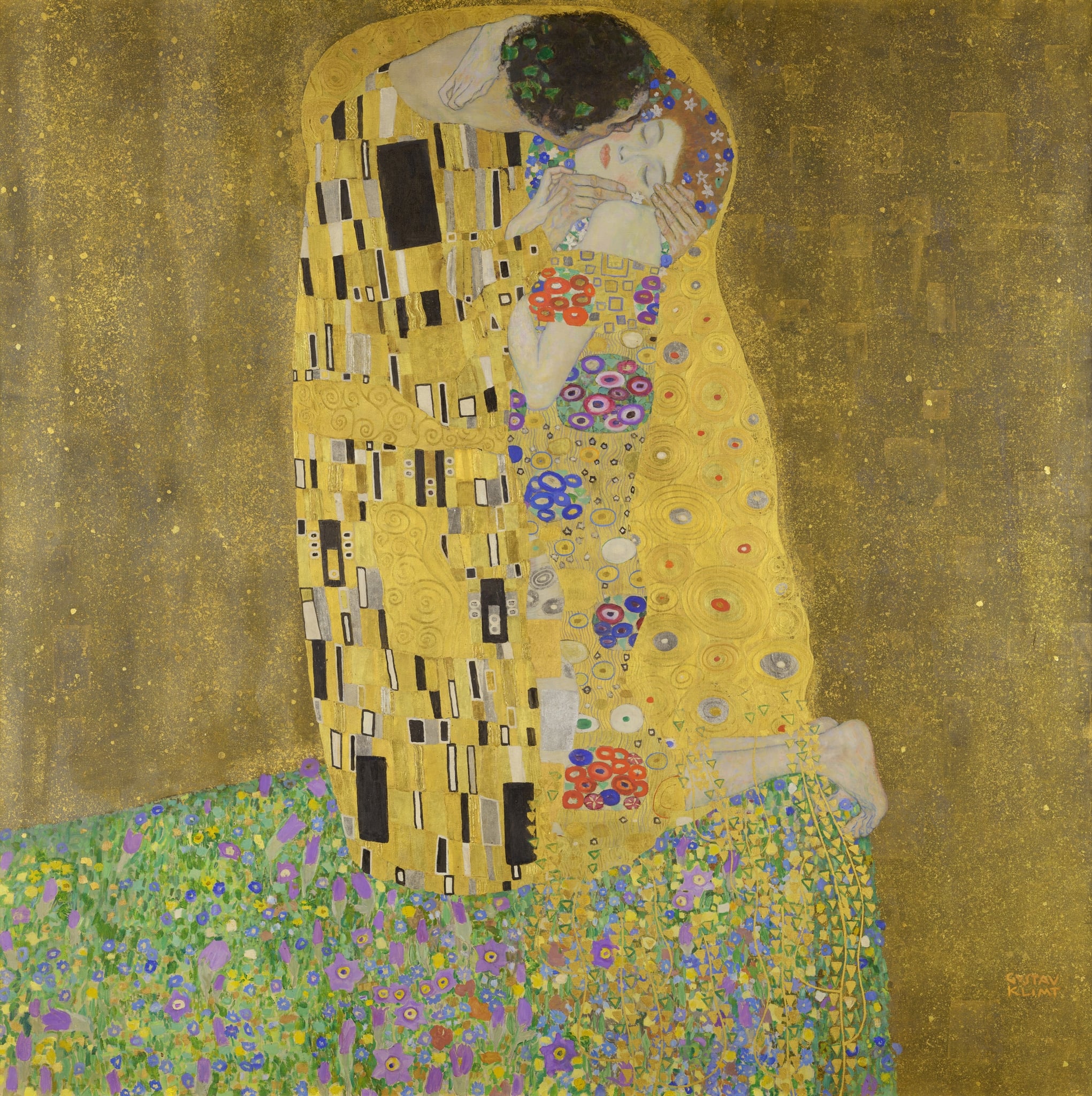
The Kiss (Lovers) crystallizes Klimt’s Golden Period ideal: erotic union staged as a sacred vision. Two bodies fuse beneath a single golden mantle, poised on a flowered ledge at the brink of the unknown, where pattern becomes symbol and intimacy becomes icon.
💰

Market Value

$400-600 million

How much is The Kiss (Lovers) worth?

Study Print Studio

Create a personal study print

Build a companion study sheet around the part of this painting that speaks to you most. Choose a detail, shape an interpretation, and walk away with something personal and display-worthy.

Fast Facts

Year
1907–1908 (Belvedere lists 1908/09)
Medium
Oil and gold leaf on canvas (with silver noted in some sources)
Dimensions
180 × 180 cm
Location
Upper Belvedere, Vienna
See all Gustav Klimt paintings in Vienna
The Kiss (Lovers) by Gustav Klimt (1907–1908 (Belvedere lists 1908/09)) featuring Golden aureole/ground, Unified golden mantle, Rectangles and black bars (masculine order), Spirals, rosettes, and circles (feminine vitality)

Click on any numbered symbol to learn more about its meaning

Meaning & Symbolism

Klimt frames the couple inside an all-enveloping aureole of gold, a deliberate echo of Byzantine and medieval gold grounds that sacralizes the act of kissing. The man’s head inclines and nestles at her cheek; her eyes are closed and her neck arches into his touch, not in submission but in chosen surrender—an image of mutual consent articulated by his gentle, cradling hands rather than a grasping hold. The gold field flattens depth and suspends time, converting the embrace into ritual. This is not mere decoration: the icon-like platform asserts that desire can bear spiritual consequence, a thesis Klimt had been developing since the Beethoven Frieze’s climactic embrace, the “kiss to the whole world” 59. Pattern carries the painting’s core argument. On his robe, black bars and stacked rectangles march in a measured grid; on hers, spirals, rosettes, and clustered circles bloom like living tissue. The dialectic is clear: structured, rectilinear energy faces organic, cyclical growth—an oft-noted Symbolist polarity that Klimt resolves by literally sewing the two systems into a single golden mantle 46. The robes meet over their joined torsos, where rectangles and spirals intermingle, visualizing erotic complementarity as equilibrium, not dominance. Even the male figure’s leafy crown—vegetal, not martial—recasts virility as fertile vitality rather than conquest 7. The woman’s armlet of small squares sits at her shoulder like a hinge between systems, and the red-and-white discs that cluster along her side read as floral rosettes while hinting at bodily microcosms; recent scholarship has proposed analogies to histological imagery, though such readings remain speculative and non-consensus 5. Beneath them, a meadow packed with tiny violets, buttercups, and blue blossoms rises steeply to a narrow ledge. Their knees press into this brink while the golden mantle spills forward in tassel-like triangles, as if love precipitates abundance at the edge of abyss. The brink is crucial: it stages eros as a threshold where selfhood risks dissolution, yet the painting insists on poise. Square format and central placement anchor the scene; the aureole’s stamped spirals and constellated dots circulate like a quiet cosmos, suggesting that private union can align with a larger order 36. This compositional poise—ornament fused to idea—is the Secessionist dream of a Gesamtkunstwerk made intimate, and it explains why the work, unveiled at the Kunstschau 1908 and swiftly acquired for the state collection, became a national image of modern love 782. Historically, the gold is more than glitter. After the University of Vienna scandal, Klimt turns from state allegory to a personal, decorative sublime. His encounter with Ravenna’s mosaics yields a technique that lets surface carry metaphysics: gold neutralizes anecdote, flattens narrative time, and lets pattern perform meaning 36. In The Kiss (Lovers), that alchemy is complete. The painting canonizes intimacy without denying its charge, fusing masculine and feminine scripts into a single field so radiant that the figures seem already half-transfigured. The result is a modern icon: human passion sanctified, individuality softened, and life visibly blooming at the very brink.

Explore Deeper with AI

Ask questions about The Kiss (Lovers)

Popular questions:

Powered by AI • Get instant insights about this artwork

💬 Ask questions about this artwork!

Interpretations

Historical Context

Unveiled at the Kunstschau Wien 1908—an immersive Secession exhibition designed to embody the Gesamtkunstwerk—The Kiss quickly became a state-purchased emblem of modern Austrian culture 28. In the wake of Klimt’s University of Vienna scandal, the canvas recalibrated his public image: it retains erotic charge yet speaks in a devotional decorum of gold and order. The square format and altar-like presentation aligned with the Kunstschau’s choreography of viewing, where design, architecture, and painting formed a unified aesthetic environment 2. The Ministry’s acquisition for 25,000 crowns institutionalized the work as a “national interest,” signaling how avant-garde ornament could serve civic identity rather than affront it 8. In this setting, love becomes a public value, and Klimt’s ornamental language functions as cultural diplomacy for a post-scandal Vienna.

Source: Tate Etc.; Belvedere; CNN

Formal Analysis

Formally, the painting’s square field stabilizes a near-vertical thrust: aureole, bodies, and mantle ascend while the meadow heaves up to a narrow ledge 5. Klimt suppresses depth—gold ground, stamped motifs, and shallow overlap—to produce a hieratic, icon-like frontality that suspends narrative time 45. The embrace echoes the culminating couple in the 1902 Beethoven Frieze—Schiller’s “kiss to the whole world”—but miniaturizes the public allegory into an intimate icon 7. Motif economies do argumentative work: rectilinear blacks on his robe interlock with circular and spiral cells on hers, fusing opposites at the torsos. This ornamental syntax prefigures and converses with near-contemporary designs for the Stoclet Frieze’s Fulfillment, where pattern likewise carries affect and structure 45. Ornament here is not accessory; it is the composition’s grammar.

Source: Smarthistory; A&AePortal; Wikipedia (Beethoven Frieze)

Gender Politics & Agency

Klimt encodes gender as a polarity-in-harmony: the male figure’s bars and stacked rectangles propose measured, exteriorized energy; the woman’s spirals and rosettes imply interior, cyclical growth. Crucially, his hands cradle rather than seize, and her neck inclines with volitional repose—gestures that complicate Symbolist scripts of female passivity 4. The leafy circlet on his head (often read as laurel/ivy) reframes virility as vegetative vitality, not conquest, softening patriarchal tropes through Secessionist Naturform 2. The intermixing of motifs across their joined torsos visualizes erotic reciprocity rather than dominance, while the woman’s square armlet acts like a hinge between systems—an index of agency at the joint of union. Ambiguity remains—femininity is still ornamented and spectacular—but the image advances a modern, negotiated erotic ethic.

Source: Smarthistory; Tate Etc.

Medium, Gold, and Byzantine Afterlives

Klimt’s gold is a technology of transcendence. Trips to Ravenna exposed him to Byzantine mosaics whose gold grounds annul depth and mortal time; in The Kiss, leafed passages and stamped ornament adopt that liturgical surface to sanctify secular desire 36. The support behaves like a mosaic analog: tessellated motifs, planar shimmer, and specular flicker as the viewer moves. This medium choice is programmatic—after the Faculty Paintings’ censure, gold enables a non-narrative, metaphysical decorum that communicates affect without academic allegory 3. Public reactions oscillated between awe and charges of sacrilege, evidence that Klimt’s sacred-secular fusion struck a live cultural nerve in fin‑de‑siècle Vienna 6. The result is a modern icon where material preciousness and optical flatness perform the painting’s theology of eros.

Source: Encyclopaedia Britannica; Artnet News

Mythic Thresholds

The lovers kneel on a floral promontory that ends in a precipice—a staging some scholars link to Orpheus and Eurydice or other threshold myths, where touch risks loss at the mouth of the underworld 6. While identifications remain speculative, the brink dramatizes eros as a limen: self dissolves into union even as a void opens below. The hortus-conclusus-like meadow, dense with violets and buttercups, seals the embrace within a ritual garden, a protected plot of time outside history 5. Klimt’s aureole transforms the mythic ordeal into quiet cosmic order, reducing narrative to archetype. Whether or not a named myth is intended, the painting behaves mythically—compressing fate, risk, and consummation into a single suspended instant.

Source: Artnet News; A&AePortal

Biology as Ornament (Speculative Reading)

Among the woman’s circular clusters, medical‑humanities scholars have proposed analogies to histological imagery—notably red blood cells—suggesting a fin‑de‑siècle synthesis of erotic and biological life 9. While non‑consensus, this lens resonates with Klimt’s Vienna, where sex, physiology, and psychology intertwined in public discourse. If read this way, the pattern grammar carries a microcosmic argument: love as cellular proliferation, ornament as life process. Such a reading complements but does not replace Byzantine sacrality—gold flattens time while discs imply the vital. Caution is warranted: no object record confirms intentional cytology. Yet the proposal underscores Klimt’s capacity to load decoration with layered meanings, from sacred icon to somatic sign.

Source: Medical Humanities (PMC article)

Related Themes

About Gustav Klimt

Gustav Klimt (1862–1918), co-founder of the Vienna Secession, pivoted from controversial public commissions to a decorative-symbolist language in his Golden Period. Drawing on Byzantine mosaics and modern design, he fused opulent surfaces with psychological intensity. By 1908–09, he transformed scandal into canon, and The Kiss became Vienna’s emblem of modern love.
View all works by Gustav Klimt

More by Gustav Klimt

Portrait of Adele Bloch-Bauer I by Gustav Klimt

Portrait of Adele Bloch-Bauer I

Gustav Klimt (1907)

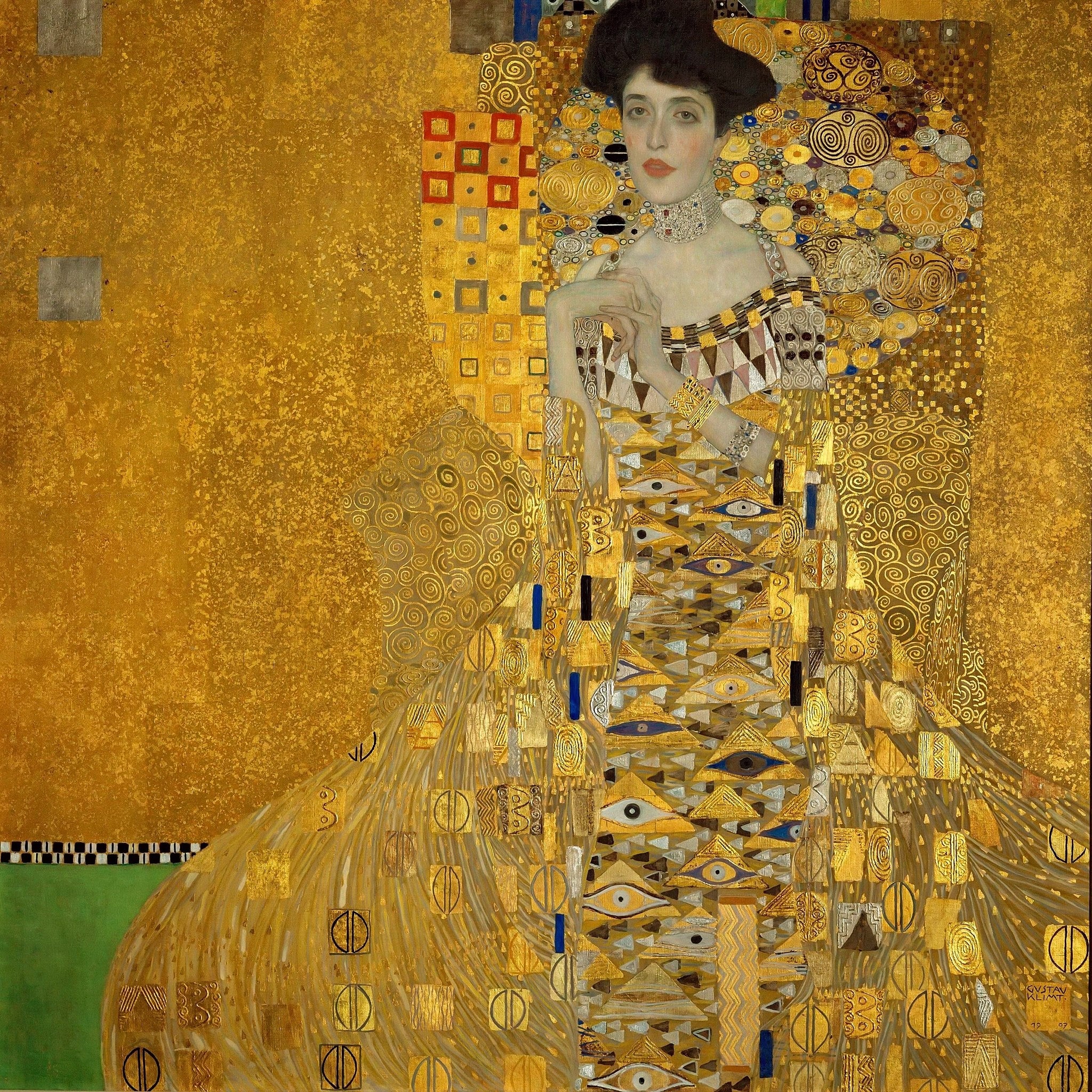
Gustav Klimt’s Portrait of Adele Bloch-Bauer I stages its sitter as a <strong>secular icon</strong>—a living presence suspended in a field of gold that converts space into <strong>pattern and power</strong>. The naturalistic face and hands emerge from a reliquary-like cascade of eyes, triangles, and tesserae, turning light, ornament, and status into the painting’s true subjects <sup>[1]</sup><sup>[2]</sup>.
Sunflower by Gustav Klimt

Sunflower

Gustav Klimt (1907/1908)

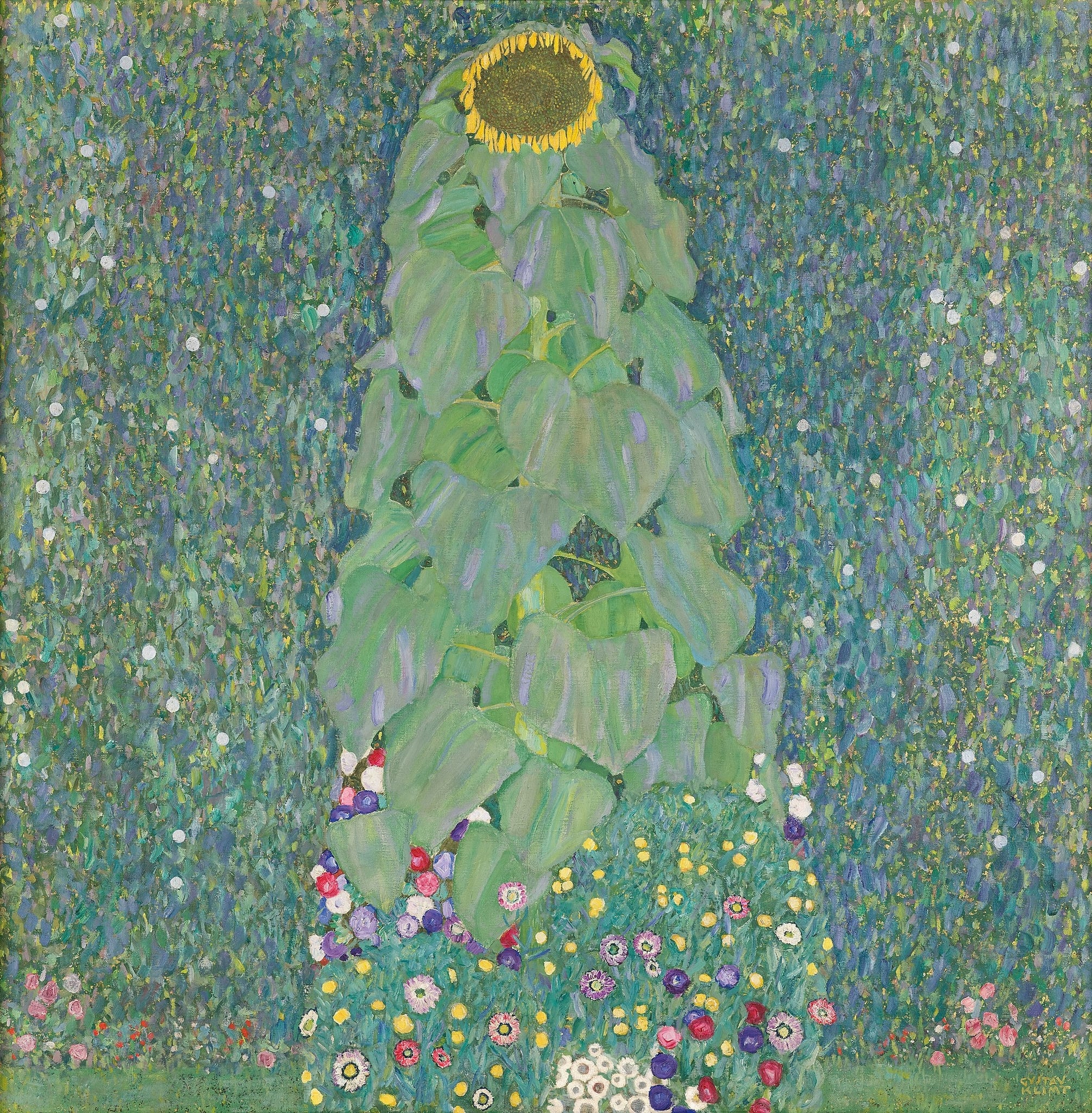
Gustav Klimt’s Sunflower turns a single bloom into a <strong>monumental, figure-like presence</strong>. A tapering stack of broad, drooping leaves rises from a <strong>mosaic-like carpet of round blossoms</strong>, crowned by a gold-flecked disc that glows against a cool, stippled field. The work fuses <strong>portrait, icon, and landscape</strong> into one emblem of vitality and quiet sanctity <sup>[1]</sup><sup>[2]</sup>.
Cottage Garden with Sunflowers by Gustav Klimt

Cottage Garden with Sunflowers

Gustav Klimt (1906–1907 (signed 1907))

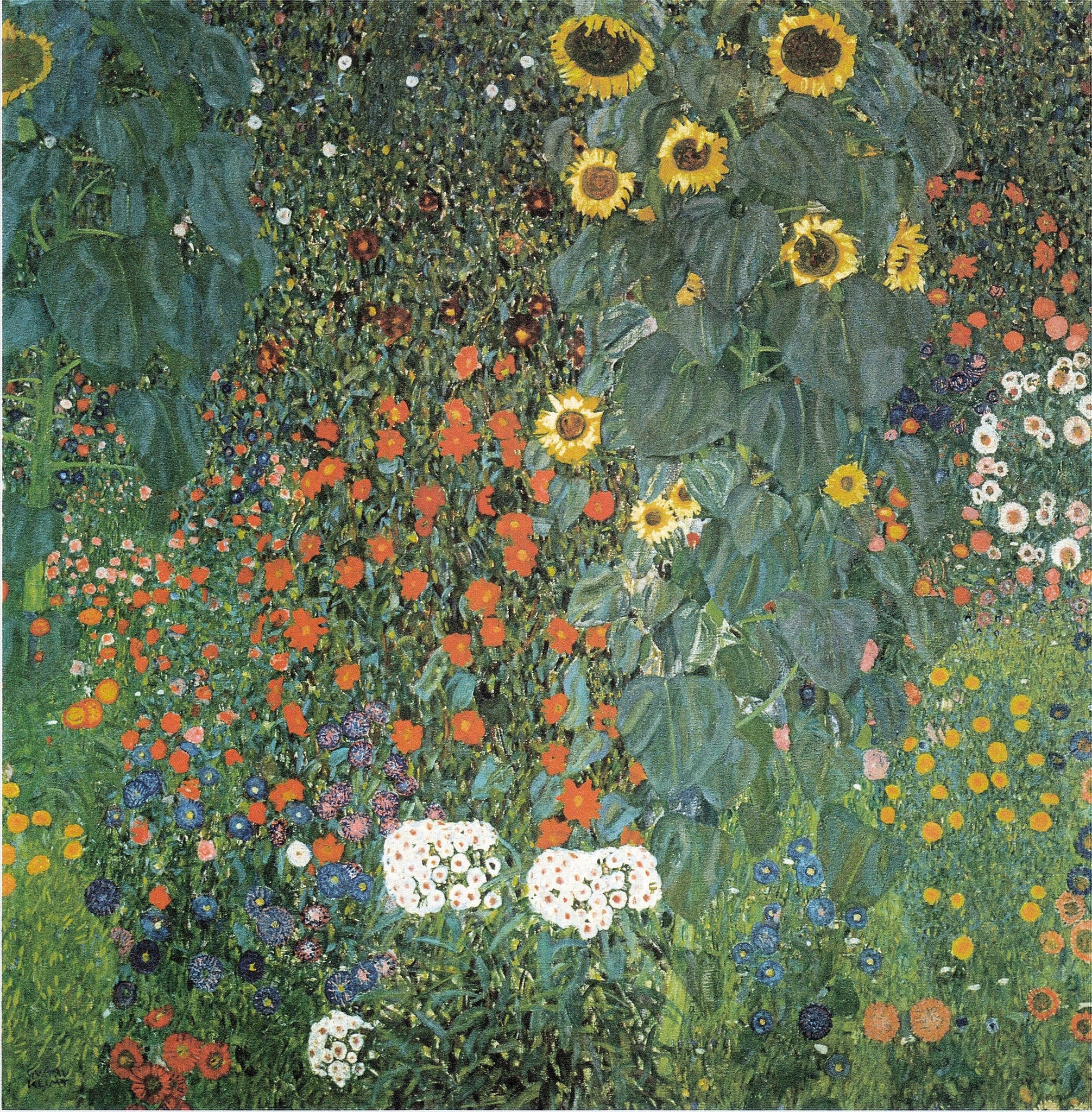
Cottage Garden with Sunflowers is a square, horizonless field of blooms where a vertical column of <strong>sunflowers</strong> anchors an all-over weave of color and pattern. Klimt fuses <strong>ornament and nature</strong>, turning a humble Litzlberg cottage plot into a radiant matrix of cyclical life and renewal <sup>[1]</sup><sup>[4]</sup><sup>[5]</sup>.
The Kiss by Gustav Klimt

The Kiss

Gustav Klimt (1908 (completed 1909))

The Kiss stages human love as a <strong>sacred union</strong>, fusing two figures into a single, gold-clad form against a timeless field. Klimt opposes <strong>masculine geometry</strong> (black-and-white rectangles) to <strong>feminine organic rhythm</strong> (spirals, circles, flowers), then resolves them in radiant harmony <sup>[1]</sup><sup>[2]</sup>.
The Tree of Life by Gustav Klimt

The Tree of Life

Gustav Klimt (1910–1911 (design; mosaic installed 1911))

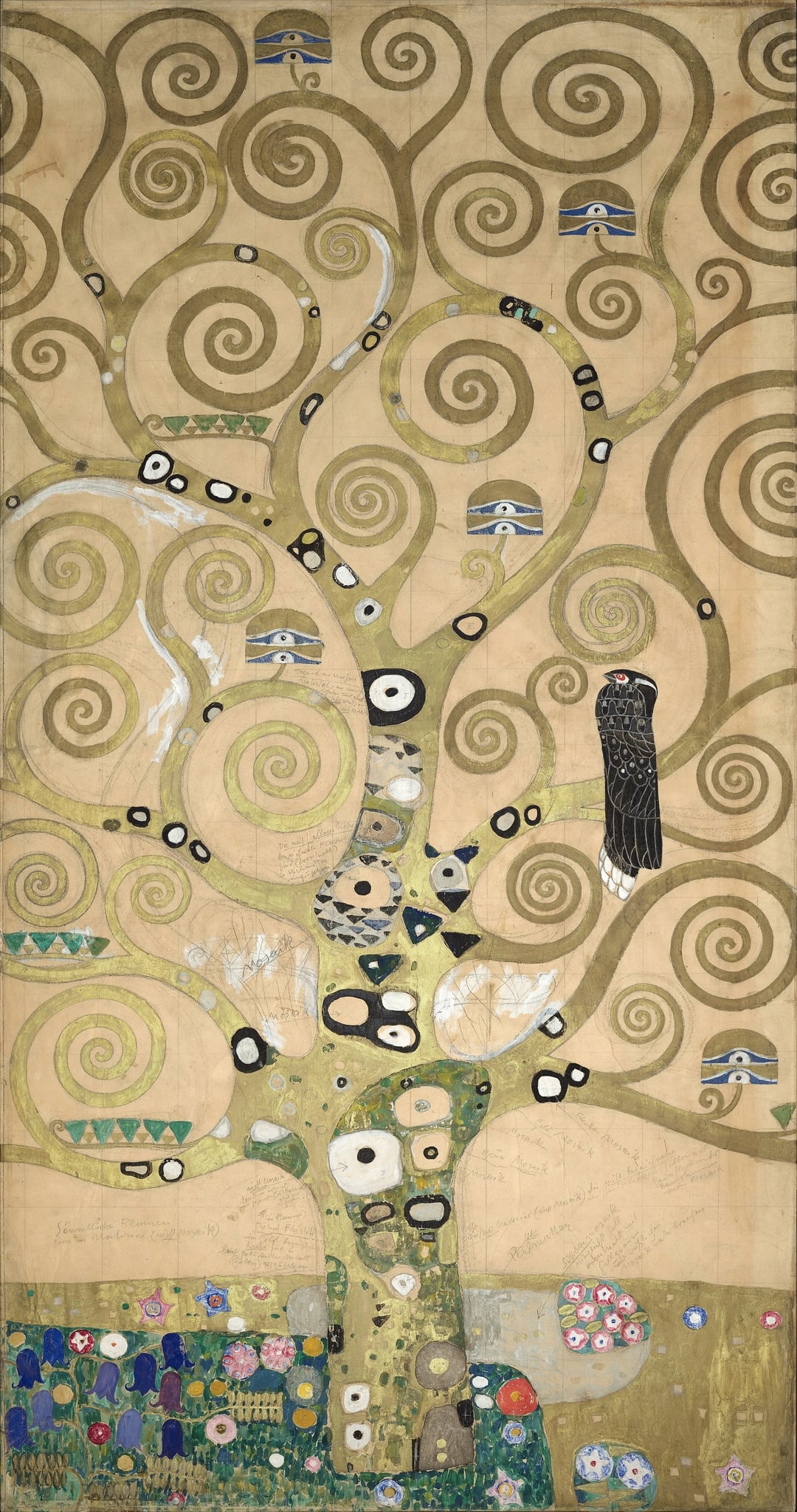
Gustav Klimt’s The Tree of Life crystallizes a <strong>cosmological axis</strong> in a gilded ornamental language: a rooted trunk erupts into <strong>endless spirals</strong>, embedded with <strong>eye-like rosettes</strong> and shadowed by a black, red‑eyed bird. Designed as part of the Stoclet dining‑room frieze, it fuses <strong>symbolism and luxury materials</strong> to link earthly abundance with timeless transcendence <sup>[1]</sup><sup>[2]</sup>.
Flowering Poppies by Gustav Klimt

Flowering Poppies

Gustav Klimt (1907)

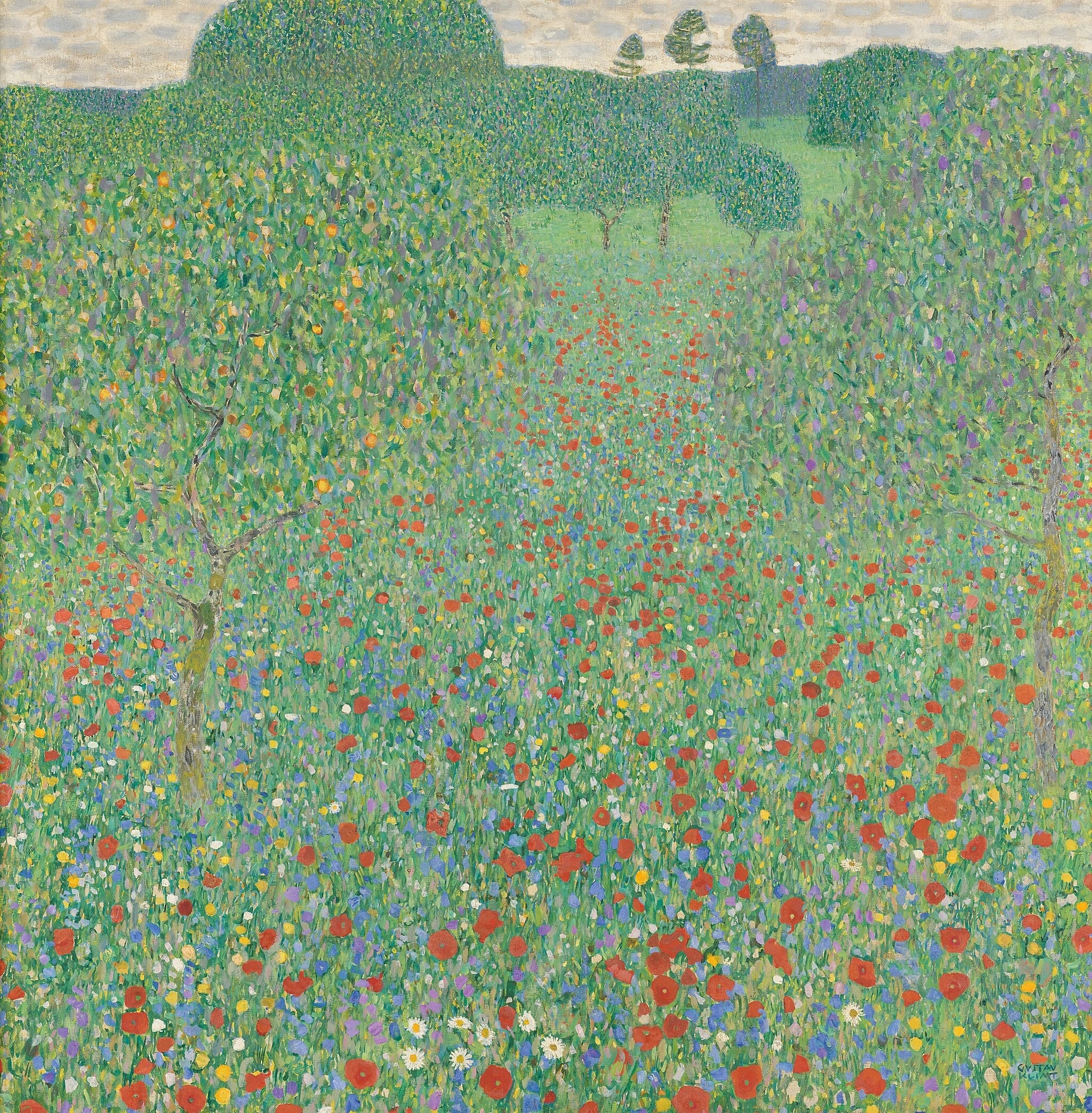
Gustav Klimt’s <strong>Flowering Poppies</strong> (1907) turns a meadow into a shimmering, all-over field where botany becomes <strong>ornament</strong>. A square canvas packed with red poppies, daisies, and fruiting trees compresses depth and invites a drifting gaze rather than linear recession <sup>[1]</sup><sup>[2]</sup>. The result is a sensuous, immersive vision that fuses observed nature with <strong>decorative abstraction</strong> <sup>[2]</sup>.