Architecture
Architectural motifs in modern painting operate as charged thresholds between private and public, nature and culture, and individual perception and collective order, translating built form into a language for negotiating modernity’s social and psychological stakes.
Member Symbols
Featured Artworks
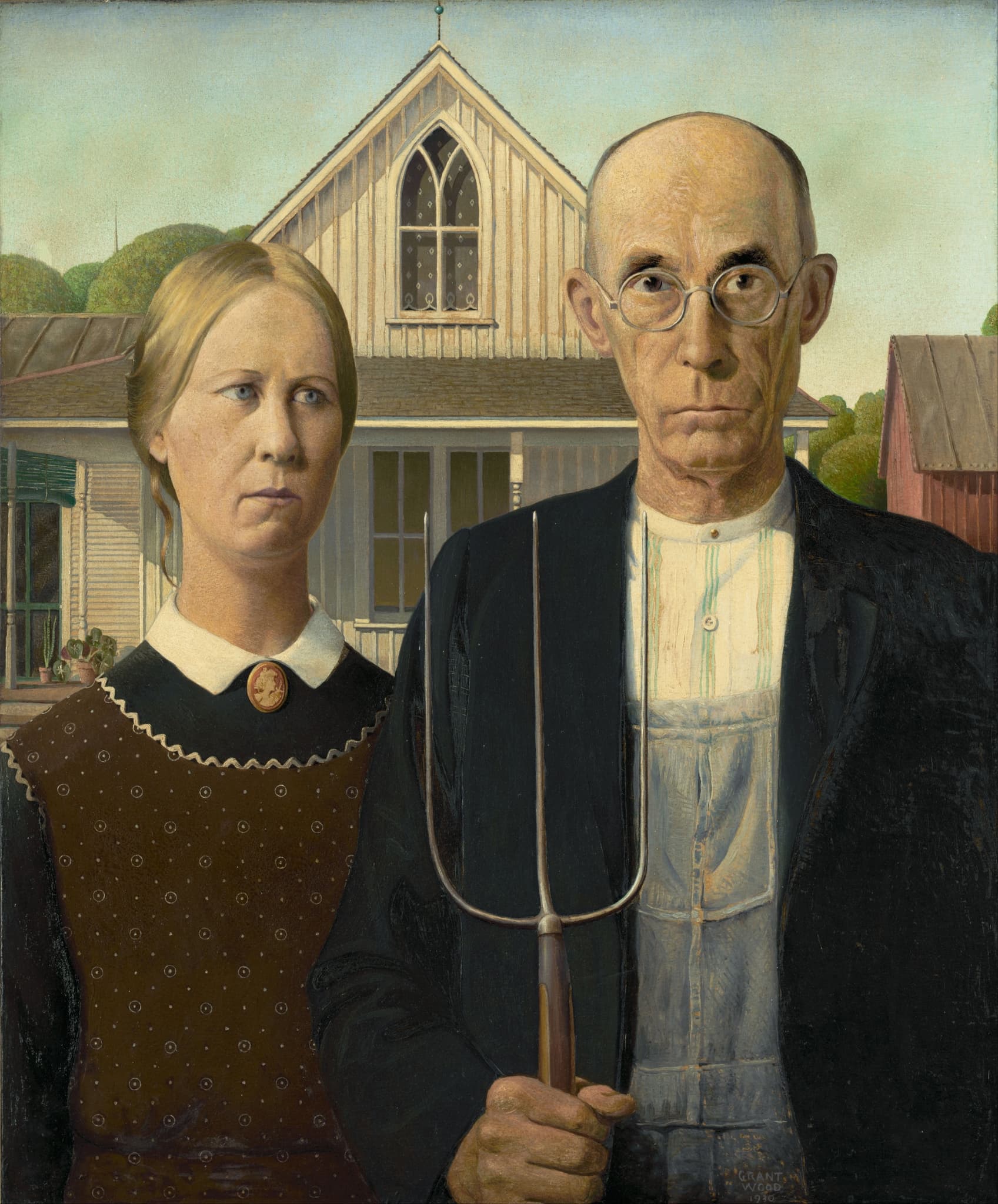
American Gothic
Grant Wood (1930)
Grant Wood’s American Gothic (1930) turns a plain Midwestern homestead into a <strong>moral emblem</strong> by binding two flinty figures to the strict geometry of a Carpenter Gothic gable and a three‑tined pitchfork. The painting’s cool precision and echoing verticals create a <strong>compressed ethic of work, order, and restraint</strong> that can read as both tribute and critique <sup>[1]</sup><sup>[2]</sup><sup>[3]</sup>.
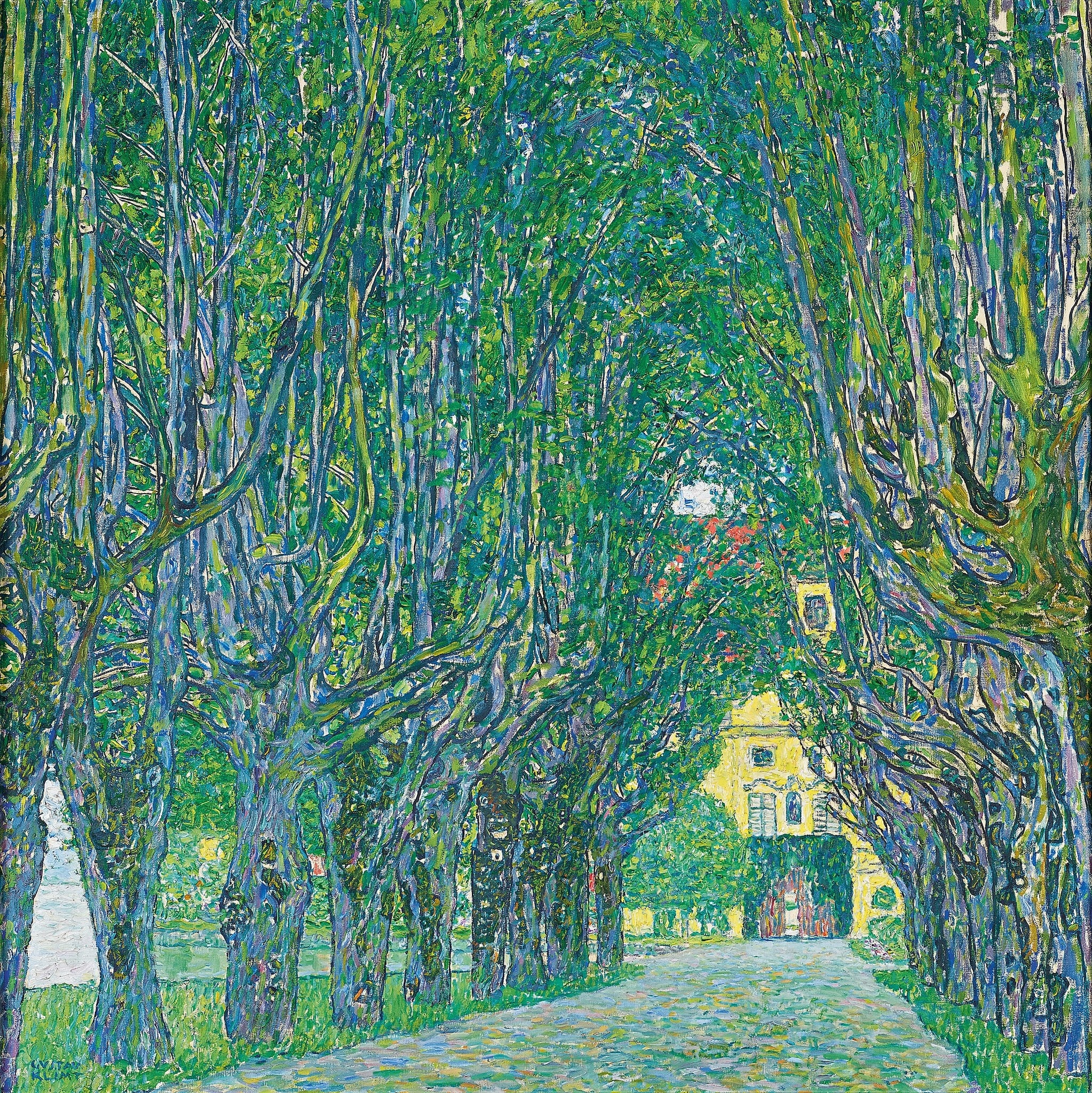
Avenue in Schloss Kammer Park
Gustav Klimt (1912)
Gustav Klimt’s Avenue in Schloss Kammer Park stages a ceremonial approach beneath a vaulted <strong>tunnel of linden trees</strong>, their pollarded limbs clasping to form a green nave. A cobbled axis pulls the eye toward a sunlit <strong>ocher façade and arched doorway</strong>, while Klimt’s tessellated strokes make foliage, bark, and shadow flicker between <strong>pattern and depth</strong> <sup>[1]</sup><sup>[5]</sup><sup>[6]</sup>.
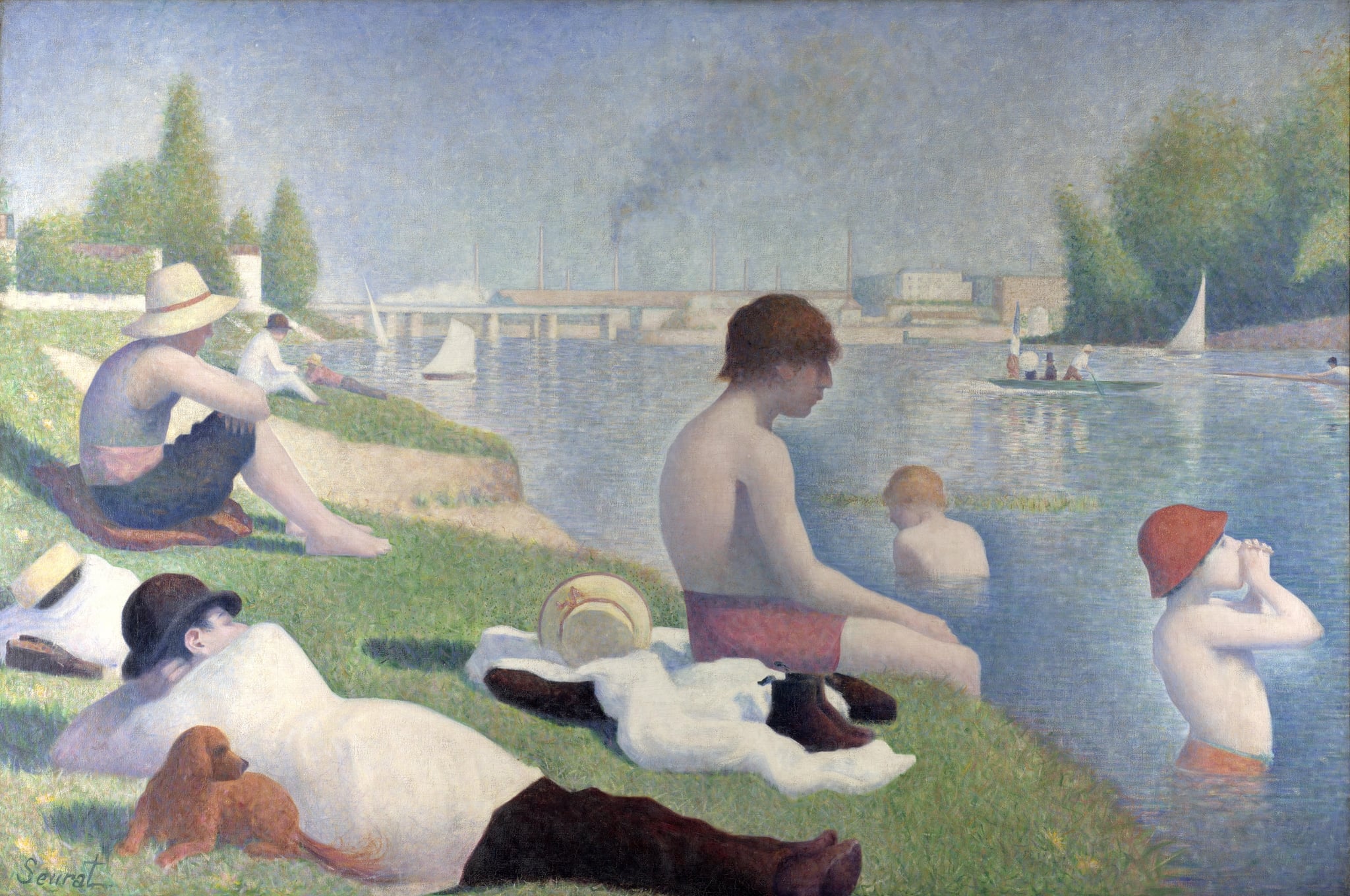
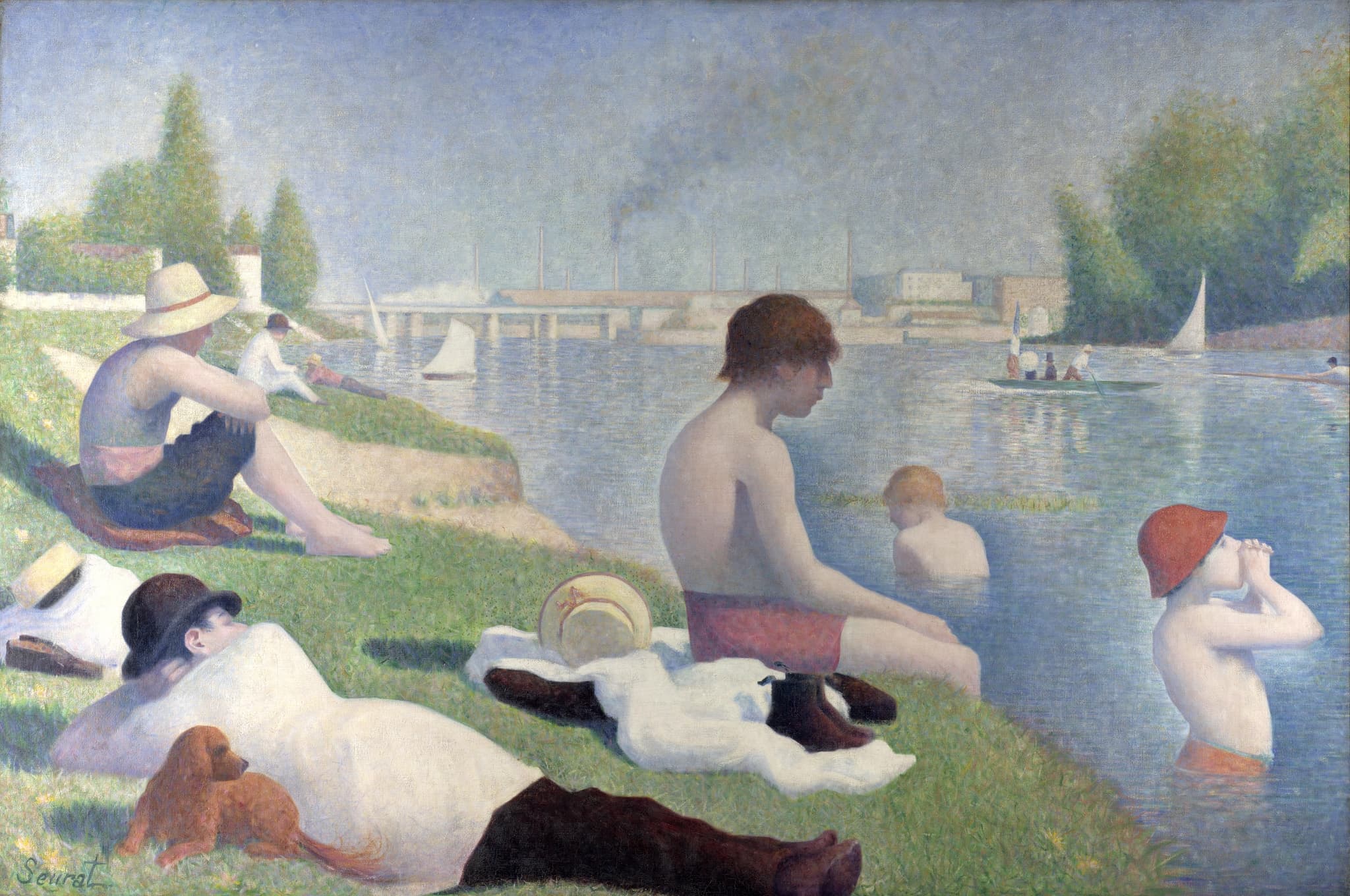
Bathers at Asnières
Georges Seurat (1884)
Bathers at Asnières stages a scene of <strong>modern leisure</strong> on the Seine, where workers recline and wade beneath a hazy, unified light. Seurat fuses <strong>classicizing stillness</strong> with an <strong>industrial backdrop</strong> of chimneys, bridges, and boats, turning ordinary rest into a monumental, ordered image of urban life <sup>[1]</sup><sup>[3]</sup>. The canvas balances soft greens and blues with geometric structures, producing a calm yet charged harmony.
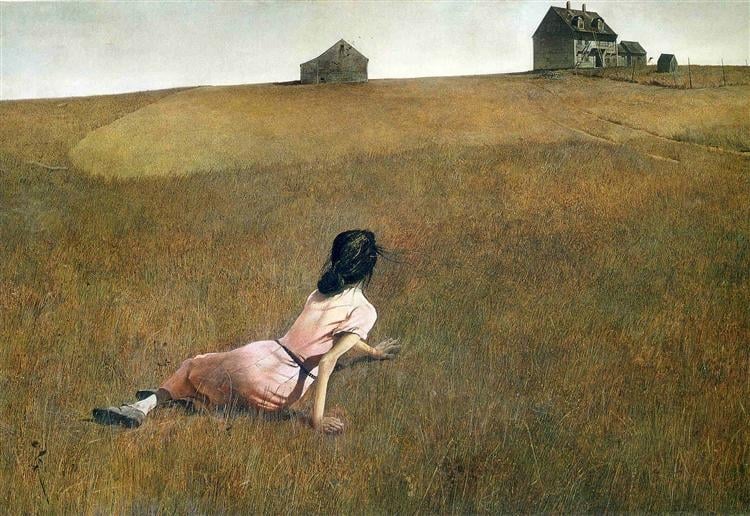
Christina's World
Andrew Wyeth (1948)
Andrew Wyeth’s Christina’s World distills vast rural space and human resolve into a single, charged image: a woman in a <strong>faded pink dress</strong> braces on the <strong>up-slope</strong> toward a weathered farmhouse. The diagonal pull between her body and the <strong>Olson House</strong> turns distance itself into <strong>yearning and endurance</strong> <sup>[1]</sup><sup>[4]</sup>. Wyeth’s spare, <strong>egg tempera</strong> surface makes every brittle grass blade feel like an act of will <sup>[1]</sup><sup>[3]</sup>.
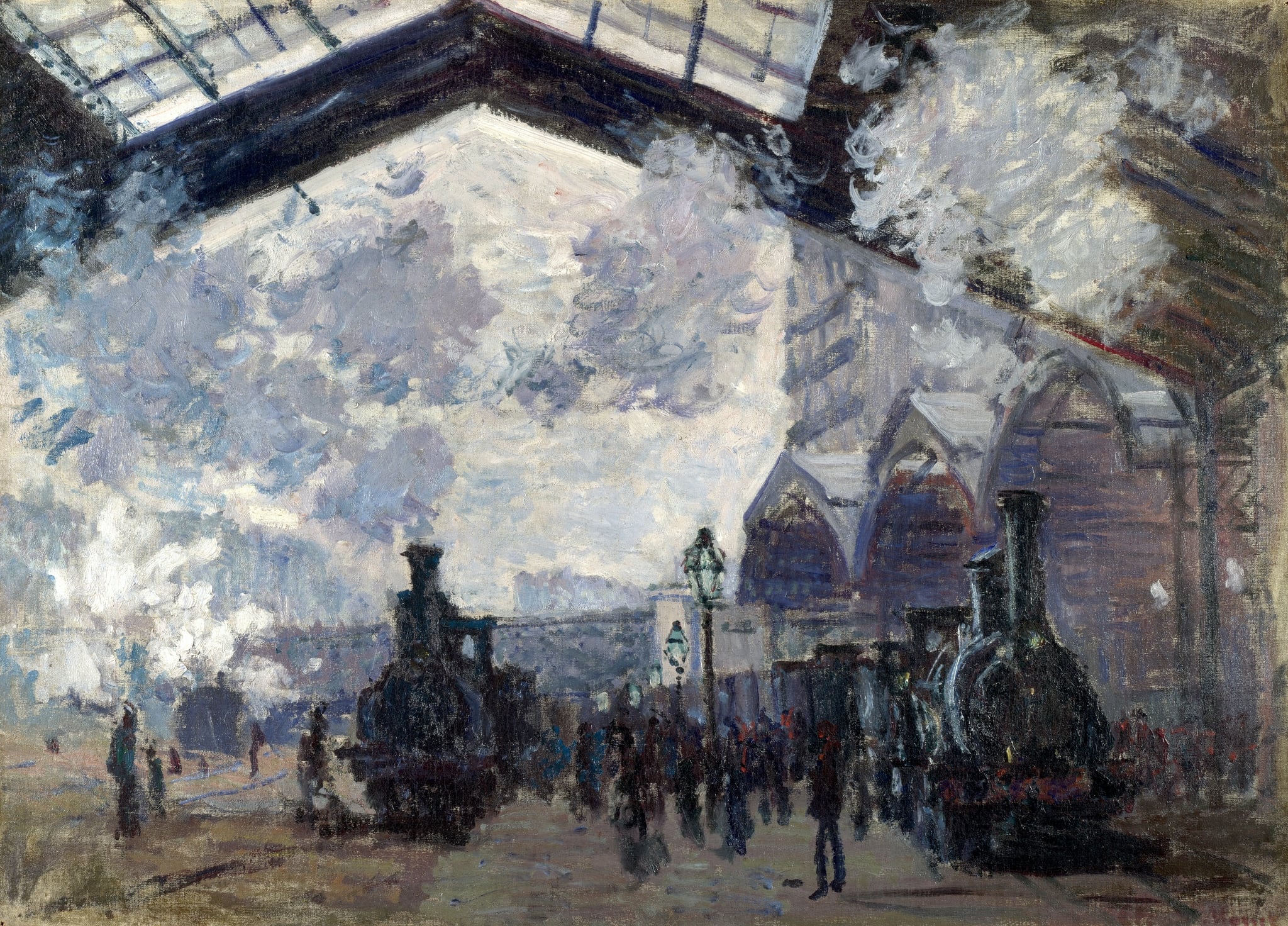
Gare Saint-Lazare
Claude Monet (1877)
Monet’s Gare Saint-Lazare turns an iron-and-glass train shed into a theater of <strong>steam, light, and motion</strong>. Twin locomotives, gas lamps, and a surge of figures dissolve into bluish vapor under the diagonal canopy, recasting industrial smoke as <strong>luminous atmosphere</strong> <sup>[1]</sup><sup>[2]</sup>.

Houses of Parliament
Claude Monet (1903)
Claude Monet’s Houses of Parliament renders Westminster as a <strong>dissolving silhouette</strong> in a wash of peach, mauve, and pale gold, where stone and river are leveled by <strong>luminous fog</strong>. Short, vibrating strokes turn architecture into <strong>atmosphere</strong>, while a tiny boat anchors human scale amid the monumental scene.

Mont Sainte-Victoire
Paul Cézanne (1902–1906)
Cézanne’s Mont Sainte-Victoire renders the Provençal massif as a constructed order of <strong>planes and color</strong>, not a fleeting impression. Cool blues and violets articulate the mountain’s facets, while <strong>ochres and greens</strong> laminate the fields and blocky houses, binding atmosphere and form into a single structure <sup>[2]</sup><sup>[4]</sup>.
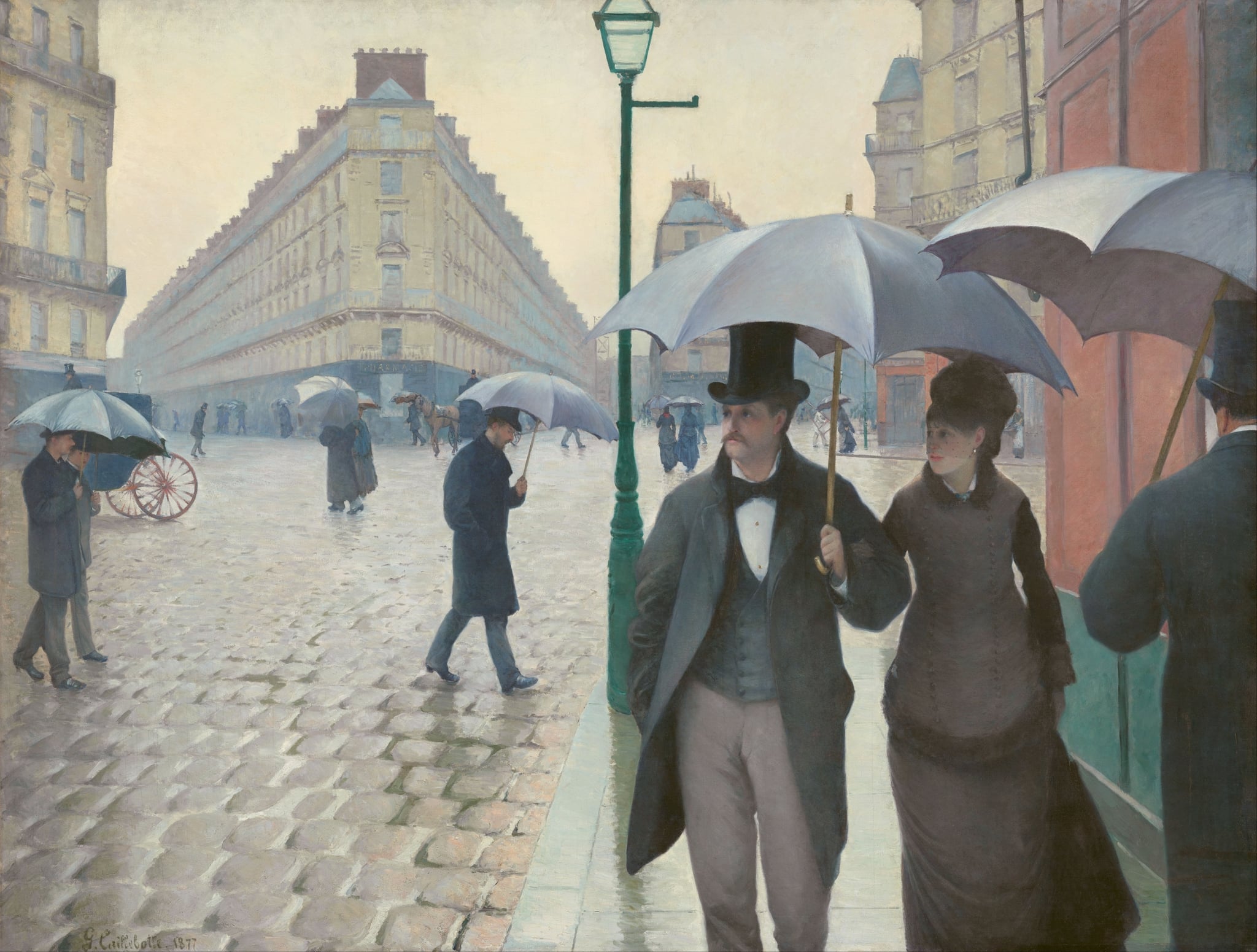
Paris Street; Rainy Day
Gustave Caillebotte (1877)
Gustave Caillebotte’s Paris Street; Rainy Day renders a newly modern Paris where <strong>Haussmann’s geometry</strong> meets the <strong>anonymity of urban life</strong>. Umbrellas punctuate a silvery atmosphere as a <strong>central gas lamp</strong> and knife-sharp façades organize the space into measured planes <sup>[1]</sup><sup>[2]</sup>.

Pont Neuf Paris
Pierre-Auguste Renoir (1872)
In Pont Neuf Paris, Pierre-Auguste Renoir turns the oldest bridge in Paris into a stage where <strong>light</strong> and <strong>movement</strong> bind a city back together. From a high perch, he orchestrates crowds, carriages, gas lamps, the rippling Seine, and a fluttering <strong>tricolor</strong> so that everyday bustle reads as civic grace <sup>[1]</sup>.
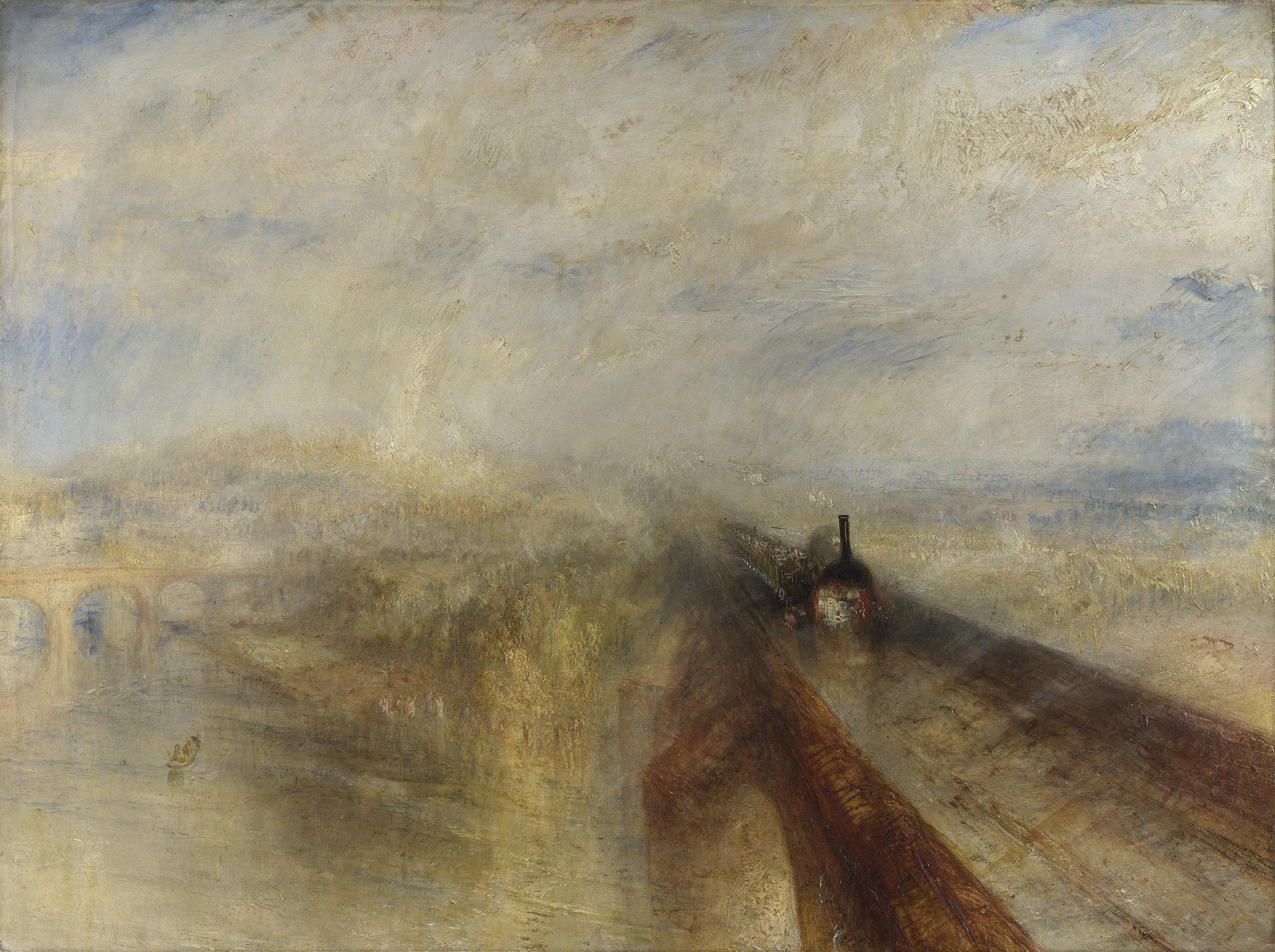
Rain, Steam and Speed
J. M. W. Turner (1844)
In Rain, Steam and Speed, J. M. W. Turner fuses weather and industry into a single onrushing vision, as a dark locomotive thrusts along the diagonal of Brunel’s Maidenhead Railway Bridge through veils of rain and light. The blurred fields, river, and town dissolve into a charged atmosphere where <strong>rain</strong>, <strong>steam</strong>, and <strong>speed</strong> become the true subjects. Counter-motifs—a small boat beneath pale arches and a near-invisible hare ahead of the train—stage a drama between pre‑industrial life and modern velocity <sup>[1]</sup><sup>[2]</sup>.
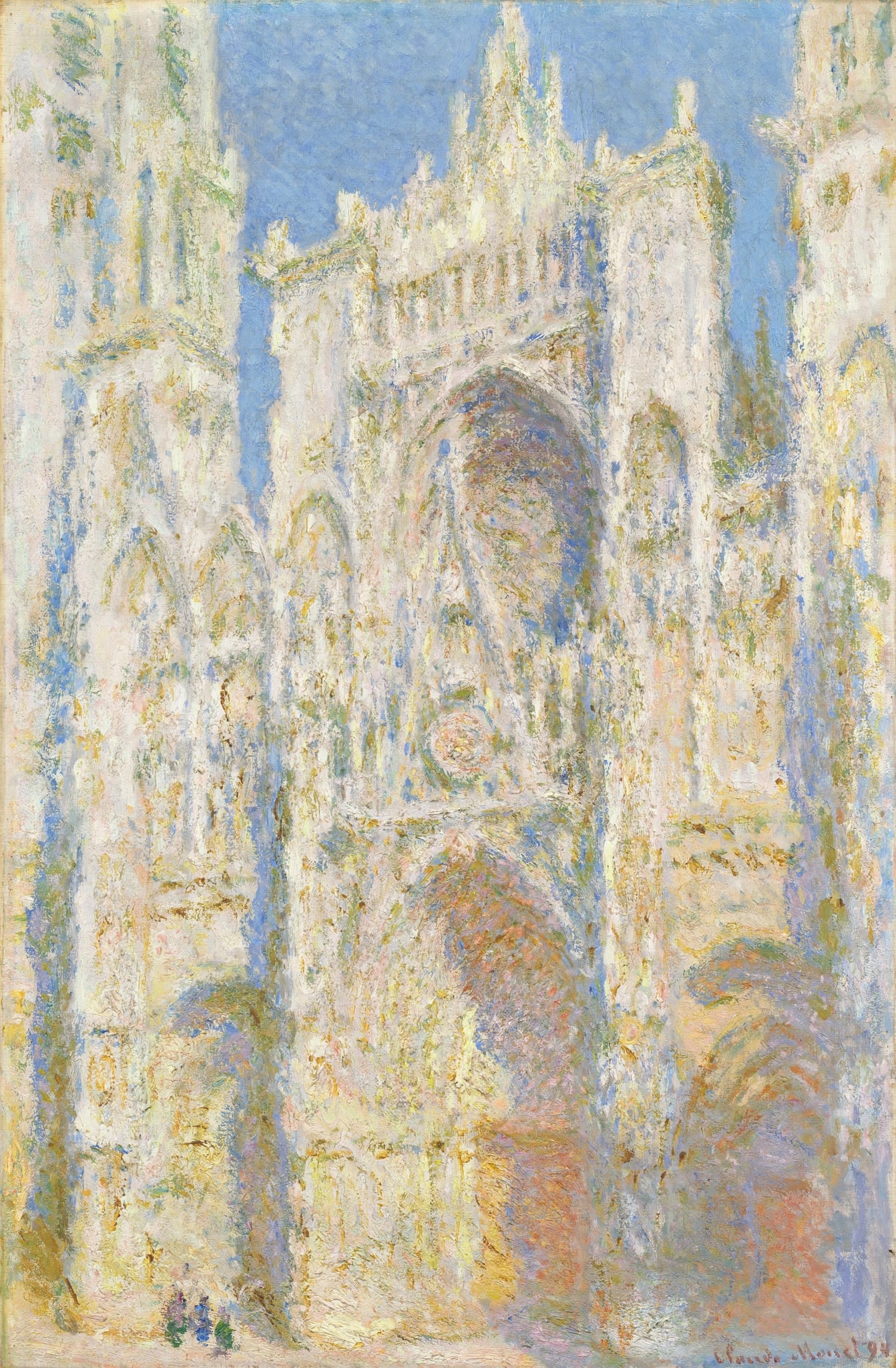
Rouen Cathedral Series
Claude Monet (1894)
Claude Monet’s Rouen Cathedral Series (1892–94) turns a Gothic monument into a laboratory of <strong>light, time, and perception</strong>. In this sunstruck façade, portals, gables, and a warm, orange-tinged rose window flicker in pearly violets and buttery yellows against a crystalline blue sky, while tiny figures at the base anchor the scale. The painting insists that <strong>light—not stone—is the true subject</strong> <sup>[1]</sup><sup>[2]</sup>.
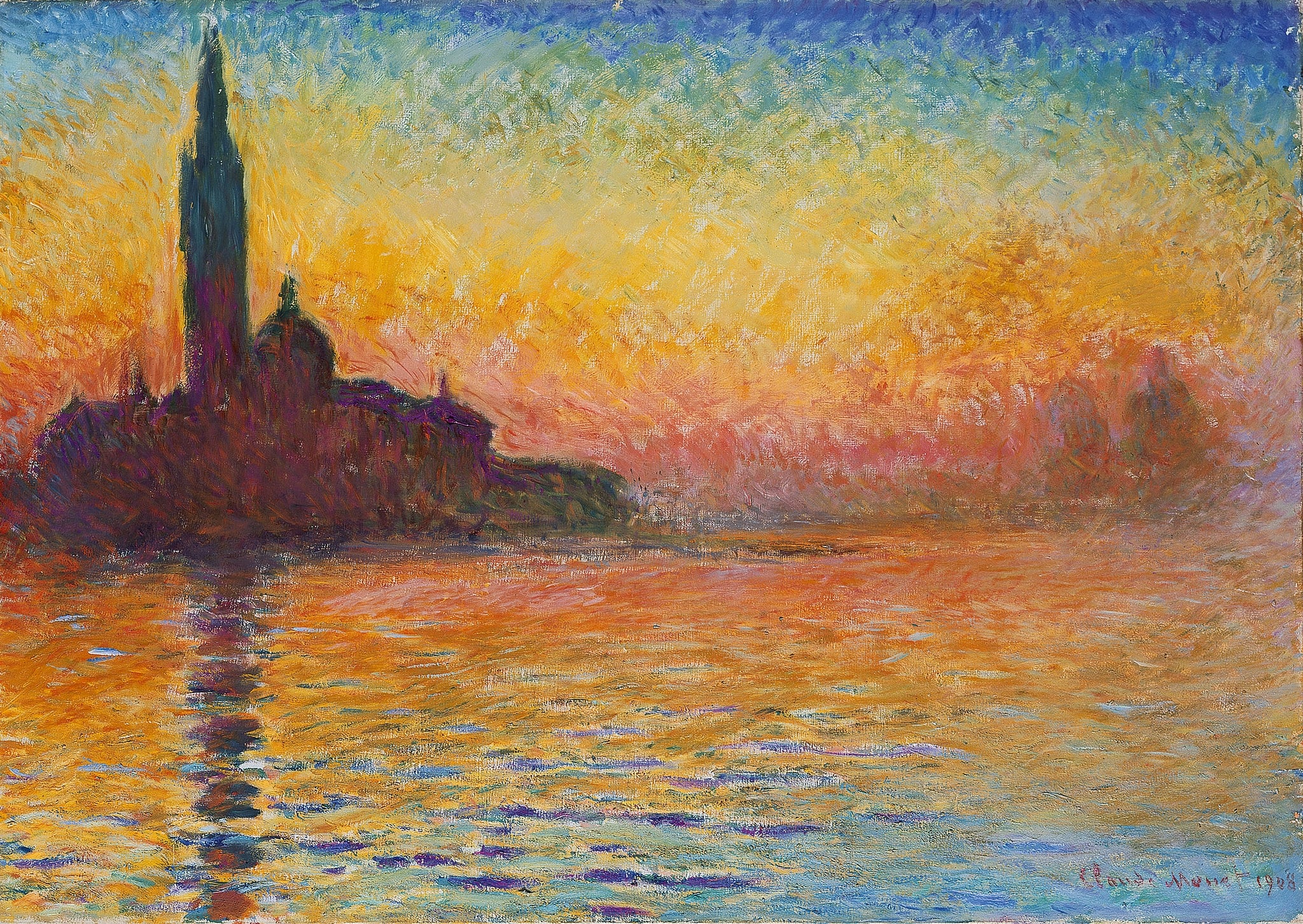
San Giorgio Maggiore at Dusk
Claude Monet (1908–1912)
Claude Monet’s San Giorgio Maggiore at Dusk fuses the Benedictine church’s dark silhouette with a sky flaming from apricot to cobalt, turning architecture into atmosphere. The campanile’s vertical and its wavering reflection anchor a sea of trembling color, staging a meditation on <strong>permanence</strong> and <strong>flux</strong>.
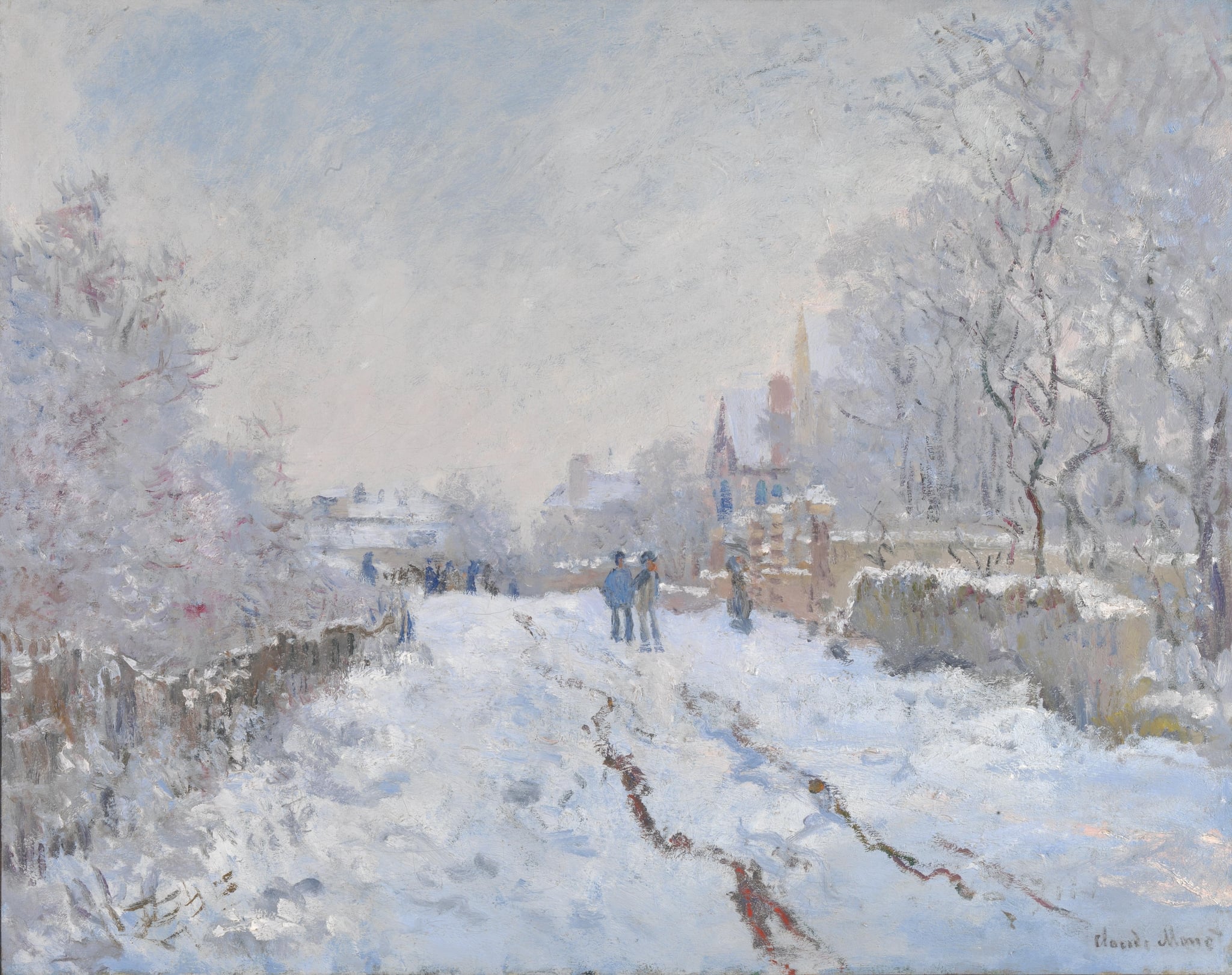
Snow at Argenteuil
Claude Monet (1875)
<strong>Snow at Argenteuil</strong> renders a winter boulevard where light overtakes solid form, turning snow into a luminous field of blues, violets, and pearly pinks. Reddish cart ruts pull the eye toward a faint church spire as small, blue-gray figures persist through the hush. Monet elevates atmosphere to the scene’s <strong>protagonist</strong>, making everyday passage a meditation on time and change <sup>[1]</sup><sup>[2]</sup>.
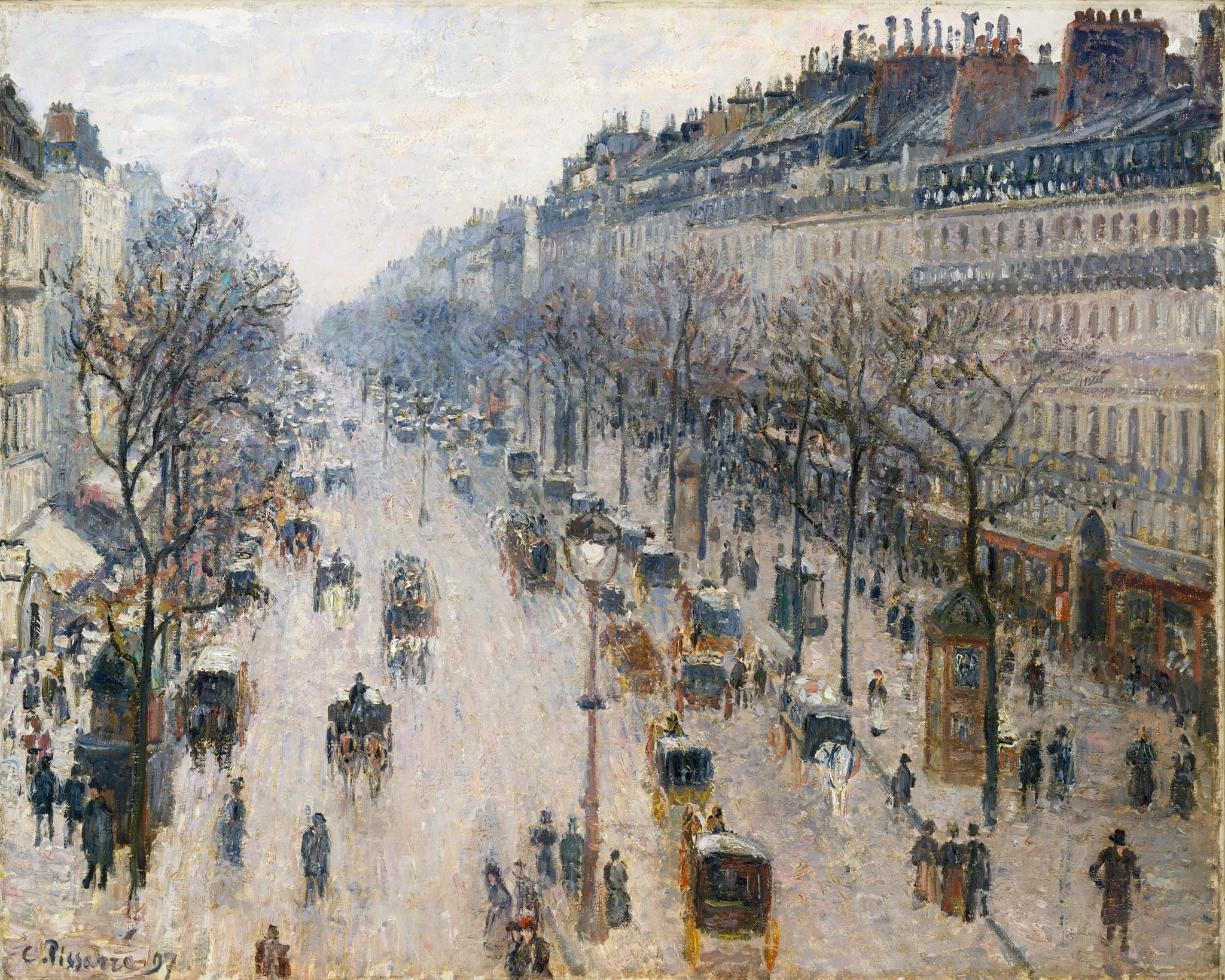
The Boulevard Montmartre on a Winter Morning
Camille Pissarro (1897)
From a high hotel window, Camille Pissarro renders Paris as a living system—its Haussmann boulevard dissolving into winter light, its crowds and vehicles fused into a soft, <strong>rhythmic flow</strong>. Broken strokes in cool grays, lilacs, and ochres turn fog, steam, and motion into <strong>texture of time</strong>, dignifying the city’s ordinary morning pulse <sup>[1]</sup><sup>[3]</sup>.

The Church at Moret
Alfred Sisley (1894)
Alfred Sisley’s The Church at Moret turns a Flamboyant Gothic façade into a living barometer of light, weather, and time. With <strong>cool blues, lilacs, and warm ochres</strong> laid in broken strokes, the stone seems to breathe as tiny townspeople drift along the street. The work asserts <strong>permanence meeting transience</strong>: a communal monument held steady while the day’s atmosphere endlessly remakes it <sup>[1]</sup><sup>[2]</sup><sup>[3]</sup>.
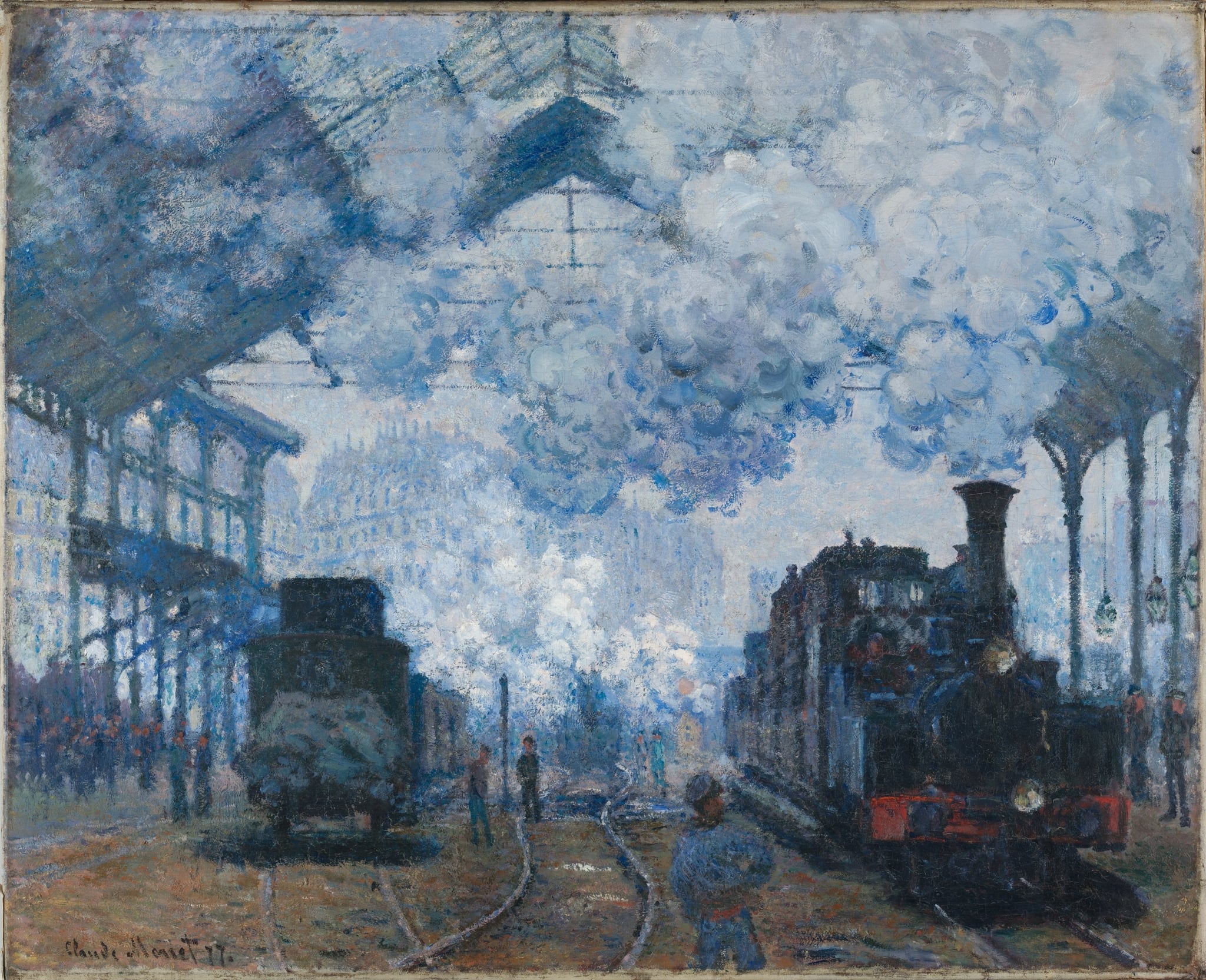
The Gare Saint-Lazare: Arrival of a Train
Claude Monet (1877)
Claude Monet’s The Gare Saint-Lazare: Arrival of a Train plunges viewers into a <strong>vapor-filled nave of iron and glass</strong>, where billowing steam, hot lamps, and converging rails forge a drama of industrial modernity. The right-hand locomotive, its red buffer beam glowing, materializes out of a <strong>blue-gray atmospheric envelope</strong>, turning motion and time into visible substance <sup>[1]</sup><sup>[3]</sup>.
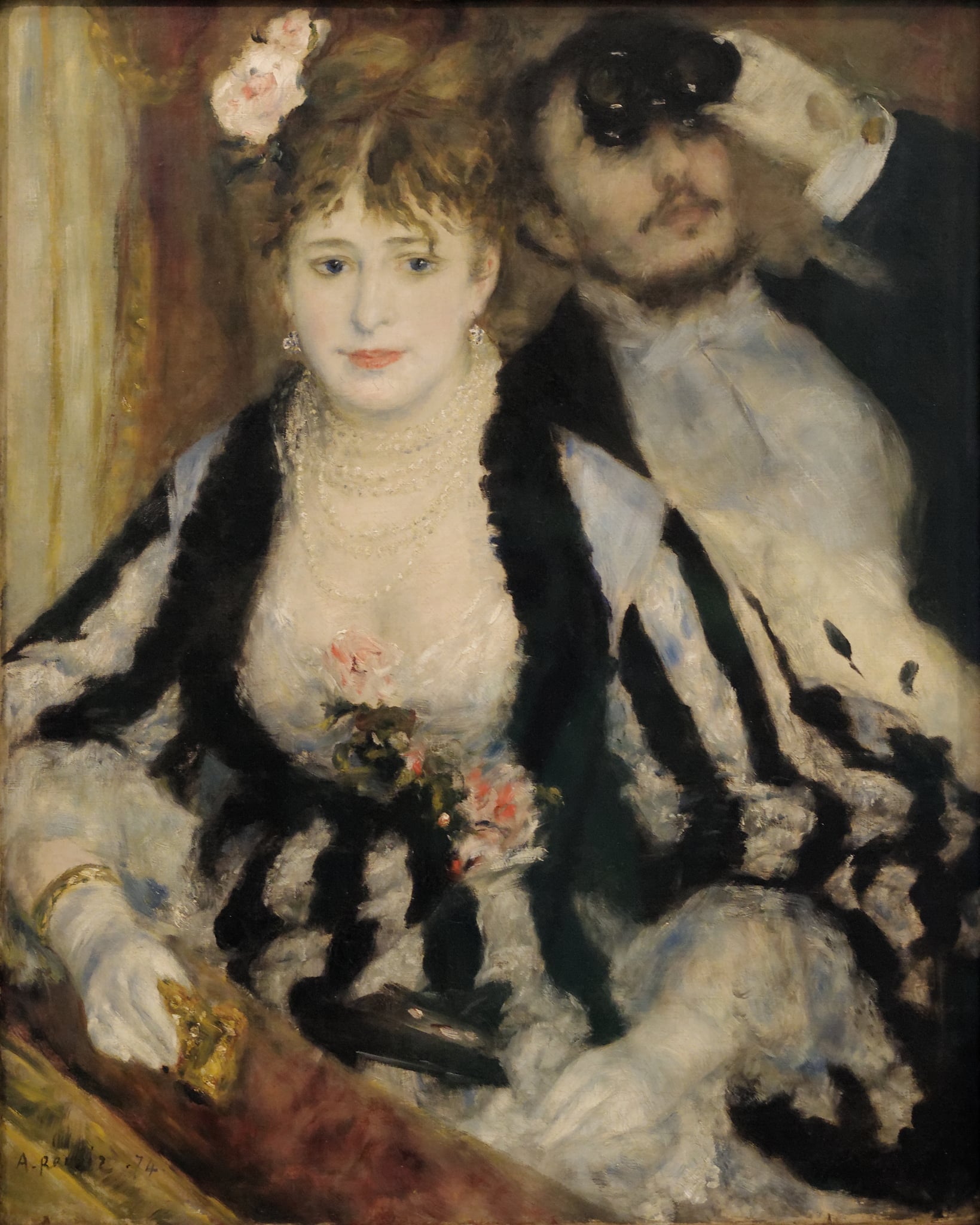
The Loge
Pierre-Auguste Renoir (1874)
Renoir’s The Loge (1874) turns an opera box into a <strong>stage of looking</strong>, where a woman meets our gaze while her companion scans the crowd through binoculars. The painting’s <strong>frame-within-a-frame</strong> and glittering fashion make modern Parisian leisure both alluring and self-conscious, turning spectators into spectacles <sup>[1]</sup><sup>[2]</sup>.

The Palazzo Ducale (The Doge’s Palace)
Claude Monet (1908)
Claude Monet’s The Palazzo Ducale (The Doge’s Palace) converts Venice’s seat of power into an apparition of <strong>light and atmosphere</strong>. The lilac-and-rose façade dissolves into rhythmic brushwork while its <strong>broken reflection</strong> braids golds and violets across the canal. Monument becomes <strong>sensation</strong>, authority becomes shimmer.

The Palazzo Ducale, Seen from San Giorgio Maggiore
Claude Monet (1908)
In The Palazzo Ducale, Seen from San Giorgio Maggiore, Claude Monet turns Venice into a theater of <strong>light and time</strong>. The Doge’s Palace glows as a pale, honeyed rectangle while the <strong>lagoon’s rippling violets and blues</strong> swallow stone into shimmer. A <strong>dark triangular quay</strong> in the foreground steadies the eye, making the city seem to hover above water.
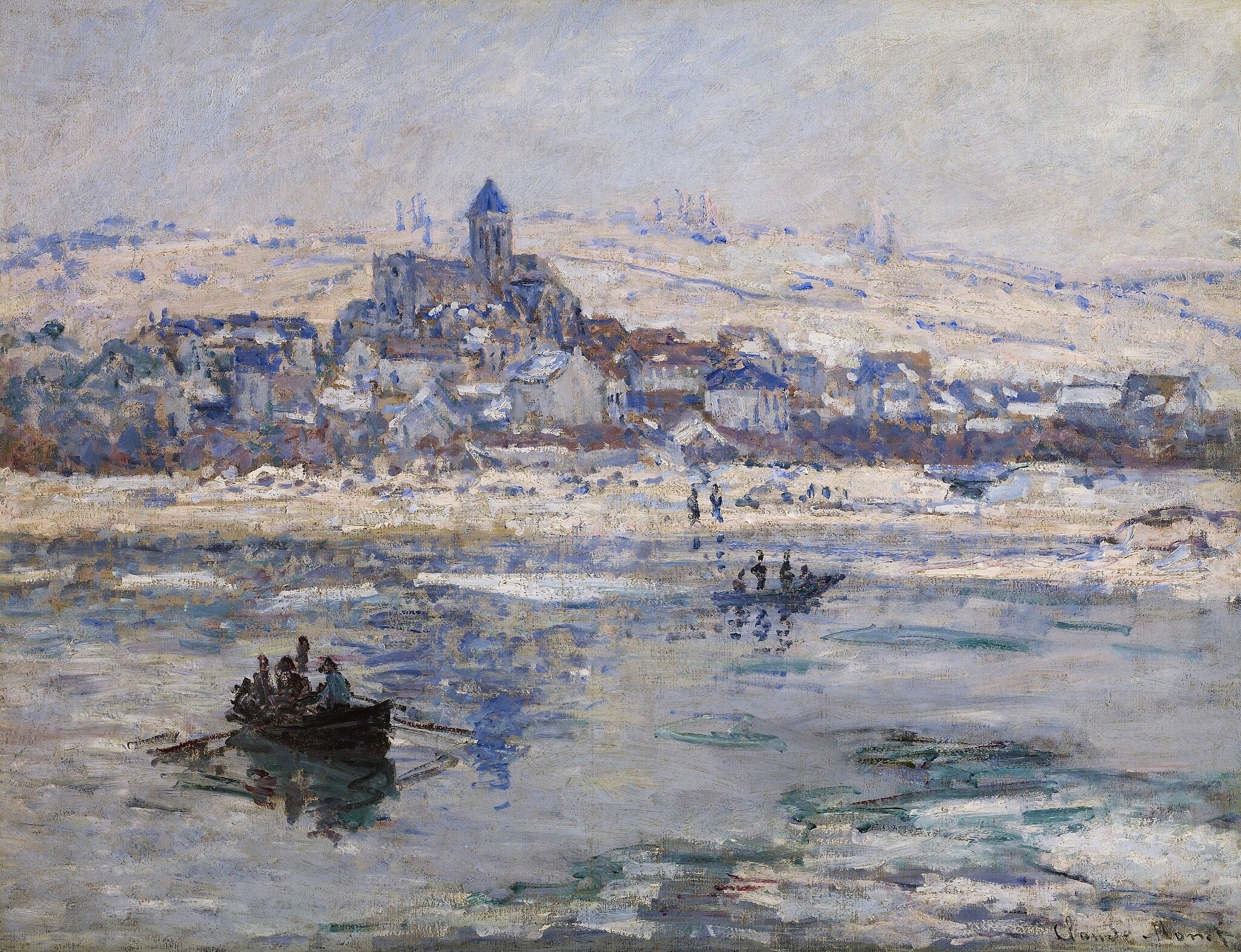
Vétheuil in Winter
Claude Monet (1878–79)
Claude Monet’s Vétheuil in Winter renders a riverside village in a <strong>silvery, frost-laden light</strong>, where the Seine carries <strong>broken ice</strong> past clustered houses and the tall church tower. The scene’s <strong>granular blue-green palette</strong> and softened edges make the town appear to crystallize out of air and water, while small boats and figures signal quiet persistence.
Related Themes
Related Symbolism Categories
Domesticity
The “Domesticity” symbolism category traces how modern artists transform humble household objects, routines, and furnishings into a complex visual language of labor, intimacy, and psychological tension within the home and its adjacent social spaces.
Urban
Urban symbolism in modern painting transforms streets, stations, and squares into coded fields where infrastructure, light, and crowd dynamics visualize the social logics of the nineteenth- and early twentieth‑century city.
Vision
“Vision” symbols in modern painting mark not only what is seen but how seeing itself becomes a historical, technological, and psychological problem, turning light, reflection, and vantage into active agents of meaning.
Within the history of painting, architectural motifs have long functioned as more than mere settings: they articulate thresholds, stabilize pictorial space, and materialize abstract structures of authority, belief, and social order. From church spires that anchor communal identity to bridges and train sheds that condense the promises and dislocations of industrial modernity, architecture operates semiotically as a repertoire of forms whose meanings are continually renegotiated. In the modern works considered here, built structures become crucial symbolic devices for staging the encounter between singular experience and collective systems—civic, economic, or spiritual.
Several of these symbols operate explicitly as thresholds. Klimt’s Avenue in Schloss Kammer Park culminates in an arched doorway / portal embedded in the ocher façade at the end of the tree-lined allée. Semiotic weight accrues less to the door’s literal function than to its position as the vanishing axis of the composition: the cobbled path and the vaulted canopy of pollarded lindens drive the eye toward this dark aperture, a concentrated sign of transition and entry. Iconographically, the arched portal inherits a long Christian and Baroque tradition of framing passages between worldly and sacred domains; here, transposed to a country house, it signifies a more secular passage—from undifferentiated, flickering pattern in the avenue to the promise (or opacity) of domestic interiority. The door’s darkness, opposed to the façade’s glow, sharpens its status as a liminal void, a point where the painting’s oscillation between flat decorative surface and receding space reaches its most focused ambiguity.
A related but more diffuse threshold appears in the back-wall architecture and windows that close Seurat’s Bathers at Asnières. In the far distance, bridges and factory structures punctuate the horizon; the riverbank’s opposite side is edged with a receding architectural strip whose openings and industrial apertures read as a porous back wall to this riverside stage. Semiologically, these elements mark a passage beyond the idyllicized foreground of leisure toward the sphere of labor and infrastructure. The windows and bridge arches are not individually legible, but as a band of punctured architecture they stand for transcendence of the immediate scene—not in a religious sense, but as an index of the broader urban system within which these workers’ respite is embedded. Iconographically, Seurat thus updates the traditional open window motif of Netherlandish painting, which once signaled spiritual or metaphysical depth, into a register of industrial modernity’s encompassing horizon.
Monet radicalizes this logic of architecture as horizon in his serial London and Paris subjects. In Houses of Parliament, the Houses of Parliament and clock tower (and, more specifically, the Parliament silhouette with Victoria Tower and spires) are reduced to a dark, crenellated mass whose edges are frayed by fog. Semiologically, the building functions less as a legible seat of government than as a silhouette—an emblematic outline of institutional power whose solidity is deliberately suspended. The clock tower’s traditional connotation of regulated civic time dissolves into a shimmering afterimage; Parliament becomes a mutable halo of color. Iconographically, the Gothic profile survives as a sign of the state, but Monet’s chromatic dematerialization insists that this authority is always mediated by atmosphere, pollution, and the temporality of perception. The architecture is present as a necessary contour against which light’s volatility is measured, yet it is precisely that volatility which now defines the motif’s meaning.
A similar tension between structural fixity and experiential flux underwrites Monet’s Gare Saint-Lazare. The iron-and-glass train shed, articulated by the V-shaped iron-and-glass canopy, operates as a secular nave: a modern “roof of state” that organizes the surging forces of steam, locomotion, and crowd. Semiologically, the canopy’s dark, receding truss is a diagram of modern order, a rational geometry that both contains and reveals the otherwise formless plumes of vapor. Positioned where a Gothic vault might appear in ecclesiastical architecture, the shed reassigns sacred spatial logic to industrial circulation. Iconographically, this makes the station an emblem of the “framework of modernity,” a place where standardized time, mechanized speed, and mass transit are experienced as quasi-transcendent phenomena. The shed’s rigid perspectival lines; in particular the V-shaped roof truss, turn the spectator’s vision into something like a train itself, funneled through an engineered apparatus of seeing.
If Monet reimagines the nave as iron and glass, Turner in Rain, Steam and Speed thematizes passage via the Maidenhead Railway Bridge, its diagonal arcade compressed into a single thrusting vector. Here the bridge is not merely a connector between riverbanks; semiotically, Brunel’s structure is the visible infrastructure of speed. Its elliptical arches recede headlong into rain and vapor, underscoring the bridge’s role as engineering triumph and as the conduit through which modern velocity is felt. The diagonal arcade functions iconographically as a new kind of architectural sublime: a human-made corridor that both competes with and reframes natural forces. The small boat and the spectral hare below and before the train stage a counter-iconography of pre-industrial mobility; the bridge thus condenses, in one structural motif, the drama between older rhythms of passage and the unidirectional rush of railway time.
Caillebotte’s Paris Street; Rainy Day brings this discourse of engineered order down to the level of urban planning. The Haussmann wedge block at the composition’s center, flanked by Haussmann façades, is a symbol of rationalized urbanism: its oblique edges meet at a controlled vanishing point, and its regimented windows register the new uniformity imposed on Paris. Semiologically, the block is a metonym for Haussmannization itself—those wedge-shaped islands of masonry produced where grand boulevards intersect. The façades’ standardized fenestration and cornice lines function as a visual grid against which individual pedestrians and umbrellas appear contingent, even interchangeable. Iconographically, these forms mark a decisive shift from the organic medieval city to one understood as a diagram of circulation and visibility, echoing the period’s preoccupation with hygiene, policing, and spectacle. Crucially, the receding street with townspeople funnels anonymous figures into the compositional depths, suggesting how citizens are absorbed into the planned trajectories of the modern city.
Renoir’s Pont Neuf Paris offers a more festive version of urban cohesion, centered on the Pont Neuf parapet as symbolic connector. The bridge’s balustrade operates analogously to the “loge rail” in his later theater paintings, turning the pedestrians into a frieze of bodies in transit and display. Semiotically, the parapet is both safety barrier and viewing platform, a structure that simultaneously joins the city’s halves and stages its inhabitants as a public spectacle. Iconographically, the Pont Neuf—Paris’s oldest bridge—has long stood for continuity and civic unity; Renoir’s high vantage point and bright palette reassert that cohesion after the ruptures of mid-century conflict, binding the present crowd to the equestrian statue of Henri IV in the distance. Here, architecture is the precondition for a vision in which disparate urban lives can be seen as part of a single, luminous current.
In more rural or domestic contexts, architecture assumes a different symbolic charge. Cézanne’s Mont Sainte-Victoire integrates blocky houses into the tessellated middle ground so thoroughly that they read as pure volumes, scarcely distinguishable in kind from the layered planes of field and mountain. Semiotically, these houses signify “human presence as pure volume,” a reconciliation of culture and geology. They do not interrupt the landscape but complete its constructive logic, acting as intermediary solids between agricultural patches and the mountain’s crystalline mass. Iconographically, they resist the picturesque in favor of an ontological claim: habitation is here a mode of structural participation in nature’s order, not a sentimental incursion.
Wyeth’s Christina’s World pushes domestic architecture toward psychological emblem. The Olson House (farmhouse and sheds) rises at the top of the hill as a destination that anchors the entire composition. Semiologically, the house is less a mere shelter than the fixed term in a visual equation whose other term is Christina’s prone figure; the sloping field between them is charged space, a measure of effort, desire, and limitation. Iconographically, the weathered clapboards and cluster of outbuildings condense “home, belonging, history,” yet their slight estrangement on the ridge lends them an almost unreachable, mythic distance. Architecture here symbolizes not the achieved stability of habitation but the arduousness of return.
Finally, Grant Wood’s American Gothic crystallizes the moral stakes of domestic architecture through the Carpenter Gothic window. The pointed arch, lifted from a real Iowa cottage, imports ecclesiastical form into the vernacular farmhouse. Semiologically, the window is a sign of “religious or moral authority and austere order imposed on domestic life”: its sharp geometry and vertical emphasis resonate with the man’s pitchfork and the repeated seams of clothing and siding, generating a visual code of strictness, uprightness, and judgment. Iconographically, the Carpenter Gothic motif fuses the church and the homestead, suggesting that the house is itself a moral institution. Where Cézanne dissolves houses into landscape structure, Wood hardens architecture into a doctrinal emblem that presses down upon the sitters, as if their identities were vaulted by that pointed aperture.
Across these examples, architectural symbols chart a trajectory from premodern stability toward modern contingency and critique. Spires, portals, and bridges retain their traditional associations with continuity, passage, and cohesion, but in Monet’s and Turner’s hands they register the volatility of atmosphere and speed; their authority is tested by fog and acceleration. Haussmann blocks and train sheds codify a new urban and industrial order, simultaneously rational and alienating, while rural houses oscillate between integration with natural structure (Cézanne) and oppressive moral architecture (Wood). The semiotic field of architecture thus expands from a vocabulary of permanence and sacred hierarchy to one capable of articulating the fraught structures—technological, civic, psychological—that organize modern life. In this expanded field, built form no longer simply grounds the image; it becomes a critical instrument for thinking about how humans inhabit time, space, and one another.