Lady in White

by Gustav Klimt

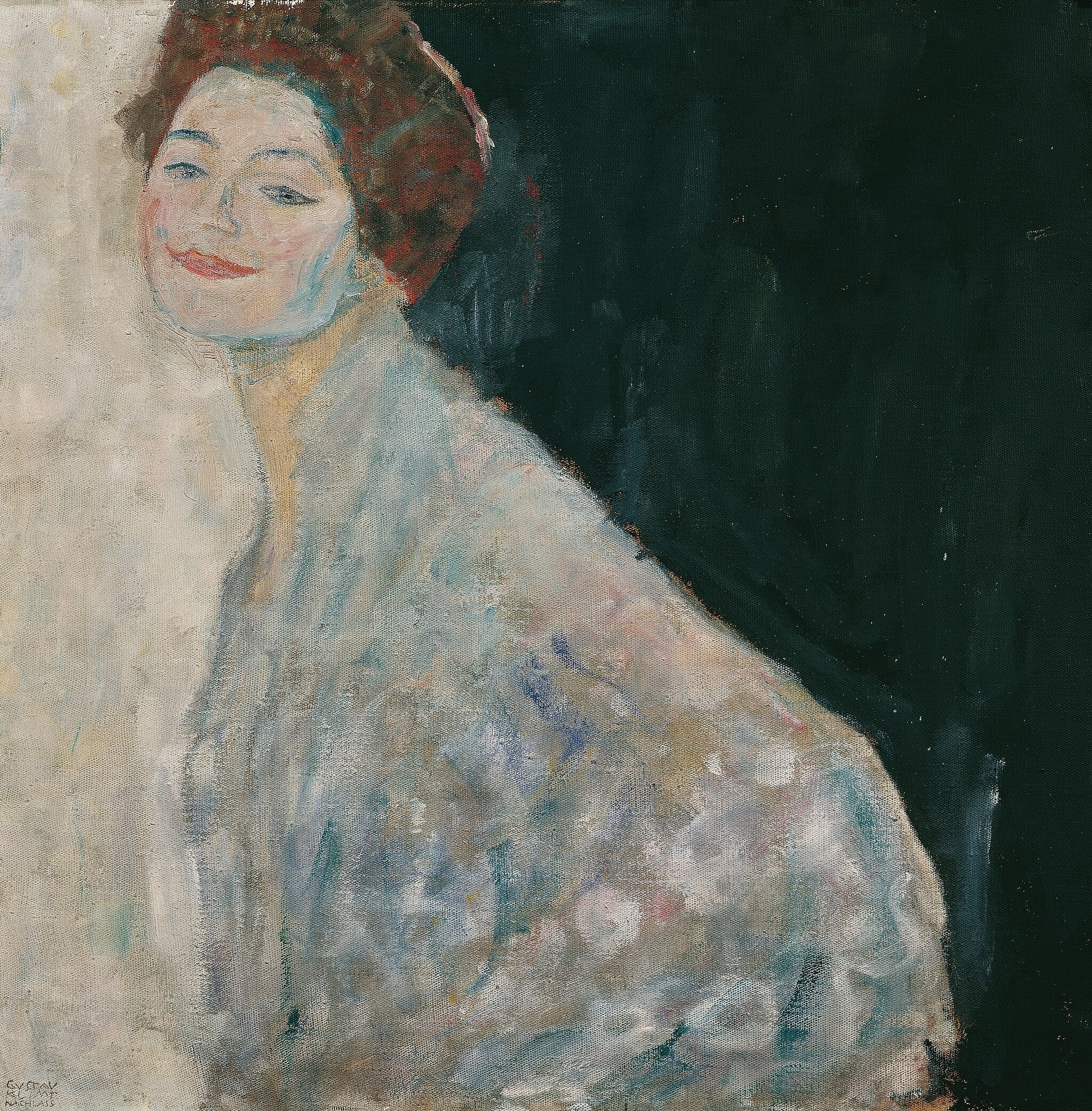
Lady in White crystallizes Klimt’s late style as a liminal apparition: a woman who seems to form out of paint where a pale field meets a dark one. Her kimono‑like robe dissolves into iridescent whites touched by blues and violets, while a tilted, mask‑like smile hovers between intimacy and anonymity [1][2][3]. The result is less a likeness than a luminous state of being suspended on a threshold.
💰

Market Value

$55-85 million

How much is Lady in White worth?

Study Print Studio

Create a personal study print

Build a companion study sheet around the part of this painting that speaks to you most. Choose a detail, shape an interpretation, and walk away with something personal and display-worthy.

Fast Facts

Year
1917–1918
Medium
Oil on canvas; unfinished
Dimensions
70 × 70 cm
Location
Upper Belvedere, Vienna
See all Gustav Klimt paintings in Vienna
Lady in White by Gustav Klimt (1917–1918) featuring Light–dark threshold (diagonal seam), Iridescent white robe, Mask-like smile, Head tilted toward light

Click on any numbered symbol to learn more about its meaning

Meaning & Symbolism

Klimt builds Lady in White on a deliberate diagonal that splits the square into three planar zones—figure, a light field at left, and a dark field at right—so the sitter seems to advance along a seam between radiance and shadow 1. That compositional cut is not mere staging; it is a proposition about identity. The woman’s body, draped in a kimono‑like, dotted robe that Klimt treats as atmosphere rather than cloth, dematerializes into soft whites infused with bluish, violet, and rose modulations; this painterly vapor makes her both present and slipping away 2. Up close, the garment’s field of feathery touches fuses figure and ground, flattening depth in a manner aligned with Viennese Jugendstil while also signaling Symbolism’s preference for mood over description 14. The head tilts toward the light, but the glance turns outward with a sly, knowing curve of the lips; the face is sharply keyed yet blurred at its edges, intensifying the sense that we are witnessing an apparition at the very moment of formation. Conservation imaging confirms that Klimt reworked the hairstyle and features, producing a "mask‑like" smile that estranges the likeness and underscores the sitter as an archetype, not a portrait bound to a single identity 3. Even the unusually unprimed support and visible revisions read as choices that keep the image in a state of becoming, a late‑style wager that the truth of a person might be captured in flux rather than finish 3. From this architecture flows the picture’s argument about the modern woman. She is neither an allegorical emblem with attributes nor a society portrait fenced by décor; she is a charged presence, poised on the boundary where interior feeling touches external appearance. The stark polarity of the background—velvety dark green at right, bleached field at left—operates as a symbolic threshold: youth/time, desire/restraint, appearance/essence 1. Yet Klimt refuses to lock these binaries into narrative; instead, their tension animates the image, like two magnetic poles holding the sitter in suspension. The robe, frequently read as "kimono‑like," is not a program of Japonisme here; rather, it is a formal device to de‑materialize the body and emphasize planar rhythm, distinguishing this work from the overt East Asian motifs of Lady with a Fan 2. In this way, Klimt turns pattern into psychology: the garment’s flicker of dots and pastel eddies suggests respiration, tremor, and thought. The smile—too steady to be coy, too revised to be innocent—works as a veil, a performative surface between viewer and selfhood, consistent with Symbolism’s fascination with the femme as both invitation and enigma 4. Placed among Klimt’s late, unfinished portraits from 1917–1918, Lady in White compresses a career’s worth of inquiry into one square: the Secessionist devotion to flat design, the Symbolist conversion of likeness into state of mind, and a late, freer brush that courts abstraction 124. Technical studies even hint that Klimt was exploring alternative identities and formats—another sign that the painting’s authority lies in process rather than completion 3. The canvas therefore becomes a manifesto, asserting that modern portraiture attains truth not by completing the figure but by letting it hover, exquisitely, on the edge of disappearance.

Explore Deeper with AI

Ask questions about Lady in White

Popular questions:

Powered by AI • Get instant insights about this artwork

💬 Ask questions about this artwork!

Interpretations

Technical Process & Unfinishedness

Klimt’s late procedure is legible in the support and surface: the canvas is unusually unprimed, and conservation imaging registers repeated adjustments to hair and features, yielding the later, “mask‑like” smile 3. These material facts redirect reading away from anecdote toward process as meaning. The lightly scrubbed whites, visible revisions, and unfixed contours suspend the portrait between study and statement, encouraging viewers to experience identity as provisional rather than concluded. In this lens, “unfinished” is not deficit but method: the work establishes a studio‑like arena where likeness is tested, erased, and restated. That exploratory facture aligns with Klimt’s final months and with a broader Viennese turn toward surface and planarity, letting the picture disclose how it was made even as it withholds completion 13.

Source: Lentos Kunstmuseum Linz; Belvedere Museum

Beyond Japonisme: Pattern as Dematerialization

Although the robe reads as “kimono‑like,” curatorial research cautions against projecting a Japoniste program here. Unlike Lady with a Fan, where East Asian birds and flowers structure iconography, Lady in White shows no evidence that Klimt intended such motifs 2. The patterned garment instead functions as a formal solvent: dots and feathery strokes blur figure/ground, thinning corporeality into atmosphere. This is less cultural quotation than a late planar strategy, consistent with Viennese Jugendstil’s flattening impulse and with Symbolism’s drift from description to mood. In refusing explicit exotic decor, Klimt keeps attention on the sitter’s oscillation between presence and dispersal, turning pattern into psychology rather than ornament—a distinction that clarifies how Lady in White diverges from contemporaneous, more overtly Japoniste canvases 12.

Source: Klimt-Foundation (Klimt-Database); Belvedere Museum

Planar Architecture & Threshold Space

The composition’s diagonal cleaves a square into three planar fields—figure, pale left, dark right—producing a taut, late‑Jugendstil architecture that is almost poster‑like in its flatness 1. This framework is not neutral staging: it forges a symbolic threshold where the sitter advances along a seam of radiance and shadow. Klimt uses value blocks like magnetic poles, holding the body in visual suspension while collapsing conventional depth. The result is a portrait that reads as surface event rather than spatial narrative, a calibrated contest between velvety green and bleached light that activates the face and robe as mediating membranes. Such planar engineering lets “pattern become psychology,” converting background into a field of affective charge that structures how we register time, desire, and appearance without fixing them into plot 12.

Source: Belvedere Museum; Klimt-Foundation

Archetype over Likeness: Symbolist Psychology

Klimt’s reworked visage—sharp yet blurred at its edges—and the ultimately “mask‑like” smile estrange straightforward resemblance, nudging the sitter toward archetype rather than person-specific portraiture 3. This stance is consonant with Symbolism, where woman often figures as a charged, enigmatic presence whose surface both invites and veils interiority 4. Here, the smile operates as a “performative surface,” a calibrated screen between viewer and selfhood; the robe’s vaporous touch amplifies that ambiguity by letting the body dissolve into mood. Instead of offering attributes or social markers, Klimt crafts a psychological icon whose truth lies in suspended feeling. The portrait thus participates in a broader fin‑de‑siècle project: testing how much of identity can be conveyed when finish gives way to atmosphere, and when physiognomy becomes an instrument of projection 34.

Source: Lentos Kunstmuseum Linz; The Met (Heilbrunn Timeline of Art History)

Study, Reuse, and Alternative Identities

Technical-connoisseurial comparisons propose that Lady in White may relate to the large, full‑length Ria Munk III composition: superimposed outlines and the exploratory, unprimed support suggest a study‑like role within a mutable working process 3. If so, the painting records Klimt cycling through alternative identities and formats, trying on faces, hairstyles, and attitudes before fixing a final solution. This hypothesis reframes the picture as a laboratory of likeness, where the sitter is less individual and more variable schema—a matrix through which Klimt refines late stylistic goals (planarity, atmospheric whites, chromatic economy). Read this way, Lady in White literalizes the idea that portraiture’s authority can reside in process, and that modern identity might be grasped most truthfully in the flux of revision rather than in definitive completion 3.

Source: Lentos Kunstmuseum Linz

Related Themes

About Gustav Klimt

Gustav Klimt (1862–1918), co-founder of the Vienna Secession, pivoted from controversial public commissions to a decorative-symbolist language in his Golden Period. Drawing on Byzantine mosaics and modern design, he fused opulent surfaces with psychological intensity. By 1908–09, he transformed scandal into canon, and The Kiss became Vienna’s emblem of modern love.
View all works by Gustav Klimt

More by Gustav Klimt

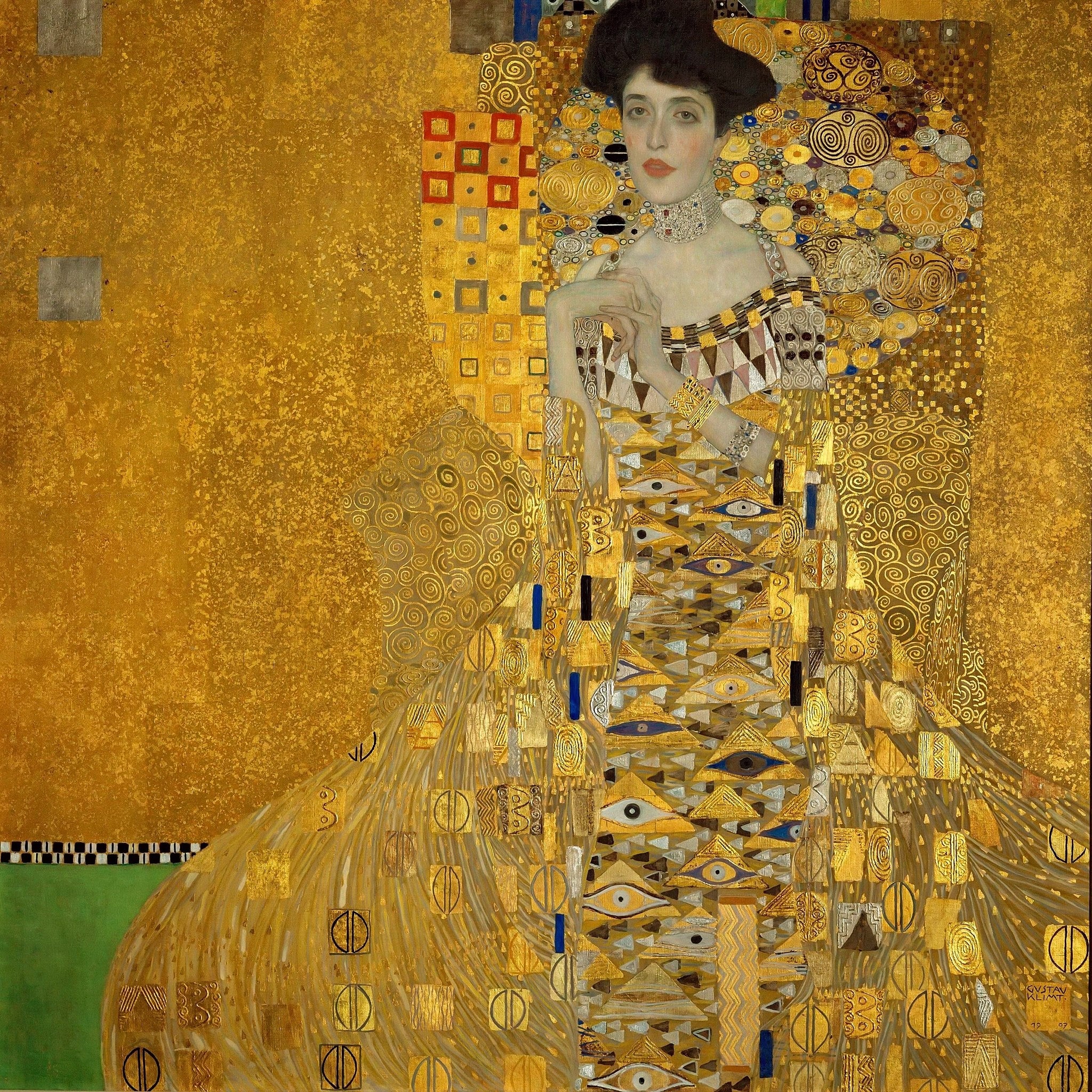
Portrait of Adele Bloch-Bauer I by Gustav Klimt

Portrait of Adele Bloch-Bauer I

Gustav Klimt (1907)

Gustav Klimt’s Portrait of Adele Bloch-Bauer I stages its sitter as a <strong>secular icon</strong>—a living presence suspended in a field of gold that converts space into <strong>pattern and power</strong>. The naturalistic face and hands emerge from a reliquary-like cascade of eyes, triangles, and tesserae, turning light, ornament, and status into the painting’s true subjects <sup>[1]</sup><sup>[2]</sup>.
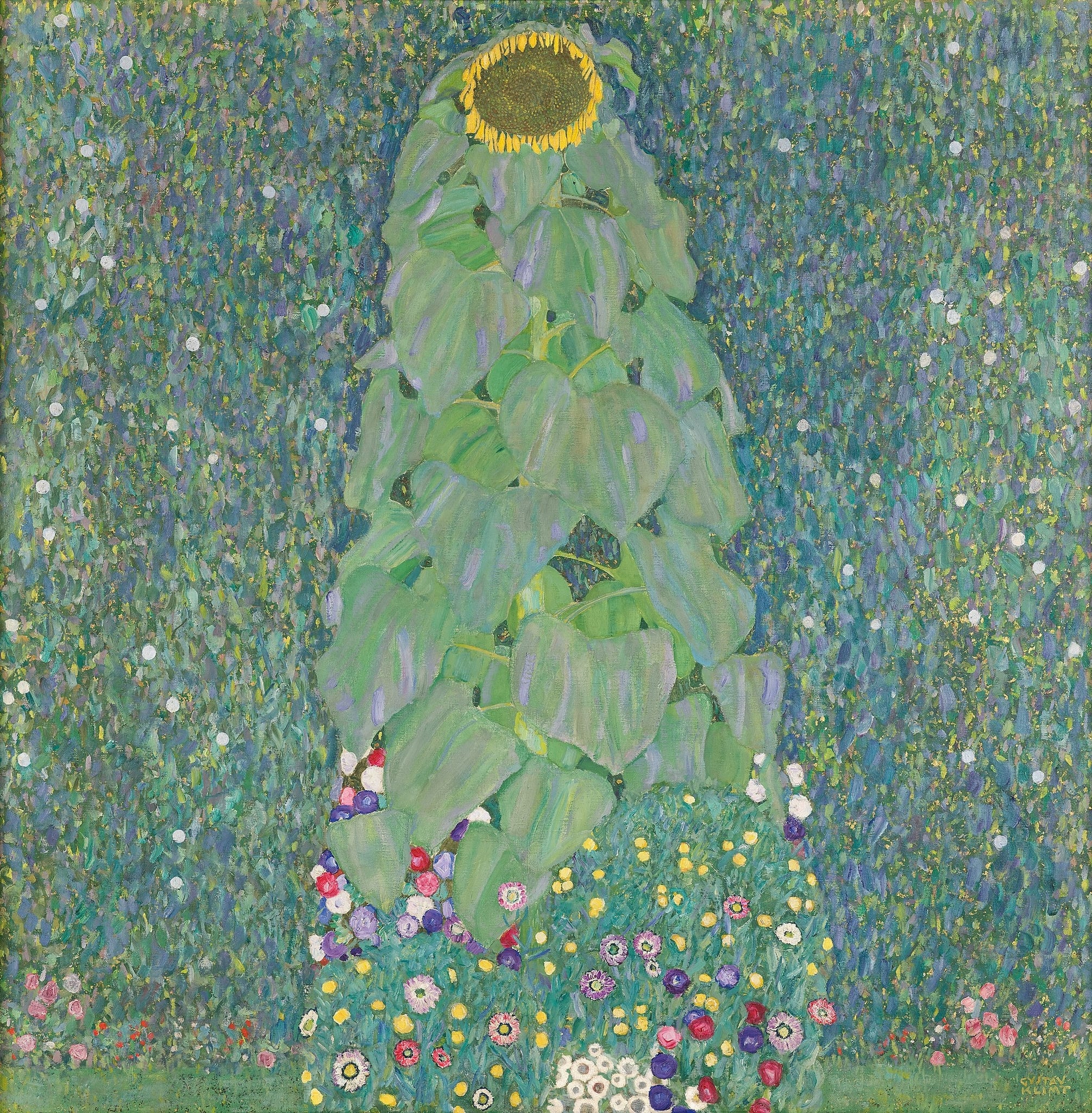
Sunflower by Gustav Klimt

Sunflower

Gustav Klimt (1907/1908)

Gustav Klimt’s Sunflower turns a single bloom into a <strong>monumental, figure-like presence</strong>. A tapering stack of broad, drooping leaves rises from a <strong>mosaic-like carpet of round blossoms</strong>, crowned by a gold-flecked disc that glows against a cool, stippled field. The work fuses <strong>portrait, icon, and landscape</strong> into one emblem of vitality and quiet sanctity <sup>[1]</sup><sup>[2]</sup>.
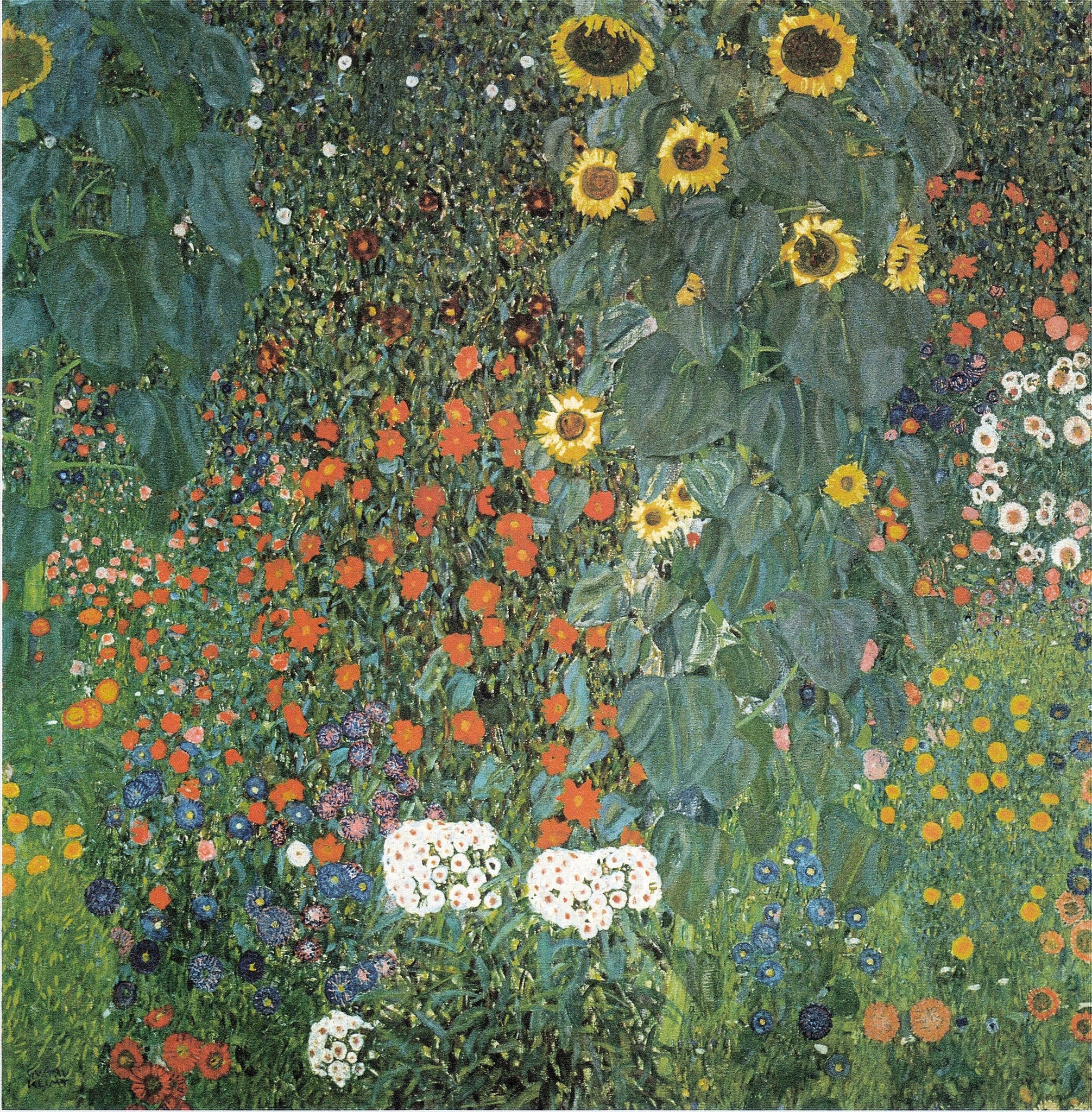
Cottage Garden with Sunflowers by Gustav Klimt

Cottage Garden with Sunflowers

Gustav Klimt (1906–1907 (signed 1907))

Cottage Garden with Sunflowers is a square, horizonless field of blooms where a vertical column of <strong>sunflowers</strong> anchors an all-over weave of color and pattern. Klimt fuses <strong>ornament and nature</strong>, turning a humble Litzlberg cottage plot into a radiant matrix of cyclical life and renewal <sup>[1]</sup><sup>[4]</sup><sup>[5]</sup>.
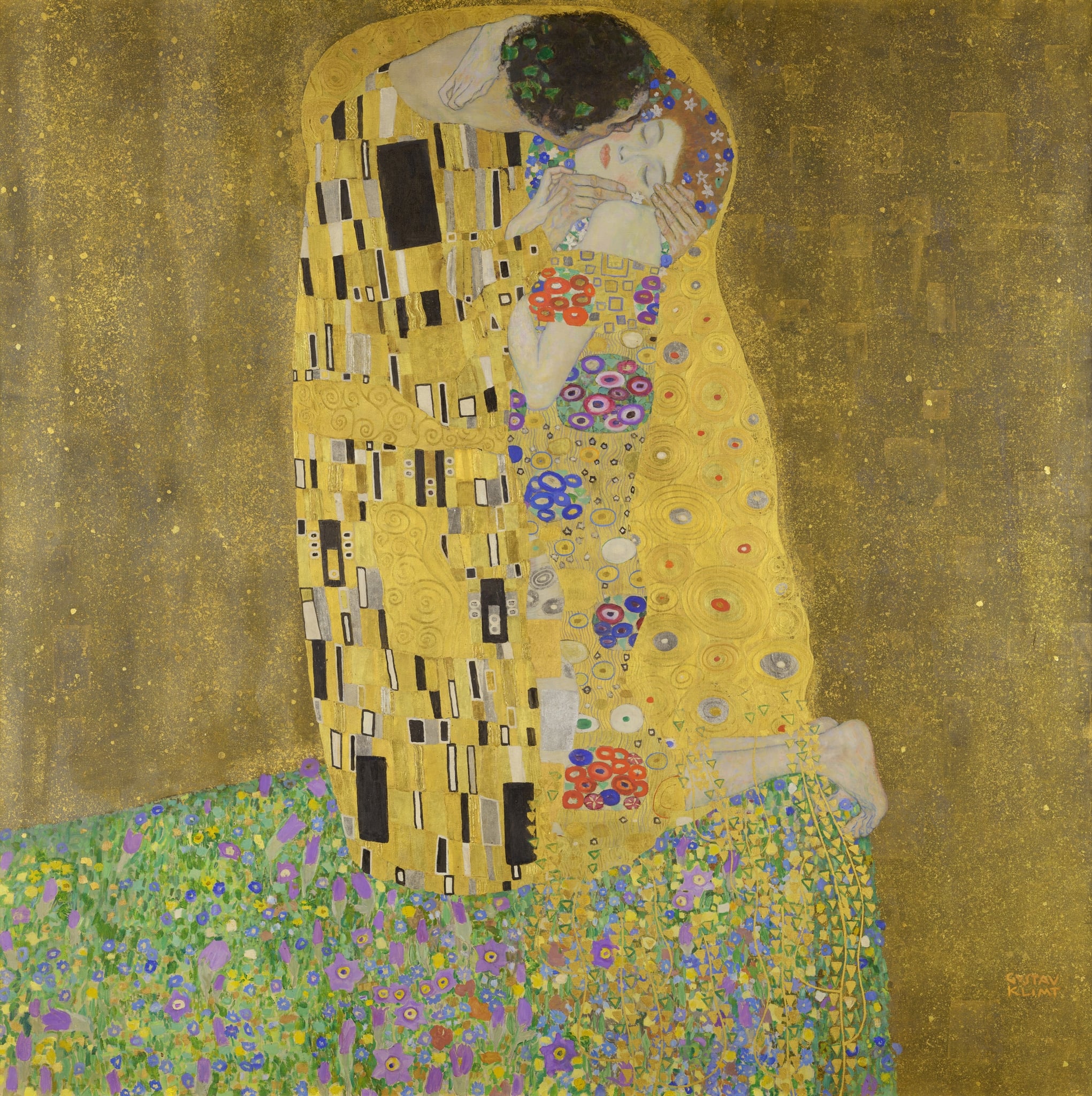
The Kiss by Gustav Klimt

The Kiss

Gustav Klimt (1908 (completed 1909))

The Kiss stages human love as a <strong>sacred union</strong>, fusing two figures into a single, gold-clad form against a timeless field. Klimt opposes <strong>masculine geometry</strong> (black-and-white rectangles) to <strong>feminine organic rhythm</strong> (spirals, circles, flowers), then resolves them in radiant harmony <sup>[1]</sup><sup>[2]</sup>.
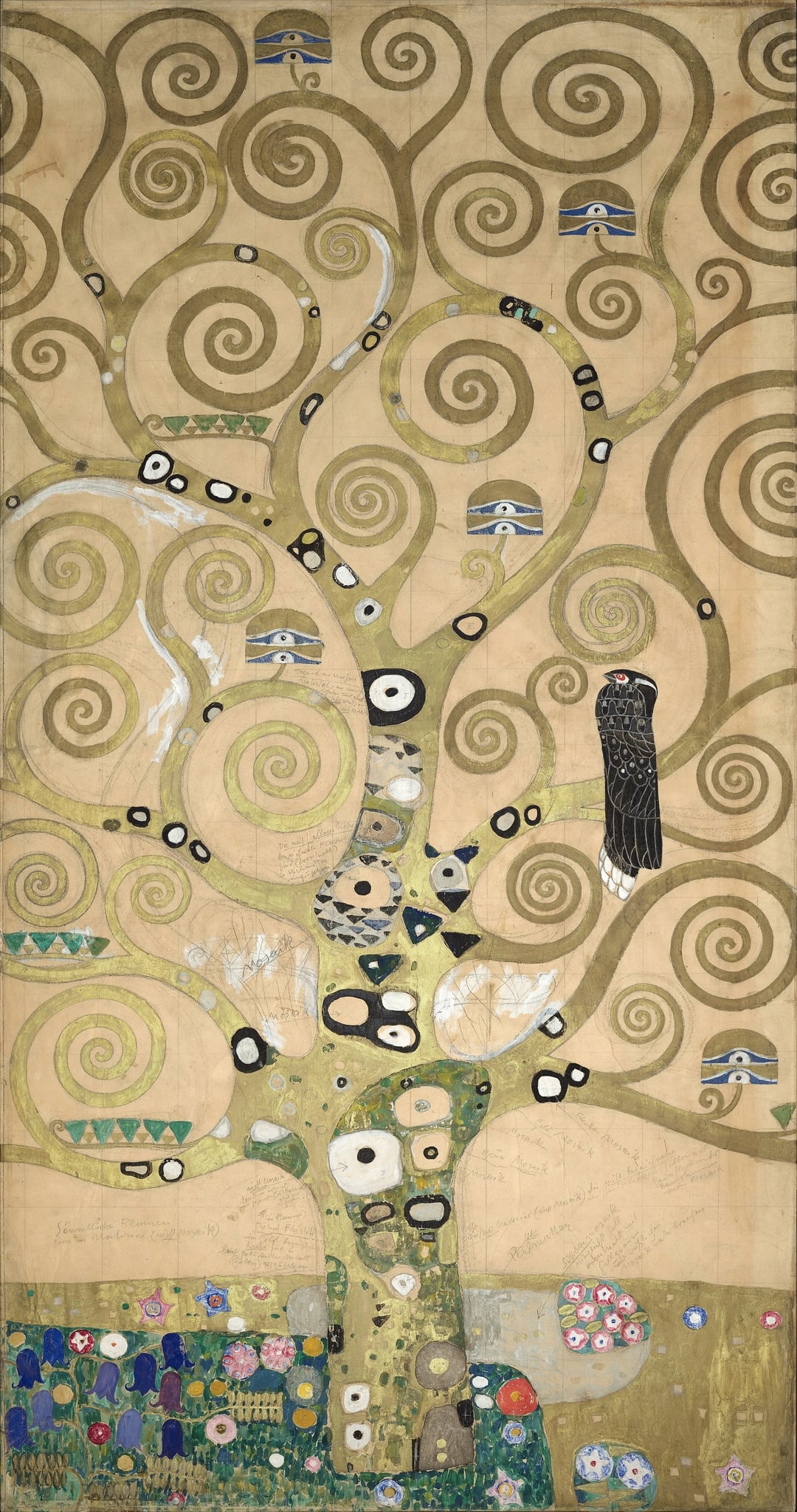
The Tree of Life by Gustav Klimt

The Tree of Life

Gustav Klimt (1910–1911 (design; mosaic installed 1911))

Gustav Klimt’s The Tree of Life crystallizes a <strong>cosmological axis</strong> in a gilded ornamental language: a rooted trunk erupts into <strong>endless spirals</strong>, embedded with <strong>eye-like rosettes</strong> and shadowed by a black, red‑eyed bird. Designed as part of the Stoclet dining‑room frieze, it fuses <strong>symbolism and luxury materials</strong> to link earthly abundance with timeless transcendence <sup>[1]</sup><sup>[2]</sup>.
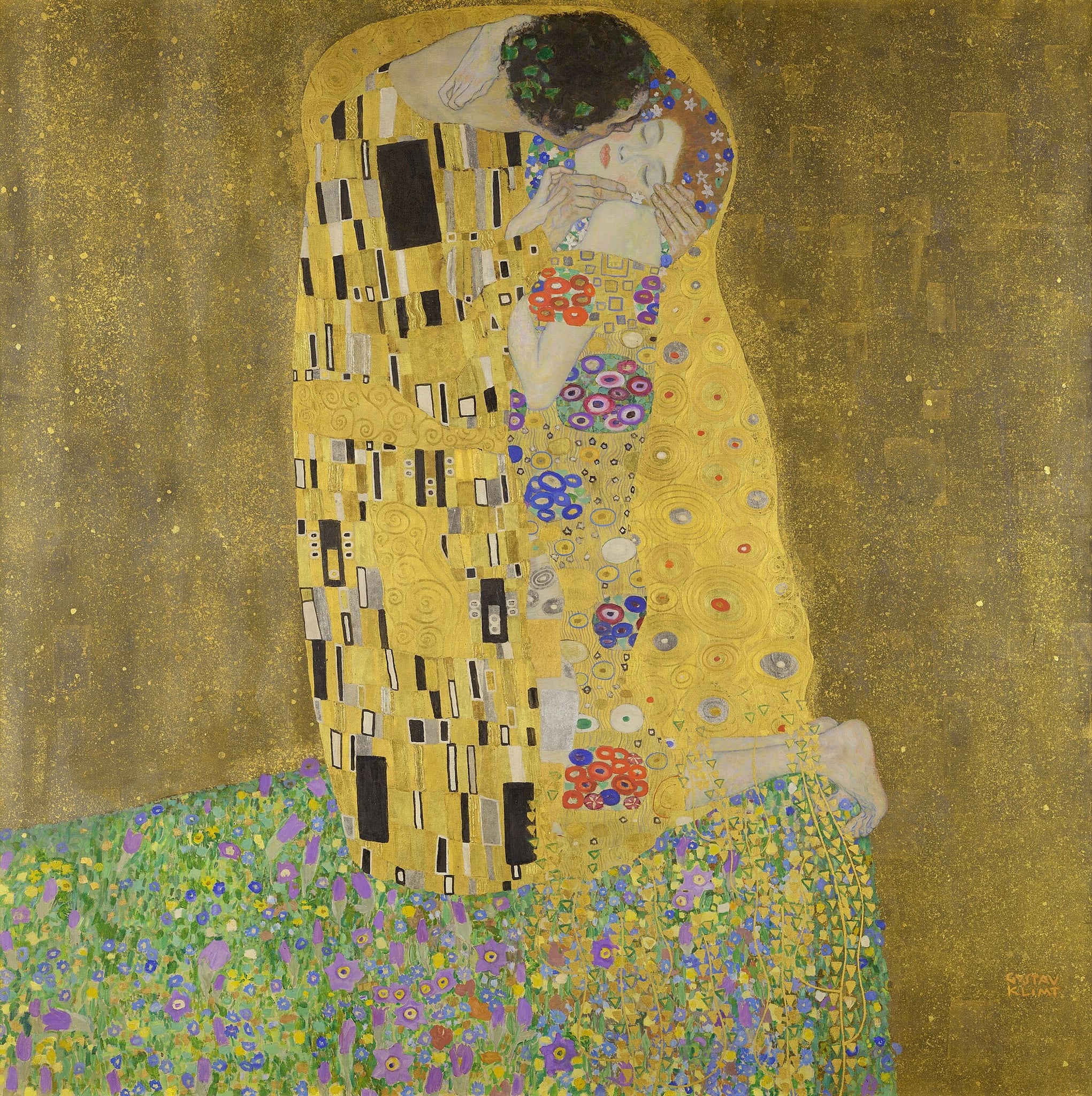
The Kiss (Lovers) by Gustav Klimt

The Kiss (Lovers)

Gustav Klimt (1907–1908 (Belvedere lists 1908/09))

The Kiss (Lovers) crystallizes Klimt’s <strong>Golden Period</strong> ideal: erotic union staged as a sacred vision. Two bodies fuse beneath a single golden mantle, poised on a flowered ledge at the brink of the unknown, where <strong>pattern becomes symbol</strong> and intimacy becomes icon.