Amalie Zuckerkandl

by Gustav Klimt

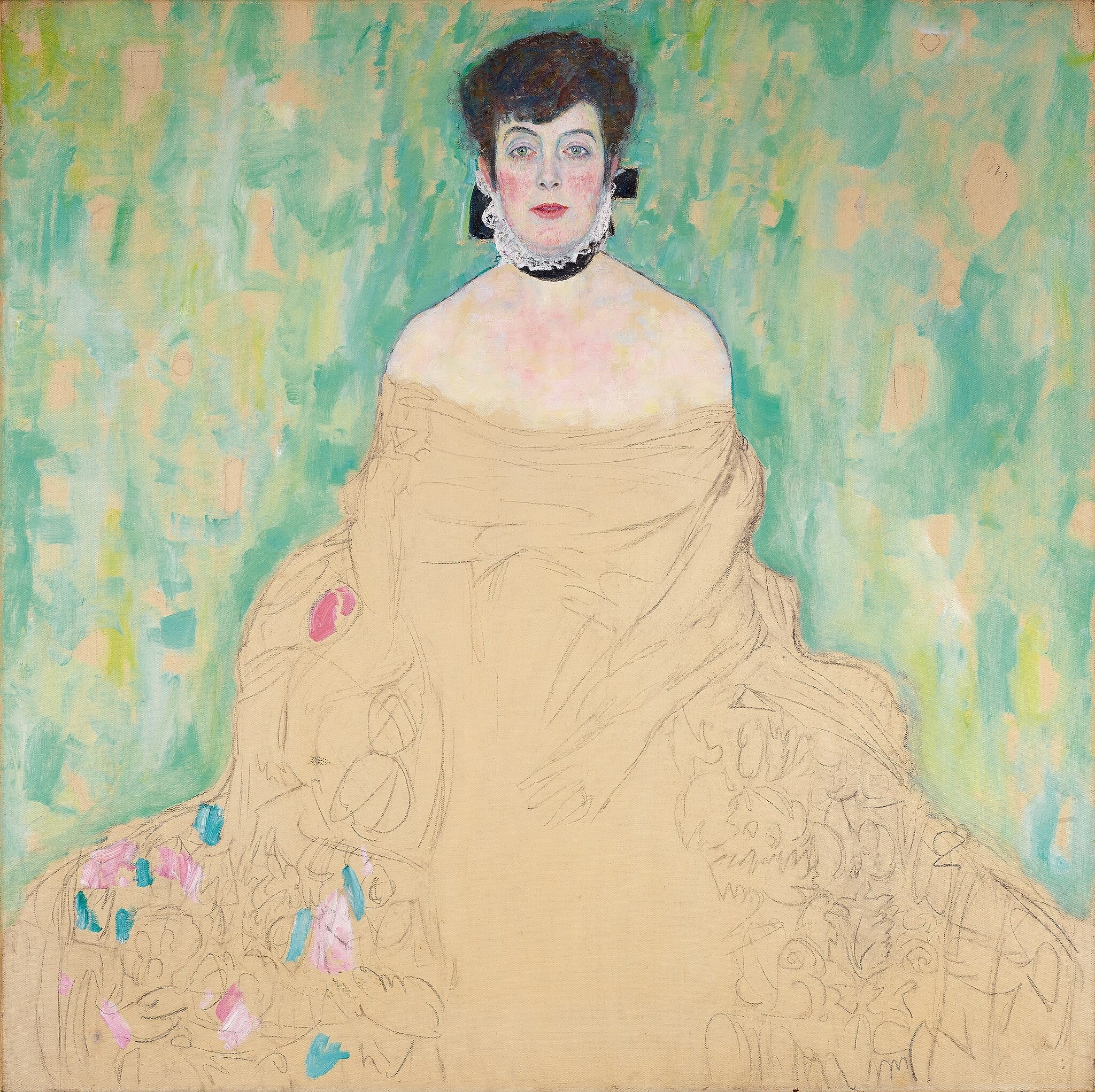
Gustav Klimt’s Amalie Zuckerkandl is an unfinished late portrait in which a fully realized head and shoulders float above a gown left as skeletal graphite and washes. Set against a mottled, cool green ground, her flushed face, direct gaze, black choker and crisp lace collar stage a drama of poise, sensuality, and restraint [1][6]. The painting’s incompletion becomes the work’s meaning: a vivid selfhood emerging while ornament remains in potential.
💰

Market Value

$70-110 million

How much is Amalie Zuckerkandl worth?

Study Print Studio

Create a personal study print

Build a companion study sheet around the part of this painting that speaks to you most. Choose a detail, shape an interpretation, and walk away with something personal and display-worthy.

Fast Facts

Year
1917–1918
Medium
Oil on canvas
Dimensions
128 × 128 cm
Location
Österreichische Galerie Belvedere, Vienna
See all Gustav Klimt paintings in Vienna
Amalie Zuckerkandl by Gustav Klimt (1917–1918) featuring Black choker ribbon, White lace ruff/collar, Unfinished gown (graphite and washes), Mottled green background

Click on any numbered symbol to learn more about its meaning

Meaning & Symbolism

Klimt concentrates finish where it matters most: the sitter’s luminous head, pale shoulders, and the emphatic black choker cinched beneath a crisp white lace ruff. The eyes meet ours levelly; the cheeks are warmed with pinks that echo—deliberately—down the surface as discrete notes of rose and turquoise in the sketched gown. Around her, the green, lightly stippled background refuses architectural anchoring: there is no room or furniture, only an abstract field that suspends the figure and heightens her psychological immediacy. This shift from gilded splendor to an airy chromatic atmosphere is characteristic of Klimt’s late manner, where color and emptiness carry the charge once borne by gold and mosaic pattern 46. Below the bust, the paint thins to exposed canvas and agile graphite, making Klimt’s method overt. The dress is mapped as looping arabesques, with floral clusters merely indicated; the left hand rests along the lap as a traced outline, while scattered touches of turquoise and pink signal where embroidery or blossoms would have cohered. This is not failure but strategy: Klimt stages a dialectic between flesh and ornament. The head and throat—framed and constrained by the choker—declare presence and self-command; the unfinished gown, by contrast, is decorative potential, a system that in earlier works would enfold the sitter. Here the individual prevails. Studies for the portrait already fix the choker as a key motif, a deliberate device to isolate and exalt the head while signaling fashionable restraint—a band of elegance that is also a subtle girdle of control 5. In this portrait, the black ribbon’s insistence deepens that paradox: sensual exposure (bare shoulders) is simultaneously framed by a sign of decorum. The work’s incompletion also marks historical time. Klimt’s death in early 1918 froze the painting at a moment when he was refining faces first and integrating drapery second, a process visible across his final portraits 146. That arrested state has become integral to its meaning: a modern subject who emerges but is never fully absorbed into the ornamental universe. Exhibited as a kind of coda to “Vienna 1900,” the portrait has been read as a haunting emblem of a brilliant, vulnerable bourgeois culture at the edge of catastrophe 6. The sitter’s biography and fate lend tragic resonance to the canvas’s suspended becoming, but the painting does not sentimentalize; instead it asserts a fragile sovereignty through gaze, color, and the charged negative space that holds her. In Amalie Zuckerkandl, Klimt distills late Secessionist portraiture to essentials—face, field, and sign—transforming a portrait commission into a meditation on identity, modernity, and impermanence 146.

Explore Deeper with AI

Ask questions about Amalie Zuckerkandl

Popular questions:

Powered by AI • Get instant insights about this artwork

💬 Ask questions about this artwork!

Interpretations

Formal Analysis

Klimt’s late portrait method orchestrates a calibrated tension between a fully modeled visage and a dematerialized field. The mottled green ground substitutes for the earlier gold ground, turning space into an active, abstract atmosphere that isolates the head and shoulders while refusing architectural anchoring. The chromatic economy—pinks and turquoises echoing from cheek to bodice—threads the composition without enclosing it. This selective finish is not deficit but design: a hierarchy of attention that privileges psychological immediacy over décor. The squareness of the support (128 × 128 cm) intensifies the frontal address, while the brisk arabesques below the bust function as notational prompts rather than descriptive fabric. In this idiom, Klimt stages perception itself—what must be complete to signify a person, and what may remain open to sustain modern ambiguity 12.

Source: Österreichische Galerie Belvedere; The Guardian (Jonathan Jones)

Symbolic Reading (Dress as Device)

The black choker and lace ruff operate as semiotic hinges between allure and discipline. Already fixed in preparatory studies, the neckband frames the head like a cartouche, elevating the face while signaling fashionable restraint; its taut, dark register counterpoints the luminous skin and airy ground. In tandem with the crisp ruff, it articulates a regime of self‑presentation in which ornament both adorns and governs the body. The bare shoulders amplify this paradox: sensual surfaces are admitted, yet bordered by decorum. Such calibrated display—central to late Klimt—translates fashion into iconography, where accessories function less as description than as characterizing signs, anchoring identity amid an otherwise dissolving ornamental field 34.

Source: Lentos Kunstmuseum (via Google Arts & Culture); Albertina

Historical Context

The portrait’s temporality is double: biographical and epochal. Klimt’s stroke and death in February 1918 left the canvas incomplete, crystallizing a working sequence—face first, drapery later—typical of his final years. Exhibited as a coda to “Vienna 1900,” the work reads as an elegy for a cosmopolitan milieu already frayed by war and social unraveling. Its airy ground and suspended dress become historical metaphors for a culture losing its supports. Within months of its making, the Habsburg order collapsed; within decades, the sitter’s extended family would face persecution and murder. The painting’s modernity lies in acknowledging contingency: identity asserts itself through gaze and chroma even as structures—social or ornamental—fail to fully cohere 256.

Source: Britannica; The Guardian; Studio International

Provenance & Restitution Lens

The work’s afterlife complicates its meanings. Sold in 1942 to dealer Vita Künstler for 1,600 RM under conditions of persecution, the painting reappeared postwar and entered the Belvedere in 1988 as a gift from Künstler. In 2006, Austria’s Art Restitution Advisory Board declined to restitute it, distinguishing this case from the Bloch‑Bauer Klimts. Yet public debate persisted, resurfacing during the National Gallery’s 2013 exhibition. This trajectory folds legal and ethical questions into the picture’s reception: how do we read an unfinished modern portrait when its subject and milieu were violently unmade? The canvas thus carries a second inscription—of dispossession and contested memory—overlaying Klimt’s visible process with the “process” of 20th‑century history 789.

Source: ORF (Ö1); Austrian Art Restitution Advisory Board; E. Randol Schoenberg legal filings

Psychological Interpretation

The level gaze, set against a diffuse green field, creates a calibrated assertion of self—what curators and critics have called a fragile sovereignty. The head’s finish furnishes a center of agency, while the sketched dress and open ground stage a self not yet assimilated to ornament or role. This is portraiture as emergence: identity tested at the threshold between appearance and disappearance. The choker’s encircling line both isolates and protects the visage, converting fashion into a psychic armature. Critics at Facing the Modern singled out the canvas’s haunting presence—its stillness charged by absence—while scholarship on Klimt’s late portraits underscores the intentionality of this hierarchy of finish as a psychological device 210.

Source: The Guardian; Jonathan Petropoulos citing Tobias G. Natter

Process/Technique (Medium as Meaning)

Klimt makes construction visible: contours in agile graphite, scumbled passages of thin oil, and reserves of bare canvas that read like breaths within the image. This procedural candor is not merely preparatory; it’s compositional. By mapping floral clusters as notations and letting the left hand persist as outline, he establishes a spectrum from idea to realization across the surface. The viewer witnesses translation—drawing into paint, sign into ornament—arrested mid‑flow. Late portraits repeatedly show this sequence (head resolved, drapery pending), suggesting a deliberate method and aesthetic of becoming rather than a studio accident. Here, medium reflexivity amplifies meaning: form mirrors subject, an identity suspended between potential and declaration 111.

Source: Österreichische Galerie Belvedere; im Kinsky (catalogue commentary)

Related Themes

About Gustav Klimt

Gustav Klimt (1862–1918), co-founder of the Vienna Secession, pivoted from controversial public commissions to a decorative-symbolist language in his Golden Period. Drawing on Byzantine mosaics and modern design, he fused opulent surfaces with psychological intensity. By 1908–09, he transformed scandal into canon, and The Kiss became Vienna’s emblem of modern love.
View all works by Gustav Klimt

More by Gustav Klimt

Portrait of Adele Bloch-Bauer I by Gustav Klimt

Portrait of Adele Bloch-Bauer I

Gustav Klimt (1907)

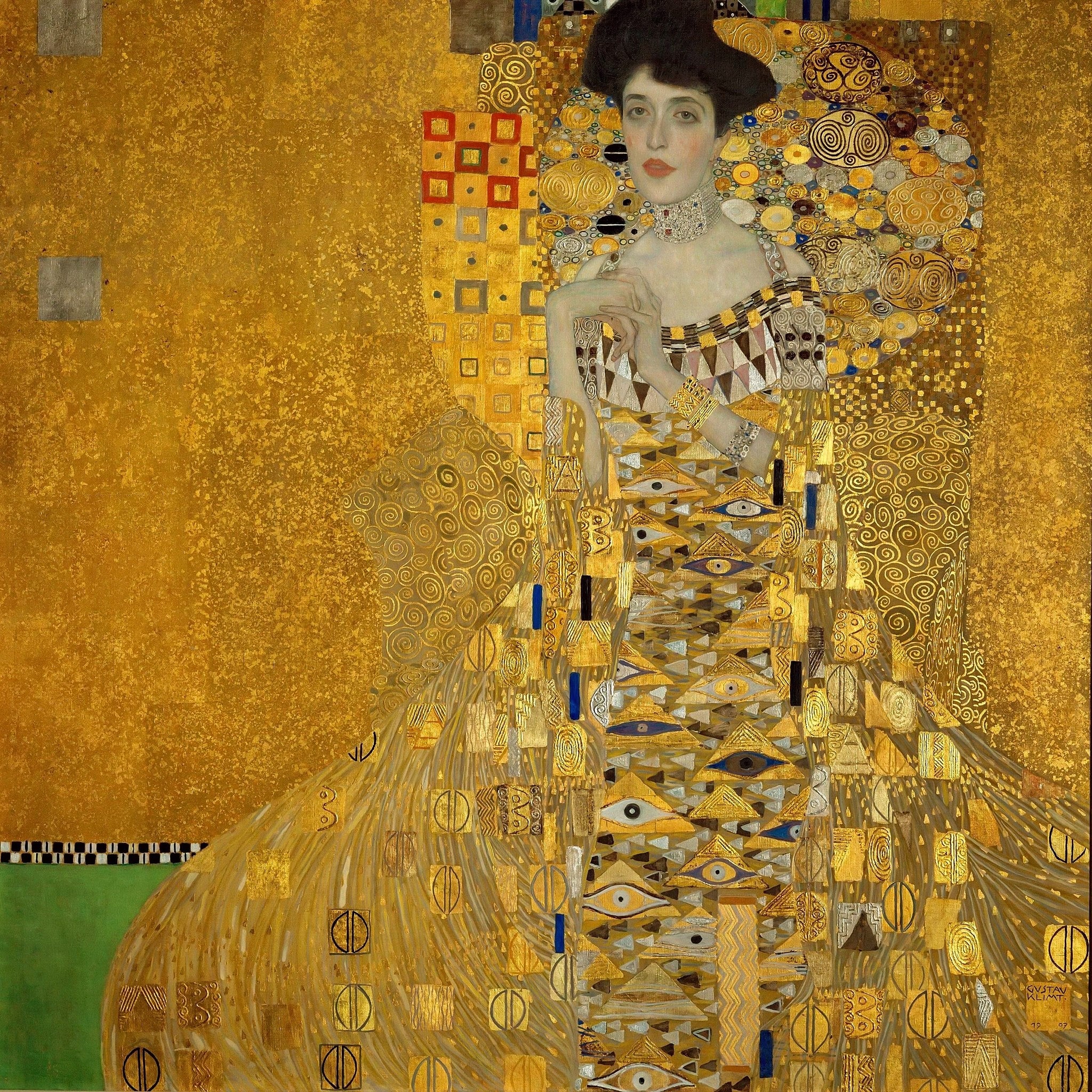
Gustav Klimt’s Portrait of Adele Bloch-Bauer I stages its sitter as a <strong>secular icon</strong>—a living presence suspended in a field of gold that converts space into <strong>pattern and power</strong>. The naturalistic face and hands emerge from a reliquary-like cascade of eyes, triangles, and tesserae, turning light, ornament, and status into the painting’s true subjects <sup>[1]</sup><sup>[2]</sup>.
Sunflower by Gustav Klimt

Sunflower

Gustav Klimt (1907/1908)

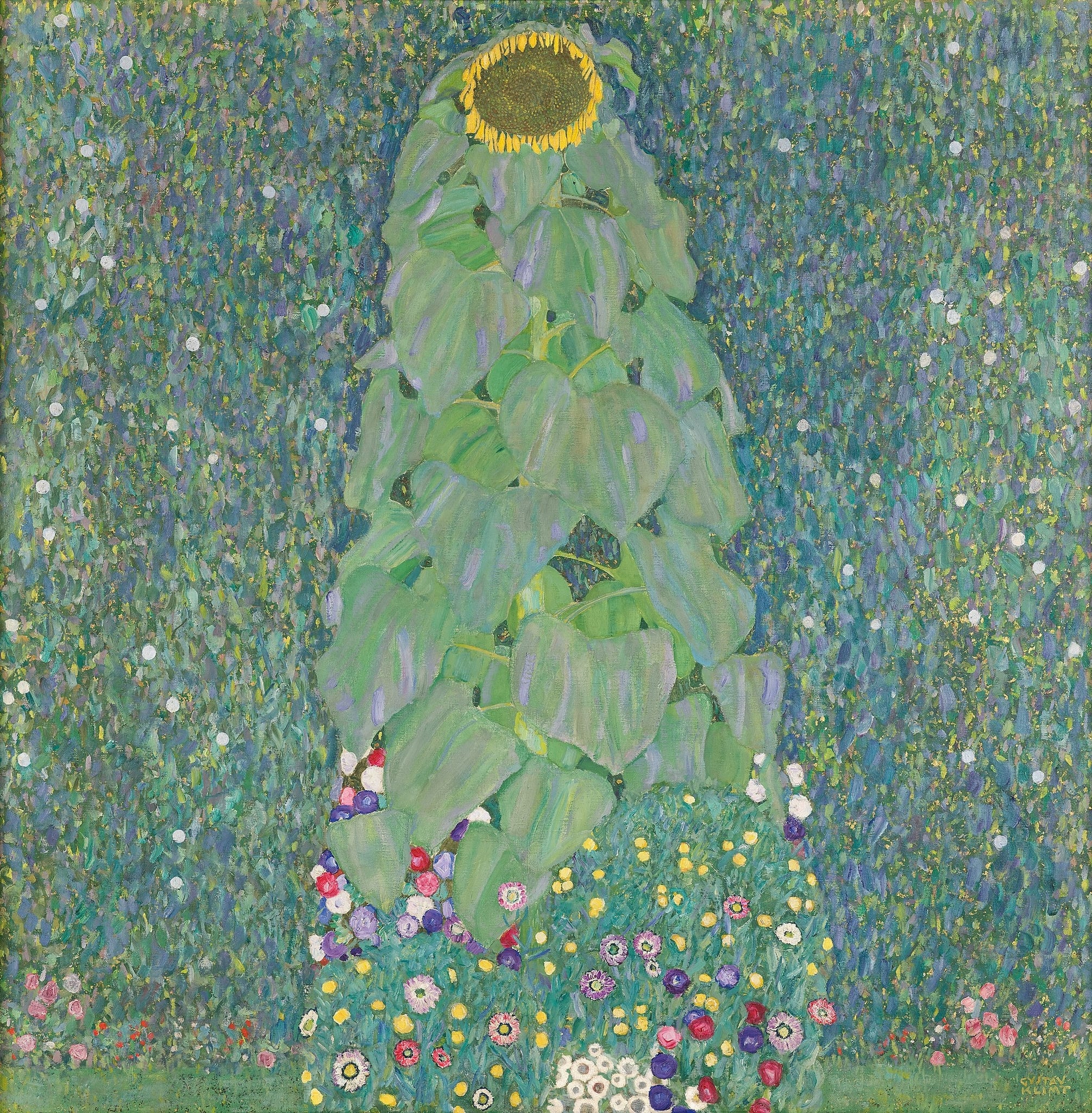
Gustav Klimt’s Sunflower turns a single bloom into a <strong>monumental, figure-like presence</strong>. A tapering stack of broad, drooping leaves rises from a <strong>mosaic-like carpet of round blossoms</strong>, crowned by a gold-flecked disc that glows against a cool, stippled field. The work fuses <strong>portrait, icon, and landscape</strong> into one emblem of vitality and quiet sanctity <sup>[1]</sup><sup>[2]</sup>.
Cottage Garden with Sunflowers by Gustav Klimt

Cottage Garden with Sunflowers

Gustav Klimt (1906–1907 (signed 1907))

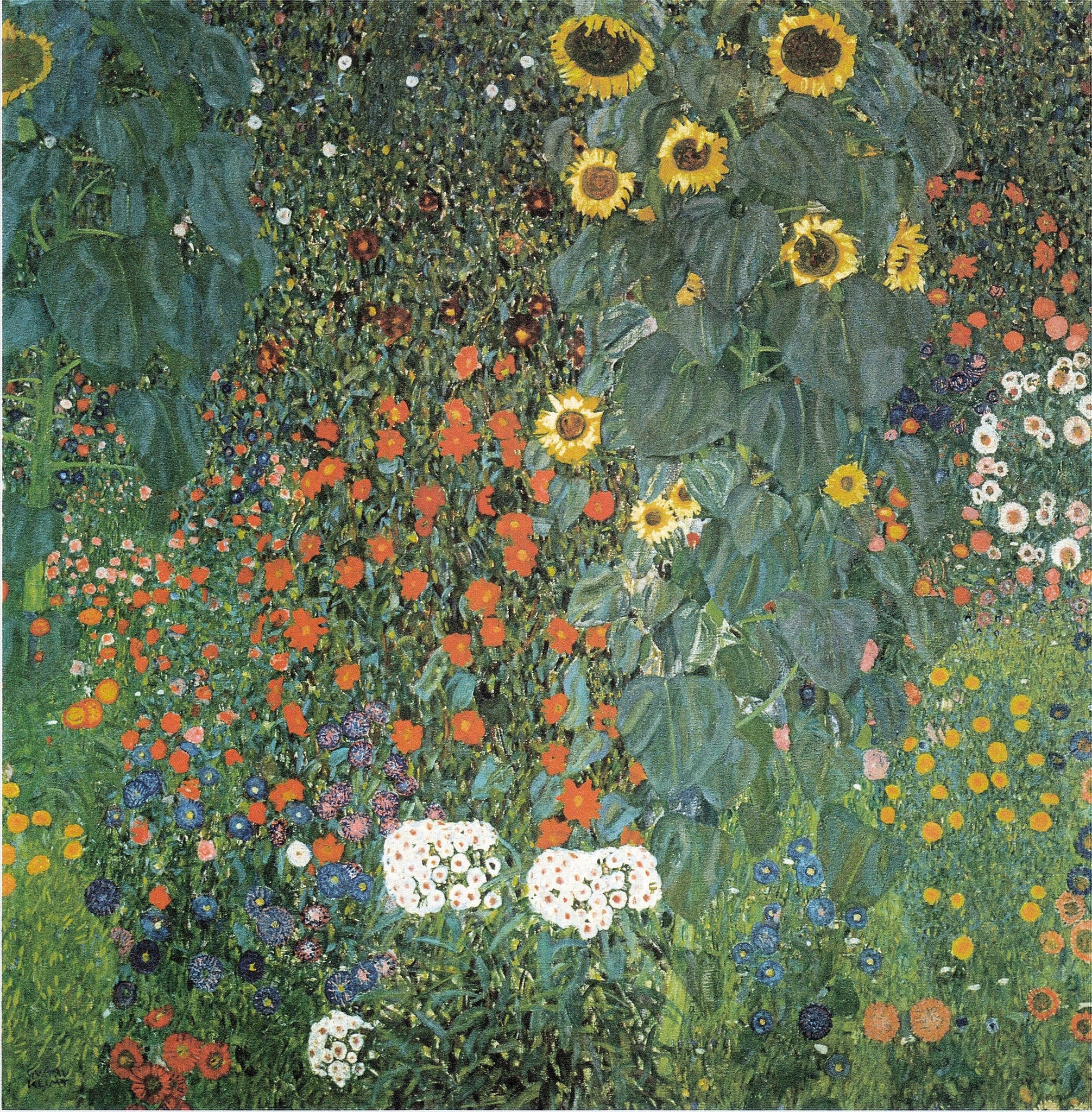
Cottage Garden with Sunflowers is a square, horizonless field of blooms where a vertical column of <strong>sunflowers</strong> anchors an all-over weave of color and pattern. Klimt fuses <strong>ornament and nature</strong>, turning a humble Litzlberg cottage plot into a radiant matrix of cyclical life and renewal <sup>[1]</sup><sup>[4]</sup><sup>[5]</sup>.
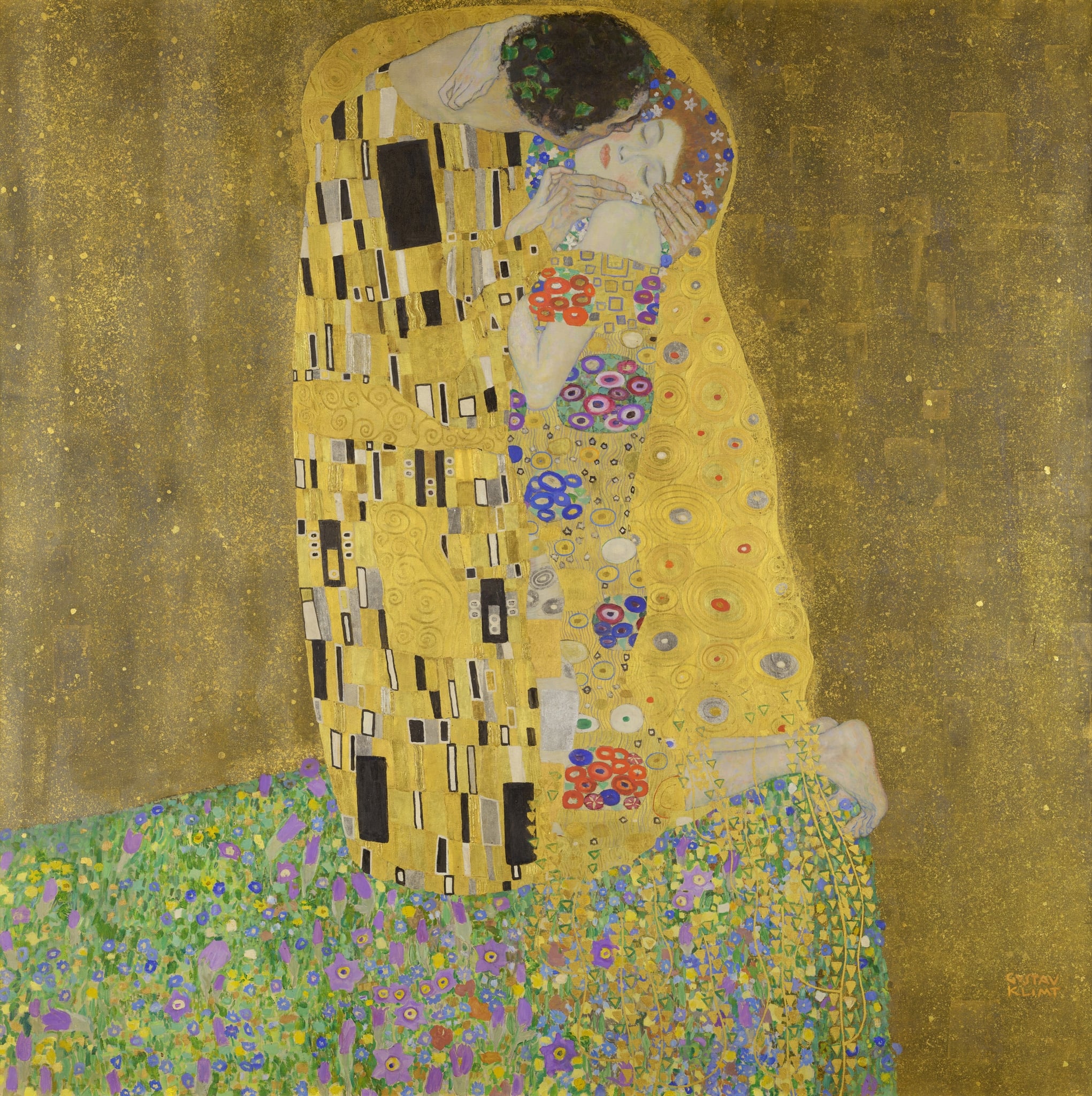
The Kiss by Gustav Klimt

The Kiss

Gustav Klimt (1908 (completed 1909))

The Kiss stages human love as a <strong>sacred union</strong>, fusing two figures into a single, gold-clad form against a timeless field. Klimt opposes <strong>masculine geometry</strong> (black-and-white rectangles) to <strong>feminine organic rhythm</strong> (spirals, circles, flowers), then resolves them in radiant harmony <sup>[1]</sup><sup>[2]</sup>.
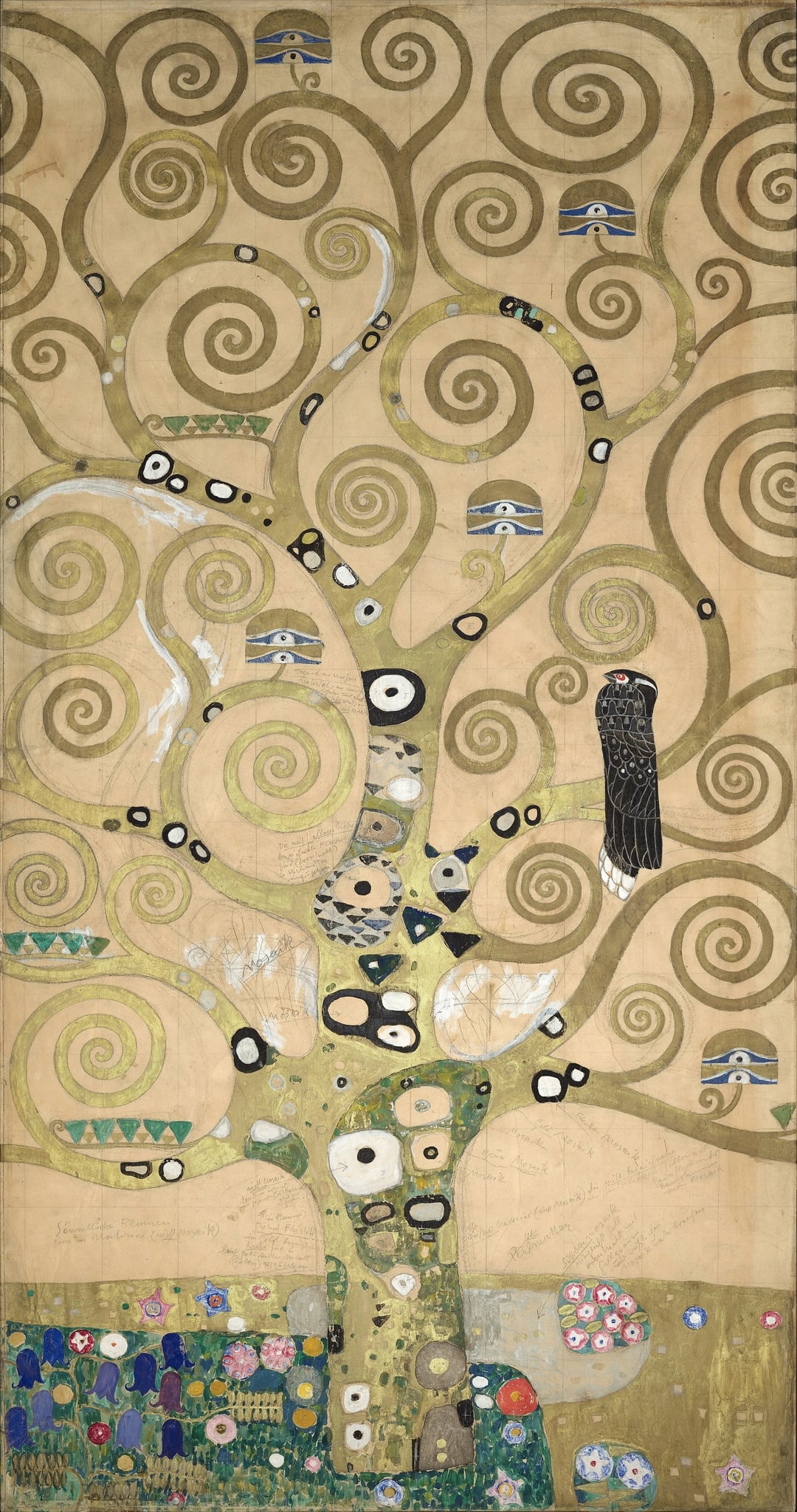
The Tree of Life by Gustav Klimt

The Tree of Life

Gustav Klimt (1910–1911 (design; mosaic installed 1911))

Gustav Klimt’s The Tree of Life crystallizes a <strong>cosmological axis</strong> in a gilded ornamental language: a rooted trunk erupts into <strong>endless spirals</strong>, embedded with <strong>eye-like rosettes</strong> and shadowed by a black, red‑eyed bird. Designed as part of the Stoclet dining‑room frieze, it fuses <strong>symbolism and luxury materials</strong> to link earthly abundance with timeless transcendence <sup>[1]</sup><sup>[2]</sup>.
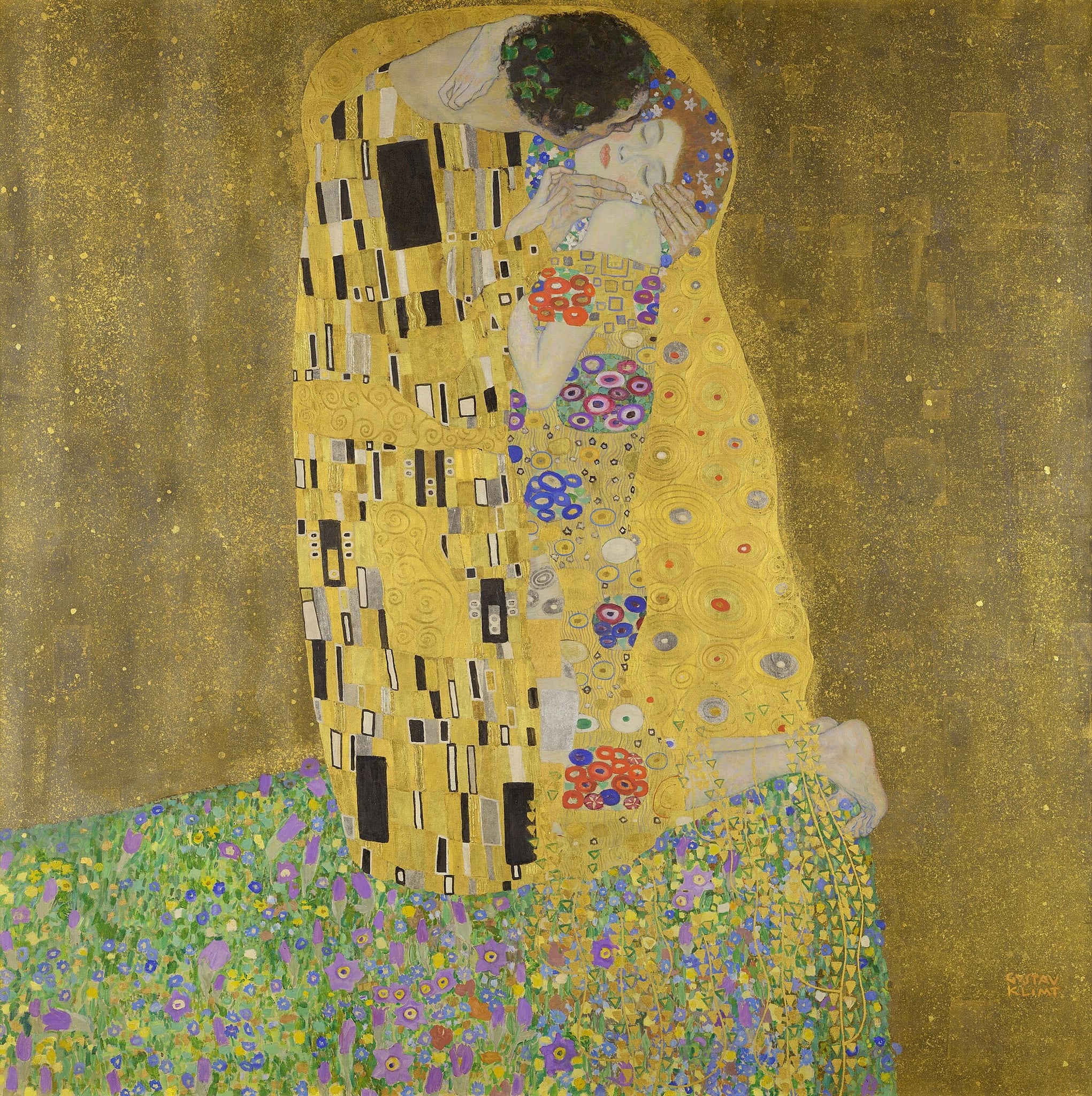
The Kiss (Lovers) by Gustav Klimt

The Kiss (Lovers)

Gustav Klimt (1907–1908 (Belvedere lists 1908/09))

The Kiss (Lovers) crystallizes Klimt’s <strong>Golden Period</strong> ideal: erotic union staged as a sacred vision. Two bodies fuse beneath a single golden mantle, poised on a flowered ledge at the brink of the unknown, where <strong>pattern becomes symbol</strong> and intimacy becomes icon.